1,3-Dihexadecylimidazolium Bromide: A Commentary
Historical Development
The journey of 1,3-Dihexadecylimidazolium Bromide traces back to the broader development of ionic liquids and surfactant chemistry. As research in organometallic compounds picked up pace in the mid-20th century, scientists realized the need for specialty substances that could perform well in unique environments—think high temperature, intense reactivity, or strong polarity. Chemists seeking alternatives to classic quaternary ammonium and phosphonium salts started experimenting with imidazolium scaffolds. By the 1990s, researchers in academic and industrial laboratories understood that swapping out the imidazolium’s side chains with long alkyl groups yielded intriguing surfactant properties. Throughout those decades, advances in purification and synthetic techniques helped transition these compounds from the realm of laboratory curiosity to essential tools for dissolving, catalyzing, and separating a variety of materials.
Product Overview
1,3-Dihexadecylimidazolium Bromide lands in the class of surfactant ionic liquids. It displays amphiphilic behavior, which stems from its imidazolium ring and a pair of 16-carbon straight alkyl chains. This special structure gives people working in pharmaceutical, material science, and catalysis sectors a molecule that binds, solubilizes, and modifies diverse surfaces. In my own time working in a materials processing lab, a well-stocked shelf always included a selection of ionic surfactants like this one. A good ionic liquid isn’t just about breaking down stubborn reagents; it opens up synthetic shortcuts and helps create more controlled nanostructures. The market sorts 1,3-Dihexadecylimidazolium Bromide under synonyms such as C16C16ImBr or 1,3-Bis(hexadecyl)imidazolium bromide, so keeping an eye on seemingly “different” products often leads back to a single trusted compound.
Physical & Chemical Properties
The physical form at room temperature tends to be a waxy solid or viscous oil, with a melting point usually above 40°C—though impurities or solvent traces may push this around. The twin hexadecyl arms generate significant hydrophobicity. This leads to strong self-assembly when introduced to polar solvents, producing micelles and vesicles, a property often exploited in nanomaterial synthesis and drug delivery. The imidazolium core gives the molecule a distinct positive charge, with bromide ions acting as the balancing counterion. In solution, especially in water or organic solvent blends, the ionic strength and aggregation behavior hinge on concentration and temperature, echoing what I’ve seen under the microscope during emulsification experiments. The molecular weight hovers around 646 g/mol, and its high purity grades are crucial for reproducibility in research and industry.
Technical Specifications & Labeling
Clear and accurate labeling cannot be overlooked. Sellers provide clear product codes, the IUPAC name, CAS number, and ensure the packaging states exact concentrations, usually above 97% purity. You have to be able to trust supplier data sheets detailing moisture content, residual solvent, and lot-to-lot consistency. Stability guidance remains straightforward: keep sealed in a dry, dark spot; avoid sources of acid or strong oxidizer. Labels also clarify incompatibilities and shelf life. As regulatory standards evolve, suppliers now include batch-specific safety and transport information, a great help for anyone who handles these substances in a busy lab or production site.
Preparation Method
Synthesis of 1,3-Dihexadecylimidazolium Bromide revolves around nucleophilic substitution. The process often begins with imidazole, which reacts first with one equivalent of 1-bromohexadecane to create N-hexadecylimidazole. Then, a second alkylation occurs, using more 1-bromohexadecane, granting both nitrogen atoms a long C16 arm. Both steps benefit from phase transfer catalysis in solvents like acetonitrile or DMF, and elevated temperatures. Typical byproducts include unreacted alkyl halide and low amounts of monoalkylated imidazole; careful purification by precipitation, extraction, and recrystallization is needed. Over the years, the yield and scalability have improved, which further increases access for diverse industries.
Chemical Reactions & Modifications
The structure of this ionic liquid lends itself to chemical modifications, either at the alkyl chains or the imidazolium ring. Scientists swap the bromide for other anions through metathesis to alter solubility or functionality. Sulfonates, tetrafluoroborate, and PF6- bring about new solubilities and thermal stabilities. You’ll find that the long alkyl tail can undergo further functionalization to introduce polarity, fluorescence, or reactive sites for more complex tasks. In catalysis, these imidazolium salts often work with transition metal complexes, supporting the conversion of small molecules or polymerization reactions.
Synonyms & Product Names
Depending on the chemical supplier or catalog, this compound appears under different names: C16C16ImBr, 1,3-Bis(hexadecyl)imidazolium bromide, or simply DHDIM-Br. Laboratories and material suppliers around the world know these labels; misreading a data sheet and missing a synonym leads to orders of redundant stock, a mistake I’ve encountered more than once. Good database management at the procurement stage avoids such confusion.
Safety & Operational Standards
Work involving 1,3-Dihexadecylimidazolium Bromide brings with it expectations for strong safety habits. Gloves and eye protection are standard, as the compound—like many ionic liquids—may cause irritation to skin or mucous membranes. Vapor pressure sits low due to minimal volatility, though care during heating prevents thermal decomposition and potential fume formation. Safety Data Sheets detail handling, first-aid, and spill protocols. Inhalation hazards remain slight due to solid form, but the possibility of dusting calls for a good fume hood. Disposal focuses on controlling environmental release; these chemicals do not break down easily, underlining the importance of following waste disposal laws and best practices.
Application Area
Industries and research domains continue finding fresh uses for this versatile compound. In my own experience, nanomaterial synthesis and drug delivery receive the most attention. The amphiphilic structure supports the creation of self-assembled capsules, vesicles, or micelles that carry hydrophobic drugs across challenging barriers. Catalysis profits as the ionic liquid dissolves tough reagents or helps separate product streams in green chemistry cycles. Applied material science leans on these molecules to create functional coatings, smart membranes, and stabilized nanoparticles. Environmental engineers use them in sensors and filtration tasks when water-oil separation reaches new complexity. Each year brings novel cross-disciplinary applications, proving that the initial promise of ionic surfactants keeps expanding.
Research & Development
Research in this field surges as scientists chase more sustainable production, tailored reactivity, and benign-by-design properties. Lab groups test performance in fuel cells, batteries, and photo-catalysis. Analytical chemists test limits for extraction, purification, or analyte immobilization. New derivatives emerge with side-chain engineering for specific mobilities, melting points, or environmental fate. The literature base grows fast—patents abound, and grant programs funnel investment toward practical innovations. University-industry partnerships help translate lab observations to large-scale reality. In this space, curiosity and practicality blend, with hands-on experimenters pushing boundaries beyond what aged textbooks predicted.
Toxicity Research
Concerns about toxicity drive much of the present scrutiny. Initial studies flag caution for aquatic organisms, with hydrophobic ionic liquids persisting longer than simple salts. Some research groups find evidence for membrane disruption and bioaccumulation risk, even at nanomolar levels. Still, toxicity varies widely depending on dose, exposure pathway, and organism, and as with many surfactants, context shapes hazard. Clear labeling, restricted lab uses, and risk assessments keep potential impacts under watch. Regulatory authorities and journals now require complete data on environmental fate and health effects before commercial approval, closing the data gaps from a decade ago.
Future Prospects
Looking ahead, the future of 1,3-Dihexadecylimidazolium Bromide seems closely linked with sustainable chemistry and smart materials. Researchers hunt for versions biodegradable in soil or water, while also chasing performance for electronic devices, therapeutics, and energy storage. The “benign by design” push means tweaks in side chains, counterions, and ring composition, aiming for molecules that work hard in process streams but break down safely outside controlled environments. The intersection of material science, toxicology, and engineering promises a steady stream of innovation. For young scientists and seasoned professionals alike, this class of ionic surfactant found its place on the workbench—and in the years to come, new challenges in technology and safety will keep these substances front and center on the scientific agenda.
The Basics
1,3-Dihexadecylimidazolium Bromide stands out in labs for its chemical structure featuring two long hydrocarbon chains locked onto an imidazolium core. It looks a bit like a soap molecule, but chemists know it brings more to the table than just cleaning power. The family of compounds it belongs to—ionic liquids—draws plenty of attention, especially as the world searches for greener technology. From my work in academic research, I’ve seen scientists count on compounds like this to break away from outdated, often harsher chemicals of the past.
Driving Innovation in Research
This compound turns up most often as a building block or additive in materials science and chemistry research. I remember working late in university labs where students tested ionic liquids for their ability to speed up or direct chemical reactions. When you’re running a tricky synthesis, 1,3-Dihexadecylimidazolium Bromide can act as a surfactant or stabilizer. That doesn’t just help reactions finish faster—it often helps cut down on waste, too. A lot of what gets published in academic papers comes down to these molecules helping researchers move away from old-school, toxic solvents toward something more sustainable.
Role in Nanotechnology
This chemical goes beyond just helping reactions along. It finds a good home in nanotechnology, especially if someone tries to form nanoparticles in water. The structure lets it wrap around teeny-tiny particles, keeping them from clumping up. I’ve seen graduate students marvel at how well it keeps gold or iron oxide nanoparticles evenly dispersed. When working with these kinds of nanoparticles, you usually need stable, uniform results—nobody wants a solution full of clumps when they’re building new drug delivery systems or electronic devices.
Improving Drug Delivery
Biotechnology researchers also look to specialized surfactants for tough jobs. 1,3-Dihexadecylimidazolium Bromide can help make structures like liposomes—tiny fat bubbles that carry drugs right to where they’re needed. Because this compound can form ordered layers, it’s become a player in test-tube trials for gene and drug transport. In these fields, clear advantages show up: better drug stability, more precise delivery, and sometimes even fewer side effects. That matters to the people inventing medical solutions and, eventually, to the patients who benefit from those advances.
The Push for Greener Chemistry
Ionic liquids like this one get recognition for possible low volatility and non-flammable properties compared to familiar solvents. The push for green chemistry means universities and industry look hard at these compounds as replacements for harsher chemicals in everything from synthesis to materials manufacturing. Environmental groups have urged caution with new chemicals because “green” doesn’t always mean harmless, but with the right testing, these kinds of molecules can cut pollution and support safer workplaces.
What To Watch For
The excitement around 1,3-Dihexadecylimidazolium Bromide shows up in many journals and patents. Its success often depends on careful assessment of toxicity and lifecycle impacts. Some studies point toward new ionic liquids offering lower environmental risk than traditional solvents, but long-term testing is crucial. Research teams, including mine, try to assess not just performance, but how these chemicals break down in the environment.
Where Things Go Next
The future of 1,3-Dihexadecylimidazolium Bromide likely lies at the border of chemistry, biology, and engineering. For now, it helps scientists develop more effective reactions, design new nanomaterials, and imagine less toxic paths for manufacturing. Continued research, strict assessment, and a willingness to rethink old habits will shape what role compounds like this carve out in labs and industries around the world.
Getting to Know the Structure
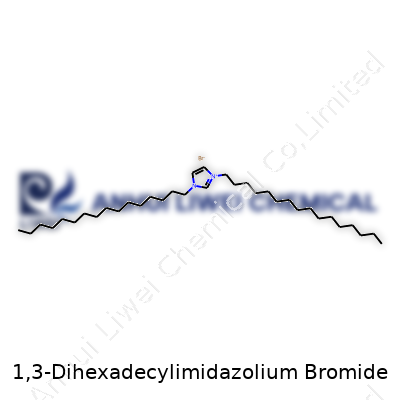
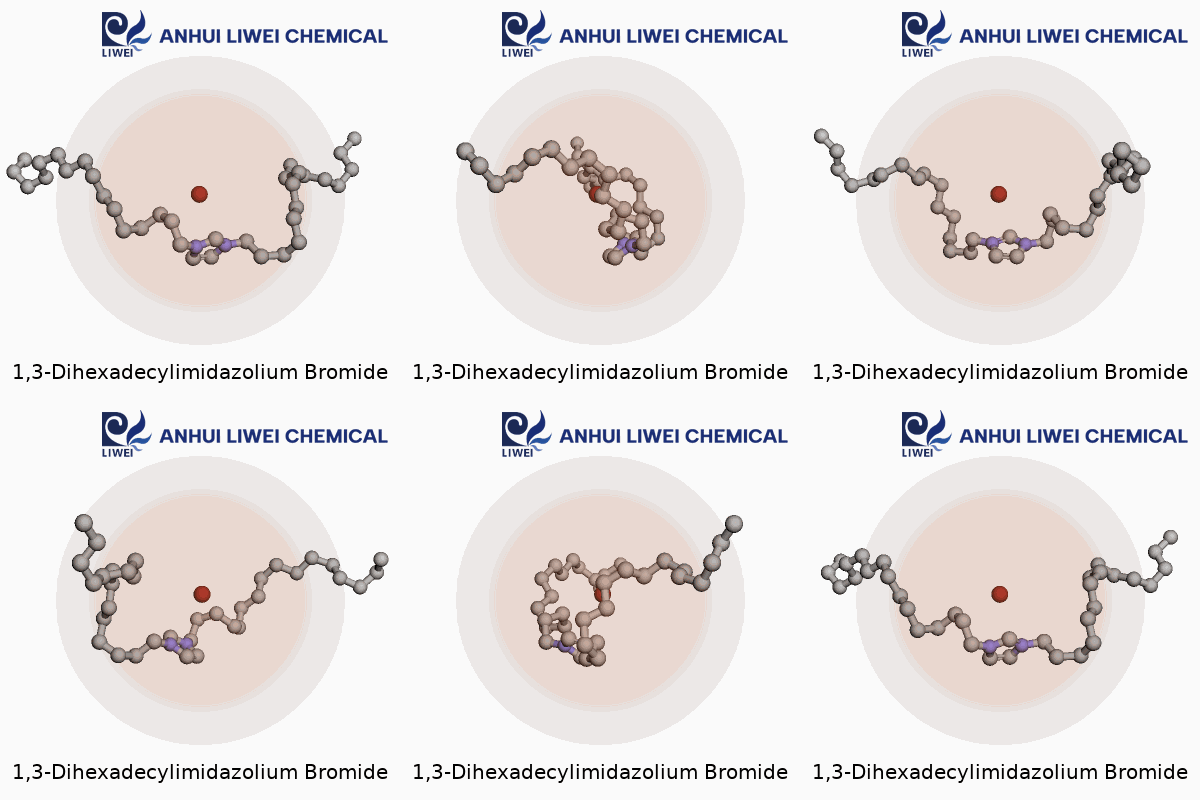
1,3-Dihexadecylimidazolium bromide sits among the family of ionic liquids that have carved out a space in research labs aiming to shape new functional materials and chemical methods. Looking closer, this compound features an imidazolium core, a five-membered ring with two nitrogen atoms at spots one and three, sandwiched between carbons. At those same one and three positions, hefty hexadecyl groups (carbon chains, sixteen atoms long) stretch out, giving the molecule a strong hydrophobic character.
A bromide anion gives the compound its charge balance. In simple terms, an impression of this molecule shows a bulky dual-tailed structure, where both tails are straight hydrocarbon chains extending from a central imidazolium ring. That kind of molecular shape pops up in many ionic liquids that show both solid-like and liquid-like properties, depending on their environment.
Molecular Features Matter
Solid science sits behind this arrangement. Long alkyl chains on both sides deliver strong van der Waals interactions, making the molecule less willing to dissolve in water but much more eager to mix with organic solvents or form self-assembled layers at interfaces. The imidazolium ring, charged positively, brings its own game to solubility and stability, while the bromide anion remains relatively laid-back, often replaced for even slicker performance.
People who have spent time in a lab with amphiphilic ionic liquids know their stubbornness and flexibility, sometimes like oil clinging to glassware, sometimes forming micelles as if they’ve read the recipe in a shampoo bottle. The way these two hexadecyl chains branch out from the imidazolium makes the compound behave a bit like a surfactant, gathering into ordered structures or forming neat films across water surfaces.
Why Structure Influences Application
In the past decade, chemists took a serious interest in ionic liquids, especially with such dual-chain imidazoliums. The ability to tune the length of the side chains means scientists can play with melting points, viscosity, and other physical features. 1,3-Dihexadecylimidazolium bromide doesn’t just float around in a beaker; its presence changes the way molecules interact on a small scale, making it a helpful tool in the design of membranes, drug carriers, and materials for chemical separation.
Not all ionic liquids are equal. Compounds like this one, with double long chains, resist dissolving in water and show a real knack for organizing into bilayers and vesicles, somewhat like the way phospholipids shape up in biological membranes. That behavior makes them interesting for work in nanotechnology and biochemistry, with uses that range from stabilizing proteins during storage to building new delivery vehicles for medicine.
Challenges and Looking Ahead
Handling chemicals with long alkyl chains often means facing solubility puzzles, waste management, and cost hurdles. The reality of using these compounds at larger scale demands careful evaluation of environmental impact, since long hydrocarbon tails sometimes linger in natural systems and may harm aquatic life if not handled responsibly. Companies and research groups who jump into the game need to pay close attention to lifecycle analysis, aiming for greener synthesis and smart disposal routes.
In my own work years ago, cleaning up a flask that once held an ionic liquid felt like chasing oil through water—messy, persistent, and making me respect the hidden costs of specialty chemicals. The growing field, though, keeps pushing for new synthetic routes that cut down on waste, use safer ingredients, and lower costs without dumping extra burdens on the environment.
Imidazolium compounds, and especially those with double long-chain substitutions, show the impact of thoughtful design at the molecular level. They remind us that every structure, even one built with sixteen carbon tails, shapes not just lab work but the choices we make in technology, health, and sustainability.
Getting Storage Right from Day One
A lot of chemicals end up forgotten on backroom shelves, labels fading, lids caked with residue—until an accident or a failed experiment reminds everyone that storage isn’t just for show. Anyone handling 1,3-Dihexadecylimidazolium Bromide quickly learns it’s not like tossing salt in a pantry. The stakes are real: this isn’t some harmless powder, and a slipup can shut down a lab or cause a serious health problem. Even if you’ve handled tons of reagents, cutting corners with an ionic liquid like this can cost you.
Stable Temperatures: No Room for Guesswork
I’ve worked in spaces where the climate control went out for a few days, and you could almost watch some reagents change. Fluctuations drive moisture into places it shouldn’t go and encourage decomposition. For this bromide salt, keep things steady—right around 2 to 8 degrees Celsius. Better to err on the cool side than push your luck. A standard lab fridge works well, protected from the frost build-up that wrecks labels and gets containers wet. If you leave it on a sunny windowsill or near a heater, don’t be surprised if you come back to a clumpy mess or odd discoloration.
Avoiding Light and Moisture
Most experienced chemists have cracked a vial open only to find something far different than what they bought. Light and humidity don’t just alter appearances; they speed up breakdowns you can’t always see. 1,3-Dihexadecylimidazolium Bromide, built to handle certain conditions, can still react with water in the air. Always keep it in an airtight, amber-glass container. The extra step of using a desiccant pays for itself, since once moisture gets inside, it rarely comes back out. Skip humid storage rooms or places prone to leaks. Even tape seals might not help if the cap is loose or the seal is broken.
Labeling and Accountability
During my years managing a teaching lab, I learned nothing causes more confusion than vague or fading labels. Bad marking invites accident and waste. Every bottle or vial needs a clear label—chemical name, date received, expiration, initials of whoever last handled it. Use chemical-resistant stickers and keep a digital log. Forgetting detail puts everyone at risk and undermines traceability, something any lab running audits or searching for contamination sources can’t ignore. The rule is simple: if you’d hesitate to use it without double-checking the label, fix it now.
Keeping It Away from Incompatibles
It’s tempting to line up all your bottles by size or shape, but real safety means separating things by risk. Strong acids, oxidizers, or anything known to react violently with imidazolium salts should never share a cupboard or storage area. I’ve witnessed cross-contamination during busy projects, and more than once, a simple shelving mistake led to headaches and hazardous spills. Invest in decent secondary containment and use solid spill trays—don’t rely on cardboard boxes or metal shelving alone to keep things separate. A chemical fire in a storage area, even from a minor mix-up, leaves a mess that can end careers.
Long-Term Longevity Depends on Habits
Some teams succeed for years just by treating their storeroom like a living workspace, not a graveyard for forgotten chemicals. Snap inventory every quarter. Rotate older stock forward, and dispose of materials that look dodgy or past their recommended dates. Inexperienced users sometimes assume “if it looks fine, it’s fine,” but this can backfire quickly. Respect the shelf life, and if you inherited an unlabeled jar, don’t gamble—discard it according to hazardous waste rules.
Trustworthy Sources Back Up Best Practice
Solid guidelines exist for a reason. The Sigma-Aldrich safety sheets recommend these same strategies for imidazolium salts, stressing the need for dry, cool, and well-separated storage. Research from the American Chemical Society covers ionic liquid handling, echoing these steps. Relying on established protocols, not personal hunches, sets a safe foundation for everyone working with these advanced reagents.
Respect the Chemical, Respect Yourself
Working in research tends to throw a few challenges at you, especially with compounds like 1,3-Dihexadecylimidazolium Bromide. In my years juggling various reagents, I’ve seen what cutting corners brings—and it’s never worth the short-term gain. This compound, a commonly used ionic liquid, doesn’t scream danger like some, but it hides a real risk just the same.
The Hazards Lurking on the Label
This isn’t your everyday salt or sugar. Reading the SDS closely, skin absorption and eye contact both pose threats. There’s irritation, but also the potential for long-term sensitivity. Nobody wants to end a workday with inflamed hands or worse, damage that lingers. Breathing in dust or fine particles can leave your nose and lungs regretting it. I always treat any fine powder or crystalline compound as an invisible threat to my respiratory system.
The Basics Protect Best
I grew up thinking gloves were for the squeamish. A few years and a burn or two later, gloves made sense. For something like 1,3-Dihexadecylimidazolium Bromide, nitrile gloves do the trick. They resist most chemicals in this class, unlike latex that melts in the face of many solvents. Lab coats matter too—ideally buttoned up so sleeves cover the whole arm. Forgetting eye protection is asking for trouble; goggles stop splashes cold, and the cost of skipping them once just isn’t worth it.
Clean Air Isn’t Just for Chemophobes
Fume hoods became standard for a reason. Air near your work shouldn’t become a toxic soup. Fume hoods suck up airborne particles before they drift into noses and lungs. Working with volatile solids or compounds you don’t fully trust demands proper ventilation. I’ve watched folks shrug off this step and cough for days. It’s a minor hassle that saves major headaches.
After Work, the Chemicals Hang Around
Hand washing isn’t about looking clean for lunch. Washing up means you don’t bring home relics from the lab or rub something dangerous into your eye. It’s easy to get careless if you’ve handled a dozen chemicals in one shift. I keep a routine: gloves off, immediate trip to the sink, thorough scrub, and never touch my phone or glasses until I’m sure my hands are safe. Surfaces need regular cleaning too—residues hide in plain sight, and all it takes is one lazy day for them to build up.
Think Beyond Your Bench
Spills seem minor until you see the chaos they cause. Having proper absorbent pads and knowing where cleansing solutions sit means you're ready to move fast. Colleagues sharing the space deserve the same quality of care; shared equipment gets wiped down before and after every use. Labeling keeps accidents to a minimum too—I once saw a colleague nearly rinse glassware with an unlabeled squirt bottle of a reactive solvent. Clear labeling, double-checking, and open communication save lives.
Safety Means Staying Curious
Complacency brings mistakes. Checking current SDS sheets, sticking to protocols, and asking for help when uncertain create a safe lab culture. I’ve learned that the best scientists in any group look out for each other. This means not just following rules, but understanding where danger comes from and taking real steps to avoid it. Every precaution, no matter how tedious, is a sign of experience and respect—for the work, for colleagues, and for the value of health.
Everyday Experience and Why Solubility Matters
Solubility can shape our whole experience with a chemical. In the lab, researchers and students deal with failure and frustration because a substance simply refuses to dissolve. Whenever someone tries to mix an organic compound with water, the results can look very different from mixing sugar or salt. For many, solubility questions carry real-world impact—from how medicines get absorbed to why crops sometimes fail. The story changes for every molecule, and 1,3-Dihexadecylimidazolium Bromide happens to illustrate the ways chemistry surprises those who pay close attention.
Structure Dictates Solution Behavior
This compound features a bromide anion, which generally mixes with water just fine. The real twist appears in the cation, dotted with two hefty hexadecyl groups. Each one includes sixteen carbons strung together: these chains act like grease or oil instead of neat, polar crystals. Researchers have shown that long alkyl chains typically lean away from water. This isn’t just theory; in the lab, as chain lengths stretch beyond ten carbons, solubility fades quickly.
Imidazolium-based compounds can dissolve in water—small ones with short alkyl groups do so easily. For comparison, 1-butyl-3-methylimidazolium bromide melts straight into water until it forms a viscous liquid. The extra-long hexadecyl arms turn the molecule into something like a surfactant. I remember trying to dissolve this class of compounds as an undergraduate—creaminess at the surface and a cloudy phase always showed up before anything mixed in, especially in cold water.
Facts, Studies, and Street-Level Chemistry
Studies in physical chemistry highlight this trend. Published results confirm that as the alkyl chain goes up in length, water solubility shrinks. That means 1,3-Dihexadecylimidazolium Bromide barely wants to go near water. Instead, the substance will cluster up, forming aggregates or micelles just as most detergents do. If someone stirs the powder in pure water, a cloudy suspension is more likely than a clear solution. Persistence rarely pays off—no amount of shaking will turn this substance into something like saltwater.
From a toxicity and environment standpoint, this behavior matters. Many researchers worry about how resistant substances accumulate. If a formulator ignores the poor solubility, unintentional pollution or discharge could linger in waterways since normal water processes won’t readily break the chemical down. Handling and cleanup become more complex when a compound likes to separate from water.
What Could Be Done
Lab workers and industrial chemists can turn to co-solvents or emulsifiers if dissolving this chemical in water remains necessary. I’ve seen ethanol, acetone, or other organic solvents work for other long-chain compounds. Ultrasonication, which relies on high-frequency sound, can sometimes break up aggregates, though this still often leaves a cloudy mixture. People should always weigh these strategies against environmental risks, especially considering the use of large solvent volumes. Green chemistry pointers push teams to either pick shorter-chain analogues or engineer new materials that dissolve in water while keeping the performance needed.
Researchers should also publish data on partitioning, toxicity, and biodegradability for lesser-known ionic liquids, especially those with such long alkyl tails. Education and transparency will help industries choose safer, more sustainable chemicals before problems show up in rivers and lakes. That is one challenge with the ever-expanding field of specialty chemicals: each new molecule deserves close attention, not just on paper, but out in the world where results truly count.