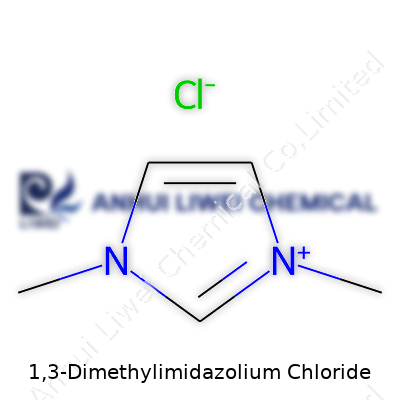
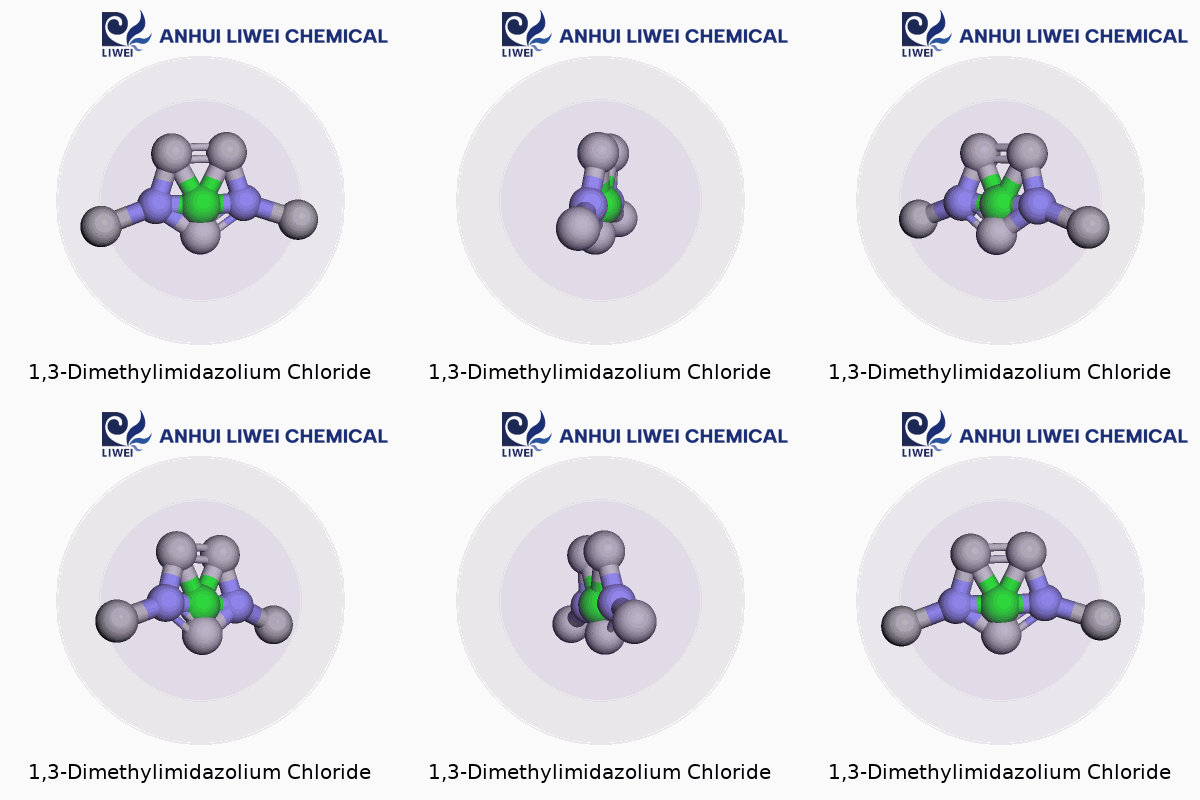
1,3-Dimethylimidazolium Chloride: A Deep Dive
Historical Development
In the landscape of modern chemistry, 1,3-dimethylimidazolium chloride owes a lot to the initial fascination with ionic liquids in the late 20th century. Early research buzzed around how these salts break the mold—liquids at room temperature with almost no vapor pressure in comparison to volatile organic solvents. Back in those days, chemists were used to flammable, noxious solvents, so a stable and essentially non-evaporative substitute looked promising for cleaner synthesis and sustainable industry practice. After being documented among the first room-temperature ionic liquids, 1,3-dimethylimidazolium chloride found a place in pioneering literature and started a trend in “green chemistry” conversations.
Product Overview
1,3-Dimethylimidazolium chloride forms as a white or off-white powder or as a viscous liquid when hydrated, a member of the imidazolium salts family. Chemists buy it for its strong solvating power, typically as a supporting electrolyte, catalyst, or extraction medium across different sectors. Cost and purity play big roles in how it gets chosen for either industrial-scale applications or pure research. Vendors give a range of grades—laboratory, analytical, or technical—because not all uses need the highest levels of purity.
Physical & Chemical Properties
This salt melts down around 70-80°C, dissolves in water, and tends to draw moisture from air. The imidazolium center keeps it thermally stable below 300°C, though it does start breaking down if you push the temperature. Unlike old-school molecular solvents, its structure doesn’t allow flammable vapor clouds to build. The compound conducts electricity as an ionic liquid and can help dissolve cellulose, opening doors for unique applications in material science.
Technical Specifications & Labeling
A typical bottle’s label reads CAS 65039-09-0, formula C5H9ClN2. Lab suppliers specify purity, often upwards of 98%, water content under 1%, and levels of metal contamination. Safety markings usually include hazard statements for irritation and environmental precautions—nobody wants accidental exposure or waste runoff. Labels skip the marketing jargon and get straight to the details: melting point, shelf life, container type, and recommended storage temperature.
Preparation Method
Classic routes start with 1-methylimidazole, which reacts with methyl chloride gas or methyl iodide to produce this salt. The process works best in sealed vessels, often cooled to prevent runaway reactions, and demands careful venting and product purification. Each step has to address side products and trace impurities, and final drying may run under mild vacuum or over phosphorous pentoxide to yield a pure product. Lab-scale setups mirror industrial synthesis, though the scale difference brings its own logistical puzzles—from handling hazardous gases to dealing with heat management.
Chemical Reactions & Modifications
1,3-dimethylimidazolium chloride stands as a solid starting block for further reactions. Chemists attach longer alkyl chains to tweak solubility or introduce functional groups that tune electronic properties. In nucleophilic substitution, the chloride anion may get swapped with others to create “task-specific” ionic liquids, like 1,3-dimethylimidazolium acetate or triflate—sometimes to extract metals, sometimes to catalyze precise organic reactions. These modifications shift the compound’s whole personality for new tasks in metal recovery, energy storage, or pharmaceutical synthesis.
Synonyms & Product Names
In the catalogues and research databases, this chemical hides under several tags: 1,3-dimethylimidazolium chloride, DMIM-Cl, or simply Dimim-Cl. Product codes like IL-400 show up in some catalogs. Older research sometimes refers to it as 1,3-diMeIMCl, which can trip up literature searches if you don’t know your way around chemical nomenclature. Recognizing synonyms helps avoid purchasing mistakes or redundant experiments.
Safety & Operational Standards
Whenever my lab group handled 1,3-dimethylimidazolium chloride, gloves and goggles were standard. On contact with skin or eyes, irritation pops up fast, and breathing in dust is never wise. It pays to run work with this salt inside a chemical fume hood and to keep it away from food or busy walkways. Manufacturers stress tightly sealed storage—humidity shortens its shelf life and can even force it to clump. For waste, we kept strict tracking and used designated containers since local ordinances sometimes treat ionic liquids as hazardous due to unknown long-term effects.
Application Area
Academic labs use this salt to dissolve biopolymers and run tests on cellulose or chitin. In industrial settings, mixing cellulose with DMIM-Cl helps form films or fibers for specialty textiles and composites. Extracting metals, especially from e-waste or batteries, gets efficient with this ionic liquid, because it can selectively solvate rare earth elements. Electrochemists use the compound in batteries and capacitors, where stability and conductivity improve device lifetime. For pharmaceuticals, DMIM-Cl works as a medium for “clean” reactions, helping reduce the byproducts that crop up with more volatile solvents.
Research & Development
Lately, a lot of development has shifted toward functionalizing DMIM-Cl to serve new fields—like capturing carbon dioxide, recycling plastics, or even processing biomass. Academic groups publish on how subtle tweaks to the imidazolium ring change its ability to catalyze key reactions. Some teams examine how nanoparticles behave in solutions of this salt, reporting new advances for battery tech and fuel cells. What used to be a niche compound in green chemistry now finds allies in chemical engineering and materials science.
Toxicity Research
Despite its reputation as an “environmentally friendly” solvent, DMIM-Cl isn’t without hazard. Studies run toxicity screens on aquatic life and soil bacteria, with some reporting potential risks if large spills hit natural waterways. Chronic exposure data on humans still lags, though short-term handling tends not to cause lasting harm under current lab rules. Waste treatment and proper labeling of all waste bottles can’t be ignored, since new research points to possible accumulation in certain environments.
Future Prospects
As demand mounts for greener processes, 1,3-dimethylimidazolium chloride is drawing interest beyond the chemistry bench. Startups think about scaling up use in electronics recycling and advanced fiber production. Next-generation batteries call for safer, more stable electrolytes, and this salt sits on many shortlists. With stronger focus on sustainability, more labs and companies want clear data on long-term toxicity and environmental impact. Regulatory bodies might eventually update their risk assessments as new results come in, and the hope is that future variants keep the versatility while dialing down any environmental trade-offs. People working with this chemical today shape best practices that could define how ionic liquids weave into the next era of sustainable technologies.
Understanding a Not-So-Ordinary Salt
1,3-Dimethylimidazolium chloride doesn’t pop up in regular conversation at the dinner table, but it’s quietly playing a role in the lives of anyone who follows scientific innovation. This chemical belongs to a family called ionic liquids—substances that stay liquid even at room temperature. These aren’t your average salty solutions, and their uses show just how creative chemists can get.
Why Industry Loves It
Factories and research labs count on 1,3-dimethylimidazolium chloride mostly because it works as a solvent. Imagine trying to take apart a tough material like cellulose—the stuff that gives plants and trees their structure. Regular water and alcohols barely make a dent. Ionic liquids like this one soak right through, pulling the stubborn plant fibers apart so they can be turned into biofuels, textiles, new materials, or even packaging products that try to break our crowded plastic habit.
The last time I talked with a scientist working in biomass, he described chasing greener ways to chop up wood and crop leftovers. Tossing in another toxic solvent just piles on new headaches about waste streams. Ionic liquids like dimethylimidazolium chloride promise less pollution and a better shot at recycling what you use. There’s a hint of hope in the way these solvents break down cellulose at room temperature, slicing energy bills and plant emissions.
Lab Work and Better Chemistry
I’ve watched grad students tear their hair out because stubborn chemicals refuse to mix. Dimethylimidazolium chloride often solves that. It holds onto all sorts of metals and organic molecules—making reactions run better, faster, and sometimes safer. Researchers get more freedom to chase new types of medicines, plastics, or catalysts because this oddball liquid shrugs off limits that stop traditional setups. It skips the explosive fumes of traditional solvents, and that can make the workplace fairer and less stressful.
Big Promise, Real Challenges
Even with these wins, life rarely fixes itself. Some worry about cost. Making ionic liquids from scratch is no bargain, and their price keeps smaller companies or schools from jumping in. Disposal rules loom large. These chemicals behave kindly in the lab, but everybody wonders what happens after the experiment ends. Getting rid of spent solvent without polluting water or soil calls for some tough planning.
What Could Make It Better?
Stepping forward means dialing down the price, maybe by tweaking recipes or using cheaper starting materials. Schools and companies sharing their recycling tricks could peel back some of the costs and environmental fears. Regulators chiming in early—before the stuff hits streams or landfills—would help. Scientists also need transparent studies on long-term health and environmental footprints, so users trade hype for facts.
A Quiet Enabler of Change
Some people see chemicals as boring background details, but the story of 1,3-dimethylimidazolium chloride shows how lab benches can make real shifts outside. Cutting waste, trimming energy use, and opening doors to new green technologies mean more than name recognition. Whether you’re reading a label or investing in new processes, knowing about these behind-the-scenes helpers puts real power in your hands.
What 1,3-Dimethylimidazolium Chloride Means in Chemistry
Anyone spending time in a lab recognizes formulas not as secret codes but as gateways. The chemical formula for 1,3-Dimethylimidazolium Chloride is C5H11ClN2. Breaking that down, it shows five carbon atoms, eleven hydrogens, one chlorine, and two nitrogens. At first glance, just a collection of elements. Yet, for researchers, this formula can shape the direction of a project. I remember working late with colleagues, weighing compounds like this, knowing a mistake in the formula would waste both time and effort. A little error sparks a domino effect, sometimes pushing back weeks of work.
Why This Formula Matters in Labs and Industry
1,3-Dimethylimidazolium Chloride lands under a family of compounds called ionic liquids. These aren’t your everyday kitchen liquids—these salts often stay liquid below 100°C, making them great for tasks where water or traditional solvents would cause trouble. Companies and universities investigate these ionic liquids because they offer safer and more adaptable options. In real applications, this specific compound can help dissolve cellulose and process biomass. It's tough watching industries struggle with traditional solvents that easily catch fire or hurt the environment. C5H11ClN2 gives researchers the chance to cut down on risky chemicals and develop cleaner tech.
I’ve seen the safety lists in workplaces: many solvents spark headaches or worse. A formula like C5H11ClN2 brings up hope for handling hazardous tasks with less risk. That’s more than academic—it's about protecting the hands and lungs of people mixing test tubes or operating machinery.
The Value for Clean Energy and Green Chemistry
Years ago, my research group worried about the impact our work had on the environment. Strong acids and bases came with every project, and disposal meant costs and environmental responsibility. The rise of ionic liquids made us rethink our toolkits. The formula for 1,3-Dimethylimidazolium Chloride points toward sustainability. More scientists can phase out harsh solvents. Large-scale chemical extraction and biofuel production can shift gears, opting for a safer, more recyclable compound. This means less toxic runoff in water sources and cleaner air in cities near chemical plants.
Even outside the lab, these advances flow downstream. Everyday products—medicines, plastics, or fuels—can become safer with responsible chemistry at the base. Students and new technicians picking up bottles labeled C5H11ClN2 stand a better chance of working in a safer, more controlled environment.
Pushing For Practical Solutions
Every formula brings up challenges. With 1,3-Dimethylimidazolium Chloride, questions always center around cost, purity, and environmental impact during production. Research teams and industry groups should share their results more openly—successes and errors. This makes it easier for suppliers to improve purity and for companies to lower manufacturing costs. R&D budgets tend to favor projects with immediate profit, but environmental health needs a seat at the table. Policies encouraging greener alternatives—tax breaks, grants, or support for scaling green solvents—could steer both private companies and universities in the right direction.
Knowing the formula for 1,3-Dimethylimidazolium Chloride takes you past memorization. It sparks better lab safety, greener technology, and the chance to turn the tide on environmental damage caused by older chemicals. With each use and each publication, more communities get a little closer to safer, smarter science.
Looking at the Facts
1,3-Dimethylimidazolium chloride shows up more often in chemical labs than folks outside the field might expect. Many researchers use it as an ionic liquid for dissolving otherwise stubborn materials, like cellulose, or as a solvent for specialty reactions. It’s easy to understand the appeal: it’s usually stable, non-volatile, and mixes well with water and organic compounds. The big question that keeps popping up is whether it’s safe to use—or if it hides dangers that don’t always show on the surface.
Checking the Safety Sheets
Pick up the safety data sheet for 1,3-dimethylimidazolium chloride, and certain warning signs jump out. Direct skin or eye contact tends to cause irritation in most people. Breathing in fine dust can leave someone coughing, or with scratchy lungs. The European Chemicals Agency keeps a close eye on these imidazolium salts, flagging irritation risks and reminding workers not to get casual around spills or dusty workbenches.
Some animal studies suggest imidazolium-based chemicals might disrupt certain cells or enzymes. Scientists have reported that high exposure to these kinds of solvents messes with aquatic life, especially small freshwater organisms. In a world so worried about water quality, taking any new environmental hazard lightly seems foolish. I remember early research projects in my lab days—no one wanted eye protection or gloves, until a splash on bare hands sent two people to the campus health center.
Handling and Personal Experience
Chemists lean on strict handling rules. No eating at the bench, gloves always on, splash-proof goggles strapped tight. The substance can stick around on surfaces, especially in humid labs. In my own experience, a forgotten spatula picked up from an unwashed glassware pile left me with red, itchy fingers. Tiny mistakes happen, but routines help cut down on accidents.
If a spill happens, the lab’s safety plan kicks in—contain the powder, ventilate the room, clean with care so the compound doesn’t drift into drains. No rinsing big spills straight into the sink; there’s too much risk that the stuff winds up in rivers, and even a few grams dumped routinely could add up across the world.
Long-Term Exposure and Unknowns
Some governments classify 1,3-dimethylimidazolium chloride as an irritant, rather than a confirmed toxin. Still, researchers keep raising the question of what happens with long-term, low-level exposure. Little hard data exists on effects in humans after years of work, but early studies show that some ionic liquids build up in aquatic species and disrupt metabolism. That matters for wastewater treatment workers and lab staff.
Most users don’t see the risks upfront because daily exposure usually comes in small doses, with protections in place. Lab culture sets the expectation for eye protections and careful waste collection. One exception can wipe out the benefits of years of steady habits—so there’s no sense in being careless with containers or ventilation.
Pushing for Safer Practice
Lab supervisors and safety committees need to update training every year. Clear labeling, spill kits within reach, and honest conversations about risk go further than a printed set of precautions stuck on a wall. One way to help is by swapping out the more hazardous solvents for versions with cleaner profiles, wherever possible. Some labs now research alternative green solvents as replacements wherever the chemistry allows it. Until those options fit every case, making sure users get the right training, gloves, and waste disposal routines provides the best protection on a daily basis.
Why Storage Demands Serious Attention
People who spend time in chemistry labs or industrial production know that 1,3-Dimethylimidazolium chloride can be useful across a range of applications, from advanced materials to solvent systems. This versatile salt brings plenty of benefits, yet it doesn’t belong on a random shelf or in an open drawer. Mistakes in storage might sound small but can set the stage for ruined experiments, lost money, or even health risks.
Simple Truths about Safety
I remember my first year working in a university lab, thinking glass bottles on old wooden shelves were fine for most compounds. But a sharp-eyed colleague taught me—some chemicals need extra care to prevent changes in their composition or unintentional exposure. 1,3-Dimethylimidazolium chloride falls into this camp. It doesn’t explode at room temperature or react violently with water, but it draws in moisture from the air over time. That creeping dampness can change its purity or performance, especially in sensitive research or industrial settings.
Moisture: The Silent Spoiler
Anyone who’s opened a jar of sugar in a humid kitchen knows clumping can happen quickly. With 1,3-Dimethylimidazolium chloride, this isn’t just a hassle. The extra water absorbed into the powder or crystals can shift concentrations and interfere with reactions. Manufacturers specify storing it in a tightly sealed container, away from direct air flow. I’ve seen teams rely on double-bagging and sturdy glass vials with polypropylene screw caps. They don’t take shortcuts because surprises can set their work back by days or weeks.
Temperature and Light—Not Just Background Actors
My old lab used simple locked cabinets for many salts and solvents. Yet for sensitive compounds like this one, we chose a cool, dry storage room—often around 15-25°C, definitely away from heat sources or direct sunlight. Prolonged heat exposure has a way of accelerating decompositions, sometimes in ways you only spot after expensive trial runs. Darkness shields the material from unwanted chemical changes, so opaque or amber bottles come in handy.
Labeled and Accounted For
Neglecting proper labeling creates confusion in shared workspaces. I’ve seen accidents caused by someone grabbing the wrong bottle—one had water contamination and was completely wasted. Outdated or carelessly handled jars risk cross-contamination, which may not be visible but shows up as failed experiments or skewed data. Every time we opened a new lot, we logged it in our chemical inventory software. Small discipline, big payoff.
Planning for the Worst
Let’s be honest—accidents aren’t rare. Spills, splashes, and residue on gloves or aprons must be treated with respect. Good practice means keeping 1,3-Dimethylimidazolium chloride in an area with spill control kits, safety data sheets close by, and personal protective equipment (PPE) mandatory. Simple gloves, goggles, and a lab coat can prevent minor incidents from becoming serious problems.
Steps Toward Improvement
Schools, labs, and factories should set up regular audits for chemical storage. I found that checklists tailored for each type of chemical stopped a lot of issues before they happened. Auto-locking cabinets and clear, up-to-date signage help new staff stay alert. If you’re running low on space or handling larger amounts, dedicated dry storage units—sometimes with built-in desiccant cartridges—bring peace of mind.
Every Detail Counts
Years of experience taught me that chemical safety isn’t about overreacting but about caring for your team and the work they do. Handling 1,3-Dimethylimidazolium chloride with daily respect protects health, saves money, and keeps projects moving forward. What looks like extra effort pays off each time things run smoothly. Following storage best practices never feels like wasted time.
Understanding the Basics
Over the past few years, ionic liquids like 1,3-dimethylimidazolium chloride have found their way onto the workbenches of chemists, environmental engineers, and materials scientists. A lot of research has focused on their solubility because getting them to dissolve or stay put is often half the fight in designing better reactions and greener processes.
In Water: Not Hard to Dissolve
Water is the undisputed champion at dissolving many salts and ionic compounds. 1,3-dimethylimidazolium chloride doesn’t buck that trend. It mixes into water at concentrations well above 50% by weight without much effort. If you drop some into a beaker and swirl, you’ll get a clear solution. This high solubility owes much to the ionic charge and relatively small size of the chloride anion and the imidazolium cation. As someone who’s dissolved hundreds of salts for experiments, I recognize that this behavior opens doors, especially when you want to pair organic reactivity with water-based chemistry.
Why does this matter? Water-soluble ionic liquids bring fresh approaches to biomass processing and “green” solvent systems. Sugar dissolves, tough lignin breaks down, and the process can skip harsh or toxic solvents scientists grumbled about for decades. Seeing papers on cellulose dissolution and enzyme activity improvement with salts like this shows direct benefits in biofuels development and natural product extraction.
Solubility in Organic Solvents: A Mixed Bag
Moving from water to typical organic solvents, things change. Add 1,3-dimethylimidazolium chloride to ethanol or methanol, for example, and you’ll see some dissolve, but only at lower concentrations. Try anything less polar—like ethyl acetate, dichloromethane, toluene—and you’ll run into trouble. The salt barely disappears. The reasons are simple: organic liquids don’t stabilize separated ions very well, so there’s just not the same drive to dissolve.
Some folks attempt to coax it into solution by heating the mix or using specifically tailored cosolvent systems, but success can be limited. On the rare occasion I needed it dissolved in something like acetonitrile or DMSO, a bit went in, but not nearly as much as in water. Researchers have measured solubilities of less than 0.1 gram per 100 mL for many nonpolar organics. Choosing the right solvent often means picking something with a higher dielectric constant and some polarity, but truly broad solubility across both water and nonpolar solvents remains out of reach without chemical modification.
What’s at Stake?
All this boils down to a key point for people designing processes and products: solubility governs your options. Water-loving nature ensures 1,3-dimethylimidazolium chloride fits in catalysis and material treatments where moisture is present. Organic synthesis routes that require dry environments or strictly organic phases need more creative approaches—maybe salt metathesis to switch out the chloride for an organic anion, forming a less polar ionic liquid, or using additives to coax more into solution.
In a world aiming to move away from volatile and toxic solvents, finding ways to use or improve salts like these is important. Their strong affinity for water is a double-edged sword: great for “green” chemistries but challenging for applications demanding compatibility with traditional organic solvents. Labs and companies keep searching for tweaks—both in the molecule’s structure and the system it’s used with—to stretch these boundaries further.