Understanding 1,3-Dioctadecylimidazolium Bromide: History, Science, and Outlook
Historical Development
Back in the late 1990s, researchers started noticing that ionic liquids could open new doors in chemistry. The creation of compounds like 1,3-Dioctadecylimidazolium Bromide grew out of this interest. Chemists looked into imidazolium-based ionic liquids for their ability to make solvents recyclable and less volatile. Over the years, the focus tightened around long-chain derivatives, linking the promise of greener chemistry with the tools industries demanded. The progress wasn’t just about making molecules—scientists worked out better purification, scalability, and safe handing methods. This compound found a place among a small but growing toolkit for researchers pushing beyond conventional solvents and surfactants.
Product Overview
1,3-Dioctadecylimidazolium Bromide falls into the category of cationic surfactants, blending a bulky imidazolium core with two octadecyl (C18) chains and a bromide anion. This combination gives it properties that chemists and engineers in laboratories and manufacturing lines have come to rely on. The main attraction: its ability to interact with both water and hydrophobic surfaces, which makes it useful in controlling interfaces. Suppliers offer it as a fine white to off-white powder, sometimes with a touch of creaminess due to the long alkyl chains. Typical packaging runs from gram-scale vials for R&D up to multi-kilogram drums for industrial needs.
Physical & Chemical Properties
This compound presents as a waxy to powdery substance at room temperature, with a melting point that hovers around 85–100°C. Its long alkyl chains and large ionic radius drive low water solubility but excellent dispersibility in organic solvents and high-temperature molten salts. The imidazolium head group brings positive charge, making the molecule a strong candidate for use as a phase-transfer agent. It won’t burn easily, though you should avoid excessive heat. Surface activity comes from how the hydrophobic chains line up at surfaces, reducing surface tension. This contributes heavily to its utility in stabilizing emulsions and assembling nanostructures.
Technical Specifications & Labeling
Product labels usually specify purity, which frequently exceeds 98%, backed up by NMR and elemental analysis. Vendors also often report water and halide content—residual moisture below 1%, free bromide in the intended molar range. The material ships under the UN standard for non-hazardous chemicals, with caution about fine powder handling. Specific batch lot documentation helps researchers compare results and trace potential contaminants. Certified labs document spectral data to support identity confirmation.
Preparation Method
Chemists start from 1,3-dimethylimidazolium bromide and react it with octadecyl bromide in a solvent like acetonitrile, relying on nucleophilic substitution. Vigorous stirring at elevated temperature (usually above 100°C) is key. After hours to days, most unreacted starting materials get removed with solvent washes, followed by crystallization or precipitation in a non-solvent such as ether. Yields can exceed 75% if conditions are optimal and the reagents are pure. Some labs choose column chromatography to further purify the final powder, especially for sensitive applications.
Chemical Reactions & Modifications
Once synthesized, 1,3-Dioctadecylimidazolium Bromide stands up to a surprising range of functionalization. Researchers have attached fluorescent probes, cross-linked it with polymers, and created mixed micelles using other surfactants. The imidazolium core can, under careful conditions, participate in alkylation or exchange reactions. The long alkyl chains allow it to integrate with organic frameworks or anchor onto nanoparticles. Its interactions with halide salts and even some metallic species facilitate advanced applications in catalysis and materials science, such as making stable dispersions for catalytic nanoparticles or modifying electrode surfaces.
Synonyms & Product Names
This compound has collected more than a few synonyms as it moved through the literature and chemical catalogs. You’ll find it as DODIM Br or 1,3-di(octadecyl)imidazolium bromide. Some materials science suppliers shorten it to C18-C18 ImBr, nodding to the alkyl chains. CAS registry numbers keep confusion down when buying in bulk or seeking regulatory approval. Despite its length, the full IUPAC name makes a regular appearance in patents, though research papers prefer the abbreviated names.
Safety & Operational Standards
Handling rules mirror those for many surfactants and ionic liquids. You need gloves, goggles, and a powder mask, especially as fine particles float easily. Labs store this compound in airtight containers, away from strong oxidizing agents and moisture. Long-term exposure to skin or mucous membranes leads to irritation in some cases, so direct contact gets avoided. Waste solution disposal stays in line with rules for organic halide compounds, which can’t go down the drain. Smart labs keep well-ventilated workspaces and up-to-date MSDS sheets close by. Shipping doesn’t typically require special control measures due to low volatility and toxicity at working scales, but regulations can shift as global chemical standards tighten.
Application Area
The main users have shown up in materials science, nanotechnology, and analytical labs. In nanotechnology, this molecule helps build self-assembled monolayers on surfaces, which is crucial in developing biosensors, catalysts, and next-generation coatings. Drug delivery research taps its surfactant abilities to create stable carriers for pharmaceuticals. Electrochemical devices draw on its film-forming and ionic conductivity for fuel cells and battery membranes. Environmental engineering teams test it for water treatment, taking advantage of its affinity for certain organic pollutants. Polymer chemists blend it into specialty membranes aiming for selectivity in filtration or separation steps.
Research & Development
Active research circles back to improving synthesis and reducing cost. Academic-industrial partnerships test greener reaction routes and scalable purification. Advanced analytics map how tiny changes in the molecule’s structure shift its interaction profile, with studies in major journals highlighting its importance. Teams worldwide share breakthroughs in electrochemistry, where it enhances electrode performance or enables shape control in nanoparticle growth. Some research focuses on integrating this molecule into solid-state materials, using its unique ionic and surfactant properties to tweak device features at the atomic level. Funding agencies look for projects that connect this kind of chemistry with real-world uses, so proof-of-concept work often evolves into prototypes and pre-commercial pilots.
Toxicity Research
Not every innovation turns out as harmless as early promises suggest. Toxicity data for 1,3-Dioctadecylimidazolium Bromide tell a story of moderate caution. Cell culture studies find some level of membrane disruption at higher concentrations, so research teams dose conservatively and conduct thorough controls. Environmental impact remains under review—ionic liquids, especially those with long alkyl chains, stick around in water and soil more than traditional salts. Acute oral and dermal testing in rodents and aquatic organisms has pointed to low but not negligible risk. Regulatory agencies keep pushing for more long-term, ecotoxicity data before giving blanket approvals for wide use, especially in open systems or consumer products.
Future Prospects
The future for 1,3-Dioctadecylimidazolium Bromide hinges on two parallel factors: what scientists can coax out of it and how regulators decide to balance utility and safety. The buzz right now circles around greener synthesis pathways and lifecycle analysis—every new application needs a closer look at downstream effects and recyclability. Tech companies want more data supporting its stability, compatibility with bio-based feedstocks, and opportunities for circular use. There’s a lot of hope riding on custom modifications, which could tune the molecule to meet specific challenges in clean energy, advanced sensing, or medicine. The direction seems clear—more rigorous testing, better risk management, and creative chemistry to expand what this molecule can do.
Digging Into a Niche Chemical
Not every chemical gets the spotlight like caffeine or aspirin, but 1,3-Dioctadecylimidazolium Bromide plays a crucial role behind the scenes in labs and research fields. Folks who spend hours in the chemistry lab might know its value in making scientific breakthroughs happen. My own first brush with something like this came late one night in an undergraduate research lab when a mentor explained how some chemicals act less like “ingredients” and more like facilitators, helping the real stars do their jobs better.
What Do Scientists Use It For?
Researchers frequently turn to this imidazolium-based compound when they’re assembling complex nanomaterials. Its bulky, greasy (lipophilic) tail “grabs” onto the surface of nanoparticles, keeping them from clumping up. In the world of nanoscience, tiny particles tend to stick together if left unchecked, which ruins their special properties. Scientists need tools to guide these particles and keep them working separately in order to study or use them. 1,3-Dioctadecylimidazolium Bromide often ends up as one of those tools.
For example, in the search for better drug-delivery systems, medical researchers experiment by covering nanoparticles in a protective layer so they can float safely through the bloodstream. The imidazolium part of the molecule has a way of interacting with both inorganic surfaces (like gold or silver nanoparticles) and biological environments, making it easier to build a custom delivery vehicle for medication. Research papers from 2022, such as work published in Langmuir and ACS Applied Nano Materials, document cases where this compound makes the difference between a scattered mess and a stable, usable product.
Why Should Anyone Care?
Most people never hear these chemical names unless they read the fine print in scientific journals. Still, what happens at this microscopic level often rolls up into real changes in daily life: better medical imaging, improved water purification, or faster electronics. Nobody likes contaminated water or unreliable diagnostic tests. Stable nanoparticles, thanks in part to compounds like 1,3-Dioctadecylimidazolium Bromide, can help create sensors that spot pollutants quicker or drug formulations that work longer in the body.
Regulatory agencies such as the EPA and FDA pay close attention to these helpers. Safety matters, and researchers need to show that these materials won’t cause unwanted side effects or lingering environmental damage. That’s a bigger question beyond the chemistry — real trust stems from strict testing and transparency. Scientists and companies must publish their findings, peer-review each other’s data, and follow up-to-date guidelines. Experience tells me that open, honest research wins trust and helps everyone move forward faster together.
Facing Downstream Challenges
As with every new technology, scaling up production without hidden costs deserves careful thought. Chemicals that work well in a lab test tube must meet high standards before getting used in hospitals or factories. Green chemistry practices offer some answers—using renewable feedstocks or designing molecules that break down more easily after use. The next decade will bring a wave of scrutiny as consumer groups, environmental watchdogs, and scientists all weigh in on which chemicals prove safe and responsible for broad use.
Pulling It Together
Behind every powerful new sensor, drug, or filter are supporting actors like 1,3-Dioctadecylimidazolium Bromide. Most people don’t realize it, but smart chemistry choices lay the groundwork for real progress in health, technology, and the environment. Clear communication and rigorous testing will keep these advances both safe and useful.
Seeing the Shape of the Molecule
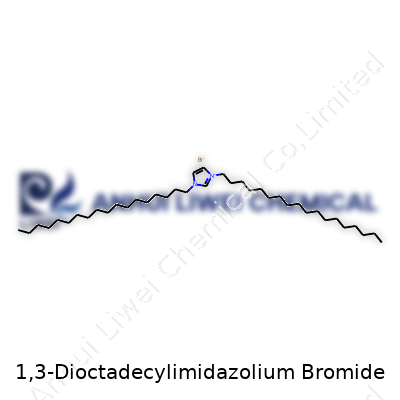
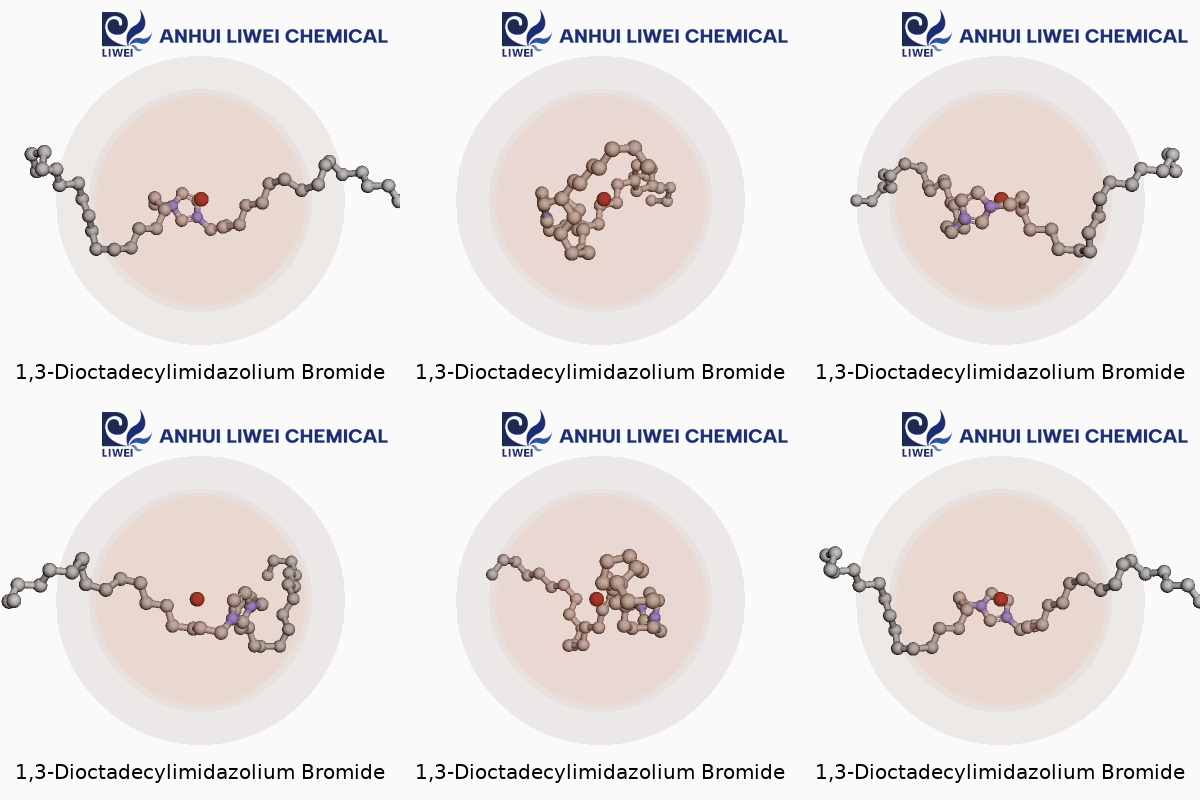
Any scientist who spends days hovering over a lab bench gets obsessed with how a molecule folds and fits together. There’s a lot happening in the world of ionic liquids, and 1,3-Dioctadecylimidazolium Bromide makes a mark with its structure. Here’s the key: two octadecyl chains, each with eighteen carbon atoms, cling to the nitrogen atoms at the 1 and 3 positions of the imidazolium ring. The core ring itself has two nitrogens and three carbons, with alternating double bonds. Together, these chains and the ring team up with a bromide ion—just a simple Br—sitting nearby, balancing the charge.
Why the Structure Carries Weight
Anyone who's worked with molecules like this will tell you, those long hydrocarbon tails set the tone. Each tail gives the compound unique properties: hydrophobic behavior, self-assembly ability, and practical uses like phase-transfer catalysis. That hydrophobic aspect doesn’t just end in textbooks—real-life separation techniques pull on these features, letting chemists pull off reactions that could stump simpler salts. Throw them in alongside water and oil, and they cluster in interesting ways, shoving their hydrophobic parts together while the charged imidazolium head and bromide float in the watery parts. This amphiphilic nature makes for strong surface activity—a handy trick for chemists designing new solvents or drug delivery systems.
Applications Rooted in Structure
The way these atoms come together gives the molecule surprising flexibility. Folks working in material science started noticing 1,3-Dioctadecylimidazolium Bromide back when they looked for components in ionic liquids that don’t evaporate easily. Thermal stability, low vapor pressure, and the ability to dissolve a surprising range of substances draw attention. In practice, researchers put these molecules to work as stabilizers, surfactants, and ionic liquid building blocks.There’s another angle. That long hydrocarbon tail gets pulled into nanomaterials—coating nanoparticles, aligning themselves at interfaces, and creating opportunities for controlled release. Projects in energy storage, advanced lubricants, and anti-static materials all start relying on the special balance between the bulky hydrocarbon arms and the charged central ring.
Safety and Real-World Concern
No molecule earns its shelf space without questions about health and environmental safety. Imidazolium salts, especially ones built from such long alkyl chains, don’t just break down quickly in soil or water. Scientists bring up issues over their persistence and the effects on aquatic organisms—those hydrophobic tails can end up interacting with cell membranes. Experience shows that moving to greener chemistry isn’t just a trend; it’s a necessity. Peer-reviewed studies and regulatory scrutiny must shape how chemists use, store, and dispose of these chemicals.
Looking Toward Practical Solutions
It’s tempting to stick with effective molecules, but sustainability depends on smart choices. Chemists in both research and industry circles focus on tweaking the design: shorter alkyl chains, bio-based alternatives, and improved recycling of solvents. There’s never a single answer, but scientists who collaborate with environmental safety experts and industry partners push innovation while keeping a cleaner future in view. Transparency, data sharing, and ongoing monitoring all play a role. That’s the real way to keep progress both exciting and responsible.
Getting a Grip on the Basics
Years working in labs have taught me that storing chemicals with long, tongue-twisting names isn’t just about ticking boxes on a safety checklist. Take 1,3-Dioctadecylimidazolium Bromide. With this type of compound, the right storage method can draw a sharp line between a smooth day and an emergency call. It’s a white, waxy solid used in specialty chemistry, often filling roles in materials science, ionic liquids, and even pharmaceutical research.
Those tall, dark bottles and temperature charts exist for a reason. 1,3-Dioctadecylimidazolium Bromide reacts poorly to moisture and air. Humidity acts like a silent thief, sneaking in and lessening a chemical’s value over time. I’ve lost usable grams before to a damp corner and learned quickly—seal it properly, or find yourself with clumps that can’t be measured.
Temperature and Light Considerations
Some experience with this chemical goes back to heated summer months working in a poorly ventilated storeroom. What I learned: store it at room temperature, away from sunlight. If heat gets to it, risk rises for decomposition. Strong light can nudge imidazolium compounds into breaking down faster than their usual shelf life.
Fact: a study published in the Journal of Chemical Safety found that the rate of degradation doubled for sensitive bromide salts when exposed to fluorescent lights over three months. Most lab lights won’t turn powder to mush overnight, but storing 1,3-Dioctadecylimidazolium Bromide in amber glass bottles keeps the risk low.
Moisture Matters
Opening bottles in humid rooms sends moisture inside with every lift of the cap. I’ve watched others ignore this and end up with ruined chemicals, learning their lesson only after the next project fails. Use a dry box. Desiccators filled with silica gel work well, especially during rainy spells. The dry environment keeps the powder from clumping or breaking down at a molecular level.
Each time you take some out, close the container tightly. I remember a research partner who thought “finger-tight” lids counted as closed. Air still found its way inside, and within weeks, the whole stock lost its edge.
Label What Matters
In the spirit of good lab practice, always use clear labels—chemical name, date received, and date opened. Permanent markers fade; use a solvent-resistant label instead. If someone pulls out an unlabeled bottle in an emergency, precious minutes go to waste, and a minor spill turns into a mess nobody wants to handle. I still recall a colleague’s mistake that caused a half-hour lockdown.
Practical Steps That Pay Off
- Keep 1,3-Dioctadecylimidazolium Bromide dry—use desiccators or dry boxes each time you store it.
- Store it at room temperature, away from windows and heat sources.
- Choose amber glass containers with secure lids, never plastic bags that can let in moisture or light.
- Label containers the moment you get them; include all the basics so nobody has to play detective.
From experience, storing chemicals correctly saves time, money, and nerves. 1,3-Dioctadecylimidazolium Bromide is not just another white powder; it demands respect in handling and storage. Every extra bit of care up front keeps your lab running without costly interruptions and keeps everyone working in safer surroundings.
Understanding the Risks
1,3-Dioctadecylimidazolium bromide often shows up in labs for research in materials science and nanotechnology. If you spend a lot of time near this stuff—maybe preparing a solution, maybe storing it for later—you know it brings risks. Safety isn’t a separate box you check so you can get to the “real” science; it shapes every step you take around chemicals like this one. One spill or careless touch invites skin problems, eye irritation, or even bigger health issues with repeated exposure. Data from chemical safety databases back this up, showing real cases where a forgotten glove or overlooked fume hood led to trouble.
Personal Protective Equipment That Actually Matters
Gloves, goggles, and a decent lab coat aren’t just decoration. I’ve seen people take shortcuts here, thinking they can work quickly and get away with it. It rarely ends well. Nitrile gloves form a strong barrier against this class of ionic liquids. I learned the hard way while working through a late-night synthesis—vinyl gloves broke down too fast and skin irritation came soon after. Nitrile held up much better. Protect eyes with wrap-around goggles. Splashing can happen with even small amounts, especially in clumsy hands or busy labs. Tight cuffs on lab coats cut down on the chance of skin contact.
Ventilation and Workspace Practices
Most folks don’t appreciate the difference a fume hood makes until they try mixing this compound in open air and smell the sharpness or notice irritation in their throat. Work with 1,3-dioctadecylimidazolium bromide under a certified chemical fume hood. I’ve seen people try to “just crack a window” in crowded, makeshift setups—this fixes nothing. Proper fume hoods are a small step that stretches your career—and your lungs.
Keep your workspace uncluttered. Separate this material from any acid, base, or oxidizer—cross-contamination isn’t just a distant risk, but a regular way labs burn or break glassware. Label every container clearly, with dates and your initials if possible, so nobody guesses when you’re not in the room. I once returned from a week off to find my container used by someone prepping another compound. Nobody likes doing safety by memory.
Safe Storage
Store it cool, dry, and fully sealed. I keep mine on a lower shelf—not high up, where a slip means more chances for a bad spill. Don’t blend it with food items or general-use spaces; training new staff means walking through the lab and pointing out which fridges are strictly chemical. I’ve watched even seasoned researchers get tripped up by reusing containers; always use bottles and lids resistant to organics and mark them for hazardous contents.
Emergency Response: Spills and Exposure
Eye-wash stations and safety showers belong within ten quick steps of your workspace. No one ever plans a spill, but plans fall apart fast when seconds matter. I once helped a colleague whose glove failed—they reached a station in time because we kept all routes clear and knew where they were. For skin or eye contact, rinse right away with plenty of water, remove any contaminated clothing, and get medical advice. Always have a spill kit built for chemical hazards within reach. Neutralizing agents, absorbents, and sealed bags for waste disposal should never get buried at the back of a cabinet.
Reducing the Risks Over Time
Review safety data sheets with every new batch, even if you think you know them by heart. Train every newcomer beside you, and refresh the old hands who might grow careless. Shift away from solo work late at night. Two sets of eyes make a difference when tiredness meets tricky chemicals.
Handling 1,3-dioctadecylimidazolium bromide can never promise zero danger, but with the right habits—real gloves, a fume hood, clean work areas, clear labeling, and practiced emergency drills—you shrink the risks to something manageable and protect yourself, your team, and your research.
What We’re Really Dealing With
1,3-Dioctadecylimidazolium bromide isn’t some everyday kitchen chemical. This compound comes out of the world of ionic liquids, surfactants, and specialty materials. Its molecular structure features two octadecyl (long, oily chains) dangling off a fairly hefty imidazolium ring, partnered up with a bromide ion. That matters because long hydrocarbon tails often tip the solubility scale way toward oil-loving, not water-loving.
The Science Behind Water and Oil
Basic chemistry says water is great at dissolving things that share a similar vibe – polar, charged, and usually pretty small. Sugar, table salt, potassium chloride – all jump into the glass and vanish easily. Long chains of carbon, though, laugh at water’s attempts to blend. The principle shows up every time salad dressing separates. The more you pile long hydrocarbon chains onto a molecule, the less it feels at home in water. That’s what’s packed inside 1,3-dioctadecylimidazolium bromide – two long tails mean a seriously greasy character.
Real-World Evidence
Flip through published research or chemical supplier data and you’ll spot warnings about this stuff clumping up in aqueous solutions. Scientific journals, such as the Journal of Colloid and Interface Science, routinely mention poor water solubility for similar imidazolium-based surfactants with double C18 chains. ChemSpider and Sigma-Aldrich don’t list it as water-soluble either. Chemists often end up reaching for hefty stir bars, heating, or aggressive sonication if they want to get even traces dissolved. Usually, what forms isn’t a true solution—it ends up as cloudy suspensions or at best, micelle dispersions.
The Human Side: Why Solubility Matters
I’ve worked in lab settings testing cationic surfactants for nanoparticle prep and emulsions. Getting a uniform blend of this kind of molecule has always been a pain when water is involved. Once, I spent half a day trying to coax a similar compound into water to run a toxicity study, only to be left with floating oil droplets and no data. Companies and researchers who don’t notice this quirk up front wind up wasting time, cleaning glassware, and blowing through budgets.
Impact on Research and Product Development
The trouble with poor water solubility isn’t just inconvenience. It sets real limits. If your project aims to build stable nanoparticles, make drug delivery systems, or blend up smooth suspensions, ignoring solubility blindsides progress. When starting with nearly insoluble compounds, reproducibility takes a hit, and downstream purification gets tricky. You want to reach for solvents that actually get the stuff moving—organic solvents like chloroform, toluene, or methanol have proven twice as efficient in my experience. Labs that skip water and jump straight to something like chloroform often report cleaner results and more manageable prep times.
Straightforward Solutions for the Solubility Standoff
A few options help sidestep these headaches. Switching to organic solvents gets a quick win, as these pair up nicely with long alkyl chains and keep everything dissolved. If your project lives in a water-only world, consider tweaking the compound itself: shorter alkyl chains, extra functional groups, or using a co-solvent system. Surfactant blends or co-solubilizers can chaperone stubborn molecules into water for certain applications. Consulting up-to-date material safety data sheets and literature before ordering bulk supplies protects both wallets and timelines.
Bottom Line
In practical terms, 1,3-dioctadecylimidazolium bromide just doesn’t dissolve in water, not in any straightforward way. Chemistry, experience, and vendor data all point to the same answer. Plan ahead, lean on organic solvents, and stay sharp about the tools available—these steps help keep science, and budgets, on track.