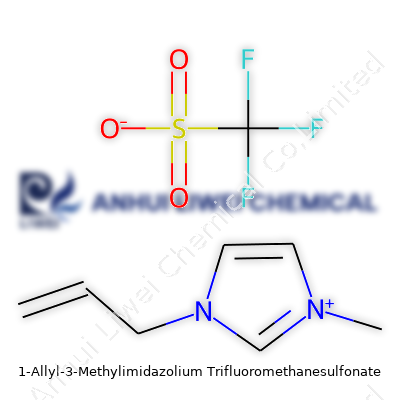
An In-Depth Look at 1-Allyl-3-Methylimidazolium Trifluoromethanesulfonate
Historical Development
Scientists spent much of the last century hunting for alternatives to volatile organic solvents, pushing for greener, more manageable chemistry. In this search, ionic liquids found the spotlight, bringing unique qualities to the table. 1-Allyl-3-methylimidazolium trifluoromethanesulfonate emerged from this wave of innovation, offering chemists a stable, low-volatility choice. Born from practical trial and error during the 1980s and 1990s, these compounds began showing up in labs that wanted to avoid the flare-ups and chaos of old-school solvents. Researchers noticed early on how these materials defied easy classification—they stayed liquid at room temperature, and didn’t have the same flammability issues. The field shifted as people realized that ionic liquids like this one could handle tough jobs, allowing for safer and more efficient reactions.
Product Overview
1-Allyl-3-methylimidazolium trifluoromethanesulfonate comes as a colorless to pale yellow viscous liquid, often sold in sealed glass or polymer bottles. The trade often calls it AMIM OTf or uses its short code, [AMIM][OTf], reflecting both the cation and anion components. It carries a clear signature: a mild, almost sweet smell, with a weight that hints at its nonvolatile nature when compared to more common solvents or reagents. Industry labels and shipping notices usually note its high purity, often greater than 99%, and stress that the water content stays below trace levels. Detailed certificates, including impurity breakdowns and shelf-life estimates, usually come from established chemical suppliers, and that transparency matters for any serious research or application.
Physical & Chemical Properties
Physically, [AMIM][OTf] holds a density just over 1.3 g/cm³, putting it a bit heavier than water but still manageable for most bench-scale work. Its melting point stays well below the freezing point of water, hanging around -20°C, and it doesn’t catch fire easily thanks to almost nonexistent vapor pressure. This low volatility makes it less likely to waft away or ignite unexpectedly, which counts for a lot in tight lab settings. When considering solubility, it mixes well with many polar organic solvents and handles water in moderate doses, which opens up a ton of chemistry that’s not possible with conventional media. Its chemical makeup brings together an imidazolium ring with both methyl and allyl groups, giving it enough stability to survive harsh reagents, yet enough flexibility to participate in diverse synthesis routes. People in the field appreciate that it works as a solvent, a catalyst, or a reaction medium, showing no clear boundaries in how it gets used.
Technical Specifications & Labeling
Product containers carry batch-specific data that include molecular formula (C7H11F3N2O3S), molecular weight (276.23 g/mol), and visual quality scores. Labels note the CAS number (274378-15-3), which ties it cleanly to chemical inventories and regulatory tracking systems. Storage advice typically urges keeping the liquid tightly sealed, away from strong acids or bases, with recommended storage at temperatures between 5–30°C to preserve long-term structure. Documentation often highlights hazard pictograms for irritancy, but avoids any symbols for flammability or acute toxicity, which gives it a leg up over more hazardous solvents.
Preparation Method
Synthesis of [AMIM][OTf] usually kicks off with 1-methylimidazole and allyl chloride, which react to form 1-allyl-3-methylimidazolium chloride as an intermediate. This step takes well-controlled temperatures and efficient stirring, often using acetonitrile or another water-miscible solvent. The next phase brings in trifluoromethanesulfonic acid or its salt to swap out the chloride ion for trifluoromethanesulfonate, usually via metathesis in aqueous media. Careful washing removes byproducts and exchanges ions cleanly, with final vacuum removal of solvents yielding the nearly pure ionic liquid. Each batch undergoes rigorous drying under vacuum and is checked for water trace content, as lingering moisture changes both reactivity and shelf-life.
Chemical Reactions & Modifications
[AMIM][OTf] works well in many organic transformations. It dissolves both polar and nonpolar substrates, supporting Brønsted and Lewis acid catalysis, and helps speed up reactions that struggle in water or hydrocarbons. Chemists often modify its alkyl side chains or swap out the anion to tune solubility and reactivity, letting the same core structure match very different roles. The cation’s allyl group can tether to functional groups in polymers, while the trifluoromethanesulfonate anion support reactions involving strong electrophiles. Grignard and alkylation reactions, for example, run cleaner and faster in this medium, giving better yields and easier workup. Material scientists have grafted the imidazolium ring onto longer polymer chains, fashioning task-specific ionic liquids for materials chemistry or separation technologies.
Synonyms & Product Names
Chemicals often get known by multiple names, and [AMIM][OTf] fits that pattern. Beyond its IUPAC name and [AMIM][OTf] shorthand, this liquid appears in catalogs as 1-allyl-3-methylimidazolium triflate, N-allyl-N-methylimidazolium trifluoromethanesulfonate, or simply allylmim OTf. Some research circles prefer the more descriptive "imidazolium-based ionic liquid," highlighting its structural core, which can confuse less-experienced hands. Clarity in naming matters in research and purchasing, and reputable suppliers aim to include every common synonym to avoid costly mistakes.
Safety & Operational Standards
Safe handling practices draw from industry standards, but many labs find that [AMIM][OTf] brings fewer headaches than volatile or flammable solvents. Still, contact with eyes or skin causes irritation, so personal protective gear—goggles, gloves, and lab coats—remains nonnegotiable. Local exhaust ventilation helps, especially during mixing or high-temperature operations. Waste protocols must follow hazardous chemical guidelines, collecting scraps for approved disposal instead of washing down the drain. Users keep detailed spill response steps posted, as the syrupy liquid spreads quickly but cleans up with absorbent pads and soap. Emergency services treat spills like irritating but not acutely toxic incidents, keeping risk profiles on the manageable end of the spectrum for most workplaces.
Application Area
Researchers working in catalysis, electrochemistry, polymer science, and biomass processing have picked up [AMIM][OTf] for its versatility. It serves in lignocellulose breakdown, often acting as a solvent for cellulose and hemicellulose, which remains a tough challenge for anyone developing biofuels or bioplastics. In organic synthesis, it helps boost yields for metal-catalyzed reactions or can serve as a reusable medium for cross-couplings and cyclizations. Analytical chemists use it in sample preparation, as its ability to dissolve both organic and inorganic residues makes it a strong alternative to older extraction protocols. Electrochemists study its conductivity profile in battery research, where the ionic liquid helps stabilize reactive intermediates, keeping cells running longer. Environmental labs look to it for dissolving pollutants or handling trace metals, banking on both its chemical stability and selective solubility.
Research & Development
Much of the published work focuses on fine-tuning [AMIM][OTf] for green chemistry, aiming to cut down on energy use, waste, and hazardous byproducts. Projects set out to understand how varying the alkyl group or changing the paired anion might lower viscosity or raise solubility for specific tasks. Computational modeling joins hands with bench work, mapping out ions’ behavior at the molecular level and translating those findings into new ionic liquid families with tailored properties. Collaboration across institutions drives forward the push to replace older solvents in everything from pharma production to environmental cleanup, and most researchers share data openly, knowing that trust and transparency push everyone ahead.
Toxicity Research
Toxicity studies cover acute and chronic exposure, seeking to flag any threats before wider adoption in green technology or industry. Results so far point to low vapor risk and limited systemic toxicity, but skin and eye irritation stand out as the main short-term hazards. Environmental studies run simulated spills through soil and water samples, tracing breakdown products and persistence in the environment. The trifluoromethanesulfonate part of the molecule draws extra attention for its resistance to natural degradation, so researchers watch downstream impacts on wastewater and sludge. Regulatory agencies weigh these findings closely, ready to update safety guidelines as more long-term exposure data comes in.
Future Prospects
The future for [AMIM][OTf] ties directly to changing priorities in green chemistry, cleaner manufacturing, and sustainable materials. As industrial labs push for safe, effective, and versatile solvents, this ionic liquid stands to replace tradition-bound reagents and open new doors in battery, pharmaceutical, and renewable fuel technology. Academic consortia keep refining synthetic methods, cutting down both cost and environmental load, and regulatory shifts favor liquid-phase chemistries with better health profiles. Investments in pilot plants measure scale-up challenges, while startups eye specialty markets—like controlled drug release, rare earth separation, or microelectronic fabrication. The next era likely brings tighter focus on recyclability, lifecycle impacts, and performance in real-world, high-volume applications, aiming for a sweet spot where safety, efficiency, and cost meet the practical needs of tomorrow’s labs and factories.
What Sets It Apart?
1-Allyl-3-Methylimidazolium Trifluoromethanesulfonate, a tongue-twister in the world of ionic liquids, brings something special to chemical labs and industries. This salt-like compound doesn’t stick to one job. Its knack for dissolving a range of substances, handling heat, and resisting water trouble makes it hard to replace in the lab toolkit.
Green Chemistry and Clean Manufacturing
Chemistry sometimes gets a bad reputation for dirty leftovers and waste. This compound shows up as a fix for traditional toxic solvents, helping chemists swap out the old, harsher chemicals used in tasks like separation or extraction. Its stable, non-volatile structure means spills don’t evaporate into the air. Having cleaner options matters—industries responsible for wastewaters and emissions look for ways to cut harm without slowing production. That aligns with strict government rules and public concerns. The choice to use an ionic liquid reduces hazard risks for workers and the wider environment.
Catalysis and Synthesis
A background in pharmaceuticals has shown me that getting specific molecules out of chemical reactions takes a lot of planning. Catalysts often set the pace, and the right solvent can help steer reactions so fewer by-products muddy the waters. 1-Allyl-3-Methylimidazolium Trifluoromethanesulfonate has proven good at helping reactions move along—they use it in organic syntheses, such as alkylation and cross-coupling. It keeps reactants together and helps the main reaction win-out, which means less time wasted separating out unwanted leftovers. That translates to less chemical waste and a smaller price tag for every batch made.
Electrochemistry and Battery Research
Everyone is hungry for batteries that last longer and don’t catch fire. This ionic liquid stands up to both electricity and heat, which makes it a contender in designing safer batteries and capacitors. Instead of flammable liquids, battery makers reach for ionic liquids like this one to reduce risks and possibly stretch the lifespan of their products. Safer batteries mean we can trust more devices to handle high loads, from scooters and smartphones to cars.
Biomass Processing and Biofuel
Sustainability isn’t a trend—it’s a real need, and turning plants into fuel can cut down on fossil fuel use. A challenge in biofuel production is breaking down raw, tough plant material. This chemical is tough enough to loosen up lignin and cellulose, so more sugars can be pulled out and converted to fuel. Techniques built around this compound could help bioethanol or biogas become more practical, and more environmentally friendly.
Water Treatment
Clean water is scarce in many places. Governments and industries watch out for compounds that can grab onto pollutants and help remove metals or organic gunk. This ionic liquid can grab and hold onto certain contaminants, offering a way to treat wastewater without adding more toxic chemicals into the mix.
Challenges and Solutions
Cost and recycling still weigh on chemists’ minds. Ionic liquids cost more up front than regular solvents, and if lost or spilled, buying replacements adds up. Industries have turned toward recovery and reuse systems, where they filter and purify used liquids for the next round of production. Pairing these efforts with ongoing research, companies can chip away at price and waste issues while keeping the doors open for greener technology.
Getting Familiar With the Compound
Most chemists recognize 1-Allyl-3-methylimidazolium trifluoromethanesulfonate (AMIM OTf) in the world of ionic liquids. It features a unique balance: the imidazolium ring packs some stability, the allyl group opens up reactivity for interesting transformations, and the trifluoromethanesulfonate anion contributes excellent thermal resilience. It’s not just a mouthful; it’s a tool, a solvent, sometimes even a catalyst-support player in labs that care about green chemistry.
Understanding Stability: The Everyday Stuff
You want to know if AMIM OTf can hold its own on the bench or in a reactor. Short answer? It stands up well—better than many salts and some room-temperature ionic liquids. The triflate anion, with its strong electron-withdrawing power, helps keep the ionic bond robust and limits hydrolysis compared to anions like chloride or PF6. You won’t spot much decomposition under regular storage if humidity stays down and the temperature doesn’t skyrocket.
In practical terms, I’ve left samples inside sealed glass in average lab air for weeks—no noticeable smell change, no weird color, no clumping. You might see news about imidazolium cations slowly reacting under strongly basic or nucleophilic conditions, but that’s at high pH or in exotic reaction mixes. For routine electrochemistry, catalysis, or organics work, AMIM OTf stays steady, avoiding those breakdown headaches you get from less robust solvents or supporting electrolytes.
Heat, Moisture, and the Industrial Scale-Up Challenge
Thermal stability matters most if you heat up reactions or scale equipment. Reports and hands-on testing show AMIM OTf handles temperatures up to 200°C without breaking down. By about 250°C, you start getting some degradation, usually announced by unexpected low-molecular-weight side-products or color darkening. During scaling, residual water can creep in if the ionic liquid gets stored outside a glove box. Water, while not catastrophic, does affect things like viscosity and electrical conductivity. For battery electrolytes, that sloppiness hurts reliability; for catalysis, it can tweak reaction rates.
Labs running high-voltage electrochemical tests point out that AMIM OTf behaves better than many protic ionic liquids, avoiding those runaway decompositions that release acids or gases. I’ve worked with it side-by-side with BMIM BF4 and EMIM Ac—both common, but both with weaker resistance to hydrolysis or heat. AMIM OTf sat on the shelf longer, delivered consistent NMR, and worked just as well after six months in a capped bottle as on day one.
Environmental and Safety Angles
Imidazolium-based ionic liquids once got billed as ‘green’ partly because of their thermal and chemical stability. The triflate anion resists oxidation and does not easily form toxic byproducts under standard reaction conditions. You have to worry more about safe handling—wear gloves, don’t inhale dust, avoid skin contact—than about the compound suddenly breaking down and causing problems in the process or environment.
Real Concerns, Tested Solutions
People tend to worry about ionic liquid longevity in continuous-flow or closed-loop systems. The solution sounds simple: use real drying techniques. Store AMIM OTf in well-sealed bottles, preferably under dry argon or nitrogen, and limit exposure to open air during transfers. Use vacuum ovens or gentle heating to dehydrate before sensitive uses. These tactics don’t just protect the compound; they keep your experimental or manufacturing workflow reproducible.
On my own bench, every sodium-drying tube added to the bottle, every re-cap before break time, directly translated to cleaner data and fewer troubleshooting headaches. Stability is more than a technical property—it shapes not only research but also safety, cost, and the ability to push green chemistry into industrial reality.
Paying Attention to Details Pays Off
Anyone who spends time around chemicals knows there’s a wide gulf between reading a label and putting safety into action. I’ve learned the hard way that diligence can make the difference between a good day and a costly spill. 1-Allyl-3-methylimidazolium trifluoromethanesulfonate—often called an “ionic liquid”—doesn’t behave like simple solvents, and that’s why it calls for steady attention.
Keep Out Moisture—Seriously
This compound draws in water from the air, much like salt sweats on humid days. If left in a poorly sealed container, you’ll soon face a mess that throws off concentrations and ruins lab projects. For years, folks in chemistry circles have echoed the same message: dry containers and high-quality seals stop nature from sneaking in. Even a cheap parafilm can work in a pinch, but the real fix comes from proper screw-caps with liners and a quick wipe-down before closing up.
Cool, Dark, and Dry Win Every Time
Heat speeds up the breakdown of these organic salts. Any daylight on your storage shelves gives light sensitive materials a decent chance to shift color, turn cloudy, or even break down into things you never ordered. Cupboards below eye level and clear of steam pipes keep things steady. I remember pulling out a vial from the sunny side of a university storeroom—half the batch had changed color and the rest gave off a strange smell, ruining a week’s work.
If your lab handles lots of reactive or moisture-prone liquids, consider a desiccator or a storage bin filled with silica gel packs. It keeps humidity low and gives everyone peace of mind, even during summer or in regions where air conditioning fails to keep labs bone dry.
Don’t Skimp on Labeling
Clear labeling sounds too simple, but I’ve seen too many close calls from someone grabbing the wrong bottle in a rush. Permanent marker doesn’t cut it on glass. Use chemical-resistant labels and write the date opened along with your own initials. These habits don’t just prevent chemistry errors; they also keep inventory honest, so replacements come before the last drop runs out.
Mind the Incompatibles
Storing chemicals isn’t about neat shelves—it’s about knowing which neighbors spell danger. Acids, strong oxidizers, and bases should sit far from this ionic liquid. Even though it doesn’t burst into flames easily, some reactions with other shelf-mates can whip up hazardous gases or corrosion. My old supervisor used to separate all organic salts from anything labeled with a skull-and-crossbones; not the worst rule to live by.
Regular Checks Matter
Over time, bottles age and seals slip. I’ve caught problems early by setting reminders—monthly looks at the inventory helped us catch leaks or crust forming at the cap. Anything that smells odd or changes texture gets removed on the spot, no questions asked. This practice fits every workplace, whether you’re in a spotless university building or a startup lab short on space.
Common Sense Means Fewer Headaches
Careful storage might not win awards, but it stops a lot of headaches down the line. Spend the extra five minutes on moisture control, labeling, and separation, and you check off safety and save costly mistakes. Every lab person brings their own routine, but putting careful storage at the front of the list always pays off—whether you’re a new grad or the person with the keys to the chemical cupboard.
Making Sense of a Modern Chemical
1-Allyl-3-methylimidazolium trifluoromethanesulfonate belongs to the class of ionic liquids. These have gained a reputation as promising alternatives to traditional solvents, mainly due to their low volatility and strong solvation abilities. Still, just because something carries a “green” label or feels like a new innovation, it doesn’t always guarantee safety—especially in a lab or industrial setting.
What Happens Upon Exposure
Ionic liquids, including this one, can bring polar and nonpolar molecules into solution with unusual ease. Yet, the properties that make them useful also deserve respect. Scientific research finds that compounds containing trifluoromethanesulfonate (triflate) anions can persist in the environment and sometimes undergo slow degradation. This can lead to the formation of byproducts, some of which haven’t been fully mapped out.
Short-term exposure in the lab—think an accidental splash or inhalation—causes irritation to eyes, skin, and the respiratory tract. This aligns with my experience working with related imidazolium salts. A drop on unprotected skin caused itching and redness, strong enough to teach anyone to rely on gloves. Direct inhalation of vapors feels like catching a whiff of strong cleaning fluids mixed with hot electronics—harsh and dry.
Hazards Beyond the Lab Bench
Though ionic liquids don’t emit dangerous fumes like some organic solvents, there’s an equal need for ventilation and safe work practices. Mistakes often come from thinking a substance missing that “classic solvent smell” is automatically benign. Some colleagues discovered persistent headaches and mild dizziness after working on open benches with ionic liquids, revealing that invisible does not equal safe.
Environmental concerns matter as well. Water testing shows that even stable ionic liquids can affect aquatic life. Small exposures impede the survival of micro-organisms and cause stress in crustaceans and fish larvae. The triflate ion, by its design, resists natural breakdown, so it moves through wastewater treatment mostly unchanged. When solvents run off into streams or seeps into the ground, disruption of local ecosystems follows. I’ve seen lab effluent protocols grow stricter for this reason—there’s little patience now for casual dumping or lax disposal.
Better Choices—And a Call for Caution
Misconceptions around “green” chemistry can lead to shortcuts. Using personal protective equipment isn’t optional with any ionic liquid, especially ones like this one with poorly studied chronic effects. Fume hoods, nitrile gloves, and decent goggles turn what could become a health risk into just another item on the chemical shelf.
Ionic liquids like this one might appear less hazardous because they don’t burn skin instantly or quickly evaporate, but danger lives in delayed reactions and long-term exposures. Safety data sheets remain uneven; scientists must dig beyond the basic summaries and scrutinize published toxicology—and, if anything is missing, pressure suppliers to close those gaps.
Disposal forms a crucial piece of this conversation. Incineration in specialized facilities can prevent triflate ions from getting loose in rivers or soil. Treating these chemicals as anything less than persistent pollutants puts local environments and health at risk.
Minding New Chemistry’s Place in the World
Adopting new materials in the name of progress means understanding their hazards as closely as their benefits. Familiar solvents delivered their warnings with sharp odors and quick reactions; today’s ionic liquids deliver harm by invisibility and persistence. Respect, education, and precise lab habits offer the strongest protection—inside the lab and well beyond its doors.
Understanding What Sets This Ionic Liquid Apart
1-Allyl-3-methylimidazolium trifluoromethanesulfonate, often called [AMIM][OTf], looks like a mouthful but plays a real role in both chemistry labs and larger-scale industry. I’ve worked alongside researchers trying to swap out toxic solvents, and this stuff offered them a real alternative. You pick up the bottle and first thing that hits you is its completely liquid state, clear, almost like slightly thickened water. No crystals in sight, even at room temperature, and that speaks volumes about its melting point—this compound stays fluid well below ambient conditions, usually below –20°C. That’s a win for anyone who needs a solvent that doesn’t gum up under typical lab or process temperatures.
Pick up a pipette and try moving this liquid around. The viscosity lands somewhere between water and honey—definitely thicker than common solvents, but not so syrupy that it slows you down. Temperature nudges it along as well. As it warms up, it flows easier. Viscosity for [AMIM][OTf] clocks in at roughly 70–100 centipoise at room temperature, changing quickly as the temperature rises.
Checking Out the Thermal Stability and Conductivity
One thing people notice: this compound doesn’t break down when you warm it up to reasonable working temperatures. Thermal stability stretches well beyond 200°C. It’s comforting, especially for anyone running reactions that spike hot. Unlike old-school organic solvents that can start smoking or evaporating, [AMIM][OTf] holds steady, refuses to boil off and doesn’t flash ignite. Its boiling point stands high—out of everyday reach for most benchtop work.
Imidazolium-based ionic liquids like this one also bring strong ionic conductivity. I’ve seen experiments where the conductivity lands in the ballpark of 8–11 millisiemens per centimeter (mS/cm) at 25°C. Practical? Absolutely—this opens the door for energy storage and battery research. Electrolytes need predictable behavior, and this liquid pushes ions along without making a huge fuss, even without lots of added salt.
What About Solubility and Interactions?
The trifluoromethanesulfonate anion pairs nicely with water and a spread of organic compounds. The result? [AMIM][OTf] dissolves many polar chemicals and even plays nice with some non-polar organics. I've seen it break down cellulose, dissolve metal salts, and even offer up a platform for catalytic work where you want neither pure acid nor basic conditions, but something a little closer to neutral. That ability owes a lot to the nature of the cation and the size of the triflate anion, which can't tightly pair up, letting other molecules squeeze in and dissolve.
Why These Properties Matter for Researchers and Industry
Getting away from volatile organic solvents matters for lab safety and the planet. I’ve watched colleagues try to replace old favorites like dichloromethane or acetonitrile and struggle with either solubility or the risk of fire. [AMIM][OTf] sidesteps a lot of those headaches. There’s next to no vapor pressure at room temperature, so inhalation risk drops, spills stay local, and there’s less worry about a fire starting up compared to low-boiling alternatives.
Of course, there’s still work to do. Disposal challenges crop up, especially since ionic liquids don’t break down as fast in the environment as some alternatives. Researchers and environmental folks need to keep finding better ways to recover and reuse them rather than heading straight to incineration. Leaning into closed-loop systems or on-site cleanup will keep costs and risks down over time, making these innovative solvents even more practical. Looking at tools like membrane separations or catalytic breakdown, the field can shrink the environmental footprint without losing all the benefits offered by these unique liquids.