1-Allyl-3-Octylimidazolium Bromide: A Deep Dive into an Emerging Ionic Liquid
Historical Development
In the last two decades, ionic liquids started showing up in conversations way beyond the lab. Once people realized that swapping around the building blocks of imidazolium salts gave them liquids that act nothing like everyday solvents, everything changed. The synthesis and use of 1-allyl-3-octylimidazolium bromide (AOIMBr) grew out of a search for ionic liquids with better thermal stability, lower vapor pressure, and the right balance of hydrophobicity. Researchers wanted something that doesn’t evaporate or degrade under heat, and they kept tweaking the length and structure of the alkyl chains attached to the imidazolium core. AOIMBr reflects a period in chemical science where flexibility and adjustability matter much more than simply copying old-school solvents or salts. This compound now plays a part in the wider story of designing molecules that don’t just dissolve things but open up new ways to do chemistry, separation, and catalysis.
Product Overview
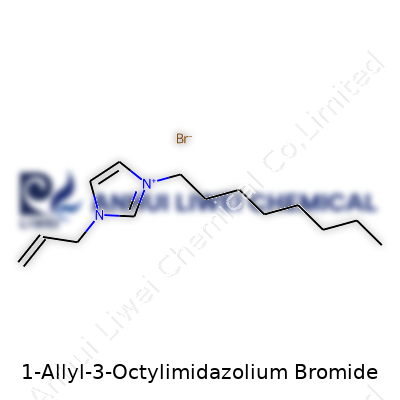
1-Allyl-3-octylimidazolium bromide comes from the family of ionic liquids based on the imidazolium cation. Its unique structure — with an octyl chain adding hydrophobic character and an allyl group providing extra reactivity — brings features that chemists look for: thermal resilience, non-flammability, and a broad window where the substance remains liquid. Products containing AOIMBr have found a place in electrochemical devices, solvent extraction, and as functional additives to tune behavior in a whole range of applications. What separates it from shorter or more symmetrical imidazolium salts is the tuned balance of physical properties. Researchers use these kinds of ionic liquids to push past limits set by traditional organic or inorganic salts.
Physical & Chemical Properties
AOIMBr usually appears as a pale yellow or colorless viscous liquid at room temperature. It stays liquid well below zero Celsius and keeps its form at temperatures exceeding 100°C, sometimes touching above 200°C before anything degrades. Density runs around 1.0 to 1.2 g/cm³, and its viscosity allows for easy handling compared to other ionic liquids with longer tails. Water solubility tends to drop with the octyl chain, but AOIMBr still mixes with polar organic solvents, letting it act as a mediator in complex reactions. The electrical conductivity and wide electrochemical windows come from the imidazolium backbone. Its bromide anion gives it features that suit electroplating, extraction, and catalysis. From a practical standpoint, the absence of volatility limits inhalation risks and makes AOIMBr easier to contain than solvents like acetonitrile or chloroform, which are notorious for evaporating rapidly.
Technical Specifications & Labeling
In the marketplace, AOIMBr usually arrives with a purity above 98% and trace levels of water below 0.2% after vacuum drying. Labels reflect storage guidance, often suggesting a cool, dry environment away from strong oxidizers. Most suppliers provide the CAS number 75716-60-0, the molecular formula C16H29BrN2, and the molar mass (329.32 g/mol). You’ll often find warnings about avoiding skin or eye contact and keeping the product sealed to prevent moisture absorption. Packaging uses amber glass or high-density polyethylene bottles, sometimes with secondary containment for larger batches in research or pilot-plant settings.
Preparation Method
Making AOIMBr requires a reaction between 1-allylimidazole and 1-bromooctane, usually in a polar aprotic solvent like acetonitrile. The process calls for refluxing the reactants under nitrogen, allowing the imidazole ring to undergo quaternization at the 3-position. Post-synthesis, most labs wash the product with ether or hexane to strip out unreacted starting material and then dry the ionic liquid under vacuum. The approach balances straightforward steps with careful purification, which keeps byproducts from muddying later experiments or scale-up. Practical lab notes reveal that yield and purity depend strongly on stoichiometry, stirring efficiency, and water control throughout the process. Not every batch turns out the same, but after some experience, chemists nail down the key points to reproducible, clean AOIMBr.
Chemical Reactions & Modifications
AOIMBr draws attention because of the allyl group on the imidazolium ring, which creates new opportunities for post-synthetic modification. Click reactions, metathesis, and even simple alkylations allow transformation of the cation, which lets researchers attach a range of new functional groups intended to tweak hydrophobicity, catalytic activity, or hydrophilicity. On the anion side, metathesis can exchange bromide with other anions — such as bis(trifluoromethylsulfonyl)imide or tetrafluoroborate — resulting in ionic liquids with radically different solubility, viscosity, or reactivity profiles. In practical settings, these modifications lead to custom-designed ionic liquids for separation, electrochemical, or analytical tasks. From my own work, swapping anions has let me tune solubility for specific metal chelates, making extraction much more efficient.
Synonyms & Product Names
AOIMBr shows up under several names in supplier catalogs and research papers. Some call it 1-allyl-3-octylimidazolium bromide, while others use abbreviations like [AocIm][Br]. Don’t be surprised to see it referred to by systematics that highlight the cation: 1-allyl-3-octylimidazolium bromide, but it’s the unique structure of the long octyl and allyl functional group together that distinguishes this liquid from the rest. Keeping track of these names avoids mix-ups and supports accurate sourcing, especially in international or multi-disciplinary collaborations.
Safety & Operational Standards
AOIMBr has earned interest from safety coordinators since, like many ionic liquids, it doesn’t burn easily or release hazardous vapors, but it doesn’t mean handling is risk-free. Gloves, goggles, and chemical-resistant coats must make up the basic PPE. Skin and eye contact can cause mild to moderate irritation, especially for those sensitive to brominated compounds, and good lab hygiene helps keep accidents rare. Waste AOIMBr or contaminated material goes into halogenated organic waste streams, not regular trash. If heated, AOIMBr breaks down slowly, but above ~250°C, some decomposition products can be hazardous. Spill control starts with absorbents and careful containment, since ionic liquids can linger on surfaces longer than water-based spills. Standards set by organizations like OSHA or REACH in the EU guide best practices, but each lab or plant still requires tailored protocols depending on scale and application.
Application Area
Researchers and engineers have found AOIMBr useful across electrochemistry, extraction, analytical chemistry, photovoltaics, and organic synthesis. In batteries and supercapacitors, AOIMBr’s stability and conductivity support the push for safer, nonvolatile electrolytes. It also draws interest in separating rare metals, thanks to its selectivity and immiscibility with water. In my own experiments extracting platinum-group metals from industrial waste, AOIMBr-based systems showed cleaner phase separation than traditional chlorinated solvents with far less odor. Other labs have introduced it into dye and pigment manufacture, antifouling coatings, and even as a reaction medium for challenging organic transformations. Uses continue to expand, sometimes in unexpected ways, especially as new functional modifications become possible with the allyl group.
Research & Development
Academic and industrial labs keep probing AOIMBr for new applications by blending its unique properties with creative designs. Automation, robotics, and miniaturized sensors all rely on new electrolytes and solvents, pushing researchers to iterate beyond simple extraction or battery tests. Scientists also look into biocompatibility—testing AOIMBr as a medium for enzyme-catalyzed reactions or as a stabilizer for proteins that won’t last in water or classic organic phase environments. With the current push toward greener chemistry, the non-volatile, recyclable nature of AOIMBr and its relatives draws more development grants. Laboratory groups often share data on the recyclability, thermal cycling behavior, and compatibility with common process materials, making it easier for industry to adopt these substances into pilot and production scales.
Toxicity Research
Toxicity questions loom over every new class of chemicals. Initial studies on AOIMBr show low volatility and low acute toxicity for most routes of exposure, but the compound causes moderate irritation to eyes and skin. Chronic effects still get attention, as researchers run genotoxicity and eco-toxicity tests in fish, Daphnia, and plants. Early results suggest lower environmental persistence compared to some persistent organic pollutants, yet the bromide content can cause problems in wastewater or soil. Labs work out decomposition and removal pathways using advanced oxidation, membrane separation, or bioremediation. More work remains to map out the long-term fate of AOIMBr in the environment, especially if use expands beyond controlled lab and pilot settings. Anyone who works with ionic liquids knows that safety data tends to lag behind adoption, which means strict handling until full toxicological profiles become public.
Future Prospects
AOIMBr stands out as something more than another entry in the ionic liquid catalog. The rise of electrified industry, better recycling methods, and demand for safe, high-performance solvents creates pressure for new materials. AOIMBr and its derivatives can adapt to everything from rare earth extraction to grid-scale batteries and rapid diagnostic sensors. With wider access to raw materials and continuous process development, future supply chains may benefit from newer, less energy-intensive syntheses. Researchers now look at ways to integrate AOIMBr-based systems into circular chemistry, where every step — from manufacture to end-of-life — aims for recyclability and minimal waste. As toxicology and environmental profiles become clearer, regulations may shape how these compounds enter widespread use, but for now, curiosity and necessity keep driving research and application. That intersection — between molecule design and real-world problem solving — is where AOIMBr finds its purpose, and where the next wave of scientific and technological advances could spring.
A Closer Look at an Unusual Chemical
Walk into a lab stocked with bottled compounds and there’s a good chance you’ll find chemicals with tongue-twisting names that don’t explain much. 1-Allyl-3-Octylimidazolium Bromide fits that category. It does a lot behind the scenes — mostly in research and specialty industry work, where little tweaks in structure can change the way things mix, break down, or assemble.
Role in Green Chemistry
This compound falls into the ionic liquid family, which has been drawing attention for more than a decade as a possible answer to pollution-heavy old-school solvents. Scientists look for these because ionic liquids don’t evaporate and pollute the air the way regular solvents do. They invite fewer safety headaches for people handling them day-to-day. I remember talking to folks working in university labs looking for ways to swap dangerous solvents with ionic ones, making their experiments less risky without losing performance.
Researchers reported that ionic liquids like 1-Allyl-3-Octylimidazolium Bromide dissolve a bunch of substances that water or alcohol tends to leave behind. That can come in handy for making ultrathin films, recycling metals, or even working with stubborn cellulose from biomass. Environmental watchdog groups like the European Chemicals Agency pay attention to these options because of the long-term drop in toxic runoff and vapors.
Smart Material and Energy Applications
Chemists lean on this compound to build smarter materials. Some teams use it to stabilize nanoparticles used in catalysts and energy storage. In the battery research field, ionic liquids help make safer electrolytes that are less likely to catch fire compared to the ones used in older lithium batteries. My own run-ins with battery research highlighted just how picky the industry can get about conductivity and temperature stability. Adding small tweaks to the ionic liquid’s structure lets researchers target those exact needs, and 1-Allyl-3-Octylimidazolium Bromide proves to be flexible there.
Electrochemical sensors also benefit. The use of this compound allows for better detection of things like heavy metals in water, thanks to improved ion transfer rates. I’ve seen environmental engineers push for sensors that don’t just detect more accurately but also last longer in harsh field conditions. Ionic liquids form a bridge for those improvements, partly due to their resistance to evaporation and breakdown.
Barriers to Broader Use
For all its promise, 1-Allyl-3-Octylimidazolium Bromide doesn’t pop up in consumer products you can buy off the shelf. Price plays a part. Making these specialized chemicals often involves slow, expensive synthesis. There’s also a lack of long-term toxicity data for some members of this chemical family. Regulators and public watchdogs want answers about what happens if compounds accidentally leak into soil or water. Scientists are digging for that information, but chemical safety research tends to move slow.
Pushing Progress with Care
Looking forward, spotlighting the real strengths of chemicals like this one starts with good data and open communication. Research needs funding for both innovation and long-term safety checks. Industry practices can move forward by linking up with academic partners who stress-test these compounds in real-world settings. Any claim about being “green” or “safe” only means something if it’s backed by rigorous results and honest reporting. As with so much in science, slow, steady effort gives the sharpest answers.
Getting Down to the Basics
1-Allyl-3-Octylimidazolium Bromide isn’t a compound you hear about at the dinner table, but in research labs and the chemical industry, it has sparked conversations. Its chemical formula—C16H29BrN2—might look like random letters and numbers until you break it down. Each part tells a story: C is carbon, H is hydrogen, Br is bromine, and N is nitrogen. This ionic liquid comes from fusing an imidazolium core with an allyl group and an octyl chain, then pairing it up with a hefty bromide anion.
Understanding this formula isn’t a pointless exercise. Research with ionic liquids has shown they shake up solvents, battery electrolytes, and even drug delivery. Without a clear idea of what’s inside the bottle, it’s easy to misjudge its reactivity, toxicity, or environmental impact. That C16 layout gives away a lot—lengthy carbon chains change how the substance handles heat or dissolves things. Nitrogen in the imidazole ring adds stability and flexibility to the molecule’s structure.
Molecular Weight: It’s Not Just a Number
Molecular weight matters anytime you plan to measure or mix chemicals. For this compound, its molecular weight hits about 357.32 grams per mole. Rounding up numbers left and right might make you think it’s just a reference for the lab, but it means more. It guides you in preparing solutions for extraction experiments, or calculating doses for toxicity studies. Leave out this detail, and mistakes pile up fast—concentrations end up off, and data loses reliability.
Scientists rely on well-documented weights like these to compare substances. For instance, if a research team studies how organic molecules break down in an ionic liquid, using the exact molecular weight helps compare apples to apples—not apples to gorillas. Beyond the bench, this weight feeds into safety protocols. You can’t calculate exposure limits or storage needs unless you work from precise numbers, not guesses.
The Real-World Stakes of Clarity
Anyone who’s spent time with chemicals knows how much hasty mistakes hurt. Grab the wrong figure, write it in your notebook, and everything downstream spirals—failed reactions, safety risks, wasted money. That’s why E-E-A-T matters here: expertise ensures the facts are right; experience tells you the numbers aren’t fluff, but the backbone of safe and successful science.
In a lab setting, I’ve seen a team pause an expensive experiment because someone mixed up notations in a formula, leading to a shortage of reagents at the worst time. Fixing that issue meant going back, rechecking the chemical’s weight, and recalculating every step. The process takes up hours you’ll never get back, frustrates your colleagues, and can cost serious funding in research circles.
Moving Toward Smarter Chemistry
Getting chemical formulas and weights straight doesn’t just help with paperwork. It minimizes waste and reduces safety risks. For those working with ionic liquids, up-to-date chemical databases come in handy—no more squinting at faded textbooks or questionable online tables. Sharing verified information—like C16H29BrN2 for 1-Allyl-3-Octylimidazolium Bromide—keeps everyone on the same page.
Training new chemists to always double-check formulas and weights has paid off in my career. Simple habits like paying attention to these details stop bigger problems in their tracks. Proper storage, calculated handling, and responsible waste disposal all depend on these facts. Chemical safety isn’t about fear; it’s about knowing your materials down to the molecule.
Understanding the Risks
1-Allyl-3-octylimidazolium bromide belongs to a group of chemicals known as ionic liquids. Chemists and engineers prize these substances for their low volatility and interesting solvent properties. A quick look through lab safety data reveals a mix of facts and experience. Handling organic salts like this one generally means thinking about more than just splash and spill; it’s about knowing how skin, eyes, lungs, and the environment can all be affected.
Safety data sheets from major suppliers list this compound as irritating to skin and eyes. Add a dash of my own experience—touching it without gloves leads to visible redness or mild burns after repeated exposure. A colleague once got some on a finger and felt stinging right away. This is not a substance for hands-on learning without protection.
Handling Precautions
Gloves are non-negotiable. Nitrile gloves do a good job for most ionic liquids. Eye protection should always be within reach because accidental splashes can pack more punch than you expect. After one distracted moment on a late shift, I learned the hard way to keep a pair of safety goggles at my bench.
Ventilation matters. Despite lower volatility compared to common organic solvents, fine mist or accidental heating releases vapors that don’t belong in your lungs. A chemical fume hood pulls those vapors away. Working in open air or near regular ventilation doesn’t cut it. Once during a project on imidazolium-based liquids, a peer tried to cut corners and ended up with an itchy throat. It’s not just about what you can smell—some of these compounds fly under the nose’s radar.
Spill cleanup needs a plan. These liquids don’t evaporate as fast as acetone or ethanol, so they sit on bench tops longer. Keep absorbent pads and neutralizers ready. If any reaches the floor, step carefully—many ionic liquids can make surfaces slippery. In one training session, someone slipped when a few drops landed on tiles. Moving slow, using proper soakers, and cleaning up thoroughly kept the rest of us upright.
Environmental Considerations
Too many labs rush to the drain with waste liquids. Compounds like 1-allyl-3-octylimidazolium bromide bring problems for water treatment plants and aquatic life. I remember reading about toxicity tests on tiny aquatic organisms. Concentrations that seem low in the lab can do harm in rivers and lakes, targeting gills and nervous systems in critters that rely on cleaner water.
Practical Steps for Safe Use
Training makes the difference. Reading a safety sheet isn’t enough—practical demonstrations and sharing stories build habits that stick. Label every container, even if you just need a small amount for a demonstration. Store bottles in cool, dry cabinets marked specifically for hazardous organic salts, away from strong acids or oxidizers.
Legal guidelines from places like OSHA and REACH help, but experience adds another layer. Teach new lab members the tricks and tips that aren’t printed anywhere—the right way to handle a pipette with gloves, which detergent lifts stains from lab coats, who to call for emergency waste pickup. Care in prep, handling, and disposal keeps accidents rare and makes sure curiosity about chemistry doesn’t come at the expense of safety or the environment.
Understanding the Risks on the Shelf
1-Allyl-3-Octylimidazolium Bromide came into my radar during a stint at a modest materials science lab. We were always told that new ionic liquids like this can change the rules in extraction and catalysis, but the blunt part most folks ignore is: many chemicals bring real challenges if they aren’t parked in good conditions. This is more than just keeping your notebook tidy—it’s about staying safe and protecting research investments. Stories around dismissed safety notes circle around every lab, but they land harder with compounds that fly a little under the radar.
Why Care About How It Sits on the Shelf?
I remember the morning someone left a similar compound next to a sunny window, thinking “It’s fine in the brown glass.” Moisture seeped in. The bottle got crusty, contents degraded, and that batch had to be scrapped—hundreds of dollars and a whole week’s work down the drain. With 1-Allyl-3-Octylimidazolium Bromide, even though it isn’t notorious for wild reactivity, being a smart steward of the stuff counts. These ionic liquids can draw in water from the air or shift around chemically if they’re baked by heat or hit with light. Messing up here is one fast way to nuke purity.
Keeping Integrity: Daily Storage Habits
The best routine has always been the simplest. I prefer using a desiccator or a tightly sealed glass container, not some cracked old plastic. Find a bench spot away from sunbeams and heat vents. Shoot for room temperature, not fluctuating cellar caves. Humid corners spell trouble, especially with bromide salts.
Labeling jumps out as something so easy yet regularly skipped. Scratching a date and opening event on the bottle’s tape makes a difference when something starts to smell off or doubts loom about contamination. Everybody wants to blame “bad supplier material,” but more often it’s a slip-up in daily habits that takes the punch out of purity.
Facts the Literature Shares
Looking through recent papers and the safety data sheets, the consensus is clear: keep 1-Allyl-3-Octylimidazolium Bromide well-sealed, dry, and temperate. The Sigma-Aldrich datasheet keeps it succinct—store below 30°C, avoid moisture, use original packaging. Moisture in the bottle? That’s a marked drop in shelf-life and usually alters the ionic character, which torpedoes most lab plans. There’s no benefit in tempting fate by pushing these boundaries.
Better Storage, Less Waste
From my own time chasing results, I learned that the cost of bad storage goes way beyond a wasted reagent. It sometimes lands you a failed experiment, data you can’t repeat, or—worst of all—an equipment deep clean thanks to byproducts or corrosion. Investing in some basic reusable desiccators and a decent supply of silica gel pays for itself after just one jar is saved from clumping or going off-color.
Facing Slips: Solutions That Actually Work
Every lab has a tale about someone’s “secret stash” of chemicals aging in a corner. Excavating these usually turns up messes. The fix comes down to a bit more discipline and team responsibility. Rotate stock, check seals monthly, and build storage habits into the standard sign-out sheet routine. If a compound like 1-Allyl-3-Octylimidazolium Bromide isn’t performing right, talk to the supplier early—don’t keep tossing reactions and blaming the unknown.
Smart storage isn’t just bureaucracy; it pays off every time you crack open a bottle and find exactly what you expected. In the end, small steps save big headaches—nobody in the lab wants their name attached to an avoidable disaster.
Stepping Inside the World of Imidazolium Salts
Walking into most research labs today, you spot chemicals that didn't even have a name a generation ago. 1-Allyl-3-octylimidazolium bromide is one of those compounds that brings a bit of modern excitement to the workbench. Its structure might look straightforward, but chemists have a habit of getting creative with these ionic liquids, often flipping expectations about what matters in an organic transformation or a catalyst toolbox.
Why Chemists Grow Curious About This Salt
People care about 1-allyl-3-octylimidazolium bromide for more than just the impressive name. The imidazolium core makes the cation stable, while the octyl chain supplies a boost in hydrophobicity. This slick combination means it doesn’t just dissolve in water or organic solvents—it can sometimes shape the interface between them. That opens the door for more than simple dissolution; it can tweak reaction environments, help separate products, and serve as a medium for reactions traditional solvents can’t pull off.
Many ionic liquids mess around with organic reactions by stabilizing charged intermediates, putting up barriers to evaporation, or even participating in the reaction themselves. This isn’t speculation—ionic liquids like 1-butyl-3-methylimidazolium hexafluorophosphate have cropped up in countless published syntheses from oximes to more exotic couplings. Papers over the past five years show chemists swapping in 1-allyl-3-octylimidazolium bromide and its cousins to improve yields or slash reaction times compared to more volatile solvents.
Real-World Examples Aren’t Wishful Thinking
Looking beyond the glassware, there’s a practical angle here. Big companies and startups both worry about solvent waste. Nobody likes breathing in a room full of ether or dumping buckets of hazardous liquids into disposal drums. Ionic liquids, including those built on octylimidazolium, boil down to much less vapor pressure. In real life, that means cleaner air, lower fire risk, and solvents that often get recycled a few times before heading for disposal.
There’s also the trick with catalysis. Many metal catalysts dissolve readily in these ionic liquids, staying stable for longer and even getting reused. Twenty years ago, separation took a lot of elbow grease and generated loads of waste. Now, with these room temperature salts, chemists can run a reaction and often separate the catalyst by decanting the product or cooling the mix to make the catalyst crash out. That can save thousands on catalyst spend and drive down the environmental bill.
Challenges and Honest Roadblocks
Not every story gets a happy ending. Scaling up can bring sticker shock—some ionic liquids cost much more per liter than plain solvents. Some labs find ionic liquids harder to purify than they’d like, facing knock-on problems from impurities. And even if something looks promising at small scale, handling hundreds of gallons with odd viscosity or water content issues takes more than optimism. People in the business end up tweaking conditions each time, building know-how that doesn’t always show up in the literature.
What’s Next and Where Does Opportunity Lurk?
Earlier in my own research, I watched teams switch over to ionic liquids for metal-catalyzed transformations, especially under air. They shaved hours off their time, and the work-up dropped from a headache to a walk in the park. These compounds will keep finding new uses, especially as more chemists share detailed notes on what works and what backfires. If manufacturers can cut costs and guarantee batch quality, this compound could give some classic solvents a run for their money.
Nobody should expect miracles, but 1-allyl-3-octylimidazolium bromide gives organic chemists another tool—sometimes a better one—when juggling the needs of modern synthesis and the demands for greener, safer protocols.