Commentary: The Evolving Role of 1-Butyl-2,3-Dimethylimidazolium Chloride
Historical Development
Back in the late 20th century, the fascination with ionic liquids kicked off as scientists dug through organic chemistry for safer, more effective ways to replace traditional solvents. 1-Butyl-2,3-dimethylimidazolium chloride (BDMIM-Cl) entered the scene as part of a new generation of room-temperature ionic liquids. Early publications from European and Asian research groups highlighted this salt for its unique chemical stability, which right away attracted researchers tackling difficult separation and catalysis problems. Before BDMIM-Cl, imidazolium-based salts had gained traction, but their volatility and toxicity concerns lingered. This chloride variant, discovered as part of broader efforts to widen the set of available ionic liquids in the 1990s, promised both thermal stability and versatility. That history forged its ongoing popularity in synthetic labs and pilot-scale engineering setups.
Product Overview
In practice, BDMIM-Cl arrives as a pale, viscous liquid or sometimes a colorless crystalline solid, depending on production. Labs rely on it for more than just its ability to dissolve stubborn materials; it provides a different toolkit compared to water or common organic solvents. High ionic conductivity and a wide electrochemical window make it a natural pick in batteries, while chemical manufacturers favor its low volatility for safer, cleaner processes. This ionic liquid carries enough resilience to survive repeated high-temperature cycles, which broadens its value far beyond one-off experiments and toward continuous process engineering.
Physical & Chemical Properties
Taking a closer look, BDMIM-Cl displays a melting point typically ranging from 70 to 80°C and remains stable up to 280°C without significant decomposition. Its high polarity drives dissolution of a wide spectrum of polar and semi-polar compounds, a boon for researchers who grew tired of reactivity limited by petroleum derivatives. The substance remains non-volatile and hydrophilic, absorbing moisture from the air that can influence its effectiveness in certain applications. Its electrical conductivity proves vital to industries developing electrochemical devices, and its density—about 1.1-1.2 g/cm³ at room temperature—allows for easy liquid handling in labware built for organic chemistry.
Technical Specifications & Labeling
Reliable suppliers provide BDMIM-Cl in purity grades above 97%, complete with Certificates of Analysis to document residual water, halide content, and possible organo-contaminants. It generally ships in sealed amber glass bottles or high-density polyethylene containers to block out moisture and prevent air exposure, clearly marked with hazard warnings in accordance with GHS (Globally Harmonized System) rules. Key identifiers—such as CAS number 358734-93-5 and Molecular Formula C9H17ClN2—stay prominent on every label, reflecting a growing regulatory emphasis on transparency and safety. Over the years, distributors have shifted toward eco-friendly packaging and improved supply chain tracking to address both sustainability goals and customer trust.
Preparation Method
Making BDMIM-Cl most often starts with a methylimidazole backbone, reacting it with butyl chloride under controlled temperature and pressure, then purifying the mixture by washing, drying, and crystallization. Organic synthesis classes often use this protocol as a teaching aid since it balances the challenge of handling anhydrous reagents with the satisfaction of seeing a product emerge in high yield. Industrial batches scale up by switching to closed reactors with more automated control over heating and agitation, enhancing reproducibility and minimizing impurities. Afterward, every batch undergoes physical testing—HPLC, NMR, and FTIR included—to sniff out side reactions and guarantee the ionic liquid is ready for demanding applications.
Chemical Reactions & Modifications
Once produced, BDMIM-Cl offers itself as a blank slate for further modifications. Chemists tweak its side chains or trade out the chloride for other anions such as BF4- or PF6- to change everything from thermal stability to reactivity profiles. Routinely, this compound acts as a supporting electrolyte in catalytic cycles, stabilizing transition states and boosting reaction rates in alkylation, acylation, or cycloaddition processes. BDMIM-Cl demonstrates solid performance not only as a reaction medium but also as a phase transfer catalyst, particularly for challenging cross-coupling or substitution reactions. Its chemical resilience under oxidative or reductive stress keeps it relevant in emerging electrodeposition and electrochemical analysis.
Synonyms & Product Names
In academic and industrial circles, folks might encounter BDMIM-Cl under several banners: 1-butyl-2,3-dimethylimidazolium chloride, [BM2Im]Cl, or CAS 358734-93-5. Commercial products sometimes appear under catalog codes unique to Sigma-Aldrich, TCI, or Alfa Aesar, all reflecting the subtle branding arms race within fine chemicals supply. No matter the label, researchers confirm identity with NMR and MS before moving forward, minimizing mix-ups in increasingly fast-paced labs. Knowing the trade names and structural shorthand helps quickly navigate both procurement channels and scientific literature.
Safety & Operational Standards
Workplace handling of BDMIM-Cl sets a high bar for chemical safety. Direct exposure to skin or eyes burns, and repeated inhalation over months adds up to respiratory irritation. Per OSHA and REACH regulations, operators wear gloves, lab coats, goggles, and work inside fume hoods. Labels flag the risks, and SDS sheets outline step-by-step responses for spills or accidental ingestion. Disposal follows hazardous waste protocols due to both chloride content and imidazolium toxicity, steering clear of drains and landfill. Training for emergency scenarios ranks as high as process optimization in labs prioritizing research and organizational risk management.
Application Area
BDMIM-Cl punches above its weight in a surprising range of industries. Battery engineers value it for electrolytes in next-gen lithium-ion and redox flow systems; pharma labs draw on its solvent powers for green synthesis, cutting out legacy petroleum solvents and lowering EHS (Environment, Health, Safety) concerns. Cellulose processing takes off with BDMIM-Cl, where fiber dissolution has unblocked innovations in renewable plastics and eco-textiles. Semiconductor makers turn to it for precise control over wet etching and electrodeposition, seeking both purity and reliability. In analytics, chemists deploy it for improved NMR and chromatography, raising both sensitivity and selectivity. Having used BDMIM-Cl for catalyst screening and cellulose breakdown, I know the frustration that comes with narrow solvent compatibility—this liquid opens doors that were shut with classical solvents.
Research & Development
Ongoing research threads run deep into imidazolium chemistry. Teams continue to discover new reaction pathways made possible by BDMIM-Cl. Electrochemical engineering studies keep pushing its performance as an ion conductor for capacitors or supercapacitors. In green chemistry, developers seek process coupling where BDMIM-Cl provides a one-pot synthesis route, cutting steps and waste right out of reaction planning. Biotechnology labs use it as a mild extraction fluid, targeting enzymes and proteins from stubborn biomass sources. Time and again, BDMIM-Cl figures in patent filings for both established and fledgling industries. My own work in mechanochemistry highlighted how this ionic liquid’s ability to stabilize radical intermediates beats so many other candidates, offering fresh routes to sustainable chemical production.
Toxicity Research
Toxicologists grapple with BDMIM-Cl’s safety. Acute dermal or oral exposures in animal models indicate moderate toxicity, with longer-term effects tied to organ stress, mostly liver and kidney. Aquatic studies trigger concern over bioaccumulation and persistence if improperly disposed. Researchers now screen for eco-toxicity as much as process efficiency. Early-stage cell culture studies flag moderate cytotoxicity, driving the shift toward closed-loop processes and better effluent filtration. Regulation may tighten, as data accumulates and pressure mounts to address emerging contaminants. Experience as a lab manager led me to invest in neutralization and containment setups, since no solvent, no matter how “green,” gets a free pass on environmental impact.
Future Prospects
Looking to the future, BDMIM-Cl stands out for those chasing the next leap in green solvents, electrochemistry platforms, and efficient biopolymer processing. Demand from electric vehicle and battery manufacturers will likely push continuous scale-up and deeper process integration. Ongoing collaborations between academic chemists and commercial engineers show promise: higher purity, reusable cycles, and lower treatment costs. On the regulatory side, improving hazard profiling and lifecycle analysis of ionic liquids forms the backbone for wider adoption. Breakthroughs in tailoring the side chains or anion structure keep rolling in, pointing toward safer and even more efficient versions. The strongest signal comes from labs facing mounting pressure to balance innovation with responsibility—BDMIM-Cl, with all its quirks, remains a chemical worth watching.
A Unique Player in Chemical Research
1-Butyl-2,3-dimethylimidazolium chloride, often referred to as an ionic liquid, doesn’t grab headlines on its own, but take a closer look and you’ll spot it in some remarkable places. Conventional solvents like water or ethanol can’t tackle everything. They often fall short when dealing with special reactions in labs or trying to dissolve tough substances. This is where ionic liquids enter the conversation, and this one, with its odd-sounding name, packs a particular punch.
Helping Make Chemistry Greener
Step into a research lab focused on environmental solutions and you’ll probably hear about the push for “green chemistry.” My years in academic research taught me how common solvents bring headaches—flammability, toxicity, even pollution from evaporation. 1-Butyl-2,3-dimethylimidazolium chloride ends up in these spaces because of its stability and very low vapor pressure, which reduces workplace hazards and keeps more material in the flask instead of the air.
Scientists reach for this chemical while searching for better ways to dissolve cellulose, process plastics, or separate metals. In some cases, traditional approaches just can’t get the solution clear enough. The science community published a stack of studies where ionic liquids like this one dissolve plant fibers, making biofuel production and new bioplastics more practical. This gains extra importance since modern manufacturing leans on nonrenewable resources and complex, sometimes risky, techniques.
Pushing the Boundaries in Electrochemistry
One place I’ve noticed 1-butyl-2,3-dimethylimidazolium chloride shine is in batteries and capacitors research. The hunt for safer, higher-capacity batteries never stops. Standard battery fluids come with risk—leaking and combusting—while ionic liquids sidestep these problems. Cleanrooms and battery labs now experiment with this compound as the base of electrolytes. These move charged particles without drying up fast or catching fire, a serious benefit for next-generation electronics and green energy storage.
Working on an energy storage project last year, my team needed a solution that wouldn’t turn volatile under pressure. The imidazolium chloride was there to keep things running when regular liquids either boiled off or corroded our equipment. In scientific circles, this flexibility means a lot, since a failed battery doesn’t just slow down experiments, it can harm people or facilities.
Potential Downsides and The Way Forward
Of course, nothing’s a perfect fit for every job. Costs tend to be high for some ionic liquids, and disposal can raise new issues. For all its “green” credentials, these compounds demand extra scrutiny—some are tough to recycle, can break down into less friendly chemicals, or present handling questions that don’t have simple answers yet. Having seen chemical waste management up close, it’s clear that labs and industry must pay as much attention to disposal as to initial use.
Innovation could ease some of these roadblocks. Chemists experiment every year with tweaks that reduce costs or boost biodegradability. The best path forward stays grounded in real evidence: look closely at risks, share data transparently, and aim for compounds that serve both science and the planet. Technologies built with that mindset will use ionic liquids thoughtfully, not just because they’re new, but because they genuinely solve hard problems.
Breaking Down the Chemical Structure
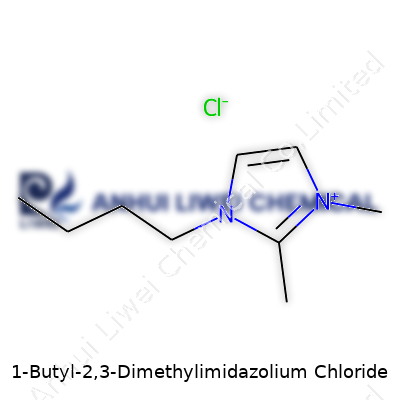
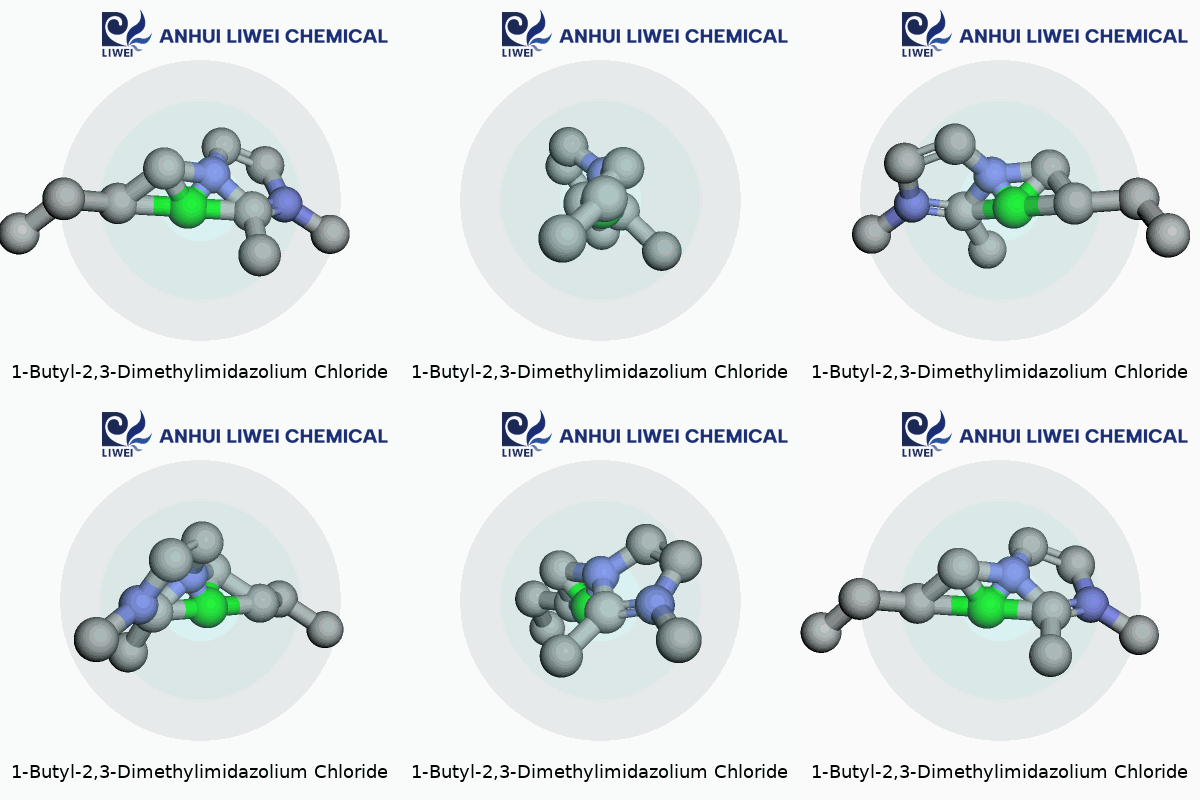
1-Butyl-2,3-dimethylimidazolium chloride may sound like a mouthful, but dig into its structure and things get clear. The molecule draws its backbone from the imidazolium ring. In this specific cation, two methyl groups attach at the 2 and 3 positions, while a butyl group takes the 1 position. Chloride serves as the counterion. Chemists building a visualization see five carbons form the imidazolium core, with one nitrogen at each 1 and 3 spots.
Place a butyl chain on the 1-position and two methyls at 2 and 3: the structure starts to feel familiar to anyone who’s worked with ionic liquids. The methyl and butyl substituents tweak the solubility and thermal stability, making compounds like this one popular for green chemistry, electrochemical devices, and as solvents for difficult separations.
Molecular Formula—Simple But Powerful
You can count the atoms by following the substituents. The imidazolium ring, plus the butyl at N1 and methyls at C2 and C3, gives:
- Carbons (C): The ring has three, the butyl group adds four, the two methyl add two more. Total: 9.
- Hydrogens (H): Butyl group holds 9, methyls add 6, ring hydrogens throw in 1, totaling 17.
- Nitrogens (N): One imidazolium ring brings in 2 nitrogens.
- Chlorine (Cl): The anion is a single chloride ion.
All added up, the molecular formula lands at C9H17N2Cl. Most chemistry guides back this up, and you will find the same when you draw out the full Lewis structure.
Figuring Out the Molecular Weight
Molecular weight helps gauge quantities for lab prep and industrial scale-up. Grab the atomic weights:
- Carbon: 12.01 g/mol
- Hydrogen: 1.01 g/mol
- Nitrogen: 14.01 g/mol
- Chlorine: 35.45 g/mol
Running the math with these numbers from reliable tables:
- C (9) × 12.01 = 108.09
- H (17) × 1.01 = 17.17
- N (2) × 14.01 = 28.02
- Cl (1) × 35.45 = 35.45
Sum it up: 108.09 + 17.17 + 28.02 + 35.45 = 188.73 g/mol.
Importance in Practical Work
Understanding formulas and weights isn’t academic trivia – it grounds real lab projects. During scale-up, every extra decimal matters in mol ratios or when sourcing high-purity materials for batteries, pharmaceuticals, or green solvents. One mistake with molar mass, and a whole synthesis drifts off course. Times spent recalculating a batch or cleaning up after an off-spec mixture drive home the point.
I have watched the cost of correcting a weigh-out gone wrong. That balance between precision and practicality always matters in projects. Facts like these seem small, but in experience, they cut down wasted time and resources. In chemical research, knowledge about structure and calculations supports good experimental design and sharpens troubleshooting skills.
If any part of the formula or calculation seems fuzzy, a quick double-check against trusted sources—such as Sigma-Aldrich catalogs or the PubChem database—prevents downstream errors. Over time, this habit builds reliable, reproducible protocols for lab teams, large or small.
Why the Way You Store This Chemical Matters
Over the years, I’ve walked through plenty of labs and factories where chemical storage often gets treated as an afterthought. With 1-Butyl-2,3-Dimethylimidazolium Chloride, tossing the container onto a random shelf easily turns a convenient routine into a costly mistake. This ionic liquid has special quirks. Anyone who has handled such chemicals knows that improper storage doesn't just mean some lost product, it often leads to unstable conditions, unnecessary contamination, and sometimes hazardous responses.
Understanding the Risks
1-Butyl-2,3-Dimethylimidazolium Chloride can absorb water from air, changing its purity fast. Moisture loves to find a way in, even through lids that look perfectly tight. The compound turns clumpy and unpredictable after exposure, with possible changes in color, solubility, and reactivity. The science here is straightforward: most ionic liquids have a natural tendency to mix with water molecules. If the surrounding air holds some humidity, you’re almost guaranteed to watch the product degrade.
Oxygen and heat make things even worse. Slow but steady contact with the atmosphere actually oxidizes certain chemical compounds. Add fluctuating temperatures or that classic sunny window spot, and soon enough you’re not storing a safe, pure sample anymore—you’re running a risk for accidents and botched experiments.
No Tricks, Just Simple Storage Habits
Glass bottles with tight-fitting caps work best. Plastic can sometimes react with ionic compounds, so glass brings peace of mind. Squeeze every bit of air out before sealing. If you have access to a glovebox, that’s where you should be opening these bottles, especially in rainy climates.
Desiccators turn into real life-savers. By keeping 1-Butyl-2,3-Dimethylimidazolium Chloride bottles together with fresh drying agents like silica gel, you keep the surrounding air dry. It seems small, but this makes all the difference for chemical lifespan in storage. On hot days or in rooms that don’t have reliable climate control, go for refrigeration—not freezing. Cold keeps chemical breakdown slow and steady without introducing the hazards that come with freezing.
Label everything with the date of storage and the date you first cracked open the seal. This habit, drilled into me by one particularly strict lab supervisor, has saved more projects than any high-tech monitoring gadget. You’ll know when chemical purity starts slipping, and there won’t be guesswork during audits or sudden investigations.
What Not to Do
Stories roll through lab circles about employees stashing chemicals on open benches or storing reactive substances next to acids, bases, or oxidizers. That shortcut might sound tempting, but it only takes one minor spill or droplet of water to produce fumes, clogs, or reactions no one wants. Storage away from direct sunlight, in a dedicated cabinet that sits away from sources of vibration or heat, protects your workspace and your product. Emergency shower stations, fire extinguishers, and good ventilation matter—because the best plans sometimes go wrong.
Improving Storage as a Team
If you manage a team, showing others these simple storage steps sets the standard, not just for safety but for saving money and reputation. Regular checks, written guidelines, even pop quizzes (I’ve seen teams do this), keep everyone sharp. People remember stories and close calls, not policy binders.
Nobody loves rules until they see how a dry, uncontaminated bottle lets everything else run smoothly—from safer handling to more repeatable results. Our routines build trust in the process and let science thrive without extra headaches.
Straight Talk on Safety and Handling
1-Butyl-2,3-dimethylimidazolium chloride pops up in research labs more often these days. Its main draw comes from properties that fit nicely in green chemistry, mostly as a solvent in reactions where old-school chemicals would create more pollution. Some chemists talk about “designer solvents” that cut back on volatile organic compounds, and this substance checks off several boxes. But before tossing the “eco-friendly” label around, safety and toxicity deserve a closer look. I’ve seen more than a few chemists make assumptions based on the word “ionic liquid” rather than digging into data.
Hazards Don’t Follow Labels Alone
Not everything marketed as green turns out harmless. If we take a closer look at available toxicology studies, 1-butyl-2,3-dimethylimidazolium chloride lands in a gray area. Its acute toxicity rates lower than plenty of traditional organic solvents—nobody’s dropping after brief exposure. That gives it an edge for specific lab work. But skin and eye exposure can cause irritation and redness, so gloves, goggles, and fume hoods still matter, even when handling just small samples.
Breathing in vapors shouldn’t be a big issue, because this liquid doesn’t evaporate like acetone or ether. Still, dust from powder forms, or heated spills, put vapors in the air. What’s in that vapor really needs more research, because relying on general “ionic liquid” properties risks overlooking something nasty. My own experience in a university lab showed plenty of people taking shortcuts once the word “non-volatility” landed in the safety briefing.
How Toxic Are We Talking?
Humidity, temperature, and the way a chemical gets used all change outcomes. Tests on aquatic life, for example, show that certain ionic liquids, including 1-butyl-2,3-dimethylimidazolium chloride, cause stress or death to fish and water fleas at relatively low concentrations. That result put a stop to any plans our lab had for pouring waste down the drain. Persistence in the environment came up, too: these compounds break down slowly, sticking around much longer than many chemists would guess. When a bottle sits forgotten on a shelf, minor spills keep building up. Questions about accumulation in soil or water deserve answers from more than a basic safety data sheet.
Best Practices in Research and Industry
I’ve learned the poster on the wall in chemistry spaces doesn’t always match what happens on the bench. Anyone storing or using 1-butyl-2,3-dimethylimidazolium chloride owes it to themselves and the people around them to use secondary containment, keep the chemical capped, and avoid any contact with open wounds or mucous membranes. If a spill does happen, dry sand or inert spill kits work well; avoid rinsing into the regular lab sink.
Waste disposal turns out to be the biggest headache-most municipal facilities don’t handle exotic chemicals like this safely. Collection for disposal by a specialized service takes time and adds cost, but it means hazardous byproducts or persistently toxic breakdown products don’t end up in groundwater. Research into greener replacements can’t stop at the "ionic liquid equals safer" stage; every compound deserves testing for both acute and chronic effects in living systems, as well as breakdown in the environment.
Why Bother with Care?
Complacency invites accidents or long-term consequences nobody intended. I learned early that “safer” never means “totally safe.” By respecting the hazards—no matter what buzzwords pop up in the manufacturer’s flyer—labs and industry protect their workers, the environment, and the communities outside those lab doors. Whether you’re an undergrad mixing grams or a process chemist handling kilos, it pays to treat 1-butyl-2,3-dimethylimidazolium chloride as a real chemical hazard, not just the newest green solvent on the block.
No Blanket Answer for Solubility
Solubility can make or break a chemical’s usefulness. In the lab, I’ve watched clear solutions turn cloudy in seconds just because someone tried to mix the wrong salt with the wrong liquid. For 1-butyl-2,3-dimethylimidazolium chloride—one of those ionic liquids with an intimidating name—solubility isn’t just an academic question. Its ability to dissolve in water and organic solvents pulls weight in real-world chemistry from batteries to drug development.
Water Mixing: Strong Suit
These ionic liquids tend to play well with water. The chloride part works like a magnet for water molecules. 1-butyl-2,3-dimethylimidazolium chloride usually dissolves without much drama at normal temperatures. Researchers at the University of Illinois have observed that similar imidazolium chlorides show high water solubility—above 2 moles per liter in common cases. That lines up with what I’ve seen doing basic solvent tests.
Once it hits the water, this salt doesn’t just blend in. The solution stays stable, and the ions help carry electricity, which battery companies love. Green chemistry advocates also keep an eye on these properties, since water remains a safer solvent compared to most organic alternatives. Open a reference guide or look at product data sheets, and “miscible in water” comes up for a good reason.
Organic Solvents: A Mixed Bag
Solving for organics, the picture changes a bit. The imidazolium ring and butyl tail tip the balance away from quick universal solubility. Drop this chloride into polar aprotic solvents like dimethyl sulfoxide (DMSO) or dimethylformamide (DMF), and you see some dissolving. In my experience, if you stir vigorously, it makes a homogenous solution in DMSO, especially when you keep things a bit toasty (around 40°C).
Try the same trick with acetone or most alcohols, results get patchier. There’s enough polarity in methanol that you get partial solubility, but ethanol already starts to struggle. Go near nonpolar solvents like hexane or toluene, and it won’t budge at all—the molecules just don’t fit together. NMR and conductivity tests back that up: organic layers stay clear and ionic liquids form a bottom phase.
Why This Matters for Science and Tech
Chemical engineers see these solubility lines as decision points. Making a pharmaceutical—if the salt blends in water, you get simple purification and formulation steps. Green process designers value water compatibility, dodging hazardous solvents. In lithium-ion battery research, solubility impacts how well the ionic liquid transports ions between electrodes.
On the flip side, difficult solubility hinders purification or reusability. Labs searching for greener catalysts or recyclable solvents scratch their heads each time chemicals don’t mix. With regulators pushing for less solvent waste, knowing how 1-butyl-2,3-dimethylimidazolium chloride behaves means fewer failed batches behind the scenes and a smaller environmental footprint along the way.
What Can Help Moving Forward
To get the most value out of this ionic liquid, tweaking its molecular side chains opens new options. Swap in a longer tail or different ring substitutions, and solubility can change overnight. My colleagues who work on ionic liquids for separations keep stacks of NMR data—seeing firsthand that a slight structure shift can turn a water-loving salt into something that only dissolves in acetone.
Software tools now help screen dozens of candidates for targeted solubility before you even order a bottle. Big labs already lean on these predictions, cutting down on tedious trial and error. Data sharing between groups worldwide also gets faster, so every new insight about solvents moves through the network, not just inside paywalled journals.
The more we learn about 1-butyl-2,3-dimethylimidazolium chloride’s solubility quirks, the better chance we have to put it to work in ways that make science cleaner, safer, and quicker.