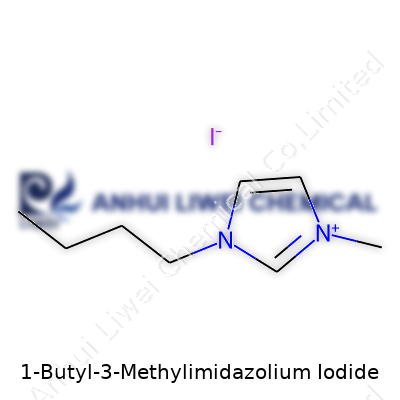
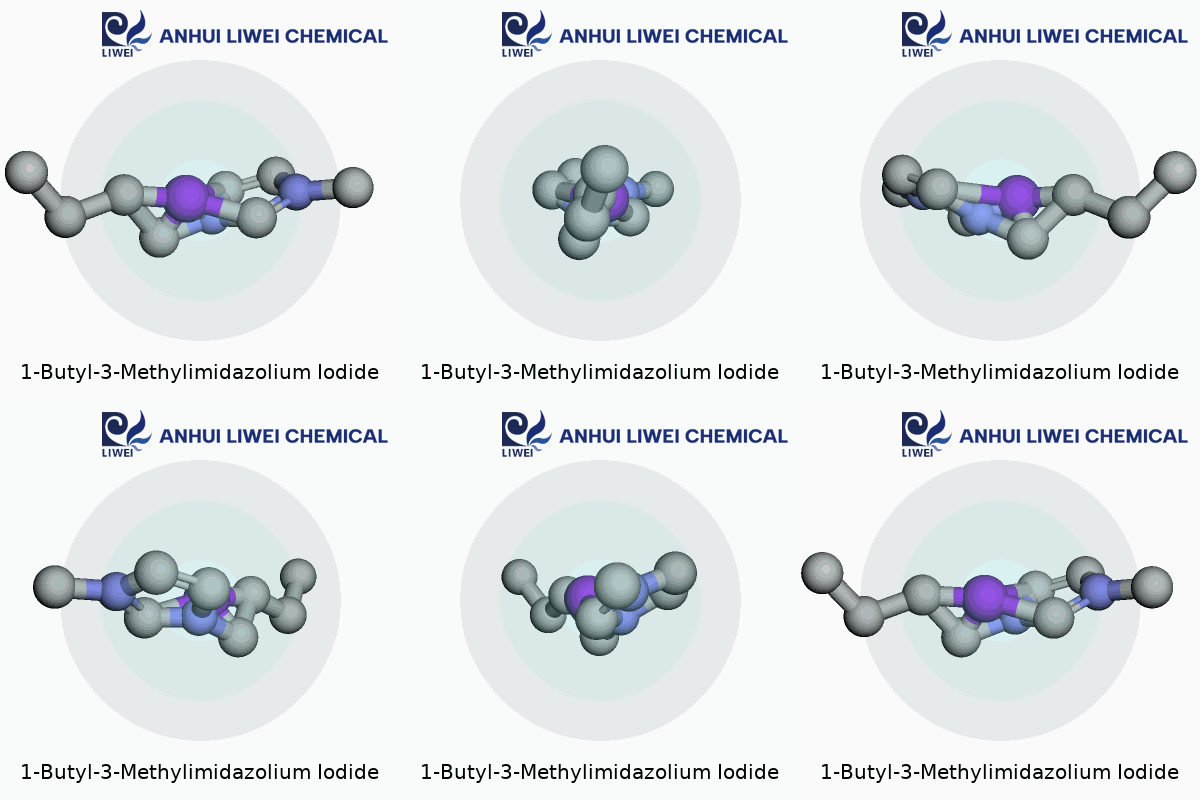
1-Butyl-3-Methylimidazolium Iodide: A Deep Dive
Historical Development
Tackling the story of 1-Butyl-3-Methylimidazolium Iodide takes us back to the roots of ionic liquid research. Through the 1970s and 1980s, scientists chasing greener chemistry started exploring alternatives to hazardous and volatile solvents. Folks realized the imidazolium-based ionic liquids, including this one, brought something new: non-flammable, thermally stable, and with unique dissolving power. Academic curiosity flipped to practical excitement, as more research teams in materials science, catalysis, and electrochemistry began swapping in these compounds for their usual solvents. The shift was less about replacing old tools and more about pushing the limits of synthesis, conductivity, and safe process design.
Product Overview
1-Butyl-3-Methylimidazolium Iodide, often called BMIM Iodide, shows up as a solid or viscous liquid depending on the conditions and purity. It stands out by offering a handy combination of high ionic conductivity, chemical stability, and pretty broad liquid range. For anyone working in electrochemical systems or dye-sensitized solar cells, BMIM Iodide becomes one of those workhorse materials—the sort you reach for when getting things to move, conduct, or dissolve demands more than standard solvents allow. The imidazolium backbone with butyl and methyl side arms creates a balance of solubility and stability that opens a lot of doors in applications.
Physical & Chemical Properties
Pour a sample and you’ll spot high density and low volatility; BMIM Iodide doesn’t try to escape like a conventional solvent. It packs a melting point around 65 to 75°C and holds up at temperatures beyond what typical organic solvents can manage. The compound dissolves a surprising range of materials—from organic molecules to metal salts—making it useful in labs and pilot plants alike. Its ionic nature shows in a hefty electrical conductivity, which makes it perfect for use as an electrolyte. Being non-flammable and barely evaporating, it’s safer than working with something like acetonitrile or ether.
Technical Specifications & Labeling
Scrutinizing a bottle of BMIM Iodide, you’ll see details like molecular formula C8H15IN2, purity often over 98%, and batch-specific water content. Regulatory and shipping requirements usually show clear hazard pictograms and warnings, since iodide salts require smart handling. Detailed certificates of analysis help scientists make sure they're using the right grade for specific experiments. Reliable suppliers make sure each shipment comes with data on appearance, melting point, moisture level, and trace metals—details that keep experimental results consistent and trustworthy.
Preparation Method
Manufacturers stick with time-tested alkylation approaches. They nucleophilically substitute 1-methylimidazole with 1-chlorobutane, giving 1-butyl-3-methylimidazolium chloride, then swap the chloride for iodide using potassium or sodium iodide in a water or alcohol wash. This two-step method keeps the process scalable, and produces relatively clean product with simple precipitation and washing. Any synthetic chemist familiar with substitution reactions would feel right at home in this process—no exotic reagents or arcane conditions required.
Chemical Reactions & Modifications
The flexibility of BMIM Iodide stands out in the way it can jump into different chemical roles. The imidazolium core survives both reducing and oxidizing environments, so the material gets used in everything from catalysis to electrolytic cells. Swapping out the anion, say trading iodide for hexafluorophosphate or tetrafluoroborate, adjusts properties such as hydrophobicity or solubility. If a researcher wants to tweak the cation, they’ll often extend or shorten the butyl group or explore other N-alkylations, which opens up fine-grained changes to viscosity, melting point, or selectivity in reactions.
Synonyms & Product Names
In journals and vendor catalogs, names like BMIM Iodide, 1-Butyl-3-methylimidazolium iodide, or [BMIM]I crop up regularly. Synonyms pop up from suppliers who market similar grades: N-Butyl-N'-methylimidazolium iodide or even 1-butyl-3-methyl-1H-imidazol-3-ium iodide. For clarity in research, tracking CAS Number 262297-48-7 helps avoid mix-ups between anion forms, since swapping iodide for, say, chloride can change outcomes dramatically.
Safety & Operational Standards
The lure of low volatility and non-flammability can tempt users to drop their guard, but BMIM Iodide deserves respect. Iodide salts can stain skin, irritate eyes, or cause some thyroid effects with repeated exposure, so standard gloves and goggles belong in every workspace using this compound. Good ventilation, sealed storage, and careful waste handling all make routine sense here. Environmental guidelines encourage thorough documentation and spill response. Lab managers would be wise to include BMIM Iodide in chemical hygiene plans, especially since its ionic liquid nature could fool newcomers into thinking it's inherently benign.
Application Area
Plenty of chemical and engineering teams put BMIM Iodide to regular use. In dye-sensitized solar cells, the material outperforms traditional solvents as an electrolyte, thanks to its strong ion transport and electrochemical stability. In organic synthesis, it serves as a green solvent and phase transfer catalyst, often replacing toluene or DMSO. Metal extraction, electrodeposition, and battery research all owe breakthroughs to these ionic liquids, where traditional solvents struggle to deliver the same stability and conductivity. Anyone working with carbon capture, biomass processing, or fuel cells will find studies citing BMIM Iodide as a game-changing solvent or support medium, letting challenging processes run at lower voltages or temperatures, and often under safer, less toxic conditions.
Research & Development
Research into BMIM Iodide attracts curious chemists, physicists, and engineers alike. Teams test new cation and anion combinations for higher conductivity, lower toxicity, or greener disposal. Journal articles pop up on using it in photonics, electrochromic devices, and biofuel cells. Scaling up from beaker to pilot plant often reveals surprises—how the viscosity, for instance, fits or frustrates continuous processes. Computational chemists map its interactions with specific substrates, hunting for breakthroughs in catalysis or nanomaterial stabilization. Some work focuses on recycling BMIM Iodide after use, keeping costs and waste lower for both academic and industrial users.
Toxicity Research
No chemical joins the toolbox without a hard look at toxicity. Early optimism about ionic liquids being “green” hit reality in the 2000s, as studies revealed some breakdown products, especially from the iodide or other halide versions, stressed aquatic systems or lingered in soil. Toxicologists run chronic exposure tests in fish and algae, while medical researchers study skin absorption and thyroid function. As a class, imidazolium salts generally perform better than volatile organics, but environmental scientists keep a watchful eye on their accumulation. Better characterization and safe waste handling protocols, plus design of even less persistent forms, all drive the next round of improvements.
Future Prospects
After years at the experimental edge, BMIM Iodide looks set for broader uptake across clean energy, advanced manufacturing, and pharmaceutical processing. A mix of regulatory attention and raw scientific excitement keeps the field busy. Bolder application designs lean into the tunable nature of ionic liquids, and BMIM Iodide keeps showing up as the testbed of choice for mixing, matching, and scaling what folks learn in the lab. The pressure to build energy storage systems, solar cell modules, and catalysts that respect people and planet keeps drawing interest out of journals and into production lines. Worries over cost, recyclability, and full-scale environmental impact won't go away, but constant research, smarter synthesis, and careful attention to real-world conditions promise to keep BMIM Iodide relevant and useful.
The Role It Plays in Clean Energy
Every time someone talks about new ways to store or harvest energy, batteries and solar cells come up. People have worked for years to pull more juice from sunlight and pack more power into a small space. In my own time visiting university labs, I’ve seen graduate students hunched over small test cells. Many of them used 1-Butyl-3-Methylimidazolium Iodide (BMIM I) for one reason: it helps solar panels push out more electricity.
Researchers turn to BMIM I because regular saltwater solutions tend to break down after a while, taking the solar cell’s performance with them. BMIM I, by contrast, keeps things running smoothly in dye-sensitized solar cells, where it helps shuttle vital ions back and forth. Experiments show that cells built with this compound often last longer and deliver stronger performance than old-school designs. With energy bills eating up a bigger share of people’s paychecks, advances like these could eventually put cheaper solar panels on more homes.
Makes Battery Performance Less of a Headache
Plenty of batteries lose steam fast, especially when you push them in hot or cold weather. One weak spot? The liquid inside them, which can corrode or dry out. BMIM I steps in as an ionic liquid, doing a better job than typical solvents. In the tests I’ve read, batteries using this ingredient hold up under tough cyclings, like the kind needed in electric vehicles or large-scale power storage.
Safety enters the picture, too. BMIM I barely evaporates or catches fire, which lowers risks when compared to other chemicals in lithium or sodium batteries. I’ve talked to engineers who say that shifting toward safer battery materials could cut down on fires linked to e-bike batteries in crowded cities. Even insurance reports underscore how much safer houses and offices feel when using batteries made with less flammable components.
Cleaner Chemistry and Less Waste
Many folks outside the lab world rarely see solvents beyond simple rubbing alcohol or acetone. In manufacturing, though, many processes still rely on nasty chemicals that are tough to dispose of and dangerous to breathe. BMIM I acts as a “green solvent”—one that stays intact and doesn’t leave behind toxic waste. I’ve seen it help chemists streamline tricky steps in drug and plastics manufacturing, slashing both emissions and cleanup headaches.
The environmental angle matters. Even the World Health Organization reports on the health toll from chemical runoff. By switching over to cleaner, longer-lived solvents like BMIM I, factories can cut their pollution and protect more workers and neighbors. That’s a goal every city and company can get behind, especially as pressure mounts from regulators and watchdog groups.
Looking Ahead
Materials like BMIM I don’t show up in splashy headlines, but they power progress. Some research flags high costs and production problems, often because the chemistry isn’t simple at an industrial scale. Creative engineering and government funding can help bring prices down, opening doors for smaller solar firms and battery startups. My conversations with people in the field make one thing clear: once affordable, safer materials hit the market, they ripple out fast—transforming how we power our homes, phones, and cars.
The Formula: C8H15IN2
1-Butyl-3-methylimidazolium iodide, known by chemists as BMIM I, carries the formula C8H15IN2. Counting atoms, this compound includes eight carbons, fifteen hydrogens, a single iodine, and two nitrogens. While it may not grace household products, this salt plays quietly in the background of a growing field of research and green technology.
Not Just for Chemistry Class
I stumble over chemical names like anyone else, but it’s worth digging into what makes BMIM I stand out. Most people never stop to think about ionic liquids, but they rarely behave the way table salt does. The magic comes from liquid salts like this one, which stay fluid even at room temperature. That sets them apart from classic salts that only melt under high heat.
BMIM I in Everyday Solutions
This compound pops up in research around batteries, especially as a potential replacement for older, toxic solvents. The imidazolium part of its structure has a knack for dissolving a wide range of materials. Experts love BMIM I because it doesn’t evaporate or burn easily, making it safer than many organic solvents we’ve relied on in the past. I remember my university lab days, the sharp tang in the air after mixing volatile solvents, and the repeated warnings to avoid open flames. BMIM I’s lower risk brings welcome relief to labs around the world.
Environmental Footprint and Health
Many groups have started to measure how safe these materials really are. The story isn’t all sunshine, though. While BMIM I sports a better safety profile during use, it takes effort to keep track of its fate in the environment. Studies point out that water treatment sites don’t always capture everything. Working to design the ionic liquid life cycle keeps environmental scientists busy, so the work doesn’t end at improved lab safety.
Where Science Pushes Forward
BMIM I opens new doors for electrochemistry and green tech. Solar cells, for example, have embraced this salt in place of polluting compounds that once looked unstoppable. Chemists don’t claim this is a one-size-fits-all solution, but every step away from harsh chemicals counts. Safe handling, spill prevention, and reuse programs all become important as labs and manufacturers scale up production.
The Road Ahead: Safer Chemistry by Design
It’s easy to get caught up in numbers and formulas, but what matters most is how compounds like BMIM I shape day-to-day practice. Regulating who uses this chemical and how disposal happens becomes just as crucial as understanding what atoms sit in the molecule. Small advances in purity can keep labs safer. Training new researchers to respect both the promise and risks means future generations won’t face the same mistakes with hazardous waste or accidental releases.
Opportunities for Change
Green chemistry offers some hope. Instead of waiting for regulations after the fact, scientists work with policymakers, aiming for chemical solutions that don’t just work, they last. Safer alternatives, on-site recycling, and real assessment of environmental behavior require everyone’s buy-in—from lab techs to top researchers. The formula for BMIM I spells out the parts, but in practice, it’s the choices around use and disposal that decide how it fits into tomorrow’s science.
Understanding the Chemical
1-Butyl-3-Methylimidazolium Iodide turns up most often in labs dealing with ionic liquids. It's popular in electrochemistry and as a solvent for reactions that need something a little more exotic than water or ethanol. The trend toward using ionic liquids grows because they have low volatility and remarkable stability. But “safer to breathe” does not always equal “safe to touch.” It’s easy to forget that just because something doesn't have a strong odor or quick vapor release, it can still cause issues if you get careless.
Real Risks of Handling
In my lab days, I trusted the data sheets more than anecdotes from colleagues. The Material Safety Data Sheet for this compound lists skin and eye irritation, and possible harm if swallowed or inhaled. In practice, you don’t see people keeling over from a whiff at the bench, but you don’t need much exposure for irritation to kick in—especially if you skip gloves or splash around without goggles. This particular imidazolium salt’s iodide content can stain skin and even damage it with repeated exposure. Some ionic liquids get labeled “green,” but that only goes as far as their lower risks for inhalation damage compared to volatile organics.
Touching unknown chemicals with bare skin happens more than anybody will admit. I once splashed a tiny drop on the back of my hand. The stinging crept in after only half an hour. It washed off, but my skin peeled two days later. Misjudging the low volatility gets people lazy about the possibility of chronic exposure, but storing up small doses in your skin or lungs causes real harm over time.
Thinking About Chronic and Environmental Impact
1-Butyl-3-Methylimidazolium Iodide sticks around longer than solvents such as acetone or ethanol. Countries in Europe have pushed for tracking and restricting persistent chemicals. Wastewater treatment struggles to break these down, so spills don’t just vanish with a mop. Most university labs run strict waste handling for a reason. If it heads down the drain, there’s a danger for aquatic life and potential for bioaccumulation. One study found that imidazolium salts slow the growth of certain bacteria even at low concentrations, threatening the foundation of the local ecosystem.
Building Better Habits for the Bench
The most reliable protection comes from building routines. I always used nitrile gloves and kept a bottle of water nearby for emergency rinses. Lab coats with tight cuffs made sense after learning how easily sleeves can brush against spills. Eye protection stopped being optional after watching a classmate scramble for the eyewash station. Fume hoods play their part. Even though the compound sits heavy in the air, bumps or splashes create aerosol mists.
A lot of people want shortcuts or a stamp of “totally safe,” but with chemicals like this one, no shortcut exists. Reading the data leads to a simple answer: treat it like any lab chemical that carries real hazards. If uncertain, contact your department safety officer or a chemical hygiene consultant. That helped me more than any single warning label ever could.
Responsible Handling: Simple Protocols
Double-check containers for leaks, keep a spill kit close, and lock up bottles after use. Logging every transfer or dilute solution in a lab notebook saves time during inspections. Anyone working in a teaching lab or with new team members should give a hands-on demo about handling spills and accidental contact. Good habits spread fast and keep everyone a bit safer.
Understanding the Compound
1-Butyl-3-Methylimidazolium Iodide shows up in research labs and industries exploring new electrolytes and solvents. With its rising popularity, keeping it in good condition makes all the difference for both safety and quality. People engaged with materials like this one already get that mishandling chemicals quickly leads to lost money, unreliable results, and sometimes hazardous situations. It's easy to cut corners—only, those shortcuts rarely go well.
Practical Storage Tips
Many stories come from time spent working in labs where even minor oversights ruined a whole batch of sample. Sunlight often slips through a window, heat rises more than expected, or humidity creeps in, and then you find contamination or degradation. 1-Butyl-3-Methylimidazolium Iodide likes dry, cool spaces. A well-sealed glass container, kept in a dry area away from direct sunlight, usually preserves its integrity. Using tinted jars helps keep light out, while silica gel packets absorb excess moisture.
Call it common sense born from hard lessons: avoid high temperatures and any area near corrosive materials. Shelving near acids, bases, or metals leads to cross-contamination or chemical reactions. Chemicals find ways to interact, even across closed containers. I’ve seen rust work its way through metal shelving and spoil what should have been stable compounds, just from residual vapors.
Labeling and Security
Clear labeling never feels glamorous, but it saves a ton of trouble. Always add both the compound’s full name and date received. Handwritten short forms don’t cut it. Safety staff and fellow researchers rely on proper labeling for both routine checks and accidents. In the heat of a spill or an unplanned audit, you want names and dates easy to spot at a glance.
Locks and restricted access protect against curious hands and accidents. I once watched a novice accidentally mix incompatible materials after grabbing an unlabeled bottle. Physical separation, both in space and storage containers, adds another layer of protection for expensive chemicals and anyone who works nearby.
Health and Environmental Considerations
Any chemical with potential toxicity or reactivity asks for more vigilance. Open bottles, evaporation, or spills expose people to risky situations. Wearing gloves, eye protection, and working in a ventilated area goes beyond following rules; it’s about keeping your own skin and lungs safe, day in and day out. Many compounds don’t show their harm right away. Thoughtless cleanup can foster chronic exposure or contaminate shared surfaces.
Proper waste disposal matters as much as storage. Throwing old compounds in the regular trash puts janitorial staff and the community at risk. Most institutions set up clear hazardous waste bins and policies. Everyone should follow these, from undergraduates to seasoned researchers, not only for compliance but to avoid wider pollution.
Room for Better Standards
Too often, training sticks to the basics, but doesn’t explain why real-world vigilance makes a difference. On-the-job learning quickly shows that good storage habits reduce incidents, save money, and improve results. Simple steps—like labeling, locking up, and choosing proper containers—form a real safety net. Encouraging a culture where everyone checks on these details, and speaks up about sloppy setups, helps protect both people and research outcomes.
Why Researchers and Engineers Keep Coming Back to This Ionic Liquid
In every chemistry lab I've seen, there’s always a handful of liquid salts tucked away in amber bottles. 1-Butyl-3-methylimidazolium iodide (BMIM-I) isn’t just a fancy name. For over a decade, whenever a sticky problem in advanced chemistry pops up, someone reaches for this salt. Over the years, it’s become a workhorse in several fields—sometimes quietly, but always getting the job done.
Solar Cell Innovation Starts Here
Most folks talking about solar panels imagine glass and silicon. Behind the scenes, there’s a deep shift underway. BMIM-I stays in the thick of it, especially in dye-sensitized solar cells (DSSCs). In these systems, the right electrolyte can make or break the efficiency figures. BMIM-I stands out because it keeps devices running longer without breaking down or letting the dye fade out. Research in journals like Energy & Environmental Science has called out BMIM-I’s ability to boost electron movement, translating to better current and more reliable power in laboratory cells.
Electrochemistry: Cleaner and More Reliable
Lab veterans have often dealt with messy, volatile solvents. BMIM-I came along with its stable and non-flammable structure, changing up the way certain reactions get done. In battery research, chemists use it to build safer lithium-ion and sodium batteries. The ionic liquid keeps the electrodes from degrading fast, so prototypes last through more charge cycles. Stories from the battery world tell of teams swapping out old-school solvents only to find greater cycle stability and lower risk of short circuits thanks to BMIM-I.
Organic Synthesis: A Chemist’s Trusty Tool
Countless synthetic reactions choose BMIM-I as their reaction medium. Classic polar solvents evaporate, create fumes, or interfere with side reactions. This one holds up to more heat, doesn’t stir up a bunch of side products, and after the experiment, it’s easy to recover and reuse. In one project, I watched as a team synthesized a complex bioactive molecule. BMIM-I kept the yield high and the clean-up minimal, something traditional organic solvents simply hadn’t achieved in their earlier attempts.
Environmental Testing and Green Science
The push for "greener" chemistry isn’t just a buzzword. BMIM-I allows extraction and separation of pollutants from water samples with less waste and fewer toxins left behind. Environmental analysts praise its effectiveness in pulling out heavy metals, pesticides, and trace contaminants. I saw an environmental team run side-by-side tests with this liquid versus chloroform and acetone: BMIM-I delivered cleaner results, and nobody complained about the fumes.
What Needs Fixing to Broaden Use?
BMIM-I opens doors, but it also costs more than older solvents. Scalable, affordable synthesis will turn it from a specialty item to a staple. Toxicity studies hold the key, too—while it’s often safer than traditional choices, its impacts on ecosystems and industrial recyclability need deeper dives. Industry and academia both could pool data, sharing results across borders, to drive costs down and safety up. If policymakers get detailed studies on environmental effects, future rules can support sustainable deployment instead of blocking it outright.