1-Butyl-3-Methylimidazolium Methanesulfonate: A Practical Look at a Not-So-Ordinary Ionic Liquid
Historical Roots and Shifting Terrain
Long before 1-Butyl-3-Methylimidazolium Methanesulfonate, or BMIM MeSO3, gained a following in the lab and industry circles, chemists were stuck searching for safe, reliable solvents. Early ionic liquids carried plenty of promise but also troubles—many were just too hydrophobic, hard to handle, and expensive. The introduction of imidazolium-based salts like BMIM MeSO3 in the late 20th century marked a turning point. Researchers realized these compounds offered real benefits in terms of stability and ease of handling. The transition from chloroaluminate melts to more stable organic ionic liquids came with a hefty dose of skepticism, but curiosity powered new breakthroughs. BMIM MeSO3 soon found itself in a central spot, earning attention for its performance in green chemistry initiatives and liquid-phase reactions. Speak to any seasoned chemist working in the early 2000s and there’s a good chance they’ll mention the excitement—and skepticism—that came with each new step.
What Sets This Product Apart
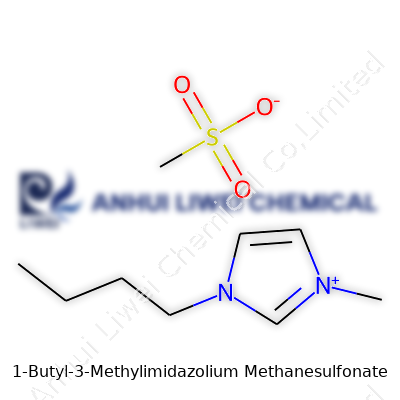
Today, BMIM MeSO3 looks unassuming: a colorless to pale yellow liquid, sometimes appearing slightly viscous, with a faint odor that signals purity. This isn’t some off-the-shelf solvent you can pick up at any hardware store. BMIM MeSO3's makeup—based on the 1-butyl-3-methylimidazolium cation and the methanesulfonate anion—gives it a unique profile. The butyl group gives it more hydrophobic character than many short-chain analogues, balancing solubility and chemical durability. There’s something almost poetic about a liquid that behaves while dissolving both salts and organics, thriving at room temperature, and avoiding volatility.
Physical and Chemical Realities
BMIM MeSO3 falls in line with what you’d expect from an ionic liquid, with a melting point well below 100°C, often sitting comfortably as a liquid at room temperature. Density readings hover close to 1.2 g/cm³, which means it pours a bit heavier than water. It refuses to boil away at common reaction conditions, thanks to a negligible vapor pressure. High thermal stability, with reported breakdown temps well above 250°C, opens up wide operational windows. Solubility shines brightest—BMIM MeSO3 loves water, mixes with alcohols, and doesn’t shy away from polar organics. Electrochemical windows extend over 4 volts, letting this ionic liquid shine in electrochemical processes. It’s fair to say BMIM MeSO3 breaks the mold set by classical solvents, straddling the line between ‘green’ and ‘pragmatic’ with uncommon success.
Technical Specs and Labeling in Real Life
Open a lab-grade bottle labeled BMIM MeSO3 and you’ll see details: CAS 343849-43-6, purity hitting the high 98-99% mark, water content rarely exceeding 1%, acid value controlled tightly, and heavy metals checked down to trace levels. Each supplier brings their quirks, but reputable outfits back every milliliter with batch certificates and clear hazard markings. From personal lab work, it’s not just about reading specs—it’s knowing a bottle left open too long absorbs water, degrading your reaction, so there’s real discipline in handling and storage guidelines.
Method of Preparation
Synthesize BMIM MeSO3 starting with a classic alkylation. The process involves methylation of imidazole, then butylation of the N1 position, followed by metathesis with sodium methanesulfonate, driving the reaction in polar aprotic solvents. Filtration takes out the sodium chloride by-product, leaving a yellowish oil, which gets washed and dried under reduced pressure. Efficient purification steps—like activated charcoal treatment and careful rotary evaporation—give a cleaner product with fewer color bodies or halide residues. Working through both bench-scale and larger reactors, success depends not only on skill but also on patience during evaporation and drying, since rushing those steps wrecks product quality.
Chemical Reactions and Modifications
What makes BMIM MeSO3 special is not just its stability, but the way its structure accommodates modification. Chemists often swap out the butyl group, lengthen chain lengths, or tweak the anion to tune properties for custom jobs—think higher polarity for one process, better hydrophobicity for another. BMIM MeSO3 stands up in alkylation, nucleophilic substitutions, and transition metal catalysis. It acts as a handy medium for metal complexations, organocatalysis, and increasingly in biocatalytic systems, thanks to its low volatility and non-flammability. Its non-coordinating anion keeps it inert for high-precision syntheses—something every organic chemist can appreciate, especially when moving tricky substrates.
Alternative Names in the Marketplace
BMIM MeSO3 goes by several synonyms, which sometimes leads to confusion. Commercial catalogs might list it as 1-butyl-3-methylimidazolium methylsulfonate, Bmim methanesulfonate, or under trade names reflecting the supplier’s branding. Some chemical brokers drop the ‘1-’ prefix, but the chemistry points back to the same core structure. Before ordering or referencing literature, double-checking these names and CAS numbers can save plenty of headaches and mix-ups. Colleagues often share stories of ordering the ‘right’ product, only to receive a close cousin with very different properties—learning to cross-reference synonyms matters.
Handling and Safety in the Real World
Working with BMIM MeSO3 means skipping some worries common with volatile solvents—no explosive fumes, and only mild odor—but it’s hardly risk-free. Skin contact leaves a slimy sensation, and occasional dermatitis crops up after frequent exposure, based on old habits of skipping gloves. Splashes in the eye sting hard. Ventilated hoods and nitrile gloves aren’t just protocol; they’re necessary. Material safety data sheets warn about ingestion and chronic exposure, and spills still demand careful cleanup. Storage in sealed, amber bottles away from high humidity helps, as water uptake alters its behavior. Anyone who has ever fumbled a bottle knows repair isn’t fun—contaminants turn reactions sour too quickly.
Application Areas With Real Impact
Transition to BMIM MeSO3 has affected several industries. It gets frequent use in cellulose dissolution, making biopolymer processing gentler on the environment. BMIM MeSO3 enters the realm of electrochemical devices—batteries, capacitors, fuel cells—where it performs well as an ionic conductor and electrolyte. Pharmaceutical labs use it for selective extractions, leveraging its solubility tricks, and green chemists often swap out classic reagents for this friendly alternative. Chemical engineers find a role for BMIM MeSO3 in separating compounds: from aromatics in petroleomics to chiral separations in bench chemistry. Practical experience shows cost and recovery still drive adoption decisions, where users recover solvent from product with rotary evaporators or distillation, keeping expenses under control.
Push for Development and Cutting-Edge Research
Nothing in science stands still, and BMIM MeSO3 surfaces often in research journals. Research groups across Europe and Asia have pushed the boundaries in catalysis, showing BMIM MeSO3 can enhance selectivity or enable reactions impossible in classic solvents. Material scientists embed it within polymers for conductive materials, or mix it with nanoparticles to make functional fluids. Academic labs search for more efficient synthesis routes, lower-cost feedstocks, and environmentally benign alternatives as regulatory scrutiny grows. These projects often inspire researchers like myself to test BMIM-based systems outside their ‘approved’ scope, discovering small wins—like faster dissolution times or improved yields in multi-step syntheses.
Real Talk on Toxicity and Environmental Effects
Despite its label as ‘green,’ BMIM MeSO3 carries environmental baggage. Toxicity tests show modest risks to aquatic life, with EC50 values sometimes lower than expected for such a modern solvent. Chronic exposure can affect reproduction in invertebrates, while soil bacteria show reduced activity under high concentrations. Workers in the field hear different stories—some claim no problems after years of lab work, while others point to allergic reactions and skin issues. The compound doesn’t evaporate easily, so air emissions stay low, but improper disposal leads to long-term contamination in water and soil. Calls for recycling and careful waste management have grown stronger as data accumulates, and companies must take these warnings seriously.
Where Things Could Go Next
Looking ahead, BMIM MeSO3 will likely gain ground in large-scale green manufacturing if costs keep dropping. Watching the field, it’s clear this ionic liquid won’t solve every process problem, but it’s spurred a rethink in solvent design. Researchers press for less toxic analogues, faster biodegradation, and energy-efficient recycling methods. Tech companies mix BMIM MeSO3 with deep eutectic solvents to craft tailored properties, inching toward true sustainability. If regulatory agencies continue tightening environmental standards, technical staff and R&D departments will race to innovate or retool. Those working on the ground see the change as slow, but relentless—everyone pushes for a better alternative, though BMIM MeSO3 still stands as a better option in many cases than classic solvents. The challenge stays the same: balance safety, cost, and performance, while eyeing the environmental ledger with each project.
A Closer Look at This Chemical’s Supporting Role
Picture a lab—flasks lined up, researchers hunting for new ways to make things greener and faster. One bottle carries a name that takes a while to say: 1-Butyl-3-Methylimidazolium Methanesulfonate. It’s not just another confusing chemical on a dusty shelf. Lately, this ionic liquid has picked up attention in science because of what it brings to the table, especially in fields fighting to go beyond old-school solvents.
Green Chemistry’s Friend
People toss around the term “green chemistry,” but it’s only real when a lab ditches something toxic for something less harsh. This is a job for ionic liquids like 1-Butyl-3-Methylimidazolium Methanesulfonate. Unlike oily solvents that fill the air with fumes, this liquid hardly evaporates. Without that constant loss to the air, accidents drop and so does the headache that comes from fumes. It’s one move toward cleaning up how science gets done. Many chemists see this compound as a keystone for more sustainable synthesis and manufacturing.
The Push for Cleaner Solutions
Solvents often get overlooked, but they leave a big mark on the planet. They show up in everything from drug making to battery research. In my graduate days, every big reaction meant hunting for a solvent that gave good results without wrecking your nose or the drain—almost always a compromise. Ionic liquids like this one stood out because they let reactions run at lower temperatures and pressures, so energy and money stay in your pocket. They won't catch fire easily, and that takes away some major risks that haunt industrial settings.
Changing the Game in the Lab and Industry
This compound acts as a direct replacement in cases where traditional chemicals keep causing headaches. It's used as a reaction medium in the lab, helping mix chemicals that wouldn't normally get along. I remember working on a project trying to separate some stubborn organic molecules. We hit a wall using regular options. When we poured in a small dose of 1-Butyl-3-Methylimidazolium Methanesulfonate, suddenly layers vanished, and the process sped up. For pharmaceutical companies trying to avoid waste, or battery makers squeezing out every bit of performance, this can mean more profit and less environmental guilt.
Bigger Promise—and Some Drawbacks
It’s not a perfect answer. The cost for making pure ionic liquids is still higher than the usual suspects. Getting rid of them at the end of a process demands care because even “green” chemicals become a mess if dumped thoughtlessly. But as more manufacturers invest and production scales up, the hope is prices drop and recycling gets easier.
A Part of the Next Wave
Innovation usually starts with small steps, and swapping out harmful solvents for something smarter makes a real difference. The real promise comes from how adaptable these liquids turn out to be—shaping future research in making everything from plastics to cleaner fuels. It isn’t just a trend science can brag about; it feels like a shift everyone invested in a healthier, safer industry wants to see stick.
Looking Up Close at This Ionic Liquid
In the field of ionic liquids, 1-Butyl-3-Methylimidazolium Methanesulfonate (BMIM MeSO3) grabs attention for its stable nature and approachable handling. Many folks hear “ionic liquid” and instantly picture white coats and lab hoods, but this compound actually reshapes chemistry and industry far from intimidating. Talking about it means going past just charts and chemical equations; its properties actually have bite and real-world impact.
Physical Features Make Working Safer and Easier
Much of chemistry gets bogged down in hazards, but BMIM MeSO3 offers one step toward safer practice. At room temperature, it shows up as a colorless or faintly yellowish liquid. The absence of a strong odor makes it friendlier on the nose. Accidental spills don’t send harsh fumes wafting; you don’t catch a headache from just being nearby. This character comes from its negligible vapor pressure—a fancy way of saying it stays put. Volatile organic solvents often mean flammable vapors and fire codes, yet BMIM MeSO3 works without posing the same risks. Its melting point sits below freezing, staying liquid in most offices even without much temperature control.
It dissolves in water with little fuss. In fact, it blends well in a range of polar solvents, broadening the toolbox for folks tackling separation, catalysis, or extraction. High thermal stability also means it doesn’t break down until you really crank up the heat, so setups working above 200°C won’t see it evaporating or reacting away.
Chemical Behavior Opens Doors for Innovation
Chemists appreciate BMIM MeSO3 because of its ions. The cation—1-butyl-3-methylimidazolium—pairs with the methanesulfonate anion to make a combination that both resists breaking apart and doesn’t grab onto water the way some salts do. Hydrolysis isn’t much of an issue here. That stability gives it a long shelf life and lets it keep doing its job after months in storage, saving money and cutting back on chemical waste.
Researchers keep finding that BMIM MeSO3 nudges reactions in unique directions. Its polarity suits tasks that stump regular solvents, including dissolving cellulose, extracting rare metals, or improving yields for tricky organic syntheses. Its inertness means enzymes stay alive and working longer during biocatalysis—a quality needed in green chemistry as industries hunt for cleaner processes.
Why It Matters: From Green Chemistry to Everyday Uses
The world faces piles of waste and pollution whenever common solvents run through manufacturing. BMIM MeSO3 doesn’t evaporate into the air or contaminate waterways, so users can reclaim and reuse it instead of treating it as disposable. Its use cuts back on greenhouse gases tied to volatile solvents. I remember home lab days, blowing fans and wearing masks, just to keep the air clear. Properly handled, BMIM MeSO3 reduced those headaches—literally and legally—since it meets with stricter regulations for air quality and worker safety.
Cost and availability sometimes slow adoption, but many see it as an investment. Universities pilot test it for extracting biofuels from algae or developing safer batteries. Companies already shift toward these ionic liquids for pharmaceutical production and recycling electronics, where safety and efficiency take priority.
For folks outside the lab, it’s worth knowing some progress hides behind invisible liquids like BMIM MeSO3. Its physical and chemical properties mean fewer health risks, longer-lasting performance, and a solid handhold on cleaner technology. That counts for chemistry class, and for the next generation of safer, more sustainable production.
What This Chemical Does in Real Life
Working in a chemistry lab exposes you to all sorts of synthetic compounds. Among them, 1-Butyl-3-methylimidazolium methanesulfonate stands out. It’s a type of ionic liquid, often used to dissolve cellulose, catalyze organic reactions, or as an electrolyte in batteries. Scientists gravitate to it because it does not evaporate easily and can replace volatile organic solvents. That alone draws plenty of interest from industries that care about greener processes.
Toxicity and Human Health: Facts, Not Hype
Most people hear “imidazolium” and get nervous. Some ionic liquids do raise red flags on toxicity, yet this specific one shows moderate toxicity, especially compared to old-school industrial solvents. Recent peer-reviewed studies show that direct skin or eye contact can irritate. Swallowing it or breathing dust during processing also poses risks, just like with most chemicals that have complex organic rings. Lab animals exposed to high concentrations faced trouble with liver and kidney function, but those are doses rarely seen in typical use cases.
The European Chemicals Agency lists the chemical as “not acutely toxic” in small exposures. Workers who handle it regularly still wear gloves, goggles, and lab coats, using fume hoods for extra safety. Anyone who cares about long-term exposure wants to ask: does it pile up in our bodies? Studies suggest the body breaks down and excretes it fairly well, with no sign of it building up in major organs. Researchers still caution anyone to avoid regular, high-dose handling without solid protection.
Environmental Perspective
Green chemistry gave ionic liquids a strong reputation, but that’s not a free pass. 1-Butyl-3-methylimidazolium methanesulfonate does not evaporate into the air the way solvents like benzene do. That’s positive, since it does not pollute indoor air quickly. Still, once it gets into waterways, some studies reveal it might stress aquatic life. The compound breaks down slowly in rivers or ponds. Microbes struggle to digest it, so it stays around longer than biodegradable alternatives. One research project reported that certain freshwater algae and fish suffered from growth issues with high levels, though concentrations used in real labs look much lower.
Disposal practices in industry matter here. Labs usually burn off waste or send it to controlled chemical processing, keeping it out of lakes and streams. Some companies explore ways to re-use or recycle spent ionic liquids instead of dumping them after a single process.
Better Practices and Where We Can Do More
At college, safety trainers drilled into us the habit of not trusting any “greener” chemical without a material safety data sheet in hand. The label “non-volatile” can hide dangers if folks get careless. Proper storage stops accidental spills. Running solvent recycling units on-site limits how much ionic liquid enters waste streams. Regular blood and urine screenings for anyone around significant amounts provide peace of mind that chronic exposure does not sneak up on staff.
Chemical makers and users push for more testing—especially on long-term effects in the environment and on workers’ health. Community awareness goes a long way in making sure companies follow strict guidelines. Regulators push companies to publish up-to-date safety and disposal data, which empowers everyone from lab techs to wastewater managers to make smart decisions.
Understanding the Material
I’ve spent enough years working around chemicals to know that ignoring good storage and handling can turn something ordinary into a big problem. 1-Butyl-3-methylimidazolium methanesulfonate, an ionic liquid often used in labs and industry for its solvency and thermal stability, falls squarely in the “treat with respect” category. It doesn’t come with strong odors or wild reactions, but that’s exactly when people get sloppy. Problems start small, then build up.
Key Storage Practices
I learned early in my career to keep these liquids away from light and moisture. Moisture creeping in means you risk slow hydrolysis or contamination, especially since this compound has a tendency to pull water from the air. A tight, sealed container made of glass or high-grade plastic shields it from ambient air. I’ve seen folks use ordinary screw-top bottles and wind up with ruined batches — the humidity sneaks in and then the work goes down the drain. A desiccator, packed with silica gel, makes a world of difference for longer storage — it’s a simple fix that saves effort and money. Direct sunlight also causes compounds like this to break down over time. A cool, dark, dry cabinet remains the safest bet, usually at room temperature, unless the manufacturer says otherwise.
Safe Handling Steps
I always reach for gloves and safety specs working with any ionic liquid, and this one’s no exception. Some people ignore lab coats for these chemicals, thinking “it doesn’t look dangerous,” but splash protection takes seconds and can save hours of discomfort. In my own lab work, accidental splashes, even with low-toxicity chemicals, have ruined shirts and prompted first aid runs. For this liquid, nitrile gloves work well, since latex can swell or degrade if it’s exposed for too long. If the liquid gets on skin, washing up fast with soap and water does the trick, though avoiding contact beats dealing with it later.
Ventilation and Spills
Poor ventilation creates headaches in the workplace, literally and figuratively. Even if this ionic liquid doesn’t bite at your sinuses like old solvents, it makes sense to handle it under a fume hood or at least near a vent. This keeps stray fumes or aerosols away from faces and lungs. If a spill happens, you want absorbent pads close by. Scooping with paper towels might spread the mess, so I keep chemical-resistant wipes dedicated for the job. Bag up anything used in cleanup and toss it into the proper waste bin — no drains, no sinks.
Taking Inventory and Labeling Seriously
Unmarked bottles cause confusion and lead to dangerous mix-ups. Permanent marker fades less than printed labels, and I make it a habit to write the date received and opened. I tally up containers every quarter, and set aside any that look cloudy, smell odd, or sit near their shelf life — that small routine helps catch problems before they leave the storage cabinet. Documentation not only keeps people honest, but also gives you peace of mind. Regulatory agencies look favorably on labs that demonstrate control and organization, based on reports of chemical safety incidents. Even for a substance that seems safe, these habits keep people and products protected.
Building Reliable Habits
From experience, the best labs and shops don’t just invest in equipment — they teach good habits and encourage everyone to speak up about storage or handling. If a container cracks or a seal weakens, reporting it right away prevents bigger headaches down the line. Investing in periodic safety reviews, providing easy access to up-to-date material safety data sheets, and making sure everyone has routine training all add up to a safer, more productive workplace. I’ve seen minor lapses spiral because no one wanted to be “the complainer.” Real professionalism comes from caring enough to get the basics right with every bottle and every task.
Understanding Why Solubility Matters
Anyone who’s mixed substances in a lab knows how the question of solubility can make or break a day, especially with ionic liquids like 1-butyl-3-methylimidazolium methanesulfonate. The growing use of these compounds in green chemistry and specialty applications means you can’t ignore their behavior in various environments. Solubility ties right into their impact on reaction rates, separations, and even how hazardous waste gets handled in a facility. Every chemist wants something that dissolves cleanly, works with diverse solvents, and doesn’t bring headaches at the bench or in scale-up.
Water Solubility: Easy Mix, Big Implications
This ionic liquid stands out for its strong affinity for water. In real-world terms, that means it dissolves rapidly even at room temperature. In my experience, there’s no struggle getting this salt into solution—a plus for those setting up reactions or performing extractions. The methanesulfonate anion and the bulky imidazolium cation both like water, and you get a clear, uniform solution fast. Studies back this up: its water solubility easily passes the 50 g/L mark, which beats many classic salts and rivals other popular ionic liquids. In practice, this can save time, lower the energy bill, and reduce the risk of undissolved residues fouling up glassware or interfering with analysis.
Organic Solvents: Compatibility Depends on Polarity
The story changes when organic solvents come into play. You won’t see it dissolve in nonpolar solvents like hexane or toluene—nothing but a stubborn residue remains at the bottom. This comes from the strong ionic structure, which just doesn’t mingle with nonpolar molecules. Moving up to moderately polar solvents like dichloromethane or ethyl acetate, it shows minimal solubility. The real action comes with polar organics: methanol and ethanol take up the salt fairly well, though not at the same level as water. Acetonitrile handles it decently, which opens doors in electrochemical setups and analytical work, but not everyone wants to deal with acetonitrile’s toxicity on a daily basis.
The pattern is clear—if you choose a solvent that can form hydrogen bonds or supports ionic interactions, you’ll see practical solubility. Try to force this ionic liquid into anything too apolar, and you wind up wasting material.
Why the Details Matter Every Day
Real labs don’t have time for workarounds when stock solutions won’t dissolve. With 1-butyl-3-methylimidazolium methanesulfonate, teams working in biomass processing or battery research often use water as their main solvent. You get a safe, effective medium with few surprises in daily operation. But switching to an organic extraction might mean you’re out of luck—limiting some advanced separations or certain catalyst recyclings to just the most polar solvents.
The take-home message brings everything down to planning. Knowing the solubility profile of 1-butyl-3-methylimidazolium methanesulfonate adds flexibility. Use water for easy prep and cleanup, or polar organics for specialty syntheses. Factoring in this information from the beginning can prevent scale-up delays, cut down on chemical waste, and keep both budgets and people safer in the long run.
Facing Solubility Challenges with Solutions That Work
In cases where the right solvent isn’t available, consider modifying your workflow. Techniques like using co-solvents, gentle heating, or ultrasound can help nudge a reluctant solid into solution. Some labs tweak ionic liquid formulations, swapping out the anion or cation to adjust compatibility, though that slows down most research cycles. The simple truth: matching solvent to task saves headaches and keeps chemistries running smoothly.
Anyone designing greener, more efficient systems will continue to look for ionic liquids that blend reliable water solubility with wider compatibility. Clear data and practical experience remove a lot of the headaches from selecting or swapping out materials—and makes real advances possible in both sustainable chemistry and everyday lab work.