1-Butyl-3-Methylimidazolium Tosylate: A Commentary
Historical Development
Chemistry trails its origins in curiosity, in trying to make things work better or faster. 1-Butyl-3-Methylimidazolium Tosylate (BMIM Tosylate) follows this pattern of evolution. Back in the late 20th century, scientists started looking at ionic liquids—salts that turn liquid at room temperature. Traditional solvents like benzene and chloroform brought environmental headaches and lab mishaps, so researchers sought safer options. As work progressed, BMIM cations paired with different anions kept offering promise, and the tosylate anion paired up to form a liquid stable enough for industrial and laboratory work. This specific combination started appearing in patents and research journals as the “greener” path for chemical transformations. One reason for this shift wasn’t just technical curiosity. Regulations kept tightening. Workers demanded safer environments. And chemical manufacturers watched Europe, North America, and Asia roll out stronger laws about toxic emissions or workplace exposure. Scientists, at that point, believed ionic liquids like BMIM Tosylate could usher in a cleaner era for chemistry.
Product Overview
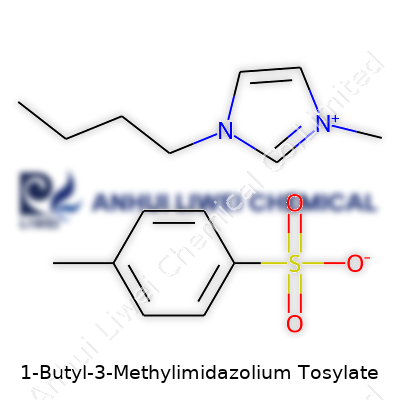
Anyone who has handled BMIM Tosylate knows you’re not dealing with an everyday salt or solvent. Its structure puts together a butyl group, a methyl group, and an imidazolium ring—partnered with p-toluenesulfonate as the counter ion. In practice, it pours more like oil than the crystalline table salt people use at home—a detail that changes the chemistry lab routine. Suppliers across Europe and Asia have commercialized BMIM Tosylate, often targeting it toward specialty chemical markets and academic researchers. In manufacturing, having access to BMIM Tosylate can open doors for reactions that need a non-volatile, non-flammable medium.
Physical & Chemical Properties
BMIM Tosylate stands out because of its low volatility. It doesn’t give off noticeable fumes under standard laboratory temperatures—making it less of a nose-burner compared with classic organic solvents. At room temperature, this ionic liquid has a viscosity higher than water, so it pours slowly and clings to glassware. Its melting point usually sits below 100°C, but the actual value can swing based on how pure the sample is and whether it’s picked up any water from the air. Water absorption matters—a lot—since BMIM Tosylate tends to pull water from humid air, which can throw off precise experiments. Chemists need to keep it capped and stored with desiccants for best results. Its color can look pale yellow to amber. Since it doesn’t readily evaporate, lab benches rarely stink of this compound after a day of synthesis work. As for its solubility, it mixes well with many common organic solvents like ethanol, acetonitrile, or even DMSO, but won't blend well with non-polar solvents like hexane. This range has made it increasingly popular among people tired of “one size fits all” solvents.
Technical Specifications & Labeling
Most chemical catalog listings for BMIM Tosylate spell out the minimum purity—often above 98%. Impurities, water content, and color are closely monitored. Labs have come to rely on these details, since the wrong batch can sink a research campaign. Some suppliers now print QR codes on the packaging, letting buyers access the certificate of analysis from a phone. Storage instructions land front and center. Dry, cool, and away from light—because BMIM Tosylate can slowly degrade or absorb moisture, and this time, the label warnings match real-world experience. Labeling needs clarity, especially with a compound whose misuse doesn’t just cost money but raises safety flags.
Preparation Method
Synthesizing BMIM Tosylate usually starts with the alkylation of 1-methylimidazole, followed by a reaction with butyl halides to introduce the butyl group. The product—1-butyl-3-methylimidazolium halide—then undergoes ion exchange with sodium p-toluenesulfonate, tossing the original halide for the tosylate group. After multiple washing steps to remove leftover starting materials and salts, rotary evaporation strips solvents. Chemists then dry the product—often under vacuum, sometimes over phosphorus pentoxide—to shave off as much water as possible. Home lab kit fans find this route tricky; moisture control and patience separate a usable ionic liquid from a sticky mess. In synthetic practice, the method has matured, and innovation now focuses on using greener or less wasteful routes by reclaiming solvents or swapping the ionic exchange step for other purification tricks.
Chemical Reactions & Modifications
BMIM Tosylate works as both a solvent and an active reaction partner. With polar or biomolecular substrates, it encourages specific phase-transfer reactions. For example, in Friedel-Crafts alkylation or acylation, it can alter product selectivity compared to the classic routes. Researchers have used it for metal-catalyzed couplings, oxidation reactions, and as a stabilizing medium for enzymes. Some groups modify the side chains or swap out the counter-ion (an easy path to new applications or tailored reactivity). The imidazolium cation, especially with longer or branched side chains, tweaks the liquid’s viscosity, polarity, and even toxicity. These chemical knobs make BMIM Tosylate a kind of platform: tunable, with further modification waiting for new problems or manufacturing processes. Modification experiments often aim to produce better extraction profiles for biomolecules or improved electrochemical properties for batteries and supercapacitors.
Synonyms & Product Names
BMIM Tosylate pops up in chemical catalogs under several names. The most common: 1-butyl-3-methylimidazolium p-toluenesulfonate. Other listings feature abbreviations like BMIM OTos or simply BMIM Tos. Some patents and older research use the shorthand [BMIM][Tos]. Keeping these names straight matters—mismatched compounds cause havoc in multi-step syntheses or regulatory filings. Commercial suppliers have developed their own brand names for purity grades, dry or anhydrous forms, and sometimes for pre-packaged blends meant for catalysis or high-throughput screening. Accurate specification on purchase orders prevents expensive setbacks.
Safety & Operational Standards
Hands-on experience with BMIM Tosylate teaches caution, even if it looks benign at first glance. Its low volatility cuts down fire risk, a relief for labs handling solvents like ether or acetone. But the story doesn’t stop at fire codes. BMIM Tosylate can cause skin irritation after repeated or extended contact; some workers report mild burns or rashes if proper gloves are avoided. Splashing into eyes prompts immediate medical care—the standard operating procedures flag this with urgency every time. Disposal becomes another sticking point: ionic liquids don’t fit in general waste streams, and labs collect them as hazardous waste. Most regions require documentation for handling chemicals with limited long-term toxicity data. The chemical safety data sheet advises against inhalation, ingestion, or prolonged skin contact. Lab managers spend time training newcomers because early mistakes—like underestimating cleaning times or skipping gloves—can turn manageable situations into medical emergencies.
Application Area
Industries and researchers grab BMIM Tosylate for a broad set of tasks. Used as a “green solvent,” it replaces hydrocarbons or halogenated media in organic synthesis and catalysis. Pharmaceutical research teams search for solvents that don’t leave tricky residues in drug candidates, making BMIM Tosylate a go-to in certain reactions. Analytical chemists deploy it in extraction processes, pulling out everything from amino acids to pesticides. Battery developers test it as an electrolyte in new generations of lithium-ion and supercapacitors, chasing higher conductivity without toxic emissions. Enzyme stabilization, another strong suit, has led to more robust industrial biocatalysis reactions, especially those requiring heat or unusual pH conditions. Some textile manufacturers now explore BMIM Tosylate as a processing aid for fibers and dyes. This push to shift away from flammable, low-boiling solvents gives organizations a bit of breathing room when managing environmental audits or re-certifying clean manufacturing lines.
Research & Development
Research into BMIM Tosylate exploded in the last decade. Labs in Europe, Asia, and North America ran side-by-side comparisons with more volatile, traditional solvents. Many projects highlighted its ability to dissolve both polar and non-polar substances, something rare in the solvent world. Researchers, often faced with messy results due to water sensitivity, kept working on controlling purity and reproducibility. Stability toward thermal degradation came under the spotlight, especially for scale-up in industry. The “customizable” aspect drove a flurry of papers; change the side chain, gain different solubility or viscosity—making the same backbone a tool for multiple fields. Real progress came from harnessing BMIM Tosylate in metal ion extraction, biomass processing, and proton-conductive membranes. Large-scale industrial tests, particularly in cellulose dissolution and biofuel production, now rely on it. Funding agencies follow this trend, supporting studies that push the boundaries of what ionic liquids can accomplish in sustainable chemistry.
Toxicity Research
Toxicity questions follow any new chemical that finds its way into wider and wider circles. Early optimism about BMIM Tosylate’s “green” image faced hurdles as more data came in. Studies show moderate aquatic toxicity; discharge into waterways causes stress to fish and invertebrates. Repeated skin exposure can trigger allergic reactions or dermatitis in sensitive individuals. The imidazolium ring doesn’t break down quickly in soil or water, posing long-term environmental questions. Labs now test for chronic toxicity, exploring links to enzyme inhibition or endocrine disruption over time. Regulatory groups watch this field closely, cautioning companies to avoid direct releases and to collect and incinerate waste. For now, the chemical presents lower risks than volatile organic solvents, but its full impact remains a research target. Workers adapt by applying strict controls at every preparation, usage, or disposal stage—minimizing personal and environmental exposure.
Future Prospects
Eyes turn toward the future, and BMIM Tosylate offers several new waves for chemistry. Researchers believe its customizable nature could fit next-generation batteries, fuel cells, and bio-refineries. As countries clamp down further on solvent emissions or workplace exposures, companies look for ionic liquids with lower toxicity and higher recyclability. BMIM Tosylate, with its unique structure, stands to benefit from new engineering tricks that reduce manufacturing waste or recycle spent material. Waste valorization—using BMIM Tosylate to extract valuable compounds from what used to be trash—catches attention in the sustainable chemistry community. Attention to toxicity and environmental buildup remains; future work in “greener” ionic liquid design targets even this backbone for safer breakdown and removal. My own experience says the community’s hopes rest on continued improvements in cost, handling, and downstream cleanup. Every new technology, from pharmaceuticals to electronics, seems to find a question that compounds like BMIM Tosylate could answer—if the right balance of performance and responsibility is reached.
What Makes 1-Butyl-3-Methylimidazolium Tosylate Stand Out?
1-Butyl-3-methylimidazolium tosylate, often shortened to BMIM Tosylate, holds a special spot in the world of chemistry because it opens doors that older solvents keep locked shut. As someone who has worked in research labs, I’ve seen first-hand how BMIM Tosylate helps chemists solve problems that once demanded harsh or toxic chemicals. This compound belongs to the family of “ionic liquids,” which are salts that stay liquid even at room temperature. That unique property changes the game for both lab work and industrial applications.
Pushing Green Chemistry Forward
Lab safety hits home with anyone who’s ever spent a few hours breathing in the stench of traditional organic solvents. Replacing toxic or flammable options with BMIM Tosylate dramatically reduces health risks. Unlike common solvents, BMIM Tosylate barely releases vapors. I remember comparing work days between acetone-heavy rooms and labs using ionic liquids—the difference hits your nose and your lungs. This compound lets teams pursue “green chemistry,” which means fewer burns, less irritation, and far less danger from spills or fire.
Making Difficult Reactions Possible
Some organic and inorganic reactions just won’t happen without a perfect setting. BMIM Tosylate offers an environment that supports unusual combinations of reactants or high-temperature synthesis. In my time at a materials science lab, phosphorescent nanoparticles would only form properly in this ionic liquid. Other solvents left us with clumpy powders or incomplete reactions. BMIM Tosylate’s unique mix of chemical stability and ability to dissolve salts or polymers lets researchers push the boundaries of creativity—whether they’re stacking atoms for next-gen batteries or designing drug molecules.
Cleaner Tools for Catalysis
Bottling up a meaningful reaction often means finding the right catalyst and the right solvent. With BMIM Tosylate, both bases and acids dissolve easily, so reactions run smoothly and produce less waste. In industrial settings, this means factories can reduce chemical stockpiles and minimize accidental byproducts. As I noticed in pilot-scale syntheses, mixing metals, organic molecules, and this liquid often creates faster reactions and cleaner yields, trimming costs and landfill loads alike.
Extracting and Separating with Finesse
Many industries pull resources from messy mixtures—think pharmaceuticals, food additives, or rare-earth elements. BMIM Tosylate pulls its weight in extraction and separation processes because it loves to mix with both water and oil-based substances. I’ve watched teams use it to grab precious flavor compounds out of plant material, or tease rare minerals out of electronic waste, with stronger results than water or simple alcohols. Cleaner separations and fewer purification steps mean less water and energy wasted.
Challenges and the Way Forward
No chemical solves every problem. BMIM Tosylate sometimes sticks in products and costs more than older solvents. Its manufacturing footprint and eventual breakdown in the environment need more research, along with plans for safe reuse or disposal. Factories and labs interested in using ionic liquids should work with experts in toxicology and green engineering to address these lingering issues. Working at the intersection of chemistry and safety shows me that progress calls for cooperation across fields—bringing together chemists, engineers, and environmental scientists. BMIM Tosylate shows promise, but wise use and continued study will make its positive effects last.
Understanding the Structure that Shapes Ionic Liquids
1-Butyl-3-methylimidazolium tosylate stands out as one of those ionic liquids you can spot from a mile away, both in labs and in industry. The chemical formula for this compound is C13H20N2O3S. Breaking it down, you’ve got the cation part, which is 1-butyl-3-methylimidazolium (C8H15N2), and the anion, the tosylate or p-toluenesulfonate (C7H7SO3).
In my time working with organic syntheses, ionic liquids like this one made tough reactions a little less of a headache. The combination in this material comes down to swapping the usual halide anion for tosylate, which shakes up solubility, reaction selectivity, and even environmental impact.
Why Ionic Liquids like This Matter
The discovery of room-temperature ionic liquids changed how we think about solvents. Regular organic solvents—your toluene, your hexane—boil away easily and come with a fair amount of safety and disposal worries. 1-Butyl-3-methylimidazolium tosylate stays put at standard lab temperatures, practically odorless, and won’t light up from a stray spark. Studies, including those referenced by the Royal Society of Chemistry, point out their lower volatility and ease of recycling, which cuts down long-term waste. Using these in my own work meant more time on the science and less on cleaning up after.
In applications ranging from catalysis to electrochemical cells, the cation-imidazolium part gives stability and lets the material resist harsh reaction conditions. The tosylate group attracts a lot of interest for the way it can enhance solubility for polar and nonpolar substances. For researchers chasing more sustainable ways of manufacturing, this kind of chemical structure marks a shift toward greener labs.
Concerns and Next Steps
A lot of colleagues still ask about long-term toxicity and bioaccumulation impacts. The sulfur atom in the tosylate does bring up environmental questions, and more real-world studies on breakdown products would help clarify the risks. Right now, disposal recommendations involve regulated waste streams. This means researchers can’t just pour leftovers down the drain, a lesson I learned fast.
Manufacturers, including major chemical suppliers, have started working to develop even more benign versions. There’s an active effort to break down the large-scale synthesis pathways, for instance switching from petroleum-based feedstocks to renewable sources. Some teams, especially in Europe, push for recycling protocols at the industrial scale, where solvents like these can be reclaimed instead of replaced. Policy support for solvent recycling infrastructure could go a long way.
What It Means for Chemistry’s Future
Adopting materials like 1-butyl-3-methylimidazolium tosylate balances technical flexibility and responsibility. From hands-on experience, once a material offers safer handling and tunable properties, the switch becomes hard to ignore. With more openness about safety data and environmental profiles, the move to these kinds of ionic liquids could speed up—nudging chemistry forward with every experiment.
Looking at the Science and Real-World Impact
1-Butyl-3-methylimidazolium tosylate (also called BMIM Tosylate) isn’t just another chemical sitting on a lab shelf. It forms the backbone of a growing movement toward greener chemistry. The question of its water solubility sounds simple, but it ends up shaping decisions in labs and manufacturing plants worldwide.
Understanding BMIM Tosylate
Researchers commonly turn to BMIM Tosylate because it belongs to a family called ionic liquids. These salts stay in liquid form at room temperature, which opens doors for eco-friendlier processes where volatile organic solvents just make a mess. People want ionic liquids like this one for dissolving tough chemicals, extracting metals in mining, or helping to break down biomass for biofuels and bioplastics.
Experiencing Practical Challenges
Getting hands-on with BMIM Tosylate, I found it behaves differently than what pure chemistry textbooks outline. Its solubility in water is moderate. It dissolves fairly well—scientific papers back this up, listing values like 18-24 grams per 100 milliliters at room temperature. I remember how surprised I was the first time I saw clear BMIM Tosylate solutions in the lab after gently stirring. But the nature of this “ionic liquid” tricks you: the longer it sits, the more you notice that mixing doesn’t reach the ease of tossing salt into a glass of water.
Why This Question Matters
Solubility changes everything. If BMIM Tosylate mixed as freely as table salt, you could wash it out of reaction vessels almost without thinking. That’s not always the case. Its moderate solubility creates headaches during recovery and recycling steps in industrial chemistry. Plus, each bit that ends up in wastewater won’t just disappear. Ionic liquids aren’t yet fully understood in terms of their long-term impact on aquatic environments.
I once worked with a research team designing a pilot process for pharmaceutical cleanup. We faced a choice: stick with BMIM Tosylate for its efficiency, or switch to a more water-soluble cousin. In the end, our wastewater treatment system couldn’t recover BMIM Tosylate as well as expected, leaving a puzzle for environmental safety. It’s not enough to ask if something dissolves—you need to know how fast, how completely, and whether it leaves behind exchanges that complicate purifying water for the community.
Opportunity for Better Solutions
Solubility matters if you care about both efficiency and safety. Chemists should keep asking tough questions, like whether using BMIM Tosylate brings more benefits than the risks. Better analytical tools—ion chromatography, mass spectrometry—make it possible to track these ionic liquids at low concentrations in real settings. Encouraging more open data about the environmental footprint of BMIM Tosylate pushes the whole field forward.
Industry teams can support green chemistry by running pilot studies, publishing full solubility curves, and investing in new recovery methods. Water testing at each step of a process matters more than ever; as more companies move toward closed-loop systems, even moderate solubility like BMIM Tosylate’s raises issues worth attention. The research isn’t just about academic curiosity. Every choice made with chemicals like this one plays out in water downstream, and the consequences go far beyond the beaker.
Understanding the Material Matters
1-Butyl-3-Methylimidazolium Tosylate stands out as a useful ionic liquid in research labs. It usually appears as a colorless or light-yellow liquid. Chemicals like this rarely announce their quirks, but over time, those working around them learn what works and what leads to problems. Every material brings its own quirks, and anybody responsible for chemicals knows a bit of caution upfront saves lots of hassle later.
The Right Container Makes All the Difference
In my early days handling chemicals, one clear lesson always resurfaced: use compatible containers. For 1-butyl-3-methylimidazolium tosylate, glass or HDPE bottles support safe, long-term storage. Metal containers work poorly here, as ionic liquids may cause corrosion. Closures matter, too—airtight seals, no compromise. Once, a colleague left a cap loose and came back to a sticky mess collecting dust and debris. Always tighten lids, and choose stoppers wiser than cork or rubber, which may react with contents.
Temperature: Avoiding Trouble
Store at cool, room temperature—roughly 20°C is ideal. Exposing such liquids to heat can speed up unwanted reactions or even decomposition. While it may not catch fire easily, leaving it near a heat source is asking for volatility, literally and figuratively. I've seen chemical fridges packed with everything from reagents to lunches, but this liquid never belongs in the freezer. Freezing risks changing the chemical structure or making it tough to use later. Simply put: keep it cool and steady, away from sunlight, radiators, or windowsills.
Moisture: The Silent Saboteur
Humidity always tries to find a way in. Despite some ionic liquids being praised for ‘high stability’, water slowly sneaks in and ruins purity. In workspaces where pipettes or bottles get left open, contamination pops up fast. One lab I worked at had a strict rule—always recap, label, and tuck away quickly. Storing chemicals in a dry cabinet or desiccator cuts down moisture risk. Those silica gel packs piling up in shoe boxes can serve well here for small containers.
Avoiding Unwanted Interactions
Never park this liquid next to oxidizers, strong acids, or bases. Accidental spills or vapors from reactive neighbors spell disaster. I’ve worked in places where mixing storage of such liquids led to impressive fizzing reactions no one wanted. Segregating incompatible materials on separate shelves or within trays makes cleanup easier and reduces accident chances. Those moments save expenses, injuries, and nerves.
Label and Log Everything
It’s easy to misplace things in a busy lab. Mark bottles clear and bold with the full name, date received, and any expiration. Keeping a simple inventory—the way hardware stores handle nails—helps track stock without fancy software. If sealed and stored right, many ionic liquids keep their properties for years.
Personal and Environmental Safety
Gloves, goggles, and a long-sleeve lab coat create a safe buffer zone. Even small splashes or spills on skin can irritate or go unnoticed until much later. Every spill should get immediate attention—no shortcuts. Waste needs collection in designated containers. Dumping any ionic liquid down the sink not only breaks rules, but passes the problem on to the environment, sewer pipes, and water treatment staff.
Better Storage Means Better Science
Handling 1-butyl-3-methylimidazolium tosylate with the same care as any prized reagent pays off. Relying on sturdy containers, cool and dry storage, and solid labeling practices turns chemical care from a hassle into routine. Science moves fastest in safe, organized spaces.
What Are We Dealing With?
1-Butyl-3-methylimidazolium tosylate, often showing up in labs as [BMIM][OTs], acts as an ionic liquid favored for dissolving cellulose and running green chemistry reactions. Its unique mix of properties makes it shine where traditional solvents fall flat. Scientists love it for its low volatility and clear ability to stay stable under pressure. The story shifts, though, once we look past laboratory benefits and start asking—what about health and environment?
Understanding Toxicity
Many of these fancy-sounding ionic liquids entered research circles on a wave of “environmentally friendly” hype. Lack of fumes and ease of reuse seemed like a dream come true. Yet, my own run-ins with these chemicals convinced me that “green” does not mean “harmless.” BMIM-based compounds, including the tosylate variety, show limited research on long-term effects. Only minutes spent in a chemistry storeroom, sorting bottles labeled “caution,” burned home the reality: always treat the unknown with respect.
Research groups, such as one led by M. Petkovic and colleagues, dug into the toxic profile of many ionic liquids. Their findings show BMIM-based salts can hit aquatic species hard. Water fleas and algae show signs of stress, even at low concentrations. The cation seems to do most of this dirty work, targeting cell membranes and stirring up trouble inside. Long story short: the compound is not the silent bystander it might appear on a shelf.
Human Health Concerns
Handling any ionic liquid, BMIM tosylate included, will expose skin to strong irritants. A spilled drop on gloves often leaves behind a slight itch or redness hours later. Studies in mice, referenced in journals like Chemosphere, suggest oral exposure produces similar digestive upset to common irritants. High doses or repeated contact raise more alarm bells, with some imidazolium salts triggering liver and reproductive problems during extended trials.
Bioaccumulation and Persistence
There’s no easy walk away here. These ionic liquids resist breaking down in water and soil. Tossing out waste thoughtlessly could lead to gradual buildup in groundwater, with unforeseen effects floating downstream. Regulatory bodies in Europe call for more testing, but so far, safety sheets only manage blanks in the “long-term effects” column. Spending years near university stockrooms, I picked up early on that standard lab gloves only keep you so safe; solvents slip through most synthetic barriers if left for hours. It’s common sense, yet easy to forget in practice.
Responsible Use and Alternatives
Safe chemical handling calls for attention and self-accountability. Even promising technology carries risk if routine safety is ignored. Labs should invest in personal protective equipment—nitrile gloves, goggles, well-fitted coats—and use fume hoods during transfers. Disposal must follow hazardous waste pathways each time. Research into bio-based, biodegradable ionic liquids continues, though wide adoption has not come yet. Pioneers making greener solvents must also measure their safety from the start, not as an afterthought.
Labeling something “non-volatile” or “green” makes a nice soundbite, but solid decisions need data and transparency. Until long-term studies confirm low toxicity, proceed as if exposure carries risk. Ask questions, read safety sheets with a skeptical eye, and handle every bottle as if it hides trouble behind a friendly label.