1-Decyl-2,3-Dimethylimidazolium Bromide: Deep Dive Into a Modern Ionic Liquid
Historical Development of Imidazolium-Based Ionic Liquids
Growing up surrounded by chemical engineering textbooks, I saw the story unfold: Imidazolium ionic liquids, which started as mere curiosities in a few academic journals, gained their status in the late 20th century. Chemists were looking for solvents that could do the heavy lifting without the hazards tied to volatile organics. The discovery that these salts could exist as stable liquids at or near room temperature felt like a minor miracle for many of us concerned with both lab safety and greener chemistry. The increased focus on alkyl chain substitutions, such as adding decyl or methyl groups, didn’t arise by chance. Each tweak to the molecule brought new performance perks or opened the door to fresh applications. 1-Decyl-2,3-dimethylimidazolium bromide represents such a tailored approach, where researchers sought to harness longer carbon chains for improved hydrophobicity and target unique solvent properties.
Product Overview
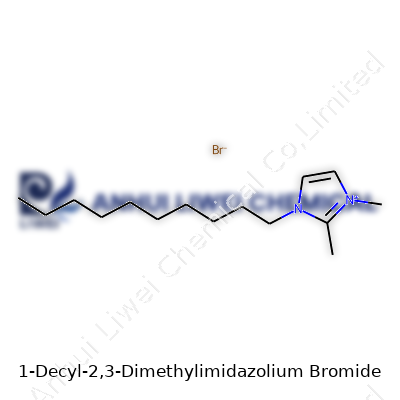
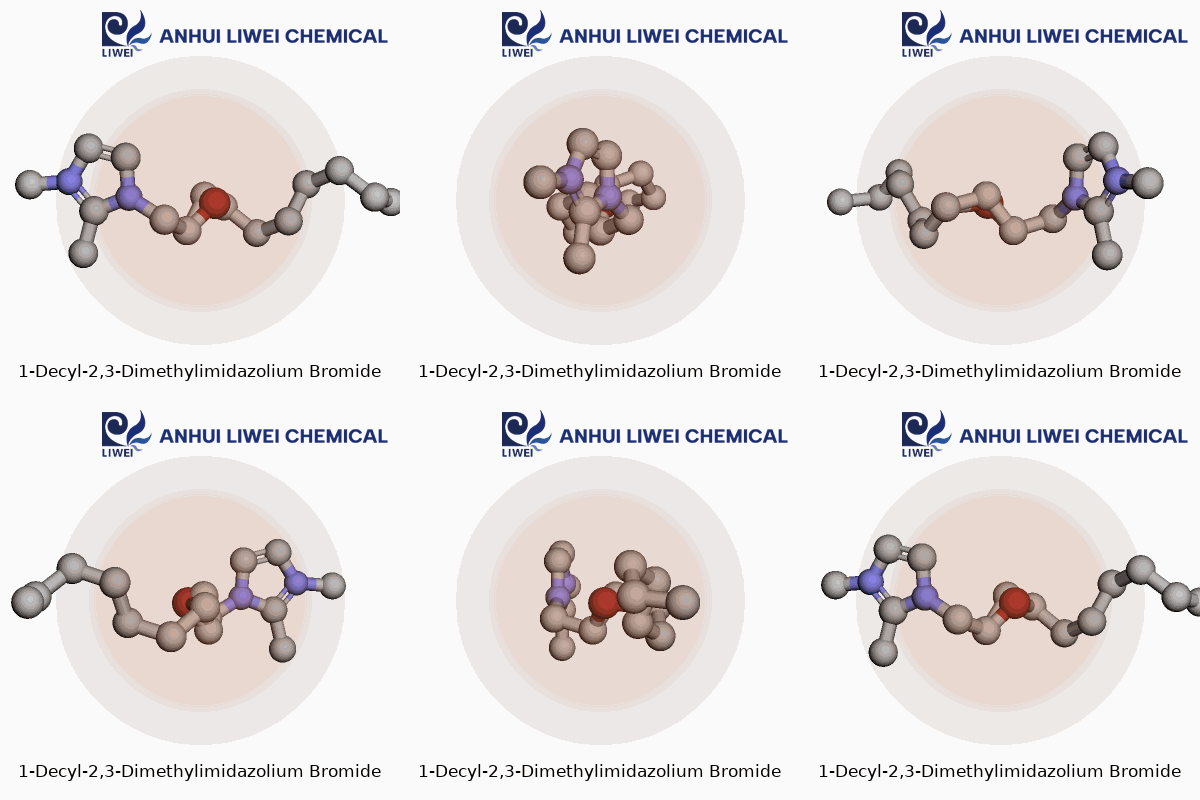
In the lab, 1-decyl-2,3-dimethylimidazolium bromide sits as a colorless to pale yellow viscous liquid or low-melting solid, depending on the temperature. It’s a member of the broader imidazolium ionic liquid family, with a 10-carbon decyl group at the N1 position and two methyl groups at the 2 and 3 positions of the imidazolium ring, counterbalanced by a single bromide anion. This structure drives its solubility profile, thermal stability, and all the downstream benefits associated with using it in research or industry. Unlike conventional solvents, it won’t release hazardous fumes under ambient lab conditions. That alone sets it apart each time I uncap the bottle or run a reaction setup.
Physical and Chemical Properties
1-Decyl-2,3-dimethylimidazolium bromide typically appears as a highly viscous liquid at room temperature, boasting an impressive thermal range. Its melting point hovers near 30°C, and it remains thermally stable up to at least 200°C in the absence of strong oxidizers. The long decyl chain assigns significant hydrophobicity, making this compound partially miscible with water but fully compatible with many organic solvents. The presence of bromide, compared to other anions, enhances solubility for certain substrates without compromising the electrochemical window critical in battery or capacitor research. Conductivity sits lower than shorter alkyl imidazolium analogs, a direct trade-off for the chain’s hydrophobic shielding that blocks ion mobility. Yet, that same hydrophobicity expands its value in liquid-liquid extraction or as a phase-transfer catalyst, which becomes obvious after some hands-on experimentation in the separation of complex mixtures.
Technical Specifications & Labeling
Labeling this ionic liquid, suppliers detail purity (often 98% or higher), water content (typically under 0.5% by Karl Fischer titration), halide levels, and the absence of undesirable impurities (like halogenated aromatics). Spectroscopic data include 1H and 13C NMR, IR, and mass spectrometry confirmation of the main peak. The CAS registry number streams through databases for quick cross-referencing. Bottle labels don’t just show hazard statements—they cover shelf storage instructions, batch number, synthesis lot, and recommended use. A good supplier always traces the journey of that batch, something every responsible chemist double-checks before entering data into a lab notebook.
Preparation Method
Making 1-decyl-2,3-dimethylimidazolium bromide isn’t much more complicated than most imidazolium salts with tailored alkyl groups. The core steps involve starting with 2,3-dimethylimidazole, adding decyl bromide, and carrying out a straightforward nucleophilic substitution. The reaction typically proceeds under reflux in a polar aprotic solvent—acetonitrile works well—until the product separates. Purification includes repeated washing with ethyl acetate followed by vacuum drying to eliminate organic residues. From my experience, the defining factor in reproducible yield sits with the drying step since even trace moisture alters downstream application results, skewing reproducibility and data integrity in later research.
Chemical Reactions and Modifications
1-Decyl-2,3-dimethylimidazolium bromide behaves reliably as a phase-transfer agent and solvent in both nucleophilic and electrophilic reactions. It enables transition metal catalysis, enzymatic transformations, and organic extractions with minimal cross-contamination. Functionalization at the N1, C2, or ring positions opens the door to novel derivatives. Reacting the cation with various anion exchange reagents transforms the bromide portion, switching in bis(trifluoromethylsulfonyl)imide, hexafluorophosphate, or tetrafluoroborate for specialized electrochemical or catalytic tasks. Real-life outcomes hinge on carefully monitored reaction conditions since trace byproducts can ruin downstream work-up, a hard-learned lesson during exploratory R&D projects.
Synonyms and Product Names
This compound may appear in catalogs or publications under related names: 1-decyl-2,3-dimethylimidazolium bromide, [C10C1C1Im]Br, and decylmethylimidazolium bromide—each identifier often reflecting the dominant naming tradition in a regional or industrial sector. Standard identifiers, such as the CAS Number and InChI Key, lock down the identity, letting researchers avoid confusion across inter-lab collaboration or supply chain management.
Safety and Operational Standards
My first real encounter with ionic liquids happened before many in the field had explored their toxicologic profile. Early assumptions labeled them as benign “green solvents,” but the real world rarely fits textbook optimism. 1-Decyl-2,3-dimethylimidazolium bromide doesn’t carry explosive volatility, but accidental skin contact may cause moderate irritation; it’s essential to use gloves and avoid inhalation of aerosols. Ventilation and eye protection rank as essential, not optional, since long-term health effects of chronic exposure to bromide ions or substituted imidazolium systems haven’t been fully mapped. Disposal routes demand thoughtful chemical waste handling, as even substances with low acute toxicity may generate persistent environmental footprints after repeated use and disposal.
Application Areas
Every time I look at where imidazolium ionic liquids find a foothold, versatility stands out. In analytical chemistry, 1-decyl-2,3-dimethylimidazolium bromide dissolves nonpolar samples that traditional solvents leave untouched, perfect for TLC or HPLC advancements. In material science, it provides stable electrolyte matrices in supercapacitors, batteries, and even as antistatic coatings for sensitive surfaces. It’s hard to imagine improved phase transfer catalysis or selective extraction techniques in pharmaceutical analysis without using an ionic liquid of this class. Polymer synthesis, nonaqueous enzymology, and nanomaterial stabilization rely on the unique microenvironment this compound brings, shaping new areas that didn’t exist a generation ago.
Research and Development Efforts
Modern R&D frames 1-decyl-2,3-dimethylimidazolium bromide as a jumping-off point for both applied and fundamental advances. Projects target better conductivity, higher chemical durability, or enhanced solubility for stubborn reactants. Novel catalysts designed around this ionic liquid continue to emerge from labs worldwide, catalyzed by awareness that single-step improvements can unlock industrial cost savings, improved safety, or dramatic energy efficiency. Multidisciplinary teams—chemical engineers, toxicologists, and environmental chemists—lean on the flexibility of this molecular scaffold to solve persistent roadblocks in everything from CO2 capture to fine chemicals separation.
Toxicity Research
Hard numbers matter in the realm of toxicology. The overall toxicity profile for 1-decyl-2,3-dimethylimidazolium bromide remains under active study. Early work lays out moderate aquatic toxicity, prompting caution toward disposal in water systems. The bromide ion, as part of this salt, doesn’t build up in living organisms as organochlorines might, but chronic exposure at high concentrations still strains local ecologies. Mammalian cell line assays indicate low acute impact, but vigilance prevails, stemming from incomplete data on long-term metabolic or reproductive outcomes. Responsible use grows from this research, fueling stricter guidelines across academic, industrial, and government laboratories.
Future Prospects and Potential Solutions
Looking ahead, the future for 1-decyl-2,3-dimethylimidazolium bromide links directly to innovations in renewable energy storage, sustainable separations, and materials design. Sustainable chemistry pushes researchers to modify these ionic liquids for lower environmental persistence or easier degradability, keeping performance high while shrinking the ecological footprint. Proposed solutions include designing new anion combinations or functional group attachments that degrade under controlled conditions outside main application environments—creative chemistry with real-world benefit. Progress on high-throughput toxicological screening, coupled with computational modeling of metabolite breakdown, will provide critical data. This work, fueled by international standards and transparent reporting, strengthens trust and underpins wider adoption across energy, materials, and biotechnology sectors. As research pushes boundaries, hands-on experience and community vigilance serve as the strongest anchors, grounding each big leap in real-world accountability.
Looking into the Chemistry
Understanding chemical structures often feels like solving a puzzle. Taking apart this name—1-Decyl-2,3-Dimethylimidazolium Bromide—unpacks a story of how chemists build specific molecules for targeted applications. This compound's chemical formula stands as C15H31N2Br. The “decyl” tells you there’s a ten-carbon straight chain attached. Dimethyl indicates two extra methyl groups on positions two and three of the imidazole ring. Bromide rounds everything off, serving as the counter ion for the positively charged imidazolium.
Why Does This Matter?
Out of all the compounds lining lab benches, few have changed the way materials science and green chemistry work as much as ionic liquids—compounds like this one. The push for safer, more sustainable solvents drove research toward these salt-like chemicals, which hardly evaporate and often break down more easily than older options. The formula lays out the blueprint, but its relevance stretches further.
Plenty of industrial reactions have used hazardous solvents. Shifting to ionic liquids such as 1-Decyl-2,3-Dimethylimidazolium Bromide brings less pollution and, sometimes, sharper selectivity or higher yields. Labs appreciate that swapping in these chemicals can help control temperature and phase behavior during synthesis. Cleaning up the process isn’t just about green marketing—researchers want real, measured gains against environmental impact.
Real-World Applications Reshape the Question
My own run-ins with ionic liquids came in research that felt both exciting and practical—extracting metals from complex ores, stabilizing enzymes in solution for tricky biochemical processes, or separating hard-to-recycle plastics. C15H31N2Br, like other imidazolium salts, can dissolve metals where nothing else works as well. Adding a decyl chain tweaks its viscosity and solubility to fit slightly different niches.
Researchers searching for new battery electrolytes stumble on these organic salts often. The non-flammability and tunable conductivity open doors for safer, longer-lived batteries. This isn’t theory—it’s real lab data, with safety reports detailing fewer releases of volatile organic compounds and less energy wasted cooling or containing solvents.
What Could Clear the Path Forward?
Playing with chemical structure and making each component greener still needs effort. Toxicity and end-of-life disposal keep surfacing as concerns, even for the most modern ionic liquids. Scientists would do well to develop synthetic routes that avoid harsh reagents and to dig deeper into the long-term breakdown products of these compounds. Regulators and manufacturers have to lean on open data sharing so choices in the lab don’t burden communities down the line.
Supply chains stand to gain from tracking and improving the lifecycle of specialty chemicals. Recyclability and recovery of ionic liquids could shrink costs and help curb waste. It won’t happen with a single formula or overnight fix, but a wider conversation between chemists, engineers, and policy makers can keep pushing toward solutions grounded in real impact, not just novelty.
Closing Thoughts
Knowing the formula C15H31N2Br is only the tip of the story. Every time a new application pops up—whether it’s in extraction, energy, or new materials—the importance of understanding what sits behind a chemical name gets reinforced. Real progress depends on matching structural detail with genuine environmental and social responsibility.
Chemistry in Action: Where 1-Decyl-2,3-Dimethylimidazolium Bromide Steps In
Scientists and engineers lean into 1-Decyl-2,3-Dimethylimidazolium Bromide for good reasons. This ionic liquid brings a unique chemical structure to the party, having both hydrophobic and hydrophilic qualities. That split personality opens up some game-changing options. I’ve watched research teams measure its value through real-world applications, not just theory. This compound shows up often in academic journals and lab notebooks with plenty of confidence behind its uses.
Solvents for Green Chemistry
As labs chase cleaner and safer chemistry, 1-Decyl-2,3-Dimethylimidazolium Bromide stands out for its solvent power. Regular organic solvents struggle with volatility and pollution. This ionic liquid doesn’t evaporate or catch fire easily. Chemical reactions get easier to control, and cleanup isn’t so troublesome. Companies chasing “greener” product lines treat this as a friend. I’ve seen it in tasks like catalytic processes, where traditional solvents would raise more headaches than solutions.
Electrochemistry and Energy Storage
In batteries and capacitors, the hunt for reliable and stable electrolytes leads straight to the doorstep of compounds like this. Energy researchers plug it into devices because of its ionic conductivity, meaning electric currents move through it with little fuss. Overheating or breaking down doesn’t happen as quickly, so the lifespan of the devices improves. In the search for better lithium-ion batteries or supercapacitors, 1-Decyl-2,3-Dimethylimidazolium Bromide often plays a supporting role. In my work with engineering teams, devices powered longer and suffered fewer malfunctions with this inside.
Separation and Extraction
To pull valuable substances from complicated mixtures, industries often wrestle with waste and environmental costs. This compound can help pull specific metals from mined ores, treat wastewater, or refine specialty chemicals. Industrial extraction needs selectivity and efficiency. 1-Decyl-2,3-Dimethylimidazolium Bromide can separate rare earth elements without leaving behind as much toxic residue. That pays off for industries balancing efficiency with regulations. Regulatory bodies demand cleaner processes, and this chemical delivers on that front.
Drug Delivery and Life Sciences
Pharmaceutical researchers eye this compound for more than just its chemical quirks. Its molecular structure lets it wrap around tough substances and ferry them across biological barriers. In my own reading, I’ve seen studies where tricky drugs get solubilized and pushed deeper into cells. That property could make therapies more effective for patients who lose out on treatment options because their medication just can’t reach the target. Medical research and pharmaceutical firms are still working out safety and long-term effects, but progress here looks promising.
Pushing for Safer and More Responsible Use
Excitement around 1-Decyl-2,3-Dimethylimidazolium Bromide can sometimes outpace caution. Safety data matters, both for people working with it and for communities where the compound might end up. Teams need robust protocols and real transparency, so mishandling doesn’t undo the green gains. Regulatory authorities ask for more rigorous toxicology studies, and responsible labs listen. Stronger communication between scientists, manufacturers, and the public can help build trust. Innovation moves fastest when it respects both the environment and the people behind the research.
Understanding Why Solubility Matters
Knowing whether a chemical dissolves in water or organic solvents can make or break a process in research and industry. I’ve crossed paths with ionic liquids like 1-decyl-2,3-dimethylimidazolium bromide in the lab, usually found somewhere between a salt and an oil. Their behavior is quirky, and that starts with their structure. This one, built with a bulky imidazolium head and a long decyl chain, chases down a bromide anion. The tension between these pieces shapes how the chemical interacts with water or organics.
How 1-Decyl-2,3-Dimethylimidazolium Bromide Behaves in Solvents
Water likes things that carry a charge. Imidazolium-based salts play well with water—plan on dissolving, at least if those chains remain on the short side. The twist hits with the decyl group. Over a decade of lab experience confirms this: longer carbon tails push ionic liquids away from water and more toward oil. Adding two methyl groups to the ring gives more bulk, further shielding that charged part, and lowering attraction to water.
Facts back this up. Research published in Green Chemistry and Journal of Chemical & Engineering Data shows solubility sliding down with longer alkyl chains. Similar salts with eight or ten carbons on the imidazolium ring barely dissolve in water. Some reports note a cloudy suspension, not much more.
On the flip side, organic solvents—think dichloromethane, chloroform, toluene—often take up these long-chain salts more easily. The nonpolar decyl chain prefers to nestle amongst the molecules in these solvents. Even ethanol, common in many wet labs, strikes a kind of truce: some solubility, but not as much as in pure hydrocarbons.
Why Chemists Care About This Solubility Question
It goes beyond curiosity. The people formulating catalysts, electrolytes for batteries, extractions for pharma—they have to think about where their ingredients end up. Drop this salt into water, and most see it sink or float rather than disappear. That blocks it from playing a major role in water-based systems. Somebody hoping for a “green” extraction or reaction with this compound loses out on water compatibility, which bumps up the cost and environmental impact by shifting to organics.
Anyone who’s tried to clean glassware stained with this class of salt after an organic synthesis knows what a hassle it becomes—the soap scum of the chemistry world.
Solutions and Smart Alternatives
Some researchers engineer shorter chains to improve water solubility, but that strips away some unique properties, like low volatility or selective partitioning. Tailoring the anion works for certain cases; swapping bromide for chloride or another friendlier counterpart tweaks interactions but doesn’t always move the needle.
From a practical angle, I find that it helps to lean on mixed solvent systems—start with a bit of methanol or acetonitrile and coax the ionic liquid toward the phase you need. For purely water-based work, picking a different cation structure or shaving the chain down avoids tricky surprises partway through a project. Engineers aiming for better solvents might keep tinkering with chain length to strike a balance between process efficiency and environmental cost.
Takeaway from the Lab Bench
Decyl-substituted imidazolium bromide remains a tough customer in water, easier in organics, and that shapes the whole workflow. Researchers keep pushing the boundaries, looking for liquid salts that blend into water without losing their magic. Finding the sweet spot between chemical performance and sustainable practice deserves as much attention as the chemistry itself.
Why Personal Safety Demands Attention
It’s easy to get comfortable in the lab, especially if days start to blur together. Getting too relaxed, though, usually leads right to trouble, especially around chemicals like 1-decyl-2,3-dimethylimidazolium bromide. The scientific promise of these ionic liquids attracts researchers, but the firsthand risks can’t be set aside. Eyes, skin, lungs—each faces threats if someone overlooks simple precautions. Even a seasoned chemist can get caught off guard. Not long ago, I watched a colleague brush away a loose glove and spend a week fighting a lingering rash.
Recognizing Real Hazards
According to recent safety data sheets, contact with this compound often brings skin and eye irritation. Inhalation or swallowing can add nausea, trouble breathing, or worse. If a spill gets on exposed skin, water sometimes isn’t enough. Bromide salts slip past natural defenses in the body, and some studies link prolonged exposure to nerve damage and headaches. Stories from university labs back this up, as folks tend to pick up mild symptoms after getting careless.
Here’s What Basic Protection Looks Like
No need for fancy gear here, just consistent basics—gloves made of nitrile, goggles, and a well-fitted lab coat. Nitrile holds up against most organic droplets, so I swear by them over latex, which breaks down fast. Avoid open-toed shoes. Work behind a chemical fume hood instead of an open bench. This isn’t just for the newbies walking the lab—it’s something I double check even after years in the field.
Never rush to open bottles near your face. Once, while prepping a reaction with a similar imidazolium salt, I got a face full of vapors and lost an afternoon to watery eyes. Keep pipettes and spatulas separate; cross-contamination spreads more quickly than most realize.
Cleaning Spills and Avoiding Accidents
Spills happen. The way a lab handles them changes everything. Dry spills stay put with damp paper towels—never sweep or blow at crystals. Bag everything, label as waste, and wash skin for at least fifteen minutes under running water if anything lands on you. Don’t shortchange this step. Someone I knew once tried to wipe a spill with a dry towel and left a streak across his wrist that lasted for days.
Keep spill kits stocked and chemical waste stored in closed, labeled containers. Never pour leftovers down the drain. Proper disposal protects the environment and prevents buildup in pipes, which is a real headache for facilities.
Ventilation and Storage
Air circulation cuts down exposure. Set up near fume hoods, keep them uncluttered, and check filters. Store this compound in tightly sealed bottles, away from light and moisture. Temperature swings break down some bromide salts, so cool, dry shelves do the trick. In my own space, I mark shelves and post reminders—experience proves people skip steps unless barriers are low.
Building Layered Awareness through Training
Safety training matters. Refresher courses keep the right habits fresh and encourage everyone to report close calls. Peer oversight catches mistakes early. Internal reviews highlight any bad habits before they create emergencies. Look for the latest facts—science shifts quickly, and regulations follow. The best labs back up their policies with real action: shared responsibility, not just another task to check off a list.
Towards Safer Research
The payoff for treating these chemicals with respect becomes clear when seeing entire teams leave a long day healthy. Take handling seriously, build routines around proven safety habits, and everyone benefits. Research becomes safer, more reliable, and much more rewarding. If small adjustments prevent even one accident, that’s time well spent.
Treating 1-Decyl-2,3-Dimethylimidazolium Bromide Like a Valuable Asset
Folks working in labs know that one careless move with storage can knock the wind out of months of effort. I remember a grad school mishap where mislabeled solvents quietly degraded, costing our research time and money. With something like 1-Decyl-2,3-Dimethylimidazolium Bromide, a specialty ionic liquid, you must take storage seriously. This isn’t just fussing—good habits keep your hard-earned money from evaporating or breaking down into useless sludge.
Light, Heat, Moisture: Not Your Friends Here
Direct sunlight can set off chemical reactions you didn’t bargain for. 1-Decyl-2,3-Dimethylimidazolium Bromide fares best in amber glass bottles, far from windows or exposed bulbs. Storing in a standard refrigerator (2–8°C) makes a world of difference—this holds true for many organic chemicals prone to slow decomposition at room temperature. Humidity walks in quietly and bogs things up, especially with salts and ionic liquids. In my own work with similar compounds, keeping desiccant packs next to the bottles became routine. Before sealing up for the weekend, I’d double-check that the container felt dry inside.
Seal the Deal: Why Air and Lid Quality Matter
Air doesn’t just mess with freshness in your cereal at home. Oxygen and water vapor sneak through cheap lids, so always choose containers with airtight seals. Glass wins over plastic every time—less chance of leaching or accidental reactions. Some suppliers ship this bromide in vacuum-sealed vials. If you break the seal, transfer immediately to your own tight-sealing vessel.
Labeling plays a big role too. A permanent date showing the first day the bottle opened and the intended storage conditions keeps others from guessing. I’ve seen teams lose track, only to learn too late that what they’ve been using won’t give them repeatable results.
Practical Steps that Make a Big Difference
Don’t stash chemicals next to acids, peroxides, or solvents that could trigger a reaction if they spill. Assign a fridge shelf or cabinet for similar compounds, and lock it if possible. Each lab member should go through a simple storage checklist: lid tight, light blocked, fresh desiccant inside, and a dated label. Investing a few extra minutes upfront saves confusion later.
Keep your inventory tight. Every couple of months, I used to review all containers for discoloration, leaking, or odd smells. Discard questionable material—a few grams cost less than ruined experiments. Good practice means using online safety data sheets (SDS) and double-checking what the manufacturer says about shelf life and optimal temperature.
Trust in Routine and Backed-Up by Science
1-Decyl-2,3-Dimethylimidazolium Bromide won’t give problems if handled with the respect sharp chemicals demand. Even startups and classrooms can avoid chemical waste and guesswork by building storage logic into the daily routine. Simple steps—cool, dark, dry, sealed—backed by reliable science, lead to reproducible results and long-lived reagents. In the end, stable chemicals mean fewer reruns and stronger, publishable data.