1-Decyl-2,3-Dimethylimidazolium Chloride: A Deep Dive into its Journey, Properties, and Possibilities
Historical Development
Looking back, the interest in ionic liquids like 1-Decyl-2,3-Dimethylimidazolium Chloride did not spring up overnight. For decades, researchers pushed to find safer, more stable alternatives to volatile organic solvents. The push gained steam in the late 1990s as Green Chemistry championed substances that cut environmental and health risks. Chemists in both industry and academia began turning their tools toward customized imidazolium cations paired with halide anions, encouraging innovation. The addition of a decyl chain and two methyl groups to the imidazole core created a compound that separated itself—providing robust thermal properties, low volatility, and tunable solubility. These features allowed scientists to break into solvent systems, advanced material synthesis, and electrochemistry with more confidence than with predecessors that often carried flammability or toxicity baggage.
Product Overview
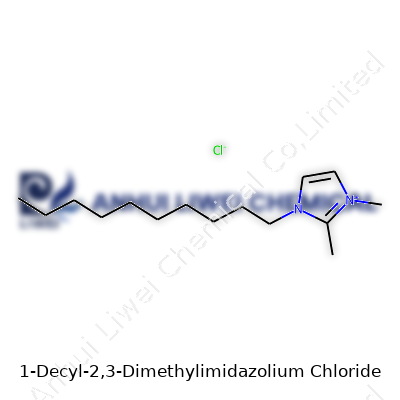
1-Decyl-2,3-Dimethylimidazolium Chloride stands as a room-temperature ionic liquid. The imidazolium ring at its heart links a decyl tail with methyl arms in positions 2 and 3. This specific architecture enhances alkyl chain flexibility and improves the liquid’s ability to dissolve organic and inorganic molecules. Because of these traits, I’ve seen this product offered in labs as a solvent, antistatic agent, or even as a matrix for advanced sensors. Companies in the chemical supply chain use precision instrumentation to confirm purity, since trace moisture or impurities undermine its signature performance.
Physical & Chemical Properties
The liquid state persists at room temperature, making handling straightforward. It demonstrates low vapor pressure—spills rarely fill a room with fumes, which means easier lab work and fewer inhalation hazards. With a melting point generally below 30°C and excellent thermal stability up to a couple hundred degrees Celsius, it survives repeated cycles in applications that call for both heat and cold. Solubility leans toward both organic and aqueous phases, which shows up in extractive and catalytic contexts. Unlike short-chained analogues, its decyl tail grants improved hydrophobicity and surfactant behavior. The ionic liquid nature ensures high electrical conductivity, low flammability, and superior solvation power for a wide range of solutes. In many tests, it resists peroxide formation, something regular solvents can’t claim.
Technical Specifications & Labeling
Vendors provide specification sheets that detail chemical purity—commonly over 97%—along with precise limits for chloride and water content. Physical indicators on bottles identify appearance as clear to pale yellow liquid, with density clocks in near 0.9-1.1 g/cm³. Refractive index, usually checked at 20°C, confirms batch consistency and labeling often includes GHS hazard details. Labels include the IUPAC name, CAS number, and hazard pictograms to alert users. Storage methods emphasize tight sealing, moisture control, and keeping it out of direct light. For larger facilities, drums feature barcodes and QR codes enabling stringent traceability across batches—essential for industry audit standards.
Preparation Method
Production usually starts with the alkylation of imidazole, introducing the decyl chain under basic or catalytic conditions. Subsequent methylation of the ring’s 2 and 3 positions employs methylating agents in the presence of an inert atmosphere, fending off side reactions. After ring-substitution, quaternization with methyl chloride finalizes the chloride anion’s attachment. Modern manufacturers prefer one-pot synthetic routes that streamline waste control and reduce water usage. Final products pass through multiple washes with organic solvents and vacuum drying—processes that industry veterans use to hit tight purity targets time after time. The whole operation, from flask setup to packaging, benefits from automation and strict environmental controls, minimizing human error and cross-contamination.
Chemical Reactions & Modifications
The chemical structure invites functional modification. Researchers swap out the halide for alternative anions to tweak properties like polarity and viscosity. The imidazolium cation tolerates substitutions, opening up the path to designer solvents or catalysts. I’ve witnessed labs attach functional moieties to the decyl tail to create amphiphilic agents for emulsion stabilization. In battery research, scientists look into ligand coordination and redox chemistry. Its resistance to nucleophilic attack lets it serve in harsh reaction environments, and the compound plays a role in extraction systems by selectively binding certain metals—vital in recycling and resource recovery efforts. Academics often use the chloride version as a platform compound in studies on ion transport, phase behavior, and electronic structure.
Synonyms & Product Names
Alongside its formal IUPAC name, chemists recognize titles like [C10m2mim]Cl, Decylmethylmethylimidazolium chloride, and DMMI-Cl. Each supplier might badge it with a catalog number, but these chemical shorthand names appear in academic publications and patents. Brand-specific naming can pop up but rarely strays from this root formula. In regulatory circles, CAS 778759-85-6 leads industry inventories and safety data sheets.
Safety & Operational Standards
Everywhere safety gets top billing, from academic labs to industrial plants. Standard operating procedures start with gloves, goggles, and lab coats. The chemical’s low volatility helps cut inhalation risk, but splash hazards remain. It poses moderate skin and eye irritancy potential; accidental ingestion requires immediate medical evaluation. Spills generally call for absorbent pads and collection for approved solvent disposal. Facilities maintain Material Safety Data Sheets for quick reference, updating them as hazard research advances. Long-term storage in dry, cool places limits degradation and formation of by-products. Fume hoods and closed systems contribute to worker protection, especially during larger scale synthesis and handling. Emergency protocols and spill kits stand close at hand in work areas—an ounce of prevention keeps people and property safe.
Application Area
In electrochemistry, this ionic liquid’s wide electrochemical window provides a platform for batteries, capacitors, and sensors. Synthetic chemistry benefits from its solvation power, especially in metal-catalyzed reactions and peptide synthesis. Environmental engineers harness it for separations—pulling out heavy metals or organic pollutants from water samples. Polymer and material science teams use it to disperse nanoparticles or template new nanostructures. In the world of pharmaceuticals, it sometimes acts as a carrier or stabilizer for problematic drug formulations. The decyl chain’s surfactant properties see use in advanced coatings and inkjet technology. Research continues to break ground in using these structures for CO₂ capture, with potential implications for industrial-scale carbon management.
Research & Development
Research continues at a steady clip. In the last five years, academic journals saw a spike in publications investigating the tuning of alkyl chain lengths and head group substitutions for specialized uses. Industrial R&D teams test new blends in battery electrolytes and look at recyclability after use. Green Chemistry frameworks encourage cradle-to-cradle thinking. Pilot projects explore 1-Decyl-2,3-Dimethylimidazolium Chloride as an extractant for rare earth elements, an area of strategic importance. Startups appear on the scene, chasing custom ionic liquids for bespoke industrial problems—striving for compounds that do the job better and leave less mess behind for future generations. Recognizing these efforts, collaborations between universities and private labs steadily expand application boundaries.
Toxicity Research
Scientists don’t take toxicity questions lightly. Early results suggest low acute toxicity in mammals but highlight varying impacts on aquatic life; the decyl group, in particular, may cause bioaccumulation. Sub-chronic exposure calls for close monitoring, especially in manufacturing settings. Ongoing work in environmental toxicology dives deeply into breakdown pathways, with recent studies emphasizing biodegradable alternatives and strategies to neutralize spent ionic liquid streams. Cytocompatibility and mutagenicity tests run in parallel in the pharmaceutical field, where safe solvent systems must pass strict regulatory hurdles. Data transparency helps to identify gaps and drives improved risk mitigation for all stakeholders.
Future Prospects
Every day, new doors open for advanced ionic liquids. With climate concerns driving change across industries, 1-Decyl-2,3-Dimethylimidazolium Chloride’s ability to bridge traditional chemistry with eco-friendly solutions stands out. Pressure from regulators and end-users alike pushes research toward higher energy density batteries, selective extractions, and safer lab practice—all dependent on robust, versatile solvents. As society pivots to sustainable manufacturing, the need for closed-loop chemical systems grows, and ionic liquids—even ones as specialized as DMMI-Cl—find themselves at the table. Investment continues to flow into pilot plants and specialty chemistry ventures, eager to capitalize on technology that balances performance, safety, and environmental responsibility.
Understanding the Basics
1-Decyl-2,3-dimethylimidazolium chloride often appears in research revolving around ionic liquids. These aren’t the sort of chemicals you see on grocery store shelves, but they play a pivotal role in fields as wide as green chemistry, electrochemistry, separation science, and even material synthesis. They're all about combining performance with environmental safety in industrial and laboratory settings.
Real-World Uses and Importance
I started noticing more scientists turning to ionic liquids like this one as they moved away from traditional solvents. Many conventional solvents evaporate into the air and cause pollution or pose safety risks. That risk sits lower with ionic liquids. 1-Decyl-2,3-dimethylimidazolium chloride stays stable and rarely gives off toxic fumes. Fact is, people working on chemical processes want results with as little headache as possible—both for their health and for regulatory compliance. This compound comes in handy where less flammable, non-volatile alternatives are needed.
In laboratories, 1-Decyl-2,3-dimethylimidazolium chloride helps dissolve a range of compounds, including ones that just won’t budge in water or alcohol. Researchers involved in organic synthesis often choose it as a solvent because it allows chemical reactions to go off with fewer contaminants. In my own experience, swapping old-school solvents for ionic liquids cut down on unpleasant odors and made cleanup much easier.
Energy, Extraction, and Advanced Materials
Work on battery tech depends on stable, conductive materials that don’t degrade quickly. Electrolytes based on ionic liquids are a game-changer in lithium batteries. Chemists lean on compounds like 1-Decyl-2,3-dimethylimidazolium chloride because they combine thermal stability with solid ionic conductivity. This helps devices run longer and safer. No surprise that more research groups tap into this class of chemicals in the race to build better, cheaper, more durable batteries.
On the environmental front, these ionic liquids also find use in extracting metals from ores and recycling electronic waste. For instance, separating rare earth elements or recovering gold calls for selective solvents. Using this class of chemical, extraction becomes more targeted, often with less harm to water and soil. That matters in a world where e-waste piles up fast and old extraction methods leave behind scars.
Looking at the Downsides
Every new solution comes with tradeoffs. Some worry about the long-term toxicity and biodegradability of ionic liquids. Studies point out possible risks if large amounts leak into rivers and lakes. Still, the potential for customization is high. Chemists experiment with different structures to keep performance without piling on the environmental risks.
Where Things Could Go Next
To make sure these chemicals do more good than harm, open discussion is key. Industry players can work with academic labs to boost understanding of toxicity and safe disposal. It’s also worth pushing public investment into research on greener alternatives. Sharing knowledge across sectors helps steer new discoveries in the right direction.
1-Decyl-2,3-dimethylimidazolium chloride isn't on everyone’s radar, but it keeps cropping up in some of the most pressing science and tech projects of our era. Its evolution stands to teach a lot about balancing progress, safety, and sustainability.
What Is 1-Decyl-2,3-Dimethylimidazolium Chloride?
This mouthful of a name belongs to a class of chemicals known as ionic liquids. These compounds show up in labs, often as solvents or support materials for chemical reactions. They promise newer, greener approaches to old-school chemistry. But a fancy label like “green chemistry” doesn’t mean a free pass on safety. Every bottle in a lab—especially unfamiliar ones—deserves respect.
Hazards: Don’t Skip the Small Print
Ionic liquids like this one sometimes get called “benign by design” because they tend to evaporate less and don’t catch fire easily. It’s tempting to cut corners around safety goggles and gloves, since the bottle rarely smells or fumes up the room. But the safety data sheets and toxicological records tell a more cautious story. Studies in recent years show that long-chain ionic liquids are not just bystanders. They can damage cell membranes and disrupt biological systems if mishandled. Skin contact can cause irritation and, in rare cases, allergic reactions. Inhalation risks may seem low at room temp, but spills and splashes are always unpredictable. Accidental exposure builds up over time.
Taking Experience from the Bench
Having spent long mornings pipetting ionic liquids, I’ve learned never to judge safety by appearances. Many of these liquids look and pour like vegetable oil—nothing dramatic, just a slow drip. But I’ve seen one too many colleagues rush, skip gloves, and end up with dermatitis. One friend tried cleaning a sticky spill bare-handed, hoping to save time. That patch of irritated skin cost much more time over the next week. Even “low volatility” doesn’t mean it won’t find a crack in your routine.
Data and Facts: Not All “Green” Means Safe
A paper in the journal Chemosphere in 2019 looked at toxicity in several alkyl-imidazolium salts (the same family as decyl-based versions). The research found measurable effects on fish, bacteria, and human cell models. Even small, repeated exposure matters. Regulations still lag behind, and most products ship with generic hazard icons, not detailed instructions. This gap puts even careful workers at risk.
Good Practices: Keep It Simple, Keep It Safe
Any handling should mean gloves, goggles, and a coat as standard gear. That little effort keeps accidents from snowballing. Work in a fume hood when possible, since spills don’t always behave as expected. If something splashes, wash right away with soap and water. A broken habit: letting glassware “soak” in open air. It’s easy to forget what’s in a beaker from last week.
Cleaning up, don’t cut corners. Wipe spills promptly, and don’t mix unknowns down the drain—the ionic part means these compounds hang around in water supplies. Set aside pipettes and other tools for these chemicals only. Label everything clearly. In our lab, people stopped sharing wash bottles, as cross-contamination just wasn’t worth the headache.
Shifting the Culture
The safest labs grow from straight talk and question-asking, especially about new chemicals like this one. Trust gut instincts when something doesn’t feel right. Leadership matters, too—supervisors who model careful clean-up and post safety posters earn more than grouchy respect; they keep people from getting burned.
Room to Improve
Bigger manufacturers have started developing safer protocols and offering more data in recent years. Still, workers can push suppliers for clearer safety testing. Labs, schools, and factories need better training materials, up-to-date SDSs, and easy ways to share near-miss stories. The best workplace I trained in held five-minute “hazard huddles” before trying new chemicals. A small routine, but it helped.
Why Storage Choices Matter for Ionic Liquids
With 1-Decyl-2,3-Dimethylimidazolium Chloride, storage isn’t just a box-check for some obscure registry. Contamination and unexpected chemical reactions aren’t minor slip-ups—they can turn a valuable sample into a hazmat headache or degrade your research results. Anyone who has spent time in a chemistry lab knows how easily moisture in the air or a poorly cleaned container can ruin a run, making proper storage more than a formality.
This chemical stands out as a member of the ionic liquids family. Because of their low melting points, ionic liquids like this one have almost no vapor pressure. That trait lets them avoid evaporation, but they attract water from the atmosphere like magnets. High humidity turns pure liquid into something unpredictable. Storing them correctly protects both the user and the chemical’s unique properties.
Dry and Inert: The Best Approach
After opening a fresh bottle of 1-Decyl-2,3-Dimethylimidazolium Chloride, rapid changes can begin. Left open too long, water seeps in. Standard lab air rarely falls below 30% humidity. Many researchers keep these ionic liquids in tightly sealed glass bottles, but the trick involves more than a tight cap. Some folks store the sample inside a desiccator, using silica gel or molecular sieves to chase off water vapor.
For extra insurance, some labs use nitrogen or argon to blanket the liquid inside the container. It might sound excessive, but labs that skip this step see faster breakdowns and unreliable results. These are not just best practices passed down from textbooks; they’ve saved real projects from silent failures. When you handle a compound that pulls in water or reacts with common gases, every step matters.
Temperature Control—Not Too Hot, Not Too Cold
Direct sunlight will wreck the shelf life of 1-Decyl-2,3-Dimethylimidazolium Chloride. Many organic and ionic chemicals become unstable or decompose faster when exposed to light and fluctuating temperatures. People working in hot, humid climates learn this lesson quickly; left on a sunny windowsill, the chemical loses purity and utility. Most lab guides recommend a cool, shaded cabinet, ideally between 15°C and 25°C, away from any heat sources.
Home refrigerators tempt those looking for convenience, but the risk of condensation inside a fridge creates more trouble than it solves. Instead, dry, temperature-controlled cabinets set to room temperature prolong the lifetime of this chloride—without the hassle of accidental water buildup.
Labeling and Segregation Keep Labs Safer
Mistaking a clear liquid for a less hazardous chemical could mean disaster in fast-moving workplaces. Up-to-date labels and distinct storage areas cut down on mistakes. I’ve worked in labs where busy days led to unmarked vials, and that’s when spills and unsafe mixes happened. Much of this can be avoided with color-coded racks and routine inventory checks. Even the smallest spill is easier to contain and clean if every researcher knows what’s in each bottle.
Pushing for Better Habits—and Policies
Storage policies sometimes get overlooked in academic and startup labs short on space or funding. But every bad day in the lab traces back to ignored protocols or rushed decisions. By setting up reliable drying stations, reviewing shelves for leaks or broken seals, and involving every team member in safety walkthroughs, labs foster a culture that keeps both science and people safer. Getting storage right for chemicals like 1-Decyl-2,3-Dimethylimidazolium Chloride can make the difference between repeatable experiments and serious setbacks.
Recognizing the Challenge
Chemicals like 1-Decyl-2,3-Dimethylimidazolium Chloride aren’t household names, but they slip into labs, research centers, or even production floors without most people ever thinking twice. This particular compound, an ionic liquid, catches attention in academic papers or specialty industries, mainly for its solvent properties and unique chemistry. The tricky part isn’t just handling it safely—it’s knowing how to get rid of leftovers without harming people, pipes, or the surrounding environment.
Facts and Hazards
I once worked in a university lab where improper disposal gave the drains a chemical burn that cost thousands in repairs. Even a small mistake with an ionic liquid starts a chain reaction, contaminating groundwater or hurting aquatic life. Chloride-based chemicals like this often stay in water, harming local ecosystems. One scientific review from 2022 showed that some imidazolium compounds linger in waste streams much longer than conventional cleaners or salts.
The US Environmental Protection Agency has flagged several similar chemicals for their persistent, bioaccumulative properties. This means organisms soak them up, store them, and can spread the contamination higher up the food chain. Someone with a bucket of waste in the back room might not think much about it, but years later, those choices turn up in water samples or fish tissue studies. Skipping a safe disposal process only kicks the problem further down the road.
Walking Through Practical Solutions
Safer disposal always starts with information. Read the Safety Data Sheet; it rarely offers a miracle step, but it lists what happens if spilled, burned, or dumped down the drain. Most guidelines say to treat any unused 1-Decyl-2,3-Dimethylimidazolium Chloride as hazardous chemical waste. Avoid pouring leftovers into the sink or tossing rags in the regular trash.
The best approach brings in professional help. In my experience, university labs partner with waste management companies that gather, label, and store chemicals in secure containers. Employees learn to seal the liquid in leak-proof jugs or drums with clear hazard symbols. This small up-front step pays off by dodging fines and protecting cleaning staff, who don't expect chemical burns from ordinary trash.
Some facilities try chemical neutralization under expert supervision. This isn’t a DIY project. Creating by-products or releasing toxic fumes team up to cause more headaches than solutions. Real neutralization involves controlled chemistry and protective equipment. Skip the home chemistry kits for this one—let the pros handle it.
Down the road, some industries look for greener alternatives. Chemists keep searching for ionic liquids that break down safely after use. This takes time, and shifting to safer options won’t fix legacy spills. For now, the only smart move is containment and professional disposal.
What Everyone Can Do
Everyone working with specialty chemicals needs training. I remember getting real value from sessions hosted by state regulators—they walked us through local sites for drop-off, gave us checklists, and told stories of chemical mishaps that stuck in my mind. Students, hobbyists, and seasoned researchers should all hear those talks. Companies with responsible disposal habits prevent future cleanup bills and safeguard their neighbors’ water.
It comes down to respect. People treat knives or electricity with care because ignoring risks leads to disaster. Chemical waste like 1-Decyl-2,3-Dimethylimidazolium Chloride isn’t different. With the right information, a storage plan, and a call to experts, people keep the environment and everyone around them safe. No shortcut will fix a corner cut. Reliable solutions come from investing in training and sticking to proven procedures from disposal professionals.
What Makes This Molecule Stand Out
The name might look intimidating, but 1-Decyl-2,3-Dimethylimidazolium chloride has a solid place in modern chemistry. Its structure holds the key to why so many labs and industries pay close attention to ionic liquids. This compound brings together a long-chain hydrocarbon, the imidazole ring, and a chloride anion. Each part of the molecule pulls its weight in making it useful.
Breaking Down the Structure
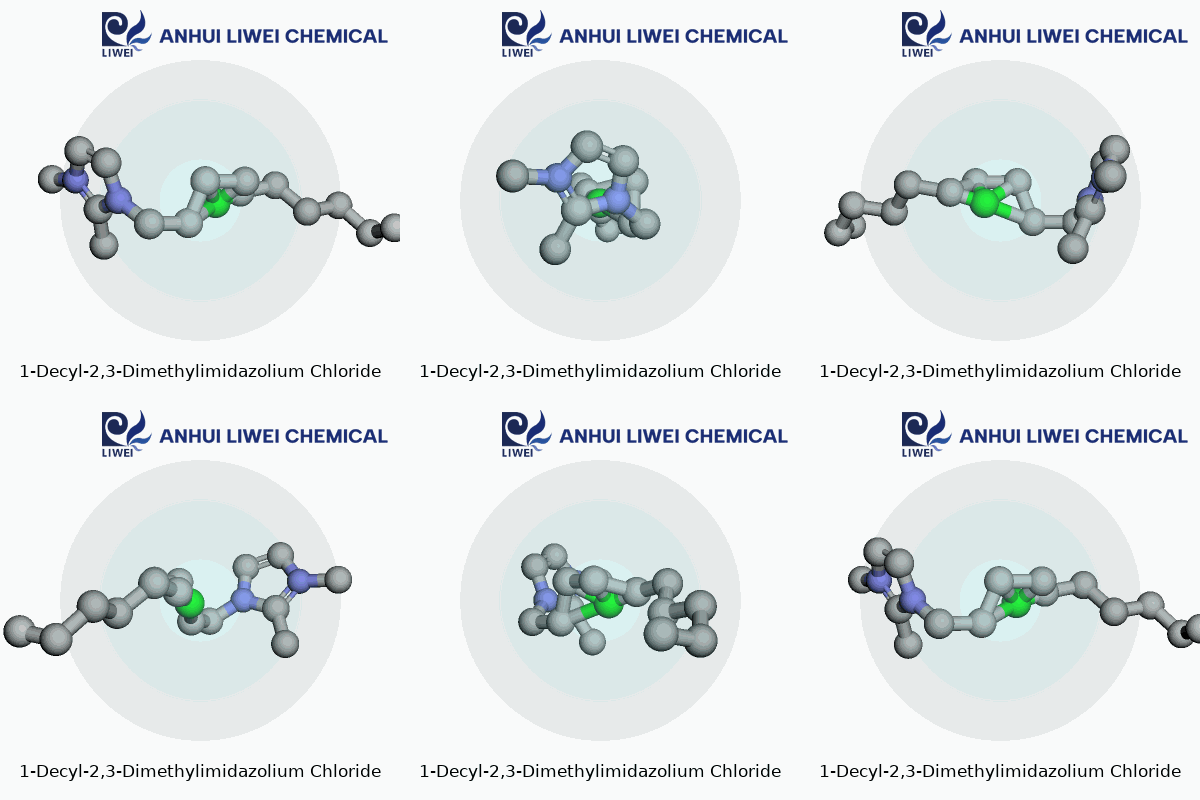
The backbone of this molecule comes from the imidazole ring, which contains two nitrogen atoms and three carbon atoms arranged in a five-membered structure. At the 2nd and 3rd carbon positions, methyl groups attach themselves, bringing extra bulk and tuning the molecule’s properties. A decyl group branches off from the nitrogen at position 1, stretching out a ten-carbon alkyl chain, which delivers hydrophobic character and influences how the molecule dissolves and behaves with other chemicals.
Chloride hangs out as the counterion, balancing the positive charge thrown by the imidazolium cation. The result is a salt, but one that often stays liquid at room temperature. That’s unusual for a salt, and explains why chemists call it an “ionic liquid”. Common table salt only melts at over 800°C. This stuff is runny and ready to use well below that temperature.
What Difference Does This Structure Make?
Attaching a long decyl chain to the imidazolium ring does more than just look fancy on a diagram. It tweaks physical and chemical traits. The chain makes the ionic liquid less polar, less soluble in water, and able to mix with oils better. That opens new doors for applications in separation science, catalysis, and extraction work. With the two methyl groups fixed to the 2 and 3 positions of the ring, these liquids often gain better thermal stability and resistance to breakdown. That lets them stand up to harsher chemical environments without falling apart. I think back to my early lab work, how regular solvents seemed to vanish with a bit of heat. Ionic liquids like this one do not give up so easily.
The chloride ion brings its own contributions. It engages well with a range of solutes, helping to coax metals or other charged species into solution. This means researchers use these liquids to capture rare earth metals, recycle batteries, or clean up industrial waste. Their non-flammability gives extra peace of mind compared to traditional solvents such as ether or acetone.
Environmental and Safety Impact
Some folks see the “chloride” part and get nervous about toxicity and environmental persistence. Ionic liquids vary—some break down faster than others in natural settings. A handful can harm aquatic life if dumped carelessly. There’s a growing push to design greener versions. Researchers search for ionic liquids that break down into safer products, while still delivering the unique performance that comes with structures like 1-decyl-2,3-dimethylimidazolium chloride.
Opportunities and Solutions
Efforts are underway to recycle and reuse these substances, especially in high-value settings. Closed-loop processes capture the liquid, clean it, and feed it back in, trimming down waste. With better analytics and environmental assessments, industry leaders look for trade-offs that avoid just swapping one pollution problem for another.
Learning more about this molecule’s structure opens the doors for chemists, engineers, and environmental scientists. Every time we think through structure, we get closer to safer, smarter, and cleaner technology.