1-Decyl-3-Methylimidazolium Chloride: Deep Dive into a Versatile Ionic Liquid
Historical Development
In the early 1990s, chemists started to look for greener alternatives to classic solvents—something that wouldn’t evaporate as quickly or pose the same safety hazards. Out of this hunt for sustainability came ionic liquids, and before long, 1-Decyl-3-Methylimidazolium Chloride, or [C10mim]Cl, began to show up in academic papers and experimental setups. Pioneers in green chemistry drew up synthetic routes, mapped out the potential of these roughly room-temperature molten salts, and kept refining processes for both lab scale and industrial use. People who first adopted this compound often spoke about the fresh flexibility it offered for dissolving biopolymers, extracting rare earths, or working with stubborn materials. In the years since, its popularity hasn’t waned. The growing body of patents and papers signals a rising acceptance in both research and manufacturing.
Product Overview
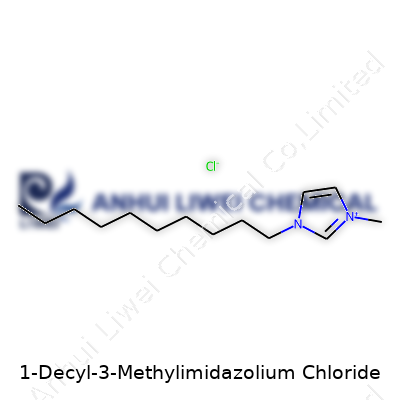
1-Decyl-3-Methylimidazolium Chloride is part of the imidazolium family, a group that’s made a real mark due to their hydrophobic and hydrophilic balance. This specific compound features a ten-carbon chain on its imidazolium core, landing it a place among low-melting-point salts. Suppliers provide it as a viscous liquid or crystalline powder, depending on the storage temperature. Researchers use this salt in everything from cellulose dissolution and catalysis to organic synthesis and electrochemical studies. Unlike generic solvents, it doesn’t disappear into thin air in the lab. Instead, it lingers—making extended reactions possible and reducing waste in the process.
Physical & Chemical Properties
This ionic liquid comes with a molecular weight near 266 g/mol. Its melting point generally sits under 40 °C, but it stays liquid at the temperatures most laboratories work at. Its viscosity is higher than water, which can make stirring and pumping a bit more involved. The compound handles heat well, showing stability far above what aqueous solvents tolerate; decomposition tends to start above 200 °C. In water, 1-Decyl-3-Methylimidazolium Chloride can dissolve but will show strong phase separation if mixed with less polar liquids. Researchers appreciate the flexibility here, especially for applications that require selective extraction or material precipitation. The cation portion brings hydrophobicity, while the chloride makes it mix with polar substances.
Technical Specifications & Labeling
Labels on bottles usually highlight purity, typically reaching or exceeding 98% by HPLC or NMR verification. Color tends to be pale yellow or colorless, and reputable suppliers back their claims with batch-specific certificates of analysis. Odor is generally faint or absent, and the material often ships in vacuum-sealed or nitrogen-flushed containers due to sensitivity to atmospheric water or carbon dioxide. Storage conditions on labels reflect that caution: recommendations include keeping the product away from strong oxidizers, acids, or open air. Those using the compound at scale receive technical data sheets with thermal stability curves and impurity profiles for each lot.
Preparation Method
Making 1-Decyl-3-Methylimidazolium Chloride starts with 1-methylimidazole and decyl chloride, using a classical alkylation reaction. In most protocols, the two react under nitrogen and mild heating—carefully controlling temperature to avoid side products or decomposition. Once combined, purification often relies on crystallization from organic solvents or liquid-liquid extraction to wash out unreacted starting material and inorganic salts. At the end, producers test for halide content and residual solvent, since impurities can change how the compound behaves in sensitive settings. In educational or research labs, small batches can be made with glassware and a stirring hotplate, but safety and ventilation should always take center stage.
Chemical Reactions & Modifications
Beyond acting as a solvent, 1-Decyl-3-Methylimidazolium Chloride can serve as a reactant in metathesis or ion-exchange reactions, often pairing with silver salts or anion-exchange resin to yield new imidazolium salts with tailored properties. Chemists modify the alkyl chain to shift hydrophobicity or tweak the imidazolium ring for better chemical compatibility. Such changes create ionic liquids tailored for catalysis, separation science, or high-performance electrochemical cells. Replacing the chloride with other anions opens the door to compounds with different melting points, viscosities, or solubilities, broadening the toolkit of anyone working to solve tricky separation, extraction, or catalysis challenges.
Synonyms & Product Names
Catalogues and scientific literature list this compound under a handful of names, with [C10mim]Cl often used as shorthand. Other names seen in research: 1-methyl-3-decylimidazolium chloride, Decylmethylimidazolium chloride, and N-decyl-N’-methylimidazolium chloride. Distributors usually group it under imidazolium ionic liquids, so searching with alternate names can unearth studies and data that would be easy to miss. Recognizing synonyms matters, especially for researchers comparing outcomes across journals, patents, and supplier technical sheets.
Safety & Operational Standards
Safety data sheets flag 1-Decyl-3-Methylimidazolium Chloride as an irritant—contact with eyes or prolonged skin exposure can lead to discomfort or inflammation. Inhalation issues arise if fine particles or vapors are allowed to build up, usually seen during improper transfer or accidental spills. Standard PPE includes gloves, lab coats, and chemical splash goggles. Spills tend to be easy to mop up but should be contained and collected without flushing down drains. Companies and universities focus on air quality and ventilation in any space working with this class of ionic liquids, as improper storage will bring product degradation and potential health hazards. Waste disposal follows guidance for non-volatile organic compounds, often involving incineration.
Application Area
The reach of 1-Decyl-3-Methylimidazolium Chloride covers extraction of cellulose from woody biomass—a complicated process without the right solvent. It has a spot in catalysis, helping speed up organic transformations that won’t run efficiently in water or traditional organic solvents. In battery labs, this compound helps stabilize electrolytes in prototypes where thermal stability or wide electrochemical windows give an edge over outdated formulations. Environmental engineers use it in the recovery of metals from e-waste or ores, skipping the need for more damaging chemicals. Biotechnologists tout its ability to dissolve chitin or silk fibroin, often opening up new routes for material processing or enzyme studies.
Research & Development
Recent years brought a steady uptick in studies around biodegradability, recyclability, and toxicity—concerns that echo across the chemical industry. Industrial R&D groups keep tweaking synthesis to cut waste, lower impurities, and recycle spent ionic liquid back into the process. Scientists map out compatibility with a wider range of polymers and experiment with blending to tailor viscosity and solubility for specific needs. There’s an ongoing conversation about how to reclaim, purify, and reuse these solvents, and advances in distillation and membrane filtration add to these efforts. Test labs publish on scaling methods up while maintaining product consistency, all while working to answer sharper regulatory scrutiny.
Toxicity Research
Toxicologists dig deep to figure out where this ionic liquid falls along the spectrum from benign to hazardous. Animal studies and aquatic toxicity reports point out mild to moderate toxicity, with fish and invertebrates showing sensitivity to certain concentrations. Chronic exposure or improper handling can lead to cellular damage or disruption of enzyme function, so safety rules around local containment and controlled discharge have real consequences. Studies highlight the importance of limiting release into water bodies or soil, since breakdown in nature can stretch over months or more. Despite some concerns, many regulators allow controlled industrial use if facilities handle recovery and limit loss to the environment.
Future Prospects
The future for 1-Decyl-3-Methylimidazolium Chloride rides on solving the challenges of recyclability, selective extraction, and wider industrial adoption. The push for sustainable processes creates a strong incentive to swap out old solvents with safer options, and this ionic liquid brings enough unique properties to keep researchers engaged. Large-scale biorefineries look at it as a bridge to cellulose-based materials and biofuels, provided recovery and purification match economic targets. Emerging work may shrink toxicity with new tweaks to the imidazolium ring or chain, making versions that meet strict regulatory hurdles. The next wave of development will hinge on smart control of waste, sharp cost management, and sharper toxicity oversight. Labs and industries willing to invest in better recovery and lower-impact use stand to benefit most as regulations tighten and demand for greener solvents rises.
A Closer Look at This Unusual Chemical
Ask most folks about 1-Decyl-3-Methylimidazolium Chloride and you’ll get a blank stare. In the world of solvents, though, this ionic liquid pulls a surprising amount of weight. Its story sits in the details—how its structure lets it do things that other solvents just can’t manage. With a chunky decyl chain and imidazolium core, it brings both stability and creativity to problem-solving in science and manufacturing.
Green Chemistry Picks Up Steam
Ever tried to clean greasy engine parts or unstick stubborn paints? Growing up working in my uncle’s workshop, I remember the headaches from harsh fumes, skin irritation, and just how wasteful it felt pouring these volatile solvents down the drain. Labs and factories face the same problems. As researchers hunt for better answers, 1-Decyl-3-Methylimidazolium Chloride provides a real shift. Unlike the flammable, stinky organic solvents everyone hates, this one barely evaporates. It lowers fire risk and cuts down hazardous air pollution. The EPA and researchers both keep an eye out for these so-called “green solvents,” and this one grabs attention for dissolving tough compounds—from cellulose to specialty plastics—without leaving a chemical mosh pit behind.
Boosting Efficiency in Industrial Catalysis
Catalysis sounds like a textbook concept, but it controls the price, waste, and output for everything from plastics to medicines. Factories want reactions that finish quickly and produce more usable stuff, using less energy. This ionic liquid steps up here. By dissolving metals and organic molecules the old solvents spit out, it lets parts meet that otherwise couldn’t mingle. For example, it’s helped create new ways to produce biodiesel and pharmaceutical ingredients, nearly doubling yields in some cases compared to old-school solvents. Industry data and scientific publications have highlighted its efficiency since the early 2010s, and companies continue to tinker, looking for that edge.
Pushing Forward in Extraction and Separation
Anyone who’s squeezed lemon juice looking for pure flavor can appreciate why separating and extracting the right stuff matters. In mining, food production, and wastewater cleanup, the pure product means higher profits and safer waste. Traditional solvents miss a lot—they’re picky, expensive to recover, and often flat-out toxic. I’ve seen environmental teams struggle to hit acceptable contamination levels even after multiple tries. Here, 1-Decyl-3-Methylimidazolium Chloride brings selectivity. It grabs hold of heavy metals, dyes, or unwanted chemicals, and lets you pull them from muddy water or industrial byproducts with less fuss. Advanced water treatment labs and even the rare-earth mining sector have reported cleaner separations and easier recycling using this chemical. Less environmental stress, more valuable output.
The Roadblocks and the Fixes
No single chemical solves every challenge. Cost is the first thing that comes up. Right now, 1-Decyl-3-Methylimidazolium Chloride requires careful factory controls during its production. Early adopters in research settings have seen the price fall as more manufacturers enter the field and as recycling protocols get more robust. Next, there’s scaling—some factories stick to tradition, worried about disrupting huge, decades-old recipes. Clearer regulatory guidelines and more robust studies on health and safety will help producers make the switch without risking legal headaches or unexpected accidents.
A Push Toward Cleaner Industry
Every year, labs publish new ways to use this chemical. Cellulose fiber processing grows cleaner. Recycling batteries gets simpler. Biotech teams test it in drug-making and enzyme reactions. As researchers share data and engineers lower costs, it sets a path for broader industry adoption. The story stands clear: in a world craving safer production and cleaner processes, chemicals like 1-Decyl-3-Methylimidazolium Chloride open the door to smarter, more responsible manufacturing—something we all depend on, whether we realize it or not.
Chemistry’s “Green” Push, Real-Life Risks
A decade ago, I started my first research job buzzing with news about new “ionic liquids.” 1-Decyl-3-methylimidazolium chloride turned up on plenty of lists as the next big thing in eco-friendly chemistry. It’s non-volatile and has no strong odors, so people started calling it safe. But safety isn’t just about what you smell or see.
This ionic liquid pops up a lot in labs working on sustainable processes or advanced materials. Some folks treat it like water. It doesn’t evaporate, you barely notice it on your gloves, and most suppliers sell it with a “handle with care” on the bottle, but not a serious hazard label. Still, repeated contact can lead to skin irritation—especially over weeks. I remember seeing some of my colleagues with dry, cracked hands because they skipped the gloves for a day or two.
Diving into Health Data
At first glance, toxicology on this chemical looks thin. Animal studies show that it’s less toxic than traditional organic solvents, such as toluene or benzene. Media coverage sometimes jumps on that point and calls it “safer.” Here’s the catch: less toxic doesn’t mean non-toxic. Cell studies have flagged it for being harmful to aquatic life if it ends up in waterways. It also sticks around in the environment longer than expected. Over time, small doses build up—think of it as the PFAS of ionic liquids.
Accidental splashes rarely cause immediate disaster. Rinsing thoroughly with water deals with most incidents. Inhalation risks run low because this stuff barely vaporizes at room temperature. Still, if you heat it, fumes can appear. These fumes haven’t been fully studied yet; in my view, uncertainty around what happens at higher temperatures deserves respect. We have plenty of examples—from asbestos to formaldehyde—where doubt turned out to mask serious hazards down the line. Just because we don’t see the harm today doesn’t mean it’s not there.
The Importance of Real-Life Precautions
I always keep gloves on while working with chemicals like this, even if it “feels” harmless. Every safety data sheet I’ve checked recommends basic PPE: gloves, goggles, lab coat. Once, after cleaning up a spill by hand, a colleague came down with a rash that stuck around for days. What works for one person may mess up another’s skin barrier. You won’t always see immediate pain or redness. A slow rash or respiratory irritation can sneak up after repeated contact.
Storage and waste matter. Just because the chemical won’t catch fire easily, doesn’t mean you can drop leftovers down the drain. Disposal in tightly sealed containers and transport to chemical waste facilities protect both people and the planet. In the early days, some labs washed it down the sink; local water authorities soon complained about fouled tests downstream.
Better Protocols, Fewer Regrets
Using this ionic liquid safely comes down to common sense and recent scientific research. The occupational limit numbers aren’t widespread yet, so keep exposure as low as you can. Ventilation, PPE, careful cleanup, and never assuming a new chemical is totally safe—that’s how risk drops. Labs and companies must push for more toxicity testing, especially before scaling up new processes. It’s easier to stay healthy and protect our waterways by treating even “greener” chemicals with respect, not as free passes.
What makes a compound stable in the lab?
Experience in chemical research reminds me that stability sets the groundwork for any practical use. Ionic liquids like 1-decyl-3-methylimidazolium chloride show up in a lot of development work. They attract attention because of their low volatility and strong ability to dissolve both organic and inorganic materials. Yet, every chemist knows not to take stability for granted when tuning temperature, humidity, or exposure to air.
Heat, humidity, and the test of time
High temperatures always stress a material. Above 200°C, organic parts in ionic liquids start to break apart, which produces byproducts that complicate cleanup. In the case of 1-decyl-3-methylimidazolium chloride, long alkyl chains and the imidazolium backbone hold strong against moderate heat. I’ve watched samples at 100°C in the lab with barely any color change or odd odor, both of which signal chemical breakdown. In fact, thermogravimetric analysis of this salt confirms its stability up to roughly 180°C. This makes it handy for catalytic applications where gentle heating stays in play. But push it past this threshold, and decomposition accelerates.
Humidity weaves its own challenges. Even in a closed bottle, strong hygroscopicity draws in moisture over time. Exposure to humid air encourages clumping and turns the powder sticky. Once the water gets in, dissolving this salt back to a pure state takes patience and careful drying. Moisture also opens the door for unintended reactions, especially if the ionic liquid sits in contact with Lewis acids or metal halides. Those tiny pockets of water within the liquid’s structure can speed up degradation and spoil the whole batch for reuse.
Oxygen and light exposure—what goes wrong here?
My years running reactions with imidazolium salts tell me oxygen rarely plays the enemy, but watch out for free radicals. Under UV irradiation, these radicals break open the imidazolium ring or cut alkyl chains, producing smaller molecules and occasional gas evolution. In a glass bottle on the shelf, out of direct sunlight, this salt survives for months without changes. Throw in harsh light or oxidative catalysts, though, and stability takes a hard hit.
Solutions for everyday handling
Anyone thinking of using 1-decyl-3-methylimidazolium chloride should treat it like any moisture-sensitive lab material. Store it in tightly sealed glass jars with desiccant pouches. Run purity checks if the salt sits for long stretches, especially if color, odor, or form changes. For scale-up and pilot plant work, boxed storage with low-humidity air and minimized headspace cuts down on both hydrolysis and oxidation risks. Repack under inert gas to further lock out water and oxygen. When cleaning glassware after use, thorough rinsing avoids slow buildup and loss of performance in later experiments.
The practical payoff
Stable ionic liquids like this one hold promise for greener chemistry—less hazardous vapors, low flammability, and the ability to recycle. Only by respecting their true stability range do researchers and manufacturers keep safety and reliability at the top. Every small lab mishap where moisture crept in or overheating went unchecked highlights the value of smart storage and clear operational routines. The more we pay close attention, the better our results and the fewer wasted resources.
Why Storage of Chemical Compounds Matters
Handling chemicals brings daily reminders that safe storage is more than a procedure — it’s a habit that protects not only the product itself but also the people in the lab and beyond. Take 1-Decyl-3-Methylimidazolium Chloride, for example. Anyone who’s used ionic liquids knows they open doors for reactions that wouldn’t otherwise happen, but mishandled storage reduces both yield and safety.
Key Risks with 1-Decyl-3-Methylimidazolium Chloride
Corrosive and moisture-sensitive chemicals often respond poorly to careless storage. I remember once, years ago, a seemingly harmless bottle of imidazolium salt drew moisture from humid lab air overnight, clumping up and complicating measurements the next day. If a chemist breathes in dust or touches a spill unprepared, skin irritation, eye stinging, or even more severe health outcomes come into play. Data from supplier safety sheets and peer-reviewed studies confirm: you can’t afford to ignore basic storage rules.
Practical Steps for Secure Storage
Let’s strip out the jargon and keep this simple. A tightly-sealed container means less chance for the compound to grab water out of the air or leech out toxins. Plastics or glass offer the best choices — no cheap lids or corroding metals. Once, I saw a poorly sealed vessel leak and contaminate a whole shelf. That’s a risk nobody wants.
Store 1-Decyl-3-Methylimidazolium Chloride somewhere dry, away from light, and in a cool spot. No sunlight sitting on bench tops. Sun accelerates decomposition and heat increases vapor risk. Small refrigerators set aside for chemicals can give peace of mind, but never mix food with chemicals. I’ve spotted shared fridges full of coffee creamers and buffer solutions — a clear setup for disaster.
Personal Protective Habits and Emergency Prep
Safety culture doesn’t end at the shelf. Label every bottle with date of opening, and train anyone handling it to understand proper procedure. Spills tempt people to wipe them up fast and ignore the long-term effects. Handy spill kits and protective gloves, not tomorrow but today, limit skin contact and keep reactions contained. Sometimes a quick grab for the right gloves or a dash to the eyewash station saves a trip to the campus nurse.
Waste Management and Compliance
Haywire management of chemicals also becomes a headache for waste disposal. Experienced chemists separate ionic liquids from regular solvents, and any leftover material gets logged for proper collection. Regulators expect you to keep detailed records of how and where chemicals are stored. During audits, gaps in records or sloppy shelves can trigger major consequences — both fines and a halt in research.
Simple Solutions, Big Impact
At the end of the workday, routine checks matter. Lids on tight, bottles clean and dry, correct labeling. Even ten seconds of attention can stop a ruined experiment or a personal injury. As new team members arrive, mentor them on why these steps exist. One overlooked instruction today begets trouble tomorrow — not out of malice, but out of ignorance or hurry. Sharing knowledge honestly means fewer surprises for everyone who works nearby.
A Closer Look at the Chemical
1-Decyl-3-Methylimidazolium Chloride pops up in labs and industries as a type of ionic liquid. It helps in chemical reactions and finds its way into solvent systems, extractions, and catalysis. Even though it might appear less volatile than traditional solvents, calling it ‘green’ doesn’t give anyone a free pass to pour leftovers down the drain. Just because a liquid doesn't have a strong odor or evaporate easily doesn’t mean it plays nicely with nature.
Why Disposal Matters
Unchecked disposal usually comes back to haunt public water supplies or soil quality. Rivers and streams cannot break down most synthetic chemicals quickly. Ionic liquids can linger and show up in fish or crops long after the original user has forgotten about them. Lab safety data often lists 1-Decyl-3-Methylimidazolium Chloride as harmful if swallowed or inhaled, and that risk doesn’t disappear after use. Tossing chemical waste into regular trash or drains risks contaminating groundwater – and that eventually cycles right back to human health, one way or another.
Best Practices for Disposal
Most chemical manufacturers, including the bigger and more trusted names, recommend treating 1-Decyl-3-Methylimidazolium Chloride as hazardous waste. The easiest way to see if your batch qualifies is to refer to both the Safety Data Sheet (SDS) and local regulations. Not every lab or facility runs the same, but in the US, the EPA lists many ionic liquids as hazardous, with similar guidelines found in the EU under REACH. Local agencies expect any leftover or spill residue to go into properly labeled, sealed containers. These containers get sent to licensed disposal firms, not local dumpsters.
Getting rid of even a small beaker’s worth of this chemical starts with collecting all the waste in a compatible, sealable vessel. Don’t try to neutralize or burn it yourself – these homebrew solutions usually go wrong or cause toxic fumes. Once full, the container label needs the full chemical name and hazard classification, nothing vague. That clear chain of custody protects both sanitation workers and the ecosystem.
Environmental Impact and Alternatives
Dumping or burning ionic liquids may send persistent toxins downstream, and studies suggest some of these compounds stick around in water or soil. Ecotoxicology research tracks how ionic liquids, including this one, stress aquatic organisms at low concentrations. Fishermen, local farmers, and families who grow their own food all share the fallout when invisible toxins move through the food web. The ability of these chemicals to move easily through both water and soil shows up in regional pollution studies, too.
Switching to less hazardous alternatives may sound like something only big businesses do, but even college and high school labs can plan safer experiments. Finding chemicals with established recycling streams or clear breakdown pathways shrinks the risk. If that’s not a realistic switch, then strict handling and disposal remain the main line of defense.
Personal Responsibility Puts Community First
I’ve seen technicians rush clean-ups after long shifts. The urge to call something harmless or skip documentation leads to shortcuts that harm more than just the site. Clear instructions, easy-to-find disposal bins, and regular training actually save time, cut costs, and reduce accidents. Kids learn early that putting garbage in the right bin makes a difference—adults working with complex chemicals should hold themselves to the same standard. It only takes one shortcut to spark a headache for a whole neighborhood, whether through strange tastes in drinking water or mystery plant deaths. Every act of careful disposal is one less risk for tomorrow’s families.