An Insight into 1-Decyl-3-Methylimidazolium Tetrafluoroborate: Path, Properties, and Prospects
Historical Development
Ionic liquids used to be a niche interest for academic chemists keen on exploring their oddity and stubborn nature. 1-Decyl-3-methylimidazolium tetrafluoroborate didn’t exactly leap onto the scene overnight. It sits in a long lineage of imidazolium-based salts, which began drawing attention during the last decades of the 20th century. Early breakthroughs in the 1970s created the groundwork for room-temperature ionic liquids, but these pioneers were difficult to handle and sensitive to moisture. Through years of lab sweat, chemical tweaks led to new substitutions on the imidazolium ring, creating more robust and hydrophobic variants like 1-decyl-3-methyl derivatives. The incorporation of the tetrafluoroborate anion brought improvements in thermal stability and expanded the landscape for practical use beyond the pages of specialized journals.
Product Overview
To a casual observer, 1-decyl-3-methylimidazolium tetrafluoroborate seems like yet another chemical on the endless bench of liquid salts. In the lab, it shows up as a clear, viscous fluid. Structurally, the long decyl chain attached to the imidazolium increases hydrophobicity, while the tetrafluoroborate anion adds chemical resilience and lower melting points. Producers offer it in different purities, making it a go-to for both industrial needs and rigorous research protocols. Given its dual personality—part hydrocarbon, part charged ion—it stands apart, refusing to mix with water while still providing strong ionic character.
Physical & Chemical Properties
The visual presentation of this ionic liquid says a lot: nearly colorless and syrupy, it resists evaporation and sticks around for the long haul in the open air. With a molecular weight around 338 g/mol, density just under 1 g/cm³ at room temperature, and a melting point well below freezing, it flows even when ice forms outside the flask. The high thermal stability, with decomposition only at temperatures above 320 °C, means it won't break down easily in demanding environments. The low vapor pressure seals its usefulness for non-volatile formulations, while high electrical conductivity and broad electrochemical window push it into battery and sensor setups.
Technical Specifications & Labeling
Bottles stocked in catalogs list the chemical as 1-Decyl-3-Methylimidazolium Tetrafluoroborate or sometimes under trade names and shorthand like C10mim BF4. Standard labeling must reflect CAS Registry Number 306367-29-5 and hazard codes for eye and skin irritation along with environmental warnings. Certificate of analysis documents detail water content, residual halides, and purity, often exceeding 98%. For storage, suppliers always recommend keeping containers tightly sealed and away from strong oxidizers.
Preparation Method
Making this compound relies on a two-step process honed through years of research and plenty of trial and error. Chemists quaternize 1-methylimidazole with 1-decylbromide under controlled heat, producing the bromide salt with high yield. Anion exchange follows: mixing the crude imidazolium bromide with sodium tetrafluoroborate in water or organic solvent leads to precipitation or direct extraction of the ionic liquid. This process demands careful washing and drying to strip out traces of water, alkali metals, and halide by-products, which can spell disaster for sensitive applications. Years of practical lab experience show strict attention at each cleaning step pays dividends in purity and performance.
Chemical Reactions & Modifications
Chemists rarely leave molecules alone, and 1-decyl-3-methylimidazolium tetrafluoroborate does not escape their attention. The imidazolium ring can act as both a Lewis acid and a weak ligand, creating opportunities in transition-metal catalysis and organic synthesis. The decyl chain can undergo classic functionalizations—oxidation, halogenation—or even serve as a tether for immobilizing catalysts. In extraction science, this ionic liquid has proven itself capable of separating metals or organic dyes by exploiting its distinct amphiphilic nature. The robust tetrafluoroborate anion resists hydrolysis and limits reactivity to very strong acids or bases, giving the compound reliability in harsh chemical environments.
Synonyms & Product Names
This substance goes by several names that researchers and suppliers use interchangeably: 1-decyl-3-methylimidazolium tetrafluoroborate, C10mim BF4, [C10mim][BF4], and its registry identifier, CAS 306367-29-5. Each name surfaces depending on context—synthetic procedures, material safety data sheets, or trade catalogs. The shorthand form speeds up laboratory communication, while regulatory documents stick to systematic listings.
Safety & Operational Standards
Handling 1-decyl-3-methylimidazolium tetrafluoroborate demands respect and diligence from everyone who opens the bottle. While not classed among the most hazardous chemicals, it causes skin and eye irritation on contact. Prolonged exposure contributes to mild respiratory discomfort, something I’ve witnessed first-hand during long synthesis days without proper fume hood ventilation. Standard lab safety—gloves, eye protection, and lab coats—offers reliable protection. Spills on benches or skin should get prompt cleanup and washing. Regulatory guidelines, such as the REACH and GHS frameworks, require clear labeling, risk warnings, and guidance on correct disposal, usually as organic waste for specialist treatment. Measures to prevent environmental runoff take priority since persistent ionic liquids can build up in aquatic systems, straining water treatment facilities.
Application Area
Industries seizing the green chemistry movement see the draw in ionic liquids like this imidazolium compound. Electrochemists apply it for supercapacitor electrolytes and room-temperature batteries, drawing on its wide electrochemical window and low volatility. Organic chemists work it into catalytic cycles, using it to dissolve both ionic and nonpolar reactants, eliminating the need for more toxic solvents. Metal extraction and separation benefit from its selectivity for certain ions, while analytical chemists use it in stationary phases for chromatography, chasing better separations of complex mixtures. Besides research, industrial players push the technology in specialty lubricants, anti-static agents, and even as processing aids in pharmaceuticals, reflecting a shift to less volatile and persistent chemicals.
Research & Development
Innovation in ionic liquids depends on cross-disciplinary teams, often requiring a strong line of communication between academic researchers and industrial partners. Over the past decade, the variety of publications focused on new synthetic methods, recyclability, and task-specific functionalization for 1-decyl-3-methylimidazolium tetrafluoroborate keeps growing. One memorable project in my own research involved exploring its role as a dual solvent and catalyst support, a tricky balance that demanded careful tuning of the alkyl chain length for optimal performance. R&D spends significant time improving environmental impact, focusing on life-cycle analyses, reusability, and biodegradable analogs. The rhythm of progress in this area follows both demand for greener solvents and stricter regulations on traditional chemicals.
Toxicity Research
Safety profiles raised fresh questions as ionic liquids entered the mainstream, and toxicology studies soon followed. Research in aquatic toxicity showed that long-chain imidazolium salts persist in water and harm certain invertebrates at low concentrations. Chronic exposure data for humans remains limited, but preliminary skin irritation and cytotoxicity tests indicate the need for cautious use in manufacturing and disposal. Frequent monitoring and realistic lab simulations are key. Real stories surface from teams studying the bioaccumulation potential, reinforcing why routine risk assessments and waste management plans matter so much—these liquids don’t just vanish after a reaction wraps up.
Future Prospects
Looking ahead, sustainable chemistry counts on improvements in ionic liquid design, efficiency, and end-of-life management. Companies keep exploring applications in batteries, solar cells, and environmentally safer chemical transformations. With pressure building on industry to cut emissions and waste, 1-decyl-3-methylimidazolium tetrafluoroborate’s low volatility and customizable properties stand as valuable assets—if environmental risks get managed. More biodegradable variants with similar performance sit on drawing boards across university and corporate labs. Investment in ecotoxicity research and smarter synthesis methods could pave the way for broader adoption, turning this once obscure lab oddity into an everyday asset in the transition to a cleaner, cost-effective chemical future.
Where Chemistry Meets Daily Life
1-Decyl-3-methylimidazolium tetrafluoroborate sounds complicated, but plenty of labs use it for real reasons. It belongs to an interesting family known as ionic liquids. Unlike water or gasoline, these liquids don’t evaporate easily and resist catching fire, which helps prevent some safety issues you might see with other solvents. Chemists see a future in them because they work under milder conditions and sometimes make processes run cleaner.
New Faces in the Solvents Game
Solvents play a part in almost any lab. Most folks have heard about acetone or alcohols, but there’s always a push to swap out old favorites for safer or greener choices. 1-Decyl-3-methylimidazolium tetrafluoroborate comes up often in work on catalytic reactions, organic syntheses, and separations. A lab might reach for it to make reactions work faster or avoid foul-smelling vapors. It seems odd at first to pour a salt-like liquid in place of chalky powder or harsh-smelling chemical, but this is where ionic liquids have carved out a niche.
Tough Jobs in a Cleaner World
One real strength comes through in extraction or separation work. Companies might want to recover valuable metals from old electronics or get natural products out of plants without producing mountains of toxic waste. This is not just pie-in-the-sky thinking. A paper published in Green Chemistry showed that some ionic liquids boost the recovery of precious metals far beyond what older solvents could touch. Every ton of circuit boards pulled apart in a responsible way means less mining and less pollution down the line. It’s a solid reminder that chemistry isn’t just about what happens in test tubes—a better process can lighten our industrial footprint.
Challenges and What Still Needs Answers
I’ve seen excitement over green chemistry fizzle out when safety data falls short. Ionic liquids like 1-Decyl-3-methylimidazolium tetrafluoroborate score wins with low flammability and low vapor pressure, but questions still swirl around what happens if large amounts get out into the environment. Some ionic liquids turn out to stick around a long time or prove toxic for aquatic life. Sustainability isn’t just about avoiding fumes in the lab—it also means caring about what happens after we dump out the waste.
Cost is another hurdle. Compared to solvents you can buy at the hardware store, these liquids demand a fat wallet. For big factories, that’s a roadblock unless prices drop or there’s a clear payoff—like new products you can’t make any other way.
What Moves This Field Forward
Progress hinges on research that tells the good, the bad, and the ugly. Labs crunching the data on biodegradability and toxicity shed light on how safe new materials really are. Partnerships between academic groups and manufacturers speed up these studies. Regulations rooted in evidence—like those for pharmaceutical ingredients or food extractions—offer safety nets so shortcuts don’t sneak through.
The more chemists, policymakers, and industry folks talk to each other, the less likely we are to repeat mistakes like the ones seen with solvents from decades past. 1-Decyl-3-methylimidazolium tetrafluoroborate opens doors for creative solutions. Careful choices, strong data, and honest risk assessment help keep that door from slamming shut.
Understanding What You’re Facing
Ionic liquids sound harmless enough, but 1-Decyl-3-Methylimidazolium Tetrafluoroborate shows how tricky chemistry can turn with casual habits. In the lab, I’ve seen how mishandling these chemicals brings headaches nobody wants. This compound plays a role in electrochemistry and green chemistry labs, although “green” doesn’t mean harmless. Just because a liquid doesn’t fume like concentrated acid doesn’t mean you should drop your guard. It’s easy to let routine set in and skip basics, so remembering why each step matters becomes key to staying healthy and keeping results clean.
No Substitution for Proper PPE
The temptation to grab a beaker bare-handed, especially for a run-of-the-mill task, can be real. I’ve watched colleagues, and even made this mistake myself, finding out later through cracked skin or stinging fingers that solvent-resistant gloves aren’t just for dramatic spills. Safety goggles offer more than clear sight—they catch splashes you never see coming. Standard cotton lab coats protect clothes, but full-length sleeves, nitrile or butyl gloves, and snug-fitting eyewear block the real hazards. Face shields sometimes enter the picture when decanting or pouring larger amounts. Relying on cheap or worn-out gloves turns small spills into costly injuries, so picking chemical-specific gear makes an obvious difference.
Why Ventilation Can’t Get Ignored
Lots of people figure that lack of smell means lack of danger. Working with tetrafluoroborate salts, I learned fumes build up even in what seem like small operations. The tetrafluoroborate ion can release corrosive gases like hydrogen fluoride if it meets water or acid. Watching tiny whiffs cause coughing fits in an otherwise “safe” fume hood made the value of airflow pretty clear. No experiment runs faster than an ambulance ride, so prepping every step in a functioning chemical hood remains a non-negotiable habit. If persistent fog or deposited film appears on the sash or glass, something’s gone sideways and needs fixing fast. Routine checks and maintenance of ventilation systems make every lab safer for everyone who might step through the door.
Clean-Up: Not an Afterthought
Accidents don’t always announce themselves. I once turned from an experiment only to spot a slow ooze working its way under a balance. Treating every cleanup as if it involves something noxious—using proper absorbent pads, chemical-neutralizing agents, and removing saturated rags to sealed waste bins on the same day—quickly becomes second nature. Nobody wants a bag of soaked towels turning into a toxic hazard after hours. This vigilance protects not only the person who made the mess but also the next one to walk by. Clear labeling and spill response kits by every doorway keep confusion and hesitation far from the scene if trouble hits.
Training Turns Good Habits into Reflexes
Many labs cut corners on continuous chemical safety training. From experience, a half-remembered lecture rarely beats hands-on reminders. Real-world drills, step-by-step walkthroughs of equipment, and review of MSDS sheets stick better than slideshows. Supervisors who insist everyone can find an eyewash or shower—even with eyes shut—set a tone of shared responsibility. Knowledge covers a lot, but culture cements it. Feedback after close calls, rather than blame, encourages better habits from everyone.
Minimizing Risk, Maximizing Safety
The chemistry lab offers important reminders every day. Handling 1-Decyl-3-Methylimidazolium Tetrafluoroborate doesn’t call for panic. It calls for steady respect: treat spills with care, double-check your gear, keep the air clear, and train until responses become second nature. Science pushes boundaries, but nobody should have to gamble with health while doing the job.
The Nature of the Chemical
Working in academic labs early in my career, I met a fair share of unusual chemicals, but ionic liquids often caught me off guard. 1-Decyl-3-Methylimidazolium Tetrafluoroborate falls into that group. It doesn’t behave like water or regular organic solvents; it's more sensitive to the air than many realize. Experience teaches that some compounds grow dangerous not because they explode if dropped, but because they quietly break down or react, posing long-term hazards.
Why Moisture Matters
Tetrafluoroborate anions break down if left open to humid air. The boron part interacts with water vapor, and then hydrolysis products form, which weakens the value of the whole sample. Sometimes you might see cloudiness, a crust, or the unpleasant, acid-like whiff of boron byproducts—never a good sign. If your work relies on tight specs or long-term use, you want to block out both moisture and air. My own mishaps, like opening a bottle and finding sludge, cost days of troubleshooting and wasted money.
Temperature and Light: Hidden Enemies
Few people think about sunlight’s effect on something like 1-Decyl-3-Methylimidazolium Tetrafluoroborate. Extended exposure to light, especially the kind streaming through a lab window, sets off slow but steady changes at the chemical level. It breaks bonds that seemed secure when the bottle sat undisturbed in the dark. Swinging temperatures—hot spells followed by cold nights—also punish these compounds. Fluctuations pressurize the container and power the slow march of decomposition. Stability data backs this up: ionic liquids hold best in cool, dark places.
Choices for Containers Make a Difference
I once thought any bottle with a decent lid would do. After a few months, seals failed and vapor got in, so now I never settle for less than amber glass with tight, Teflon-lined caps. Good labs invest in these because mistakes from poor storage don’t just slow down research—they create hazards nobody wants. Glass beats plastic if the chemical tends to leach, and an amber hue stops UV rays from sneaking in. Every inventory check starts with a glance at the containers; no sense keeping a stockpile that will let moisture or air through.
Clear Labeling and Training Matter Most
One thing I learned after supervising students is that chemicals only stay in good shape if users get clear instructions. Labels give more than just a name—they warn about risks and lay out the right temperatures, tightly closed storage and reminders to record how often a container moves in and out of the fridge or glovebox. Teaching these habits early stops accidents and keeps samples in spec.
Solutions for Safer Storage
Setting up a proper storage system isn't about fancy equipment. Start with dry, dark cabinets away from sunlight, humidity, and shifting temps. Fridges with moisture control, desiccators filled with good drying agents, and well-fitted glassware take care of most problems before they start. Don’t ignore expiration dates—periodic checks with simple tests can catch early signs of breakdown. Smart purchasing decisions, including splitting large stocks into smaller sealed bottles, stop big losses before they start.
Bottom Line: Respect the Chemistry
Anyone handling 1-Decyl-3-Methylimidazolium Tetrafluoroborate needs to treat it with respect. Small choices—where you store, how you seal, and how you train your team—save time, money, and aggravation. Chemistry never sleeps, even if we hope it will quietly wait for us on the shelf. Proper storage isn't just a box to check for safety regulations; it’s the only way to guarantee pure results and a safe workspace for all.
A Look at the Building Blocks
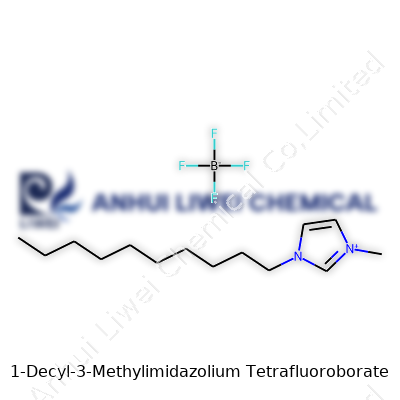
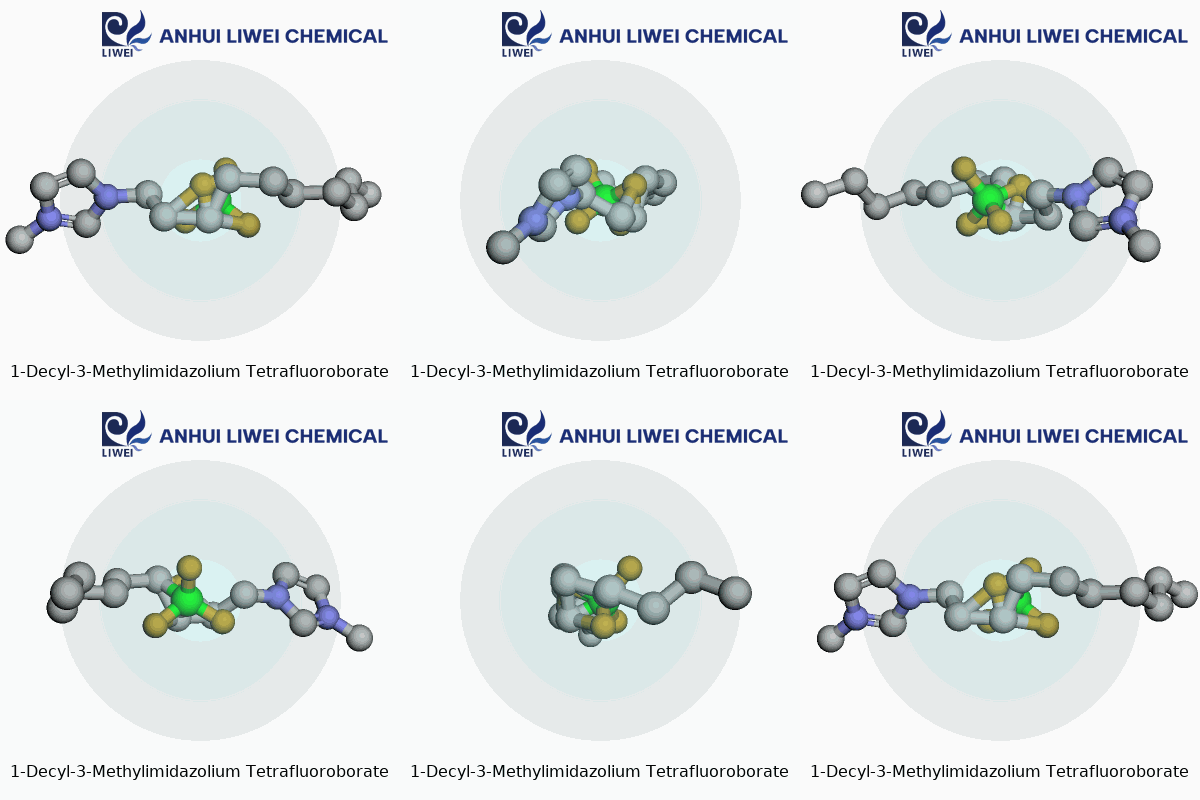
1-Decyl-3-Methylimidazolium Tetrafluoroborate stands out in the mix of ionic liquids for lab and industrial use. By naming, this chemical brings together an organic part and an inorganic counterion. The core of its structure lies in the imidazolium ring—a five-membered ring holding two nitrogen atoms, three carbon atoms, and a couple of side chains. One methyl group hangs off the third position on that imidazolium ring, not much but enough to influence its chemical character. The other side carries a decyl chain, ten carbons stretching away, hydrophobic by nature.
Pair this ion with its counterion, the tetrafluoroborate anion, and things get interesting—BF4-, with one boron atom surrounded by four fluorine atoms. This combination brings physical and chemical properties that stay different from common organic solvents or salts. The structure doesn’t break apart under standard conditions, and the liquid form remains steady across a broad temperature range. That comes in handy in real-world environments, not just textbook settings.
Applications Tied to Structure
That long decyl chain on the imidazolium ring pushes this molecule into the realm of room-temperature ionic liquids. It drives solubility and viscosity in ways you just don’t see from smaller alkyl chains. In lab work, both these factors matter. Ionic liquids like this beat traditional solvents by offering low volatility and solid chemical stability—making them candidates for tasks like extracting metals, battery electrolytes, or greener alternatives in chemical processes.
The imidazolium cation brings customization. Swapping out those carbon chains changes the way the substance mixes, dissolves, or conducts electricity. Solubility stands as a big deal for researchers. You either get a wide window of compatibility or you don't. 1-Decyl-3-Methylimidazolium Tetrafluoroborate leans toward stability, letting engineers and scientists trust their results over repeated cycles. In battery research, the low flammability reduces safety worries. No one wants a volatile electrolyte in their power cell.
Handling and Environmental Responsibility
Ten years ago, fewer people worried about how chemicals like this left a footprint. That’s changed. Tetrafluoroborate’s stability means it can build up in water or soil if dumped without care. Disposal becomes a topic of conversation, not just afterthought. The imidazolium ring resists breakdown under normal conditions, too. This makes recycling a concrete goal for labs, not just a line in protocol paperwork. If a process can recover ionic liquids instead of consuming and tossing them, both budget and conscience breathe easier.
Room for Progress
Here, green chemistry sets its sights high. Factories and academic groups push for safe and thorough recovery. Methods like distillation or selective extraction pull these ionic liquids out of waste streams, though the cost and technology need work. Finding less persistent alternatives to the tetrafluoroborate anion matters. Success would help keep useful ionic liquids in circulation without environmental baggage. For now, paying close attention to both chemical properties and management practices calls for honest assessment, data sharing, and a push for responsible progress.
The structure of 1-Decyl-3-Methylimidazolium Tetrafluoroborate shapes more than its physical appearance. It affects safety, performance, and the kind of legacy each lab or facility leaves behind.
What Makes a Salt Go into Water?
Looking at any chemical, especially those fancy-sounding ionic liquids, figuring out if it’ll mix well with water leans on simple rules anyone who has ever mixed sugar in tea already knows. Things with a lot of big, greasy, non-polar parts don’t fit easily into the world of water. Water doesn’t really like to break up its own neat hydrogen-bonded world for long oily chains. Now, toss in a big molecule like 1-decyl-3-methylimidazolium tetrafluoroborate. It’s a mouthful, sure, but hidden in that jumble of syllables is a chemical with both a charged “head” and a long, old-school greasy tail.
The Nature of the Beast: Structure Tells the Story
The imidazolium part is like a magnet for water, thanks to its charge. That length of decyl—ten carbons in a row—drags the overall molecule toward the territory of oil, the kind that quickly separates in salad dressing. The tetrafluoroborate counterion sometimes helps ions dance with water, sometimes not; the jury’s out depending on the specific story.
Most of the research and my own experience thumbing through chemical catalogs shows these ionic liquids resist dissolving into water when the carbon chain sticks out long enough. A one-methyl variant of imidazolium chloride, for example, jumps right into water, but add a ten-carbon tail like in 1-decyl-3-methylimidazolium and you’re asking water to welcome in something it just doesn’t feel comfortable with. Organic chemists, especially those who’ve made or handled these, will tell you they often see two layers settle out unless you shake like mad or dump in a co-solvent.
Scientific Footprints Back This Up
A 2011 paper in the Journal of Physical Chemistry B dug into imidazolium-based ionic liquids with different chain lengths. They found the longer the “tail”, the worse the water solubility. In plain talk, think of shoving a spaghetti noodle into a bowl of water versus a grease-coated pipe. That decyl tail behaves like the plumbing, not the pasta. The data showed water grabs about a tenth of a gram of this stuff per every 100 grams of water—barely noticeable. Once you cross past octyl, solubility drops quick.
If you trust reference handbooks like the CRC or the chemical giants like Sigma-Aldrich, they put similar ionic liquids with decyl groups as “sparingly soluble” or even “almost insoluble” in water. You’ll see cloudy layers, slick surfaces, and frustration if you try mixing high concentrations.
Why Solubility Matters for Labs and Factories
If you’re in the lab, mixing this chemical with water comes with wasted time if you try to use it as a regular solvent system. A chemist has to reach for co-solvents, organic phases, or surfactants to get things moving. This matters in green chemistry, too, since ionic liquids often get marketed as earth-friendlier than volatile organics, but low water solubility changes how you recover, recycle, or even clean up after them.
Factories using this for catalysis or extraction get hit with phase separation headaches. Streams backed up by mistimed mixing, more use of energy, and higher costs enter the picture quickly. It’s not a small consideration — the roots of environmental risk and economic stability both need careful chemical compatibility assessment before putting a product line in place.
So, Where Can This Lead?
Chemists gravitate toward tailoring the carbon chain length: cut it shorter, up goes water solubility. Another route is tweaking the counterion: swapping tetrafluoroborate for one with a stronger affinity for water sometimes tips the balance. In teaching and research labs, more scientists have moved toward using shorter chains, taking cues from journal evidence and environmental reports.
At the end of the day, knowing the details of this molecule’s dance with water saves real money and avoids headaches, whether it’s prepping a reaction or running a production line. Staying curious about the nuts and bolts of solubility means fewer surprises, and a smoother run from the bench to industrial scale.