Everything About 1-Decylimidazole: Past, Present, and Where It’s Headed
Historical Development
Chemists started paying close attention to imidazole derivatives in the twentieth century, looking to use their unique structures in pharmaceuticals and materials. Out of these projects, 1-Decylimidazole stands out, thanks to its particular long carbon chain attached at the nitrogen. Early work relied on older alkylation techniques, but better purification and understanding of imidazole reactivity came with advances in the 1970s and 80s. Laboratories in Europe and North America explored decyl groups, not just for basic research but to see how longer chains tweaked melting points, surface activity, and biological compatibility. Researchers today owe much to the curiosity of these earlier scientists, who laid the groundwork for safe and scalable synthesis.
Product Overview
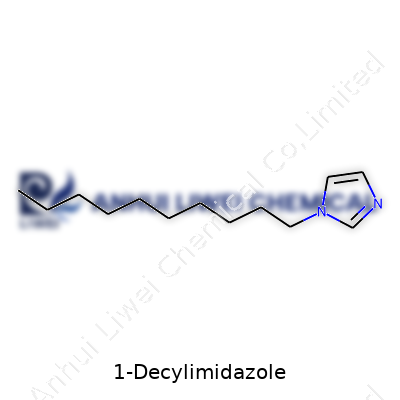
1-Decylimidazole falls in the group of N-alkylimidazoles, sporting a ten-carbon straight chain on the nitrogen atom. Its molecular formula reads C13H24N2, making it a solid choice for those searching for amphiphilic molecules. Chemists appreciate its amphiphilic behavior—the decyl chain brings a non-polar punch, while the imidazole ring stays polar. That split personality helps the molecule find a place in everything from ionic liquids to corrosion inhibitors, giving clear value for both academic labs and commercial buyers. Thanks to its tailored structure, this compound doesn’t just slot into one type of formulation; it often brings results in places other imidazoles don’t.
Physical & Chemical Properties
Look at a bottle of 1-Decylimidazole and expect a liquid or waxy solid, ivory white or pale yellow, depending on how pure and how fresh the sample is. Boiling hovers near 320°C; melting usually lands within the range of 28–32°C. The decyl group lowers solubility in water, pushing it toward organic solvents like ethanol, acetone, and toluene. The molecule resists hydrolysis under neutral pH but starts to break up under strong acid or base. Odor is light and often described as faintly sweet or oily. Storage calls for careful labeling and avoidance of heat and light exposure, which can spark slow but irreversible decomposition.
Technical Specifications & Labeling
Manufacturers selling 1-Decylimidazole usually list purity well above 98%, checked by gas chromatography. Buyers should look for detailed COAs specifying moisture content, residual solvent, and metals analysis—trace heavy metals can catalyze slow side reactions. The container must show chemical name, batch number, production and expiry dates, and recommended storage. Proper labeling supports both safety and traceability, a point reinforced by regulators. Larger labs and industrial buyers go beyond, demanding information about synthesis origin and any stabilizers present in the sample, since those details influence downstream use.
Preparation Method
Making 1-Decylimidazole starts with imidazole and a decyl halide, typically decyl bromide, in the presence of a base like potassium carbonate or sodium hydroxide. The process plays out in a polar aprotic solvent, such as DMSO or DMF, over several hours. Temperature control remains crucial—too much heat, and undesirable byproducts form. Purification involves vacuum distillation or recrystallization from an appropriate solvent. The alkylation step depends on reagent quality; impure decyl halide or dirty glassware introduces headaches, as side reactions lower yield and complicate purification. Clean bench work pays off in every batch.
Chemical Reactions & Modifications
The imidazole ring supports substitution at various positions, providing a platform for post-alkylation chemistry. Researchers have nitrated, sulfonated, and even phosphorylated the imidazole ring in the presence of the decyl tail. The long hydrocarbon chain can be oxidized to introduce carboxylic acid or alcohol groups for further functionalization. This built-in flexibility makes 1-Decylimidazole a favorite for those developing surfactants, ion conduction materials, or new drug candidates. Catalytic hydrogenation handles any residual unsaturations that sneak in from the starting material. Experiments have demonstrated compatibility with click chemistry to link up with a range of partners, provided the conditions stay mild enough to avoid ring-opening.
Synonyms & Product Names
Vendors and scientific articles sometimes call it N-Decylimidazole, Decylimidazole, or Imidazole, 1-decyl-. Catalogs list its CAS number, but for practical use, “1-Decylimidazole” dominates. A few specialty suppliers sell custom analogs named by chain length, so caution helps when searching or ordering. Regulatory agencies may refer to it with systematic names: 1-(Decyl)-1H-imidazole or N-Decyl-1H-imidazole, though in day-to-day lab work, most stick to the short form.
Safety & Operational Standards
Readers handling 1-Decylimidazole should follow best practice—gloves, goggles, and proper venting. OSHA and related standards require labels and safety sheets on-site, especially above 500g. Spills create slippery floors and low-odor vapor exposure can irritate airways, so storing the liquid in a tightly sealed amber glass bottle limits accidental exposure. Containers need to stay in a cool, dry cabinet, away from oxidizers and strong acids. Small-scale waste heads to halogenated organic collection and doesn’t go down the drain. Documenting handling, labeling, and disposal forms a safety net that keeps accidents rare in responsible hands.
Application Area
1-Decylimidazole appears in a surprising number of places. In the chemical industry, it acts as a corrosion inhibitor for metal equipment exposed to aggressive environments, outperforming simpler imidazoles in some settings because the decyl chain boosts adsorption. Researchers report strong performance as a surfactant in emulsions and as a supporting component in ionic liquid formulations for electrochemical cells. The pharmaceutical sector tests it as an intermediate for more complex molecules—sometimes looking to tweak antifungal or antibacterial activity. Laboratories use it in functional studies of imidazole-based ligands for catalysts and sensors. Everywhere this molecule turns up, makers expect its tailored properties to provide a gain over older, shorter alternatives.
Research & Development
Current research digs deep into modifications that widen the molecule’s portfolio. Electrochemical workers explore it as a building block for room-temperature ionic liquids, pushing for eco-friendlier solvents and battery electrolytes. Surface chemists study its self-assembly on metals—work that could change how anti-corrosion coatings are designed. Medicinal chemists use the imidazole core as a launch point for preparing novel antifungal candidates, tweaking the alkyl chain for optimal bioavailability. Environmental researchers run tests to see how 1-Decylimidazole breaks down, aiming to understand its stability in wastewater and soil, where long-chain organics can sometimes persist. The compound’s versatility hasn't escaped notice as a model system for teaching reaction kinetics to chemistry students, who can clearly see how a single N-alkylation changes physical and biological performance.
Toxicity Research
Studies focusing on acute and chronic toxicity suggest that 1-Decylimidazole carries low to moderate toxicity in standard mammalian models, but careful hands should always treat any imidazole with respect. Inhalation and skin contact may irritate; repeated contact risks sensitization. Long-chain alkylated imidazoles sometimes show slow breakdown in aquatic settings, which brings environmental concerns to the front for those planning large-scale use. European regulations require detailed ecotoxicity data for any compound imported in bulk. Early cytotoxicity screens show that the molecule doesn't bioaccumulate significantly but breaks down primarily via oxidation, forming less hazardous derivatives. Responsible development avoids releasing this compound into watercourses and monitors both worker health and emissions closely.
Future Prospects
Scientists working on 1-Decylimidazole predict a bigger role in cleaner energy applications and smart materials. Development of new battery electrolytes and greener solvents will likely expand as regulations tighten on volatile and toxic solvent use, opening doors for safer, more robust chemicals. Further down the road, better understanding of its structure–activity relationship could allow for drugs that beat resistance in fungal infections or deliver selective catalysis in polymer production. Rising demand for advanced materials—especially those that combine low toxicity with strong performance—places 1-Decylimidazole in a promising position for years ahead, provided sustainable manufacturing and disposal strategies keep pace with market growth.
Taking a Close Look at 1-Decylimidazole
In the world of chemistry, some molecules quietly carry much of the load behind the scenes. I remember the first time I read a formulation sheet for an advanced epoxy adhesive; one ingredient that stuck out was 1-Decylimidazole. It didn’t get the fanfare of the main binder, but ask any industrial chemist worth their salt, and they’ll tell you it’s a workhorse. This compound, part of the imidazole family, brings a flexible decyl chain to the table. That chain transforms it from a specialty chemical to a linchpin in multiple chemical processes, particularly in the adhesives and coatings space.
Why Manufacturers Reach for 1-Decylimidazole
The biggest value of 1-Decylimidazole shows up in epoxy resin curing. Its role goes beyond being a simple catalyst. Many of us who work with epoxy bonds have struggled with slow curing and incomplete cross-linking. Poor curing leads straight to weak products and coatings that chip or peel under regular wear and tear. The addition of 1-Decylimidazole to a blend leads to a faster, more reliable cure at lower temperatures. This means less downtime and reduced energy bills on the production floor. For sectors like construction, electronics, and aerospace, those savings in time and cost multiply fast.
What the Science Tells Us
With a little bit of research, you’ll see 1-Decylimidazole isn’t just a random additive. The imidazole ring itself is favored for catalytic activity, and the decyl tail makes it more compatible with organic materials. Published studies have highlighted how this structure boosts solubility and spreads more evenly through mixtures than other, shorter-chain imidazoles. The result is a tougher finished product. Scientific reports back up the claim: coatings cured with 1-Decylimidazole often resist abrasion and moisture better than those cured with traditional agents. Better performance means parts last longer, which matters in the real world, especially for large-scale builds and machinery repairs.
Environmental and Safety Considerations
Lately, conversations around chemical production put more emphasis on safety—both for people and for the planet. Chemical plants and labs pay extra attention to the potential hazards of their additives. Based on reliable safety data, 1-Decylimidazole falls into the “handle-with-care” category. Direct contact can irritate skin and eyes, and inhaling dust or fumes isn’t a good idea. Responsible users wear gloves, goggles, and make sure their spaces are well-ventilated. Proper protocols matter here, just as they do for many industrial chemicals. Disposing of leftover material according to local regulations helps avoid harm to local waterways.
Meeting Tomorrow’s Needs
As the world leans toward environmentally friendly products, the role of chemicals like 1-Decylimidazole faces more scrutiny. Researchers aim to fine-tune these molecules so that they remain effective, but also safer and easier on living systems. Some look at tweaking the structure or exploring plant-derived versions. The search for greener formulations is well underway. My own experience in the lab showed me that improvements happen step by step—through pooling industry experience, seeking out new test results, and never losing sight of safety. Demand for stronger, safer, and faster-curing resins won’t diminish, so innovation around key catalysts like 1-Decylimidazole won’t be slowing down either.
Meet the Building Blocks
In chemistry labs, there’s nothing quite like the moment a new compound catches your eye. 1-Decylimidazole falls into this group. It has a simple yet telling structure—an imidazole ring, which shows up everywhere from drug discovery projects to cleaning agents, connected neatly to a long decyl chain.
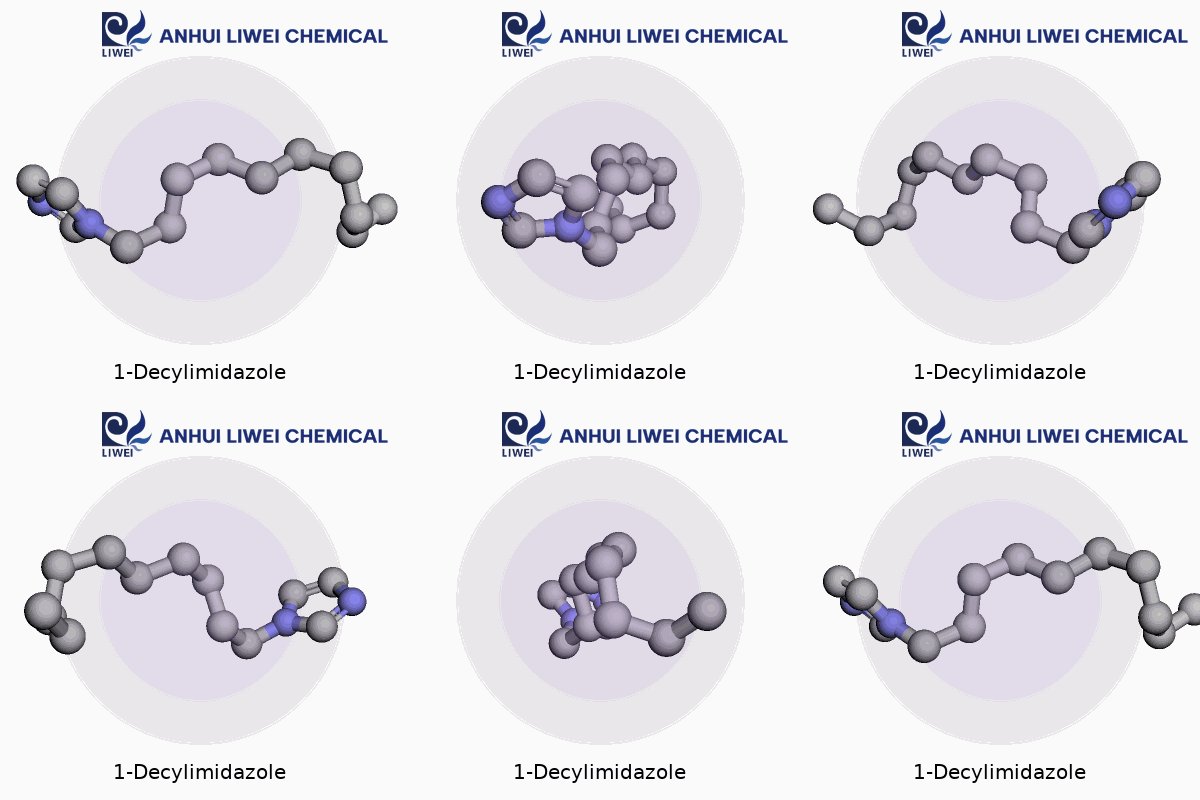
Let’s lay it out: The core of 1-Decylimidazole is a five-membered imidazole ring. Picture two nitrogens sitting at the 1 and 3 positions of a pentagon, with three carbons filling out the rest. Here’s where the twist comes in—a decyl group hooks onto the ring’s first nitrogen. In basic terms, this decyl is a straight chain of ten carbon atoms, and each one in the chain links to hydrogen atoms. That long tail tugs the molecule strongly toward the “grease-loving” side, which changes how it behaves in water and with other chemicals.
Why Long Chains Change Everything
Long alkyl chains like the one in 1-Decylimidazole don’t just sit there. They give the molecule special tricks. Add a decyl group to imidazole, and everything changes—solubility, how it mixes with oils, how tightly it clings to surfaces. I’ve handled surfactant-like molecules in my research. It’s always striking to see how those carbon chains play tug-of-war with water, splitting molecules into teams: some reach out to water, others snuggle into fats and oils. 1-Decylimidazole acts much the same.
Chemistry at Work: Where Structure Meets Function
Imidazole rings bring unique benefits. They pop up in nature—look at histidine, an amino acid you’ll find in proteins, or check any enzyme handbook. That ring system handles electron-rich processes, helping molecules grab or release protons, which is the heart of so many chemical reactions. Stick a decyl group on that framework, and now you have a molecule that wants to stick to oily spots while still carrying the subtle powers of the imidazole ring.
The structure makes 1-Decylimidazole a likely player in forming ionic liquids. These are salts that stay liquid at lower temperatures than table salt or other familiar squirts from chemistry kits. Ionic liquids grab the attention of researchers for green chemistry—cleaners, solvents, reaction media—because they avoid the volatility (and fumes) of many organic solvents. The long decyl chain offers a non-volatile backbone. Meanwhile, the imidazole ring holds the electrical side steady.
Real-World Connections and Solutions
1-Decylimidazole isn’t just a curiosity tucked in a textbook. Companies searching for less toxic, more sustainable cleaners and solvents look to compounds shaped like this. In pharmaceutical design, the imidazole scaffold carries a reputation for biological activity. By tweaking the chain length or modifying the ring, scientists aim to balance safety and effectiveness.
Safety always matters. Research points to imidazole derivatives helping to break down harmful microbes—attracted by the fatty chains, the molecules latch onto cell membranes, poking holes or disrupting vital functions. That opens doors for new disinfectants or surface coatings that target trouble without lingering in the environment. Regulatory pressure nudges industries toward liquids and additives that won’t evaporate into the air or persist in waste streams. The structure of 1-Decylimidazole, with its hydrophobic chain and stable ring, lines up with these trends.
The Bottom Line: Structure Shapes Use
Look at any chemical innovation, and it usually traces back to a simple truth: a small change in structure delivers new advantages. Mix the tough, smart chemistry of an imidazole ring with the grip of a decyl side chain, and you get 1-Decylimidazole—a molecule with reach, both literally and in its potential impact.
Getting to Know 1-Decylimidazole
1-Decylimidazole doesn’t make headlines, but it shows up in various chemical processes and lab settings. Its structure gives it unique properties, which explains its use as a specialty chemical in industry. Anyone handling such compounds benefits from understanding risks, not just the benefits.
Why Hazard Questions Matter
Calling a chemical hazardous isn’t just about rules. It’s about the people who work with it, the folks who process it, and the environment. 1-Decylimidazole mixes the world of organic chemistry with the reality of human lives. The trouble starts when a chemical shifts from the theoretical realm to the real world, where exposure becomes a real possibility.
Looking at Toxicity
Research on 1-Decylimidazole remains lean compared to common household chemicals. Still, published safety data sheets classify it as hazardous in several ways. It causes skin and eye irritation, so even casual contact becomes a problem. Inhaling or swallowing the substance can cause harmful effects, and in large enough quantities, this becomes serious. Its imidazole core, shared by pharmaceuticals and pesticides, hints that small molecules with such a backbone often interact sharply with biological systems.
Add a decyl chain, and you get increased oil solubility, making skin absorption more likely. That means even a splash might sneak past gloves if the material isn’t right. Occupational exposure raises concern since vapor in confined spaces can affect mucous membranes and, over time, cause more worrying chronic effects.
Facts from Experience
Working in a college lab, I saw how easy it is to brush off chemical safety when the name isn’t familiar. One day, a bottle of a similar imidazole compound broke—nothing dramatic, just another Tuesday until irritation set in. Even with proper ventilation, handling protocols matter. Too many times someone believes a less-famous compound is “boring” and skips the gloves or goggles. That’s a quick path to skin burns or respiratory issues.
Assessing Environmental Impact
Few studies cover the environmental fate of 1-Decylimidazole, but related molecules stick around, persisting in soil and water. Persistent chemicals often build up in ways that catch communities off guard. It doesn’t take much for water contamination to move up the food chain. Lack of long-term data doesn’t equal harmlessness; it means nobody has looked close enough.
Handling the Risks
Sensible chemistry focuses on prevention. Smart engineering controls, proper glove material, and goggles cut down most risk. Spill kits, good training, and attention to air handling systems do even more. Companies testing new chemicals should work with experienced environmental health teams, looking at both short-term exposure and what happens if the stuff escapes the building.
Suppliers have a duty to share up-to-date data. People working in the line of fire learn the habits that keep their lungs and skin in one piece. In practice, most accidents start with a single step skipped. Fresh review of the chemical’s handling instructions, regular safety drills, and open discussion after near-misses provide real protection.
Better Answers Through Research and Openness
Every new compound deserves honest scrutiny. Talking about 1-Decylimidazole means respecting the gaps in what we know while not waiting for perfect information before acting safely. Clarity, responsibility, and science keep industry and workers moving past the uncertainty into thoughtful action.
Protecting Quality: Why the Right Conditions Count
Taking care of chemicals never just means putting a label on a bottle and tossing it on a shelf. From my time in a university research lab, storage practices often determined the outcomes of whole projects. Chemicals like 1-Decylimidazole offer no exceptions. The stuff isn’t on every bench, yet its stability and shelf life play a huge role in its application. Its sensitivity to moisture and oxygen means steps need to be taken—simple as keeping air and water out, sometimes as detailed as making sure it doesn’t sit in sunlight for days.
Polishing off a project late at night, I often noticed how chemicals, when ignored, started changing color or weight. I learned early: once atmospheric oxygen gets in, you notice it. Not immediately, maybe, but down the road, something goes wrong—yields drop, results get funky, safety can slide. 1-Decylimidazole isn’t one you want soaking up water from the air. It can react and break down, sometimes into unknown byproducts. Storing small volumes in tightly sealed glass helps, but large operations benefit from inert conditions—think nitrogen or argon blankets.
Finding the Balance: Temperature and Ventilation
Most organic compounds hold up best at room temperature, and 1-Decylimidazole is similar. Overheated storerooms drive up chemical volatility, while environments colder than a kitchen refrigerator start making bottles difficult to handle. I keep a thermometer in every storage area, always shooting for a steady 18–25°C. Direct sunlight ruins a lot of compounds. It’s not about paranoia—just good habits. Shelving in dark or amber glass containers helps slow down any photochemical reactions that can sneak in through room lighting or cracks in curtains.
Ventilation stands out as an everyday concern. Fumes aren’t just an annoyance—they can signal slow leaks or breakdown. When a bottle lets out odors, it’s telling you something’s off or that the cap hasn’t been tightened. Labs running through larger volumes should use dedicated chemical cabinets with built-in vents. I’ve watched how a shared fume hood used as backup led to confusion, cross-contamination, and, last year, a nearly ruined experiment. Single-purpose spaces keep risks down.
Safety Measures Protect More Than the Chemical
Spillage makes messes nobody enjoys cleaning. Still, lining chemical cabinets with absorbent pads has saved my team more times than I can count. Labels ought to stay clear and updated; even a sharpie date written on the top helps everyone remember its age. Company SOPs often outline storage rules, but they tend to get ignored unless leaders set an example and keep everyone aware with reminders and refresher meetings.
Long shelf lives attract cost-cutting, but saving money with bulk buys means nothing if each reopening introduces new contamination. Working from smaller aliquots avoids repeated bottle openings. Transferring chemicals should always be done with dry equipment—moist spatulas or wet gloves spell trouble and quick losses of purity.
Room to Improve: Simple Upgrades Make a Difference
Keeping things tidy matters more than most realize. Signage, clear shelving, inventory checks every month—these tasks eat up time but prevent losses that run much higher than the minutes spent. I don’t trust luck or memory—using an inventory tracking app, even a basic spreadsheet, keeps me updated. Training new staff on careful weighing and transfer makes a real difference, and investing in better storage containers pays for itself every year. Reliable safety practices in storage safeguard not just the chemical, but every researcher and worker on site.
The Hunt for 1-Decylimidazole
Shopping for chemicals like 1-Decylimidazole steers you through a maze of suppliers, pages full of jargon, and rules that only seem to make sense to regulatory agents. If you’ve ever tried to order a reagent—especially one outside the big-name crowd—you’ve met the same resistance. This isn’t just a story for PhDs; small business owners, industrial formulators, and research students all hit the same walls.
Most people aren’t looking for 1-Decylimidazole for anything nefarious. Its value turns up in the cosmetics world, making surfactants for gentle skin care products. It appears in industrial research, helping to stabilize reactions or modify surfaces. It’s a regular piece of the jigsaw for chemical engineers. Still, one day you look online, and every other page hides behind login screens, “request a quote” forms, or warnings about “shipping restrictions.”
Legit Sources—And Red Flags To Watch
I’ve seen people burn hours scrolling internet pages or even pretending to be a Fortune 500 company just to see who’s holding real stock. One way to cut through the noise is focusing on vendors with real-world experience. Sigma-Aldrich, TCI, Alfa Aesar, and Acros pop up near the top of search lists for a reason. These companies have their compliance in order and inventory that actually moves. They’re not perfect—prices run high, and paperwork can drag on—but you’re far less likely to get scammed or end up with a mystery powder.
If a company asks for an unusual amount of personal information or their checkout process reads like it came out of 1994 HTML, close the tab. One seller out of Eastern Europe once requested a scanned copy of my driver’s license before even talking about pricing. That’s the opposite of safe. In the chemical business, transparency is non-negotiable. Reputable dealers list Certificates of Analysis, Safety Data Sheets, and clear origin details. If these aren’t on the product page, keep moving.
Laws and Shipping Headaches
Ordering chemicals doesn’t work like Amazon. Laws control each step, especially for international orders. Customs, import restrictions, and licensing rules often turn a simple purchase into a bureaucratic gauntlet. For buyers in the US or Europe, sticking with large, established suppliers avoids most legal headaches. They handle customs forms, and their compliance team clears up country-specific restrictions before the order even leaves the warehouse. Small importers who take shortcuts often lose money when customs blocks a shipment or returns it entirely.
Students and independent researchers usually don’t have access to institutional licenses. I’ve seen creative solutions, from using shared group orders through a university’s chemistry department to reaching out for industry collaborations just to qualify for an account. It isn’t fair, but safety rules exist for good reasons—misuse of specialty chemicals still happens, and one bad actor ruins it for everyone.
What Works—And What Would Help
The market for specialty chemicals would work better if trusted suppliers opened up lower-quantity purchases for legitimate small-scale buyers. Right now, minimum order sizes block access for anyone outside big labs or factories. Creating platforms where hobbyists, independent scientists, or small businesses file minimal, verified paperwork could bridge the gap.
Direct, open communication with suppliers counts for more than online marketing. A phone call, honest conversation about intended use, and willingness to provide real-world references often clear more hurdles than endless emails. The future of chemical supply should look like responsible transparency, not endless hoops and lockouts.