1-Dodecyl-3-Methylimidazolium Bromide: Insightful Commentary on an Influential Ionic Liquid
Historical Development
The story behind 1-Dodecyl-3-Methylimidazolium Bromide reflects the broader evolution of ionic liquids in science and technology. Research on imidazolium-based salts ramped up in the 1990s, driven by the quest for efficient and environmentally sound alternatives to volatile organic solvents. Chemists noticed imidazolium ionic liquids resisted evaporation, showed low flammability, and worked well in diverse environments. The addition of a 12-carbon chain, like the dodecyl group, landed this compound in a sweet spot—balancing solubility and thermal stability. Labs worldwide seized on its structure, and peer-reviewed literature blossomed with synthesis techniques, characterization approaches, and applications spanning from catalysis to separation technologies.
Product Overview, Physical & Chemical Properties
1-Dodecyl-3-Methylimidazolium Bromide stands out for its amphiphilic nature, blending a hydrophilic imidazolium "head" with a hydrophobic dodecyl "tail." This fusion influences solubility in both water and organic phases. Its melting point typically stays below 70°C. The compound remains thermally stable below 200°C, surviving conditions that ruin traditional organic solvents. The long alkyl chain bestows unique self-assembly behavior, drawing attention from researchers studying micelles, vesicles, and ordered liquid crystal phases. As a white crystalline solid at room temperature, this material dissolves well in polar solvents but shies away from completely non-polar environments.
Technical Specifications & Labeling
Manufacturers supply 1-Dodecyl-3-Methylimidazolium Bromide under strict technical criteria. Purity levels hover at 98% or higher, leaving behind trace moisture and minimal halide contaminants. Labels note critical details, including batch number, manufacturing date, and expiry estimates. Customers often ask for certificates of analysis, which list water content (often below 1%), apparent density, and color. Storage instructions focus on keeping the material dry, shielded from light, and cool to preserve its reliable behavior in lab and industrial settings.
Preparation Method
Researchers typically prepare 1-Dodecyl-3-Methylimidazolium Bromide through a classic quaternization reaction. N-Methylimidazole reacts with 1-bromododecane in an anhydrous solvent, often acetonitrile, under inert atmosphere. The mixture heats gently, prompting the methylimidazole’s nitrogen atom to attack the alkyl halide, forging a new imidazolium salt. Purification follows with a few straightforward washes in ethyl acetate or ether, yielding a pure product ready for a wide array of chemical transformations. This pathway avoids harsh reagents or complex purification, helping keep environmental impact fairly low.
Chemical Reactions & Modifications
Chemists can tune 1-Dodecyl-3-Methylimidazolium Bromide further through counterion exchange. Swapping bromide for hexafluorophosphate, tetrafluoroborate, or bis(trifluoromethylsulfonyl)imide enhances properties like hydrophobicity and thermal resilience. This versatility opens many paths to create custom ionic liquids for specialized projects. In catalytic systems, this salt sometimes acts as more than a medium—it stabilizes metal nanoparticles or organizes reactants for more efficient chemical transformations. Its imidazolium ring can anchor further functional groups, giving rise to task-specific ionic liquids tailored for CO2 capture, organic synthesis, or battery electrolytes.
Synonyms & Product Names
Chemical commerce recognizes this compound by several names, including 1-dodecyl-3-methylimidazolium bromide, C12mimBr, and DMI-Br. International suppliers sometimes list it under proprietary names, but nearly all serious vendors include both the systematic IUPAC title and the shorter abbreviations that dominate academic and patent literature.
Safety & Operational Standards
Workplace handling of 1-Dodecyl-3-Methylimidazolium Bromide demands attention to skin and respiratory protection. Data from safety sheets flag irritation risks to eyes and skin, drawing on both animal tests and in-vitro studies. Prolonged contact increases the odds of dermal effects, while inhalation of fine particles can aggravate lungs. Chemical waste disposal routes must follow environmental regulations, as imidazolium salts resist breakdown in aquatic settings. Labs rely on gloves, goggles, and fume hoods during manipulation, and spills get collected swiftly to limit contamination risks.
Application Area
Diverse industries engage 1-Dodecyl-3-Methylimidazolium Bromide as a tool and raw material. Major research uses include solvent separation, phase-transfer catalysis, and nanoparticle stabilization. Electrochemists find this ionic liquid helpful for shaping electrodeposition environments and boosting ionic conductivity in batteries and capacitors. Biotechnologists tap it to extract DNA, denature proteins, or grease the wheels in biotransformations. Its surfactant properties appeal to formulators chasing new detergents or emulsifying agents. Some polymerization processes see rate and control improvements when this salt joins the reaction mix, carving out a niche in specialty plastics.
Research & Development
Scientists and engineers keep digging into tweaks, trying to unlock new mixtures or pairings that lower toxicity and sharpen performance. Universities and startups run comparative studies to pinpoint how chain length, ring modifications, or anion swaps shift physical and biological properties. Publications track advances in solvent-free synthesis, renewable feedstocks, and greener alternatives for both manufacturing and application. Joint projects with industry focus on building scalable, efficient, and safe production lines to meet stricter future regulations.
Toxicity Research
Most toxicity studies on this compound reveal moderate concern regarding aquatic organisms and some mammalian cell lines. Imidazolium-based ionic liquids with longer chains generally show higher toxicity than their shorter cousins, mainly for fish and algae. Researchers measure lethal concentration (LC50) values across several species, confirming the need for responsible waste handling and supervision outside the lab. Up-to-date cytotoxicity assays check compatibility with human and animal tissues to shape industrial safety guidelines. Eco-toxicologists keep sifting through breakdown pathways and bioconcentration factors, aiming for formulas that blend safe performance with lower ecological burdens.
Future Prospects
Market signals and regulatory forecasts point to wider adoption of 1-Dodecyl-3-Methylimidazolium Bromide in cleaner chemical synthesis, materials engineering, and green catalysis. Directed molecular design, powered by machine learning, could soon unlock even better-functioning derivatives. Ongoing work on recyclability, low-energy processing, and benign disposal methods aims to allay the most pressing environmental concerns. The combination of straightforward production, reliable performance, and vast modification capacity secures this ionic liquid’s place in both laboratory and industrial toolkits, though public acceptance ultimately hinges on transparent communication and tight coordination between researchers, regulators, and product developers.
The Quiet Player in Modern Chemistry
Step into almost any advanced chemistry lab and sooner or later you’ll see a row of oddly named bottles, each holding some surprisingly versatile compounds. One of them, 1-dodecyl-3-methylimidazolium bromide, doesn’t catch much public attention, but folks on the research side value it. From the labs I’ve spent time in, its presence signals you’re dealing with challenging processes—ones that go beyond what water or traditional organic solvents handle.
Changing the Way Solutions Behave
In school, I remember thinking all salts just dissolved in water and that was the end of it. Over time, I learned that's barely half the story. Some salts, like this one, dissolve to form ‘ionic liquids’—liquids made entirely of ions, not molecules. 1-dodecyl-3-methylimidazolium bromide steps in as a solvent in chemical reactions that demand more than what oil, water, or even acetone can deliver. Its unique structure allows it to dissolve both greasy and polar substances, helping scientists break rules that used to limit what we could build at the molecular level.
Real Changes in Green Chemistry
I’ve worked on research teams looking for safer alternatives to old-school, toxic solvents. The push for greener practices has turned these ionic liquids into favorites. While many solvents float off as fumes and bring headaches for workers and regulators, this compound barely evaporates. This means less pollution and safer air in the lab, which isn’t just good for the planet but also for the scientists who spend entire careers breathing in these spaces. You see environmental impact dropping not just in theory, but in toolbox shifts across university and industry labs.
Scrubbing and Separating the World's Waste
The first time I helped run tests for wastewater remediation, it struck me how many chemicals get dumped after being ‘untreatable.’ Ionic liquids, including 1-dodecyl-3-methylimidazolium bromide, have this smart ability: their charged and non-charged domains can trap metals, dyes, and even grease in water streams. Some industrial operations already add these compounds to filters or columns to pull out toxins before the water heads back to rivers. It’s a shift that proves how deeper chemical knowhow saves costs and damage down the line.
Building Blocks for Drug Delivery
I’ve talked to friends who work in pharmaceutical labs, and they rave about the versatility of this compound for drug formulations. The compound’s surface-active properties let it double as a surfactant, surrounding medicine molecules and helping them slip into the body more efficiently. This can mean fewer pills, faster relief, and less waste because the body absorbs medicines more effectively.
Looking at What Needs Fixing
Every tool brings its own set of problems. Some critics worry that while these ionic liquids cut down harmful emissions, no one has mapped every long-term effect on ecosystems. Rigorous standards and open papers should guide learning, not marketing hype. Chemists and manufacturers can keep pushing for better recovery methods to recycle these valuable compounds, limiting leaks from production to disposal. Continued transparency and global cooperation will move things forward, so the benefits don’t get lost in the fine print.
Understanding the Risks of this Ionic Liquid
Working with chemicals like 1-Dodecyl-3-Methylimidazolium Bromide means keeping safety at the front of your mind. For those who’ve spent hours in a research lab, the story is always the same—before picking up a new bottle, you scan the safety data sheet, ask around, and weigh every risk. This compound, known mostly to chemists aiming to tap into ionic liquid tech or solvent work, demands respect.
Researchers usually seek out alternatives to volatile organic solvents, and ionic liquids like this one often get touted as the “greener” path. Less volatility can mean cleaner air in the lab and fewer headaches. But just because it doesn’t hit your nose with fumes like acetone or chloroform doesn’t mean you can let down your guard. The slick, colorless look of this liquid says nothing about how it behaves once it meets your skin, eyes, or lungs.
Physical Contact Comes at a Cost
Chemists who’ve handled hundreds of organic salts know things aren’t always as mild as they seem. 1-Dodecyl-3-Methylimidazolium Bromide has a nasty side if it contacts human tissue. It’s not just a skin irritant; stories float through the grapevine about colleagues dealing with persistent irritation, redness, and worse from a splash. Eye exposure means watering, stinging, sometimes even a trip to the clinic. The chemical doesn’t just wash off with a rinse. Its oily nature clings to the skin and hangs on clothing, so even a minor spill turns a boring Wednesday into a lost afternoon.
Accidentally inhaling dust or vapors produced by this salt poses a real risk, especially during weighing or transfers in a dry room. Coughing and running nose are lesser problems compared to what exposure can mean for those with asthma or chemical sensitivities. Though acute toxicity tends to rate as moderate, long-term effects aren’t well-documented since most safety profiles get drawn from short-term studies. That shroud is enough to keep a sensible technician alert.
Environmental and Waste Considerations
Some see ionic liquids as eco-friendly, but their environmental fates are rarely simple. Pouring any leftover 1-Dodecyl-3-Methylimidazolium Bromide down the drain is a mistake. These compounds resist breaking down and hang around in wastewater—potentially harming aquatic life. Studies out of Europe and Asia revealed changes to bacterial populations and tiny aquatic organisms exposed to even low concentrations. Research on human impacts is still shallow, so the best move is to treat every drop like a contaminant.
Smarter Handling Practices
For those in a teaching or research setting, the habit starts with engineering controls: fume hoods and glove boxes come first, not last. Nitrile gloves, not vinyl, block more direct contact, and safety goggles are non-negotiable. As someone who’s spent late nights cleaning up after forgetful colleagues, I’ve learned to triple-check containers, avoid eating anywhere near these compounds, and use closed waste collection systems. Signs remind people to wash up, but muscle memory does more than reminders ever could.
Training never stops. Those leading student labs have a duty to drill safety routines—explain the “why,” not just the “what.” Using labels, keeping clean-up kits handy, and documenting every incident builds a kind of collective wisdom that protects not just researchers, but everyone downstream. While regulators update exposure limits, self-policing remains the strongest layer of defense. Real safety comes from experience, vigilance, and a real understanding that every shortcut has consequences.
Everyday Chemistry Meets Practical Application
Chemistry never felt so present as it does with compounds like 1-Dodecyl-3-Methylimidazolium Bromide. Just saying that name out loud makes you realize how layered our world gets when you peek beneath the surface of everyday products. No long-winded novelty here: this compound matters in labs because it opens doors in research and industry, especially when folks look for greener alternatives in solvents and detergents.
What Is It, Really?
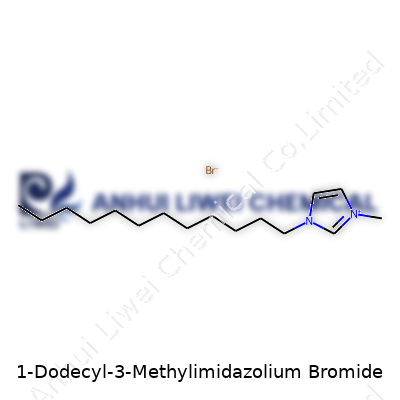
Running your mind through the name, it describes exactly what you're dealing with. The backbone comes from an imidazolium ring—two nitrogens, three carbons, and a double bond working together. On one side, a one-carbon methyl group clings to a nitrogen, and on the other, a dodecyl chain (twelve carbons, straight as an arrow) runs off the ring. The real kicker: bromide, tagging along as the anion, keeping things neutral but never dull. The full formula: C16H31N2Br.
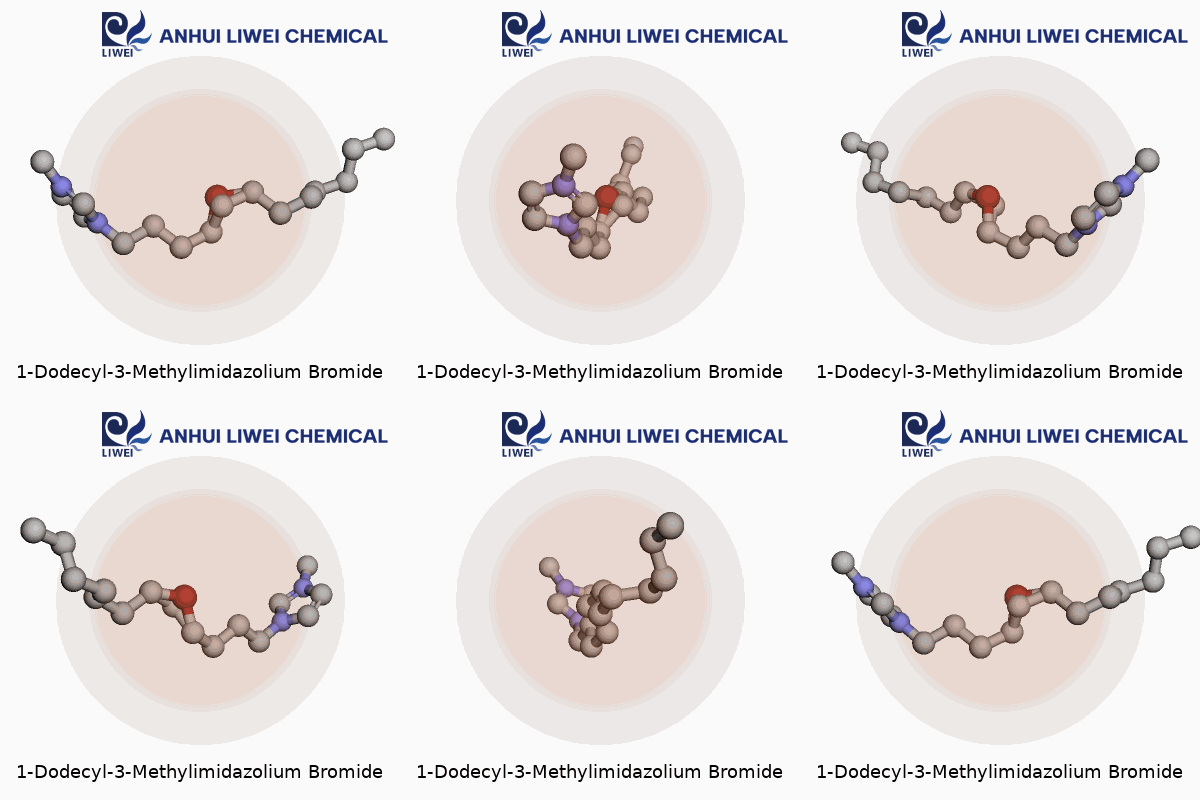
If you tried to picture this, it’s almost like a tadpole with a big head clinging to a long tail. The head is the imidazolium ring with its positive charge, stabilizing itself with the nearby bromide. The tail, that dodecyl chain, gives it a hefty hydrophobic character. It swims both in water and in oil, breaking up the tension—classic behavior for surfactants.
Why This Chemical Shows Up Everywhere
Grow up around folks who fix things or make their own soap and you’ll notice: surfactants matter. They break apart grime, pull slick oil off surfaces, help active ingredients reach where they’re supposed to go. 1-Dodecyl-3-Methylimidazolium Bromide cracks into that club with even more versatility. It stands out because it falls into a newer family of substances called ionic liquids. These aren’t your grandma’s cleaners—ionic liquids barely evaporate, don't stink up the room, and harm the planet far less than standard stuff. I saw labs scramble for greener alternatives, and compounds like this one always lead the hunt.
Academic journals highlight its low volatility and strong solubility properties. Chemists tinker with this molecule to run catalytic reactions. Medics test it in antimicrobial solutions. Even engineers working on batteries and sensors tap its ability to refine interfaces between different materials. It shows a clear trend: building blocks matter, and some do the job better, cleaner, and more efficiently.
Concerns and Paths Forward
One hang-up appears around toxicity and environmental load. Every new surfactant gets run through the wringer, and this one’s no exception. Bromide ions can become a problem if they wind up in sensitive aquatic systems. Responsible sourcing and careful waste handling keep the environmental impact manageable. More work needs to go into figuring out how these ingredients break down in the wild or under light and heat. The chemical industry can roll out real change by demanding full testing and clear labeling.
Sustainable chemistry needs compounds that work without leaving damage behind. My time in research labs hammered in the lesson that every change, down to a single atom, shifts safety and usefulness. 1-Dodecyl-3-Methylimidazolium Bromide shows that with a well-chosen structure and keen oversight, we can get better at building materials and processes fit for our century.
Why Proper Storage Matters
Many scientists and lab workers underestimate the risks that come from storing specialty chemicals like 1-Dodecyl-3-Methylimidazolium Bromide carelessly. This compound shows up often in studies on ionic liquids and separation processes. I remember my first encounter with it during a university research project; it looked like a simple white powder, but the safety sheet told a different story. Mishandling this material, or forgetting about basic storage rules, can invite unnecessary hazards or even compromise your results.
Understanding the Chemical’s Nature
This type of imidazolium salt pulls water from the air with ease and tends to break down faster in humid situations or around strong sunlight. We saw this happen firsthand one summer in the lab, after someone left a bottle uncapped on a workbench—what started as fine powder clumped into a sticky mess not fit for future experiments. Moisture not only damages the chemical, it raises the risk of unexpected reactions, especially if there’s trace contamination. Security for both experiment and experimenter relies on keeping the environment dry and controlled.
Storage Steps Anyone Can Follow
Experienced chemists know that location and container choice make a difference. Airtight bottles make the best option. Glass jars work well, though high-quality plastic with tight seals can prevent leaks too. Placement within a cool, dry cupboard, away from direct sunlight, keeps the product in its best shape. All chemicals in this family benefit from storage away from heat, so avoid keeping them near radiators or window sills. The risk of decomposition goes up fast with higher temperatures, possibly ruining expensive batches in just a few days.
Checking Labels and Access
The biggest lab accidents in my experience stem from mislabeling or confusion over contents. Firm, readable labels with both the full chemical name and the date of arrival go a long way. If your group works with several similar salts, color coding might save time and prevent mistakes. Controlled access matters, too. Open shelves seem convenient, but locked cabinets keep unauthorized hands away, reducing both theft and mishandling. GHS symbols, such as corrosive or irritant marks, send an instant signal about precautions, especially to new staff or students.
Environment and Waste Considerations
Labs working with bulk quantities or frequent transfers sometimes generate dust and residue. It helps to store small daily-use portions in separate vials, limiting exposure to the main stock. Any spills or leftover material go straight into a marked hazardous waste container. Sink disposal, as tempting as it may be for tiny amounts, creates problems downstream. Municipal water authorities often lack protocols for novel ionic liquids, and environmental contamination raises serious ethical issues.
Training and Real World Habits
Reading the safety data sheet feels like a chore, but everyone gains from it. Institutions that run refresher training see fewer incidents. It makes a real difference when supervisors run spot checks or quizzes on storage rules. I remember working in a group where ignoring a broken cap became nobody’s job—until one morning, cleanup took half the day. Accountability drives better habits.
Final Reflections
Storing chemicals like 1-Dodecyl-3-Methylimidazolium Bromide safely is an active commitment, not just a box to check. Small habits, such as labeling with care and thinking about access, keep both people and experiments safer. Smart storage builds trust in your workplace and in your results.
I’ve handled a fair share of chemicals in the lab, but compounds like 1-dodecyl-3-methylimidazolium bromide always grab attention. Their name alone feels heavy—yet the way they fit into daily research shows real value. Talking about its physical properties feels a bit like unwrapping a surprising gift. This isn’t just another salt; it holds a combination of long alkyl chains and an imidazolium core that opens doors in both science and industry.
The Basics—What Does It Look Like?
Laying eyes on 1-dodecyl-3-methylimidazolium bromide for the first time, you’ll probably see a solid, sometimes crystal-like at room temperature. With its extended dodecyl tail, the material doesn’t flow like water but doesn’t resist as iron does. You touch it and sense a waxy texture, and on a warm day, it might lean closer to an oily appearance.
The melting point sits higher than what you’d expect from table salt—usually somewhere between 50°C and 90°C, depending on the batch and purity. This number matters, since it sets the boundary between its stable storage and its transformation into a liquid, which opens new paths for researchers who look at ionic liquids.
Solubility: Where Does It Mix In?
Pop a few milligrams into water and watch it dissolve. The behavior’s quite different in non-polar solvents. Surface tension drops off fast when this compound joins a liquid—chemical folks love that for its surfactant qualities. In day-to-day lab work, you’ll notice how easily it helps water play with oils, a rare feat without synthetic help. Its amphiphilic nature means one part loves water, the other one shuns it. This split personality fits well with tasks that need both grease-cutting and gentle care for sensitive molecules—like prepping nanoparticles or stabilizing tricky emulsions for industry.
Color and Odor
There’s little color to speak of, usually white or pale. No sharp odor stands out—definitely not like ammonia or something pungent. Anyone working in the lab can manage it without wrinkling their nose, and that level of comfort draws researchers toward using this kind of ionic liquid more often.
Stability Counts
The compound stays solid pretty well at room temperature unless exposed to consistent moisture or high heat. 1-Dodecyl-3-methylimidazolium bromide resists breaking down under regular conditions, which means storage doesn’t become a headache. It doesn’t burn unpredictably, and won’t take on static, so safety is easier to maintain.
Why Physical Properties Matter in the Real World
After years in the lab, it’s easy to see why properties like melting point, solubility, and stability matter more than a passing glance reveals. For example, when handling reactions that demand tight controls or preparing cleaner processes for manufacturing, knowing a compound’s comfort zone makes the difference. In wider fields—where researchers chase greener alternatives to harsh solvents—this ionic liquid’s behavior lets it fit in water treatment, advanced battery design, and even pharmaceuticals. The oily tail and water-loving head mean scientists can solve real-world problems without always reaching for crude oil-based options.
Room for Solutions
There’s always a flip side. Handling surfactant chemicals brings up questions of safety, waste, and environmental persistence. When labs and plants use these compounds, it requires responsible packaging and planning disposal practices that keep water systems safe. Developing more biodegradable versions, tightening purity for pharmaceutical use, and documenting the full impact on aquatic life all stand out as solutions that matter. Coming from a practical background, I’d also urge anyone handling this to keep up with safety sheets and invest the time in training—lessons learned from real mishaps pay off for everyone who comes next.