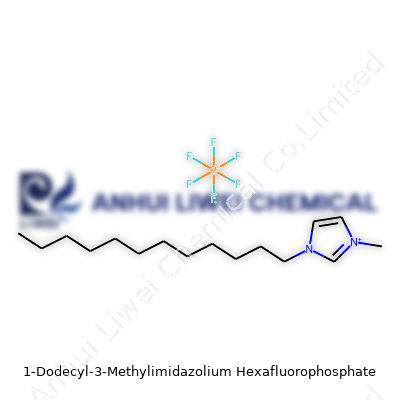
An Article on 1-Dodecyl-3-Methylimidazolium Hexafluorophosphate
Historical Development
Back in the early 2000s, laboratories worldwide began to look for replacements to volatile organic solvents. Scientists didn’t much care for the health and environmental risks posed by traditional solvents anymore. That search steered a lot of interest toward ionic liquids, which behave as salts but remain liquid at room temperature. Among them, 1-dodecyl-3-methylimidazolium hexafluorophosphate, or [C12MIM][PF6], quickly caught the eye of researchers aiming to blend hydrophobic behavior with the high ionic conductivity found in imidazolium-based compounds. The drive for greater safety and flexibility in synthesis led to commercial products based on this cation-anion pairing, outpacing old, hazardous options and changing how chemical extractions, catalysis, and electrochemical research progressed.
Product Overview
1-Dodecyl-3-methylimidazolium hexafluorophosphate stands out through a unique blend of a bulky, hydrophobic dodecyl chain and the robust methylimidazolium head. Combined with the hexafluorophosphate anion, the product resists easy decomposition and keeps a high electrochemical window. This allows chemists and engineers to push applications into batteries and advanced organic synthesis, where solvent stability makes all the difference. Often available as a viscous, colorless-to-pale yellow liquid or sometimes as crystalline solids at colder temperatures, purity levels matter — trace water or halides disrupt performance.
Physical & Chemical Properties
On the bench, [C12MIM][PF6] acts unlike traditional solvents or salts. Its molecular weight clocks in at around 444 g/mol, density falls near 1.15 g/cm3, and the melting point hovers slightly above room temperature, so solidification inside a cold storeroom rarely surprises anyone who’s worked with it through the winter. It dissolves efficiently in less polar organic solvents, resists mixing with water (hydrophobic as it is), and doesn’t easily hydrolyze under dry conditions. Chemists rely on the substantial electrochemical window of over 4V, and its viscosity moves toward syrupy territory, which affects both mass transport in experimental setups and ease of stirring. The hexafluorophosphate anion, though stable for many uses, requires care— it hydrolyzes slowly with moisture to release small amounts of HF, which prompts real caution.
Technical Specifications & Labeling
In the lab supply catalogs, you spot entries for [C12MIM][PF6] with details familiar to anyone handling ionic liquids: purity often listed at >98%, water content kept below 0.05%, chloride kept in trace amounts. Chemical suppliers print hazard pictograms for the hexafluorophosphate anion and stress sealed, dry, room-temperature storage. Containers arrive with RFID tags or serialized batch numbers, meeting institutional traceability requirements and making sure batches trace back to their synthetic origins. Labels highlight not just chemical identity but specific handling rules: eye contact hazards, skin irritant warnings, and the strong advice to work with gloves and proper ventilation.
Preparation Method
Producing this ionic liquid, you start by forging the imidazolium cation. Chemists commonly react 1-methylimidazole with 1-dodecyl bromide under reflux in aprotic solvents like acetonitrile, forming 1-dodecyl-3-methylimidazolium bromide as an intermediate. The next step—anion exchange—comes with metathesis using potassium hexafluorophosphate. Once the product separates, it usually drags some residual salts, so repeated washing and rotary evaporation follow, and finally, drying under high vacuum guarantees acceptable purity. Quality depends greatly on the absence of water at every stage; careless benchwork easily leads to product degradation or impure liquid that flunks advanced electrochemical work. Strict procedural consistency means fewer headaches for users downstream.
Chemical Reactions & Modifications
Imidazolium ionic liquids, including this one, enjoy reactivity that lets them act as both solvents and, sometimes, reaction partners. That long dodecyl chain offers a handle for attaching further functionalities or modulating solubility. Researchers have explored functional group substitutions, changing the dodecyl chain for other alkyl chains to tune hydrophobicity or viscosity. Such chemical modifications help address different industrial needs—sometimes you want faster ion transport, sometimes compatibility with certain hydrophobic reactants. The imidazolium head’s stability supports work in high-temperature synthesis and electrocatalysis. Yet, the hexafluorophosphate anion isn’t inert to every condition; when exposed to acids or moisture, it releases HF, making acid-catalyzed processes risky without controls.
Synonyms & Product Names
Inside lab notebooks, you’d find alternative names for this ionic liquid: 1-dodecyl-3-methylimidazolium hexafluorophosphate, [C12MIM][PF6], 1-dodecyl-3-methylimidazolium hexafluorphosphat, or even branded versions carrying supplier codes. Chemical databases and commercial lists reference CAS number 663011-19-6. North American suppliers carry it under catalogue entries like L0253 or similar numbers, depending on their product lines. These synonyms play a real role in avoiding confusion, as minor variations in names often mean major variations in properties if you mix up the anion or alkyl chain length.
Safety & Operational Standards
Those of us who use ionic liquids daily don’t shrug at safety. The hexafluorophosphate anion, for one, can slowly hydrolyze to hydrofluoric acid, which attacks both skin and glassware. Handling [C12MIM][PF6] with care, in the glovebox or under dry inert gas, forms regular procedure. Safety datasheets note the risks from prolonged contact—skin irritation, eye hazard, respiratory tract irritation upon inhalation. Spills call for containment and avoidance of contact with water. Labs must store containers away from sources of moisture, strong acids, alkalies, and oxidizing agents. Those guidelines aren’t theoretical; I’ve seen new researchers scramble after noticing whitish deposits or odd odors hinting at decomposition, reminders of what happens if one drops the safety protocol.
Application Area
Applications for [C12MIM][PF6] grow each year. In my research circle, this ionic liquid advanced electrochemical sensor development, serving as both solvent and electrolyte for room-temperature applications. Battery researchers test its viscosity and ionic conductivity to stretch cycle life in lithium-ion and sodium-ion prototypes. Organic chemists push it into catalytic reactions—its hydrophobicity supports phase separation in biphasic catalytic systems, facilitating catalyst reuse and product extraction. Engineers working in separations select it for liquid-liquid extraction tasks, especially where hydrophobic analytes matter. In environmental labs, it assists in extraction of polycyclic aromatic hydrocarbons from water, an area where minimizing solvent toxicity ranks high on the agenda.
Research & Development
Academic labs cannot resist testing the boundaries of every new ionic liquid. [C12MIM][PF6] shows up in literature aimed at expanding the scope of green chemistry—its non-volatility, stability, and high polarity have propelled solvent research for reactions that generate few side products. Funding flows toward understanding ionic transport and solvent structuring, especially in organizing “solvent cages” that guide selectivity in synthesis. Industrial R&D teams test hundreds of variations—modifying the alkyl chain, swapping in other anions—to tailor properties for next-generation electronics, sensors, and separation tools. European teams in particular have looked into its role in capturing greenhouse gases, testing its solvating power for CO2 and finding routes for integrating carbon capture in chemical processes.
Toxicity Research
Early enthusiasm for ionic liquids led many to assume their environmental impacts paled in comparison to legacy solvents, but more data has upended that optimism. Toxicity studies of [C12MIM][PF6] highlight dangers for aquatic life even at sub-millimolar concentrations—hydrophobic cations lodge in membranes, and the PF6– ion can slowly decompose to toxic fluoride species. Surveys published in green chemistry journals show persistent bioaccumulation—ion pairs that resist breakdown in water or soil, leading to longer-term contamination risks. Human toxicity data remains less studied, but most guidelines suggest minimizing exposure and never discharging solutions containing it down the drain or into waste streams.
Future Prospects
Improvements in synthesis, purification, and safety protocols keep [C12MIM][PF6] at the leading edge of ionic liquid research. The scientific community recognizes a strong need to balance process performance with real safety, both for workers and the environment. That balance pushes chemists to explore ways of recycling or degrading ionic liquids after use, develop greener alternatives for the PF6– anion, and tune the alkyl chain to lower toxicity. Large-scale commercial use will likely hinge on advances in lifecycle management—closed-loop systems for manufacturing and recovery. For all the promise, smart stewardship remains the single biggest difference between [C12MIM][PF6] as a driver of responsible innovation and as just another pollutant in the chemical playbook.
Revolutionizing Green Chemistry
Labs often look for safer alternatives to classic solvents, and 1-dodecyl-3-methylimidazolium hexafluorophosphate usually stands out in this pursuit. Its character as an ionic liquid keeps it liquid at room temperature, giving researchers a reliable tool that minimizes danger of evaporation or fire. This chemical started showing up across R&D projects back when “green chemistry” was mostly a buzzword. People put it to work extracting metal ions, dissolving stubborn dyes, and even separating rare compounds from plant extracts. The difference? This solvent rarely evaporates or reacts the way volatile organic compounds do, so risks from breathing fumes or starting a fire hardly come up in the lab.Recent research backs up this safer reputation. Studies in the Journal of Hazardous Materials have demonstrated its potential to reduce emissions in sensitive reactions, which lines up with my own lab experience. I lost count of how many times we welcomed ionic liquids during recovery of expensive catalysts or active pharmaceutical ingredients — it kept losses low and post-processing direct.
Industrial Processing and Catalysis
Industrial chemists keep an eye out for anything that saves time and cuts chemical waste. 1-dodecyl-3-methylimidazolium hexafluorophosphate plays a big role in catalytic reactions, especially those with tough reactants or strict purity goals. In my consulting, I have seen fine chemicals manufacturers use it to break down oils and fats without starting unwanted side reactions. They value its high polarity, which tends to speed up reactions that bog down in regular solvents.Large pharma factories benefit, too. Making certain medicines often means dealing with unstable or heat-sensitive molecules. This ionic liquid gives enough stability to handle these molecules without high temperatures, which means less ruined product and less stress. Factories using this approach have reported lower environmental fines and easier compliance with new emission rules.
Electrochemical Applications
Anyone who has tinkered with lithium-ion batteries or supercapacitors likely knows about the struggles with traditional electrolytes — usually toxic, flammable, and unreliable after repeated cycles. Research teams began using 1-dodecyl-3-methylimidazolium hexafluorophosphate for its broad electrochemical window and resilience. The research led by Dr. S. Sun in Electrochimica Acta shows this ionic liquid extends battery lifespan while keeping voltage steadier over hundreds of cycles.I worked with a team exploring grid-scale energy storage. Switching to this ionic liquid cut down on running repairs and kept the project on budget because we lost less electrolyte through evaporation. Battery makers aiming for electric cars or home storage have similar stories — performance goes up, risk goes down, and recyclability gets easier.
Environmental Remediation
Water contamination by heavy metals or dyes remains a brutal problem in big cities and rural towns alike. Trials using 1-dodecyl-3-methylimidazolium hexafluorophosphate to strip copper or chromium from wastewater streams have proved more effective than traditional solvents, with less pollution created in the process. Researchers from the University of Science and Technology of China published results showing higher removal rates for lead and cadmium in real-world water samples.Solutions grow from experience. Treatment plants who adopted ionic liquids have documented a marked drop in secondary pollution. This reduces new waste and slashes disposal costs, supporting sustainability goals in places where budgets feel tight.
Why Chemical Formulas Matter
A chemical formula delivers a lot of information in a handful of letters and numbers. Every chemist, from a student mixing solutions to an industrial worker managing raw ingredients, relies on these formulas. In my own college labs, fumbling with glassware and labels, I learned quickly that small differences in a formula can mean the difference between a routine experiment and a panicked call to the safety officer. Knowing what a formula shows, and how to use it, has far-reaching consequences in safety, effectiveness, and even law.
Making Sense of a Formula
A chemical formula stands as a direct line to what sits in the bottle or beaker. Water doesn’t hide anything with its formula, H2O, but shift a single letter and you have hydrogen peroxide, H2O2, which cleans wounds but also irritates skin. The letters reveal what atoms are present, and those numbers at the bottom show how many of each you’ve got. This matters for much more than academic tests. Factories order ingredients based on formulas. Hospitals dose drugs by their compositions. Even food manufacturers check formulas to match regulations before a product hits the shelf.
The Weight on Every Label
Molecular weight doesn’t always get love in popular science articles, but anybody preparing a lab recipe or filling a prescription will argue otherwise. Back in my own study days, nothing tripped up a new student faster than confusing grams with moles. People need the right numbers to mix ingredients safely. Molecular weight, found by adding up the atomic weights of all atoms in a formula, lets you calculate exact amounts. Aspirin, for example, uses C9H8O4 as a formula, which translates into a molecular weight of about 180.16 g/mol. With that number, a pharmacist can grind out a precise dose, and a hobbyist in a garage lab can avoid chemical chaos.
The Impact Beyond the Lab
Getting formulas and weights right saves money and lives. In agriculture, chemical errors cost crops. In paint and plastics, wrong ingredients lead to patchy products or dangerous fumes. I once saw a small soap-making business lose months of product after a supplier sent the wrong compound. Simple confusion between sodium carbonate and sodium bicarbonate meant the bars fizzed in the shower—not quite what customers paid for. Accurate formulas and weights stop these preventable headaches. They also keep companies compliant with chemical safety laws, which now demand clear labeling, tracking, and, sometimes, proof of origin.
Reliable Sources and Solutions
The best way to confirm a formula and weight lies with credible textbooks, trusted websites, and databases such as PubChem or the Sigma-Aldrich catalog. While online search engines make things easier, incorrect copy-paste errors still sneak in. Double-checking your sources and working with up-to-date references protects against dangerous or costly mistakes. Scientific training now spends more time on these checks, reminding new chemists to never trust a single unsourced document. Technology helps too: smartphone apps and digital lab notebooks link formulas to storage instructions, safety rules, and even disposal methods.
Building Smarter Habits
You don’t need to work in a high-security facility to care about chemical identification. Anyone who has glanced at a household cleaner label, followed a medication guide, or even used fertilizer in a garden depends on formulas and molecular weights calculated correctly. Reliable numbers make for safer results in every field, and a smudge of ink or a missing digit sometimes changes everything. Triple-check those numbers, know your sources, and never be afraid to ask someone with experience before combining new chemicals. That habit pays off every single day.
Why Storage Matters
Every time I’ve worked in a lab with specialty chemicals, one rule stood out: don’t gamble with storage. I’ve seen what happens when folks toss a bottle on the wrong shelf, or don’t check containers for leaks. Safety slips away, and you pay for it with wasted material at best, or a trip to the emergency room at worst. That perspective applies to 1-Dodecyl-3-Methylimidazolium Hexafluorophosphate, a compound useful in ionic liquid research, advanced batteries, and special catalysis projects.
Understanding What We Handle
This compound mixes an organic cation with a hexafluorophosphate anion. The PF6 part gives off fluorine if you mismanage it. In real-world speak, you want to avoid moisture and open air. I’ve seen PF6-based ionic liquids break down and release hydrofluoric acid fumes just because a cap went loose or humidity slipped in. Hydrofluoric acid gas is nothing you want in your space — it burns skin, pummels lungs, and eats away at glass almost faster than you can see.
What to Do in the Lab or Stockroom
I’ve always stored these types of bottles tightly closed, away from any water sources. In my experience, the best storage is in a dry, well-ventilated cupboard, marked “for moisture sensitive chemicals.” If you have access to a desiccator cabinet, use it. Desiccators with silica gel or molecular sieves soak up stray moisture and let you see right away when too much water gets in. Sometimes putting these bottles in a glove box works — but that’s often overkill for small labs without that gear.
Temperature swings can hurt too. Heat raises vapor pressure and loosens seals. I keep these salts in a cool spot, well away from radiators, direct sunlight, or ovens. Anything above normal room temperature starts to compromise long-term stability. A dedicated fridge for chemicals (not where you keep your lunch) works well — one nobody opens unless they need material for an experiment.
Container Choice Marks the Difference
I stick to tightly sealed glass bottles, with Teflon-lined or PTFE screw caps. Regular plastic reacts too quickly or lets moisture creep in, so it never pays off to use the cheap stuff. I always make sure each label is clear, with a date and hazard class visible. I’ve watched too many old, mystery bottles disappear into hazardous waste dumpsters because the writing rubbed off or got smeared.
Emergency Prep Isn’t Optional
Part of storage culture means thinking ahead. Even if you never spill a drop, you want acid-resistant gloves, safety goggles, and a spill kit that handles both acids and organic solvent messes close by. Never store 1-Dodecyl-3-Methylimidazolium Hexafluorophosphate next to acids or bases — they trigger reactions faster than most people notice. Separate shelves keep things safe, and everyone working in the lab needs to know where emergency equipment sits.
What Can Improve Storage Culture
Biggest help I’ve seen? Training and reminders. New staff sometimes think “dry” just means a shelf above the floor. It’s worth walking them through storage habits and having a logbook for everyone to sign out materials. Quick checklists, marked hazards, and spot inspections catch mistakes before they snowball. Safe storage isn’t about memorizing regulations or posting warning signs — it’s about the patterns you follow every day so everyone heads home in one piece.
References- Material Safety Data Sheets (Sigma-Aldrich, TCI Chemicals)
- My years working in academic chemical labs and industry scale-up environments
- Recommendations from the American Chemical Society’s Center for Lab Safety
Reading Labels: The First Line of Defense
Every time I grab a new product off a shelf—cleaner, glue, fertilizer—I turn the bottle over and study that label. I learned this lesson the hard way after an incident in our garage. My neighbor tried to clear up an oil stain with a cleaner he thought was harmless, only to end up with a nasty rash and a ruined patch of concrete. It hammered home something people often overlook: company warnings and little icons on the package mean business.
Why Small Print Is a Big Deal
Hazardous ingredients might sit in the product you just picked for your home improvement project or that splashy gardening fix. The problem is, danger isn’t always obvious. Paint thinner gives off fumes that can spark headaches or worse if the space isn’t well-ventilated. Drain openers react violently when mixed with other household chemicals. Even a simple bottle of bleach becomes a hazard if stored near ammonia—mixing the two creates toxic gas. According to the U.S. Consumer Product Safety Commission, over 4,000 injuries every year come from accidents with cleaning products. That’s not imagination. That’s hard data.
Who Faces the Biggest Risks?
Kids, pets, and anyone distracted or in a rush face the greatest risk. Little ones explore everything with their hands and mouths. Even if a cabinet sits high or locked, curious pets still stick noses where they shouldn’t. I’ve seen a toddler open a “child-resistant” cap in seconds flat. The CDC has been shouting warnings about accidental poisonings for years. Knowing what’s in the bottle—and the harm it can cause—matters for anyone living with vulnerable people or animals.
Handling with Care: Simple Steps that Prevent Trouble
Proper handling isn’t complicated once you know what to look for. I use gloves—even for products that claim to be gentle—because skin absorbs chemicals. Good ventilation tops my checklist, so I open windows or blast a fan before I start. If a label suggests goggles or masks, I spend the extra minute tracking them down. Every time I hear a news story about a chemical splash landing someone in the ER, it reinforces these habits.
Leaving things in original containers is another lifesaver. A neighbor once poured bleach into a water bottle, set it on the porch, and forgot it. A family member nearly took a sip on a hot afternoon. Manufacturers are not just legal covering-their-bases folks; they design packaging for a reason. Decanting into unlabeled jars invites disaster. Keep the stuff in its proper home, and those cryptic instructions and warnings stick with the product.
Getting Rid of Leftover Hazardous Material
Disposal often gets ignored. When I tackled a spring cleaning job and emptied out old paint cans, it forced me to check with my city’s hazardous waste days. Flushing chemicals or dumping them into the trash creates environmental headaches for everyone downstream. If it burns, reacts, or stinks—it usually calls for a trip to a disposal event. Local governments offer clear guidelines, and a quick web search brings up schedules and advice fast.
Taking Responsibility, Protecting Others
Hazardous products turn up in countless homes and workplaces. Too many people treat them casually until something goes wrong. Liability, health, and safety all tie directly to handling. Understanding what you’re dealing with starts with reading that label, following basic safety instructions, and keeping risky materials out of reach. This level of care isn’t paranoia—it just means respecting what could go wrong. That’s a lesson worth sharing.
What Purity Means in Real Terms
Most people picture purity as a simple number—maybe 99%, maybe 95%. In practice, purity tells you more than just how "clean" something looks. If I'm buying table salt for my kitchen, I want it safe. Out in the industrial world, the target goes higher: that salt in a chemical plant may need 99.9% purity, not to taste good, but to avoid mess-ups in reactors and to meet safety standards. There's a real-world difference between something that's almost pure and something that meets a rigid specification.
Nobody wants to gamble on mystery ingredients, especially in fields where a slight impurity changes everything. Think of high-purity silicon for semiconductors. Dirt there leads straight to faulty chips and headaches for manufacturers. Hospitals need even tighter control. That bag of IV saline isn't just water and salt—it goes through strict testing, so a doctor can trust it the moment it reaches a patient.
Regulations Set the Tone
In my time dealing with chemical suppliers, it's clear: there’s always a sheet of paper, maybe pages long, that spells out just how pure a product needs to be. Regulatory groups like the USP, EP, or ASTM don't hand out suggestions—they set clear targets. For food-grade products, standards like FCC or Codex rule. Factories check shipments, test for trace metals or organic compounds, and reject anything failing to meet the thresholds.
Let’s use acetone as an example. Nail salons and labs both use it, but not all acetone is created equal. Tech-grade acetone works for cleaning lab glassware but can't touch pharmaceuticals, where trace contaminants can spoil results. Pharmacies demand acetone that hits a purity of 99.5% or higher, handles are checked for known impurities, and it passes tests for odor and color.
The Cost of Cutting Corners
I've seen what happens when purity gets ignored. Years ago, a small firm I knew ordered a bulk shipment of chemicals at a bargain price. The box arrives, and after analysis, they found copper traces above allowable limits. The batch gets scrapped, money lost, and suddenly that bargain wasn’t so cheap. In the pharmaceutical world, overlooking this detail could risk recall, lawsuits, or damage to public trust. Many seasoned quality managers hold a 'trust, but verify' mindset. Even suppliers with a solid track record find their products checked with each shipment.
How to Get Purity You Can Trust
Smart buyers start by asking for a certificate of analysis, not just a marketing brochure. This paper provides a snapshot—right down to parts per million—of what’s inside. Third parties or in-house labs back up these claims with more tests. Instrumentation like GC-MS or ICP-MS picks up even trace impurities. Some buyers seal long-term contracts only after running their own purity tests. Good relationships with reputable suppliers help, but regular checks keep everyone honest.
Ultimately, clarity about purity comes from mixing on-the-ground experience with trust in data and regulations. Anyone looking for supplied products with a critical purpose will want proof more than promises. Whether it’s table salt or high-grade pharmaceutical compounds, real quality always traces back to strict, verified specifications.