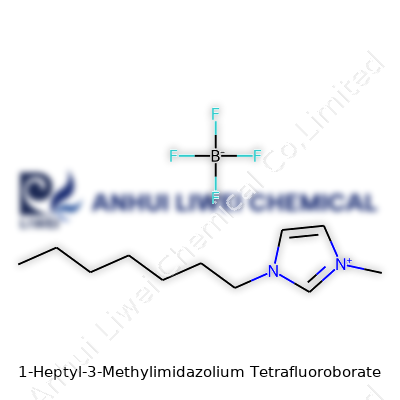
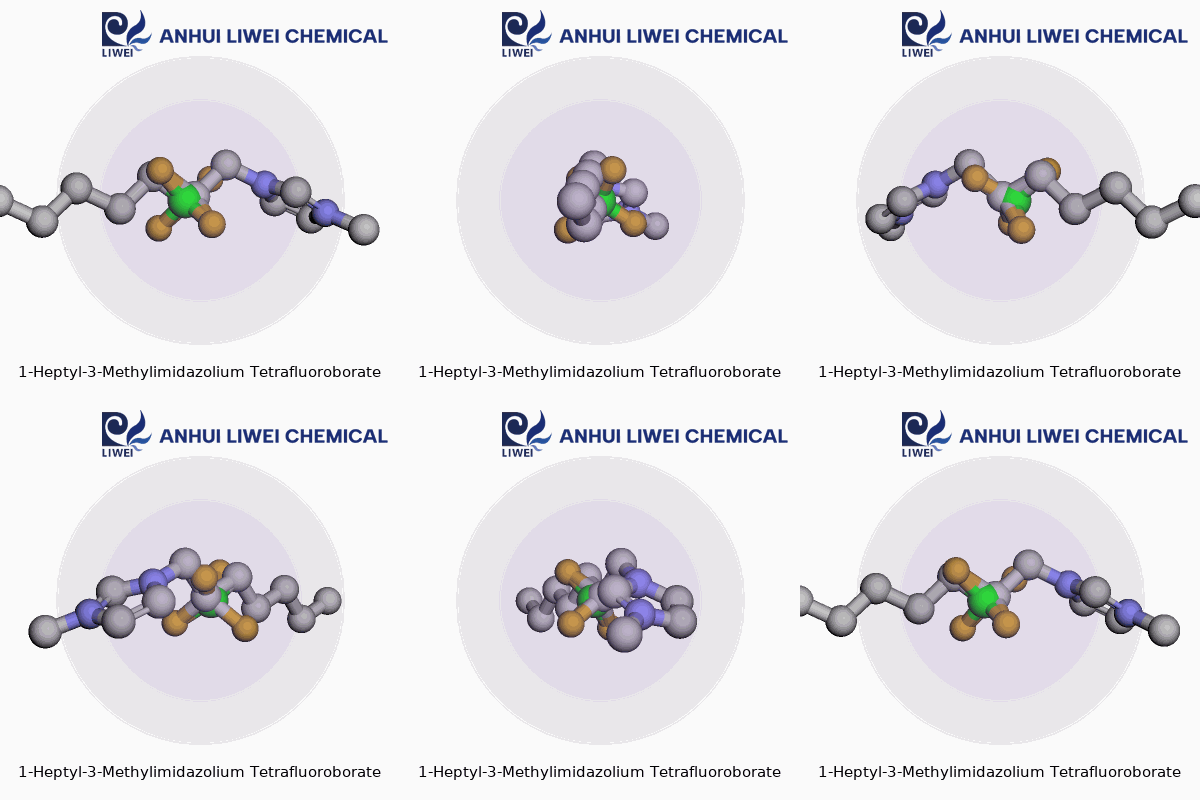
1-Heptyl-3-Methylimidazolium Tetrafluoroborate: A Deep Dive into an Unassuming Ionic Liquid
Historical Development
It’s hard to talk about ionic liquids without thinking back to early breakthroughs in chemistry where scientists pushed past the boundaries of water and solvents with vapor pressures ready to boil away at the drop of a hat. The late 20th century saw a wave of experimentation that put salts in the spotlight, not just as table seasonings, but as potential green solvents. Researchers started mixing cations and anions to form salts that happened to be liquid around room temperature. Among this new breed of materials, imidazolium-based ionic liquids stood out. Chemists discovered that tweaking the side chains attached to the imidazolium ring made it possible to dial in properties like melting point and viscosity. So, 1-Heptyl-3-Methylimidazolium Tetrafluoroborate took shape as both a laboratory curiosity and a practical solution, finding a place on lab benches across the world.
Product Overview
This ionic liquid brings together a heptyl group and a methyl group on an imidazolium ring to form a structure with strong, directional interactions. Its counterpart, the tetrafluoroborate anion, adds chemical stability and makes the overall liquid highly resistant to both water and oxygen. In the bottle, the compound looks oily and colorless, sometimes picking up a faint tint because of trace impurities. The blend of alkyl chain length and the imidazolium core boosts compatibility with a broad range of solutes, both organic and inorganic. In the field, scientists often rely on this compound in synthesis, extraction, and electrochemical applications, chasing improvements in efficiency and environmental compatibility.
Physical & Chemical Properties
1-Heptyl-3-Methylimidazolium Tetrafluoroborate typically remains in a liquid state at temperatures slightly above room temperature, with a melting point falling between 5 and 20°C depending on sample purity. Density tends to hover around 1.1 g/cm³. Water solubility is limited, so it tends to form two phases with water unless you force it otherwise with vigorous mixing or additives. The electrical conductivity clocks in much lower than traditional aqueous electrolytes, but the ionic mobility remains sufficient for electrochemical processes involving slow, controlled ion exchange. The viscosity feels a little syrupy to the touch, something you’ll notice during handling, though it flows far better than many longer-chain analogues. Tetrafluoroborate often gets picked for its hydrolytic stability compared to more easily decomposed anions like PF₆⁻.
Technical Specifications & Labeling
Manufacturers assign CAS numbers and purity grades to every batch. Purity often runs at 98% or higher, with residual water and halide content kept as low as possible since even trace amounts can influence performance in sensitive reactions. Labels list storage precautions, including airtight containers and temperature ranges from 2 to 30°C. Proper labeling highlights the chemical structure, hazard pictograms according to GHS standards, and emergency procedures for accidental skin or eye contact. Regulatory numbers give peace of mind for those working in labs conforming to ISO guidelines or REACH compliance in Europe.
Preparation Method
Synthesis of this ionic liquid usually starts with 1-methylimidazole and 1-bromoheptane. Combine them under reflux in a dry, inert atmosphere to keep moisture out and drive the reaction to completion. The resulting heptyl-methylimidazolium bromide salt moves on to an anion-exchange process, typically with sodium tetrafluoroborate in water or suitable organic solvent. Stirring transfers the BF₄⁻ anion, then the organic phase is separated, washed multiple times with water to strip out sodium bromide, and dried under vacuum to remove lingering moisture. Recrystallization may follow to hit tighter purity targets, though often, after vacuum drying, the compound comes out ready for most research or industrial uses.
Chemical Reactions & Modifications
The imidazolium core offers a sturdy foundation, but some chemists like to tweak the side chains for special purposes. Adding bulk near the nitrogen can tune solubility and viscosity even further. The tetrafluoroborate anion doesn’t react much unless exposed to strong acids or bases, which can cause slow decomposition and release of boron fluoride compounds, so users avoid extremely harsh conditions. Under milder circumstances, the ionic liquid behaves inertly, making it a true workhorse for catalysis, extraction, and electrodeposition work. Mixing in functionalized additives can turn the base liquid into task-specific solvents for metal extraction, gas absorption, or drug formulation.
Synonyms & Product Names
Chemists sometimes call this compound [HMIM][BF₄], where HMIM stands for 1-Heptyl-3-Methylimidazolium. The more formal names show up in academic papers: 1-Heptyl-3-Methylimidazolium Tetrafluoroborate or Heptyl Methyl Imidazolium Tetrafluoroborate. Suppliers stick to systematic labeling, sometimes abbreviating as C7mim BF₄. Customers may see catalog listings under names like Ionic Liquid 701 or Tetrafluoroborate Heptylmethylimidazolium, depending on their distributor.
Safety & Operational Standards
Handling safety tops the priority list. Direct contact can cause mild skin and eye irritation, though the liquid isn’t known for severe acute toxicity. Lab workers wear nitrile gloves, goggles, and long sleeves for good measure. Inhalation rarely poses a problem due to the compound’s negligible vapor pressure, but care during heating or vacuum drying prevents accidental aerosols. Waste disposal follows guidelines for organofluorine compounds, including containment and transfer to dedicated waste streams. The tetrafluoroborate ion remains stable under normal lab conditions, but strong acids or bases should stay clear to prevent breakdown. Emergency showers and eyewash stations stand ready, but in practice, the material’s risk profile fits comfortably below more aggressive industrial chemicals.
Application Area
Ionic liquids such as 1-Heptyl-3-Methylimidazolium Tetrafluoroborate found a home in green chemistry labs trying to move away from volatile organic solvents. Electrochemists reach for it in battery and capacitor development, where stability at both electrodes matters. The compound often steps in to extract rare earths or transition metals from mixed ore, offering high selectivity without boiling off harmful solvents. Synthesis of fine chemicals benefits from low volatility and recyclability, cutting down on both process losses and worker exposure. Pharmaceutical researchers weigh its use in drug delivery and formulation, exploring how the ionic core can help shuttle tricky molecules across biological barriers. It also pops up in analytical chemistry for sample pretreatment and extraction, valued for its broad compatibility and tunable properties.
Research & Development
Research groups keep pushing the envelope on ionic liquid design. Functionalized analogues build on the heptyl/methyl imidazolium scaffold, adding new functional groups for targeted metal capture, pollutant absorption, or selective catalysis. Spectroscopic studies dig into molecular dynamics in different environments, hoping to unravel how side-chain length and branching influence bulk properties. Electrochemical studies measure stability windows, cycle life, and compatibility with electrode surfaces. The biggest challenge comes from balancing ionic liquid price against performance gains; while these materials often bring unique advantages, their cost keeps them confined mainly to high-value applications for now. Academic groups and industrial chemists continue to hunt for synthesis methods that deliver better price points or easier recycling.
Toxicity Research
1-Heptyl-3-Methylimidazolium Tetrafluoroborate does not usually bioaccumulate or persist in natural systems, since it hydrolyzes over time in moist environments. Acute toxicity in animal studies sits low on the hazard scale, though extended exposure can cause irritation and organ stress in small mammals based on dose and frequency. Safety data sheets emphasize avoiding ingestion or direct injection due to lack of longitudinal data in humans. Water treatment facilities keep an eye on the breakdown products, especially where higher concentrations might meet surface or groundwater. Continued studies watch out for chronic exposure patterns, but evidence points to manageable risk with routine lab precautions. Regulatory groups maintain surveillance, periodically updating exposure limits and safety classification as more information comes in.
Future Prospects
The road ahead for 1-Heptyl-3-Methylimidazolium Tetrafluoroborate looks promising on several fronts. Green chemistry keeps gaining importance, and ionic liquids represent a chance to shrink carbon footprints in manufacturing, extraction, and catalysis. Material scientists refine synthetic protocols to cut energy and raw material input, hoping to scale up industrial adoption. Researchers working on next-generation batteries and supercapacitors look for better electrochemical stability and recyclability, seeing ionic liquids as key players. Environmental chemists monitor breakdown and recovery in natural settings, aiming to balance performance with responsibility. Global networks of suppliers and users pool safety and performance data, shaping best practices and paving the way for more sustainable use across industries. Every new application deepens the understanding of these versatile liquids, setting the stage for discoveries that stretch beyond today’s boundaries.
A Simple Look at What This Chemical Brings to the Table
1-Heptyl-3-methylimidazolium tetrafluoroborate often finds itself in the toolbox of chemists and engineers who want safer, cleaner alternatives to traditional solvents. Chemists call this substance an ionic liquid, but that jargon hides practical benefits. It looks almost like oil, but avoids the fire risk of many other liquids. I have stood in a lab, grateful for an option that does not fill the room with flammable fumes. That peace of mind alone deserves recognition.
Giving Green Chemistry a Real Option
Years spent sifting through research talk about “sustainability,” but most still count on harsh, petroleum-based chemicals in daily work. Swapping those liquids for something like 1-heptyl-3-methylimidazolium tetrafluoroborate helps. It resists evaporation, does not ignite easily, and allows chemists to cut back on hazardous waste. Researchers at the University of York, among others, used it to separate natural compounds from plants without the mess and risk of ether or chloroform. Instead of a roomful of sharp-smelling solvents, they wound up with a tidy process and easier clean-up.
Supporting Energy Storage and Batteries
Electrochemistry labs give this compound a place in their batteries and devices. I remember reading papers from battery researchers who tired of water and standard organic solvents corroding their parts. They tested ionic liquids for supercapacitors and new battery types, finding that 1-heptyl-3-methylimidazolium tetrafluoroborate stays stable over a wide voltage range and does not break down easily. Devices ran longer, handled higher currents, and did not lose capacity as quickly. In practice, this leads to phones, power tools, and even electric vehicles that hold a charge longer and work in more extreme weather.
Helping the Pharmaceutical Industry Extract Purity
Drug making demands precise separations and high-purity ingredients. The pharmaceutical industry has turned to this ionic liquid as a way to pull chemical building blocks apart or remove contaminants with less energy and water use. Pfizer and other big firms released studies on the potential to streamline steps once carried out with gallons of harsh acid or base. I remember how tedious it felt to evaporate strong acids off precious samples—now the job calls for milder conditions and gives better recovery in many cases. This change saves time and cuts costs without sacrificing reliability.
Bringing Down Pollution from Industrial Processes
Traditional chemical plants often vent volatile solvents into the atmosphere, adding to smog and posing health risks. 1-heptyl-3-methylimidazolium tetrafluoroborate, thanks to its low vapor pressure, keeps those emissions in check. Researchers in Spain used it to process cellulose, avoiding noxious clouds and improving worker safety. After use, the ionic liquid gets recycled or regenerated, instead of needing disposal. From my time consulting in green chemistry, these changes steered plants toward cleaner air and helped meet stricter environmental rules without massive investment in new equipment.
Room to Improve: Tackling the Challenges
Ionic liquids cost more than common solvents, especially in large amounts. Manufacturing raw materials still requires careful handling. Broader adoption calls for more innovation, so teams are developing ways to recover and reuse them more efficiently. The future seems promising—scientists already report new blends that boost performance, reduce cost, and minimize environmental impact even further. By working across lab, factory floor, and supply chain, companies and researchers can deliver more benefits from compounds like this one where safety and sustainability really count.
Understanding What’s at Stake with Stability
1-Heptyl-3-methylimidazolium tetrafluoroborate, or [C7mim][BF4], pops up as a favorite among researchers exploring ionic liquids. From personal experience in an academic lab, one quickly learns that stability isn’t just a checkbox—it controls safety, shelf life, and usefulness in experiments or processes. I’ve seen what happens when an ionic liquid breaks down mid-reaction. Without fail, good data turns into a mess and glassware often pays the price.
How [C7mim][BF4] Handles the Lab Environment
This compound looks like it packs a punch with its thermal stability. Studies show it holds together up to 300°C, well above the operating temperatures found in most synthetic or extraction setups. Still, don’t let that number give a false sense of security. Even at room temperature, water in the air can slowly start to push the tetrafluoroborate anion to give off a little bit of hydrogen fluoride. Hydrogen fluoride is corrosive and toxic—even a trace amount stings the nose and makes a tough clean-up job. Anyone who doubted that fact and stored sample vials outside a glovebox, learned quickly to scan labels and store such compounds tightly capped.
Light doesn’t push [C7mim][BF4] too hard, but direct sunlight over days can speed up decomposition. I remember a forgotten vial left on a sunny window ledge. It lost clarity and gained a faint whiff, reminding me that ignoring warnings on storage does more than just fade the label text. So, darkness and dryness make a big difference for shelf stability. Labs use amber bottles and silica gel for a reason.
Chemical Interactions and Decomposition Risks
The chemical structure tells another story about its stability. The imidazolium ring and long heptyl chain give a stable platform, but the BF4– anion acts as the weak link. Strong acids or bases break it down fast, and that can spoil reactions that rely on predictable ionic behavior. During my time working with metal complexes, I saw unwanted side reactions pop up when we left [C7mim][BF4] in contact with Lewis acids—a rookie mistake. The result: messy solutions and questionable yields.
The Safety Perspective
Anyone around ionic liquids learns to watch for decomposition by-products. Hydrolysis of BF4– can eventually produce hydrofluoric acid, and even minute spills mean using gloves and face shields. After a student accident in our lab—just a drop on the bench—decontamination drills became regular practice. Repeated experiences like that push for sealed systems and regular purity checks.
Charting a Wiser Course
Reducing exposure, limiting contact with water and storing under argon or dry nitrogen is practical wisdom—not just academic advice. Small steps, like using a desiccator for open containers, make a difference. Recent research suggests swapping out BF4– for more robust anions in greener processes could keep performance strong and raise safety. In some recent syntheses, using bis(trifluoromethylsulfonyl)imide (NTf2) anions kept up ionic liquid benefits with even better resilience against breakdown.
Final Thoughts: Treat It With Respect
Predictable behavior in the flask depends on knowing your chemicals don’t decompose before your eyes. For [C7mim][BF4], watching humidity, light, and reactivity pays off. Experience in the lab proves that reliability comes from respect for the material, not just its impressive stats.
Putting Chemical Safety in Perspective
1-Heptyl-3-methylimidazolium tetrafluoroborate often shows up in labs working on ionic liquids or green chemistry. The long name doesn’t change the fact that safe storage matters as much at home labs as it does in bigger research settings. Overlooking a liquid’s storage risks means turning a blind eye to health and the environment—two things we can’t afford to gamble with. Tech companies, researchers, and even small producers all need clear habits at the bench and in the storeroom.
Keys to Safer Storage
Start by knowing the chemical’s personality. 1-Heptyl-3-methylimidazolium tetrafluoroborate sits among ionic liquids, which often resist water, yet don’t ignore moisture. Tetrafluoroborate salts may react slowly with water to give off corrosive gases like hydrogen fluoride. Shelving a bottle right by the sink or under an open window sets up real trouble. Humidity enters and starts reactions you might not notice immediately.
Glass works well for storage, as this liquid won’t eat through it the way some acids would. I’ve always kept mine in tightly sealed amber bottles, away from sunlight, heat sources, or any wild temperature swings. My mentor drummed into us that darkness gives an added layer of protection, as light sometimes nudges chemicals to break down. Watching for cracked seals and keeping backups in hand makes it easy to swap bottles before leaks start giving headaches.
Room Design and Organization
Some might stash specialty chemicals on open shelves for convenience—but open shelves leave too many things exposed to light, heat, and air. Cabinets with clear labeling save time and mess in an urgent moment. For years, I kept flammable solvents and potential toxins separated by shelf and cabinet type. Ionic liquids like this one don't catch fire easily, but the container still keeps out dust and air, which protects both the user and the sample.
Temperature changes can mean big shifts inside the bottle. Cold might bring out crystals, heat could push vapor pressure higher than expected. Lab fridges—designed for chemicals—make a difference, bringing peace of mind. Avoid crowding the fridge with food or drinks. Segregating chemicals with similar needs reduces confusion and mistakes during routine checks or emergencies.
Labeling and Communication
Skipping labels sparks confusion for colleagues. Every bottle in my lab carries a clear label, showing the full chemical name and hazard warnings. In a shared lab, a missing label wastes time, but it could also mean a dangerous mix-up in an emergency. Training new researchers to recognize the right storage habits cements a safety-first culture.
Extra Steps for Long-Term Storage
Regularly check on bottles to catch early leaks, cloudiness, or sludge at the bottom. I’ve never regretted setting aside time to inspect chemicals and update logs. Desiccators hold value when extra dryness counts. Silica gel packs inside a sealed bag can go the extra mile for long-term reserve bottles.
Planning for Spills and Problems
A small spill might seem minor but mishandling 1-heptyl-3-methylimidazolium tetrafluoroborate can bring skin and eye irritation. I always train newcomers to wear gloves, goggles, and keep spill kits close at hand. Quick access to Material Safety Data Sheets clears up confusion during clean-up, so everyone knows how to act smart and fast.
Leading By Example Creates a Safer Work Space
Following smart storage practices doesn’t slow down progress in the lab—it keeps people safe and products pure. The habits you set now ripple into every experiment and every interaction. Chemistry rewards those who plan ahead and treat each bottle as more than a name on a label.
Understanding the Chemical
Some researchers see ionic liquids like 1-Heptyl-3-Methylimidazolium Tetrafluoroborate as a breakthrough. They don’t evaporate easily, and they dissolve a wide range of materials. Labs use them for catalysis, separations, and electrochemical studies. But with usefulness comes responsibility, since these chemicals can do harm if folks treat them lightly.
What Makes This Chemical Worth Caution
Long, mouthful names in chemistry often signal molecules designed for specific work but carrying their own set of risks. Tetrafluoroborate anions have a reputation for releasing toxic gases if they contact water or acids. I’ve seen students ignore warnings about boron-fluoride salts, trusting their low volatility, only to call for help once the pungent odor of hydrogen fluoride alerted the building.
Most ionic liquids don’t have published long-term toxicity data. That means the usual warnings about what they might do to skin, lungs, or water supplies carry extra weight. New doesn’t always mean inherently safer, especially without years of health research to lean on.
Precautions Before Opening the Bottle
Good habits start before the seal breaks. Inspect packaging for leaks or pressure build-up, and read the material safety data sheet (MSDS) from a reliable source, not just a random download. The document nails down the best gloves, usually good nitrile, and reminds you of splash protection. Some ionic liquids eat through cheap polyvinyl gloves or stick around after washing, so I don’t skip double-gloving for unknowns.
Choose a workspace with strong airflow, either a chemical fume hood or a well-maintained exhaust system. These steps seem simple, but opening a bottle in an open lab space can fill a room with fumes faster than you’d expect. The day I got lazy with a “non-volatile” reagent, the sting in my eyes reminded me how little it takes to cut corners.
During Use: Eyes, Skin, Lungs
Splash goggles hang beside fume hoods for a reason. Tetrafluoroborate can irritate or burn eyes and skin on contact. Even trace splashes need an eyewash bottle within arm's reach. I’ve seen more than one peer realize too late they wish they had a clean water source handy.
Direct inhalation brings bigger risks than you’d think. Gloves, goggles, and lab coats don’t handle everything. Some colleagues use a face shield if there’s any heating or transfer under pressure, since accidental spattering proves more common than anyone wants to admit.
I always keep calcium gluconate or similar neutralizers on my bench where strong fluorides might come into play. Quick access can limit the damage of small spills, especially before medical help arrives.
Storage and Disposal
Humidity introduces new dangers with these salts. Secure, tight containers and dessicators avoid accidental hydrolysis and unexpected gas formation. Only trained personnel should handle storage to prevent mix-ups. Dedicated waste containers, labeled and separated from general solvent waste, avoid cross-contamination. One slip into the wrong drum may release toxins nobody wants to breathe. I label waste in clear block letters as a reminder both for myself and others using the same bench.
Why Culture Matters
No policy beats a safety-focused lab culture. New faces in the lab learn most by example, not rules posted on a bulletin board. If the most experienced chemists emphasize careful handling—asking questions, modeling glove changes, or swapping out goggles at the right moment—that attitude sinks in. Cutting corners adds risk for everyone. My own habits grew stronger watching supervisors tackle routine tasks with the same seriousness they gave to the “big” experiments.
Every ionic liquid has its quirks. With 1-Heptyl-3-Methylimidazolium Tetrafluoroborate, clear eyes, good gear, careful habits, and a little humility protect both the experiment and the experimenter.
Getting a Handle on Ionic Liquids
Anyone working in the lab with ionic liquids quickly learns not all of them agree with water or organic solvents. People eye 1-Heptyl-3-Methylimidazolium Tetrafluoroborate, wondering where it sits on this spectrum. This substance, mouthful of a name and all, brings up debates for good reason: labs look for solvents that cooperate with each other for clean, easy reactions and separations.
Breaking Down Its Chemical Nature
Here’s what’s inside: a seven-carbon heptyl chain, a methylimidazolium cation, and a tetrafluoroborate anion. That heptyl chunk tilts the molecule towards hydrophobic territory. That means water, the universal solvent, usually pushes this kind of material aside.
Try mixing 1-Heptyl-3-Methylimidazolium Tetrafluoroborate with water, and two layers often show up instead of one. Even with a vigorous shake, most of it doesn’t want to dissolve. Hydrophobic alkyl chains tend to ball up and shove water molecules out, so there’s not much room for blending in aqueous systems. Researchers repeatedly report its poor blending with water, based on simple shake tests or NMR studies. This trait stands in sharp contrast to imidazolium ionic liquids with shorter tails, like ethyl or butyl groups, which jump into water much easier.
Organic Solvents Step In
Flip open a bottle of organic solvent, and things start getting friendlier. Solvents like dichloromethane, ethanol, or acetone bond easily with that long non-polar chain and the rest of the cation. In my years in the lab, pouring in most common organic solvents pulled this ionic liquid right in without much coaxing. It blends because those solvents balance out the hydrophobic and polar parts, so nothing gets excluded.
Solubility tests back up what people see in the flask. Groups worldwide find high miscibility with mid-polar and nonpolar organic solvents. This lets chemists fine-tune solvent systems for tasks like extraction, separation, or catalysis. Need to separate products from water-based reactions? Add this ionic liquid to an organic layer and you open up a fast, clean solution path. People appreciate this flexibility in green chemistry, because tailored solvent mixes often cut down on volatile organic compounds and waste.
Why Does Miscibility Even Matter?
Folks hope to design processes that leave the door open to greener chemistry. Many industries—pharmaceuticals, fine chemicals, materials science—run complex separations and catalytic reactions. If you’re left with a tough separation job, a poorly chosen solvent can gum up the works and waste hours. If your ionic liquid ignores water, you skip long distillations. Pour off one layer, save resources, and reduce hazards.
A chemist worried about toxic solvent waste can use these tailored ionic liquids to fit their process. Since 1-Heptyl-3-Methylimidazolium Tetrafluoroborate loves organic solvents but not water, you can recover your valuable products efficiently—even extract with less effort—if you plan ahead. You free up time and keep dangerous emissions down.
Next Steps for Better Processes
Getting the best out of these systems means understanding their solvent preferences. In my own work, trial and error helped, but reading up on polarity scales, solvent interaction diagrams, and recent papers cut down the time spent guessing. If you need better mixing with water, shorter alkyl chains or swapping the anion may help. Safer, smarter, cleaner processes grow from handling these fundamental chemistry lessons.