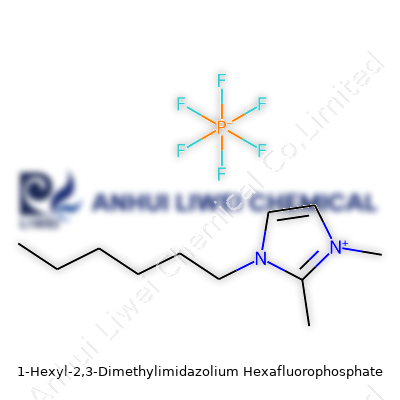
1-Hexyl-2,3-Dimethylimidazolium Hexafluorophosphate: A Comprehensive Look
Historical Development
Ionic liquids haven’t been around forever. In the late ‘90s and early 2000s, chemists took a hard look at alternatives to the flammable, volatile solvents crowding labs, and saw potential in compounds where organic cations teamed up with inorganic anions. Compounds like 1-Hexyl-2,3-Dimethylimidazolium hexafluorophosphate, often abbreviated as [C6mmim][PF6], owe their existence to that research momentum. Folks working with classical imidazolium salts found that longer alkyl chains on the imidazole ring tweaked solubility and viscosity in ways classic solvents just couldn’t manage. As industry and academia started needing substances that could stay liquid at room temperature and survive under demanding electrochemical conditions, chemists set their sights on the versatility of imidazolium-based products.
Product Overview
At its core, 1-Hexyl-2,3-Dimethylimidazolium hexafluorophosphate is a room-temperature ionic liquid. It packs a bulky organic cation (with that tell-tale hexyl chain) paired with the robust PF6 anion. This combination delivers liquid-state stability beyond what’s possible in many other organic salts. As demand for non-volatile, thermally stable liquids grew in the last two decades, this compound popped up more and more in R&D labs and specialty markets, particularly where non-aqueous environments are critical—think inside advanced batteries, electrochemical cells, separation technologies, and beyond.
Physical & Chemical Properties
The colorless to pale yellow liquid shows up without a strong odor, and usually refuses to evaporate at room temperature. High thermal stability is one of its claims to fame, resisting decomposition at temperatures most common organic solvents buckle under. The viscosity comes in fairly high—higher than water or simple organics—which affects how quickly ions and molecules slide past each other inside it. Water solubility? Pretty negligible. That’s intentional, as chemical engineers and battery manufacturers want hydrophobic performance, especially to avoid issues with water-sensitive components. Its high ionic conductivity and electrochemical stability (thanks to the non-coordinating nature of the PF6 anion) help it stand out from the crowd of alternatives.
Technical Specifications & Labeling
1-Hexyl-2,3-Dimethylimidazolium hexafluorophosphate usually arrives with clear labeling, including CAS number, batch information, purity rating—often upwards of 98%—and information on water and halide content, which tend to matter in precision electronics and pharmaceutical contexts. The packaging is engineered for dry environments, as even trace moisture can impact applications in energy storage or synthesis. Storage recommendations typically mention cool, dry, and well-sealed conditions to minimize the risk of PF6 hydrolysis and associated formation of HF, which is undesired under any working condition.
Preparation Method
Manufacturers synthesize [C6mmim][PF6] in a couple of steps, starting with alkylation of 2,3-dimethylimidazole using 1-chlorohexane or a similar halide. That step forms the imidazolium chloride salt. Then, metathesis with potassium hexafluorophosphate or sodium hexafluorophosphate gives the final product. The process isn’t forgiving of sloppy technique: impure starting materials or careless washing can leave behind halide ions or unreacted precursors, which interfere in sensitive applications. Post-reaction washing with organic solvents like dichloromethane, then drying under vacuum, typically yields a product fit for most research and industrial scenarios.
Chemical Reactions & Modifications
The imidazolium core gives room for functionalization, and chemical groups can be swapped or extended along the alkyl chain to tune solubility, viscosity, melting points, and interaction with target compounds. In the lab, it holds up under strong reducing or oxidizing conditions—something that traditional organic solvents often can’t offer. While the PF6 anion is chosen for its low nucleophilicity and chemical robustness, the cationic head remains a site for experimental tweaks. Some chemists have swapped it with bis(trifluoromethylsulfonyl)imide (commonly abbreviated as TFSI) or other anions to broaden the working range for electrochemistry and catalysis.
Synonyms & Product Names
Trade literature and research papers often refer to the compound as [C6mmim][PF6] or Hexyl-dimethylimidazolium hexafluorophosphate. The product turns up under various proprietary names depending on the supplier. It’s wise to double-check the labeling and structure, especially where isomerism or different chain lengths might sneak into the mix. No matter the name, the hexyl and dimethyl imidazolium head, plus PF6, define the chemical backbone.
Safety & Operational Standards
Lab work with [C6mmim][PF6] calls for respect. Direct skin contact is discouraged; gloves rated for chemical resistance are routine. The PF6 anion, under hydrolysis or when poorly handled, generates hydrogen fluoride—a substance to absolutely avoid breathing. Lab ventilation, PPE including goggles, and safe storage practices save trouble down the line. Waste disposal follows strict guidelines: no pouring down drains, and used material needs storage in dedicated hazardous waste containers. Safe handling protects not just people, but the sensitive setups where contamination or mishandling can throw entire experiments off track.
Application Area
[C6mmim][PF6] stretches across specialized uses. It’s made its strongest mark in electrochemistry—high-power batteries, supercapacitors, and ionic liquid-based dye-sensitized solar cells see the clear benefit of ionic conductivity and stability. In organic synthesis, it serves not just as a solvent, but sometimes as a reaction promoter, driving faster reactions at higher selectivity compared to volatile solvents. Researchers working on gas separations take advantage of its negligible vapor pressure and ability to dissolve gases like CO2 at different concentrations, making it attractive for carbon capture. In analytical chemistry, it finds use as an extraction medium or as a stationary phase additive in chromatography. The chemical’s hydrophobicity and resistance to breakdown open doors for robust applications that don’t tolerate water or oxygen.
Research & Development
Research teams keep pushing the limits for ionic liquids in green chemistry, and [C6mmim][PF6] ranks high on their lists. By reducing waste, ditching flammable solvents, and enabling reactions at mild temperatures, these liquids claim a rightful space in sustainable chemistry. Published studies compare it with imidazolium liquids of different chain lengths or with varying anions, looking to fine-tune everything from reaction rates to selectivity and long-term material stability. Ongoing research looks for ways to recycle or reprocess these ionic liquids economically, given sourcing and production costs. Upcycling or decomposition studies are ongoing, aiming to close the loop on environmental impact and open new industrial possibilities. Academic and corporate partnerships drive pilot projects that test the waters for full-scale commercialization, bridging the gap from lab to factory floor.
Toxicity Research
Toxicology teams take the health and environmental impact of new chemicals seriously. With [C6mmim][PF6], cell line and aquatic toxicity studies highlight moderate hazards at higher concentrations. The PF6 anion presents a risk if degraded under moist, acidic, or high-heat conditions, given how it can form HF. Chronic exposure data remains limited, though acute studies show that handling with basic chemical hygiene keeps risks low. Unlike most classic organic solvents, this ionic liquid does not evaporate away, so concerns about vapor exposure stay low. Still, regulatory bodies keep a close eye on disposal, persistent environmental buildup, and long-term effects. Pursuing more biodegradable ionic liquid designs forms a running thread across recent environmental chemistry publications.
Future Prospects
Advances in electrochemical systems, renewable energy technologies, and greener industrial processes keep the door open for compounds like [C6mmim][PF6]. Synthetic chemists, battery engineers, and sustainability advocates all stand to gain where safer, more stable solvents make industrial processes less hazardous and wasteful. Customers looking for high-performance media that won’t degrade easily are paying attention as improved versions come to market—whether through smarter cation design, alternative anion pairing, or smarter production processes. As regulatory agencies and the end users call for better environmental profiles, makers push to develop variants with lower toxicity and higher recyclability. The research field continues to grow, pulling together fundamental chemistry, environmental science, and advanced materials to make better use of what ionic liquids have to offer.
The Rise of Ionic Liquids in Industry
Not every chemical turns industry heads, but 1-Hexyl-2,3-Dimethylimidazolium Hexafluorophosphate (sometimes called [C6m2im][PF6]) has found its way into a surprising range of uses. It falls into the family of ionic liquids—a group prized for their low volatility and unique solvation abilities. Engineers look for chemicals that can stand up to both heat and demanding chemistry, and this one meets those challenges. Having spent years with chemical process teams, I’ve seen these liquids move from research curiosity to real-world application.
Electrochemistry and Energy Storage
People in the battery world know just how much safety and performance matter. Regular electrolytes in lithium batteries can catch fire under stress, but ionic liquids like this one barely evaporate, even at high temperatures. Labs working on next-generation supercapacitors and rechargeable batteries often swap out volatile solvents for [C6m2im][PF6] to cut down on risks and push energy limits higher. Its stability allows for battery cycles that last longer and charge faster, all with less risk of leaks or breakdown. Publications from the Journal of Power Sources and Electrochimica Acta show that using these alternatives has led to marked improvements in both safety and cycle life.
Green Solvent for Organic Synthesis
Chemists have always hunted for ways to make reactions cleaner, safer, and less wasteful. Traditional solvents like acetone or chloroform pollute air and water, which pushes up costs and environmental headaches. In research benches and small pilot plants, 1-Hexyl-2,3-Dimethylimidazolium Hexafluorophosphate lets teams ditch those solvents. Its ionic structure can dissolve both polar and non-polar compounds, making it handy for reactions that stubbornly refuse to run otherwise. I remember working with a group tackling stubborn Suzuki couplings—swapping to [C6m2im][PF6] slashed toxic fumes and let us recycle more of our reagents.
Separation Science and Analytical Chemistry
Analytical labs need to pull out trace substances from complex mixtures—think water testing or pharmaceutical QA. Classic liquid-liquid extractions often use harsh organic chemicals. This ionic liquid steps in as a replacement, thanks to its ability to solubilize both ionic and organic species. In practice, labs have cut down on hazardous waste and streamlined workflows. According to reviews in Analytical Chemistry, methods using these newer solvents increase extraction efficiency for heavy metals, dyes, and certain drugs out of biological samples. It’s a change that not only speeds up work, but also reduces handling risks for lab workers.
Other Promising Uses and Responsible Adoption
As more industries roll out “sustainable” headlines, chemicals like this ionic liquid are moving into catalysis and material design. Polymer researchers use it to fine-tune plastic textures and create conductive films for electronics. In the world of solar cells, [C6m2im][PF6] acts as a charge-transport layer that stands up to both sun and moisture, giving panels a longer field life. The push for green chemistry is real, but no chemical comes free of toxicity or disposal issues. Manufacturers have to weigh gains in safety and efficiency against potential environmental impact when the product reaches end-of-life. It calls for updated regulations, better recycling strategies, and transparency in reporting both benefits and risks.
Real-World Experience with Stability in Ionic Liquids
Every chemist who spends time working with ionic liquids like 1-Hexyl-2,3-Dimethylimidazolium Hexafluorophosphate (C6C1C1ImPF6) knows the value of a reagent that holds up under pressure: heat, light, and common contaminants. Here, stability doesn’t just matter for a tidy shelf—it makes the difference between success and failure in labs that need consistency day after day.
Why Stability Matters in Practice
A lab running regular syntheses needs to rely on ionic liquids not losing their edge over time. No one wants their electrolytes degrading from exposure to moisture or air, leading to confusion about whether unexpected results come from operator error or perishable chemicals.
Key Points That Shape Real-World Shelf Life
Moisture SensitivityPeople sometimes treat ionic liquids as bulletproof. Experience says otherwise. PF6-based ionic liquids like C6C1C1ImPF6 are especially known for picking up water from the air. Once water gets in, hydrolysis kicks off, creating hydrofluoric acid—a troublemaker both for lab equipment and data reliability. Just a week of poor storage in a humid room can cause a drop in purity.
Thermal StabilityThermal runway in ionic liquids doesn’t start out of nowhere. Research points to C6C1C1ImPF6 holding steady up to about 350°C—solid for most everyday experiments. That said, higher temperatures over long periods do nudge the PF6 anion toward decomposition, breaking down into toxic or corrosive products and shortening the shelf life.
Air and Light ExposureThis ionic liquid doesn’t break down in daylight, but oxygen isn’t its friend. Prolonged exposure to air and the inevitable CO2 absorption start to shift pH and purity in subtle ways. Real experience says dark, airtight bottles do more than keep a workspace tidy; they stretch shelf life significantly.
Shelf Life in the Real World
Put a bottle of C6C1C1ImPF6 in a glovebox or seal it with dry nitrogen and you’ll see two to three years of reliability. Out in the open, on the other hand—especially with a loose cap and a muggy lab—the shelf life slides down closer to six months before a serious drop in quality. A friend’s electrochemistry project struggled when an opened bottle, forgotten on the bench for months, gave erratic readings due to undetected water uptake and PF6 hydrolysis.
Supporting Facts
A 2020 study from the Journal of Physical Chemistry B showed PF6-based ionic liquids stored at 60% humidity for eight weeks developed 10% hydrolysis products by weight. Thermal analysis backs up lab experience, reinforcing the typical safe temperature range for storage below 100°C, far from any heat source or windows.
Improving Shelf Life: What Actually Works
A little prevention goes a long way. Storing ionic liquids under argon, in sealed glass, with a desiccant packet reduces headaches at inventory time. Regularly checking weight and visual clarity in stored bottles means water and decomposition products don’t get missed. Some labs go further, aliquoting high-purity samples into small vials—saving the bulk from repeated air intrusion. Simple, practical steps like these stretch the useful life of C6C1C1ImPF6 much farther than just relying on vendor promises.
Understanding the Chemical’s Personality
No one walks into a lab hoping for a messy situation with chemicals. If you have worked with ionic liquids like 1-Hexyl-2,3-Dimethylimidazolium Hexafluorophosphate, you know they appear stable and user-friendly. But looks rarely tell the whole story. This compound may not explode on contact with air, but once it mixes with water, things change. The PF6 anion inside it reacts with moisture to produce toxic byproducts, including hydrofluoric acid. I remember two colleagues handling a related substance without adequate ventilation. Both ended up with minor exposure symptoms the day after, which prompted an overhaul in our storage practices.
Storing with Respect
Plastic containers with loose lids never kept anything from going bad, and the same lesson carries over here. If you toss this chemical onto a random shelf, surrounded by air, humidity, and sunlight, it won’t stay safe. Glass bottles with Teflon-lined caps outlast everything else. That simple choice kept the substance dry for years in our facility. Tack a clear chemical label on it, not just a faded sticker. Store it away from acids and bases. Place it on a low shelf, not overhead, to avoid spills falling further. Sunlight should not hit it—store in a shaded or dark cabinet, far from heat sources. Even a small temperature swing can accelerate breakdown or pressure buildup.
Labs that don’t regulate humidity see labels peeling and caps rusting. Fluctuating environments turn any storage plan into a risk. I’ve seen how failings in environmental controls open the door for moisture, and the consequences are always expensive. I always advocate for a desiccator or dry box for storage. If resources allow, using a glovebox with a nitrogen or argon atmosphere blocks out air and keeps the compound clean. Few things prove as reliable as an ounce of prevention at the storage stage.
Handling Without Guesswork
Gloves, goggles, and a lab coat never felt optional since my first year working with fluoro compounds. Direct skin contact stings and brings long-term health problems. Full-length nitrile gloves shield the hands much better than latex. Eye protection is non-negotiable, even for experienced researchers. A chemical splash can happen in a split second, and I’ve seen one too many close calls to ever consider skipping it.
All manipulations belong under a fume hood. You can count on the fan to pull vapors away from lungs and eyes. Good labs keep spill kits and neutralizing agents nearby. Watch for even small leaks around crucibles and pipettes, since hydrofluoric acid forms easily if moisture sneaks in. Seal waste instantly after use; don’t leave contaminated tips or wipes to sit out. Simple habits—like washing hands and checking labels twice—create a stronger safety net than any expensive equipment. Years spent with careful mentors taught me to stay patient and treat every container as if there’s risk inside, even after countless successful transfers.
Training and Communication Matter Most
People graduating from chemistry programs still need hands-on reminders. Pairing newcomers with skilled staff keeps accidents low. Talking about near misses, not just major incidents, helps everyone adjust their approach. I would rather spend thirty extra seconds reviewing protocol with a colleague than a day managing an exposure case. Taking time to train, asking questions, writing simple checklists—these little steps combine to keep labs safe, chemicals stable, and everyone heading home healthy.
What Is This Chemical?
1-Hexyl-2,3-Dimethylimidazolium hexafluorophosphate belongs to a group called ionic liquids. Labs searching for new solvents or greener alternatives to volatile organic solvents use these a lot. These are not household materials; you won’t find them under the sink or in a corner store. You mostly spot them in chemistry labs or industrial testing facilities exploring new battery technology, fuel cells, and more.
Why Do Folks Care About Its Toxicity?
Lots of chemists and workers have already switched over to ionic liquids because the ingredients don’t evaporate as quickly, cutting down on smog-making emissions. Some people think that sounds like a win for safety. That tells only half the story.
The real problem crops up once you take a look under the hood. The imidazolium core with hexafluorophosphate forms a salt that’s stable, but stability doesn’t always go hand in hand with safety. A glance through research and safety data sheets shows that enough exposure can irritate the skin, eyes, and airways. Accidentally splashing this stuff or breathing in aerosols can send someone to the emergency room with burns or breathing trouble. On-the-job experience in any chemistry lab reinforces the lesson: gloves and goggles are not optional.
Environmental Impact
1-Hexyl-2,3-Dimethylimidazolium hexafluorophosphate doesn’t stick around for decades like pesticides, but when it washes down the drain, it doesn’t break down easily. Hexafluorophosphate anions can transform into hydrofluoric acid—a strong acid that chews through glass and tissue—or release toxic fluorine compounds into soil and water supplies. These substances don’t play well with fish or wildlife. Water treatment plants struggle to break these molecules apart; that means they slip through the cracks and end up downstream.
Researchers already have flagged these chemicals as persistent and potentially harmful if too much ends up in the wrong places. In my own work, every step for handling ionic liquids comes with a warning label. Missteps could hurt both people and the planet.
Human Health Risks and Real-Life Experience
Direct exposure brings trouble. I’ve seen gloves melted by chemicals left on them for too long. Safety goggles cloud over from one small fume. These chemicals attack skin, eyes, and lungs. In lab accidents, only fast action—rinsing and removing soiled clothing—keeps accidents from turning severe.
One study published in the journal Chemosphere detailed how similar imidazolium salts caused damage to tissues in aquatic animals. Even low concentrations made it tough for cells to function normally.
No one knows yet if these salts cause cancer or long-term genetic harm, but toxicologists agree that regular, direct contact with skin or inhalation isn’t worth the risk. Regulatory agencies in the EU call for strict warnings on chemical containers. In the United States, researchers recommend working only with heavy-duty gloves, fume hoods, emergency showers, and spill kits at arm’s reach.
Safer Handling and Alternatives
Just wearing gloves isn’t enough—labs need real policies. Training new hires, keeping clear labels, and writing up easy-to-follow standard operating procedures keeps people alive and healthy. Disposal should go through hazardous waste programs, not down sinks or regular trash. For greener chemistry goals, researchers now chase after ionic liquids that break down naturally or lack fluorinated parts. Some labs use alternative salts or more benign solvents to limit harm at every stage, from mixing to clean-up.
No one wants a headline about spilled chemicals in a river, especially if it could have been avoided with a few more safety measures or a smarter choice of ingredients. That’s the real lesson from working close to these modern chemicals: don’t let novelty outrun common sense.
Understanding Purity
Anyone working with ionic liquids such as 1-Hexyl-2,3-dimethylimidazolium hexafluorophosphate (usually shortened to HdmimPF6) knows purity isn’t some luxury—it determines if a project succeeds or fizzles out. In labs and chemical industries, suppliers typically provide this salt at a minimum purity of 98%. Push beyond 99% and those tiny percentages become the difference between reliable results and confusion. HdmimPF6 is especially sensitive to contaminants like halides, water, or leftover solvents from synthesis, each tampering with its physical and electrochemical behavior.
Researchers often get caught off guard if they ignore the finer details in the certificate of analysis. Even a trace of water changes viscosity and conductivity. Organic synthesis teams relying on ionic liquids for catalysts or solvents know this from experience—skip mindful handling and purity gets away from you fast. I’ve seen even sealed samples absorb moisture for breakfast after a careless moment out of the glovebox.
Fact: when the sample is labeled “anhydrous,” it's still a chemical daredevil. Ionic liquids act as moisture magnets—store open vials near a sink, and a week later, good luck reproducing your NMR results. Strict procedures and silica gel packs aren’t just for show; for HdmimPF6, they’re the only way to keep your data believable.
The Tangible Side of Characterization
Checking purity and confirming identity takes more than glancing at a label. Each batch of HdmimPF6 should go through heavy-duty analysis. Nuclear Magnetic Resonance (NMR) spectroscopy stands as the main workhorse here—the 1H and 13C NMR spectra lay out the molecular “fingerprint” crystal clear. Impurities show up as unexpected signals, so if you spot mystery peaks, it’s time to look at your sample source or process. High-resolution NMR even helps spot those minute methyl group differences on the imidazolium ring.
Elemental analysis chips in, giving the C, H, and N percentages for a cross-check against the ideal formula. Deviations—a carbon count too high or low—often point to organic byproducts. For the PF6- anion, 19F NMR can unmask hydrolysis to HF or conversion to other fluoride species, a problem I’ve run into more than once when a supplier got lax with storage.
Thermogravimetric analysis (TGA) answers questions about leftover solvent or water. If weight drops below expected thresholds, there’s a hidden impurity. Combining these methods forms a real picture. Infrared spectroscopy (FTIR) spots specific bond stretches, ruling out unwanted functional groups, and mass spectrometry confirms the exact molecular weight.
Why Characterization Matters—And Solutions That Make a Difference
Talent and expensive equipment don’t shield anyone from problems caused by low-quality chemicals. One low-purity batch of HdmimPF6 can ruin the subtle solubility trends in materials research or wreck the electrochemical window for a battery project. That’s why regular in-lab checks matter as much as trusting vendor claims. Relying solely on vendor data without backup caused me to rewrite project results—trust, but verify.
To dodge these headaches, it pays to keep a set of in-house standards—a pure, well-characterized reference batch of HdmimPF6—to compare every new delivery. Dry box storage and frequent Karl Fischer titration for water content make a real impact over just relying on ambient shelf storage. In practice, small investments in drying columns and routine re-analysis stopped cascading failures in several collaborations I worked on.
Quality starts with sharper habits—never assume purity based on price or paperwork. Document everything, keep baseline spectra for every reagent, and always air on the side of caution about storage. With ionic liquids like HdmimPF6, there’s no shortcut worth taking—real science demands a careful hand and honest data.