1-Hexyl-3-Methylimidazolium Trifluoromethanesulfonate: An In-Depth Commentary
Historical Development
People started looking into ionic liquids with real curiosity back in the late 20th century, chasing a better, less hazardous replacement for the old-style, volatile organic solvents. Out of many, 1-Hexyl-3-Methylimidazolium Trifluoromethanesulfonate sprung from labs experimenting with both cation and anion tweaks. Chemists loved the imidazolium core, and as early as the 1990s, research groups dove deep into swapping out alkyl side chains, with the hexyl group standing out for its balance between solubility and hydrophobicity. Tackling the anion side, trifluoromethanesulfonate (triflate) earned a place for its stability and weak coordination, giving rise to a product that could dissolve many organic and inorganic compounds others could not touch. Over the decades, journals told the story: this substance soon filled shelves in chemical storerooms hoping to explore new reaction windows and electrochemical possibilities.
Product Overview
The compound with the elongated name always goes by shorthand — [HMIM][OTf] or simply the “hexyl-imidazolium triflate.” It shows up as a clear to pale yellow liquid, barely carrying a scent, flowing thickly between your fingers if you ever pour it straight from the bottle (gloves on, always). Chemistry suppliers ship it in glass bottles or sealed polyethylene, with most labs using it without any further purification. As an ionic liquid, it rarely evaporates at room temperature, which makes storage safer but also means a spill lingers until mopped up. What sets it apart from ordinary solvents is its ability to behave both as a solvent and as a reagent, thanks to its stable yet easily customizable ionic structure.
Physical & Chemical Properties
Anyone handling 1-Hexyl-3-Methylimidazolium Trifluoromethanesulfonate will notice its high viscosity. Pour some in a flask, and it coats the glass with a sticky sheen. It boils only at extreme temperatures (beyond 300°C) and shows thermal stability up to about 200°C, resisting decomposition under most lab conditions. With a density around 1.2 g/cm³, it feels heavier than water. This ionic liquid mixes freely with many organic solvents, but water only creeps in slowly, owing to the hydrophobic hexyl chain. Electrochemical researchers like its broad stability window, as it resists both oxidation and reduction better than many alternatives, and its low vapor pressure means little gets lost to the air — a real perk for long reactions that need constant conditions.
Technical Specifications & Labeling
On the bottle, suppliers usually print the CAS number (174899-82-2) and the chemical formula: C10H19F3N2O3S. Purity grades can reach better than 99%, which synthetic chemists demand to prevent unwanted side reactions. Labels note the hygroscopic nature, warning the user to keep the bottle tightly capped between uses. For those running analytical methods, impurities below 0.5% are typically called out, and some companies run specific tests for halide content, which should stay minimal. Due to its ability to hold trace water, most labs open and close these bottles in glove boxes or under argon, prolonging shelf life and minimizing contamination.
Preparation Method
Labs often build the molecule by quaternizing N-methylimidazole with 1-chlorohexane, generating the chloride salt of the cation. They follow this by salt metathesis — swapping chloride out for trifluoromethanesulfonate using sodium triflate in water or acetonitrile. After stirring and separating the product, chemists remove water and volatile byproducts by rotary evaporation and vacuum drying, often repeating until every last trace of precursor is gone. This process doesn’t throw off much toxic waste, especially compared to traditional organic syntheses, which helped the reputation of ionic liquids back when green chemistry really picked up steam.
Chemical Reactions & Modifications
The imidazolium backbone of this compound opens the door to all sorts of chemical tinkering. Researchers modify the hexyl side chain or swap triflate for other anions, tailoring properties like solubility or conductivity. In organic synthesis, [HMIM][OTf] acts as a reaction medium, supporting hydrogenation, alkylation, or even biotransformations, since it rarely interferes with catalytic sites. Electrochemists rely on its chemical inertia, using it in batteries and capacitors, and analytical chemists adapt it for separation science or as a component in sample preparation. The cation tolerates N-alkyl substitutions, but running harshly basic or nucleophilic reactions risks knocking the imidazolium ring apart, especially at high temperatures.
Synonyms & Product Names
Chemists know 1-Hexyl-3-Methylimidazolium Trifluoromethanesulfonate by several handles: [HMIM][OTf], 1-hexyl-3-methylimidazolium triflate, or even “hexyl-methylimidazolium triflate.” Catalogs sometimes shorten it just to “hexyl-imidazolium triflate IL” when listing among related ionic liquids. Swap out a few letters in online databases, and it still turns up under supplier codes and product SKUs. No major trade names or brands have monopolized this corner of the market, so whichever bottle arrives, it’s usually ready for bench work no matter the vendor.
Safety & Operational Standards
Anyone working with [HMIM][OTf] reads a safety data sheet before pouring it. It won’t easily burst into flames, and its vapor pressure stays close to zero, so inhalation risks are lower than with acetone or ether. Spill some on skin, though, and it sticks, causing possible irritation after minutes of contact. Labs mandate gloves, goggles, and sometimes bench coats for routine handling, and spills call for absorbent pads followed by soap and water, never solvents that push the compound deeper into surfaces. Waste streams carrying triflate get directed to specialist incinerators or chemical waste processors. While animal studies suggest modest acute toxicity, long-term environmental impacts are still under the microscope, calling for continued caution and proper disposal procedures.
Application Area
The reach of this ionic liquid runs from catalysis labs to battery assembly lines. Organic chemists use it as a solvent for reactions needing gentle, non-volatile conditions or improved selectivity. Electrochemcial teams pour it into supercapacitors and lithium-ion battery cells, valuing its wide electrochemical window and low flammability. It holds ionic conduction steady at elevated temperatures, outperforming many older options. Analytical labs depend on its role as a mobile phase or additive, improving resolution in chromatographic methods. Some biotechnology projects even test it with enzymes, as many proteins remain active when standard solvents would denature them. The shared thread: it makes tough jobs easier by handling heat, electrochemical stress, or reactive reagents when nothing else suffices.
Research & Development
Research groups track subtle changes in ionic liquid structure, searching for better performance. Synthetic chemists study how swapping the hexyl chain for longer or branched groups tweaks viscosity or enhances catalyst compatibility. Materials scientists modify the anion, hoping to adapt ionic liquids for membrane fabrication or nanoparticle stabilization. Battery developers study combinations with new electrolyte salts, seeking a jump in energy density or thermal stability. Every new paper on 1-Hexyl-3-Methylimidazolium Trifluoromethanesulfonate unearths a new application: from corrosion protection to carbon dioxide capture, labs tap into its unique properties under extreme conditions.
Toxicity Research
Safety studies so far don't point to dramatic acute hazards, but the story isn't over. Trial after trial in fish and earthworm models demonstrates that while acute lethality stays low, reproductive impacts at moderate doses can occur. Plant growth assays highlight stunted germination at concentrations seen in industrial washout scenarios. The imidazolium ring, persistent in soil, raises concerns as more ionic liquids move from benchtop to manufacturing plant — regulatory bodies like the EPA and REACH push for deeper long-term toxicity and biodegradation studies. Anyone using these compounds in volume tracks all published toxicity data before scaling up, not just out of compliance but respect for community health and environmental balance.
Future Prospects
Every year turns up new ideas for where to use 1-Hexyl-3-Methylimidazolium Trifluoromethanesulfonate. Green chemistry initiatives see potential for replacing legacy solvents in reactions that otherwise generate volumes of hazardous waste. Renewable energy developers anticipate its wider adoption in next-generation solid-state batteries, as it keeps up with the race for higher voltage and better cycle life. Early work on carbon capture paints a promising future: this compound absorbs and releases carbon dioxide efficiently over repeated cycles, curbing the cost and trouble of scrubbing industrial emissions. Researchers keep returning to its resilience under challenge — whether withstanding strong acids or enduring hundreds of battery charge cycles — and look for ways to tune its structure so it fits better with devices and processes barely imagined a decade ago. People who work arm in arm with these liquids see a future where safer chemistry and smarter energy storage aren’t buzzwords but the day-to-day routine.
At the Crossroads of Chemistry and Innovation
1-Hexyl-3-methylimidazolium trifluoromethanesulfonate, known in many chemistry labs as [HMIM][OTf], often spends its days as a silent workhorse. As someone who’s cleaned the sticky residue from glassware, this ionic liquid impresses with its unique mix of stability, low volatility, and solvation power. These qualities make it more popular among synthetic chemists and engineers who want something that can break from water or standard organic solvents.
Solvent With a Purpose
Most people would never notice this fluid in daily life, but in research and industry, it’s deeply involved in making new materials and cleaner processes. Many green chemistry initiatives lean on ionic liquids. [HMIM][OTf] stands out because it rarely evaporates, so it avoids releasing fumes that toxic solvents often throw into the lab atmosphere. Breathing easier, I’ve noticed the difference myself during long synthesis runs. Keeping air and lungs cleaner matters in both research and routine production.
Dissolving tough reactants is a big job for this compound. Chemists blend it with stubborn starting materials that refuse to dissolve elsewhere. Its unique electrical structure helps in catalyzing reactions and even speeds up some slow synthetic steps. This means new medicines or polymers develop faster and with less waste. Watching a sluggish reaction pick up steam after switching to an ionic liquid stirs up real excitement at the bench.
Batteries, Fuel Cells, and the Future
Battery researchers lean heavily on [HMIM][OTf] as they search for safer, longer-lasting, and more efficient batteries. Its ability to stay stable at both low and high temperatures, while not catching fire like more common solutions, draws attention. In fuel cells, it improves ion transport—a key step for making portable energy cleaner and more accessible.
My time working beside energy storage teams convinced me of this compound’s value. Colleagues testing new lithium-air battery designs relied on ionic liquids, including [HMIM][OTf], to get past the short-lived power limits of tradition. With cleaner electrolytes, not only do they side-step dangerous leaks, but they also help devices run longer between charges.
Challenges and the Path Forward
Despite its promise, 1-hexyl-3-methylimidazolium trifluoromethanesulfonate comes with baggage. Its price outpaces old-school solvents, and questions about toxicity and safe disposal keep popping up. My own projects have faced the disposal challenge—safely breaking down or reclaiming used ionic liquids takes planning and money.
Some researchers develop recycling systems or break down ionic liquids after use, but widespread adoption slows until these solutions become more cost-effective. Keeping the environment in mind, strict management throughout the lifecycle—manufacturing all the way through disposal—makes sense.
Balancing Progress and Responsibility
Seeing this compound’s use spread from the lab to the power grid shows how modern chemistry shapes daily life. Even though it won’t grab headlines, safe handling and responsible use can help push technology with less damage to people and places. Supporting innovation means thinking through the cleanup, not just the breakthroughs.
Peeling Back the Layers of Its Chemical Structure
Chemistry thrives on the details. Every time I’ve worked with specialty salts in the lab, especially ionic liquids, I learned not to look at just the components, but how they bond, run together, and throw surprises once combined. 1-Hexyl-3-methylimidazolium trifluoromethanesulfonate, better known by many as [HMIM][OTf], brings out this lesson fully. Its chemical structure sits at an intersection of organic and inorganic, with enough nuances to let researchers push boundaries.
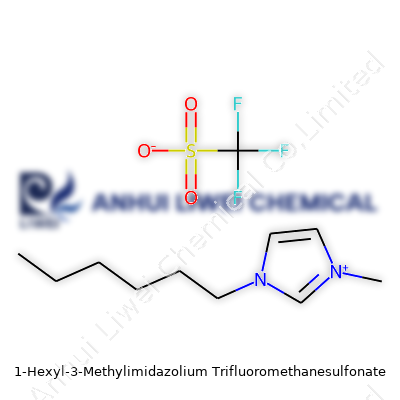
Let’s break this down piece by piece. The cation, 1-hexyl-3-methylimidazolium, features a five-membered imidazole ring. A methyl group nests at the third position and a hexyl chain stretches from the first. That’s six carbons trailing out like a tail, adding hydrophobic character. The cation’s full formula is C10H19N2+. I remember mixing similar imidazolium salts and being surprised by how adding a single methyl or swapping out the tail could instantly change a liquid’s solubility or melting point. You cannot discount the role of these tiny tweaks.
Trifluoromethanesulfonate: The Counterion Sidekick
Its anion, trifluoromethanesulfonate, also goes by triflate. This anion comes together from one carbon, three fluorines, three oxygens, and a sulfur—CF3SO3−. Those fluorines don’t just hang out for show; they push electron density around in ways that make the salt far less likely to jump into side reactions. Many researchers, including myself, turn to triflate-based ionic liquids to avoid hassle with sensitivity or stability when working with air or water. This stability widens their use in electrochemistry, catalysis, and sometimes even pharmaceutical research.
Why Structure Matters for Real Work
Look at this molecule, and you see more than the sum of its parts. The chemical formula for 1-hexyl-3-methylimidazolium trifluoromethanesulfonate as a salt looks like C10H19N2CF3SO3. You bring together the cation and anion, and you land an ionic liquid with low volatility, good thermal stability, and solvent power that lets it dissolve both organic and inorganic molecules. It’s not magic—just strong ion pairing and the right blend of hydrophobic and hydrophilic regions. Pouring it in a flask, I’ve noticed its viscosity differs from the shorter-chain variants; this affects everything from stirring to residue cleanup.
Challenges: Handling and Scale-Up
Troubleshooting always pops up once chemistry scales up. In the laboratory, small bottles of [HMIM][OTf] behave. Large reactors introduce concerns about purity, waste, and even recovery. Triflate’s environmental persistence means waste management plans must be strict. Mistakes in handling can lead to contamination hard to clean up. I’ve found that careful planning for closed systems, strict waste segregation, and strong ventilation pay off, especially since some byproducts release noxious fumes if heated too quickly or mixed wrongly.
Moving Forward with Ionic Liquids
To truly unlock value from 1-hexyl-3-methylimidazolium trifluoromethanesulfonate, research teams should pay close attention to purity, storage conditions, and batch testing. Impurities—sometimes invisible—cause significant shifts in physical properties and reactivity. In my experience, working with trusted suppliers and confirming spectra before use often saves days of downstream troubleshooting. As demand for green chemistry climbs, ionic liquids like this one deserve thoughtful development, responsible sourcing, and clear communication of risk throughout the supply chain. The details matter—right down to every atom.
Chemicals and Their Surprising Stories
Chemistry labs and industrial plants often use substances with names that seem to stretch halfway down the periodic table. The real question that keeps cropping up for complex chemicals like 1-hexyl-3-methylimidazolium trifluoromethanesulfonate is pretty simple: how hazardous is this stuff to people and the environment?
Getting a Handle on What It Is
People in chemical engineering and research circles call it a room-temperature ionic liquid. These liquids have been making their way into greener chemistry projects, new battery setups, and some manufacturing processes, especially where avoiding volatile, flammable solvents matters. At first glance, anything marketed as “green” or “innovative” tends to earn an easy pass in some circles, but that would be jumping the gun.
What Toxicity Data Actually Says
Dig into studies and safety sheets, you won’t see 1-hexyl-3-methylimidazolium trifluoromethanesulfonate labeled with a big toxic warning like some solvents from decades past. Researchers have tested it on aquatic organisms and cells; several findings suggest it can cause trouble at higher doses for both fish and invertebrates, leading to stress and cell death at certain concentrations. Long-term effects stack up faster in small aquatic life compared to what's observed in short experiments.
Fire risk stays low due to the structure of ionic liquids—they refuse to evaporate the way old-school solvents do—so explosion risk is way down. This can fool people into underestimating how lingering and sneaky the effects from spillage or chronic exposure could be. The substance doesn’t just disappear after use; it lingers in water and soil. Persistence means even low-level leaks can pile up.
My Experience with Lab Safety and Getting Surprised
During grad school, I spent hours prepping solutions containing similar ionic liquids. Gloves and goggles? Worn every session, no questions asked. I remember the sense of relief in the lab: “Finally, a solvent that won’t leave me with a headache or a warning label that can be seen from down the hall.” But, as the years went on, more data about aquatic toxicity came out. The story that unfolded wasn’t one of an innocent, completely safe chemical. It served as a reminder that “less toxic” isn’t the same as “no risk.”
Looking Out for Trouble Down the Line
Testing on rodents hasn’t shown wild toxicity, though gaps in our knowledge about long-term effects on humans and the environment stand out. This should matter, even if the immediate risks look small. Labs and companies dumping ionic liquids down the drain once seemed harmless; now, regulations have tightened. Waste management rules ask for collection and specialized disposal so the stuff doesn’t slip into drinking water or ecosystems.
Smart Steps Forward
Companies and schools can demand better reporting of ionic liquid use and deal with waste responsibly. Regular monitoring of workers’ exposure helps paint a fuller picture of health risks instead of waiting for symptoms years down the road. If someone works with it all day, the precautions—ventilation, gloves, training—stick around for good reason. Even with a “green label,” hazard potential surfaces unless habits evolve alongside the emerging science.
A Closer Look at Chemical Safety
Those of us who have spent days and nights in labs know that you cannot treat every bottle on the shelf like another. Chemicals like 1-Hexyl-3-Methylimidazolium Trifluoromethanesulfonate call for respect and attention to detail. It’s not just what the material can do for research or manufacturing. It’s also about keeping people safe and making sure nobody pays the price for a shortcut.
An Eye on Stability and Compatibility
1-Hexyl-3-Methylimidazolium Trifluoromethanesulfonate is an ionic liquid, so you won’t see it fizz and pop like some acids or bases. That does not mean it takes well to heat and light. I’ve seen careless storage ruin expensive batches – strong sunlight, high humidity, and big temperature swings can leave you with a mess. Always store the bottle tightly sealed in a cool, dry environment. It resists air and most moisture, but I would never leave it open longer than it takes to pour what’s needed. Take cues from industry experience: store away from incompatible materials, especially strong oxidizers.
Contamination creeps in surprisingly fast in the wrong setting. Keep the container clearly labeled—no peeling stickers, no guessing games. If residue appears around the cap or you notice cloudiness, set it aside for proper disposal. Fume hoods come in handy, not because the substance reeks, but because even tiny splashes and dust can build up where they shouldn’t.
PPE: More Than a Suggestion
Protective gear isn’t just on the checklist for auditors. I’ve had colleagues tell stories about small droplets landing on skin and causing irritation. Always put on nitrile gloves (latex can break down), a lab coat, and solid safety goggles. Anyone who has gone home with tired, stinging eyes after a splash accident will say the same. Eye washes and safety showers must stay clear, working, and within reach. Chemical burns sneak up on you, and the folk who think “just water” is enough soon learn otherwise.
Handling Spills and Waste
Spills slow down projects and risk more than damaged tables; they invite confusion and can put people in real harm. Keep absorbent pads and neutralizing agents close at hand just in case. Use dedicated, labeled waste containers—don’t pour anything down the drain or toss it in regular trash, since ionic liquids may persist in water systems for years and could show long-term toxicity to aquatic life. Local law often requires documentation and specific disposal practices, and for good reason.
Training and Vigilance Build Trust
Training sessions seem like a formality to some, but experience shows the risks run lowest where everyone knows what’s in their hands. Don’t put off refreshing that checklist or updating labels as regulations change. Invite questions. If you see a bottle stored in a sunlit window or a waste container filling with mixed chemicals, speak up. Labs and plants run smoothly when everyone looks out for each other.
Good housekeeping, clear records, and constant vigilance make all the difference. Chemical management software helps, but nothing replaces the habits you pick up from seasoned colleagues. The work stays predictable, and people get to focus on breakthroughs—not accidents or cleanups. For anyone using or storing chemicals like this, these routines keep science moving forward with everyone going home safe.
An Up-Close Look at Melting Point and Solubility
Working with ionic liquids opens up layers of hands-on experience with versatile chemistry. One substance I’ve handled in the lab is 1-Hexyl-3-methylimidazolium trifluoromethanesulfonate, often abbreviated as [HMIM][OTf]. Its behavior sheds light on what makes ionic liquids stand apart, especially in research settings that need robust solvents or adaptable media for chemical reactions.
Melting Point — Why It Matters
Anyone weighing their options for a solvent in synthesis knows how critical the melting point gets. [HMIM][OTf] shows a melting point typically in the range of 10–15°C. That means it’s a liquid at room temperature in most laboratories. Not having to fuss with heating or melting makes life a lot easier during transfer, mixing, or storage. Working with something fluid at ambient conditions trims down safety risks linked to spills or crystal clumping.
Nature rarely gives a single number; impurities or humidity can nudge the melting point a few degrees. Consistency of the room environment and bottle care keeps surprises in check. When samples are impure, I’ve seen the liquid stay oily down to just a few degrees above freezing.
Solubility and Real-World Compatibility
Solubility tells you where this ionic liquid “plays well.” [HMIM][OTf] dissolves readily in water, showing a strong affinity thanks to its ionic character and the hydrophilic trifluoromethanesulfonate anion. In practical terms, this means the liquid can dissolve polar reactants, but it won’t mix with nonpolar solvents like hexane.
Through personal runs in the lab, I’ve seen that adding water brings [HMIM][OTf] into a clear, single phase almost instantly. In dry organic solvents, especially alkanes, the liquid stays put, refusing to blend. Acetone, methanol, and acetonitrile accept moderate amounts. This flexibility lines up with reports in the literature and matches supplier data I’ve studied. The high miscibility with water pushes chemists to exploit [HMIM][OTf] in extractive chemistry, where separation of polar and nonpolar fractions can hinge on a single step.
Density, Viscosity, and Electrical Conductivity
The feel of [HMIM][OTf] in your hand is heavier than simple water or organic solvents. It tips the scale at about 1.2–1.3 g/cm³, depending on its exact water content. That thicker heft comes from both the molecular weight of its ions and their close packing.
Viscosity stands out, especially in cooler rooms. At 25°C, the liquid flows more slowly than water, sometimes resembling a light oil. This thicker flow shapes how it moves through glassware, how fast solutes dissolve, and whether reactions run smoothly or need extra stirring. In my experience, slightly warming the flask can boost flow and shorten mixing times.
Since the substance is ionic, expect excellent electrical conductivity when dissolved in water or used as a medium for electrolytic reactions. The conductivity varies with temperature and dilution, but stands well above organic solvents, hitting around 2–5 mS/cm in pure form.
Practical Benefits and Room for Improvement
Ionic liquids like [HMIM][OTf] don’t evaporate quickly, leading to fewer odor concerns in the working space. No one in the lab has ever worried about breathing in vapors from these solutions, a big plus for long shifts. Still, their shelf life depends on tight capping — water in the air changes behavior and sometimes shifts melting points or viscosity.
Turning to solutions, labs working with [HMIM][OTf] need reliable humidity control. Adding drying columns or regular weighing helps track any swing in sample mass. Manufacturers ought to develop containers with better seals and clearer labeling for freshly opened and hydrated samples.
Final Thoughts on Use in the Lab
As ionic liquids continue to gain ground, [HMIM][OTf] brings unique physical features to chemical workbenches. Anyone aiming for green solutions or innovative syntheses can make the most of its properties — as long as they respect the liquid’s quirks and guard against the gradual creep of moisture from the air.