1-Hexyl-3-Methylpyridinium Bromide: Beyond the Laboratory Bench
Historical Development
The story of 1-Hexyl-3-Methylpyridinium Bromide did not begin in high-tech labs outfitted with AI-powered widgets. Chemists decades ago wanted more sustainable or less volatile solvents than the usual molecular hits like acetone or chloroform. Ionic liquids grabbed headlines by skipping the familiar volatility and popping up as room-temperature salts. The pyridinium family, which includes our compound, offered a good blend of organic flexibility and ionic character. Researchers tested dozens of alkyl chains and caught on that the hexyl version brought a decent mix of solubility and melting point for bench work. Its structure owes a lot to early explorations into green chemistry and solvent engineering rather than sheer luck or corporate branding.
Product Overview
You'll find 1-Hexyl-3-Methylpyridinium Bromide logged in catalogs for chemical research, synthesis trials, and process testing. Suppliers keep the white to slightly off-white crystalline material stored in tightly sealed containers because ionic liquids often soak up water from air. In my own experience, the trickiest part isn’t handling or transportation—it’s keeping moisture at bay once the bottle opens. The alkyl chain gives it a little oily feel, but it’s easy to weigh and transfer for most solutions. Bulk deliveries follow standard UN recommendations, usually with clear labeling of its hazards and purity.
Physical & Chemical Properties
It’s not every day you get to mix high polarity, non-volatility, and wide thermal stability in one punch. 1-Hexyl-3-Methylpyridinium Bromide stands out because the pyridinium cation teams up with the bromide anion to deliver melting points near room temperature depending on hydration, densities around 1.1–1.2 g/cm3, and miscibility with water and polar organics. The hexyl chain provides lipophilicity, so the compound bridges polar and nonpolar phases better than short-chain analogs. Most solvents will dissolve it, sometimes with good conductivity, which is a big draw for research projects.
Technical Specifications & Labeling
Quality matters every step of the way. Reputable sources guarantee a purity level over 98%, with lower moisture content and clearly documented residual solvent percentages. Labels must flag hazards in compliance with GHS: acute toxicity, eye irritation, and aquatic dangers pop up as main concerns. Shipping documents call out the CAS number and UN code. Every step, from warehouse to end-user, gets a tracking number upfront so nobody gets a mystery bottle. Whether ordering for electrochemistry or pharmaceutical syntheses, I keep my own Quality Control logs to compare COA figures with in-house analyses, especially conductivity and pH.
Preparation Method
Chemists still rely on practical, straightforward routes to make this ionic liquid. One classic process involves quaternizing 3-methylpyridine with 1-hexyl bromide under reflux, usually in acetonitrile or another polar solvent. After several hours of heating, the resulting solid undergoes repeated solvent washes to strip away unreacted starting materials. For high-purity samples, repeated recrystallization or extraction and vacuum drying help knock down water and organic impurity levels. Lab-scale reactions see yields better than 80% with careful attention—no fancy catalysts or exotic reagents needed, just patience and proper fume extraction.
Chemical Reactions & Modifications
Once synthesized, the versatility of 1-Hexyl-3-Methylpyridinium Bromide starts to show. Swapping the bromide anion out for other halides, triflates, or even large organic anions opens the door for custom ionic liquids, often tailored for specific solubility or conductivity needs. The pyridinium core offers aromaticity, which lets it play host or donor in coordination chemistry. In solvents or as part of multi-phase reactions, the ionic character often means improved dissolution of target substrates, such as biomass feedstocks or precious metal salts. Functionalizing the alkyl tail—for example, appending a terminal amine—lets researchers adjust hydrophobicity and tweak performance in catalysis or separation.
Synonyms & Product Names
Not every catalog lists this compound under the same flag. You might spot names like N-Hexyl-3-methylpyridinium bromide or 3-Methyl-1-hexylpyridinium bromide. Some suppliers use abbreviations like [HmPy]Br or [C6MPy]Br. Recognizing these synonyms clears up confusion when ordering or reading older journal papers. Consistent naming, in my view, helps avoid miscommunication in multi-disciplinary projects or between international partners.
Safety & Operational Standards
Getting careless around ionic liquids can backfire. This bromide salt is more benign than classic organic solvents, yet concentrated exposure will cause skin or eye irritation, and spills pose a moderate tox risk to aquatic environments. In the lab, I rely on nitrile gloves, splash goggles, and a well-ventilated hood. MSDS sheets lay out the basics: avoid inhalation, rinse any skin contact right away, and collect all waste for proper chemical disposal rather than pouring it down the drain. Fire hazards rank low due to low vapor pressure, but adding heat can make the compound decompose, releasing toxic fumes. Responsible handling means double-checking storage away from strong oxidizers and acids.
Application Area
Where does 1-Hexyl-3-Methylpyridinium Bromide make a mark? Electrochemistry stands out—in batteries and capacitors, researchers use this compound as a conductive medium with good stability. Its solvent tunability makes it a favorite for extraction of rare earth elements and as a phase-transfer agent in tricky organic syntheses. I’ve seen reports where it serves as a catalyst or co-solvent in biomass conversion, offering benefits in both yield and selectivity for lignin-derived products. Pharmaceutical labs often reach for this ionic liquid to boost solubility in formulation or analytical testing. Other uses keep surfacing in nanomaterial synthesis and environmental remediation.
Research & Development
The pace of work with 1-Hexyl-3-Methylpyridinium Bromide keeps moving forward. Universities and corporate R&D centers screen it for applications stretching from energy storage to green synthesis. Researchers push the boundaries using the pyridinium scaffold as a template for smart solvents with custom properties—like designing fluids to strip CO2 from power plant exhaust, or improving the recyclability of rare metals from spent electronics. Directing funding into these projects makes me optimistic about breakthroughs that blend efficiency and environmental safety.
Toxicity Research
No one wants a “green” solvent that turns out to be a silent villain downstream. Investigations into cytotoxicity, biodegradation, and aquatic impacts sometimes show mixed signals—tests on aquatic larvae or algae indicate that even trace amounts can cause disruption at higher concentrations. The bromide partner and hexyl group both contribute to slow breakdown times, so chronic exposure isn’t trivial. Reviewing the literature drives home the need for rigorous monitoring in industrial release and mandating closed-loop handling for high-volume users. Self-auditing lab waste and tracking air or water releases have become second nature for responsible chemists.
Future Prospects
As industries look beyond petroleum-derived solvents, curiosity around 1-Hexyl-3-Methylpyridinium Bromide keeps growing. Prototypes for energy storage and green catalysis reach the demo stage every year, with pressure mounting to improve biodegradability or invent quick remediation if spills happen. The knowledge base of structure-property relationships continues to deepen; machine learning aids in predicting new analogs that might offer lower cost or higher safety. The path ahead could see more regulatory scrutiny or certification schemes that reward invested work in toxicology and lifecycle analysis. The compound’s success seems tied to our ability to measure, adapt, and share results across scientific borders.
A Walk Through Chemical Labs
Give me a long day in a university lab, and at least once I will hear a student mutter about ionic liquids. Some folks roll their eyes at the complexity, but the world keeps finding new reasons to pull obscure bottles down from the shelves. One name that pops up more now than ever is 1-Hexyl-3-Methylpyridinium Bromide. Odd name, and yet it manages to show up in research fields I never expected ten years back.
Unlocking a Modern Research Tool
I remember helping out with a green chemistry class six years ago, watching researchers push for solvents that wouldn’t leave the earth a toxic mess. 1-Hexyl-3-Methylpyridinium Bromide helped spark that change for some teams. Traditional organic solvents like toluene or dichloromethane come with headaches: potent smells, toxic fumes, and plenty of disposal worries. Lab techs shuffled through safety paperwork, and a lot of us wondered if greener options would ever catch up in real-world results.
This ionic liquid steps up with both hands. It barely evaporates, so the air stays cleaner and the risk of exposure drops. If you ever paused in a closed lab, you’d know how much that matters by the end of the week. Researchers use this compound mostly as a replacement solvent. Few other chemicals let scientists pull off reactions as efficiently, with less fuss over temperature swings or explosive vapors. I’ve seen it help extract natural products from plants, pull out metal ions even from complex waste streams, and up the purity on synthesized compounds.
Applications in Electrochemistry
Electrochemistry has a habit of looking for that magic electrolyte, one that keeps machines running quieter and longer. 1-Hexyl-3-Methylpyridinium Bromide slides right in here. Battery researchers add it to study charge transfer and electrode stability. Some teams use it to reduce or oxidize target molecules with more precision than old-school acid baths. The broad liquid range handles heat without splitting apart, a trait that shakes up everything from sensors to prototype supercapacitors.
Environmental Impact and Sustainability
Back on sustainability, nothing teaches a chemist humility like a mountainside landfill out behind a chemical plant. That puts ionic liquids under the lens — including this one. I’ve seen several reviews flag reduced volatility and lower flammability. These two strengths cut down on workplace accidents and waste gas emissions at a commercial scale. All that said, it’s not a zero-impact option. Researchers still debate how these ionic liquids break down in the environment or what risk they pose in water streams. That’s where green chemistry gets real: steady data, honest conversation, and long-term safety trials.
Room for Innovation
What stuck with me from years of grad school and industry work is how curiosity spins out solutions to hard problems. For every issue with toxicity or disposal, teams can craft new variants or test clean-up methods. The conversation keeps growing around safe recycling, using less hazardous counter-ions, or mixing small amounts with biodegradable media. Students run new tests every semester, and startups bank on better, cleaner molecular designs. Real progress waits for evidence, and scientists argue at conferences. No one chemical solves it all, but 1-Hexyl-3-Methylpyridinium Bromide has sparked more than one aha moment on the hunt for smarter chemistry and better materials.
Unpacking the Structure and Formula
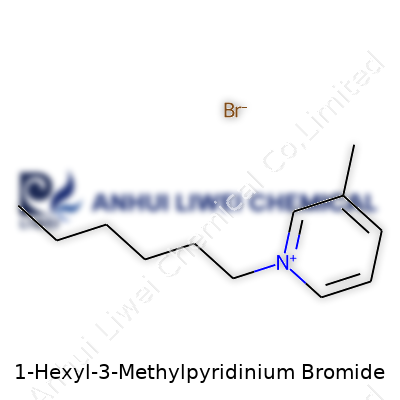
1-Hexyl-3-Methylpyridinium Bromide grabs attention for its unique arrangement of atoms. The chemical formula stands as C12H20BrN. The molecule builds itself from a pyridinium ring – think of this as a benzene ring with a nitrogen replacing one carbon – giving it a slight positive charge. Attach a methyl group to nitrogen at the 3-position and bolt on a hexyl chain at the 1-position. Bromide comes in as the counterion, evening out that positive charge and making the compound stable as a salt.
The Building Blocks: What Goes Where?
Seeing chemistry as a set of Lego bricks helps. Here, the pyridinium ring acts as the base platform. Moving clockwise, a six-carbon chain (hexyl) sits at the nitrogen. At the opposite position, a methyl group settles in. The bromide ion doesn’t connect to the ring but partners up by holding a negative charge outside the ring, forming an ionic pair.
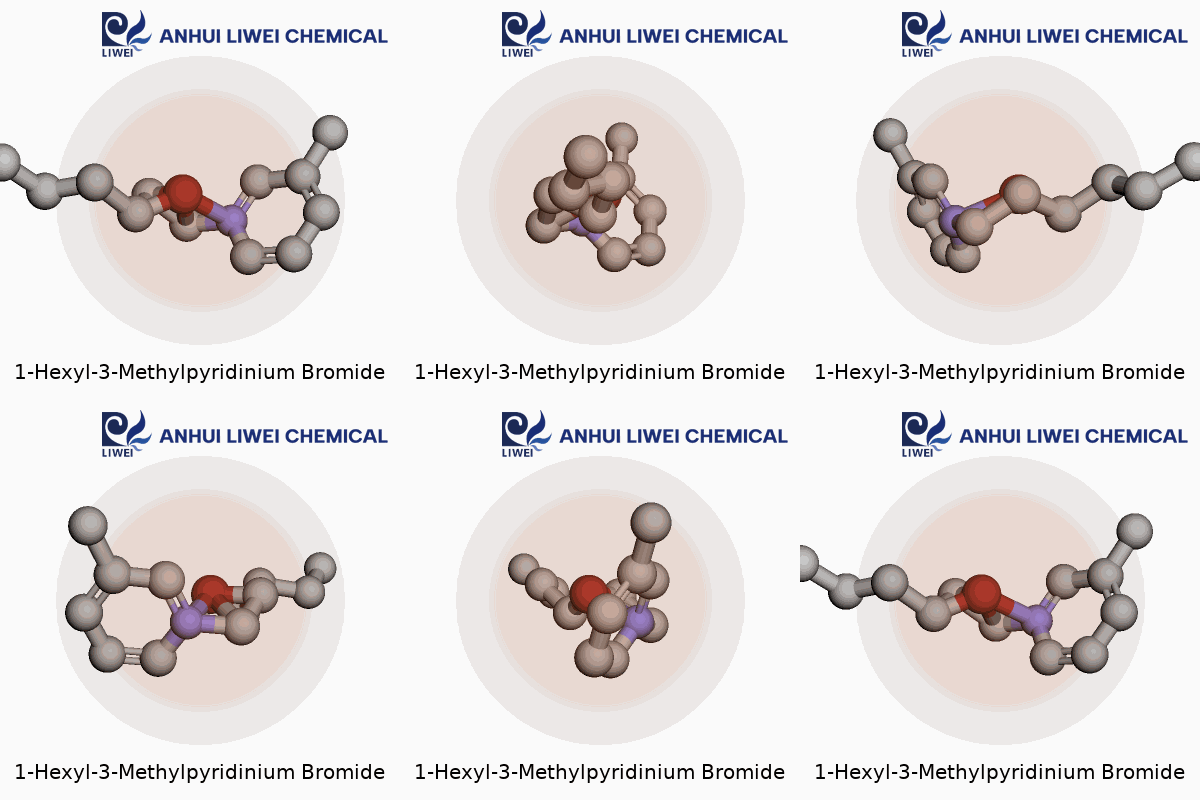
Visual representation matters in chemistry. Picture it like this: the pyridinium sits flat and aromatic. The hexyl group stretches off one side, adding slick grease-like character, while the methyl group sticks out, a simple bump near the action. The bromide tags along, loose but always present, holding the framework together.
Why It Matters to the Lab Bench
Seeing this salt appear in research labs changed my own approach to solvents. Ionic liquids—soggy, nonvolatile salt-like fluids—felt alien at first. Then 1-Hexyl-3-Methylpyridinium Bromide entered the scene, prized for a balance between hydrophilicity and hydrophobicity. That’s the magic for chemists fiddling with solubility puzzles. Its moderate chain length gives enough flexibility without adding too much grease, and the methyl tweaks stability and reactivity, especially in catalysis or extraction tasks.
Real-World Value and Practical Uses
This compound steps up in green chemistry. Traditional organic solvents often come with headaches—flammability, toxicity, pollution. Ionic liquids like this one drop the vapor pressure to nearly nothing. I’ve seen it used to pull metal ions from water and to help stir up reactions where water or classic organics just get in the way. In academic settings, students working with it don’t face the sharp chemical smells or high fume hood demands common with standard solvents.
Complex research—think enzyme reactions or tough-to-crack syntheses—benefits from this salt because it gives a friendlier medium for both sensitive biological material and reactive metals. I still remember a late-night experiment where switching to 1-Hexyl-3-Methylpyridinium Bromide finally nudged a stubborn reaction to the finish line, avoiding the annoying side products that used to plague the process.
Challenges and Moving Forward
Cost and recyclability raise real questions for regular lab use. While the initial outlay for ionic liquids runs higher than most solvents, the long-term benefits—such as less hazardous waste—often outweigh the sticker shock. More efficient recycling techniques need to crop up. Modern approaches include crystallization, selective anion exchange, or even electrode-based recovery, though every method brings its own hurdles in purity and practicality.
Tighter regulations on hazardous emissions push both industry and researchers toward these alternatives. That pressure helps accelerate innovation: tailor the alkyl chain, swap out the counterion, and suddenly the compound fits a new purpose. Collaboration with environmental experts during process design speeds change.
Final Thoughts on Safety and Transparency
As always, safety data tops the priority list. Even as ionic liquids show low vapor pressure and better lab air quality, researchers stay vigilant about skin, eye, and environmental exposure. Trusted sources, like peer-reviewed journals and regulatory agency data, keep everyone grounded in facts, not hype.
It’s crucial to share findings—good and bad—not only within labs but across industries. That’s the real path to wider acceptance and smarter use of compounds like 1-Hexyl-3-Methylpyridinium Bromide in both science and manufacturing.
Understanding What You’re Handling
I’ve spent years in labs and around chemicals, so I know there’s a big difference between reading a safety data sheet and facing a real spill. 1-Hexyl-3-Methylpyridinium Bromide, used in organic synthesis and research, looks harmless at first glance. Clear liquid, not especially smelly. That can lull someone into thinking it’s just another bottle on the shelf. Trouble starts when you don’t respect it.
Hazards on the Table
This compound doesn’t give you many warnings by smell or appearance, but like many ionic liquids, it disrupts cell walls and membranes. What that means: let it touch your skin and you might end up with irritation or chemical burns, especially with repeated exposure. Get it in your eyes and you’ll know right away—intense pain, risk of lasting damage if you don’t flush quickly. Inhaling vapors or swallowing even a small amount can affect the respiratory or digestive systems. There are no heroic stories here; it just takes one mistake. I’ve seen young scientists rub their eyes in the middle of weighing and regret it for hours.
It’s worth remembering this isn’t just a “lab problem.” If you work in a facility producing ionic liquids for green chemistry or battery research, you probably handle kilo batches. Sloppy habits lead to spills, and most ionic compounds can track across floors, desks, clothing. Gloves lose their integrity way before you notice.
Building a Safer Space
I’ve watched safety culture change over the years. The best labs and plants make safety as obvious as locked doors at night. For this chemical, that means using proper gloves (nitrile or butyl rubber), keeping goggles on, and, if you’re pouring or mixing, wearing a face shield. Cotton lab coats or chemical-resistant aprons keep accidental splashes off your skin and out of your clothes.
Work in a fume hood even if that means carrying your bottle down the hall. The fewer chances for splashes and inhalation, the better. Shipments come with instructions for spill cleanup, but don’t wait until something tips over to read those. I always tell new lab members: keep a well-stocked kit (inert absorbent, waste container, neutralizer if needed) within arm’s reach. You need to know, not guess, what to do in an emergency.
If Something Goes Wrong
I’ve responded to minor accidents and near-misses. Immediate action stops a minor mistake from becoming a disaster. If this chemical contacts skin, wash with soap and water for a good 15 minutes. Eyes need a rapid flush with plenty of water—get someone to help if you can’t hold the eyelids open yourself. For spills, ventilate the area, scoop up the liquid with inert material, put it in a sealed container, and label it for hazardous disposal.
Keep emergency numbers posted where everyone can see them. You don’t want to be scrolling through your phone with burning hands. Follow up every incident with open conversation. Learning from each other builds a safer workplace.
Room for Improvement
A lot of safety problems come from rushing or assuming you know best. If you’re new to handling chemicals, ask for a walkthrough. Ask too many questions—your hands, eyes, and lungs are worth more than a quick shortcut. Management must back up safe practices by providing real training and making sure no one cuts corners to “save time.” Investment in safety pays itself back every day nothing goes wrong.
Why the Details Matter in Lab Safety
Anyone working with chemicals knows the job rarely allows for shortcuts. Even something that looks harmless on paper can lead to disasters if you skip the basics. 1-Hexyl-3-Methylpyridinium Bromide isn’t just a line in a catalog; it’s a substance that influences daily routines in labs and small chemical storage rooms. It’s an ionic liquid often used for research, but ignoring storage guidelines turns it from a useful tool into an accident waiting to happen.
Temperature and Humidity Aren’t Just Numbers
Storage temperature sets the tone for chemical safety. Anyone who’s watched a clear liquid turn cloudy or, worse, noticed unexplained pressure in a sealed bottle, knows the pitfalls of excess warmth or fluctuations. 1-Hexyl-3-Methylpyridinium Bromide prefers a cool, stable shelf—think below 25°C, away from sunlight and away from any exposed heat source. Humidity also poses issues; high moisture can trigger hydrolysis, creating byproducts that nobody wants to contend with later. Keeping a few desiccants in the cabinet proves more practical than cleaning up a mess or losing a costly batch.
Keep Oxidizers Far Away
Mixing incompatible substances becomes a chemistry lesson nobody wanted. 1-Hexyl-3-Methylpyridinium Bromide doesn’t get along with strong oxidizers. That’s not just textbook advice. Cross-contamination can turn an uncluttered lab into a hazardous zone. A clear label paired with separate storage, ideally in a sturdy secondary container, is worth the extra step. Personal experience says forgetfulness in this area leads to phone calls you won’t want to make and lessons best avoided.
Ventilation Saves More Than Air Quality
Odorless does not equal harmless. Even if this compound flies under the radar for most, improper storage in airtight or unventilated areas puts everyone at risk. Accumulated vapors might not trigger alarms until it’s too late. Choosing a location with steady air exchange, away from break rooms or high-traffic spots, keeps small problems from turning into big ones.
Original Packaging Tells a Story
There’s a reason suppliers send chemicals with specific packaging and labeling. The original bottles create a barrier between the compound and its surroundings. Improvised containers, even sturdy ones, might react or leach material over time. In one case, I watched a colleague pour an ionic liquid into a plastic jar, only to return weeks later and find the sides softened and bowed out. Manufacturers use proper materials for a reason. If you transfer anything, always use inert glass, and update the label right away.
Access Controls Do the Heavy Lifting
Not everyone belongs near every chemical. Lockable cabinets and inventory logs might feel tedious, especially for low-volume users or academic researchers, but they keep honest mistakes from affecting the whole workspace. I’ve seen problems unfold after a single unsupervised bottle ended up on the wrong shelf—a costlier error than any security upgrade.
Preparedness Beats Cleanup
Chemical spills can disrupt an entire lab’s workflow, sometimes for days. Spill kits and clear emergency instructions save time and stress. Training everyone who enters the storage area pays off during real-world mix-ups. After handling a minor leak thanks to a clear protocol, I stopped seeing safety training as a checkbox exercise and started treating it as the insurance policy it is.
Summary
Proper storage for 1-Hexyl-3-Methylpyridinium Bromide doesn’t call for fancy infrastructure—just consistency, vigilance, and a respect for the fine details. Standard procedures and a bit of personal responsibility build safer, more reliable lab environments, where mishaps take a back seat to progress.
Why Scientists Pay Attention to This Ionic Liquid
1-Hexyl-3-Methylpyridinium Bromide doesn’t get as much attention as household chemicals, but the folks in chemistry labs and tech companies notice it for its versatility. In my own time testing out materials in university, certain ionic liquids stood out because they brought the best of both the oil and water worlds. This one, with its unique molecular makeup, falls right into that sweet spot.
Solvents That Break the Mold
Researchers need solvents that handle metals and tough organic substances. Water and alcohols only get some of the jobs done. 1-Hexyl-3-Methylpyridinium Bromide excels in dissolving metal salts and organic compounds that remain stubborn in other solutions. It’s not volatile like typical solvents, sidestepping lab safety headaches. My mentor once joked that you notice the difference the first time you’re not coughing or wearing a fume hood for hours.
Switching to ionic liquids helps teams recycle chemical streams without hazardous waste. According to a 2022 review in Chemical Reviews, using ionic liquids like this bromide reduces exposure to toxic emissions and cuts down the environmental toll of metal plating or extraction.
Powering Electrochemistry and Green Processes
In battery research and energy storage, the unique structure of 1-Hexyl-3-Methylpyridinium Bromide makes it more than a scientific curiosity. This liquid withstands high voltage and stays stable under heat, making it a good fit for safer battery electrolytes. As cars and gadgets shift to greener batteries, researchers look for safer alternatives that don’t catch fire or form dangerous byproducts.
I’ve seen research labs use this ionic liquid for electrodeposition, especially when plating rare metals. The process runs smoother than with traditional aqueous acids, and the finished coatings end up less prone to defects. More efficient plating boosts chip performance and reduces waste in electronics manufacturing.
Pushing Limits in Catalysis and Organic Synthesis
Chemists always look for ways to streamline reactions. 1-Hexyl-3-Methylpyridinium Bromide acts as a reaction medium and sometimes a co-catalyst, speeding up chemical changes for important drugs and advanced materials. It helps organize reactants at the molecular level, often leading to better yields with fewer leftovers to clean up. According to the Journal of Molecular Liquids, using this bromide can lower energy needs by 20-30% for certain transformations.
Chasing Greener and Safer Chemistry
The demand for easy-to-handle, greener chemicals keeps growing. Traditional solvents come with flammability and toxicity risks, so companies are under pressure from both safety regulators and customers to rethink how they make electronics, batteries, and specialty chemicals. From my own early mistakes handling solvents, I know that even small improvements add up—one less accident, one less spill.
A big roadblock remains the high price and limited data about long-term effects on health and the environment. Most ionic liquids get stuck in research because big factories hesitate to switch from familiar chemicals. More transparent sharing of results and careful life cycle studies would help bridge the gap.
Real Solutions Need Collective Action
To get this compound out of the lab and into wider industry use, there needs to be honest cost comparisons, real-world test cases, and support from both regulators and innovation funds. I’ve seen promising results stall because decision-makers get nervous about adopting something new, even with the data in front of them. Collaboration between research centers, chemical suppliers, and engineers can untangle some of these knots.