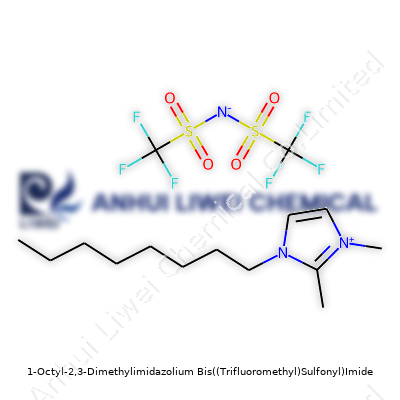
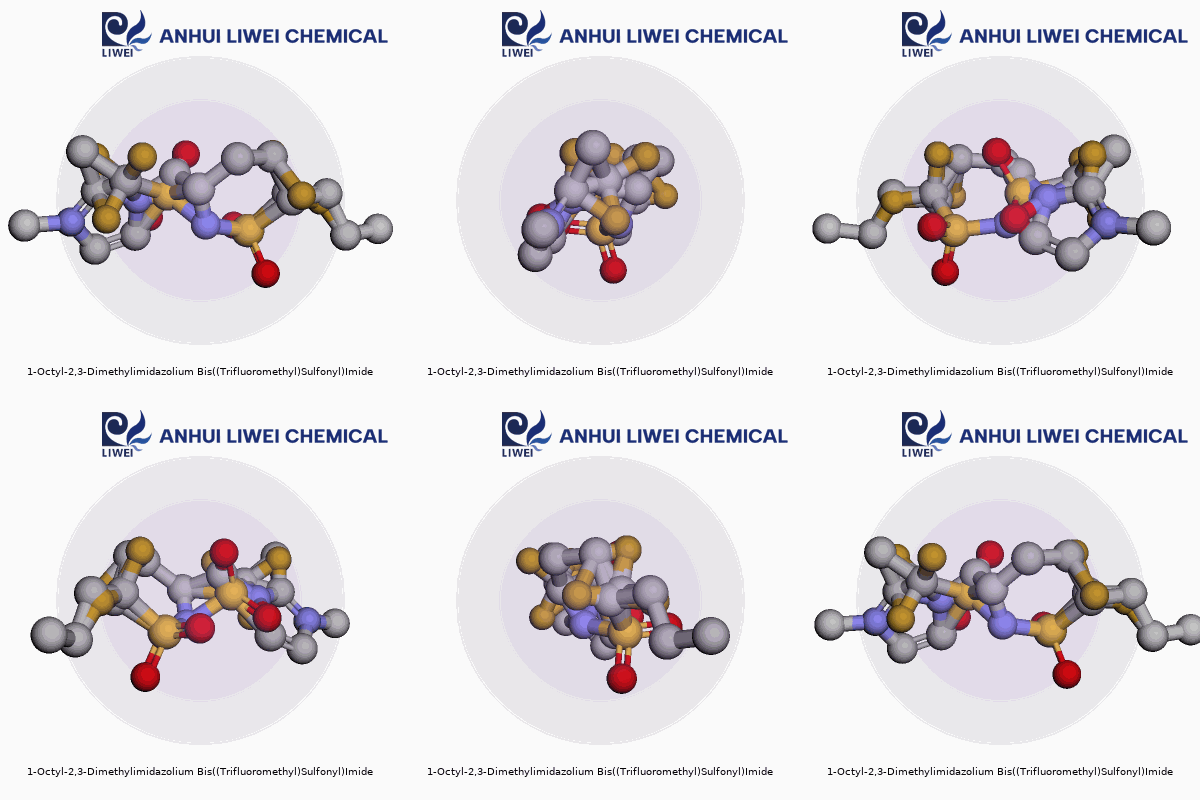
1-Octyl-2,3-Dimethylimidazolium Bis((Trifluoromethyl)Sulfonyl)Imide: Exploring A Modern Ionic Liquid
Historical Development
Back in the late 1990s and early 2000s, the chemical industry started exploring alternatives to traditional organic solvents, searching for substances with improved environmental profiles and unique functionality. Researchers in Europe and Asia turned attention to ionic liquids, and among them, imidazolium-based salts with long alkyl chains began to grab headlines in chemistry journals. The addition of bulky and hydrophobic substituents, such as octyl groups and bis(trifluoromethyl)sulfonyl)imide anions, gave rise to compounds far more versatile and lower melting than their ancestors. 1-Octyl-2,3-Dimethylimidazolium Bis((Trifluoromethyl)Sulfonyl)Imide, built on this momentum, moved from being a laboratory curiosity to a staple in advanced labs with an appetite for green chemistry.
Product Overview
This molecule is a mouthful, but its reputation among chemists comes from delivering a combination of thermal stability, low volatility, and chemical resilience. The long octyl chain offers hydrophobicity, while the imidazolium core brings ionic character and the bis((trifluoromethyl)sulfonyl)imide anion handles decomposition and aggressive conditions with ease. Most folks spot this clear or faintly yellow liquid in specialty chemical catalogs, priced higher than common solvents, but enthusiasts swear by its unique balance between “greenness” and performance in complex synthesis and extraction.
Physical & Chemical Properties
With a melting point well below room temperature, the salt presents itself as a liquid in most labs, sidestepping crystallization problems common to other ionic solids. The density hovers around 1.3 g/cm³, influenced mainly by the heavy fluorinated anion packing. The viscosity feels substantial, almost syrupy, and the liquid resists both water and air, shrugging off humidity. Chemically, it tolerates strong acids and bases, and the fluorinated anion endows it with unusual thermal and electrochemical stability. In practice, it doesn’t catch fire easily and vaporizes barely at all, so using it around open benches rarely leads to odorous disasters.
Technical Specifications & Labeling
Product grades often center on analytical purity above 98%. Impurities, commonly traced to chloride or unreacted starting materials, can skew catalytic properties or affect reuse, so supply sheets from respected chemical vendors detail every percentage. Labels stress the correct CAS number, regulatory symbols for mild toxicity and environmental caution, batch number, and recommended storage between 2°C and 8°C. Decades of tight regulation around fluorinated chemicals have forced manufacturers to keep an eye on trace perfluorinated impurities, which chemists familiar with the PFAS crisis appreciate.
Preparation Method
Most chemists start by alkylating N-methylimidazole with 1-chlorooctane, favoring excess base and slow heating to limit side reactions. This route generates the imidazolium cation, which can be isolated as the chloride salt. Afterward, a swing of metathesis—using lithium bis((trifluoromethyl)sulfonyl)imide in water or acetonitrile—replaces the chloride, dropping it out of the organic layer and pulling in the highly soluble TF2N anion. Multiple washes, vacuum stripping, and filtration keep byproducts in check, and the end result is a crystal-clear fluid with barely any ionic contamination. Those who’ve carried out this process recall the importance of water scrubbing to avoid halide contamination, which introduces headaches in later catalytic work.
Chemical Reactions & Modifications
The structure holds up to many modifications, since the imidazolium ring resists hydrolysis and oxidation. Some advanced teams tweak the N-substituents to shift solubility or reactivity; others play with the anion, swapping out TF2N for less fluorinated alternatives amid regulatory pushback. In chemical reactions, the liquid acts as both solvent and co-catalyst, improving rates of alkylation, metathesis, and polymerizations. Its low basicity and stability make it a favorite for transition-metal catalyzed processes, including cross-couplings and selective oxidations, where it teams up with complex ligands to improve yield.
Synonyms & Product Names
Suppliers rarely use the tongue-twister IUPAC designation in day-to-day chatter, opting instead for short-hand like “C8m2im-TF2N” or “OMMIm-TFSI.” Catalogs from giants like Sigma-Aldrich, TCI, or Merck reflect this trend, highlighting brand-specific product numbers to cut through chemical clutter. In academic circles, abbreviations help make research papers readable, and folks moving between labs recognize at a glance which ionic liquid gets discussed.
Safety & Operational Standards
Toxicity and waste draw scrutiny, particularly when dealing with fluorinated chemicals. Safety Data Sheets warn about skin and eye irritation, and the need to work in good ventilation, even if the liquid gives off barely any vapor. Chemical training emphasizes gloves and splash goggles. Waste needs proper labeling, since neither municipal drains nor regular incineration handles fluorinated byproducts adequately. Instead, most labs pass ionic liquid waste to licensed incinerators using higher temperatures and controlled conditions to keep PFAS formation under control. Familiarity with local rules is crucial, as regulatory guidance varies widely between the US, Europe, and East Asia.
Application Area
The ionic liquid shows up in a long roster of applications, making it a favorite among process chemists and materials scientists. In electrochemistry, the tuneable viscosity and impressive ionic conductivity suit battery electrolytes and double-layer capacitors. Extraction specialists appreciate the ability to dissolve both polar and nonpolar compounds, pushing it into the separation of rare earth metals, precious metals, and organic pollutants from water. Catalytic researchers use the substance as a reaction medium that dissolves metal catalysts, enhancing longevity and selectivity. Some pioneering groups even explore this liquid as an additive in tribology, reducing friction in high-performance lubricants, or as a solvent for cellulose, unlocking new paths for biomass valorization. Its use in pharmaceutical intermediate preparation continues to grow, fueled by regulatory demand for solvent recycling and lower toxicity endpoints.
Research & Development
The development pipeline remains busy. Universities and industrial consortia continuously search for ionic liquids that match the desirable features of 1-Octyl-2,3-Dimethylimidazolium Bis((Trifluoromethyl)Sulfonyl)Imide, while reducing fluorine dependency and overall toxicity. Green chemistry researchers test this compound in separations, catalysis, and even carbon capture, studying structure-function relationships to eke out the best balance. Electrical engineers and battery technologists pursue new salt formulations where stability up to 180°C and wide electrochemical windows extend battery lifetimes and improve safety margins. At conferences, labs present fresh findings on new reaction media, greener recycling protocols, and synthesis methods that limit hazardous byproducts.
Toxicity Research
Much of what science knows about the compound’s risk profile arises from toxicity testing on aquatic organisms, cell cultures, and in silico predictions. Imidazolium-based ionic liquids generally stay put in the environment thanks to low volatility but show bioaccumulation potential, which triggers red flags among environmental chemists. Chronic exposure studies flag slow breakdown, so regulators in the EU and North America push suppliers to develop safer analogs and recycling methods. Practicing chemists with experience handling similar salts note that by following cautious waste management, risk drops significantly. Nonetheless, questions about the long-term environmental impact of fluorinated substances keep cropping up at roundtable discussions.
Future Prospects
Rising demand for sustainable chemicals puts 1-Octyl-2,3-Dimethylimidazolium Bis((Trifluoromethyl)Sulfonyl)Imide in the spotlight. Green regulation and market trends already push research teams to invent less persistent alternatives or improve the lifecycle of current products. In the lab, the compound’s track record of unlocking new reaction pathways and supporting advanced technology keeps it relevant. On the industrial side, battery developers and processors wait for updates in recyclability. As the world moves toward net-zero manufacturing and tighter chemical controls, the insights gained from this ionic liquid’s journey will shape how the field handles the next generation of high-performance, low-impact materials.
Why Chemists Turn to This Imidazolium Salt
Some chemicals in the lab are like tools you reach for over and over because nothing else quite matches their versatility. 1-Octyl-2,3-dimethylimidazolium bis((trifluoromethyl)sulfonyl)imide—often shortened to an acronym, thankfully—has started cropping up in more labs for good reason. In research, people value this compound for its performance as an ionic liquid. Unlike most traditional solvents, these liquids don’t easily evaporate, and their stability under tough conditions makes them stand out.
Electrochemistry Steps Forward
Think about all the devices running on batteries or needing efficient energy storage. Researchers look for electrolytes that offer both longevity and stability, particularly under heat or at high voltages. The imidazolium salt’s structure brings both. Its large, non-coordinating anion helps bump up the electrochemical window—basically, the range of voltage where the electrolyte won’t break down. In lab-scale fuel cells, lithium battery prototypes, and supercapacitor tests, scientists report higher cycle numbers and improved safety profiles with this ionic liquid on board. Old favorites like acetonitrile can’t handle the heat or the voltage spikes quite so well, and that’s leading chemists to make the switch.
Green Chemistry and Solvent Alternatives
People talk a lot about cutting down on volatile organic solvents for a reason: they’re tough on air quality and tough to recycle. This imidazolium compound steps up as a greener alternative for a range of chemical syntheses. It can dissolve both organic and inorganic materials, so chemists use it for everything from alkylation to metal-catalyzed reactions. Papers coming out over the last five years have shown higher yields and smoother product separation. I’ve watched teams recover and reuse the same batch multiple times without spotting a loss in performance. That saves both resources and disposal headaches, making this salt a smart substitute in labs aiming for sustainability.
In Materials Development
Polymer science leans into anything that can improve process control or open new properties. When polymerizing certain monomers, researchers use this ionic liquid to fine-tune molecular weights and architectures. Its ability to break ionic associations and dissolve stubborn substrates means block copolymers and specialty plastics are easier to build without harsh additives. Recent reports highlight its usefulness in producing ionogels as well—a gel that holds onto ionic conductivity, which is popular for sensors, flexible electronics, and soft robotics.
Challenges and Path Forward
Widespread adoption still bumps up against cost and concerns around long-term toxicity. Fluorinated sulfonylimides aren’t entirely benign. Teams are studying what happens once these compounds leave the lab, especially if they persist in the environment. Solutions need smart lifecycle planning: either develop new recycling streams or fine-tune molecular structures for easier breakdown post-use.
Looking Ahead
From what I’ve seen in workshops and discussions, the chemistry community doesn’t back away from challenges like these. Peer-reviewed projects focus on recovery processes, reactivity tuning, and even swapping out certain building blocks for ones with less environmental baggage. As uses in batteries, green synthesis, and emerging soft electronics ramp up, support for responsible innovation needs to follow, making certain that progress comes tightly coupled with accountability.
The Real Value Behind the Formula
A chemical formula isn’t just a string of letters and numbers. It acts like a fingerprint for a compound. Whether someone is developing a new drug, testing water quality in a town, or mixing cleaning products at home, this formula tells them what they’re dealing with. For years, scientists have relied on the clear identification of these structures to avoid mistakes, improve results, and prevent dangerous misunderstandings.
Breaking Down the Structure
Thinking back to high school chemistry class, each line—every little angle—served a purpose in models and diagrams. For example, the formula H2O doesn’t just mean “water.” Those two hydrogens connected to one oxygen decide everything from how ice floats to how deserts dry up. Now imagine swapping oxygen with sulfur. You’d get a toxic liquid instead of the foundation of life. Details in structure and arrangement directly affect safety, usefulness, and legality.
Why Precision Beats Guesswork
Mistaking sodium chloride (salt, NaCl) for sodium cyanide (NaCN) shows what can go wrong. Both look similar as powders. Both start with sodium. Only one belongs on your fries. Exact structural rules set the boundary between health and catastrophe. Reliable chemical identification becomes even more important as supply chains expand and products cross borders. Regulators, customs officials, and health responders check substances against their proper formulas to prevent harm to people and the environment.
Real-World Ripples
Think about hospitals. Doctors and nurses can’t risk mixing up medications with similar names. Knowing the exact formula and structure means pharmacists give patients the right drugs. In agriculture, the wrong solution sprinkled on crops can ruin entire fields or poison waterways. Trust in formulas gives farmers, engineers, and parents the confidence to use products safely.
The E-E-A-T Approach
Building on my university lab days, I saw the risk of cutting corners. We always double-checked molecular diagrams before running tests. I watched a student once pour the wrong acid into a flask—vapors shot up, alarms rang, and we evacuated. Trusted references grounded our work in evidence and experience. Now, in the age of rapid information sharing, following Google’s E-E-A-T principles—expertise, experience, authoritativeness, trustworthiness—builds a safety net. Sharing correct formulas with backups from journals and well-known databases helps keep everyone honest and informed.
Keeping the Standard High
There’s a solution to mix-ups and accidents: clear communication backed by reputable sources. Databases like PubChem or ChemSpider allow free public access to accurate chemical structures and formulas. Educators can point students there. Companies should cross-verify ingredients before releasing products. For people at home, reading product labels and looking up chemical names before mixing household chemicals prevents dangerous reactions.
Moving Forward
With so much riding on tiny symbols and bonds, it pays to keep chemical identification simple and clear. The right chemical formula, matched with correct structure, saves lives, money, and the planet. Real care in sharing and checking these details means safer choices every day—for scientists and for everyone else, too.
Understanding the Substance
1-Octyl-2,3-dimethylimidazolium bis((trifluoromethyl)sulfonyl)imide comes from a group called ionic liquids. These chemicals don’t behave like ordinary solvents. They don’t evaporate much, but the fluorinated parts give a clue: this isn’t something to treat lightly. Many folks in labs seem to treat substances with long, complex names as regular chemicals, but experience tells a different story. Carelessness leads to unhealthy air, ruined gloves, or worse.
Setting Up Proper Storage
Storage sometimes gets second billing after safe handling, but the two go hand in hand. Any workplace stocking 1-Octyl-2,3-dimethylimidazolium bis((trifluoromethyl)sulfonyl)imide should use tightly sealed containers. Moisture in a storeroom can mess with the purity of many ionic liquids, and contamination can change how they work. Most labs set up cool, dry, well-ventilated spaces for these chemicals, far from acids and strong oxidizers, since chemical reactions risk turning a routine task into an emergency.
Containers matter more than many realize. Glass with tight-fitting tops or certain plastics approved for strong solvents usually works. Original labeling helps when you need to grab the right substance as things get busy. I've seen enough unmarked containers start confusion at just the wrong moment—clear, resistant storage prevents messy outcomes and makes life easier for the people coming after you.
Practical Handling Tips
Getting hands-on with any ionic liquid calls for thoughtful preparation. Gloves, goggles, and good ventilation all play a role. Not every glove holds up; thick nitrile tends to do better, since thinner material can swell, split, or even let chemicals soak through without anybody noticing right away. Tight-fitting safety goggles beat out glasses because accidental splashes happen fast.
Most labs rely on fume hoods for everyday handling, and for good reason. There’s a common misunderstanding that this family of chemicals barely evaporates, so ordinary ventilation could be enough. That doesn’t always hold true—a single spill or persistent exposure changes that equation. Volatile byproducts and lingering smells make a fume hood your best friend. Once you finish, washing up with soap and water, even on gloved hands, goes a long way to stop any nasty surprises from small splashes or unnoticed drips.
Addressing Spills and Waste
Even seasoned chemists spill things occasionally. Wiping up with regular paper towels or letting chemicals sit on benches causes trouble. Absorbent pads made for labs do a better job, followed by prompt disposal in hazardous waste bins. I’ve seen labs ignore routine disposal rules, but this habit only leads to environmental headaches or even legal trouble down the road.
Standard operating procedures help staff, especially new folks or occasional users. Quick access to safety data sheets saves time and takes the guesswork out of emergency response.
Building Responsible Practices
Taking shortcuts never works out in the long run, especially with chemicals like this one. Proper labeling, reliable storage, strong housekeeping, and regular safety reminders support everyone aiming for a safe, productive, and transparent working environment. Sharing these habits with newcomers and visiting researchers means raising everyone’s safety bar.
Manufacturers and suppliers offer advice based on real incidents and changes in regulations. Staying current by reading updates or following workshops offered by chemical safety organizations keeps old knowledge fresh and avoids preventable mistakes. Everyone benefits when these best practices stay front and center.
Real-World Concerns
Safety doesn't feel like a checklist—it's an ongoing conversation, especially with a product that moves through homes, workplaces, or classrooms. My family once bought a popular cleaning spray. Labels talked about "safe for kids and pets," yet a rash landed my nephew at the doctor. Turns out, good intentions don’t always match up with real-life impact.
Labels don't always tell the full story. Companies want to highlight the benefits and tuck away hazards in the fine print. For products with chemical ingredients, long-term effects can surface after regular exposure. Think about something as basic as kitchenware. Non-stick pans made with PFAS seemed like a miracle until folks started asking why these chemicals kept appearing in rivers, water, and blood samples.
What Research Shows
Toxicologists agree—dose shapes the danger. A cancer risk exists if a chemical builds up in the body or lingers in the environment. The Centers for Disease Control and Prevention, along with studies from academic labs, give straight talk: chronic low-level exposure often leads to deeper health impacts than a single spill. For instance, formaldehyde, once common in insulation, often led to headaches and respiratory issues indoors long before firemen or scientists raised alarm.
Even so, consumers rarely get a complete breakdown of research. Corporate transparency battles with marketing. Many products slip through regulatory cracks, or they’re approved with only limited studies. The European Union banned certain dyes for a reason, while these still show up in snacks and shampoos in other markets.
Hidden Dangers in Use and Disposal
Manufacturing leaves a footprint, not just on factory floors but downstream, in waste and exhaust. Vinyl chloride, used in plastics, made headlines for good reason. Even products that seem harmless at the store can release nasty byproducts as they degrade. Burning plastics can release dioxins, known troublemakers linked to cancers and immune problems.
Disposal rarely offers a clean slate. Landfills leak, and not every consumer drops expired products at hazardous waste collection sites. Flushing medications or harsh cleaners sends active ingredients straight through sewage systems and often back into water sources. Fish and wildlife pick up contaminants, and those return to people through the food chain.
Solutions That Make a Difference
Creative minds are pushing for better labeling and transparency. Apps now scan barcodes for toxicity scores, and watchdog groups publish easy-to-read ingredient lists. States like California press companies to provide ingredient disclosure, and the FDA updates databases with adverse reaction reports.
Safer alternatives exist but need support. Compostable packaging, nature-inspired cleaning agents, and dyes from plants offer new directions. Change usually flows from where shoppers place their trust—and their money. Speaking up, asking for better, and backing research drives companies to shift away from risky ingredients.
For policymakers, strong rules and routine updates matter. Clear labeling, independent testing, and stiff penalties for hiding risks make a real impact. Cutting corners doesn't just harm customers; it wrecks trust and long-term health.
Personal experience shows—if something seems safe but causes unexpected effects, talking to medical professionals and reporting the incident can push safety conversations forward. Products don't exist in a vacuum. The choices behind how they're made and used ripple out into families, workplaces, and entire communities.
The Heart of a Daily Chemistry Mystery
Most folks don’t think much about solubility outside high school chemistry class. For many, it just means watching sugar disappear in a cup of coffee. In the world of science, health, food, and even cleaning products, though, knowing where a compound dissolves—water or organic solvents—matters. It guides research, shapes regulations, and influences safety in the lab and at home.
Why Solubility Tells Us So Much
Solubility shouts out clues about a compound’s structure. Water breaks down substances loaded with polar groups—think alcohols or salts. Organic solvents attract non-polar fellows like oils or fats. This isn’t just textbook stuff. When I first wrestled with separating caffeine from tea leaves back in college, the challenge boiled down to picking the right solvent. Chloroform grabbed what water left behind. A quick change in solvent sorted out a tricky mix, much like switching fishing nets to catch the right kind of fish.
The body’s chemistry works the same way. Water makes up most of our system, and hydrophilic drugs slip right in. Fats and cell membranes play gatekeeper, only letting non-polar molecules slide through. Designers of new medicines obsess over these qualities. A lifesaving pill won’t do much if it stays locked in a tablet, failing to dissolve in the blood.
Real-Life Stakes
Hospitals rely on the right kind of mixture for IV formulations. An oily vitamin A solution injected into the bloodstream could harm more than help. Farmers fight molds with fungicides that won’t wash off in the rain, using water-insoluble compounds so crops stay protected longer. Water treatment engineers pick out non-polar pollutants because they cling to oils, not the water itself. Overlooking solubility costs time, money, and sometimes safety. Take the case of nerve agents in the environment—some dissolve easily in water, spreading fast, while others stick to fatty tissues, making cleanup tough.
Sorting Out the Science: Facts Over Guesswork
Instead of guessing, chemists check a compound’s structure to spot clues. Sugars and salts often boast charged regions, letting them cozy up to water molecules. Hydrocarbons—simple chains of carbon and hydrogen—avoid water like the plague but live happily in gasoline or ether. Research keeps cataloging these behaviors. Extensive databases listing solubility figures—like PubChem or ChemSpider—help cut through the guesswork.
Testing isn’t a chore reserved for ivory-tower scientists. I’ve seen food technologists swish oil-based colors in a test tube, checking which dyes go with water and which stick with butter. Cleaners for greasy hands strip motor oil using organic solvents—no mystery why dishwashing soap acts differently in hot water than in oil.
Moving Past the Classroom
Teaching kids to read the back of a bottle—spotting words like “water-based” or “soluble in acetone”—gives more than trivia. It trains them to think about what enters the body, what escapes into drains, and what lingers in the environment. Regulatory agencies already ask for these details in every product, from plasticizers in toys to residual chemicals in food.
Better science communication can close gaps between what experts know and what the public should understand. More open-source data helps labs, teachers, and tinkerers at home make informed decisions. Simple, clear tools for predicting solubility—apps, charts, color-coded guides—can help cooks, cleaners, and caregivers spend less time scratching their heads over what actually dissolves their stains, flavors, or messes. Those small steps change the way we handle life’s daily chemistry puzzles.