Commentary on 1-Octyl-3-Methylimidazolium Chloride
Historical Development
The roots of 1-Octyl-3-Methylimidazolium Chloride (OMIM-Cl) trace back to early ionic liquid research in the late twentieth century, a period when chemists searched for safer, more versatile, less volatile solvents than traditional organics. The imidazolium-based ionic liquids began breaking ground as greener options, moving away from toxic, flammable alternatives. As interest grew in clean chemistry, OMIM-Cl’s unique properties gave researchers a way to dissolve complex compounds, a tool that poured new energy into electrochemistry and materials science projects. My own lab memories echo this shift: new glassware ordered to house these viscous, non-volatile liquids, researchers eager to test their ability to dissolve cellulose or catalyze reactions at low temperatures, with fewer fumes and environmental risks. These hands-on changes reflected a real-world push for sustainability, not just academic theory.
Product Overview
OMIM-Cl sells as a pale-yellow, sometimes colorless liquid at room temperature, a look that can be misleading given its diverse abilities. Unlike conventional solvents that evaporate or combust easily, OMIM-Cl stays put, unfazed by heat or open air. The industry values it for staying stable across chemical syntheses, extraction processes, and for acting as an electrolyte or transport medium in batteries and sensors. My experience supervising undergraduate research taught me quickly that OMIM-Cl holds steady under long reaction times or temperature swings, helping newcomers focus on the chemistry, not cleanup or containment. Companies now ship it in a range of volumes: from tiny sample ampoules for bench-level research to kilogram drums used in materials labs, with product literature highlighting purity levels, water content, and contaminant thresholds that help users avoid costly surprises.
Physical & Chemical Properties
At a glance, OMIM-Cl stands apart with its high viscosity and unusual ability to dissolve both polar and nonpolar substances. It appears oily, resists evaporation, and handles temperatures up to roughly 120°C before breaking down. Its molecular structure—a long alkyl chain (octyl) balanced by the imidazolium ring—gives it low melting points, strong ionic conductivity, and broad miscibility. During hands-on lab work, this means students see OMIM-Cl readily dissolve dye molecules or cellulose fibers, and it leaves behind clean, colorless solutions. The chloride anion draws water, so careful storage in dry cabinets keeps its qualities intact. Handling this liquid never smells like classic organic solvents; it’s nearly odorless, reducing the headaches that led previous generations to ban open beakers from undergraduate labs. Specific density clocks in around 0.96 g/cm³, and the refractive index sits near 1.47, details directly checked with benchtop tools in chemical education.
Technical Specifications & Labeling
Suppliers list OMIM-Cl’s purity usually above 98%, flagged along with residual water content, measured using Karl Fischer titration. Standard labeling features chemical name, formula (C12H23ClN2), and CAS number 64697-40-1. Transport and storage labeling meets GHS guidelines: hazard pictograms, precautionary statements about skin and eye contact, and directions for keeping containers cool, dry, and tightly closed. In my role managing a teaching lab, I checked each batch’s safety data: making sure students donned gloves, handled spills with absorbent pads, and stored the liquid away from strong acids and water sources. Clear, detailed technical specs help prevent human error, and I’ve seen more than one experiment saved because someone double-checked the water content before running a sensitive reaction.
Preparation Method
Most OMIM-Cl comes from direct alkylation of methylimidazole with 1-chlorooctane under reflux, using catalysts to speed up the substitution. Labs often purify by repeated extractions with ethyl acetate or filtration through activated charcoal to cut down on color and contaminants. My own group’s procedures burned in the lesson: using glass round-bottom flasks, carefully controlling temperatures, all while monitoring reaction progress by NMR or TLC. Commercial providers amp up these steps, ensuring consistent scaling and batch-to-batch repeatability, but many research groups still make smaller lots on-site for specialty experiments. The drive to prepare OMIM-Cl with minimal waste and lower energy led to microwave and ultrasonic methods in recent years, cuts fossil-fuel reliance and shortens reaction times—evidence that chemists learn from experience and adapt for the future.
Chemical Reactions & Modifications
OMIM-Cl works well as a solvent, sometimes even a reactant, in alkylation, coupling, or polymerization reactions. Nucleophilic displacement on the chloride opens the door to synthesize a wide series of imidazolium salts with novel anions. In my own bench work, I watched OMIM-Cl stabilize carbocations in organic transformations, pushing reactions to higher yields than old-school solvents allowed. The long alkyl chain tunes solubility and helps dissolve tricky substrates like lignin or certain catalysts. Teams working on green chemistry projects now use OMIM-Cl as a reaction medium to lower environmental impact, cutting out halogenated solvents and showing the next generation you can be both rigorous and responsible.
Synonyms & Product Names
OMIM-Cl gets sold under names like 1-Methyl-3-Octylimidazolium Chloride, [OMIM]Cl or C8MIM-Cl, depending on the supplier. Catalogs sometimes use trade names tied to registered grades for specific industries, from battery manufacturing to pharmaceutical synthesis. Choosing the right synonym matters to avoid confusion at the ordering stage or between collaborative teams. Over more than one project meeting, I’ve had to correct mix-ups from mismatched abbreviations or hasty online orders. Accurate naming keeps research moving and prevents errors that cost both time and budget.
Safety & Operational Standards
Even with its stable, low-volatility profile, OMIM-Cl needs careful handling. While literature lists it as less hazardous than most functionalized organic solvents, its surfactant-like structure means it can irritate skin, eyes, and mucous membranes. Wearing gloves, goggles, and lab coats stays non-negotiable. From my own stints overseeing student researchers, I saw cuts and burns when safety discipline slipped—and made certain we reviewed protocol before pulling down a bottle. Labs follow GHS labeling, require proper waste disposal in sealed, non-leaching containers, and always store OMIM-Cl separately from strong oxidizers or acids. Even with solid track records, long-term exposure data is incomplete, so caution remains the smart default for health and safety.
Application Area
OMIM-Cl finds uses in electrochemical cells, separation processes, biomass fractionation, and as a platform for sensors. Industrial applications extend into catalysis, chromatography, nanoparticle stabilization, and even as a medium for recycling plastics like PET. I’ve worked with engineers who turned to OMIM-Cl for dissolving and repolymerizing otherwise stubborn polymers, reducing waste streams and reclaiming high-value materials. From energy storage to drug delivery, OMIM-Cl brings unique solvation strengths and thermal stability, letting research teams push boundaries that conventional solvents shut down. Recent fields, from quantum dot synthesis to biological imaging, now treat OMIM-Cl as a key component, opening storehouses of potential for both lab-scale investigation and commercial rollout.
Research & Development
The academic literature on OMIM-Cl has ballooned in the last two decades, covering new synthetic routes, physical property mapping, and tailored modifications. Researchers now create task-specific ionic liquids by swapping the chloride for more exotic anions or extending the alkyl chain, tuning OMIM-Cl for precise needs. My own work included exploring how OMIM-Cl interacts with different catalysts or fillers, chasing enhanced yields or reduced byproducts. Intellectual property filings show growing commercial appetite, with patents for OMIM-Cl-supported processes popping up in green manufacturing and battery sectors. Interdisciplinary teams, blending chemists, engineers, and toxicologists, help translate lab findings into real-world technology, and these partnerships show up in the most innovative conference posters and journal articles.
Toxicity Research
Toxicology studies flag OMIM-Cl as low in acute toxicity, but concerns about long-term environmental persistence or bioaccumulation steer responsible use. Tests on aquatic life point to a need for careful handling and disposal—OMIM-Cl, like many ionic liquids, can disrupt membranes and metabolism in fish and bacteria at increased concentrations. Learning from spill simulations, my team adopted triple-rinse protocols and dedicated waste streams, avoiding sewer or landfill disposal under any circumstance. Regulatory agencies and academic journals demand full disclosure of environmental testing, a move I believe strengthens both credibility and stewardship in chemical research. The field now focuses on making OMIM-Cl even safer, through greener synthesis and rational molecular design, helping ensure deep inventory checks never turn into local pollution problems.
Future Prospects
OMIM-Cl stands ready to support breakthroughs in battery technology, green chemical processing, and sustainable materials management. Tech innovation centers keep stretching its capabilities: using OMIM-Cl as a safer electrolyte for high-voltage batteries, a recyclable medium for synthetic polymers, or a tunable solvent for pharmaceutical extraction. Researchers keep pursuing easier, cleaner synthesis by integrating renewable feedstocks and energy-saving techniques, a challenge that blends academic insight and real-world needs. Environmental and occupational safety researchers will keep tracking OMIM-Cl’s pathways in ecosystems, ensuring technological advances do not outstrip good stewardship. This combination of innovation, vigilance, and collaboration offers the best shot at a future where OMIM-Cl’s impact builds without hidden costs or regret.
Seeing the Bigger Picture With Ionic Liquids
Science keeps finding ways to make everyday materials work better. Among those discoveries, special salts called ionic liquids have attracted lots of attention. One of them, 1-Octyl-3-Methylimidazolium Chloride, shows up across labs and some industries. The name might sound intimidating, but its impact stays pretty concrete. This compound helps break down tough substances, pull valuable chemicals out of messy mixtures, and sometimes even give greener options a chance in stubborn places where traditional solvents fall short.
From Pulp to Protein: Where It’s Making Waves
My time working with researchers taught me how hard it can get stripping cellulose from plant fibers. Classic solvents and acid baths push up costs and threaten the environment. Switching to something like 1-Octyl-3-Methylimidazolium Chloride let our group break down lignin and cellulose more gently. Cellulosic ethanol projects, which turn straw and waste into biofuel, found new life after trying this approach. The ionic liquid’s strong dissolving power, coupled with low volatility, means fewer toxic fumes and less energy wasted.
Extraction isn’t just for fuel. Drug makers hunt for pure compounds hidden in leafy greens and tough roots. Separating out an alkaloid from a soup of plant extract usually needs careful tuning. 1-Octyl-3-Methylimidazolium Chloride works as a solvent in such cases, helping grab the molecules of interest with less fuss. This pushes up yields and sidesteps old-school solvents that raise more red flags with regulators each year.
Tackling Pollution and Recycling Headaches
Heavy metal contamination remains a sore spot for both city water systems and mining operations. I once worked with a team hunting for smarter remediation tools. Standard chemical treatments often produce hazardous sludge or struggle with low-level toxins. Using this ionic liquid, we could pull metals like lead and cadmium out of water more efficiently. Researchers in wastewater labs have published plenty on this topic, and field trials followed up.
Electronics recycling also gets a boost from smarter chemicals. Stripping copper from e-waste or dissolving stubborn plastics gets a lot less risky when handled with ionic liquids that don’t give off harsh fumes or catch fire easily. That knock-on effect speaks to real environmental savings. No one wants to burn through barrels of benzene if a safer route exists.
Challenges and New Directions
No solution lands without a list of tough questions. Disposal and possible toxicity of used ionic liquids, including 1-Octyl-3-Methylimidazolium Chloride, stay on the radar. Greener chemistry means thinking full cycle. Finding biodegradable alternatives and closing the loop through regeneration tech stands as the next step. Public funding helps a little, but industry buy-in needs to ramp up for true shifts to take hold.
New scientists keep tinkering with tweaks to the molecule, pushing for better biodegradability and stronger performance. Open communication between academia, industry, and environmental groups will make sure this path doesn’t repeat old mistakes. Sharing real-world experiences, honest data, and long-term impacts wins out over hype or wishful thinking.
1-Octyl-3-Methylimidazolium Chloride takes on a role behind the scenes. By changing the way tough chemical challenges get solved, it quietly points to a future where science and sustainability finally meet up.
Straight to the Chemistry
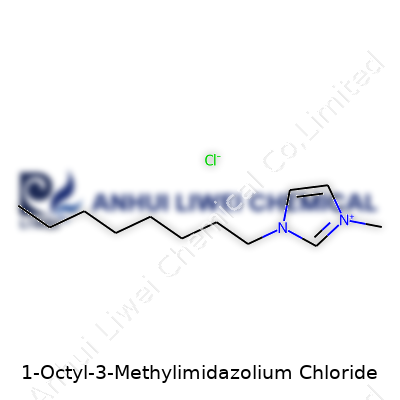
1-Octyl-3-methylimidazolium chloride, often seen in research labs, carries the molecular formula C12H23ClN2. It contains twelve carbon atoms, twenty-three hydrogen atoms, one chlorine atom, and two nitrogen atoms—simple counting, yet it speaks to much more than numbers. Its molar mass lands at 230.78 g/mol. You can’t talk about ionic liquids without running into this compound pretty quickly. It blends a methyl group at the 3-position, an octyl chain at the 1-position, and a chloride anion to keep things balanced.
Why the Formula Matters
In fields like green chemistry, accuracy in formulas means better results. A wrong count of any atom, and the whole synthesis goes sideways, purity slips or, worse, you end up with the wrong material altogether. Miscalculations mess with yields, solubility, and the very properties that draw folks to use this ionic liquid in the first place. Many chemicals get tangled up with common names and abbreviations—variation sneaks in. This formula grounds the discussion in clarity and precision.
Applications and Safety
Researchers and industry use 1-octyl-3-methylimidazolium chloride as a solvent or catalyst. Its ionic nature gives it a low vapor pressure. That makes it less likely to evaporate into the air, reducing exposure risk compared to volatile organic solvents, and supporting a transition away from hazardous substances in the lab. According to literature in Chemical Reviews, ionic liquids like this unlock new territory in biomass processing or organic synthesis. Waste streams shrink, processes simplify—a clear benefit when traditional solvents create more problems than solutions.
Environmental Responsibility
Accurate information about a chemical’s makeup helps limit mistakes—helpful in safety protocols or waste management. The heavy atom count supports certain physical properties: high solvating abilities and thermal stability. From an environmental viewpoint, ionic liquids have upsides, though they still require proper handling. Not every "green" label means zero harm, so knowledge of their components helps shape best practice, storage, and disposal.
Future Directions
Laboratories demand reliability and verification. Spectroscopy, chromatography—these techniques hinge on knowing exactly what’s in the flask. As chemists tinker with new solvents, the baseline molecular data for each candidate matters. Increased sharing of structural information, plus rigorous documentation, moves the field forward. Better reporting decreases error. In my experience, chalking up a number on paper means double-checking with trusted material safety datasheets and peer-reviewed sources like PubChem or the Royal Society of Chemistry. Errors that slip past in the classroom show up elsewhere—in cost, safety, or wasted time. Students or professionals benefit from confirming the obvious, more often than not.
Bringing It Together
For anyone working with 1-octyl-3-methylimidazolium chloride, the facts—C12H23ClN2 and 230.78 g/mol—shape everything from experimental design to storage plans. Chemistry doesn’t hand out free passes for shortcuts. Keeping things exact, documenting sources, and maintaining awareness of both benefits and risks will keep research honest and the environment safer.
Not Just Another Lab Chemical
A lot of specialty chemicals show up in research and industry, and 1-octyl-3-methylimidazolium chloride, a so-called "ionic liquid," keeps popping up. People use this stuff in solvents, batteries, catalysts, cellulose processing—places where old-school solvents can be problematic or toxic. The pitch often goes: “Less volatile, greener than what they replace.” But once you go digging, a different story emerges.
Anyone who’s spent time in research has seen how “safer” replacements may swap out one problem for another. This compound isn’t as explosive or flammable as some typical lab chemicals, and it barely smells. At room temperature, it’s a thick, viscous liquid, which means spills don’t vaporize as quickly. That might sound comforting, but there’s more to safety than the lack of a nasty odor or a hazard symbol.
What the Science Says
There’s peer-reviewed evidence that 1-octyl-3-methylimidazolium chloride isn’t as benign as people hope. Animal studies show this ionic liquid can damage cell membranes, especially in aquatic organisms. Fish and crustaceans exposed to low concentrations absorb it directly into their tissues, disrupting cell processes. Long alkyl chains like the “octyl” group tend to make these molecules more toxic to living things. Even if you’re not working with fish, this ought to make people think about what happens when any chemical finds its way down the drain or into the environment.
The problem actually gets bigger. Once this compound enters waterways, it sticks around. It doesn’t break down easily, so it can build up over time. This amplifies its effects—what seems like a tiny amount today can add up in the long run.
Worker Safety: Gloves on, Caution Up
In the lab, questions come up: “Is this going to hurt me? Do I need extra protection?” Studies have found that 1-octyl-3-methylimidazolium chloride can cause skin and eye irritation. Direct contact leaves a burning or itching sensation. Breathing in even small amounts of its mist could irritate your throat or lungs. Over months or years, even casual exposure might add up. Nobody wants to risk a nasty rash or worse.
Any chemical that dissolves a wide range of substances for science or manufacturing tends to mess with cellular membranes—our natural protective barriers. That quality is fantastic if you’re developing better battery electrolytes, but not so fantastic for your skin, eyes, or ecosystem. Respect goes a long way here: gloves, goggles, fume hoods, and airtight waste containers aren’t just performative theater. They’ll keep accidents down.
Addressing the Real Challenge
Industry can do a better job with clear hazard labeling and easy-to-read safety data. Researchers and workers need better training and, crucially, disposal guidance. Waste streams ought to hit special containment, never a regular drain or garbage can. Environmental groups and regulators have a role too: good monitoring catches spills early, so they don’t trickle into bigger waterways where damage escalates.
Substituting less toxic solvents sounds easy on paper, but history shows every replacement brings a twist. Honest, public-facing discussion—supported by solid data—helps scientists, factories, and regulators make the next choice a little better. That’s the only route to truly greener chemistry.
Understanding What’s at Stake
Shelves lined with chemical bottles always draw attention—a collection of both scientific curiosity and hidden risk. 1-Octyl-3-Methylimidazolium Chloride, which some researchers casually call [OMIM]Cl, holds a reputation for versatility across laboratories and industry. It acts as an ionic liquid, catching the interest of scientists thanks to its unique traits from conductivity to chemical stability. But as someone who has seen both well-run storage rooms and rushed setups, I’ve learned there’s no shortcut for handling this material responsibly.
Key Storage Factors—Avoid Shortcuts
Heat, moisture, and air: three forces that threaten the quality and safety of this chemical. I learned the hard way in my graduate lab, after discovering a sticky lid and discolored liquid—only to realize humidity had entered an unsealed jar. Moisture doesn’t just turn an experiment sour; it can degrade structure and lead to hazardous byproducts. Anyone working with this compound soon understands that storing it in a tightly closed container away from direct sunlight and sources of water isn’t just a guideline—it’s a basic step.
Temperature and Longevity
Extreme temperatures bring trouble. At elevated heat, chemicals degrade or react with stray particles in the air. In my experience, some researchers throw everything in one corner of a storeroom, ignoring the steady climate that certain compounds require. For 1-Octyl-3-Methylimidazolium Chloride, aim for cool—think standard room temperature, between 15°C to 25°C. Consistency protects both the contents and your lab’s budget from the cost of ruined stock. Don’t stash it near radiators or sunny windows. Instead, choose a shaded, well-ventilated shelf away from direct sources of heat.
Labeling and Organization Build a Safe Culture
A jumbled shelf leads to mistakes. Unlabeled or poorly labeled bottles create real dangers; I remember a colleague once grabbing the wrong container, costing us days in lost work and raising safety concerns. Print clear labels showing the full chemical name, concentration, date received, and hazard symbols. This habit not only meets regulatory requirements but also helps future users make informed decisions quickly. In my years handling chemicals, organized storage racks helped prevent more than one avoidable accident.
Why Segregation Makes Sense
Ionic liquids carry a reputation for stability, but that reputation falls apart with sloppy storage. 1-Octyl-3-Methylimidazolium Chloride reacts unpredictably with strong oxidizers. Mixing such materials on a shelf is asking for trouble. Segregate it from acids, bases, and any volatile substances. Color-coded cabinets or dividers can turn guidance into habit, reducing the chance of accidental mixing or contamination. I’ve seen teams benefit from annual reviews of chemical storage, identifying risks before they become emergencies.
Leaning on Real-World Best Practices
Proper chemical storage starts with people, not just protocols. Staff training built into onboarding and repeat safety drills makes guidance stick. In my early career, regular walkthroughs by safety officers caught minor issues, like cracked lids or fading labels, before they grew into major headaches. Encouraging a culture that double-checks storage and labeling preserves long-term safety for everyone in the lab.
Solutions Rooted in Experience
Basic steps—dry environments, sealed bottles, out-of-the-way shelving—anchor the smart storage of 1-Octyl-3-Methylimidazolium Chloride. Modern labs with humidity monitors and automated inventory systems add another layer of security. For small outfits or classrooms, regular inspection, clear instructions, and visible emergency procedures make a meaningful difference. Cutting corners rarely pays off in science or safety; investing effort upfront saves resources and protects health down the line.
Digging Into The Science
Standing at the crossroads of organic chemistry and green technology, 1-Octyl-3-methylimidazolium chloride (OMIM-Cl) shows up more and more in research labs. The long octyl group gives it a punchy mix of oil-loving and water-loving traits. Toss some OMIM-Cl in water, and it dissolves pretty quick—much faster than you'd guess by looking at its oily octyl chain. That chloride ion really helps. In solvents like ethanol or methanol, OMIM-Cl blends in well, almost as if those alcohols split the difference between water and oil. But pour it into hexane or toluene, and things slow down. Those classic non-polar solvents don’t get along with either the imidazolium head or the chloride tail.
Lab Realities and Industry Lessons
Trying to clean up after a run at the bench with OMIM-Cl has shown me just how sticky this stuff can be. Rinsing glassware with water or alcohol easily sweeps away residue. No surprise: ionic liquids like this thrive in polar environments. Pitch OMIM-Cl solutions into the waste barrel and the same principle applies. Waste handling folks want highly soluble salts in water—less mess and less risk floating around, because you’re not trying to mop up slippery oils.
Dive into industry uses—think cellulose processing, electrochemistry—and you see why people care about these solubility quirks. Researchers at the University of Alabama broke cellulose waste down in OMIM-Cl mixed with water, cranking out biofuels. They needed a salt that won’t turn into blobs or layer up when water's on the scene. Tighter molecular ordering from OMIM-Cl also pops up in battery research, including work by the Argonne National Lab group, which needed a room temperature ionic liquid that wouldn’t separate inside a cell. Reliability depends on the way it actually mixes.
Facts Matter More Than Hype
Most commercial OMIM-Cl comes as a viscous liquid or solid at room temperature. Its melting point typically lands around 35°C. Its solubility in water clocks in over 500 grams per liter, a figure quoted by Sigma-Aldrich and a handful of peer-reviewed studies. Nearly transparent in dilute solution, OMIM-Cl doesn’t cloud up unless it meets pure hydrocarbons.
The huge solubility in water lets folks wash OMIM-Cl out of reaction mixtures. In practice, I’ve reclaimed solvents this way: after a reaction, layer cold water in, and OMIM-Cl slips out, leaving the rest for extraction. If you try that with acetone or hexane as your workhorse, you’ll get poor separation and higher expenses. Smart chemistry departments know the cost of using wrong solvents for cleanups.
Addressing The Catch
OMIM-Cl dissolves in both water and some organic solvents, but there’s a price to pay. High water solubility helps in applications like biomass conversion but complicates recovery and recyclability. Waste streams then need careful handling, since OMIM-Cl doesn’t just evaporate; it sticks around in water and resists traditional cleanup. Closed loop recycling methods help, forcing used OMIM-Cl back into service. One method: distill water off under vacuum and recharge the OMIM-Cl for another cycle. This keeps both costs and pollution down.
Some see OMIM-Cl as a “green” solvent, but that depends on its end-of-life. Because of its powerful solubility, regulators want tight controls over spills and waste, just as they do for traditional industrial salts or surfactants. The European Chemicals Agency tracks research on OMIM-Cl’s impact in aquatic systems, pressing for data before it sees wider use. Balancing its promise means treating solubility not just as a lab curiosity, but a factor in safety, sustainability, and smart process design.