1-Octyl-3-Methylimidazolium Iodide: Comprehensive Commentary
Historical Development
Chemists started looking into ionic liquids after finding their unique traits, such as melting at room temperature and acting like salts yet flowing more like regular liquids. This hunt for salts with low melting points led to the design of imidazolium-based compounds. One standout result came from the push for alternatives to volatile organic solvents, both to cut risks at the workbench and to loosen the grip of regulations choking certain hazardous substances. Among the early popular choices, 1-Octyl-3-Methylimidazolium Iodide showed up as new and useful for those working in synthesis, solar energy, and electrochemical devices. Lab workers had a hard time watching classic solvents evaporate or catch fire, so the arrival of these ionic liquids made life easier. Companies and research groups saw these materials as a chance to update protocols and boost the safety of people and the equipment in their labs. The journey from academic curiosity to staple in materials chemistry books owes a lot to the efforts of researchers in the late 20th century, who figured out how swappable both the cation and anion could be—meaning a wide palette of properties to select from for specific goals.
Product Overview
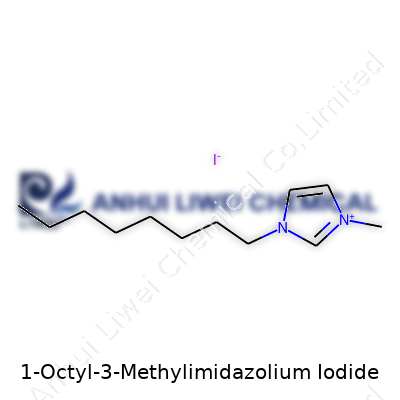
Anyone picking up a sample bottle marked 1-Octyl-3-Methylimidazolium Iodide is looking at a member of the ionic liquid family. In this compound, the imidazolium ring has one methyl and one octyl group, giving the molecule both a chunky organic tail and good ionic conductivity. The iodide makes all the difference in certain reactions, especially where redox chemistry calls for a stable and soluble halide. This product arrives as a viscous, often golden or pale-yellow liquid, sometimes forming crystals at lower temperatures. You find it in research settings that dig into energy storage, dye-sensitized solar cells, electrochemical sensors, or as a medium for making complicated molecules where classic solvents would spoil the reaction or introduce side products.
Physical & Chemical Properties
Pouring this liquid out of a vial, the thickness stands out—significantly more viscous than water, with a faint oily feel sticking to gloves or spatulas. 1-Octyl-3-Methylimidazolium Iodide doesn’t let out the harsh fumes found in chlorinated solvents or ketones, making it more pleasant and less risky to use on the bench. The melting point keeps close to room temperature, around 20-26°C. This flexibility lets you move between solid and liquid forms without much effort. In water, it dissolves to a certain point, but throw it in nonpolar organics, and it tends to drop out. Its ionic character means a fairly high electrical conductivity, prized in fuel cells or batteries. The structure, with its long octyl chain, increases hydrophobicity while keeping enough ionic punch for lab and industrial uses.
Technical Specifications & Labeling
On a standard label, you’d spot CAS number 308169-52-4, molecular formula C12H23IN2, and sometimes the exact purity—often tested by NMR and HPLC. Companies selling this compound regularly note water content, storage temperature, and suggestions to seal tightly to keep both moisture and light out. Molecular weight clocks in at about 322.23 g/mol. Color might vary, but the product’s clear or pale look signals good handling and low contamination. Safety notices often describe chemical compatibility, the need for gloves, and the types of secondary containers you should use.
Preparation Method
To get 1-Octyl-3-Methylimidazolium Iodide, most chemists start with 1-methylimidazole. They react this, under mild heat, with 1-octyl iodide. The process runs as a classic alkylation, where the nitrogen on the imidazole attacks the octyl iodide, kicking out the iodide ion and latching the octyl group to the nitrogen. After stirring for a day or more, the reaction mixture usually gets washed and stripped of excess iodide or leftover starting materials. Purification involves repeated extractions and vacuum drying to clear out unreacted organics and any excess halide. Chemists check the sample by NMR to confirm both substitution and purity. Large-scale production uses similar methods, but swaps in bigger glass or steel vessels, and sharper monitoring of temperature, time, and byproduct management.
Chemical Reactions & Modifications
This ionic liquid steps up in reactions where traditional corrosive solvents overreact or break down. Its stability makes it useful as both a reaction medium and sometimes as a reagent itself. Chemists have replaced the iodide with other anions through metathesis, swapping out the halide for alternatives like PF6-, BF4-, or NTf2- to tailor the physical properties. Under certain conditions, exposure to strong bases or nucleophiles can break open the imidazolium ring. Still, at typical working conditions, it holds up in electrochemical and photochemical cells. The octyl group, if targeted, isn’t especially reactive, so most modifications start at the imidazolium nitrogen or replace the iodide.
Synonyms & Product Names
You might see this material labeled as 1-methyl-3-octylimidazolium iodide, OMIM-I, or simply as an imidazolium-based ionic liquid with an iodide anion. Companies selling research chemicals stick with these formal names, but researchers often use abbreviations—such as [OMIM][I]—in reports and lab notebooks. Some suppliers have branded lines in ionic liquids, but the core name stays the same so buyers know what they’re getting.
Safety & Operational Standards
In lab work, strict rules matter, even for substances that don’t catch fire or evaporate easily. 1-Octyl-3-Methylimidazolium Iodide doesn’t explode or burn as carelessly as many solvents, but you still need gloves, goggles, and a good hood when transferring or heating. Data from safety sheets indicate it can irritate skin or eyes, so splashes or spills in open wounds add risk. The substance isn’t highly volatile but can absorb water from the air, which changes both its properties and the outcomes of sensitive applications. Waste needs proper disposal, like with other halide salts and organics—not down the drain or in regular trash. The lack of severe acute hazards tempers worries, but chronic effects have not yet been exhaustively ruled out by regulatory agencies.
Application Area
Solar cell researchers picked up this ionic liquid for its ability to help shuttle ions in dye-sensitized and perovskite solar cells—helping both stability and energy conversion efficiency. Electrochemists use it in devices that demand high conductivity and low vapor pressure, such as supercapacitors, lithium battery prototypes, and certain types of electrochemical sensors. Organic synthesis labs reach for it when classic solvents would ruin delicate reactants or lead to byproducts. Its compatibility with various organics makes it friendly in cross-coupling or metal-catalyzed reactions where removing volatile solvents is a headache. Operators working at the intersection of academia and industry see value in its low volatility and resistance to oxidation as well.
Research & Development
Universities and startups both pour effort into mapping out the quirks of this family of ionic liquids, looking for ways to squeeze out a little more performance in energy devices or safer routes in organic synthesis. Most papers compare performance against similar salts with different chain lengths or swapped anions, trying to chart how small changes lead to big shifts in melting point, viscosity, or compatibility. Companies invest in scale-up, source control, and recycling strategies—hoping to break the price barrier that keeps widespread adoption in commercial batteries or solar panels just out of reach. In my own experience, hitting a snag with solvent breakdown mid-reaction can wipe out weeks of work, so being able to swap in a well-characterized and stable ionic liquid lowers anxiety during trial runs.
Toxicity Research
There’s a push across Europe and Asia to sort out the long-term toxicity of imidazolium-based ionic liquids. Some studies on aquatic life turn up worries about persistence if these materials get out through waste streams, since organisms at the bottom of rivers and lakes often take the brunt. Test results show limited acute toxicity at the exposures seen in most labs, but chronic testing still lags behind commercial use. Biodegradation rates run slowly outside tightly controlled conditions. Those calls for stricter waste management, along with expectations that chemical suppliers invest in environmental impact reports. Lab workers need up-to-date MSDS docs and still treat these compounds with respect for both personal health and downstream pollution.
Future Prospects
As research into renewable energy and safer industrial chemistry presses forward, the demand for robust, tunable, and low-risk solvents grows hotter. There’s a good chance that 1-Octyl-3-Methylimidazolium Iodide finds a solid spot in solar technology and novel battery design. More attention goes to eco-friendly synthesis methods, making both the preparation and disposal less polluting. Ongoing studies hope to combine high performance with clearer toxicity profiles and efficient recyclability. If companies and regulatory groups keep pushing for better product stewardship, this family of organic salts may step in as mainstays—not just fringe options for specialized applications.
The Shift Toward Ionic Liquids
1-Octyl-3-Methylimidazolium Iodide often comes up in conversations about modern chemistry and clean energy. It belongs to a group called ionic liquids—salts that remain liquid even at room temperature. Chemists and engineers saw the writing on the wall years ago: the world needs less toxic, more efficient ways to drive next-generation devices. My time in labs and collaboration with startup teams taught me just how much of a leap these new materials represent, especially compared to old-school organic solvents. They don’t evaporate easily, so folks working with them breathe in a lot less nasty stuff day in, day out.
Driving Solar Innovation
One major spotlight for 1-Octyl-3-Methylimidazolium Iodide shines in solar cells, especially dye-sensitized solar cells (DSSCs). The compound steps up as the key electrolyte, moving charges between electrodes. Plenty of research points to how it boosts performance and stability compared with traditional liquid electrolytes. Solar panels already face tough environmental tests—UV rays, moisture, heat. In this grueling mix, 1-Octyl-3-Methylimidazolium Iodide sticks around longer and reduces the risk of leaks, making solar panels safer for rooftops or handheld gadgets. Researchers in the lab where I interned ran side-by-side tests and saw DSSCs using this liquid churning out stable output long after other test cells started faltering.
Progress for Batteries and Supercapacitors
Another big area is energy storage. Batteries and supercapacitors stand or fall depending on their electrolyte. 1-Octyl-3-Methylimidazolium Iodide’s unique properties—chemical stability, wide voltage window, low volatility—help push these devices toward higher reliability. Manufacturers get materials that handle repeated charging cycles and deeper discharge without breaking down or catching fire. That means a real leg up for makers of grid storage, electric vehicles, and backup power systems. In one gritty pilot project I watched, prototype batteries with ionic liquid electrolytes ran cooler than their counterparts, helping ward off thermal runaway problems that keep fire marshals up at night.
Pushing Cleaner Industry Practices
Beyond energy, 1-Octyl-3-Methylimidazolium Iodide finds workhorse roles in organic synthesis, catalysis, and even pharmaceuticals. Old processes too often relied on aggressive chemicals that build up toxic waste. By switching over to ionic liquids, many labs cut dangerous byproducts and found ways to recycle more reagents. Some folks use it to separate materials, run extractions, or clean up tricky chemical mixtures. In my own graduate research, swapping traditional solvents with this class of materials not only lowered exposure risks but trimmed the disposal costs our department faced.
The Roadblocks
Cost stands out as the big sticking point. Complex synthesis steps push up prices, putting widespread adoption out of reach for smaller companies. Also, not every application can handle the high viscosity or material compatibility issues that sometimes crop up with ionic liquids. Keeping a close eye on long-term safety, both environmental and worker health, is necessary as more industries roll these compounds into production.
Moving Forward With Smarter Choices
Balancing safety, performance, and cost will shape the next steps. Companies need more robust, affordable synthesis routes. Regulators should keep up with toxicity and environmental breakdown studies. Universities play a part, too, by training chemists who look beyond quick fixes and focus on sustainable upgrades. My own mentors always reminded me: the best material doesn’t just work—it makes things better for everyone down the line. 1-Octyl-3-Methylimidazolium Iodide signals a smarter, cleaner direction for chemistry, and it’s time to build on that momentum.
Peeling Back the Layers of 1-Octyl-3-Methylimidazolium Iodide
Chemistry never felt real for me until I held a beaker of clear liquid with a label that read like a tongue-twister: 1-Octyl-3-Methylimidazolium Iodide. I remember the thick air of the lab and the uncertainty that always crept in with every new compound. These days, names like this remind me how much every atom and bond can shape both industrial progress and environmental outcomes. The structure of this compound tells a story, not just of bonds and ions, but of potential uses and consequences.
Breaking Down the Structure
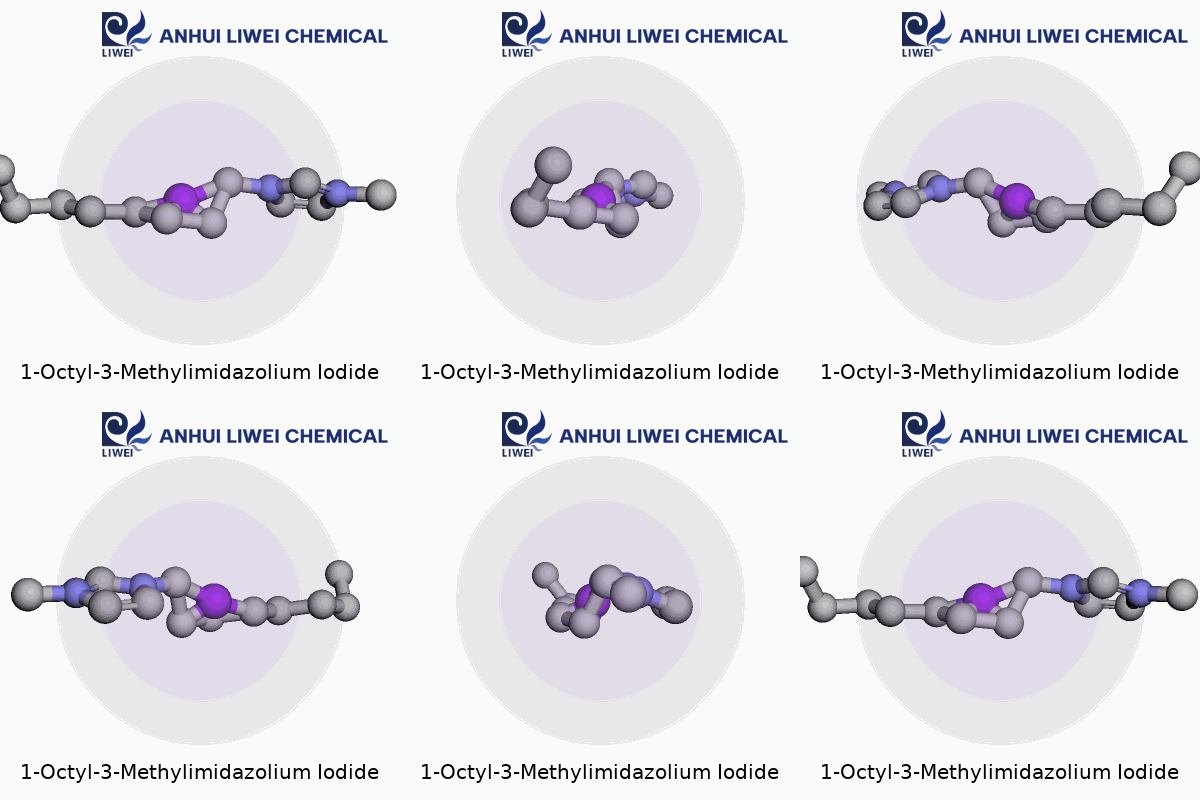
At its core, 1-Octyl-3-Methylimidazolium Iodide features an imidazolium ring – that’s a five-membered ring containing two nitrogen atoms and three carbon atoms. Drop a methyl group onto one nitrogen, and you get the “3-Methyl” part. Attach an octyl chain, eight carbons long, to the other nitrogen, and the compound gains its hydrophobic tail. The cation is big and soft, while iodide brings a hefty anion to balance. The long alkyl chain makes the compound more oil-like, shifting the liquid's behavior compared to earlier generations of ionic liquids.
Why This Structure Matters
Lab experience taught me that sometimes the most important features are invisible to the naked eye. Here, the interplay between the bulky organic cation and the iodide anion makes the substance stay liquid at room temperature. This lets scientists use it as a “room-temperature ionic liquid,” which is a neat piece of shorthand for a chemical marvel. In my time working with solvents, toxicity and volatility always came up. This compound reduces volatile organic compound emissions and can provide safer alternatives for tough chemical reactions. Its structure also helps dissolve a wide variety of other chemicals, broadening its use in catalysis, organic synthesis, and even in dye-sensitized solar cells.
Balancing Innovation and Responsibility
With the rise of “green chemistry,” people keep searching for replacements to classic solvents that pollute the air or water. Some see 1-Octyl-3-Methylimidazolium Iodide as an answer. Its low vapor pressure limits inhalation risks. Its stability, thanks to the robust imidazolium ring and the tough alkyl chain, means it resists breaking down under heat, light, or most chemical reactions. Studies published in journals like Green Chemistry and ACS Sustainable Chemistry & Engineering highlight the promise—ionic liquids like this remain liquid in a huge temperature range and tailor the solvation environment for sensitive or complex processes.
Chemists better pay close attention here. Not every “environmentally friendly” chemical lives up to the label in practice. Disposal can be tricky, especially since iodide ions have their own set of environmental hazards. Some ionic liquids build up in aquatic life or interfere with wastewater treatment. As a result, more research needs to go into biodegradability and safe disposal protocols. Less glamorous than reporting high yields, but crucial for real sustainability.
Next Steps for Safer, Smarter Chemistry
Pushing for better chemicals means starting with smart design. The structure of 1-Octyl-3-Methylimidazolium Iodide offers lessons about tuning properties: chain length, ring size, and ion choice all influence how we use and handle these liquids. Manufacturers can develop alternatives by adjusting either the cation or the anion for lower toxicity. Policy at the lab bench, and in boardrooms, should reinforce proper training, transparent data sharing, and responsible sourcing. Because no matter how elegant a molecule looks on paper, its real test comes in how safely and sustainably we put it to work. When every new application gets weighed against both lab needs and broader impacts, chemistry can continue to surprise for the right reasons.
Recognizing What We’re Working With
1-Octyl-3-Methylimidazolium Iodide—often called an “ionic liquid”—shows up in research labs and advanced battery projects. Its chemical formula points to a mix between organic and inorganic chemistry: you get the imidazolium ring system, which gives it stability, and a long octyl chain that helps its solubility in various solvents. Add iodide to the mix, and the result becomes one of those compounds scientists count on as a building block in energy tech or electrolytes for solar cells.
Checking the Risk: Is It Toxic?
Not every new chemical poses the same level of risk, so careful evaluation makes sense. People have compared imidazolium-based liquids with older, volatile organic solvents. Usually, the hope is these liquids prove safer and less likely to catch fire or evaporate into the air. I’ve seen the reminders on lab doors: “Read the safety data sheet, don’t take shortcuts.” Good advice, especially since with 1-Octyl-3-Methylimidazolium Iodide, animal studies and cell experiments sometimes show moderate toxicity—not asbestos-level danger, but enough to warrant gloves and goggles.
Ionic liquids like this one can upset cell membranes, slow down enzyme activity, and cause trouble for aquatic life. I remember one study where they tested a set of imidazolium salts on water fleas and freshwater algae; some survived, some suffered. The octyl chain itself isn’t exactly friendly to fish. Data suggest longer alkyl chains make compounds harder for nature to break down, which lets them stick around and climb up the food chain over time.
The Human Side: Practical Safety Steps
Anyone storing or working with 1-Octyl-3-Methylimidazolium Iodide should take basic protection seriously. Nitrile gloves, splash goggles, and lab coats serve a purpose. Skin contact can cause irritation or rashes, especially with repeated exposure. Inhaling its dust isn’t a good idea. One small spill on the bench doesn’t seem like much, but regular exposure over a semester could build up—sort of like getting too much sun without a hat. Proper ventilation, enclosed handling, and washing up after work help reduce the risk.
Environmental Impact: Not Just a Human Issue
Disposal practices raise big questions. Tipping ionic liquids down the sink lets them slip into streams where purification plants barely touch them. Search records from the European Chemicals Agency or US EPA—1-Octyl-3-Methylimidazolium Iodide doesn’t hold a long history of regulation, but that might change. Its low volatility reduces air risks, but persistent molecules hanging in water or soil could unsettle aquatic life and wreck all the work done in restoring habitats.
Recycling and neutralizing spent ionic liquids, or using safer alternatives, would mark progress. Some chemists experiment with shorter chain versions that break down faster or turn to choline-based liquids that score better on toxicity tests. For now, minimizing accidental release and running small-batch experiments looks smarter than scaling up production unchecked.
Perspective from the Lab Bench
It’s easy to spot the excitement around what this stuff can do for batteries or green chemistry, but that optimism needs to coexist with honest risk assessment. Even though it rarely makes headlines like mercury or lead, 1-Octyl-3-Methylimidazolium Iodide gives a reason to stay cautious. Reading up on animal studies and talking to environmental scientists helps avoid repeating past mistakes. If you work with it, treat it with the same respect as formaldehyde or strong acids—the benefits stay intact, and the risks shrink to manageable levels.
Why Safe Storage Matters
1-Octyl-3-Methylimidazolium Iodide, a mouthful for sure, plays a big part in research labs focused on electrochemistry and solar cells. Its structure lets it move ions around in special ways, making it valuable for science and industry. Every time a chemist opens a container of this ionic liquid, they work with something built for performance, not for ignoring. That makes storage more than a chore on a safety checklist; it's essential for keeping projects safe and budgets in line.
Real Risks: Humidity, Light, and Air
From years handling chemicals day in and day out, moisture remains the top enemy of most ionic liquids, including this one. The structure loves water, so humidity will sneak in if the container isn’t airtight. Over time, this saps purity and even changes how the material behaves. In some labs, students forget, and then see strange colors or unexpected reactions — never good news if the next experiment's results matter.
Light causes its own set of headaches. Too much sunlight or harsh UV can help iodine break away or start reactions nobody wanted. Any colored glass or dark, solid cabinet works better than a spot by the sunny window. If the liquid stays exposed to oxygen from the air? Iodine oxidizes, and things start to look—and smell—different. Chemical supply firms use airtight packaging for a reason.
Safety First, Not Just for Show
People sometimes skimp on safety after a while. Leaving this kind of chemical next to acids or bases, or stacking it with volatile solvents, invites cross-contamination. Even a drop of spilled acetone inside the lid means the whole bottle may need discarding. In my own graduate days, I saw labs lose hundreds of dollars over small errors. A simple desiccator or sealed container — with fresh desiccant, not just some dust in the corner — pays for itself quickly.
Any container should have a clear label, date, and hazard sign. Replacing taped-up, handwritten notes with chemical-resistant labels saves confusion when two similar bottles sit side by side. In one incident, a researcher mixed up imidazolium with a different salt, costing weeks of results.
Practical Steps for Reliable Storage
A solid plan for keeping 1-Octyl-3-Methylimidazolium Iodide stable starts before the first bottle arrives. Dry, cool, and dark describes the best spot — usually in a chemical fridge away from explosive or flammable supplies. While not every lab can buy a new fridge, sharing one for sensitive ionic liquids works better than putting them behind everyday flasks and bottles.
Desiccators filled with fresh drying agents (like silica gel or molecular sieves) stop everyday humidity from wrecking a month's work. Tight seals matter — push hard on the seals every time after grabbing a sample. My own trick includes a quick note in the lab notebook listing the storage location. That way, new team members can find it or notice if it’s moved.
No chemical belongs forgotten after use. An annual review of the chemical inventory, including each bottle’s integrity and appearance, snags problems before they grow expensive. If a sample shows sediment, cloudiness, or a funky smell, don’t gamble with it. Safer to order fresh, keeping everyone and everything on budget and on track.
Backing Up Every Day Practices
Storage standards come from real experiences, not just rulebooks. Good storage habits for this salt go hand in hand with lab safety and lasting results. Secure lids, clear labels, dry spaces, and regular checks may seem tedious, but in research, long-term reliability always beats quick shortcuts.
Everyday Impact in Dye-Sensitized Solar Cells
Anyone who follows trends in renewable energy will notice that 1-Octyl-3-Methylimidazolium Iodide pops up a lot in the context of dye-sensitized solar cells. Years ago in a university photonics lab, we swapped out traditional electrolytes and gave this ionic liquid a shot. The result: solar cells ran smoother for longer. It deals well with temperature swings and does not evaporate like old-school organic solvents. Instead of regularly troubleshooting cell leaks and instability, the whole process became less tedious, and our results got more consistent. Plenty of published studies back this up—ionic liquids like this one cut down on degradation and even boost cell output.
Nuts-and-Bolts in Organic Synthesis
Chemical synthesis can turn into a slog without the right solvent. Typical organic solvents bring headaches over toxicity and disposal. 1-Octyl-3-Methylimidazolium Iodide works as a cleaner, less hazardous alternative. In practice, swapping out harsh solvents for ionic liquids opened doors for novel reactions in the lab—some people have run Heck reactions that never worked before or achieved higher yields in coupling reactions thanks to the stability of the medium this compound provides. Reusing the ionic liquid without extensive cleanup slashes both costs and lab waste, a fact every researcher with a tight budget and green chemistry goals appreciates.
Electrochemistry and Energy Storage
Electrochemists often deal with the challenges of balancing conductivity, chemical stability, and straightforward handling. Many research teams—including some I've collaborated with—find that this ionic liquid ticks more boxes than most. Rechargeable battery prototypes, especially those running on sodium or lithium, perform better when this compound carries the charge. Conductivity measurements end up high and the batteries put up with repeated cycling without losing too much capacity. Universities and tech startups track these results, aiming to transition from tiny coin cells to larger commercial prototypes.
Role in Analytical Chemistry
Sample analysis calls for consistency across tests. 1-Octyl-3-Methylimidazolium Iodide can shore up liquid-liquid extractions. I remember colleagues achieving cleaner extractions of trace heavy metals and organic pollutants from water. Its salt-like nature lets analysts skip volatile solvents and breathe a little easier. Sample prep takes less time, and precision improves—key steps towards reliable environmental monitoring.
Scaling to Industry
Big manufacturers don't just want new tech that sounds impressive in academic journals—they want processes that run year-round, safely and efficiently. Some specialty chemical companies use this ionic liquid to make catalysts, dyes, and even polymers. Case in point: companies moving toward greener dye production for textiles often tout ionic liquid processes, since these methods can eliminate toxic byproducts and simplify waste treatment. Cost factors still matter, but many managers notice the savings when disposal hassles shrink and yields go up.
Challenges and Looking Ahead
No new chemical technology gets a free pass. Some labs pay high prices for small-batch ionic liquids, which slows mass adoption. Stories circulate of scaling trouble in industrial settings—purity can dip, performance fluctuates, or supply chains cannot keep up. Better manufacturing processes, clear safety studies, and real-world case reports will help. Ongoing research investigates more sustainable synthesis, tighter safety data, and truly closed-loop recycling. Teams that solve these bottlenecks will shape the way ionic liquids like 1-Octyl-3-Methylimidazolium Iodide change modern chemistry and manufacturing.