1-Octyl-3-Methylimidazolium Tetrafluoroborate: Commentary on an Evolving Compound
Historical Development
The rise of 1-Octyl-3-methylimidazolium tetrafluoroborate didn’t happen overnight. Back in the late 1990s and early 2000s, chemists wanted to find better solvents to replace the volatile organic compounds used across labs and industry. This particular compound emerged out of research into ionic liquids. Academic groups in Germany and Japan started looking at ways to pair different cations and anions to produce salts with low melting points. They wanted something stable, nonflammable, and easy to handle, especially during high-temperature reactions. 1-Octyl-3-methylimidazolium tetrafluoroborate quickly grabbed attention. The imidazolium core came straight from existing organic chemistry, while the octyl chain improved solubility for a range of compounds. Its first large-scale uses appeared in electrochemistry labs, and from there, research spun outward into green chemistry and catalysis. The chemical’s growth echoes a larger shift in industrial and academic thinking, moving away from hazardous solvents without giving up performance.
Product Overview
This ionic liquid doesn’t ask for much. As a room-temperature salt, it offers a low vapor pressure, high chemical and thermal stability, and a knack for dissolving both organic and inorganic chemicals. People in chemistry circles sometimes call it [OMIM][BF4], which shortens a long name but still signals to the initiated that this is no ordinary salt. It looks like a pale yellow to colorless oily liquid and doesn’t let out a pungent odor. Buyers look for purity above 98%, since residues from manufacturing steps might affect how it works in a reaction or system. What sets it apart: its ability to dissolve stubborn solids and to blend with a whole range of organics and some metals. As labs have moved closer to “greener” protocols, this salt often gets a spot on the supply shelf.
Physical & Chemical Properties
A closer inspection shows a dense oily fluid, with density typically circling around 1.02–1.07 g/cm³ at room temperature. The melting point won’t bother most researchers since it sits far below room temperature, usually in the range of -80°C to -20°C depending on sample purity and microstructure. Conductivity stands at moderate values for ionic liquids, usually between 0.5 and 1 mS/cm. Its thermal stability stretches comfortably above 300°C. Water solubility is moderate, but adding water to it changes conductivity and viscosity. The tetrafluoroborate anion holds up under mildly acidic and basic conditions, but high temperatures or strong nucleophiles might eventually cause it to decompose, releasing hydrogen fluoride. Viscosity runs higher than most organic solvents — this doesn’t always help with mixing, but for electrochemical cells and certain separations, the trait can actually enable better control.
Technical Specifications & Labeling
Suppliers don’t leave much to chance with this one. Bottles usually carry grade, water content, impurities, and storage recommendations. Sodium, chloride, sulfur, or phthalates sometimes sneak in during production, so reputable vendors run heavy chromatographic and elemental tests before bottling. Product usually ships in glass or HDPE bottles, with a tamper-evident seal and a clear batch code. Labels mark the hazard phrase “irritant” and urge the user to avoid direct contact with skin and eyes. Transport follows UN regulations for chemicals, especially since improper heating or contamination may liberate corrosive hydrofluoric acid.
Preparation Method
The synthesis requires two main steps. First, 1-methylimidazole reacts with 1-chlorooctane or 1-bromooctane, producing 1-octyl-3-methylimidazolium chloride or bromide. This reaction happens under reflux, usually with excess alkyl halide to drive the conversion to completion. The intermediate compound gets washed to remove unreacted starting material and solvent residues. Next, the halide salt meets sodium tetrafluoroborate in water or acetone. As they mix, a metathesis reaction swaps the halide with the BF₄⁻ anion, dropping out sodium chloride or sodium bromide as a byproduct. Several water and solvent washes follow, as chemists flush out the sodium salt and fine-tune purity. Drying happens under vacuum, giving a thick liquid product, which sometimes sits under inert gas to prevent water uptake.
Chemical Reactions & Modifications
This compound’s strength lies in its stability, though it participates actively in some reactions. The imidazolium ring can undergo alkylation or coordinate to soft metal centers, offering opportunities to engineer new ionic liquids or to graft onto polymer backbones. Modifying the cation, for example by varying the length of the alkyl chain, tunes solubility and viscosity. In catalytic cycles, it occasionally acts as a mild ligand to rhodium or palladium. The tetrafluoroborate anion holds up well, but in the presence of strong Lewis acids or under high voltage, it can release BF₃ and then hydrolyze to give boric acid and hydrogen fluoride, which calls for careful handling and shielding. As ionic liquids edge into new reaction roles — from phase-transfer catalysis to organic syntheses — this compound’s portfolio continues to grow.
Synonyms & Product Names
Chemists don’t always agree on naming conventions. The full IUPAC name can be a mouthful: 1-octyl-3-methyl-1H-imidazol-3-ium tetrafluoroborate. Most catalogs shorten it to OMIM BF4, or drop the BF4 and simply use OMIM. Less formal users swap the cation order: methyl-octylimidazolium tetrafluoroborate. Other synonyms include [C8mim][BF4], OMI-TBF, and 1-octyl-3-methylimidazolium tetrafluoroborate(1-). These minor twists in naming can trip up younger chemists trying to compare literature reports, and cross-referencing registry numbers (such as CAS 174501-65-6) often clears the confusion. As the compound finds new applications, more trade names and abbreviations show up in the market.
Safety & Operational Standards
This ionic liquid asks for common chemical respect: gloves, goggles, fume hood. It doesn’t ignite easily. But, the tetrafluoroborate anion brings a risk. Exposure to strong acids or bases, or heating above the decomposition threshold, releases hydrogen fluoride. This gas stings the skin, can eat through glass, and poses a real risk to anyone exposed. Handling spills requires more than a lab wipe; neutralizing with sodium bicarbonate and ventilating the area takes priority. Prolonged skin contact causes dryness and irritation. Waste handling must comply with regional hazardous waste disposal standards, since degradation byproducts can contaminate ground and water. As with all ionic liquids, rinsing glassware with copious amounts of a neutralizing detergent reduces long-term lab risks. Adults in industry remember accidents from poorly labeled or mishandled BF₄ compounds, underlining the need for strong training and supervision.
Application Area
This compound’s biggest splash lands in green chemistry and advanced materials research. Electrochemists reach for it to build stable, high-conductivity electrolytes in lithium batteries and supercapacitors. Catalysis groups use it as a solvent for cross-coupling reactions, oxidation, and alkylation. It anchors ionic liquid-based chromatography columns and membrane separations, since it promotes selective solubility on both ends of the spectrum. Extractive metallurgy tap it for separating precious metals from ores and recycled electronics. In dye-sensitized solar cells, 1-octyl-3-methylimidazolium tetrafluoroborate extends device longevity by resisting decomposition. Some biomedical researchers have begun testing its biocompatibility as a drug formulation tool. Technologists sometimes include it in nanocomposite and polymer research, blending ionic and organic properties for unique surface or electrical features. The list keeps growing — even into niche areas like carbon dioxide capture and biomass conversion.
Research & Development
Research takes two main paths: application testing and material optimization. At universities, new projects center around fine-tuning alkyl chain length and exploring how those tweaks shift viscosity, conductivity, and solubility of key compounds. Lab groups design next-generation electrolytes for batteries that charge faster and last longer. Catalysis teams wrap this ionic liquid around metal nanoparticles to drive greener and more efficient transformations, which means less waste and lower energy bills. Collaboration with industry shapes how the material rolls out on a commercial scale. Pilots test recovery protocols and recycling, since ionic liquids don’t evaporate but sometimes pick up impurities in each batch cycle. Long reports track how packages of ionic liquid behave over months and whether repeated freeze-thaw cycles change product specs. Analytical labs probe for trace hydrolysis, learning from every off-smell or color change in samples that sat too long on a shelf. R&D teams in Asia and Europe compete to patent tweaks, not just for chemistry’s sake but to grab market royalty from “greener” processing.
Toxicity Research
Real progress starts with honesty about risks. Early studies on 1-octyl-3-methylimidazolium tetrafluoroborate flagged possible toxicity toward aquatic organisms. As with many organic salts, chain length and cation ring structure affect how easily it crosses cell membranes. Long-term studies in rodents and cell culture suggest mild to moderate toxicity at high concentrations, especially for compounds containing larger alkyl chains. Decomposition products — especially hydrogen fluoride — can cause severe burns and respiratory irritation. To reduce risk, researchers look for less persistent breakdown products and keep a close eye on how the compound degrades under sunlight or microbial action. Wastewater researchers have begun monitoring traces in municipal and industrial runoff, since persistent ionic liquids might linger even after standard treatment. Data lags a bit behind technology, as always, but modern eco-toxicology places this class of compound under ongoing review.
Future Prospects
Looking forward, demand for 1-octyl-3-methylimidazolium tetrafluoroborate depends on market drivers like green-processing mandates, battery innovation, and access to raw chemical feedstocks. As lithium and sodium batteries look to replace lead and nickel systems, this ionic liquid remains in the mix due to its thermal stability and reduced flammability. Green chemistry protocols that focus on minimizing volatile organics look toward ionic liquids as drop-in replacements for hazardous solvents, though cost still weighs on mass acceptance. Research groups hope for cost reductions as production scales up, and for new safety data pointing toward less risky alternatives or ways to lock up and degrade the compound safely after use. Academic networks push for transparency about lifecycle analyses and careful mining of operational data, while startups race to secure supply lines and win patents. Future market acceptance hinges on proof that ionic liquids can deliver a lower environmental footprint and replace traditional solvents without new health risks or ballooning costs.
A Closer Look at a Modern Ionic Liquid
1-Octyl-3-Methylimidazolium Tetrafluoroborate doesn’t roll off the tongue, but this chemical captures a lot of interest in research and some areas of industry. Getting to know why folks pay attention starts with its nature—this compound belongs to a group called ionic liquids. These substances stay liquid at pretty low temperatures, sometimes below zero Celsius, and they act as strong solvents, especially for tough cases where water or regular organic solvents start to struggle.
Real-World Uses: Beyond the Science Textbooks
Chemical engineers and synthetic chemists appreciate this stuff. Back in university labs, we would pull out something like this for reactions that can’t happen smoothly in water or alcohols. Researchers love it for dissolving weird molecules or speeding up some reactions, especially in green chemistry. For those looking to avoid volatile organic solvents that hurt the environment, ionic liquids like this one sound pretty appealing.
In electrochemistry, 1-Octyl-3-Methylimidazolium Tetrafluoroborate steps in as an electrolyte in batteries and supercapacitors. Some of my chemistry colleagues tried it to develop batteries that can handle higher energy storage. Safety often becomes a concern in the battery game—using non-flammable ionic liquids gives some peace of mind, lessening risk compared to common solvents like acetonitrile.
Solving Real Challenges: Why It Matters
The world wants better solvents for drug manufacturing, high-tech electronics, and recycling. Regular organic compounds evaporate into the air and add to pollution. At home, people think about air fresheners and nail polish remover, but multiply that by the scale of a pharmaceutical plant—it’s huge. Ionic liquids stick around. They don’t just float off, so air quality can improve in factories. Some data from the EPA points out that lowering fugitive emissions helps both air and water quality around these manufacturing sites.
There's also the challenge of reusing rare or expensive metals in electronics. Some ionic liquids dissolve metal ions extremely well, helping recycle things like lithium or cobalt from old electronics. I remember one research seminar where a group showed how these solvents extracted gold out of e-waste much more easily. The waste piles up, so using less harmful chemicals here matters for cities worldwide.
The Downsides and the Road Forward
People need to talk about cost. Type any ionic liquid, especially ones like 1-Octyl-3-Methylimidazolium Tetrafluoroborate, into a chemical supply site and the price makes you wince. Widespread use would ask for better, cheaper synthesis approaches. Some ionic liquids linger in water and soil because nature doesn’t break them down quickly. There’s pushback if companies want to switch from one environmental headache to another. A few colleagues in environmental chemistry have started building cleaner versions of these liquids, swapping out the problem parts of the molecule in the lab.
Chemicals show up in news stories for accidents, breakthroughs, or new tech. 1-Octyl-3-Methylimidazolium Tetrafluoroborate represents a shift toward smarter, possibly safer chemistry. The world has more to learn, but the potential keeps drawing in fresh researchers, new ideas, and the possibility of cleaner processes, whether in batteries, medicine, or recycling old devices.
A Look at the Formula and Molecular Weight
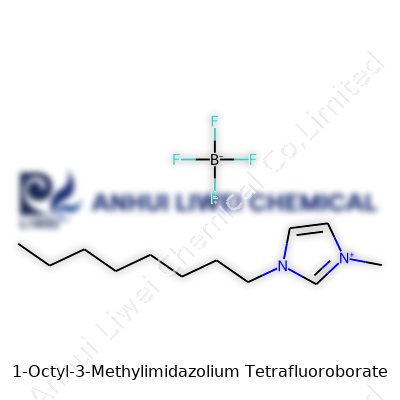
Let’s talk about 1-Octyl-3-Methylimidazolium Tetrafluoroborate, often popping up in research labs where ionic liquids make a difference. This chemical carries the formula C12H23BF4N2, pairing an imidazolium cation with a tetrafluoroborate anion. Crunching the numbers, its molecular weight lands at 284.13 g/mol. That figure is more than trivia—it’s part of why so many chemists keep it close for all sorts of reactions.
Why the Structure Means Something
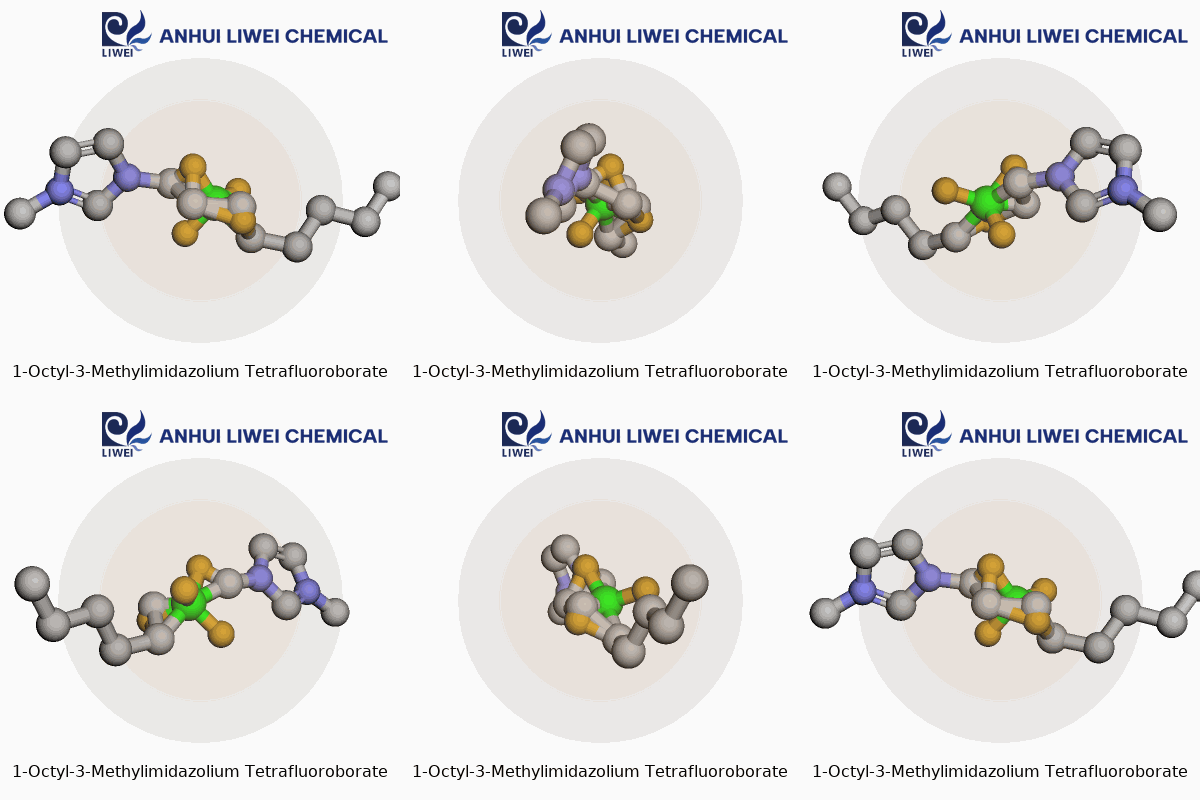
The backbone of 1-Octyl-3-Methylimidazolium Tetrafluoroborate shapes how it behaves. The octyl chain softens the ionic character, letting the compound dissolve all kinds of organics. The BF₄⁻ anion stays stable, not jumping into reactions unless pushed. With its unique properties, this liquid dodges volatility. No strong solvent smell fills the air, and flammability worries shrink. That means less risk in the lab and for those working with it.
Practical Importance in Chemistry and Industry
Some traditional solvents cause trouble for people and the planet. Many chemists look for safer swaps, and ionic liquids like this one fit the bill. They don’t fly off at room temperature, so cleaner processes follow. In hands-on synthesis, 1-Octyl-3-Methylimidazolium Tetrafluoroborate stands out for its low vapor pressure and chemical stability. Electrochemistry and catalysis rely on its staying power, and battery researchers experiment with it for better ionic conduction.
Research backs this up. Studies in Green Chemistry journals highlight strong performance as a reaction medium. One paper found that reactions run faster and get better yields compared to standard solvents. The environmental side improves, too—studies report less hazardous waste produced. These qualities help move away from petroleum-based chemicals that hurt air and water.
Handling and Environmental Impact
Working with imidazolium salts, safety starts with eye protection, gloves, and good ventilation. Some ionic liquids last in the environment, so companies stay alert to disposal rules. That’s a downside: if not treated right, persistent chemicals stick around in waterways and soil. Researchers seek out new ways to recover and reuse ionic liquids after use, making the cycle cleaner.
Looking Toward Better Solutions
Sustainable chemistry pushes us to fine-tune these compounds. Some labs focus on making biodegradable versions, so after the reaction, nothing lingers to harm wildlife. Policy can play a big part, supporting safe manufacturing and funding work on greener ionic liquids. Teamwork between universities, industry, and regulators carves a path for safer, smarter solvents in labs and factories.
Why It All Matters
Chemical formulas and molecular weights sound like textbook details, but they add up to real-world impact. In my experience, diving into details early brings more control to experiments and cuts down on mistakes. Using smart, stable chemicals like 1-Octyl-3-Methylimidazolium Tetrafluoroborate shows how science can handle risk and keep moving toward greener, safer choices. It helps mold a chemistry world that finally listens to both the molecules and the people working with them.
What We Know About This Chemical
For years, 1-octyl-3-methylimidazolium tetrafluoroborate has drawn interest in labs and industry. Its reputation as an “ionic liquid” puts it into the cutting-edge territory. People see these fluids as smart choices for green chemistry and as potential replacements for older solvents. But that word “green” can fool folks. Dig a little, and the story starts to change.
How Dangerous Is It?
This stuff does not look like liquid mercury or some villain’s bubbling brew, but the risks are not down to appearance. Research shows that 1-octyl-3-methylimidazolium tetrafluoroborate can irritate skin and eyes. Getting it on your hands or near your face isn’t smart business. More importantly, scientists have raised questions about its impact on cells. Some studies flag up changes in cell membranes, DNA breaks, or even signs of cell death after exposure, especially in aquatic organisms.
Toxicity in the water world often gives a clue about what a substance might do to humans, given enough exposure. I learned this lesson on my first chemistry project with ionic liquids. In our lab, students spent hours wearing gloves and goggles, even with small amounts. No one felt eager to take risks with something that scientists marked as “toxic to aquatic life.”
Thinking About the Bigger Picture
This chemical does not evaporate into the air easily. This quality often gets viewed as an eco-friendly win, because it avoids smog or VOC pollution. Still, that same low volatility causes it to linger in water, soil, and some parts of the production chain. If large quantities get dumped or spilled, plants and animals absorb them. Over time, this builds up and spreads. Some research groups now warn about “bioaccumulation”—the tendency for these substances to stick around and move up the food web. The balance tips from “new and useful” to “potential headache.”
Looking for Solutions, Not Panic
Some folks think banning chemicals fixes every problem. My experience says it’s not that easy. Companies handle tons of substances with risk labels, from bleach to gasoline, but rules and education keep most people safe. Applying the same thinking here, strong workplace training and tougher handling protocols give staff the right tools to limit exposure. Simple steps—ventilation, protective gear, responsible waste management—shut off many accident pathways.
Looking outside the factory floor, scientists chase better answers. Newer versions of ionic liquids pop up each year. Many designers now test their substances for environmental and health impacts from the start, not after the fact. That shift marks real progress. The community wants solvents that get the job done but break down quickly and cause less harm if they escape.
Facts Earn Trust
Reliable safety data changes the game. The European Chemicals Agency lists 1-octyl-3-methylimidazolium tetrafluoroborate as “harmful if swallowed,” “causes skin irritation,” and “very toxic to aquatic life.” These statements come out of real-world observations, not rumor. The best labs run tests for chronic exposure and keep updating old records. More transparency lets schools, businesses, and even small labs work smarter.
I’ve seen bright students step up and ask hard questions about the chemicals we use. A little skepticism leads to safer habits and better choices. Staying curious and honest about the hazards behind new tools gives everyone a better shot at protecting themselves, their coworkers, and their environment. The story of 1-octyl-3-methylimidazolium tetrafluoroborate proves that “green” isn’t always safe, but a careful approach can reduce the risks.
Understanding What You’re Working With
Taking care with any chemical starts with knowing its nature. 1-Octyl-3-Methylimidazolium Tetrafluoroborate, an ionic liquid, serves as a workhorse in a range of chemical processes. Its low volatility doesn’t mean safety steps take a back seat. A spill can do damage, and long exposure can harm the skin and eyes. Many labs choose this ionic liquid for its ability to dissolve tough materials and its stability under heat. Yet this same stability means long shelf life, so the stuff sits on stockroom shelves for years. That’s where good storage makes a difference.
Why Storage Conditions Matter
Leaving this chemical out on a cluttered shelf, with direct sunlight or inconsistent temperatures, opens the door to accidents and degradation. From my days in the lab, I learned quickly that heat and moisture were the quick and quiet threats. Over time, light can break down even tough ionic liquids, and moisture sneaks in through poorly sealed lids. In the early months of my college research, I saw a batch contaminated with just a trace of water – an expensive mistake that added hours of cleanup and extra cost to replace ruined samples. Dessicants and tightly sealed containers stopped that headache.
Making Your Lab or Workroom Safer
Best practice means picking opaque, airtight bottles. Keep them off the bench—find a chemical-safe cupboard with steady, room-level heat. Too warm and the chemical breaks down; too cold and the viscosity shifts, making transfers tough and handling awkward. On one project, liquids thickened so much from a cold storeroom that transferring them meant extra splashes, raising exposure risks. I’ve learned to check the thermometer and take the chill off by bringing bottles out before use.
Personal Protective Gear: Lessons From the Field
Early on, I underestimated how quickly accidents unfold. Nitrile gloves stop direct contact, and a sturdy lab coat saves more shirts—and skin—than many realize. Splash goggles block those small but painful eye hits. I’ve seen coworkers using just barrier cream, but it never did the job—gloves stand as non-negotiable. Good habits grow through real experience; after one splash incident, nobody in our group forgot eye protection again.
Steps After a Spill
Spills don’t last long if you prepare. Absorbent pads beat paper towels for quick cleanup. Disposal in a clearly marked waste container with other ionic liquids or non-halogenated solvents keeps everything safer for whoever takes out the chemical waste. Ventilating the area and wiping down surfaces avoids slipperiness and skin exposure hours later—a trick I picked up from senior technicians. Keep records of every spill so patterns can spark changes to layout or storage choices.
Training and Communication as Everyday Tools
Every new member of a team should see safe storage and handling in action. Don’t hand over a bottle without sharing your reasoning—explain why the storage location, bottle style, and PPE matter. I’ve seen teams avoid trouble, even after a tough day, just by talking through tasks and swapping stories of near misses. Posting clear signage near storage areas helps cement these routines. Open communication trims risks nobody needs.
Simple Steps Build Safer Habits
Treat 1-Octyl-3-Methylimidazolium Tetrafluoroborate with respect. Rely on sealed, labeled containers, steady conditions, protective gear, spill kits, and team talks. Years in chemistry taught me that discipline—built day by day—offers the best defense. Mistakes shrink with simple routines backed by firsthand experience. This turns labs into safe, productive places instead of accident scenes.
Properties That Stand Out
1-Octyl-3-Methylimidazolium Tetrafluoroborate, or OMIM BF4, doesn’t look especially flashy—most folks see a slightly viscous, colorless to pale yellow liquid. Yet, there’s a lot going on behind that plain appearance. It’s called an ionic liquid, meaning it’s made entirely of ions yet stays liquid at or near room temperature. This quality brings a whole new toolkit to chemists, especially for handling tasks where ordinary water or organic solvents fall flat.
OMIM BF4 isn’t easily flammable and won’t evaporate into the air like acetone or ethanol. Pour some out, and it’ll hang around for a while, thanks to its negligible vapor pressure. Even after spending years working with finicky organic solvents in labs, I still appreciate how much easier it is to use something that doesn’t turn my workspace into a fume hood-free-for-all. This stability reduces exposure risks and lessens the burden on ventilation systems, which matters for both home tinkerers and big chemical plants scanning for safer, greener processes.
Handling Water and Chemicals
Water and OMIM BF4 keep their distance—add water, and you’ll see them separate right away. That hydrophobic behavior comes from the long octyl chain attached to the imidazolium cation. It often gets thrown into extraction tasks when folks want to fish organic substances out of mixtures or separate compounds in a more environmentally friendly way. For example, I’ve seen researchers swap out toxic solvents in pharmaceutical purifications, taking advantage of these greener credentials.
Chemically, OMIM BF4 stays relatively inert under moderate conditions. It doesn’t rush to react with air, water, or common lab acids, so you’ve got a solvent that won’t ruin your delicate reactions with stray side products. Still, the tetrafluoroborate anion isn’t immune to strong acid or strong base—treat it rough, and you could get hydrolysis, splitting off toxic hydrogen fluoride. Respect the material and double-check compatibility charts before pushing it out of its comfort zone.
Melting, Boiling, and Conductivity
This ionic liquid has a melting point below room temp, often below 10°C, and it can tolerate heating up beyond 250°C before showing decomposition. Ordinary solvents would have vanished or lit on fire long before that. If you’re working somewhere that needs high heat stability without losing your solvent, OMIM BF4 saves money and trouble.
Another trait that can surprise newcomers is electrical conductivity. Ionic liquids like OMIM BF4 conduct electricity—a rare feature among standard liquid chemicals. This has made them popular players in electrochemistry, from batteries to sensors. I’ve seen experiments swapping out more dangerous electrolytes for ionic liquids, cleaning up processes and making them more robust.
Environmental and Health Concerns
Some folks rush to call anything labeled “ionic liquid” green, but the truth shows more nuance. OMIM BF4 resists burning and doesn’t evaporate, so air emissions aren’t much of a worry. Still, what goes down the drain can end up in wastewater since the molecule doesn’t break down quickly in the environment. Long alkyl chains in some ionic liquids can become toxic to aquatic life. Labs and factories need strong disposal policies, and wastewater treatment plants should get looped in early if OMIM BF4 use ramps up.
Finding Answers with Better Chemistry
Switching to ionic liquids like OMIM BF4 makes sense for tough jobs—especially ones where heat, flammability, or volatility raise big worries. The chemical and physical qualities offer a way to tackle challenges with less waste and fewer accidents. Building creative, responsible applications hinges on understanding these traits, not just grabbing for the next trendy solvent.