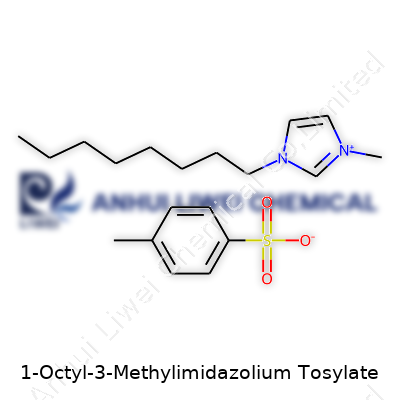
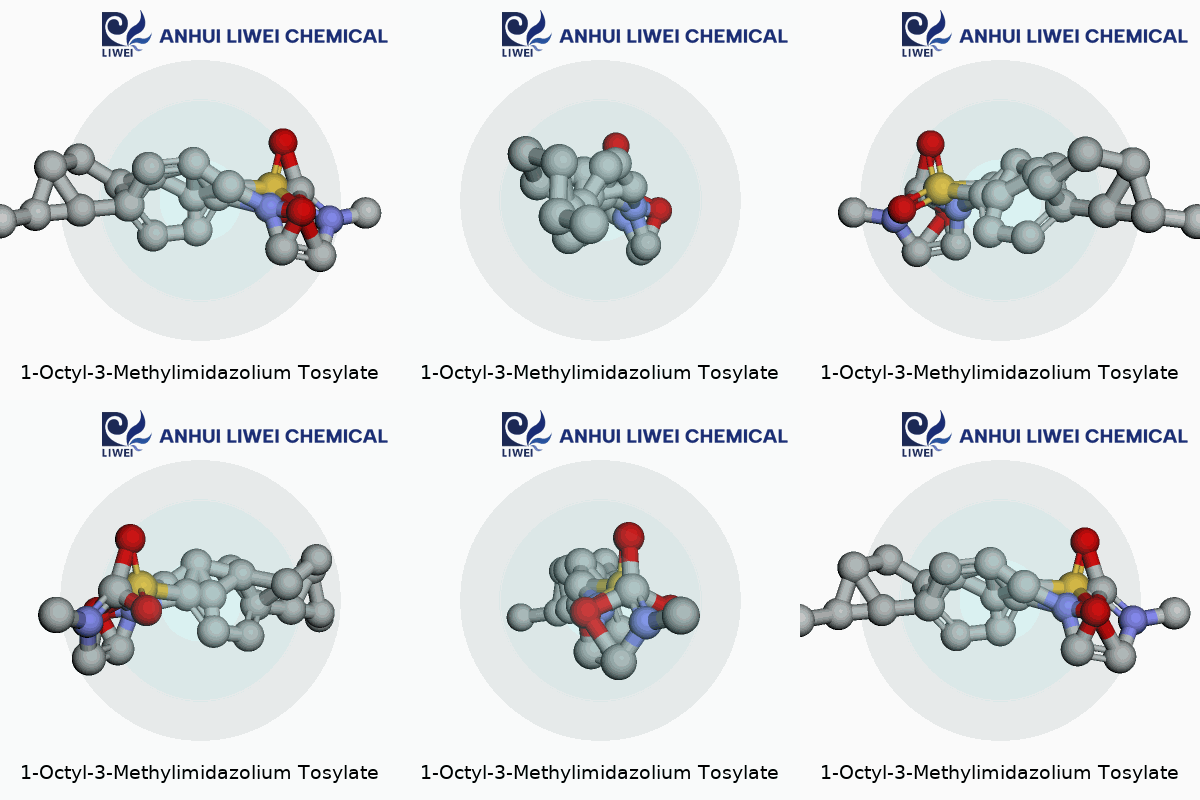
1-Octyl-3-Methylimidazolium Tosylate: An In-Depth Perspective
Historical Development
Curiosity has always driven chemists to seek better alternatives for common solvents. Decades back, the rise of green chemistry pointed researchers away from petroleum-based solvents, steering their attention toward ionic liquids. Among them, 1-Octyl-3-Methylimidazolium Tosylate emerged as a standout. In laboratories across Europe and Asia in the early 2000s, scientists honed methods to synthesize this salt, excited by its ability to dissolve cellulose and stabilize catalysts often rendered useless in conventional solvents. Progress snowballed once its low volatility and thermal stability became impossible for researchers to ignore. From handling stubborn biopolymers to enabling new separation technologies, it proved that improvement over old solvents was more than a theoretical hope—it could drive both science and industry forward.
Product Overview
1-Octyl-3-Methylimidazolium Tosylate, sometimes abbreviated as [Omim][TsO], belongs to the imidazolium-based ionic liquids family. Its structure brings together the imidazolium cation, known for tunable properties, with a tosylate anion, famous for moderating reactivity. The result: a salt that’s neither explosive nor flammable, yet still capable of dissolving polar and nonpolar compounds. On the bench, it pours like a thick oil, often with barely any scent, a clear improvement over traditional toxic and pungent solvents. Companies market it under names like Omim Tosylate or 1-octyl-3-methylimidazolium p-toluenesulfonate, reflecting its chemical makeup and tailored reputation for a new generation of applications.
Physical & Chemical Properties
Talking about 1-Octyl-3-Methylimidazolium Tosylate, its standout characteristic is its melting point—soft enough to stay liquid at room temperature, usually around 40°C or lower, depending on exact purity and handling. Density reads around 1.1 g/cm³, and it doesn’t evaporate easily. That means in an open flask, it stays put, a sharp contrast to older solvents that disappear after an hour on the stir plate. Water mixes with it only reluctantly, yet its long octyl chain allows interaction with plenty of organic and even some inorganic substances. Thermal stability climbs above 200°C before breaking down, outlasting classic solvents like ethanol or acetone in a hot reaction. As for polarity, its imidazolium heart ensures strong ionic character, but the attached octyl group steadies its balance between hydrophilic and lipophilic behavior, a trait few molecules can claim.
Technical Specifications & Labeling
Suppliers sell 1-Octyl-3-Methylimidazolium Tosylate in highly purified form, with purity levels often reaching above 98%. Labels spell out both chemical formula (C17H28N2O3S) and CAS number (usually 616481-34-6), reducing accidental mix-ups. Safety data sheets warn about possible skin and eye irritation, so most labs recommend nitrile gloves and splash goggles. Storage rooms favor cool, dry shelves out of direct sunlight. For those working under ISO quality requirements, every batch comes with a certificate of analysis, listing moisture content (often under 0.5%) and halide contamination. Some producers test for transition metal ions and residual solvents, important when the target use is in catalysis or pharmaceutical synthesis. Few solvents come with such a tight and tailored quality control approach.
Preparation Method
Synthesizing 1-Octyl-3-Methylimidazolium Tosylate has become a straightforward process over the years. It starts with 1-methylimidazole and 1-chlorooctane. Mixing these two with moderate heat encourages alkylation, yielding 1-octyl-3-methylimidazolium chloride. Afterwards, a simple ion exchange with sodium tosylate swaps out the chloride for tosylate. This reaction, usually performed in water or alcohol, takes advantage of tosylate’s low solubility, letting the product salt fall out as a heavy, almost syrupy liquid. After phase separation and careful washing, the crude product undergoes drying under vacuum to pull out remaining moisture or traces of starting material. This step matters because moisture and trace halides can dramatically affect catalytic performance. From bench-top glassware in teaching labs to reactors in specialty chemical factories, the procedure stays much the same, emphasizing reproducible yields over flashy conditions.
Chemical Reactions & Modifications
The chemical backbone of 1-Octyl-3-Methylimidazolium Tosylate serves as a platform for inventive modifications. Its imidazolium ring remains generally stable, but the long octyl tail and methylene positions set the stage for functionalization. Some groups add alkene or alkyne moieties, broadening its use as a ligand for metal catalysts. Many researchers swap the tosylate anion for PF6- or BF4-, seeking changes in hydrophobicity or ionic conductivity for specific battery or electrochemical needs. Thanks to that versatility, it works as both a reaction medium and a co-catalyst, sometimes even getting involved in hydrogen-bonding-driven transformations for biomass conversion or renewable chemistry. The ring’s ability to stabilize transition states means it doesn’t just sit there—it accelerates reactions traditional solvents would fumble or outright fail.
Synonyms & Product Names
In catalogs and textbooks, 1-Octyl-3-Methylimidazolium Tosylate hides behind several names. Chemists might call it 1-octyl-3-methylimidazolium p-toluenesulfonate, [Omim][Tos], or sometimes just Omim Tosylate. No matter the alias, each points to the same basic formula—a combination of octyl-substituted imidazolium cation and a tosylate anion. Commercial offerings come from both large multinational suppliers and smaller niche specialty companies, all eager to tap the growing demand for versatile ionic liquids. Savvy buyers always check lot numbers and supplier-grade labels, as subtle purity shifts can meaningfully affect experimental outcomes.
Safety & Operational Standards
No modern solvent conversation can skip over safety. 1-Octyl-3-Methylimidazolium Tosylate ranks as a low-volatility, relatively non-flammable liquid. Direct contact with skin or eyes may cause irritation, and ingestion isn’t advised, so standard protocol favors basic personal protective equipment—nitrile gloves, safety goggles, and in some cases, fume hoods. For disposal, environmental guidelines discourage pouring ionic liquids down the drain, since persistence in aquatic environments still needs more research. Labs collecting waste send it off for incineration or special treatment. Storage containers must use tight seals, since moisture ingress changes ionic strength and can spoil a batch’s reactivity. Several industry bodies include it on their updated lists of substances needing clear labeling in accordance with GHS (Globally Harmonized System). The focus is practical: prevention matters more than remediation.
Application Area
Lab after lab has leaned on 1-Octyl-3-Methylimidazolium Tosylate’s unique combination of ionic conductivity and thermal steadiness. Cellulose processing stands out as a big win—old solvents barely dent this stubborn biomaterial, but Omim Tosylate dissolves even tough natural fibers, aiding in bioethanol production and value-added chemical synthesis. In the pharmaceutical world, it stabilizes sensitive compounds during purification steps, replacing wasteful and hazardous organic solvents. Some teams use Omim Tosylate as an electrolyte in next-generation batteries and supercapacitors. With strong ionic motion, it keeps devices running at higher efficiencies for longer periods. Analytical chemists take advantage of its capacity to extract stubborn analytes from tricky matrices, boosting yield and reducing sample prep waste. The molecule’s hydrophobic tail and ionic buzz give it access to both oil-loving and water-loving compounds alike, making it a rare bridge between previously incompatible families of materials.
Research & Development
On the research front, Omim Tosylate continues to generate excitement for those who aim to blend green chemistry with industrial efficiency. Groups focused on sustainable energy turn to this ionic liquid when building improved supercapacitors or lithium-ion batteries—seeking stable, non-volatile electrolytes that can hold up to industrial wear and tear. Academic projects range from biomass upcycling to fine-tuning organic reactions where solvent breakdown ruins yields. Teams in analytical chemistry look to expand its role in sample extraction and chromatography, finding more selective and less toxic alternatives each year. As someone who has worked under late-night halogen lamps, the promise of using less-harmful, more versatile solvents gives every challenging synthesis a bit more room for success. Researchers keep refining ion-exchange and purification procedures, working to drive down costs and remove trace contaminants.
Toxicity Research
Toxicologists have a healthy skepticism when it comes to new solvents, even those dubbed “green.” Acute toxicity studies on 1-Octyl-3-Methylimidazolium Tosylate suggest it doesn’t pose the same immediate hazards as traditional chlorinated solvents. Few reports show severe health effects from skin contact, but at high doses or with repeated exposure, some cellular toxicity emerges, particularly for aquatic species. Chronic effects in mammals—still the subject of research—hint at mild irritation rather than anything more dangerous, provided ordinary lab protocols are followed. Environmental persistence remains a concern, as ionic liquids break down slowly in soil and water, possibly accumulating over years. Ecotoxicity data encourages careful handling and special disposal, even if acute risks look much lower than volatile organic solvents. Ongoing studies, especially from European regulatory agencies, continue to investigate any long-term metabolic or reproductive effects across exposed populations.
Future Prospects
The outlook for 1-Octyl-3-Methylimidazolium Tosylate reflects both chemistry’s promise and its challenges. With stricter regulations pushing companies away from traditional solvents, demand grows for molecules that balance industrial usefulness with environmental responsibility. Omim Tosylate’s reliability in dissolving tough biopolymers almost guarantees a role in next-generation biofuel technologies. Its use in batteries and green electronics stands to grow, driven by the global push for renewable energy solutions. At the same time, researchers strive to tweak its structure for even better biodegradability and lower toxicity—hoping not only to meet, but outpace regulatory changes. My own experience with lab-scale process optimization reminds me how incremental improvements can lead to transformative change. Each tweak in synthesis or purification moves Omim Tosylate closer to being both a workhorse chemical and a model for safe, sustainable molecular design. The path forward rests on collaboration: chemists, toxicologists, and industry experts weaving new ideas and data into practical solutions fit for tomorrow’s world.
Looking Beyond Common Solvents
Working in a chemistry lab, you notice chemicals that gather dust in storage. Others, though, seem to flow from shelf to bench to waste bottle, starring in one experiment after another. 1-Octyl-3-Methylimidazolium Tosylate falls into the second group. Chemists who keep up with green chemistry start to see its name pop up in research journals and conference abstracts.
A Fresh Face Among Ionic Liquids
This compound belongs to the family of ionic liquids, and folks in academia or industry focus on them because they shake up the world of solvents. They don’t evaporate easily, so lab air stays cleaner. Their chemical stability can cut down on hazardous byproducts. That matters to anyone who’s ever felt the sting of solvent fumes or sat through safety briefings about fire risks.
1-Octyl-3-Methylimidazolium Tosylate stands out for more than its structure. The compound stays liquid at room temperature, which opens up options that don’t fit older, more volatile solvents. Researchers choose it for tasks like dissolving cellulose—one of the toughest natural polymers known. Breaking down cellulose unlocks biofuels, biodegradable plastics, and new fibers. Traditional solvents can’t dissolve cellulose; ionic liquids have begun to do what folks once thought impossible.
Solving Old Problems in New Ways
It's not just about breaking down plant matter. This ionic liquid helps chemists separate compounds with similar boiling points. Instead of long, energy-draining distillation, you can tweak the salt's structure for smarter separation. Pharmaceuticals gain, since regulations demand high purity. It shows up when folks modify the surfaces of nanoparticles too, making tiny sensors out of metal or semiconductor bits. Controlling their surfaces would be much tougher without solvents that can coax atoms around.
The environmental angles go far beyond the lab. Because this liquid can recycle dyes and extract metals, industrial plants see less waste and fewer toxic releases. The textile industry, notorious for nasty effluents, started adopting ionic liquids for dyeing and even for getting dyes back after use. Recovering valuable rare earth metals for electronics turns less wasteful when these salts help separate them efficiently. A chemist sees more than just yield or purity; there's pride in using a tool that leaves less mess behind.
What Needs Care and What Comes Next
No chemical comes without trade-offs. Ionic liquids like this one usually cost more than old-fashioned solvents. Their slow breakdown in the environment requires more research into end-of-life disposal. Still, the field pushes forward. New work looks at ways to recycle these fluids, find plant-derived replacements, or engineer safer breakdown.
Anyone who’s cleaned up a solvent spill or watched a big drum of waste hauled away can appreciate improvements in safety and sustainability. 1-Octyl-3-Methylimidazolium Tosylate hasn’t solved every problem, but its place in everything from renewable energy to better batteries signals a strong future. The chemical world keeps moving toward smarter solutions, with this ionic liquid carrying a lot of that momentum.
Understanding What Makes This Ionic Liquid Tick
You get a feel for how 1-octyl-3-methylimidazolium tosylate behaves once you spend some actual time in a lab surrounded by bottles of viscous, oddly colored liquids. This compound, commonly known as [OMIM][TsO], belongs to the growing family of ionic liquids that chemists and engineers find tough to ignore. Its physical and chemical properties open a lot of doors in practical applications, but they also toss up challenges for those tackling industrial scale synthesis or environmental safety.
Physical Touchpoints: Not Your Everyday Liquid
Pick up a bottle of [OMIM][TsO] and straight away the oily feel and lack of volatility set it apart from plenty of everyday chemicals. Unlike water or alcohol, this liquid refuses to evaporate at room temperature. Boiling points climb high—well above 300°C—while melting points drop quite low, usually below 25°C. Its density hovers close to 1.0-1.1 g/cm³, depending on purity and temperature, giving it a heft that makes it settle quickly if dropped into water.
Color varies slightly, between pale yellow and near-clear, with faint odors that rarely bother most people. Viscosity changes with temperature, and the stuff pours like thick oil if you pull it from a chilly shelf. These attributes matter in lab work—solubility, flowing rates, and mixing depend on how thick and dense your solvent turns out to be in real time.
Chemical Personality: Stability and Solubility
On the chemical side, the imidazolium ring and its octyl tail pack some punch. The cation’s structure boosts electrochemical stability—there’s a reason battery research teams look at these liquids as possible electrolytes. The tosylate anion, known for its ability to stabilize positive charges, brings additional benefits. This chemical pairing resists light oxidation and hydrolysis under normal conditions, though strong bases or acids can eventually break it down.
Solubility paints an interesting picture; this solvent happily mixes with many polar organic compounds and even breaks down cellulose, an otherwise stubborn natural polymer. Water solubility stays moderate, unlike some ionic liquids that drown themselves in water. This helps when washing or recycling batches after reactions or separations.
Why This Matters in Real Labs and Industry
The practical importance shows up fast. Low volatility means a drop in fire risk and less inhalation exposure compared to volatile organic solvents. Labs I’ve worked in appreciate not needing fume hoods just to measure out a few grams. Workers in pharmaceutical or polymer synthesis rely on its ability to dissolve tough substances that would laugh at acetone or hexane.
Safety and environmental care still require respect. Though less flammable, these ionic liquids don’t always break down easily in nature, and there’s still work to be done figuring out their toxicity if they spill or get dumped. Green chemistry circles push for more transparent life-cycle data, and as manufacturers scale up production, pressure grows to recycle and reuse spent ionic liquids.
Tackling the Bottlenecks
Some solutions already gain traction in places I’ve trained. Companies invest in distillation columns and filtration setups for ionic liquid recycling. Academic teams chase down faster biodegradation routes and improved toxicity testing. It takes open collaboration and honesty about the downsides to keep this chemistry safe and scalable.
1-octyl-3-methylimidazolium tosylate offers more than chemical curiosity. Its unique mix of physical properties and chemical resilience drives special applications, but it needs care in use and aftercare. Sound understanding, combined with thoughtful handling and open data, moves both safety and innovation forward in every lab and industry.
What Makes This Chemical Stand Out?
1-Octyl-3-Methylimidazolium Tosylate, known to some lab workers as an ionic liquid, finds its way into workspaces where researchers chase efficiency, greener chemistry, or specialized processes. It mixes non-volatility with some handy solvent properties that have people tossing it into all kinds of reactions. On paper, swapping out older solvents for something with a better environmental record sounds smart—less air pollution, less exposure risk from inhalation. Still, tossing in anything new without understanding what it means for safety and health can invite trouble.
What the Experts Know about Safety
I’ve handled a few imidazolium salts in the lab, and they don’t look all that threatening. Clear liquid, not much odor, doesn’t fume like some old-school organics. But beneath the calm surface sits a raft of safety alerts. Just because something skips evaporation doesn’t mean you can skip gloves. These salts are often good at sneaking through skin, causing irritation or more. They’re not as tested as ancient solvents, so nobody can promise what long-term, low-dose contact really brings.
The available studies hint that many ionic liquids, including this one, fit somewhere between “mildly irritating” and “more toxic than expected” depending on exposure and the specific salt. You may not drop dead from a splash, but repeated, careless contact can leave rashes, dermatitis, or worse. Some work in toxicology points toward issues with aquatic life too, although this mostly matters for disposal.
Keeping Yourself Safe: What Makes Sense
People sometimes forget a nasty truth: lab accidents happen when folks treat “new” as “safer.” I remember a time in grad school when someone handled an ionic liquid with bare hands—thinking it wasn’t volatile—and got a stubborn rash that lasted weeks. This isn’t just about lab folklore. Safety sheets (SDS) for these salts call for eye protection, nitrile gloves, and skin covering, thanks to their irritating or possibly toxic effects. Fume hoods beat open lab benches, even if vapors seem low—pipetting a heated reaction or cleaning spills can change the game.
Label everything. People love to pour chemicals into whatever glassware fits. With ionic liquids, clear labeling stops the next shift from mistaking a potentially hazardous compound for harmless oil. Cleaning spills means skipping water, reaching for inert absorbents and following up with a proper solvent rinse. Toss all clean-up materials into hazardous waste streams, since these ionic liquids often don’t break down fast and can hurt aquatic life.
More Than Gloves: A Culture of Respect
If you’re working with 1-Octyl-3-Methylimidazolium Tosylate, don’t rely on a single set of rules. Check every new bottle’s SDS. Train folks on spills, skin contact, ingestion, and cleanup. Think beyond your fingers; make sure waste never drops down the sink. Invite the environmental officer into the discussion; most regulatory bodies flag even “green” chemicals if they build up in water or soil.
Switching to less volatile solutions feels smarter until someone gets too relaxed. Scrub all surfaces, double-check PPE every time, and treat all unknowns like trouble. Green chemistry deserves respect, but so do your coworkers, your skin, and your local river.
The Basics of Careful Chemical Storage
Lab workers and industrial chemists have enough on their plates without dealing with substances gone bad because of sloppy storage. 1-Octyl-3-Methylimidazolium Tosylate seems harmless at first glance. Many natural forms are colorless and low-odor. The catch lies in its sensitivity. If it sits in the wrong environment, problems pile up. Water vapor in the air can creep into open bottles. Light—even through thin glass—sometimes changes the real makeup of the liquid. Warm rooms speed up slow, unwanted chemical changes.
Putting E-E-A-T Into Action
I have seen new graduates hit the ground running, then stall because their test reactions keep failing. Often, the sample left on the shelf last month didn’t look different, but something invisible happened inside. According to Sigma-Aldrich and Merck, 1-Octyl-3-Methylimidazolium Tosylate gets along best with dry, cool, and dark surroundings. Regulatory guidance from bodies like OSHA and the European Chemicals Agency emphasizes this too—it’s not about pleasing bureaucrats, but about real safety and product quality.
Practical Steps for Reliable Storage
Stick to airtight, amber or opaque bottles. If humidity in the room rises, the compound acts as a sponge—it quietly absorbs water from the air, and that’s enough to ruin its chemical properties. Aluminum-lined bottle caps work well to prevent this silent problem. Never store the material near windows or under strong lights. Cabinets with plank doors block stray rays that can alter sensitive molecules.
Pay attention to temperature. Most suppliers recommend below 25°C—definitely away from direct heat sources and radiators. The sort of “just toss it on a high shelf” approach lays the groundwork for clumped, impure results later. Invest in temperature data loggers if you’re watching over more than a few grams. They help catch minor room spikes most people overlook.
Cleanliness Also Translates to Accuracy
Cross-contamination creeps up fast. Don’t reuse tools between chemicals. Even a smudge inside a spatula can affect purity, especially in research settings where results hinge on tiny details. If you pour directly from the source bottle, always wipe the rim before resealing. Mold and small organics love lingering spills—once they get in, spotting the damage can take weeks. Separate workspaces for ionic liquids reduce mix-ups if your bench feels crowded.
Safety Still Ranks First
Health agencies highlight the long-term effects of improper storage, not just the immediate spill or splash risk. Even low-volatility compounds lose integrity when handled carelessly. Choosing a lockable storage cabinet with clear labeling—both on shelf space and bottles—makes audits easier and safeguards health. Make it a personal habit to check labels for expiry or signs of breakdown, like sticky residue or color change.
Building Good Habits Pays Off
It comes down to respect: for colleagues, for data, for those who rely on purity in their research or products. Mistakes can cost weeks, or worse, slip downstream into someone’s published work or batch invoice. In my experience, the peace of mind that comes from careful handling always outweighs the handful of minutes saved by taking shortcuts. With a bit of organized storage and routine checks, 1-Octyl-3-Methylimidazolium Tosylate stays true to form, helping teams deliver honest, replicable work time after time.
Why Solubility Gets So Much Attention
1-Octyl-3-methylimidazolium tosylate catches a lot of eyes among chemists and engineers working with ionic liquids. Its solubility decides how far you can stretch its use in water, alcohols, and other solvents. In most labs and industries, easy dissolving saves time and resources. Whenever I worked with similar ionic liquids, the speed at which it went into solution set the tone for the rest of that day's work — no one enjoys babysitting a stubborn suspension.
Testing Water and Beyond
Drop this ionic liquid into water and you see limited mixing. Most reports put its water solubility around a few grams per liter at room temperature. Some researchers push it with heat or stirring and get it to dissolve a bit more. Stronger mixing helps some, but not as much as you'd hope, probably due to the long octyl chain fighting against water’s hydrogen bonding. The big lesson here? Not every ionic liquid is as “liquid” as people expect in water. I've watched students add gram after gram, frustrated to find cloudy mixtures. They learn quickly that the alkyl chain isn’t their friend when it comes to dissolving in water.
Organic Solvents: Where Solubility Shines
You take the same 1-octyl-3-methylimidazolium tosylate and give it a chance in organic solvents–now, things look different. It blends smoothly with polar organics like methanol, ethanol, or acetonitrile. Even classic lab solvents like dimethyl sulfoxide or acetone absorb it easily. Going up the hydrophobic ladder, it fares well in solvents like chloroform and dichloromethane. The long octyl group gives it enough of a hydrocarbon feel, so it joins organic solutions quickly. I’ve dissolved dozens of grams at a time in acetonitrile or methanol without seeing residue at the bottom of the flask. This helps with extraction and separation steps where water just doesn't cut it.
Why Solubility Data Matters So Much
Solubility shapes how researchers use this ionic liquid in extraction, catalysis, or synthesis. If all you care about is extracting polar molecules from an aqueous phase, poor water solubility might be a problem. On the flip side, that same property can turn into an advantage during phase-separation or back-extraction, making it easier to isolate a product.
Too often, I’ve watched projects falter because folks didn’t check this basic piece of information. Misjudging solubility leads to cloudy mixtures, wasted chemicals, and longer hours at the bench. Having clear, honest data up front means you can plan with confidence, swap in different solvents, or reach out for analogues that dissolve better. The late nights I spent troubleshooting reactions where things “should have dissolved” taught me to always consult primary literature or trusted reference tables before starting a new project.
Taking This Knowledge to the Lab
If your workflow really demands better water solubility, consider modifying the imidazolium side chain or even using a different ionic liquid altogether. Swapping out that octyl group for a shorter chain or adding polar substituents often produces dramatic improvements. For greener processes, matching solvent and ionic liquid for quick mixing keeps waste low. The right choice lets you scale up, recycle solvents, and reduce headaches during purification.
Solid solubility data isn’t just a checkbox for paperwork. It has direct consequences on speed, yield, and waste in chemical processes. Knowing where and how ionic liquids like 1-octyl-3-methylimidazolium tosylate fit in—water versus organic solvents—means fewer surprises. More time at the fume hood doing productive work. Less time asking, “Why won’t this dissolve?” That’s always a win in any lab setting.