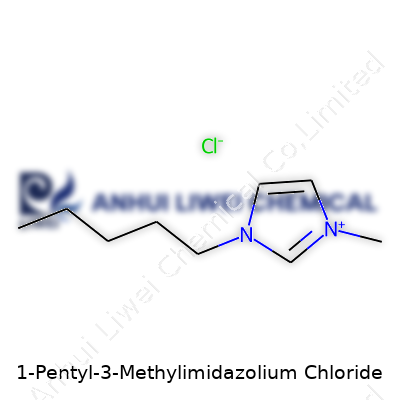
1-Pentyl-3-Methylimidazolium Chloride: A Ground-Level Look
Historical Development
Back in the late twentieth century, chemists started reaching for ionic liquids to reshape the way labs handle solvents. Among the many ionic liquids, 1-pentyl-3-methylimidazolium chloride started picking up interest for its ease of synthesis and promising versatility. It surfaced as part of the race to build "greener" chemicals that sidestep hazardous, volatile organic solvents. Labs found that swapping in ionic liquids like this one could cut out dangerous evaporation issues, supporting safer workplace environments. Over time, researchers realized this wasn’t just an odd lab curiosity—the chemical had real staying power and landed a spot on the workbench in academic and industrial labs worldwide.
Product Overview
People in research and manufacturing reach for 1-pentyl-3-methylimidazolium chloride as a room-temperature ionic liquid. This means it stays liquid at regular lab temperatures, delivering a stable, non-flammable alternative to solvents like acetone or ether. It works best where low volatility and strong chemical stability really matter. Most labs get this chemical as a clear to pale yellow liquid, and suppliers tend to package it tightly to keep out moisture, since ionic liquids don’t play nicely with water contamination.
Physical & Chemical Properties
This imidazolium compound offers a melting point well below standard room temperatures, staying comfortably fluid unless someone drops a sample into the fridge. It dissolves wide-ranging organic and inorganic materials, making it useful for extraction and catalysis. Unlike classic solvents, it barely evaporates, even with days on the benchtop, cutting back on air contamination risks. The molecule brings a strong ionic character but retains a flexible alkyl chain—just the right touch for tuning solubility and viscosity. With its decent conductivity and remarkable stability toward heat and chemicals, 1-pentyl-3-methylimidazolium chloride quickly stood out in the crowd of ionic liquids.
Technical Specifications & Labeling
Reputable suppliers label bottles with CAS number 171058-18-5, molecular formula C9H17ClN2, and formula weight close to 188.7 g/mol. Purity standards often push above 97%, since even small impurities can shift its handling and reaction features. Hazmat codes show that while it carries some risk, it's still safer than most flammable solvents. Labels should also note storage conditions—keep containers tightly sealed in a cool, dry spot and away from light. This kind of honesty in labeling and quality checks makes a real difference in both lab safety and research reliability. Since ionic liquids can react with certain materials, good labeling should include compatibility warnings for common plastics and metals.
Preparation Method
Synthesizing this compound feels like bread-and-butter organic chemistry. It starts by mixing 1-methylimidazole and 1-chloropentane under controlled temperatures, usually letting the reaction run in a sealed vessel for several hours. The result is then washed with organic solvents—often acetone or diethyl ether—to scrub out unreacted starting materials or byproducts. After a final solvent strip and possibly a vacuum drying step, the liquid shows up clear and ready for bottling. That’s the same basic preparation you’ll see in publications and patent filings, though scaling up demands a careful eye on safety, containment, and waste disposal.
Chemical Reactions & Modifications
Chemists use 1-pentyl-3-methylimidazolium chloride as both a reaction medium and catalyst. In nucleophilic substitution reactions, this ionic liquid acts as a unique, polar solvent, dissolving reagents that would often refuse to mix. Some labs swap out the chloride anion for other types—tetrafluoroborate or hexafluorophosphate—for special applications like electrochemical sensors or device coatings. Others attach functional groups to the imidazolium ring, tweaking the parent compound to create task-specific ionic liquids. Sometimes, metals or enzymes join the mix, finding this solvent’s low volatility gives them a more stable, forgiving stage for their chemistry.
Synonyms & Product Names
Other labs know this compound by its more technical names, including 1-methyl-3-pentylimidazolium chloride or [C5mim]Cl. Product catalogs sometimes shorten it to PMIM-Cl. Each name points to the same structure—a five-carbon sidechain attached to a methylimidazolium core, paired with a chloride counterion. Being aware of these synonyms matters for cross-referencing research articles and comparing product specs.
Safety & Operational Standards
People working with 1-pentyl-3-methylimidazolium chloride should stick to basic chemical hygiene. Eye protection, gloves, and lab coats limit risk, because even though the material rarely vaporizes, skin contact can cause irritation over long periods. Store containers away from direct heat and moisture. Never pour it down the sink, since ionic liquids can persist in waterways and harm aquatic life. Disposal usually means collecting waste in clearly marked non-chlorinated containers, then working with institutional hazardous waste professionals. It’s key for lab managers to review MSDS sheets and have emergency eyewash and spill kits close by, even if the day-to-day work feels routine.
Application Area
1-pentyl-3-methylimidazolium chloride shows up in chemical syntheses, electrochemistry, and catalytic research. Labs analyzing lignocellulosic materials often use it to dissolve cellulose and study biomass, since traditional solvents dissolve little or none of these stubborn plant materials. Catalysis researchers reach for this ionic liquid to run clean, high-yield reactions without metal catalysts exiting into product streams, solving a persistent challenge in pharmaceutical production. In battery development, people test this compound to find stable, conductive electrolytes for next-generation energy storage. The laundry list keeps growing, because its marriage of low volatility and strong solvating power lets it step into tricky research areas with fewer safety trade-offs.
Research & Development
Researchers want safer, cleaner, and more reusable chemicals, so they look to evolve ionic liquids like 1-pentyl-3-methylimidazolium chloride. Work continues on swapping out the chloride ion for less toxic or even bio-derived alternatives to shrink the environmental footprint. Some labs are exploring blends with other green solvents—dimethyl carbonate comes to mind—to hit the sweet spot of solubility and processability. I'm watching these developments closely. From experience, swapping traditional solvents for ionic liquids helps avoid headaches over evaporation or fire codes, but it means a learning curve with waste handling. As government regulations tighten around hazardous air pollutants, chemicals in this class likely earn a bigger spot in university and industrial research.
Toxicity Research
Toxicity research keeps people honest about new chemicals. Early studies flagged possible cytotoxicity against aquatic organisms and some mammalian tissues, mostly with chronic exposure at high concentrations. Some data suggest the imidazolium cation can disrupt cell membranes or enzyme systems, but the exact hazard depends on both alkyl chain length and concentration. Chloride’s presence also raises the bar for managing environmental waste, since chloride-based byproducts show persistence in waterways. Most short-term lab exposures don’t pose major hazards, but I always tell colleagues to remember that ‘greener’ doesn’t equal ‘non-toxic.’ Real improvements rest on careful risk analysis, strict PPE routines, and systematic waste controls.
Future Prospects
The road ahead for 1-pentyl-3-methylimidazolium chloride looks busy. Efforts arc toward more sustainable syntheses—with renewable feedstocks and energy-efficient pathways picking up support in both academia and industry grants. Researchers push to expand the chemical’s application in pharmaceutical manufacturing, smart materials, and safer batteries. Challenging chemistries—like selective hydrogenations or cellulose breakdown—draw particular interest, since this kind of ionic liquid opens new possibilities that traditional solvents can’t reach. If regulatory frameworks catch up to highlight both lifecycle impacts and cost/benefit overviews, the best ideas should stick. There’s still work left to bring down the price, improve recyclability, and address any bioaccumulation concerns. Breakthroughs tend to reward patient, honest tinkering—something the chemical sciences, at their best, do well.
Understanding this Ionic Liquid’s Appeal
1-Pentyl-3-Methylimidazolium Chloride stands out from traditional solvents thanks to its unique blend of chemical stability and low volatility. Its chemical structure puts it in the category of ionic liquids—a set of compounds that have changed how chemists and engineers tackle separation, catalysis, and material synthesis. Instead of evaporating like most regular solvents, substances like this one stick around, giving researchers several practical advantages.
Solvent Power in Extraction and Separation Work
This ionic liquid shows its true value in the world of extraction. For folks in the pharmaceutical or chemical industries, removing valuable components from a complex mixture usually comes with plenty of headaches. 1-Pentyl-3-Methylimidazolium Chloride helps streamline this process. Its chemical design allows it to dissolve a wide range of organic and inorganic molecules. Just a few years ago, I worked with a small team on metal extraction, trying out conventional organic solvents with mixed results. Once we switched to ionic liquids, including this one, recoveries shot up and waste went down.
The story is similar in bioseparations. Getting proteins and enzymes out of cell sludge once required lots of harsh chemicals. Now, labs often reach for ionic liquids like this chloride salt. They spare delicate biomolecules from denaturation—helping protect activity and function throughout the whole cleaning process. Environmental regulations keep pushing us to ditch volatile organic solvents. Using 1-Pentyl-3-Methylimidazolium Chloride helps meet these demands while keeping performance high.
Catalytic Potential and Cleaner Chemical Synthesis
Catalysts influence how reactions unfold. In some cases, the medium holding the reaction is just as important as the catalysts. This ionic liquid offers high polarity and thermal stability. In my own graduate work, I saw colleagues use it as the reaction medium for alkylations. Yields improved. By-products dropped. Plus, the reaction ran cooler—making everything safer and saving energy.
There’s also a push to recover and reuse catalysts instead of throwing them away. Ionic liquids like this chloride salt trap catalysts in solution, allowing for easy recycling batch after batch. Some teams are exploring its role in carbon capture and transformations into valuable chemicals. The promise: more sustainable greenhouse gas use.
Material Science and Electrochemistry
1-Pentyl-3-Methylimidazolium Chloride is making a splash in material science research. Engineers turn to this compound when they need to design new electrolytes, especially for batteries and supercapacitors. The low flammability and wide electrochemical window let manufacturers pursue safer energy storage devices with improved long-term stability. Last year at a conference, I saw a working demo of a lithium-ion cell using this exact ionic liquid. The cell ran cooler than traditional designs—reducing the chances of overheating and adding a safety buffer that standard electrolytes can’t match.
The textile and polymer fields are catching on. This ionic compound dissolves cellulose, which paves the way for new fiber production routes. Instead of toughening up to dissolve plant fibers using caustic mixtures, researchers have switched to gentler options, including this compound. After seeing peers in the textile sector accomplish controlled fiber spinning using this approach, I believe the shift toward ionic liquids offers a big step forward in green chemistry.
Looking Forward
Science pushes forward by solving problems as they show up. 1-Pentyl-3-Methylimidazolium Chloride gives researchers new tools for tougher extractions, cleaner chemical transformations, and safer batteries. Adopting compounds like this can reshape old processes and open up safer, more efficient ways to handle chemistry at scale. Regulatory hurdles and production costs still matter, but ongoing research and real-world case studies suggest a bright future for these next-generation ionic liquids.
A Look at 1-Pentyl-3-Methylimidazolium Chloride
I’ve spent years around chemical catalogs and research labs, and I’ve seen plenty of people gloss over chemical formulas as if they're only for textbooks. But formulas carry stories about how molecules behave, why they matter, and what risks or hopes they bring to industries, academia, and the lab benches we lean over every day. Take 1-Pentyl-3-Methylimidazolium Chloride, for instance. Folks in labs often call it [PMIM][Cl]. Its chemical formula is C9H17N2Cl, and its molecular weight clocks in at about 204.7 g/mol.
Why These Details Matter
The numbers tell us more than just what atoms cluster together. They lay out the foundation for how the molecule interacts in different settings. I remember working with imidazolium-based ionic liquids like this one during a green chemistry project. These compounds draw interest because of their structure. The imidazolium ring gets tweaked by the pentyl and methyl groups. Add in the chloride anion, and you get a salt that melts well below the boiling point of water. I once watched a colleague try to purify a sample, only to find that you can’t use regular distillation — it just doesn’t behave like table salt or ethanol.
Having the right formula helps chemists avoid headaches and wasted reagents. With C9H17N2Cl, you can calculate just how much to weigh out for a reaction or how much solvent you’ll need for complete dissolution. A student in my old research group once made the wrong assumption about an ionic liquid’s formula. The mistake led to an afternoon of troubleshooting equipment and, more importantly, wasted budget. Simple as it looks, the formula and molecular weight are the first step to getting experiments right — and saving time and resources.
Where the Real Impact Lies
1-Pentyl-3-Methylimidazolium Chloride isn’t just a mouthful; it’s made a name in solvent innovations. Researchers look to these ionic liquids to cut back on volatile organic compounds in the lab. Fewer fumes mean a safer bench and a smaller environmental footprint. My time in environmental chemistry gave me a new respect for such compounds. Ionic liquids promise less evaporation and more recycling opportunities, but only if users understand the chemistry behind each bottle.
If people slide past those molecular weights or formulas, they end up running reactions at the wrong temperatures, making unwanted byproducts, or struggling with purification. Late nights sorting through chromatography columns have taught me that overlooking those basics adds up — both financially and scientifically.
Moving Toward Solutions in Chemistry
Too many labs operate with piecemeal information. Trade names, shorthand, and catalog numbers can make it easy to forget exact formulas or weights. My advice: keep reference charts handy, update inventory sheets with formulas, and make time for brief group refreshers on compounds in use. Chemical safety and process reliability shouldn't rely on memory or guesswork.
If researchers take a few minutes to double-check details like those for 1-Pentyl-3-Methylimidazolium Chloride, they set their projects up for clearer results and safer procedures. Even as new solvents and reagents hit the market, it pays off to stay grounded in these fundamentals. Every chemical tells a story — and the numbers spelled out by a formula or a unit of molecular weight are where that story starts.
Understanding This Chemical in Plain English
1-Pentyl-3-Methylimidazolium Chloride doesn’t sound like something you would find on a supermarket shelf, and for good reason. It’s an ionic liquid, used in specialized labs and certain areas of industry, mostly for its ability to dissolve a wide range of substances and its potential in green chemistry. Now, a label like “ionic liquid” sometimes gets tossed around as if it guarantees safety, but that doesn't always hold up in the real world.
Peeling Back Fancy Labels
A lot of the time, you hear about these modern chemicals as if they are safer than old-school solvents “by design.” Sure, 1-Pentyl-3-Methylimidazolium Chloride tends to have lower volatility – so you breathe in less of it compared to, say, acetone or toluene. But less volatility isn’t the whole safety story. You still have to watch out for skin contact and accidental spills. There’s research showing that many imidazolium ionic liquids can irritate or even burn the skin. Some sources note potential DNA damage in lab animals at higher doses. We can’t brush aside those findings, even if it takes large amounts to see such harm in studies.
Risk Isn’t Always Obvious
A key thing people miss about specialty chemicals is the trap of familiarity. A few minutes without gloves feels harmless until red, itchy patches show up hours later. From my time in academic labs, it surprised me how quickly complacency set in once you moved away from solvents with strong odors. Every chemist learns at least once: just because a substance doesn’t reek doesn’t mean your skin won’t pay the price. 1-Pentyl-3-Methylimidazolium Chloride can slip right into that category.
Solid Steps: What Actually Works
It’s not rocket science to protect yourself, but you have to follow through every day, not just when a supervisor walks by. Good lab gloves work. Nitrile gloves stand up to most ionic liquids, though they don’t last forever. Eye protection stops accidental splashes from turning into real emergencies. Even after years at the bench, I never let myself off the hook from simple rules—like never pipetting by mouth and always using a fume hood when making up solutions.
Ventilation shouldn’t get overlooked. These substances don’t evaporate fast, but the stuff that does get airborne doesn’t belong in your lungs. Local exhaust (such as a fume hood) keeps most exposures below trouble thresholds. If you use this chemical in a regular workroom without ventilation, you’re rolling the dice.
Don’t Skip the Safety Data Sheet
Every container should come with a Safety Data Sheet (SDS). That document lays out hazards, fire-fighting steps, disposal advice, and even what to do if it spills on your skin or gets in your eyes. My habit has always been to review new chemical SDSs even after years of lab experience. Policies can change, and new research sometimes re-writes safety measures.
What Happens After Use
Too many people still dump extra chemicals down the drain without thinking about long-term consequences. Ionic liquids often linger in water systems. Current guidelines push for collection and specialized disposal. This secures the safety of not only lab workers but the community as a whole, protecting rivers and water treatment facilities from unknown risks.
Wrapping Up
Trust has its place—just not with chemicals. 1-Pentyl-3-Methylimidazolium Chloride sits on the list of useful but potentially harmful lab tools. Respect for its risks matters more than the marketing or scientific buzz. A base level of skepticism, paired with daily protective habits and smart disposal, keeps you—and everyone around you—out of trouble.
Looking Beyond the Label
Labs hold all sorts of bottles, and sometimes those names on the labels don’t draw much attention until you see the contents start to clump or change color. That’s usually the first sign a chemical like 1-Pentyl-3-methylimidazolium chloride needs better storage, not just a spot on the shelf. This ionic liquid plays a role in so many experiments and processes, especially in fields ranging from battery technology to organic synthesis. It asks for respect—mainly by staying dry and snug in the right container.
Why Humidity Changes Everything
Water loves to make trouble. In the lab, I’ve seen plenty of chemicals turn sticky because someone left the cap just a bit loose or set the bottle near a sink. 1-Pentyl-3-methylimidazolium chloride is hygroscopic. It grabs moisture from the air and does it fast. With moisture inside, impurities build up, properties shift, and those textbook ionic liquid reactions start to disappoint. Once, a colleague’s project nearly derailed because their sample, believed to be pure, was already tainted by ambient humidity. To avoid this headache, seal the cap tight and keep silica gel packets or another desiccant inside the storage container. Store it in a dry cabinet—no open benches, no steamy fume hoods.
Temperature: Not Just About Comfort
People talk a lot about room temperature in science, but what feels comfortable doesn’t always line up with top chemical stability. For 1-pentyl-3-methylimidazolium chloride, cool and steady temperatures help maintain quality over time. I learned to avoid leaving such ionic liquids close to heaters or in spaces with frequent door openings, since swings in temperature can break down the salt or promote slow decomposition. Most protocols suggest 15°C to 25°C—so a dedicated fridge or cool storage room does well, as long as the room isn’t humid.
Sunlight: The Silent Thief of Stability
Direct sunlight rarely does any solid chemical a favor. My students and I once lost days of work because we left a bottle of imidazolium salt in a sunbeam—color shifted, and purity slipped before we even realized it. Store these materials in amber bottles or, at the very least, out of windowsills and away from doors, to block UV radiation.
How Long Is Long Enough?
Most chemicals come with a vendor guarantee—three to five years for shelf life, if kept sealed and happy. In reality, purity lasts as long as storage discipline sticks. Every year, run a quality check: look for cloudiness, any odd smells, or notice if the melting point changes. Manufacturers say five years, but stock shouldn’t outlive its reputation for reliability. Batch testing with NMR or other methods keeps things honest.
Real-World Storage Solutions
Weighing costs against safety, the best bet combines tight lids, chemical-resistant bottles (glass with Teflon seals work well), moisture eaters, and cool, dry, dark storage. Label every bottle with the date it opened. Anything sitting too long—over three years—deserves a check-up or a spot in the chemical waste bin.
Storing Smart Makes Science Strong
In research, predictability matters just as much as innovation. From my time in crowded university labs to industry settings, stability equals good science. Respecting tools like 1-pentyl-3-methylimidazolium chloride doesn’t just follow regulations—it keeps experiments honest, reproducible, and safer for all of us.
Availability of 1-Pentyl-3-Methylimidazolium Chloride in Bulk
Tracking down 1-Pentyl-3-Methylimidazolium Chloride in large quantities isn’t like buying salt or sugar. This compound, part of the imidazolium ionic liquid family, sits in the shopping lists of advanced labs, specialty chemical distributors, and a handful of industrial clients. Not many suppliers carry it by the ton, but reliable chemical companies, usually headquartered in North America, Europe, or Asia, serve the market with everything from small grams to multi-kilogram lots.
Few people outside chemistry circles ever need to sort through bulk order forms for ionic liquids. During a stint working with specialty solvents, I noticed that most suppliers request an end-use statement and business documentation before quoting their best bulk price. This isn’t just paperwork—recent regulatory changes mean companies need to track sales and manage safety for niche chemicals with unique hazards and applications. Businesses looking for pallet-sized orders often consult directly with a technical sales rep, especially if logistics, lead time, or storage are part of the decision.
Volume discounts aren’t published online for everyone to see. Prices for 1-Pentyl-3-Methylimidazolium Chloride often slide based on purity, batch size, and demand. As with many specialty materials, larger orders unlock better rates, but you have to be ready to clear quality checks and compliance hurdles. Buying through a company with established safety and handling protocols reassures both buyer and regulator that nothing risky slips through the cracks.
Purity Grades on the Market
Most requests zero in on research-grade or industrial-grade material. You find 1-Pentyl-3-Methylimidazolium Chloride in purities hovering above 97% for basic lab use, or sometimes 99% and higher to meet strict analytical or process chemistry standards. I’ve seen project specifications call out trace metal content or want ‘ultra-dry’ variants, since any lingering water or metal ion can derail sensitive processes in electronics or catalysis work.
Some producers supply certificates of analysis breaking down purity, water content, and trace impurities. Higher grade lots get snapped up by device manufacturers and researchers where side reactions or contamination spell disaster. On the other hand, a lower grade isn’t always a bad sign—it fits applications where price trumps minuscule contaminants, such as bulk solvent or heat transfer operations.
Why Purity and Bulk Purchasing Matter
Folks looking for 1-Pentyl-3-Methylimidazolium Chloride in volume—especially in energy, green chemistry, or material science labs—see firsthand how small impurities can mess with experimental outcomes. I once worked with battery chemists facing unexplained performance drops until impurities in their ionic liquids were flagged on a better certificate of analysis. Chasing higher purities, even at higher cost, cut troubleshooting time and got products back on track.
Bulk orders bring tough conversations about waste and safety. Chemicals like this one often involve rigorous storage conditions, ventilation, spill response, and waste handling—points rarely discussed during a casual phone call with a supplier, yet they matter most after the drums arrive.
Finding Reliable Sources and Solutions for Purity
Transparency from chemical suppliers stands out. Platforms that post purity specs, safety data sheets, and sample certificates help buyers make sound choices—especially when custom purities or tight contaminant specs come into play. Experienced procurement pros invest time building relationships with suppliers that test every lot, share their compliance practices, and don’t balk at answering technical questions from engineers or quality teams.
For companies unsure about purity, ordering a small quantity for in-house analysis can save headaches down the road. Details like packaging suitability, moisture protection, and the readiness of technical support staff tip the scales in favor of suppliers who see themselves as partners, not just vendors.