1-Propyl-3-Methylimidazolium Hydrogensulfate: A Deep Dive
Historical Development
Chemists started looking at room temperature ionic liquids seriously in the late 1970s. The discovery did not happen overnight. Gradually, as folks searched for safe, non-volatile alternatives to harsh, organic solvents, labs began experimenting with imidazolium salts. 1-Propyl-3-methylimidazolium hydrogensulfate launched from a series of tweaks to earlier imidazolium systems. The introduction of hydrogensulfate counterions addressed stability issues and corrosion problems linked to halide counterparts. Over the last two decades, publications featuring this salt grew rapidly, with strong interest from green chemistry advocates. The movement from niche laboratory compound to practical material followed waves of improved synthetic control and lower production costs.
Product Overview
This ionic liquid appears as a colorless to pale yellow viscous liquid at room temperature. Often abbreviated as [PMIM][HSO4], it consists of a cation, 1-propyl-3-methylimidazolium, paired with a hydrogensulfate anion. Researchers appreciate its low volatility and ability to dissolve a wide range of inorganic and organic solutes. It's not just a greener alternative to organic solvents; its unique properties enable tasks regular salts cannot support. Commercial suppliers focus on providing high purity grades, often above 99%, because trace impurities impact performance in catalytic and separation applications. Bottles intended for research and process development environments carry thorough labeling about composition and water content.
Physical & Chemical Properties
At ambient conditions, [PMIM][HSO4] feels thick, demonstrates high ionic conductivity, and carries a density above that of water—usually around 1.23-1.30 g/cm³. Melting point hovers just below room temperature, and it doesn't catch fire easily. Solubility tables confirm its strong affinity for water and wide miscibility with common polar solvents, leaving hydrophobic substrates out. Its viscosity can frustrate users, especially in colder labs, but its chemical stability in mildly acidic or neutral conditions pays off in tough reaction environments. Unlike many classical solvents, it won’t evaporate to leave behind odorous or toxic fumes. Conductivity readings, often above 6 mS/cm at 25°C, set it apart in electrochemical studies.
Technical Specifications & Labeling
Bottles of [PMIM][HSO4] arrive with a batch-specific certificate of analysis. The document tracks purity, water content, color, and acidity. Useful parameters include CAS number 63425-53-2, molecular weight 236.29 g/mol, and stated minimum purity above 99%. Labels prominently warn about corrosive risk due to the hydrogensulfate component. Researchers double-check these details, since catalytic performance can shift dramatically with trace contaminants or excess water. Storage recommendations always dictate a tightly sealed vessel, away from open air and humidity, because moisture drifts into the sample and shifts its properties fast.
Preparation Method
Manufacturers usually choose a two-step route. First, they produce 1-propyl-3-methylimidazolium bromide from 1-methylimidazole and 1-bromopropane under controlled temperature and stirring. After isolating the imidazolium salt, they exchange halide for hydrogensulfate by treating it with sulfuric acid. Purification involves repeated washing, sometimes with ethyl acetate, then drying under reduced pressure. Each step involves checks to avoid incomplete anion exchange or leftover organic impurities, which harm downstream uses. While you might read about one-pot syntheses, most labs stick with the reliable two-step routine for better purity and reproducibility.
Chemical Reactions & Modifications
[PMIM][HSO4] acts as both solvent and reactant. It catalyzes esterification, alkylation, and oxidation reactions, making it popular in organic synthesis circles. Its acidity allows it to promote acid-catalyzed transformations without adding traditional mineral acids. Researchers also experiment with functionalizing the imidazolium ring; longer alkyl chains or branching at the 1- or 3-position shift solubility and viscosity, allowing custom design for a task. In many cases, it works in tandem with transition metal complexes to enhance rate and selectivity of transformations, especially in biomass conversion and selective extraction.
Synonyms & Product Names
You will run into several variations, including [PMIM]HSO4, 1-propyl-3-methylimidazolium bisulfate, and its trade name as ionic liquid 246. Some catalogs use shorthand such as PMIM-BS or PMimHSO4. Most chemical supply companies opt for the IUPAC-style full name, but anyone searching literature should try every version. Strict naming conventions prevent confusion when comparing research results from different suppliers or production lots.
Safety & Operational Standards
Though ionic liquids have a reputation for safety, users handle [PMIM][HSO4] with respect. It’s corrosive to skin and eyes. Standard practice involves gloves, goggles, and lab coats in any operation, as hydrogensulfate can burn exposed tissue and stain skin. I’ve cleaned up accidental spills before: slow, sticky, very hard to wash off, and it etches stainless steel surfaces over time. Proper ventilation helps, especially in larger synthesis runs, to avoid inhaling acidic vapors produced if the liquid overheats. Waste disposal runs through the hazardous organic stream, never the sink. Regular training keeps lab teams alert to accidental contact or improper storage.
Application Area
This liquid transformed some chemical processes that once relied on volatile organic solvents. Its low volatility and non-flammability make it a reliable choice in advanced catalysis and synthesis of fine chemicals. I’ve seen groups use it as an electrolyte in batteries, as a solvent for cellulose processing, and as a medium for extraction of natural products from plant material. Its role as a proton source brightens prospects for fuel cell research. Companies in pharmaceuticals test it for process intensification, where high solubility helps drive difficult purifications or improves yield. Environmental analysts experiment with it as a mobile phase in liquid chromatography for tough separations.
Research & Development
Current research focuses on lowering cost and improving recyclability. Teams work on recovering and purifying used ionic liquids after reactions, since real-world processes can’t afford to discard the liquid after each run. Scientists address environmental impact by developing biodegradable analogs and probing long-term effects in the lab and field. Some of the smartest advances come from pairing [PMIM][HSO4] with solid-supported catalysts, which allow easier separation after use. Universities and startups keep submitting patents on modifications that boost selectivity, toughness, or hydration tolerance, as demand spreads beyond specialty chemicals to broader industrial domains.
Toxicity Research
Initial optimism about ionic liquids’ safety faded after toxicology studies found some cations and anions could harm aquatic organisms. [PMIM][HSO4] offers lower volatility and environmental loss than traditional solvents, but researchers screen its metabolites and breakdown products with higher scrutiny every year. Reports link chronic exposure to changes in microbial activity and enzyme inhibition, so factories handling metric tons of the liquid conduct spill drills and invest in proper containment. Researchers agree more animal testing and environmental studies still need to happen before scaling up to truly massive processes, especially in food or pharmaceutical plants.
Future Prospects
Development pushes toward cheaper, greener, and even more versatile ionic liquids. If cost drops further and toxicological profiles improve, more industries can switch from unstable, hazardous solvents to [PMIM][HSO4]. Collaboration among synthetic chemists, engineers, and policy makers will move it past the lab into real manufacturing. Better waste handling tech and recycling strategies could relieve some regulatory barriers. Innovators stand to benefit by developing scalable purification and recovery systems. Societies looking to shrink their chemical footprint have reasons to keep a close watch on this unique class of materials.
A Closer Look at an Unusual Chemical Tool
1-Propyl-3-methylimidazolium hydrogensulfate sounds almost mysterious at first glance, but its workhorse qualities have earned respect in labs and factories alike. This chemical belongs to the class known as ionic liquids, which behave very differently from salts most people know—salts like table salt, sodium chloride. Instead of forming crystals, ionic liquids stay in liquid form at room temperature. This unusual property opens up a whole string of practical uses across chemistry and industry.
Helping the Green Chemistry Revolution
Green chemistry has gathered momentum across research and manufacturing, driven by both health and environmental concerns. The field looks for ways to cut out harsh solvents and reduce waste. Here, 1-propyl-3-methylimidazolium hydrogensulfate often steps in. Unlike old-fashioned organic solvents that can pollute air and water, this ionic liquid offers a much lower vapor pressure. Volatile emissions drop off, and researchers don’t worry as much about explosive fumes or hazardous spills.
I once spoke to a colleague who switched to this compound for cellulose processing—a notoriously sticky industrial problem. Traditional solvents break down but also damage the fibers, which leads to weak product quality. Working with 1-propyl-3-methylimidazolium hydrogensulfate gave them cleaner results and a smaller waste stream. Published studies back this up, showing the compound dissolves cellulose more cleanly than standard techniques, with less toxic byproduct.
Cleaner Extraction and Catalysis
The compound’s ability to dissolve and separate stubborn chemicals extends beyond cellulose. Oil extraction techniques have seen measurable improvements as well. Several companies now rely on 1-propyl-3-methylimidazolium hydrogensulfate to extract valuable metals and rare earths from ores. These elements might normally be lost to waste, but the ionic liquid lets workers pull them out more easily—often at lower temperatures. Less energy input and less toxic waste mean a lighter footprint all around.
Catalysis draws interest, too. Chemists work to speed up reactions, improve yields, or solve bottlenecks. This ionic liquid, with its acid properties, often acts as both solvent and catalyst. In biodiesel production, for example, it helps convert fats to fuel more efficiently than several common alternatives. The process becomes cleaner and less hazardous to those working in the plant. Data from recent industry reports suggests that final product quality tends to improve as well, bringing down both raw material costs and reprocessing needs.
Challenges and Paths Forward
No chemical solves every challenge. Price remains a sticking point, as ionic liquids are still more expensive to make than many classic solvents. Waste handling and long-term ecological effects require further study. Regulators and manufacturers need to work together to set handling guidelines. Some researchers point out that recycling and reusing the chemical can offset the higher upfront cost and ease disposal worries, provided equipment is designed to recover the liquid afterward.
From my own time in the lab, collaboration between industry and research teams usually helps. Those focused just on technical data can miss how new chemicals affect real people at the plant or in the environment. Open conversations about safety, recycling, and practical results push the field forward. Everyone has a role: scientists test new reactions, engineers tweak processes, and safety officers monitor real-world results. By sharing lessons learned, improvements take root faster and on a broader scale.
Looking to the Future
1-Propyl-3-methylimidazolium hydrogensulfate stands out as a symbol of chemical progress. Its odd-sounding name masks a tool with the potential to transform how industries handle everything from textiles to fuels. With careful focus on safety and sustainability, the hope is that we’ll see more day-to-day products made cleaner, safer, and better thanks to this quiet workhorse of the lab.
Understanding the Chemical
1-Propyl-3-methylimidazolium hydrogensulfate belongs to the family of ionic liquids, which pop up in laboratories and industry because they help speed up reactions, dissolve tough materials, and reduce flammability compared to other solvents. Like many chemicals, its promise comes with a need for care. People working with it rely on the published safety data and personal experience to judge the true level of risk.
The Real Hazards
Some folks look at ionic liquids and see them as “green” alternatives. The idea comes from their low vapor pressure: They don’t evaporate easily, so there’s little chance of breathing them in by accident. This single quality doesn’t make them safe. I’ve seen chemists forget their gloves, only to find their skin reddening because the compound is surprisingly corrosive. 1-propyl-3-methylimidazolium hydrogensulfate sports a strong acid group in the hydrogensulfate component, so it can burn the skin. Mishandling can leave chemical burns or severe irritation. Splash it in your eyes, and the pain hits quick. Over the years, safety sheets and published data have flagged these dangers—this liquid isn’t supposed to touch you at all.
Toxicity looks a lot different depending on dose and exposure. Nobody wants to put this stuff in their body. Animal testing data sits at the heart of toxicity research, and 1-propyl-3-methylimidazolium hydrogensulfate can irritate the lungs and digestive tract. There’s not enough long-term data on carcinogenic or reproductive effects, which leaves an open door for future risks. In my lab, we stored it away from food areas and always used gloves and goggles. If spilled, it needed an acid-resistant cleanup kit.
Environmental Concerns
Many call ionic liquids “environmentally friendly” because they don’t pollute the air, but this ignores the persistence of their breakdown products in water or soil. 1-Propyl-3-methylimidazolium hydrogensulfate doesn’t just disappear when washed down the drain—it sticks around and might disrupt water systems or soil microbes. In 2022, a research team in Europe found that similar ionic liquids harm aquatic life and interfere with plant growth. This worry grows when labs throw out used liquids without a waste management plan. Chemists know they can’t treat ionic liquids as harmless just because of marketing.
Handling and Solutions
Good lab practice means not trusting any chemical blindly. My own checklist for working with this liquid always starts with double gloves, a fume hood, and a sealed storage bottle. If exposed, rinsing the skin straight away and seeking medical advice beats toughing it out. Disposal was a constant issue. Partnering with certified waste handlers ensures the stuff doesn’t end up in regular landfills or water.
Researchers still chase better lab solvents that don’t leave a chemical legacy. Companies and institutions can step up by investing in real toxicity research and educating teams about risks. Regulators may need to catch up as the popularity of ionic liquids grows; new rules should reflect the way they behave outside the flask, not just on a safety data sheet.
Everyday Risks Behind the Lab Doors
In most research labs, there’s an unwritten rule: respect the bottle and what’s in it. I’ve seen talented scientists sneeze at the idea of proper storage, brushing off the extra steps or labeling every shelf. Working with ionic liquids like 1-Propyl-3-Methylimidazolium Hydrogensulfate, that attitude quickly spells trouble. The compound’s name doesn’t just make for tough spelling drills—it signals a bundle of chemical surprises you don’t want to face unprepared.
This substance isn’t explosive or neon green, but its chemical behavior deserves real attention. It’s hygroscopic, so it pulls water straight from the air. When the cap’s loose, or a bottle gets left out, you’re not just risking accuracy in experiments—the water can completely throw off future reactions and even lead to slow breakdown of the compound over time. In a few weeks, you end up questioning every result you write down, not to mention hunting for where that sticky residue came from.
Glass Before Plastic—And Always a Tight Seal
Personal experience taught me that not all containers are equal. Glass jars with airtight, chemical-resistant seals beat out plastic every time. I watched plastic bottles warp and leech after six months, all while glass stuck around unchanged. Hydrogensulfates can get aggressive with containers that don’t stand up to their acidity. Glass doesn’t just last longer; it helps stop tiny chemical exchanges you can’t spot just by looking.
Labels matter just as much as the containers. Scratching a quick name on with an old marker doesn’t cut it, especially when liquids can drip, splash, or smudge over months of use. If you can't read the date or the contents, you risk mixing up bottles, doubling your troubleshooting when experiments go sideways.
The Fight Against Moisture and Heat
Humidity creeps into labs more than we think. I tried keeping a bottle in a cupboard near the sink once. Within weeks, the contents clumped and became a mess. Storing this compound in a cool, dry place kept the liquid flowing clear and consistent batch after batch. Desiccators or storage boxes with silica gel packets make a difference, pulling stray moisture from the air that tries to sneak in each time someone opens a door. Keeping the environment dry works better than trying to dry out the chemical after it’s already absorbed water.
Most ionic liquids handle room temperature without much fuss, but swings into the high heat territory cause real problems. Overheated samples break down faster, lose some of their ionic strength, and sometimes even set off reactions you don’t see until too late. Consistent, cool storage avoids these headaches. Labs that run hot, especially near ovens or distillation setups, invite chemical changes nobody wants to clean up.
Respect Goes a Long Way
Proper storage habits don’t just protect the chemical—they protect projects, equipment, and the people who use them every day. It’s easy to take shortcuts and hope nothing goes wrong. Long-term, dry, cool storage with airtight glass containers and clear labels pays off in cleaner results and less waste. My advice? Invest five extra minutes each week for checks, and you’ll save days unraveling storage mistakes later. That kind of respect for the details shows up in every experiment—and in every safe lab.
A Closer Look at the Molecule
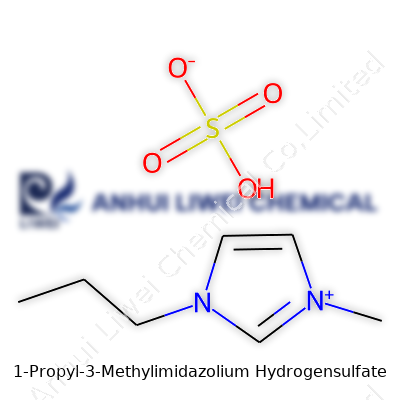
Everyday life rarely puts the spotlight on chemicals like 1-Propyl-3-Methylimidazolium Hydrogensulfate, but scratch below the surface and this ionic liquid illustrates how chemistry shapes the world. Take apart its name and you get a sense of its design—an imidazolium ring, dressed up with a propyl group on one nitrogen, and a methyl group on the other. It pairs with a hydrogensulfate anion. Together, they form a liquid salt, comfortable at room temperature, with a knack for dissolving many substances water alone cannot touch.
Drawing the Structure
The cation comes first. Picture a five-membered imidazole ring: two carbons, two nitrogens, and another carbon to close the loop. Attach a methyl group (–CH3) to nitrogen at position 3, and a straight-chain propyl (–CH2CH2CH3) at nitrogen in position 1. This arrangement gives the ring extra stability and makes the molecule more than a textbook example—it’s actually practical. The anion, hydrogensulfate (HSO4-), joins the mix: one sulfur at the center, surrounded by four oxygens, one of them bonded to hydrogen. These two parts stay together through electrostatic forces, shaping the behavior of the whole compound.
Why This Structure Matters
Structure drives function. Add a propyl group and get changes in melting point, viscosity, and how the compound interacts with other chemicals. Putting together these pieces, chemists built a molecule that handles more jobs than just acting as a solvent. Industries rely on it for catalytic reactions, separation processes, and even the creation of advanced materials. I’ve seen researchers designing new ionic liquids for cellulose treatment or biofuel refinement, and swapping side chains makes a world of difference. These groups can tune the liquid's ability to dissolve. The methyl and propyl groups don’t just sit there; they decide how friendly the molecule is with oil, water, or different polymers.
Safety and Environmental Considerations
Organic solvents often leave a heavy footprint. Ionic liquids like 1-Propyl-3-Methylimidazolium Hydrogensulfate come with lower volatility and improved stability. That means less air pollution, as these liquids resist evaporation. They often show low flammability—a big deal if safety stands front and center in the lab or on an industrial scale. Researchers still ask tough questions about biodegradability and long-term toxicity. Solutions might mean swapping out certain side groups or designing recycling pipelines. In my own work, I’ve seen companies tracking these chemicals from cradle to grave, proving that attention to a molecule’s life cycle matters as much as its chemical prowess.
Innovation from Structure
With this molecule’s unique architecture, people find ways to clean up old processes. For example, in green chemistry projects, the ionic character of the compound replaces volatile organic solvents. Fewer hazardous emissions, easier product recovery, and improvements in process efficiency grow from simple tweaks in chemical structure. A methyl here, a propyl there—small changes mean big advances. I remember one project where this ionic liquid powered biomass processing at lower temperatures, cutting down energy use. When structure and application run hand in hand, everyone benefits: manufacturers, researchers, and the planet.
Why This Ionic Liquid Demands Respect
People working with ionic liquids like 1-Propyl-3-Methylimidazolium Hydrogensulfate often run into the same challenge: these chemicals promise lower volatility and eco-friendlier profiles compared to traditional solvents, but safe handling should never take a back seat. As a researcher, I have handled dozens of similar compounds, and the best habits come not from fear, but from habit and foresight.
Protecting Yourself in the Lab
Direct skin contact or inhalation of ionic liquids can irritate, and though this particular compound rates lower on toxicity charts, it deserves the same personal protective measures as harsher agents. Always go for nitrile gloves—latex doesn’t always stand up to organic salts. Safety goggles block splashes, and a lab coat or apron saves a lot of trouble for both skin and clothing. I’ve seen a short moment of distraction lead to hours of discomfort and extra paperwork in the safety log.
Treat any spills seriously. Even though hydrogensulfate forms are less volatile, they leave sticky residues and can corrode metals. Use absorbent pads, not tissue or regular paper towels, because proper sorbents handle both the chemical and the mess. After cleanup, wash the area with plenty of water and run ventilation. Most labs keep a spill kit for solvents near the bench, and that’s where you want to reach first.
Smart Storage: Small Steps, Big Payoff
Keep 1-Propyl-3-Methylimidazolium Hydrogensulfate in sealed glass or compatible plastic containers. This type of liquid likes to attract water, so dry conditions help preserve purity. I label all reactive chemicals with easy-to-read hazard symbols and storage dates. Clear labels cut down confusion and help emergency responders act quickly. Store away from acids and oxidizers to prevent dangerous reactions. Flammable solvents, oxidizing powders, and acidic waste get their own cabinets, and this habit has saved more than one project from an unplanned reaction.
Responsible Disposal: Cutting Corners is Not Worth It
You can’t dump used or leftover ionic liquid into a sink or regular trash. Waste collection rules apply to both large research institutions and small workshops. Most facilities require spent ionic liquids to be sealed in leak-proof containers and labeled as hazardous waste. Many places recommend calling a licensed chemical disposal contractor rather than trying to neutralize or incinerate these compounds on site. A single container left unsealed can leak into drainage systems, contaminating water and soil. In my experience, facilities that ignore these steps soon face fines or costly remediation work.
Always keep a log for outgoing hazardous waste. This practice not only makes audits easier but builds trust with local authorities and waste contractors. If you’re unsure about whether a particular ion, cation, or salt needs special handling, ask your environmental health office—better to double-check now than scramble during an inspection.
Genuine Care Goes a Long Way
Good habits stem from respect for both people and environment. Ionic liquids open doors for greener chemical processes, but that promise only holds up if everyone takes responsibility from the moment a bottle arrives to the second it leaves as waste. By sticking to tested safety measures, clear labeling, and professional disposal, we protect our labs and the world outside.