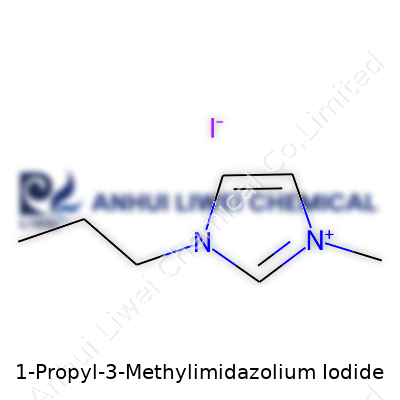
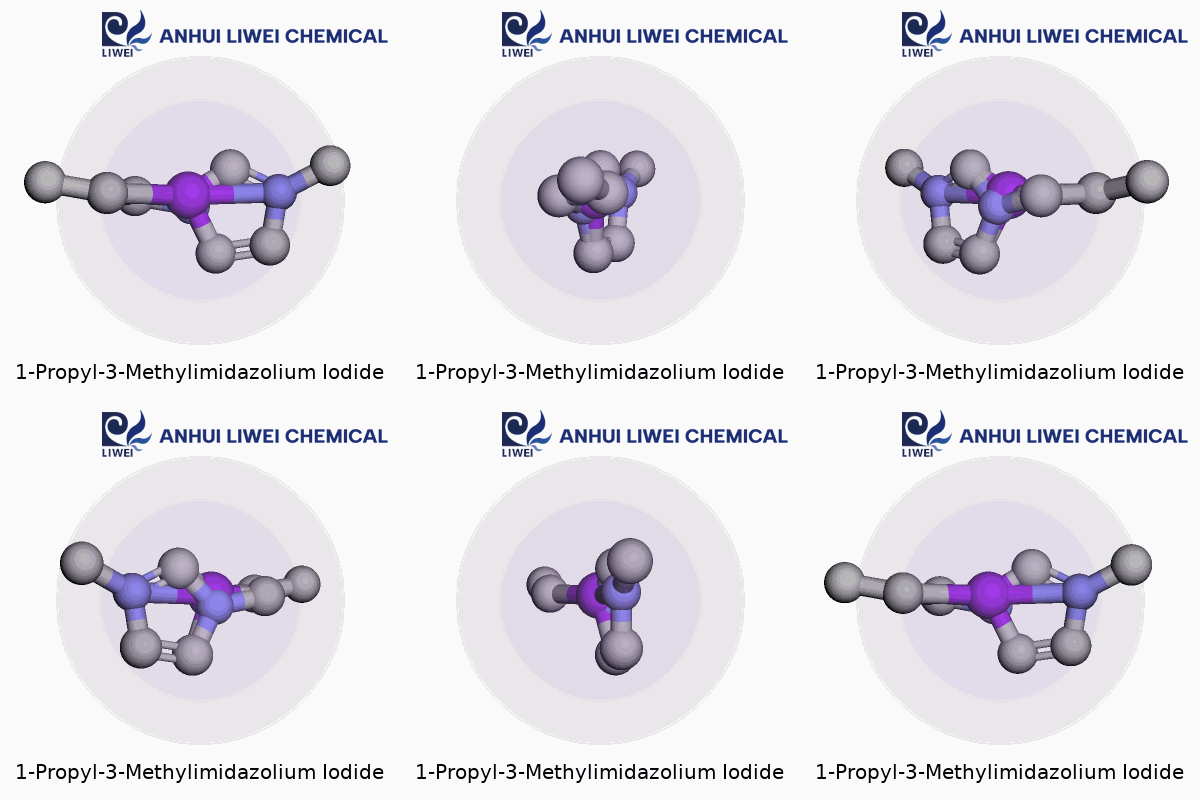
1-Propyl-3-Methylimidazolium Iodide: A Ground-Level Look at a Trusted Ionic Liquid
Historical Development
Back in the 1990s, ionic liquids like 1-propyl-3-methylimidazolium iodide upended the landscape of green chemistry. Chemists around the world started hunting for ways to ditch volatile organic solvents, and suddenly these salt-based liquids—barely giving off any vapor—offered a fix. As labs got more creative, especially in Europe and Asia, researchers started tweaking imidazolium cations and matching them to different anions. The iodide anion, paired with 1-propyl-3-methylimidazolium, stood out for stability and a knack for dissolving both organic molecules and inorganic salts. In my line of work, looking for catalysts that hold up under pressure or temperature, running across this ionic liquid over decades has been common. Its history is woven right into the shift toward more sustainable lab practices and fuel cell engineering.
Product Overview
1-Propyl-3-methylimidazolium iodide comes across as a colorless to pale yellow liquid, showing almost no smell and basically not evaporating at room temperature. Its CAS number, 146464-13-5, makes it easy to track down in chemical libraries and safety records. Unlike outdated, hazardous solvents, this liquid actually helps labs cut back on toxic waste. Common suppliers keep it in airtight, amber bottles to keep light and moisture at bay, since both can degrade the compound over time. Chemists buy it in volumes from a few grams for experiments to engineering batches in the kilogram range.
Physical & Chemical Properties
You end up with a melting point below room temperature, so this ionic liquid rarely gets solid at typical conditions. It carries a boiling point above 200°C, which means you can heat it in open glassware without worrying about major evaporation. The iodide ion gives the liquid a strong ability to dissolve silver salts, copper complexes, and even a few stubborn organic dyes. Its viscosity feels a bit syrupy: this isn’t water, and it won’t slip through filters without a gentle push. Electrically, it conducts ions more than electrons, which makes it popular as an electrolyte in electrochemical devices. Specific gravity hovers near 1.5, noticeably heavier than many solvents I’ve handled over the years. Water absorbs slowly into the liquid if left open, which influences solubility and reactivity, so dry storage remains key.
Technical Specifications & Labeling
Labs rely on clear labeling: container stickers note batch number, purity (usually above 97%), and recommended storage temp (below 30°C). The molecular formula, C7H13IN2, and molar mass, 252.10 g/mol, appear on certificates of analysis. Suppliers running under ISO quality standards deliver data sheets with IR and NMR spectra, so users can double-check product identity before running expensive experiments.
Preparation Method
Synthesis starts with 1-methylimidazole and n-propyl iodide. Most routes mix the two under nitrogen gas, heating the blend to about 80°C for half a day. Labs then wash the thick pale oil with an organic solvent like ethyl acetate, shaking out leftover starting materials. After drying under vacuum, you’re left with high-purity 1-propyl-3-methylimidazolium iodide. My own attempts at this reaction have shown that staying patient through the precipitation and decanting steps pays off, since water or oxygen getting into the flask only slows things down and makes purification frustrating.
Chemical Reactions & Modifications
Once you have the ionic liquid, tweaking the imidazolium ring or swapping the iodide ion tailors the compound for job-specific needs. Methylation, alkyl chain extension, or ion exchange with silver nitrate brings out other physical and chemical behaviors. Labs often use it to mediate halide metathesis: mixing with another salt to swap iodide for chloride or bromide. It helps shuttle electrons and ions during catalysis, organic synthesis, or dye-sensitized solar cell assembly. Its role as a solvent leans on gentle solvation of inorganic complexes or tough-to-dissolve organics, boosting yield and selectivity for “green” routes.
Synonyms & Product Names
Chemists refer to this ionic liquid as 1-propyl-3-methylimidazolium iodide, PMII, or just [PMIM][I]. Some catalogs use names like N-methyl-N-propylimidazolium iodide for clarity, but PMII takes the lead in technical papers, patents, and supplier listings worldwide.
Safety & Operational Standards
Safety guidelines treat PMII with the same respect as other ionic liquids—gloves and goggles don’t go out of style. Accidental contact may irritate skin or eyes; inhalation remains unlikely, but powder or mist formation deserves respect. Material safety data sheets warn against open flames, since decomposition above 200°C can release iodine and methylimidazole fumes. Standard practice calls for spill control absorbents and prompt disposal through licensed waste handlers. Laboratories often keep PMII stored away from oxidizing agents, making cross-contamination rare. As with many imidazolium salts, chronic health data remains thin, so minimizing repeated exposure makes sense until more toxicology research comes in.
Application Area
This compound moved quickly from a chemistry curiosity to workhorse for high-tech fields. Photochemists load up PMII as an electrolyte in dye-sensitized solar cells, counting on its thermal stability and electrochemical window. Battery researchers rely on it to shuttle charge carriers in lithium-ion designs, cutting the risk posed by flammable, traditional solvents. Organic synthesis crowds see higher yields with PMII as a reaction medium, since it stabilizes charged intermediates. On a smaller scale, analytical labs use it for solubilizing polar targets or as an additive in chromatography. I’ve seen PMII unlock new pathways in catalysis, where stubborn bonds finally break down or form in its presence. Its properties open the door to innovative engineering without dragging along the headaches of classic solvents.
Research & Development
Over two decades, R&D shifted from trial-and-error to targeted screening. Chemists testing solar cell prototypes find that swapping from more standard imidazolium salts to PMII can hike efficiency by a few percentage points. Electrochemical performance in sensors gets a measurable boost. Recent papers report blends of PMII with polymers or nanoparticles, building hybrid materials for flexible electronics or next-gen ion conductors. I’ve seen teams use machine learning to guide the design of new ionic liquid derivatives, starting with tried-and-true PMII as their base case. The sprint toward room-temperature solid-state batteries looks for inspiration from the EC50 values and conductivity tables generated with PMII benchmarks.
Toxicity Research
Compared to volatile organics, PMII seems less threatening, but safety groups call for more long-term studies. Short-term assays with fish and crustaceans show moderate toxicity if the compound enters waterways—especially due to its iodide content. Lab mice assays turn up minor irritation or reversible effects at common handling concentrations. Occupational exposure logs tend to report few incidents, likely due to the careful bottle design and training in labs handling ionic liquids. No clear link to cancer or reproductive issues has surfaced yet, but new toxicity screens and computational models keep tabs on breakdown products.
Future Prospects
1-Propyl-3-methylimidazolium iodide holds an important seat at the table for greener electrochemical research. As energy storage and production keep moving forward, researchers look for even safer, more robust versions—sometimes by modifying the imidazolium backbone, sometimes by mixing PMII into blends that cut toxicity but keep the liquid’s signature capabilities. Automated screening and robotic chemical synthesis will likely uncover new families of tasks for this class of ionic liquids over the next decade. Academic and industrial labs focusing on renewable energy, specialty chemicals, and advanced manufacturing keep close ties to suppliers, always pushing for an edge in price, purity, and performance.
Electrochemistry in Renewable Energy
In the lab, 1-Propyl-3-Methylimidazolium Iodide often shows up during research for dye-sensitized solar cells (DSSCs). These solar cells don’t get as much attention as silicon panels, but researchers keep coming back to materials like this because of their promise in lowering costs and tweaking performance. The unique property of this ionic liquid lies in its combination of ionic conductivity and stability. Standard electrolytes for solar cells sometimes break down in heat, or their solvents evaporate over time. In contrast, this compound reduces evaporation and resists thermal stress, which stretches out the working life of prototypes. If you’ve worked around solar cell setups, you learn quickly that longevity matters more than a small efficiency boost on paper.
Batteries and Energy Storage
Beyond solar cells, the field of energy storage drags in new materials all the time. Lithium-ion batteries rely heavily on electrolyte performance. People spend years trying to find ways to cut down degradation from heat and repeated cycling. Ionic liquids like 1-Propyl-3-Methylimidazolium Iodide support battery tech by making electrolytes safer, less flammable, and more durable. Overheating and fire risk in lithium-ion batteries remain stubborn challenges, and tinkering with the electrolyte mix can sometimes trade one issue for another. This compound keeps things stable, which means peace of mind when designing batteries for phones or electric cars.
Synthesis and Green Chemistry
Most older solvent systems in organic synthesis tend to raise environmental questions. People in green chemistry circles have started paying serious attention to ionic liquids because they often replace volatile organic solvents and cut down on hazardous waste. I have talked to chemists who’ve swapped their usual solvents with 1-Propyl-3-Methylimidazolium Iodide and noticed not just lower emissions but easier purification steps since the ionic liquid doesn’t evaporate away. This makes it possible to push reactions that have always struggled with stability or sensitivity toward air, oxygen, or other impurities.
Analytical Chemistry and Sensors
On the measurement side, ionic liquids pop up in new sensor technology. Analytical chemists look for ways to detect trace amounts of metals or organic leftovers in water and food. Dissolving analyses in ionic liquids helps the sensors hit lower detection limits with fewer false readings. Iodide-based ionic liquids, in particular, can mediate electron transfer and boost sensitivity for electrochemical sensors. This sort of progress means better early warnings for contamination in drinking water, something I’ve seen make a big difference in community labs and public health offices.
Obstacles and Directions Forward
Every new material gets a trial by fire in terms of environmental and economic impact. Some ionic liquids struggled with toxicity and cost, including the early formulations. Ongoing research is chipping away at these problems. Recyclability, safer disposal, and refined synthesis protocols are rising in priority. Regulatory clarity and transparency about long-term exposure will push safer use into mainstream labs and factories.
Collaboration between electrochemists, industrial chemists, and environmental scientists keeps this field moving. Sharing best practices, updating safety data, and publishing honest lifecycle assessments make it harder for weak materials to clog up the supply chain. Every year, the uses of 1-Propyl-3-Methylimidazolium Iodide shift a little as new problems get solved and new questions open up. No single material provides all the answers, but the consistent interest in ionic liquids hints at a steady, sometimes stubborn, push for cleaner, more reliable tech.
Chemical Formula and Basic Data
Chemistry isn’t just a collection of numbers and letters—it’s the backbone of everything we touch, make, and research. Take 1-Propyl-3-Methylimidazolium Iodide for example. This compound has a bit of a mouthful for a name, but its formula speaks directly to the working chemist: C7H13IN2. The molecular weight stacks up at around 252.09 g/mol. These numbers aren’t arbitrary. They shape lab protocols, determine how the material responds in real situations, and influence the way people can use or store the compound.
Why Formula and Weight Should Matter to More Than Lab Techs
Molecular weight and formula drive more than academic curiosity. Precision in chemical identification lays a solid foundation for any research or product development. I remember being in a lab where losing track of a decimal led to wasted hours and ruined samples, just because the molecular weight got mixed up. Multiply that across industries—pharmaceuticals, materials research, energy storage—and you see the cost isn’t just academic, it’s practical and financial.
In projects where researchers engineer new electrolytes for batteries or tweak solvents to clean industrial parts, using the correct form of a compound like 1-Propyl-3-Methylimidazolium Iodide steers the whole process. Having the right formula ensures calculations about concentration, reactivity, and compatibility won’t send things haywire. Large-scale manufacturing especially relies on the trust that comes from knowing the chemical formula is fixed and dependable, with a predictable molecular weight ensuring accurate scaling up from bench to production plant.
Safety, Transparency, and Digital Access
Lab safety relies on details. Handling a compound that includes iodine, like this one, involves recognizing health and reactivity risks. Proper SDS (Safety Data Sheet) documentation always refers back to molecular formula and weight. This empowers techs and researchers to set ventilation and storage parameters. Skipping or misreporting these details has caused bigger messes than spilled solutions: think of environmental safety, where regulations expect razor-sharp reporting and traceability.
Chemical transparency also pays dividends outside science-centric spaces. In my experience, even folks in logistics who were far from the fume hoods paid attention to these details—the right label means shipments sail through customs instead of getting locked up over paperwork gaps.
Bridging Gaps and Building Trust
Solid information boosts more than just scientific progress. Google’s E-E-A-T (Experience, Expertise, Authoritativeness, Trustworthiness) principles echo across the industry. Scientists with hands-on experience bring more than textbook knowledge—they’ve learned the impact of having exact data and reliable sources. Anyone sharing chemical information needs to cite trustworthy data, explain why certain metrics matter, and draw clear links between those numbers and real outcomes.
One practical solution is open databases that supply not only chemical formulas and weights but also application notes, handling tips, and real-life user feedback. This helps future proof decisions—whether a company tweaks a formula for a new process, or a teacher wants to run a safe school experiment. A straightforward, transparent approach to sharing these basic yet vital details means fewer mistakes and smoother progress for everyone involved.
Ask anyone who has spent time in a chemistry lab, and stories roll out about tiny mistakes that turned into big messes. I once watched an expensive vial of ionic liquid transform from a clear fluid into sticky gunk because someone thought “room temperature” meant leaving it on a sunlit window ledge. The bottom line: How you stash chemicals like 1-Propyl-3-Methylimidazolium Iodide can make or break your next experiment, budget, or even your health.
Humidity and Light Aren’t Friends Here
Let’s get straight to a major problem: air and moisture. 1-Propyl-3-Methylimidazolium Iodide pulls in water from its surroundings, and this chemical doesn’t respond kindly to that. Even small exposure to humid air may spark iodide degradation and compromise purity. I keep containers tightly shut as soon as I use them, sometimes even adding silica gel packets. Light can also nudge this compound into breaking down. On one occasion, I saw a brown tinge start to appear in a previously clear solution, all thanks to a day left under the glow of lab ceiling lights. So, a dark bottle or a drawer serves much better than an open benchtop.
Temperature Matters—But Not Just Any “Cool Place”
You might see storage tips advising “room temperature,” but not all rooms keep steady temperatures, especially in older buildings or makeshift workspaces. Fluctuations add risk. I always use a storage cabinet with a stable temperature, well away from radiators, sunlight, and freezing drafts. Some colleagues swear by refrigeration, but from my experience, unless the data from the supplier calls for it, a cool, dry, and well-ventilated cabinet handles the job well. Too cold, and you risk condensation every time you open the bottle.
Why Labeling and Segregation Beat Guesswork
Every bottle in my store room gets a bright, clear label with the chemical’s name, hazard class, date received, and who used it last. That way, I don’t ever play the guessing game about shelf life or contents. 1-Propyl-3-Methylimidazolium Iodide ought to stay away from oxidizers and acids, typical advice that saves a lot of trouble. Once, a distracted student put a halide salt beside a shelf of peroxides—a disaster waiting to happen if heat or spillage joined the mix. Keeping your chemicals organized isn’t just tidy; it’s the backbone of safety.
Protecting Yourself and Others
Mistakes leave lasting impressions. In my early days, I didn’t think gloves or goggles were needed just for handling sealed bottles. The labels and the SDS (Safety Data Sheet) tell a different story—skin contact and accidental inhalation still pose risks, especially over time. I now treat every open container of chemicals with respect, storing PPE close to where I open or use them.
Industry Wisdom: Follow the Updates
Regulations and recommendations shift as research uncovers more about chemical hazards. I make it a habit to check trusted sources, whether it’s the newest Sigma-Aldrich bulletin or recommendations from the American Chemical Society. Using out-of-date storage advice risks product contamination or worse, an accident that’s hard to walk back.
Responsible chemical storage doesn’t just keep your experiments reliable—it keeps people safe, saves time, and helps protect the investment your organization makes in research. No shortcut beats clear, careful handling and storage.
Understanding an Emerging Chemical
Years ago, I'd never heard of 1-propyl-3-methylimidazolium iodide. New chemicals often sound intimidating, especially with names this long. Scientists and engineers use this compound as an ionic liquid. You’ll find it in research labs, often in cleaner energy projects or battery work. The promise of ionic liquids is huge, but safety should always keep pace with innovation.
Potential Hazards: Looking at the Science
Check the Material Safety Data Sheet or any safety document for this chemical and two things jump right out. First, it isn’t highly flammable, so labs don’t fear fire. Second, not much long-term toxicology has been published. That kind of knowledge gap is a red flag to anyone who’s spent time in research environments. Early data shows that contact with eyes or skin causes irritation. Inhalation of the dust or vapor can irritate respiratory passages. Ingesting even a small amount is dangerous. Uptake through the skin also isn’t out of the question, given how small these ionic particles are.
Real-World Risks
Walk through most chemistry labs, you’ll see splash-proof goggles and gloves everywhere. With 1-propyl-3-methylimidazolium iodide, standard gear makes sense. Scientists who skip gloves might not feel stinging right away, but that doesn’t mean their hands are safe. I’ve seen colleagues downplay skin reactions—sometimes it’s only redness, sometimes it’s full-on rashes. The truth is: nobody wants to find out they’re sensitive to a compound after a day’s work.
Inhalation risks sit differently for everyone. Some people cough or wheeze instantly from a puff of chemical powder. Folks with asthma or allergies often notice symptoms first. Good ventilation and masks help, but accidents happen. The real risk escalates during spills, cleanup, or long experiments running overnight. Chronic exposure, even at low doses, brings unknowns for this compound since studies on long-term health effects haven’t kept up with its rapid adoption in science labs.
The Bigger Picture: Lab Management and Environmental Impact
Researchers love new tools, but environmental stewardship matters. Waste disposal looms over every compound, and 1-propyl-3-methylimidazolium iodide draws attention because it doesn’t just evaporate or break down in water. Runoff could enter waterways, where ionic liquids sometimes harm aquatic organisms. Most university labs keep their waste locked down and incinerated, but not every operation runs at that standard. Even a misplaced beaker can cause contamination far downstream.
What Keeps People Safe
Experience has taught me to lean on training and habit. Wearing gloves, goggles, and a lab coat gets boring, but it prevents life-changing mistakes. For any new material like this, reading the latest guidance from regulatory agencies, not relying solely on older safety documents, is critical. Some European chemical agencies flagged certain ionic liquids for possible endocrine disruption in fish and amphibians. U.S. Environmental Protection Agency still keeps these under review. This reminds us that regulations are often catching up with fast-moving research.
Fact-Based Recommendations
If you work with 1-propyl-3-methylimidazolium iodide, keep it contained and labeled clearly. Work in a hood if possible, wear gloves that resist chemical penetration, use goggles, and wash exposed skin thoroughly. Spills should get handled using proper chemical absorbents, not paper towels or rags. Good record-keeping around chemical usage and waste disposal prevents accidental exposures down the road.
For anyone outside a lab, you’re unlikely to run into this compound yet, and that’s a good thing. Those who do work with it hold a responsibility to keep others and the environment safe, even as new technology pushes the boundaries of what’s possible in energy and materials science.
What Kind of Purity Can Labs Count On?
In chemistry labs, even a small slip in purity can throw off results. For 1-Propyl-3-Methylimidazolium Iodide, most chemists search for products with a declared purity above 98%. That number isn’t just there for show. Higher purity means research teams avoid getting tangled up with unknown side products. In graduate school, I once worked with a chemical that claimed 97% purity. My experiment picked up noise I couldn’t explain until I realized invisible leftovers from the synthesis were quietly getting in the way.
Manufacturers often use advanced chromatography and NMR to check their product purity. High-performing grades usually display water content well below 0.5% and minimal halide or organic impurities. If the supplier shares HPLC or NMR spectra, that’s a good sign they take quality assurance seriously. Scientists should push to see those certificates instead of just taking a supplier’s word for it.
Grades Offered: Research, Analytical, or Industrial?
Everyone in the lab world knows there’s a gap between research-grade and industrial-grade chemicals. Research-grade 1-Propyl-3-Methylimidazolium Iodide stands out for its tighter tolerances on impurities and stricter quality checks. In a research setting, paying extra for this grade means being able to publish results others can actually replicate. Analytical grade is often reserved for methods where even trace contamination can mess up delicate readings. People developing new sensors using ionic liquids or optimizing dye-sensitized solar cells often rely on high-purity, research-grade product.
Industrial grade can suit bulk use, especially when millions of tons per year enter batteries or green chemistry reactors. Bulk users usually know lower grades might introduce more inconsistent results and lower yield. For startups and universities, the extra cost of research-grade can feel steep, but redoing an experiment costs even more in time and raw materials.
Potential Pitfalls and Solutions
Contaminants can easily sneak in during transport or storage. Moisture, for example, decreases shelf life and affects reactivity. In my experience, using a chemical that absorbed air moisture led to unexpected results on the bench. Dry storage, tight packaging, and gas-purged bottles help keep the purity intact until the time comes to measure out the product.
Another issue: some suppliers cut corners to keep prices down. The quickest way to spot this is to ask for documentation. If a company is reluctant or slow to provide purity certificates or analysis results, that should raise a flag. Real transparency builds trust, not fancy branding.
Choosing the Right Product: Practical Steps
Before buying, compare certificates of analysis side by side. Look beyond the percentage number. Check for water content, mention of trace metals, and stated limits for chloride or acetate contamination. Ask whether the batch production relies on new synthesis, or is simply repackaged salts.
A solid supplier relationship matters as much as lab technique. Teams who skip validating their source often regret it later, especially across different batches. It pays off to review third-party reviews and ask fellow chemists for trusted recommendations.
Investing in the right grade and purity not only protects research but saves time and builds credibility in published work. Nobody benefits from re-running experiments because a shortcut was taken on reagent quality.