Exploring 1-Propylimidazole: From Discovery to Future Possibilities
Historical Development
In the late 19th century, curiosity about imidazole derivatives grew as chemists began linking simple amine structures with practical applications. 1-Propylimidazole found its place during this time, showing promise through foundational work in organic synthesis. Over decades, laboratory breakthroughs slowly mapped out its synthesis, structure, and performance, driven by the search for efficient materials in pharmaceuticals and catalysis. University labs and chemical companies began isolating and testing alkyl-substituted imidazoles, gradually building a toolbox of heterocycles with propyl groups that found their niche for both research and industrial-scale manufacturing. The hands behind early imidazole chemistry paved the way for today’s selective functionalizations and large-scale production.
Product Overview
1-Propylimidazole stands out among alkylimidazoles because its structure offers a delicate balance between reactivity and stability. The propyl group bound to the first nitrogen of the imidazole ring distinguishes it from simple imidazole or methyl-derivatives, opening up synthetic channels that would otherwise stay closed. Chemical suppliers sell it as a clear, slightly viscous liquid with a faint amine-like odor, usually packaged in amber glass bottles to avoid light degradation. Quality checks measure purity above 98%, because trace contaminants can influence reaction outcomes or toxicity results. Consistent performance in the lab keeps this compound in high demand for specialized organic reactions and formulation studies.
Physical & Chemical Properties
1-Propylimidazole shows a boiling point near 220°C, proving its thermal stability compared to many simpler amines. Its density falls close to 1 gram per cubic centimeter, typical for medium-sized heterocycles, and it mixes well with most polar organic solvents. The molecule features a planar imidazole ring, stabilized by the electron-donating propyl group that changes both the pKa and overall polarity. Solubility patterns favor water at room temperature, though the propyl chain renders it distinctly more lipophilic than unsubstituted imidazole. In standard lab settings, this liquid resists oxidation but reacts quickly with strong acids, alkylating agents, and halogenating reagents.
Technical Specifications & Labeling
Bottles of 1-Propylimidazole arrive labeled with concentrations by mass or volume, specific CAS number, batch identification, preparation date, and grade—generally HPLC or analytical grade for research use. Chemical data sheets note storage recommendations, including refrigeration and avoidance of moisture, which can degrade some stocks. Most suppliers provide batch purity certificates, recording NMR or HPLC spectra for reference. Technicians watch for any color change or precipitation, signaling degradation that could spoil further formulation or scale-up attempts. While not particularly volatile at room temperature, ventilation remains necessary, and labels caution against skin or eye exposure.
Preparation Method
Laboratories typically synthesize 1-Propylimidazole by reacting imidazole with propyl halides—commonly propyl bromide or chloride—in the presence of a suitable base like potassium carbonate. The reaction tends toward good yields if the reactants mix in anhydrous solvents such as dimethylformamide (DMF). Column chromatography purifies the product, as unreacted starting materials or byproducts linger and could jeopardize downstream applications. A personal lab experiment once left me with a stubborn emulsion during extraction; tweaking salt addition and slow separation made all the difference. The process seldom varies in industry, though scale-up factors in more efficient solvent recycling and purification steps.
Chemical Reactions & Modifications
The imidazole ring of 1-Propylimidazole opens doors to several reactions. Electrophilic substitution introduces new groups at the 2, 4, or 5 positions, a popular route for developing pharmaceuticals and catalysts. The propyl moiety resists most mild conditions but succumbs to oxidation under strong reagents, offering a pathway toward carboxylic acid derivatives. Alkyl substitution at specific ring carbons requires careful temperature and pressure control to avoid ring rupture. In my research, selective halogenation reactions with NBS led to highly functionalized intermediates, later used to anchor metal ions for coordination chemistry. The versatility of this molecule keeps it on the bench of many synthetic organic chemists worldwide.
Synonyms & Product Names
Lab catalogs and chemical databases refer to 1-Propylimidazole under several synonyms. N-Propylimidazole, 1H-Imidazole, 1-propyl-, or simply Propylimidazole often appear in academic literature, trade catalogs, and international shipping manifests. Various translations surface in regulatory paperwork, so familiarity with these alternatives helps avoid confusion. Knowing the synonyms reduces time spent cross-referencing, especially when ordering from suppliers, conducting literature searches, or handling international regulatory documentation.
Safety & Operational Standards
Handling 1-Propylimidazole brings routine laboratory risks. The compound irritates skin and eyes, and inhalation can trigger coughing or dizziness in poorly ventilated spaces. Safety data sheets stress the use of gloves, goggles, and fume hoods, habits that keep me and colleagues out of the campus medical office. Fire safety drills reinforce that, while the material itself resists ignition, reaction byproducts or solvent residues may burn or fume. Regulators require storage in secure, labeled containers away from incompatible chemicals like acids or oxidizers to block any unexpected reaction. Adhering to strict protocols for transfer, use, and disposal stays non-negotiable—complacency earns only accidents and near-misses.
Application Area
The functional properties of 1-Propylimidazole open a range of uses. In pharmaceuticals, researchers trust its structure as a scaffold for antifungal and anti-inflammatory drugs. The imidazole core mimics histamine, part of its value in bioactive compound development. Material scientists blend it into ionic liquids, resins, and corrosion inhibitors, often banking on its stability and modifiable nature. Analytical chemists inject it as an internal standard during gas or liquid chromatography studies. Battery and conductor developers test this molecule for optimizing electrolyte mixtures. From a personal perspective, trialing it in catalysis experiments for C-N bond formation highlighted how small tweaks at the imidazole nitrogen deliver big changes in reaction speed or selectivity.
Research & Development
Academic labs and private firms keep expanding the chemistry of 1-Propylimidazole. Ongoing research targets more efficient synthetic routes using greener solvents and catalysts, while computational work maps its electron density for precisely tuning activity. Structural modifications drive efforts to boost drug-like properties or create selective enzyme inhibitors. Collaborations between pharmaceutical chemists and material engineers generate new formulations for medical device coatings or smart sensors. Grants from governmental agencies help graduate students and postdocs study the molecule’s interaction with biomolecules, deepening our grasp of both beneficial and adverse effects.
Toxicity Research
Toxicological studies on 1-Propylimidazole report modest acute toxicity but emphasize caution around repeated exposure. Ingestion or inhalation can disturb gastrointestinal and neurological function in animal models, with chronic effects hinging on dose and duration. In vitro work suggests possible irritation at the cellular level, something I’ve seen reflected in careful disposal procedures at my university. Regulatory agencies set workplace exposure limits and review case reports from industrial incidents. Toxicity profiles influence how much industry employs the material, pushing for updated handling recommendations and emergency protocols as science advances.
Future Prospects
Interest in 1-Propylimidazole continues to grow. Climate change pushes chemists to look for more environmentally responsible solvents, and this molecule features prominently in early-stage ionic liquid research. Drug designers chase altered derivatives for tailored therapies. I see opportunities in energy storage, where imidazole derivatives strengthen bonds between metal ions and organic frameworks. Automation in synthesis stands to streamline production, while artificial intelligence may soon predict safer formulations based on electronic structure calculations. As global regulations evolve, companies adapt their protocols, encouraging ongoing research on both practical and safety fronts. This continued focus promises innovative uses and improved safety measures for years to come.
Standing in a laboratory filled with bottles, each labeled with unfamiliar words, the label “1-Propylimidazole” never fails to catch the eye. Years ago, I first encountered this chemical during a stint helping a research team overhaul their solvents. Before then, it was just another name in a catalog. In truth, its impact runs deeper than most folks outside of chemistry would guess.
Breaking Down Its Role in Industry
Most chemists bump into 1-Propylimidazole as a solvent or intermediate. Its structure, which swaps a hydrogen on imidazole for a propyl group, gives it just the right chemical push to serve as a strong base in synthesis. Take the pharmaceutical industry: researchers value it—it helps craft everything from anti-parasitic drugs to medications targeting fungal infections. This utility pops up during a process called alkylation, where scientists modify molecules for better performance or fewer side effects. But its reach doesn’t stop with medicine. Manufacturers often use it to create more efficient corrosion inhibitors. These additives step in to protect pipes, machinery, and storage tanks. Based on my own experience reaching out to specialty suppliers, it’s clear this compound finds its way into lots of custom blends that keep companies running smoothly.
Helping Green Chemistry Move Forward
Every year, chemical production gets tighter rules set by governments and public watchdogs. Nobody wants a solvent or catalyst that lingers in soil or water for decades. Here, 1-Propylimidazole offers a step forward: its imidazole backbone links back to some bio-friendly roots, and researchers often rate it as relatively less toxic than older alternatives. In recent years, academic studies pointed out its promise in ionic liquids—these are salt-like chemicals that stay liquid at room temperature. They’re making waves in industries hunting for safer, greener reaction media instead of volatile organics. On a practical level, using better-behaved solvents means less cleanup, lower risks for plant workers, and fewer expensive environmental headaches. I’ve seen project teams score big wins by revisiting how and where they apply specialty intermediates like this one. Less hazardous waste cuts both disposal costs and regulatory headaches.
Tackling Safety Concerns and Pathways Forward
Chemists know that even versatile tools carry risks. Eye and skin irritation from 1-Propylimidazole may sound minor, but I’ve watched a carelessly handled bottle leave a grad student sidelined for a week. Gloves, vents, and goggles stay non-negotiable in any setting. Some manufacturers continue to push for even safer derivatives or reusable catalysts, shrinking exposure risks and waste at the same time. Education plays a direct role, too. Training staff how to safely handle chemicals like 1-Propylimidazole can prevent costly mistakes. I’ve worked with companies that shifted from printed safety data buried in binders to digital dashboards—staff checked chemical risks in seconds, not hours. This approach bridges the gap between regulation and everyday practice.
Looking at Responsible Innovation
With every new chemical comes a choice on how to use it. The progress made possible by compounds like 1-Propylimidazole reminds me of the balance between industrial innovation and responsibility. In my years bouncing between labs and plant floors, the companies that built lasting value always kept one eye on safety and sustainability. So next time someone asks, “What’s 1-Propylimidazole used for?” I remember that behind every technical answer stands a crowd of people working to blend progress and safety. That’s where the value truly grows.
Understanding 1-Propylimidazole
1-Propylimidazole often shows up in labs and industrial settings. Researchers use it to make pharmaceuticals, polymers, and specialty chemicals. The chemical structure, featuring an imidazole ring with a propyl chain, sets it apart from better-known relatives like imidazole or methylimidazole. Safety questions pop up because chemical cousins—for example, methylimidazoles—get flagged for health concerns.
Poking into Toxicity and Hazards
Looking for clear evidence, I checked what health agencies and the chemical safety sheets say. There’s a gap: very little published data from government regulators or toxicological studies on 1-propylimidazole in humans. That fact alone tells me many folks don’t treat it as a top concern, but it also highlights how little we really know.
Material safety data often spotlights risk around the eyes, skin, and lungs. On contact, it can cause sharp irritation. Breathing in the vapor over time potentially damages airways and leads to coughing and headaches. Some animal studies with similar chemicals raised red flags about harm to the liver or nervous system. I’ve watched colleagues in labs take special care with gloves and fume hoods—no one messes around if they can avoid it.
Exposure in Real Life
If you work in research labs or manufacturing, the most likely risk comes from spills or leaks—splashing into eyes or breathing in fumes. A spill on bare skin can sting or cause redness, nothing life-threatening but not fun either. Folks outside chemical manufacturing almost never run into this stuff. I remember asking a few chemistry professors if they’d ever touched it outside work, and their answer was a hard no.
Acute issues look limited—burns, coughs, headaches—if you let it linger on your skin or breathe a lot in. Chronic (long-term) effects? There isn’t good science proving danger at low exposure, but that doesn’t mean it’s safe. I’ve noticed regulatory bodies tend to reclassify chemicals only after a problem appears in workers or the public, not before.
Real Risks and Responsible Action
It’s smart to treat unknowns with respect. Federal agencies like OSHA set exposure limits for many industrial chemicals, yet 1-propylimidazole doesn’t have an official ceiling. That leaves it up to employers and workers to decide what “safe enough” means, case by case. Gloves, goggles, and proper ventilation look like common sense. People who mix or package chemicals need skin and eye protection. Respirators make sense in poorly ventilated rooms.
Looking forward, companies and scientists ought to invest time in getting clearer toxicity studies. The trend in chemical safety—learning from past surprises like BPA, 1,4-dioxane, or PFOA—shows the cost of ignoring data gaps. Publishing transparent research, sharing near-miss stories, and reporting accidents help everyone make better choices. If I had to pick between erring on the side of caution or shrugging off the warnings, it’s no contest: a little care today means avoiding regret down the line.
Folks handling unfamiliar chemicals—especially in schools, universities, and startups—deserve real training and accurate data. Education arms you better than any warning label ever will, and the next generation of chemists shouldn’t be left guessing what’s safe in their own hands.
Breaking Down the Structure
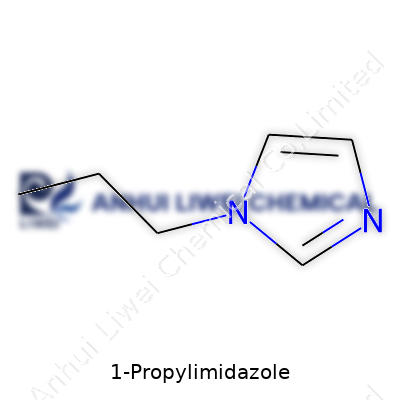
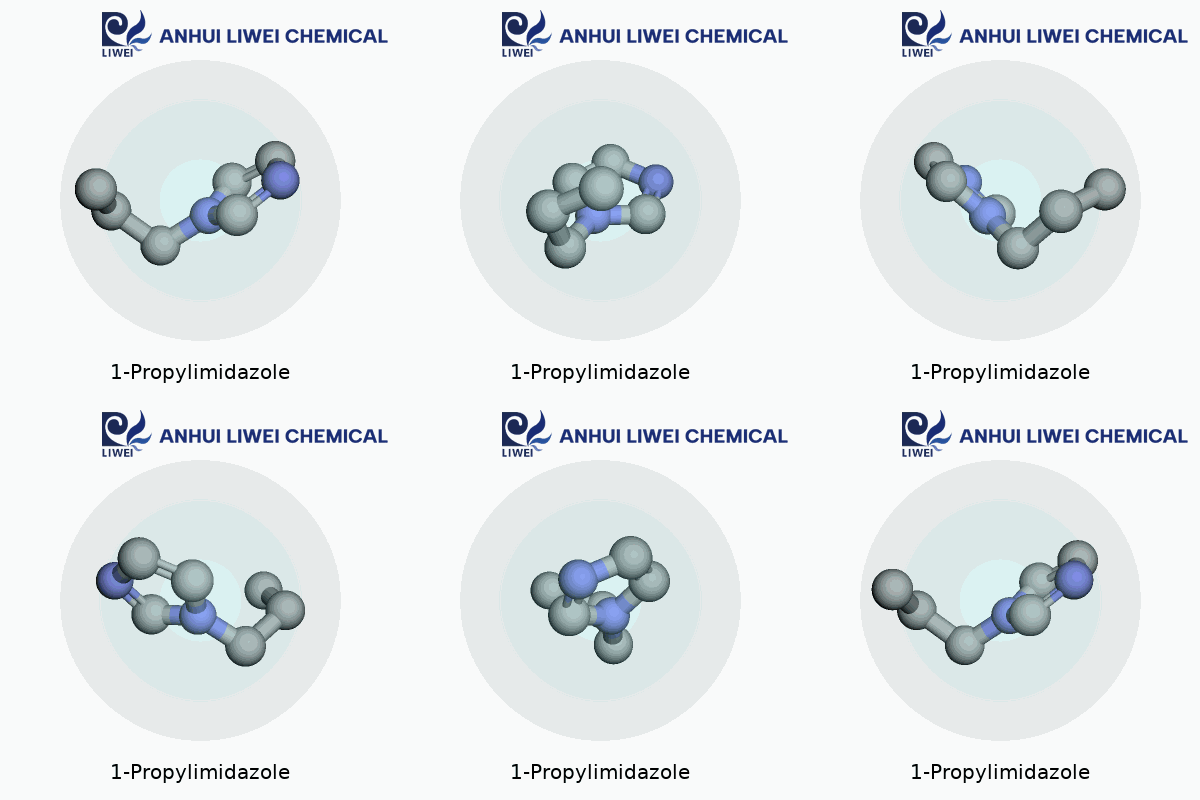
Looking at the structure of 1-Propylimidazole, we see something both simple and practical. This molecule falls in the imidazole family, which means it features a five-membered ring containing two nitrogen atoms. What sets 1-Propylimidazole apart from standard imidazole is a propyl group attached to one of the nitrogens. The chemical formula tells the story: C6H10N2. That means six carbons, ten hydrogens, and two nitrogens all coming together in a compact, useful structure.
I first learned about imidazoles while working in a pharmaceutical lab where these rings popped up constantly in design meetings and patent reviews. The structure isn’t just academic — it shapes how chemists and drug designers approach problems ranging from anti-fungal medications to solvents and even corrosion inhibitors. Adding a propyl side chain offers new potential — tweaking solubility, changing how the molecule interacts with other chemicals, and making the molecule more attractive for certain applications.
Why the Formula Matters
Understanding what's in a chemical isn’t just about memorizing letters and numbers. In real-world labs, knowing the composition helps predict how a molecule acts under heat, what it mixes with, and even how safe it is to use around people. C6H10N2 might look straightforward, but each atom plays a role. The propyl group nudges the molecule into new territories, allowing researchers to bridge gaps where other solvents or reactants stumble.
Industries often turn to 1-Propylimidazole for its qualities as a solvent or as a building block in higher-end synthesis. From my time working on corrosion-resistant polymers, we kept bumping into the versatility of these side-chain imidazoles. They helped dissolve stubborn ingredients, carried catalysts through tricky reactions, and kept unwanted reactions at bay. Knowing exactly what’s in them gave us confidence to push boundaries without sacrificing safety or efficiency.
Safety and Practical Concerns
Whenever you combine carbons, hydrogens, and nitrogens in new ways, there are health and environmental factors to weigh. Some imidazoles have perks, but also downsides. For instance, exposure to concentrated versions can cause irritation, and like any chemical, the impact on the environment gets magnified with large-scale use. It takes careful handling and strict adherence to safety data sheets.
As companies shift toward greener chemistry, formulas like C6H10N2 invite a challenge: can we design systems that use less toxic forms, generate less waste, and recycle solvents wherever possible? Some labs have begun reclaiming imidazole derivatives, cutting back on what winds up as hazardous waste. Others invest in research to swap out more toxic components for molecules that break down without harm. Understanding each atom’s place in the formula isn’t just for textbook answers; it’s a step toward responsible manufacturing and research practices.
Moving Forward
The chemical formula of 1-Propylimidazole might seem basic, but real-world science is built on these small details. The specifics of C6H10N2 drive decision-making across industries, from pharmaceuticals to materials science. It allows people in the field, whether in research, production, or safety assessment, to ask smarter questions, find creative uses, and set safer standards across the board.
Everyday Lessons from the Lab
Many chemicals pass through the hands of industry pros and researchers, but 1-propylimidazole stands out for its uses in synthesis and research. A small laboratory slip can bring big trouble, so storing this material the right way turns out to be more crucial than most people think. Let’s get down to brass tacks and cover what really matters: how to keep 1-propylimidazole safe, pure, and out of harm’s way.
Not Your Average Storage Room
Shoving bottles onto any old shelf doesn’t work if you aim to keep chemicals from turning nasty. Most experts with years in the field will tell you the same thing: store it in a cool, dry place away from sunlight and moisture. Direct sunlight can start breakdown reactions no one wants to see. Too much humidity can pull water into this compound, messing up purity and, sometimes, creating a bigger hazard if it reacts.
Chemists and warehouse managers alike learn to check the thermometer. Temperatures above regular room temperature may lead to slow changes inside the bottle—think degradation or pressure build-up. Fluctuations cause even more trouble, and every broken seal just wastes money and time. Simple shelving in a well-ventilated room with zero chances of freezing or overheating usually works best.
Know Your Risks
1-propylimidazole is not flammable like some solvents, but it still deserves respect. Leaks or open caps can turn minor spills into slip hazards, and fumes can irritate eyes and skin. Eye-level shelving with easy access helps keep accidents to a minimum. Glass or plastic bottles with reliable sealing, never metal if you want the long life of your stock. Some chemicals chew through metal—better safe than replacing an entire batch.
Personal experience in busy college labs hammered in the importance of clear labeling and secondary containment. Faded or missing labels leave everyone guessing, and guesses with unfamiliar powders or liquids get people hurt. Proper containers matter too. If your current bottle starts to look cracked, swap it. Saving a few bucks never justifies a ruined experiment or dangerous exposure.
Housekeeping Keeps Accidents Away
Regular checkups in storage areas prevent problems before they spread. Keep inventory lists updated—no one likes hunting for missing reagents, and having an expired stockpile invites chemical breakdowns. Outdated or mismanaged storage increases exposure to anyone working nearby. Professionalism demands full records and frequent checks for leaks or bulging containers.
I’ve seen the fallout from skipping these basics—one forgotten jar led to an expensive clean-up and a stern meeting with campus safety. Tracking dates, storage conditions, and bottle conditions turns storerooms into predictable, safe workspaces.
Practical Moves Everyone Should Use
Lock chemicals away from casual traffic and enforce clear access rules. Store acids, bases, and organics like 1-propylimidazole separately to limit cross-contamination risks. Isolation from food, drink, and break areas keeps everyone healthy. Uncluttered shelves make routine checks faster and limit accidents from scrambling for the right bottle in a pinch.
Smart safety training beats fancy signage. Everyone in the lab, from new interns to seasoned researchers, needs periodic reminders on proper handling, personal protective gear, and cleanup routines. These common-sense measures build a culture that values safety without slowing down progress.
Paving the Way with Smart Practice
Good storage habits for chemicals like 1-propylimidazole never come down to luck. They draw from real experience and science-backed guidelines. Attention to temperature, light, and organization delivers reliable results and keeps mishaps far from the lab bench.
The Role of Purity in Chemicals
Every time I talk with folks in labs or manufacturing, the conversation lands on one point: purity can make or break results. I’ve seen research grind to a halt over tiny amounts of contamination, and production batches fail because a shipment of solvent missed the mark. This isn’t just about being picky. Small deviations in purity ripple across entire systems in pharmaceuticals, electronics, or polymer synthesis. A material like 1-propylimidazole holds a crucial place where purity cuts through the noise and sets the baseline for safety, performance, and data you can trust.
Core Specifications for 1-Propylimidazole
For 1-propylimidazole, you can’t just settle for “clear liquid” and walk away. Reputable suppliers back up their products with proper certificates of analysis. In my experience, quality certificates outline these critical benchmarks:
- Assay (GC or HPLC): Purity usually clocks in at 98% or higher. Some labs demand 99%+ for analytical use. I’ve seen synthesis projects crumble because of under-spec material. Lab managers, keenly aware, always check assay numbers before a drop leaves the bottle.
- Water Content: Karl Fischer titration reveals how dry your sample really is. Less than 0.5% water keeps reactions in check. Moisture can derail sensitive chemistry and, in my work, trace water led to unexpected side products during scale-up.
- Color: Colorless to pale yellow gets a pass. Darker shades mean degradation or contamination. Fresh lots usually mean clear or barely tinged liquid; yellows and browns set off alarm bells.
- Acidity/Alkalinity: Check with pH paper or titration. Materials off spec by a few tenths lean toward hot reactions or corrosion in metal lab gear. Neutral profiles keep manuscripts readable and equipment unscathed.
- Identification: Suppliers confirm identity by NMR or IR. Skipping this step once cost a colleague weeks of cleanup after a mislabelled drum slipped through. Verifying the spectrum means your workflow doesn’t stall from the starting line.
- Volatile Impurities: Look for headspace GC data, verifying solvents are stripped out. Unwanted traces—acetone, ethanol, toluene—shorten a product’s shelf life or bring havoc in Pharma QA audits.
- Heavy Metals and Residues: Metals like iron, copper or zinc should sit below 10 ppm. In catalysis, even a trace above this drags results through the mud. ICP-MS or AAS screen for these ghosts.
Why Purity Standards Are a Big Deal
I’ve spent years watching teams try to build something reliable—be it a new molecule or a production line. Every shortcut on incoming materials brings future pain. Pharmaceutical companies see purity as a safeguard against patient risk and regulatory wrath. Anyone scaling up a specialty polymer counts on batch-to-batch reproducibility, and that’s only possible if the starting block—here, 1-propylimidazole—behaves the same every time. Sometimes the lab budget tempts a manager to accept a marginal off-spec. Almost always, regret follows soon after, and budgets balloon to cover lost work or recalls.
Keeping Material Standards High
A few solutions help get control over quality. Auditing suppliers, not just on cost but on their internal documentation and testing, catches problems long before drums come off the truck. Pushing for documentation traceable to batch numbers, not generic descriptions, lines up accountability. Investing in spot-checks—simple NMR or water tests—detects fakes or mistakes. When the budget allows, set contracts with clear refusal clauses for material outside agreed specs. This approach works not just for big pharma, but for universities and mid-scale startups. Taking time to spell out purity specs means fewer headaches down the road and results you can actually build a business on.