1-Tetradecyl-2,3-Dimethylimidazolium Chloride: A Closer Look
Historical Development
Chemistry always pushes boundaries by searching for better solvents, catalysts, and reaction mediums that challenge what works today. Ionic liquids, especially those based on imidazolium cores, came to the scene late in the 20th century, shifting from academic interest to major chemical platforms. 1-Tetradecyl-2,3-dimethylimidazolium chloride emerged from this wave of research. Scientists focused on longer alkyl chains aiming for room-temperature liquid states and lower vapor pressure. This compound, with its significant hydrophobic tail, owes its development to a quest for ionic liquids that don’t just dissolve stubborn reagents but also show stability and tunable surface properties. Labs in Germany and Japan, among others, started synthesizing these salts in the early 2000s, always looking for new surfactant and solvent behavior, and commercial suppliers soon followed. Over time, research programs kept building on earlier recipes, switching alkyl ranks and methyl positioning for small but meaningful shifts in melting point or solubility.
Product Overview
1-Tetradecyl-2,3-dimethylimidazolium chloride stands out for its ability to stay liquid at moderate temperatures and blend long-chain hydrocarbon character with a charged imidazolium group. The molecule looks almost like a surfactant built by chemists, where the tetradecyl chain gives it strong lipophilicity, and the imidazolium core offers strong ionic conductivity. Usually, it lands in labs as a white to pale yellow solid or a waxy paste, turning to a clear, highly viscous liquid with gentle warming. What sets it apart from older ionic liquids is not just the alkyl chain but also the dual methyl substitution, which often blocks unwanted side reactions and alters solvent properties.
Physical & Chemical Properties
The melting point tends to sit just above room temperature, so it doesn’t always flow at 25 °C but shifts phase with a slight nudge from a heat gun. Its long alkyl chain brings low water solubility compared to shorter cousins, and this property pulls attention in self-assembly and micelle research. The chloride anion handles most protic solvents, making the salt stable in humid labs, yet it sticks to glass and polar surfaces due to its surface energy. Viscosity runs higher than most common liquids, which makes pipetting sometimes tricky unless well warmed. Electrically, it carries charge well, letting scientists test electrochemical cells and double-layer capacitors. Chemically, it resists oxidation under mild conditions, yet strong oxidizers or long stints in sunlight lead to discoloration and breakdown.
Technical Specifications & Labeling
Lab suppliers typically deliver this compound with purity over 97%, sometimes even pushing past 99% for high-end work. Product labels carry hazard pictograms because, like most ionic liquids, it may cause eye and skin irritation. Bottles usually hold 10–250 grams and display lot numbers for traceability. Documents will explain that residual acid or alkyl chloride may be present at low levels but don’t usually interfere with routine usage. Certifications often align with REACH requirements in Europe, and safety data sheets outline storage advice: keep sealed, avoid moisture, and protect from direct sunlight. Some researchers check batch-to-batch differences in physical appearance, but spectroscopic fingerprints, especially NMR, help confirm identity regardless of the source.
Preparation Method
The intellectual groundwork comes from classical alkylation chemistry. Synthesis generally starts with 2,3-dimethylimidazole, stirring with excess tetradecyl chloride in a dry polar solvent—acetonitrile or DMF often get picked. The reaction happens under nitrogen, and a little heat speeds things up. This quarternization happens readily, and after several hours, the viscous ionic liquid phase drops out. Purification includes washing with non-polar solvents like ether and gentle heating under vacuum to drive off traces of acid or unreacted reagents. Labs sometimes use column chromatography for the purest samples, yet this isn’t always needed if downstream applications tolerate slight impurity.
Chemical Reactions & Modifications
This compound doesn’t just sit on a shelf; it finds use as a platform for surface modifications and as a precursor to other functionalized salts. Its long alkyl chain makes it a prime candidate for ionic surfactant research. Chemists swap the chloride for other anions—PF6-, BF4-, or NTf2-—to tune hydrophobicity, thermal stability, or ionic conductivity. Oxidants can introduce unsaturation along the chain, enabling click-chemistry or custom-tailored interactions. In catalytic experiments, it sometimes serves as both phase-transfer catalyst and solvent, moving metal ions or organic catalysts into non-traditional environments. Under strong acid or base, the imidazolium ring can break down, though this requires conditions harsher than most synthetic steps.
Synonyms & Product Names
Across catalogs and published papers, one may spot alternative names such as 1-Tetradecyl-2,3-dimethylimidazolium chloride, [C14C1C1Im]Cl, or simply TDMMIM Cl. Suppliers sometimes list it under imidazolium ionic liquids or “long-chain imidazolium surfactants,” and older studies use systematic IUPAC descriptors. Researchers often shorten it when discussing reaction schemes, and confusion arises only if other chain lengths enter the discussion. Yet, the essential structure—the dimethylimidazolium ring with its fourteen-carbon tail—remains unmistakable in NMR or MS analysis.
Safety & Operational Standards
Chemical safety never comes as an afterthought. Though ionic liquids like this often get hailed for low vapor pressure, skin and eye contact still cause irritation. Labs insist on gloves, goggles, and lab coats, and some users report mild discomfort if liquid touches the skin. Good ventilation handles any minor fumes. Spills wipe up easily but may leave greasy residues on bench tops, so a mix of detergent and alcohol cleans them off. Waste management treats this salt as a standard organic chemical, shiping waste containers for incineration or specialized disposal—never down the drain. Safety data pushes users to store away from oxidizers and acids, and training new researchers happens alongside proper PPE instruction. Research teams often document incident reports, and suppliers tweak packaging based on user feedback.
Application Area
This compound rarely sits idle in storage; it shines in green chemistry, electrochemistry, and materials science labs. Researchers test it as a solvent in biocatalysis or as a reaction medium for cross-coupling reactions, trying to replace volatile organic solvents with more stable ionic liquids. Its unique combination of hydrophobic tail and charged core sparks interest in nanomaterials—especially when shaping nanoparticles or directing self-assembly in water. Electrochemists reach for it due to high conductivity and thermal stability, sometimes making supercapacitor electrolytes from its blends. Surface scientists use it to functionalize graphene or carbon nanotubes, tuning dispersibility and charge transport. It sometimes even ends up in analytical chemistry as a phase additive in chromatography to sort tricky samples. Startups explore membrane science or battery tech, hoping to leverage non-flammability and tunable miscibility.
Research & Development
I keep seeing new spin-off projects involving further alkyl substitutions or mixed anion compositions. Industrial chemists chase greener synthesis, looking for routes that cut down on waste solvent or use milder reagents. University labs publish on using this salt to stabilize emulsions or boost enzyme function, sometimes eyeing real-world applications in pharmaceuticals or fine chemicals. Investigators keep running combinatorial tests, shifting every possible chain length and ring substitution for optimal electrochemical performance, and they report numbers for conductivity, viscosity, and thermal window that drive real improvement. Some grants back long-term toxicity and biodegradability studies, while others fund application pilots for batteries or rare metal recovery. The real breakthroughs come not from isolated technical gains, but from feedback loops between academic results and commercial troubleshooting.
Toxicity Research
Any new ionic liquid faces the same fair question: what happens when it leaves the lab bench? Environmental chemists run tests on fish, daphnia, and bacteria, tracking persistence and breakdown. 1-Tetradecyl-2,3-dimethylimidazolium chloride, with its long hydrocarbon chain, shows moderate toxicity to aquatic organisms at higher doses—a reminder that low volatility doesn’t equal zero hazard. European regulators highlight the value of decomposition studies, especially given the growing call for greener chemistry. Labs observe slow biodegradation compared to simple quaternary salts, pushing development of more biodegradable analogs. Loadings rarely reach toxic concentrations outside heavy industrial use, but waste management still closes the loop, collecting residues for incineration rather than simple landfill or water treatment. As regulatory frameworks tighten, research programs keep screening analogs with lower environmental impact while keeping beneficial properties in place.
Future Prospects
Researchers and companies both race toward more sustainable ionic liquids. 1-Tetradecyl-2,3-dimethylimidazolium chloride stays on the frontlines due to its customizable profile, yet every year brings a crop of new analogs hoping to outperform or show gentler environmental behavior. The drive to replace flammable, toxic solvents stays strong in pharmaceuticals, electronics, and energy sectors. Scientists explore enzymatic synthesis routes and greener starting materials, aiming for closed-loop production cycles and biodegradable outcomes. Industrial scaling always raises fresh challenges—batch reproducibility, impurity control, and long-term storage—but the appetite for safer, more versatile solvents creates new jobs, spurs patents, and shifts lab priorities. As electrochemistry and nanomaterials research grow, compounds like this keep their appeal. I see more conferences and journals giving space to “designer solvents,” and collaborations between academia and industry speed up real-world adoption. Keeping an eye on environmental monitoring and adopting robust waste treatment will decide how soon and how widely these materials step from research curiosities into production staples.
What Actually Happens With This Chemical?
You probably haven’t heard of 1-Tetradecyl-2,3-Dimethylimidazolium Chloride (TDMICl) in your day-to-day conversations, but chemists and industry professionals have been paying close attention to it over the past decade. I remember running across it first in a colleague’s lab notebook. That funny-sounding name pops up in more places than most folks realize. Once you get past the technical jargon, you start seeing its mark everywhere—from laboratories working on cleaner processes to companies chasing greener products.
Changing the Game in Green Chemistry
Sometimes it’s easy to forget the impact chemicals have on both industry and the planet. TDMICl belongs to a group called ionic liquids. These aren’t just standard solvents—they’re liquid salts with low volatility. What I saw firsthand was how researchers grab hold of ionic liquids to dodge some toxic solvents that traditional labs kept on hand for years. Because TDMICl doesn’t slip off into the air easily, it cuts down on harmful fumes and exposure. The chemical’s stability helps with separating tricky mixtures, so chemical manufacturers can reclaim valuable materials instead of treating them as waste.
Boosting Material Science and Manufacturing
I always appreciate walking onto the factory floor and seeing where scientific theory meets the messier real world. In plastics and coatings, manufacturers use TDMICl to tweak the properties of polymers—one of those successes you don’t see but definitely benefit from. Picture this: By dropping TDMICl into the process, engineers can stir up smoother surfaces and increase durability in plastics, without resorting to more hazardous options. This approach lines up with industry moves toward safer manufacturing and stricter environmental rules. From electronics casings to automotive trims, the results matter long after production lines shut down at night.
The Cleaner Side of Antimicrobial Treatments
Here’s something that hit home for me the last time the conversation landed on drug-resistant bacteria. People worry about overusing antibiotics and harsh chemicals. TDMICl gives a tool for disinfecting surfaces in hospitals, public transit, and schools without the fallout that follows some old-school disinfectants. The cationic (positively charged) nature lets it disrupt the cell membranes in bacteria and fungi, knocking out threats before they spread. Hospitals value anything that keeps surfaces free from lingering pathogens while sidestepping the cycle of breeding superbugs.
Making Industry Smarter
Energy is a major talking point—whether at the dinner table or at big industry events. A while ago, I came across TDMICl’s role in improving how batteries and energy storage devices are made. Because it can play along with lithium salts, engineers get a shot at designing longer-lasting, safer batteries. The hope in the research community: these new materials help electronics stay lighter, price tags drop, and throwaway culture fades.
Where to Go From Here
Companies working with TDMICl face a checklist: manage cost, understand potential health effects, and collect long-term environmental data. Regulation hasn’t totally caught up with its rapid spread. Pushing for more independent studies—especially outside controlled lab settings—could build confidence and steer clear of health or ecological headaches. Industry partnerships with research labs help sort out these questions and keep innovation from outpacing common sense.
No single solution solves every problem in chemistry or industry. TDMICl shows how new ideas and careful use of resources can take us a step closer to safer workspaces, fresher materials, and a smaller environmental footprint.
A Look Beneath the Surface
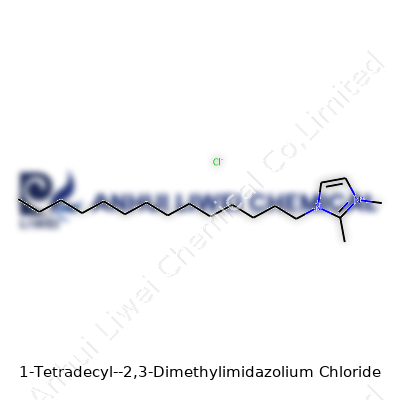
Chemical names usually look intimidating, but most tell a story. With 1-Tetradecyl-2,3-Dimethylimidazolium chloride, we find a mouthful, yet the message is straightforward: a long hydrocarbon tail linked to an imidazole ring with two methyl groups, coupled with chloride floating nearby as a counter-ion. To tall up its structure is to break down both its scientific value and the practical reality of designing molecules for jobs that no natural compound could attempt.
Why the Structure Matters
Cations in ionic liquids have shaped my understanding of green chemistry. 1-Tetradecyl-2,3-dimethylimidazolium chloride stands out since its imidazolium core handles everything from dissolving cellulose to speeding up reactions in organic chemistry. The long tetradecyl tail (14 carbons) adds bulk and nonpolarity, influencing how this molecule breaks apart in water or grabs oils. Fatty side chains of this length raise surface activity and even create antimicrobial action, which find homes in cleaning, synthesis, and even medicine.
How is the Structure Configured?
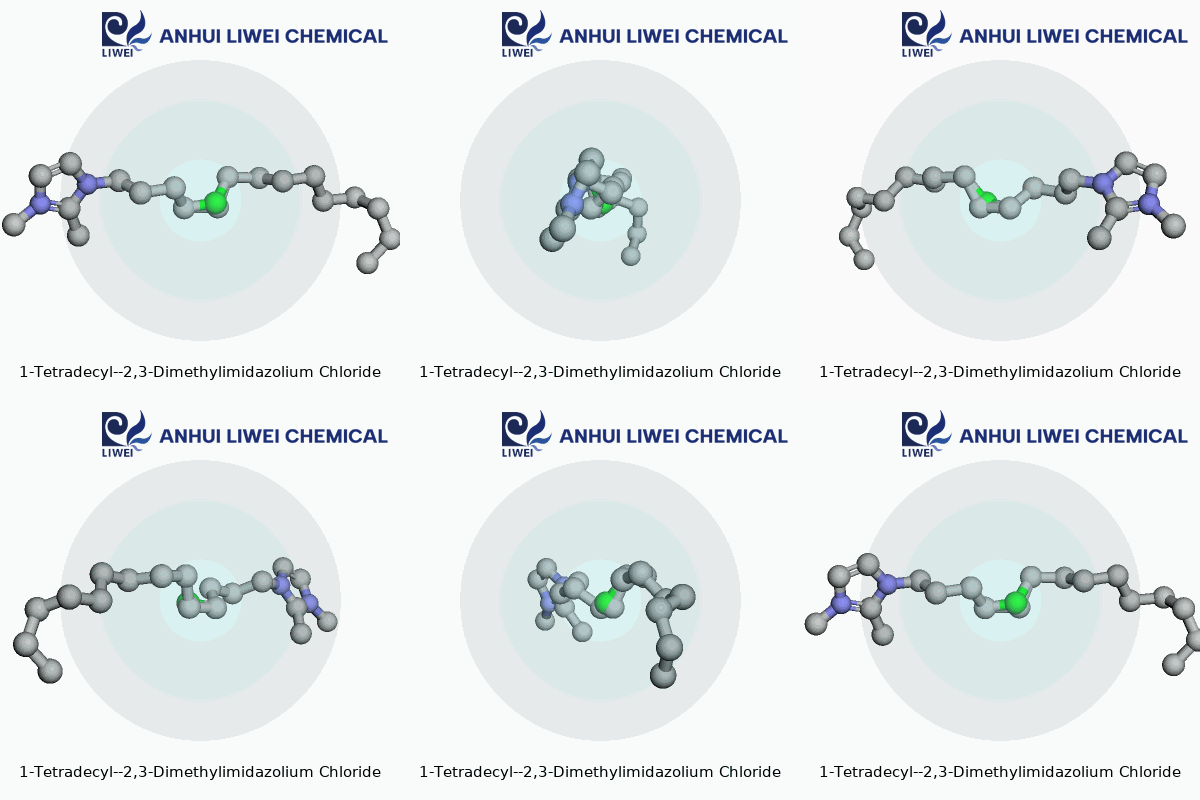
Picture the imidazolium ring as a five-membered chain in a pentagon. The 2 and 3 positions each hold a methyl group. One nitrogen (on position 1) links up with the tetradecyl (fourteen-carbon, straight-chain alkyl group). Altogether, this gives the cation a bulky, uneven look—one small ring, two fastened methyls, and a long greasy tail. Chloride sits next to the cation, but doesn’t get in the way.
Why Length and Substitution Change Everything
A long alkyl group on the imidazolium ring changes the whole character of the molecule. The molecule loses some tight friendships with water. I learned that shorter alkyl imidazoliums, like butyl or hexyl, love to dissolve in water and polar solvents. As the tail gets longer, the liquid forms micelle structures, grabbing oily dirt in water and giving this chemical surfactant qualities. Bulked up molecules like this handle organic reactions, clean up oil spills, and kill bacteria by pushing into their fatty cell membranes—things water alone would never do.
Potential Hazards and Road Maps
Long-tailed ionic liquids don’t degrade fast in the environment. Chloride versions often show up in water streams, posing toxicity risks for microorganisms around water cleaning plants. I take comfort in emerging studies suggesting new, more biodegradable alternatives can ease these issues. Adding functional groups that naturally decompose could change the game.
Paving the Path with Smarter Design
Chemists continue shaping molecules to both perform and respect the planet. In the world of imidazolium salts, tweaking the core or the tail drives chemical functionality. My studies highlight that the recipe doesn’t just affect chemistry—it shapes future habits and environmental impact. Molecules like 1-tetradecyl-2,3-dimethylimidazolium chloride work as reminders that one small change in structure can ripple through industries, from labs and production lines to nature itself.
Everyday Lab Work Puts Safety to the Test
Working with chemicals looks straightforward until a slip-up leaves you with stinging skin or worse. I’ve seen even seasoned lab folks cut corners, thinking they know the risks inside-out. That’s when the trouble starts. Let’s get real: hazardous compounds show no mercy, whether you’re new on the job or drawing a paycheck as a ten-year veteran.
Think Before You Touch: Personal Protection Isn’t Optional
Before grabbing a bottle, I always check the label—twice. The stuff that seems harmless turns out to be tricky. One time, a student I mentored got nitrite solution on his hands by skipping gloves, just because nobody else was using them. He itched for hours. Gloves may seem like overkill, but latex or nitrile stops a nasty rash, and thicker gloves shield against corrosives.
Eyes have no backup. I’ll never stop wearing splash goggles, even for “quick” transfers. A drop of phenol or acid in the eye can turn a normal day into a hospital trip. Face shields make sense with acids or alkalis that spatter. Comfortable goggles beat urgent care, every time.
Good Habits Beat Good Luck
Stories about mystery smells or hissing reactions haunt anyone who’s spent time in labs. Always work under a functioning fume hood. I worked on a floor that overlooked leaks for months—eventually some coworkers got dizzy headaches. Airflow does more than clear the air, it could keep your lungs working right.
Keep benches clean. Everyone has seen unlabeled beakers collecting dust. My own mistake was leaving a bottle of sodium hydride open, thinking I’d “get right back to it.” It caught moisture, fizzed, and could have started a fire. If every bottle carried a fresh label—substance, date, hazard—mistakes like that wouldn’t happen nearly as often.
Waste and Storage: Don’t Assume, Check the Chart
Hazardous chemicals don’t play well with others in the trash or down the drain. Years ago, an intern tried pouring old organic solvents into an acid waste jug. Bad move—released choking fumes before anyone could put the lid back on.
Every shop needs clear rules on waste. Flammable solvents need a steel disposal can. Strong acids and bases call for their own containers. Mixing chemicals risks chemical reactions that nobody wants to be around for.
Storing chemicals the right way prevents problems before they start. Oxidizers stay away from anything organic, acids away from cyanides or sulfides. I’ve heard of warehouses going up in flames from poor separation.
Training and Respect: Keys to Survival
The best gloves, goggles, and rules add up to nothing if nobody follows them. Labs benefit from a culture that treats caution as common sense. Frequent safety reviews and updated training let everyone catch up on what might have changed. Encourage folks to report near misses—everyone learns, nobody gets blamed.
Chemicals can maim or even kill, yet every rule above starts with respect for the risk. I handle compounds today the same way I did after my first scare: with clear eyes, clean hands, and a healthy dose of humility.
Diving Into the Nature of the Compound
1-Tetradecyl-2,3-dimethylimidazolium chloride doesn’t roll off the tongue, but its story matters for anyone invested in green chemistry, surfactant research, or ionic liquid development. Here’s what stands out: This compound has a long aliphatic chain, a hallmark of hydrophobicity, married to an imidazolium core, which brings clear ionic character. The chloride anion boosts polarity, too. These pieces come together to set the tone for how this salt behaves in solvents.
Water and 1-Tetradecyl-2,3-Dimethylimidazolium Chloride
Drop this ionic liquid in water and you’ll see that the story isn’t simple. The imidazolium core and chloride counterion push toward solubility, just like simple salts, but the lengthy tetradecyl (C14) tail resists. Research suggests similar long-chain imidazolium salts barely dissolve in water — think solubility in the range of a few milligrams per milliliter, and that’s being optimistic. Some users see cloudy suspensions at very modest concentrations (under 0.01 M), and any rise in concentration quickly brings on phase separation or self-assembly into micelles. These observations line up with the Handbooks: longer chains mean wedge-like amphiphilicity, so agitation only goes so far before phase behavior dominates.
What does this mean on a practical level? Forget about using this compound for jobs requiring homogeneous solutions in water beyond the lowest concentrations. Its partial solubility can be harnessed in surfactant science (making vesicles or micelles), but researchers often get frustrated when they try to scale up aqueous processes expecting ideal salt behavior.
Organic Solvents: A Different Picture
Move away from water, and things start to look different. That tail matters a lot more. In low-polarity solvents such as dichloromethane, chloroform, and toluene, the long alkyl chain grabs onto the nonpolar surroundings, and the compound dissolves well. Methanol and ethanol also support decent solubility — probably not surprising, as short-chain alcohols handle both polar and nonpolar groups. Reports from academic labs and SDS sheets back this up: you can often load grams of this material into 100 mL of dichloromethane with minimal effort.
Strongly polar aprotic solvents (e.g., acetonitrile, DMSO, DMF) work in a pinch, but the compound’s greasy tail still sets some limits. Solubility can drop if the ionic headgroup starts aggregating or if impurities tune the solvent’s microenvironment. In my own doctoral work, I’ve prepped samples using this compound and learned early: for NMR or extraction, nonpolar solvents clear things up much faster than endless sonication in water.
The Importance of Knowing Your Solubility
This might seem like dry detail on the surface, but the impacts reach into greener solvents, safer process design, and cleaner products. Many teams take shortcuts on solubility, guessing based on superficial similarities. That method wastes time and material. Mistakes here risk process failures and poorly characterized products.
Lab experience — and a close reading of the literature — makes a few things clear. For anyone developing ionic liquids or designer surfactants, running true solubility tests in target solvents right from the start avoids headaches later. Tools like turbidimetry, NMR, or simple visual inspection save days that could otherwise be lost to endless filtration and failed extractions.
Building Solutions That Last
Changing an imidazolium’s side chain seems minor, but performance and safety hinge on it. Tighter collaboration between synthetic chemists and process designers sharpens our understanding of these quirks, opening the door for cleaner reactions and more predictable formulations. Data-sharing and transparency between labs can fill gaps in published solubility tables, steering research down safer and more productive paths.
Beyond the Label: Real-World Storage Matters
Ask anyone who’s ever lost a pantry stash after a humid spell in summer, and they’ll tell you that storage isn’t just a technical piece of advice — it shapes the life of whatever product you’re trying to preserve. Many people glaze over storage instructions, but the details often decide if you’re getting your money’s worth or throwing it away after a few weeks.
Temperature: A Quiet Culprit
Most products spoil faster in heat — that’s not just grandma’s wisdom but a constant across thousands of studies. A tub of yogurt softens and sours at room temperature, and pharmaceutical tablets lose their punch when stored above 25°C. In my own kitchen, I’ve rescued chocolate bars from turning into a gooey mess by stashing them away before a heatwave hit. Keeping things below 25°C, or in the fridge if possible, extends the usable period by months for many goods and prevents expensive waste. For makers and sellers, keeping distribution trucks and warehouses cool isn’t an optional luxury. It’s a business survival tactic.
Humidity: The Silent Spoiler
Humidity plays an even trickier role. I’ve seen flour clump and coffee grow mold in damp cabinets. Excess moisture opens the door for bacteria and fungi to crash the party. Sometimes packaging claims to protect against moisture, but even the best sealing gets defeated if packages are left near sinks or in cellars. Dry, well-ventilated storage cupboards outperform fancy containers when it comes to actually keeping products crisp and fresh. Commercial players use dehumidifiers and desiccant packs for a reason. These tools should find a place at home too, especially for anyone living in humid climates.
Light: Not Just a Problem for Vampires
Some things, like medicines or oils, need darkness just as much as they need cool, dry places. Light triggers changes in compounds, leading to off smells or reduced potency. I’ve had friends complain about strange-tasting olive oil stored by a window. Pharmacies line their shelves with products in amber glass or foil packaging because exposure to sunlight or even bright fluorescent bulbs speeds up breakdown reactions. Store away from windows and harsh lights, and you’ll notice a difference over time in taste, smell, and effect.
Looking at Shelf Life Honestly
Labels give a “best before” or “expiry” date, but that’s based on test results under ideal conditions. A pack of tea stashed in a hot, muggy cupboard probably won’t taste as fresh as one kept in cool, dry darkness. My experience tracking medications for volunteer clinics backs this up — pills stored as recommended last their full shelf cycle and even longer, while boxes exposed to erratic conditions degrade early on. Shelf life predictions assume manufacturers and consumers actually follow instructions at every step, from the factory to the home pantry.
Practical Fixes That Pay Off
Improving storage habits doesn’t take much money, but the payoff shows up in less spoilage and better outcomes. Setting up a simple drawer organizer to keep pantry goods away from the stove, using opaque jars for light-sensitive items, and putting a cheap thermometer in the fridge all make a visible difference. In warehouses and retail, investing in climate control is not a marketing ploy — it’s about product value and safety. And at every link in the chain, sharing clear, plain-language advice makes it more likely people will protect what they buy.
At the end of the day, treating storage as an afterthought short-changes everyone: producers see complaints pile up, and consumers see their investment spoiled. Small changes in how we store things build big gains over time, in both dollars and peace of mind.