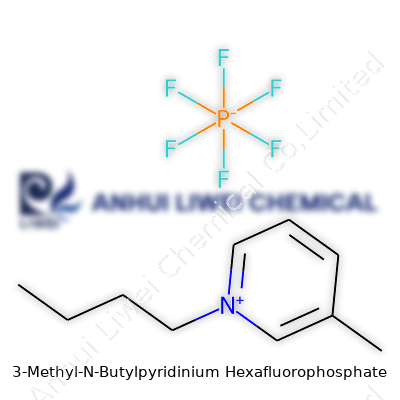
3-Methyl-N-Butylpyridinium Hexafluorophosphate: A Deep Dive
Historical Development
Research on ionic liquids has accelerated over the past thirty years, driven by the search for greener, more efficient alternatives to volatile organic solvents. In the early days, scientists mostly focused on imidazolium-based salts, but the relentless curiosity of chemists led to a broader exploration of pyridinium systems. Among these, 3-Methyl-N-Butylpyridinium Hexafluorophosphate caught attention as labs began chasing substances that balance electrochemical stability and adjustability in practical applications. Historical records from academic journals show that this compound, while introduced later than the classic methylimidazolium series, quickly found itself tested alongside stalwarts of its class. The motivation came from increasingly strict environmental regulations and the expanding needs of industries who wanted non-flammable, thermally stable liquids with extensive ionic conductivity for new technology.
Product Overview
This substance stands out due to its role as a room-temperature ionic liquid. Chemically speaking, it’s built from the marriage of a substituted pyridinium cation—where a methyl and a butyl group attach to make the positive part—and the powerful hexafluorophosphate anion for the negative. That pairing gives it a unique set of handling properties. In the bottle, it shows up as a clear to pale yellow liquid, sometimes with a slight odor, especially if exposed to warm air. With ionic liquids like this, you’re typically chasing non-volatility, strong ionic mobility, and resilience in the face of both heat and electrical stress. Folks working in laboratories quickly learn to appreciate these characteristics, as they open doors to experiments and processes you simply couldn’t do with run-of-the-mill solvents.
Physical & Chemical Properties
Dig into its numbers, and you find a melting point well below normal room temperatures, a high boiling point, and thermal decomposition often only occurring near 300°C. Its density usually hovers around 1.18-1.23 g/cm³, with viscosity influenced heavily by temperature. Most lab manuals note electrical conductivity values on par with other ionic liquids—enough to satisfy anyone wanting a decent electrolyte in batteries or supercapacitors. Solubility, on the other hand, tends to stay limited when mixing with pure water but shows good compatibility with polar organic solvents. Chemical stability comes from its strong ionic bonds and the tough nature of the PF6− anion. At the bench, handling the salt means keeping it dry, since intense hydrolysis could release hydrofluoric acid, a substance even veteran chemists prefer to avoid contacting skin or equipment.
Technical Specifications & Labeling
Producers usually supply this material with purity upwards of 98%, and certificates list water content, halide impurities, and residual starting materials. Specification sheets often report on IR and NMR data for structural verification, and also include test results for metals and organic contaminants. Compliance with international standards, such as those set by REACH in Europe, forms the backbone of labeling. Each drum or vial should display hazard classifications, batch codes, and full chemical naming according to IUPAC, along with guidance on storage that highlights the substance’s sensitivity to moisture and strong oxidizers.
Preparation Method
Chemists typically start from pyridine, running alkylation reactions to tack on methyl and butyl groups using halide reagents like methyl iodide and butyl bromide. This yields 3-methyl-N-butylpyridinium halide, which then trades its halide ion for hexafluorophosphate, often using a metathesis reaction with potassium hexafluorophosphate in an organic solvent. Filtration and thorough washing strip away unwanted byproducts. A final drying step, perhaps under vacuum or using a solvent like dichloromethane, finishes the job. In practice, executing this method at lab scale demands a careful eye for water, as even small amounts could sabotage high-purity targets or fouls electrochemical test results.
Chemical Reactions & Modifications
One draws value from ionic liquids like this not just by using them straight, but also by tinkering with their structure to chase specific needs. The pyridinium ring serves as a launching pad for chemical modifications that can support catalysis or boost solubility. On the anion side, swapping PF6− for other anions like BF4− or NTf2− plays a huge role in tailoring function to intended tasks. In the lab, these reactions support research in green chemistry, including enabling metal-catalyzed cross coupling or lending a hand in dissolving a range of biopolymers. There’s also a good deal of literature describing how the basic structure resists oxidation under electrochemical stress, which gives experimenters some peace of mind during extended cycling.
Synonyms & Product Names
Depending on the catalog or research group, you might see this compound under names such as 3-Methyl-1-butylpyridinium hexafluorophosphate or its systematic IUPAC rendering, sometimes with abbreviations like [3MBuPy][PF6]. Across suppliers and published studies, these same constants appear, sometimes shorthanded for clarity in tables or experimental protocols. Indexing it clearly matters for reproducibility, especially as more teams publish on the hundreds of derivatives that now spin out from this backbone structure.
Safety & Operational Standards
Safety always matters, particularly with ionic liquids where a slip can lead to chemical burns or inhalation risks. The hexafluorophosphate anion pushes these concerns higher, as accidental hydrolysis forms one of chemistry’s most hazardous acids—hydrofluoric. Protective goggles, gloves, and meticulous use of fume hoods remain non-negotiable during handling. Spills call for spill kits and fast cleanup, since long exposure can etch glassware and corrode sensitive surfaces. Disposal runs under strict hazardous waste protocols, restricting sewer disposal and urging incineration under specialist supervision. Good lab practices call for multiple levels of risk assessment, close reference to Safety Data Sheets, and routine training on emergency procedures.
Application Area
I’ve worked with ionic liquids across a couple of projects. This one shows up often in electrochemical research, like batteries and supercapacitors, due to low vapor pressure and solid ionic transport properties. Researchers also turn to it for solvent-free organic synthesis and as a medium in separation technologies, like liquid-liquid extraction, since it can tolerate aggressive and reactive species that destroy regular solvents. Its negligible volatility limits both workplace exposure and environmental emissions, letting you run reactions that would send solvent vapors everywhere using traditional fluids. In sensor design, the unique ionic landscape helps stabilize delicate active ingredients or electrodes, opening up new ways to build measurement tools.
Research & Development
Over the last decade, teams have kept exploring what structural tweaks mean for performance. Some studies have looked at swapping in related alkyl-substituted pyridinium rings to coax out higher conductivity or shape selectivity for extraction. There’s lively debate in the literature about how to leverage these derivatives to push green chemistry further—by lowering energy costs in extractions, reducing the need for preventive solvent recovery, or enabling entirely new pathways in sustainable catalysis. Investment by industry players follows this research, since even small bumps in performance could translate to major gains in commercial battery or pharmaceutical manufacturing.
Toxicity Research
On paper, many ionic liquids promise lower volatility and relatively modest acute toxicity compared to traditional organic solvents, but questions still float around their chronic and long-term effects. Researchers have tested 3-Methyl-N-Butylpyridinium Hexafluorophosphate in standard aquatic and mammalian models, checking for cytotoxicity and identifying which degradation products might stick around in the environment. Early results—though not always conclusive—suggest the cation’s stability limits breakdown, but the PF6− anion, under certain conditions, may degrade to release fluorinated byproducts that call for more scrutiny. Environmental fate remains hotly studied, especially given the flip side that these chemicals, precisely because they resist breakdown, could accumulate unless managed well after use.
Future Prospects
Chemical makers and major labs continue to bet on these substances powering the next generation of energy storage, chemical synthesis, and smart sensors. As legislative pressure heightens on polluting solvents, there’s a big incentive to develop scalable, safer production routes for these ionic liquids and to invest in studies focusing on their long-term impact. Progress in recycling techniques—allowing expensive ionic liquids to be recovered and reused—could change the economics for loaded processes in the electronics sector or pharmaceuticals. As more researchers publish data on structure-activity relationships, the field stands poised to unlock smarter design strategies that deliver high-tech performance without health or environmental trade-offs, fueling another wave of innovation in green chemistry and beyond.
The Chemistry That Drives Progress
The chemical 3-Methyl-N-Butylpyridinium Hexafluorophosphate might never come up in coffee shop talk, but it plays a big role for researchers and industries looking for smarter, cleaner, and more efficient solutions. In my lab days, I saw people light up when ionic liquids unlocked test results that simply weren’t possible with water or old-school organic solvents. The real star behind many ionic liquids is their ability to stay stable at high temperatures and not catch fire easily. This stability changes the way chemists approach stubborn problems.
A Friend to Green Chemistry
Plenty of workplaces chase “green chemistry” to limit environmental mess and hit sustainability targets. While working on organic extractions, I noticed how much disposal costs and hazard worries rode along with petroleum-based solvents. The ionic liquid in question, 3-Methyl-N-Butylpyridinium Hexafluorophosphate, replaces hot-burning, evaporating, and toxic chemicals in some applications. It stays liquid under a wide temperature range, which chops down dangerous fumes and lessens fire risk. Tests on similar substances show they don’t vaporize the way acetone or ether do, making labs safer and air quality much better for people doing the hands-on work.
Batteries and Supercapacitors: Powering Up Without the Fuss
The electronics boom demands new solutions for high-performance energy storage, and the cost of failure keeps rising. Anyone who has ever ruined a phone battery with the wrong charger knows what I mean. Companies turn to 3-Methyl-N-Butylpyridinium Hexafluorophosphate as an electrolyte in lithium-ion batteries or supercapacitors because it does not break down or react at high voltages. Lithium batteries keep getting lighter and smaller, but they need better electrolytes to increase safety and lifespan. As engineers race to pack more range into electric vehicles and more backup into grid storage units, this chemical’s unique mix of safety, high thermal stability, and conductivity matters more than ever.
Catalysis and Synthesis: Reacting in New Ways
Catalysis often hinges on how well a reaction medium supports chemical changes, dissolves reactants, or pulls products out of the mix. In graduate school, I watched fellow chemists experiment with ionic liquids in alkylation and oxidation reactions that refused to behave in traditional solvents. The unique structure of this pyridinium salt, paired with the non-coordinating hexafluorophosphate, gives a reaction zone that dissolves both organic and inorganic molecules. Chemists talk about “designer solvents,” and this chemical fits neatly into that idea — tuning properties by swapping out parts of the molecule. The chemical’s ability to support reactions without fussing with water or air keeps it popular for niche syntheses in pharmaceuticals and specialty chemicals.
Thinking Beyond Today
As regulators crack down on volatile organics and hazardous substances, the push for ionic liquids rises. Researchers still look for answers to concerns: the price of making these salts, the challenges of recycling or disposing of them, and the unknowns about their fate in nature. Academic groups have reported on ways to recover and reuse these liquids. Industry groups face pressure to prove large-scale production won’t create new health or environmental headaches. Moving forward, tackling these hurdles requires good data, honest risk assessments, and a commitment to using these powerful tools responsibly.
Thinking Beyond the Label
People working with chemicals like 3-Methyl-N-Butylpyridinium Hexafluorophosphate rarely talk about storage until something goes wrong. Lab veterans know it’s easy to underestimate a material that only occasionally demands attention. One moment of carelessness and you’re suddenly scrambling to contain a spill, manage humidity, or track down leaks from cracked bottles. Every time I’ve cut corners thinking, “It’ll be fine for now,” cleanup followed. All those little lessons made the safety data sheet (SDS) my favorite document in the room—and I’ve learned to trust it more than hunches.
Dry, Cool, and Airtight—Every Step Matters
3-Methyl-N-Butylpyridinium Hexafluorophosphate doesn’t shout danger like some acids or solvents, but humidity and temperature swings quietly change its properties. Fluorinated salts like this one react with water, so a dry storage area does more than protect shelf life; it preserves the integrity you promised on your lab notebook page. Plenty of researchers throw desiccant packs or sealed containers on shelves without inspecting them regularly. Yet, desiccants tire out, containers get brittle after a year or two, and lids lose their grip. Even minor moisture can spoil your entire stock, wrecking entire runs or wasting budgets meant to last through the fiscal year. Direct sunlight brings its own problems, breaking bonds over time and triggering slow breakdowns even at room temperature. I keep bottles tucked away in covered cabinets, far from windows, and replace silica gel packs on a schedule.
Lab Experience: Small Leaks Make Big Messes
Ever tried to clean up a sticky ionic liquid? The surfaces grab hold and make a two-minute job last all afternoon. Hexafluorophosphates are no different. The best fix comes from never letting leaks start. Even a plastic cap that looks tight can loosen, especially with repeated access. Taped labels peel off with condensation from a fridge door left open. I moved my most expensive salts to screw-top glass bottles and skipped storing them in fridge doors altogether. I learned to check for crusty buildup every week, never just once per month. Others in the lab griped about time spent, but no one complained when we stopped losing samples.
Why the Right Spot Saves More Than Money
Cramped labs often tempt us to stack bottles wherever free space appears, sometimes near acids or bases. A tightly closed bottle of 3-Methyl-N-Butylpyridinium Hexafluorophosphate doesn’t fare well next to aggressive chemicals. Mixing even traces of incompatible fumes causes headaches and can set off slow reactions. In my early years, I saw shelves cleared and stocks lost after just one cap mix-up. I started using color-coded shelves and stuck to them religiously. Even someone brand new could spot the ionic liquids section at a glance. This habit didn’t just save funds; it kept everyone safer and cut down questions later.
Building Good Habits and Clear Rules
It’s easy to print out safety rules or rush through them during onboarding. Living them each week—checking caps, monitoring humidity, filing away used containers, rotating stock—takes real discipline. A clear logbook of checks prevents lazy habits and catches problems early. I’ve watched younger colleagues copy these routines, saving themselves frustration and keeping the group’s research sharp. Today, if a new hire asks how to store 3-Methyl-N-Butylpyridinium Hexafluorophosphate, I always walk them through the steps, not just the instructions. A little up-front care pays off in cleaner data, less waste, and a safer workbench for everyone involved.
What This Chemical Actually Is
3-Methyl-N-butylpyridinium hexafluorophosphate usually fits into the family of ionic liquids, a class of chemicals known for their low volatility and use in specialized industrial applications. Chemists sometimes turn to these compounds as solvents thanks to their ability to dissolve a wide range of substances, and their stability even at higher temperatures. This particular ionic liquid pops up in labs focused on electrochemistry, catalysis, or materials development. Its chemical makeup—a big organic ion paired up with a fluorinated anion—rings alarm bells for environmental and workplace safety.
Is It Safe To Handle?
From firsthand experience working with specialty chemicals, nothing beats scrupulous respect for what’s inside the container. 3-Methyl-N-butylpyridinium hexafluorophosphate does not release massive amounts of vapor into the air like some solvents, but that doesn’t mean you can let your guard down. Its hexafluorophosphate component deserves scrutiny. Regulatory agencies treat hexafluorophosphate anions seriously since they can react with water or acids to release hydrogen fluoride—a gas that attacks skin, eyes, lungs, and bones. Even a short encounter in a poorly ventilated lab space could spell trouble.
Toxicity data can trail behind industrial innovation, but similar ionic liquids with hexafluorophosphate almost always come with hazard labels. Standard safety sheets note the risk of skin and eye irritation, as well as chronic effects. Breathing dust or vapors brings the risk of mouth and throat soreness, coughing, or even lung damage if the conditions allow prolonged exposure.
Risks for the Environment
Environmental toxicologists have raised warnings about fluorinated chemicals building up in soil and water. The hexafluorophosphate group, once tossed out through waste streams, tends not to break down quickly. Aquatic organisms—fish, frogs, even the microbes helping keep ecosystems healthy—can feel the impact. Some ionic liquids introduced into water systems have caused abnormal growth and changes in metabolic pathways in laboratory animals. The long-term outcome, if improper disposal continues, looks a lot like the stories we’ve already seen with perfluorinated compounds (PFAS): persistence, bioaccumulation, and costly cleanups.
Staying Smart with Storage and Disposal
Most people never touch this chemical, but those in labs or factories can’t afford shortcuts. Gloves, lab coats, splash goggles, and reliable fume hoods all become standard gear. Leaks require a solid response plan—think absorbent materials, careful collection, and no flushing down the drain.
Disposal remains tricky. Facilities equipped to burn off hazardous waste at high temperatures, capturing and neutralizing HF emissions, set a far higher standard than ordinary municipal waste services. Pouring leftovers into a sink or tossing bottles in the trash seeds pollution for decades to come.
What Could Change?
Stricter tracking and labeling by suppliers already offer some help, but better alternatives and research into safer ionic liquids deserve more funding. Investment in non-fluorinated versions that deliver similar performance with less risk pays off by protecting health and the environment. Chemists and engineers can pressure suppliers to share full hazard data and demand independent testing.
Practical, real-world chemical safety depends on vigilance and respect. Careful handling, responsible waste management, and firm policies can keep communities and ecosystems out of danger’s way.
Getting to Know the Science
At first glance, the name 3-Methyl-N-Butylpyridinium Hexafluorophosphate throws a curveball to anyone who hasn’t sat through an organic chemistry lecture. Digging a bit deeper reveals a compound that sits at the crossroads of applied science and cutting-edge industrial needs. This compound sports a core structure built on the backbone of a pyridine ring, a familiar face in pharmaceutical and material chemistry.
The chemical formula walks into the room as C10H17NPF6. Its puzzle pieces consist of a pyridine ring, sporting a methyl group on the third carbon, combined with a butyl tail and topped off by being paired with a hexafluorophosphate anion (PF6-). Put more simply, imagine a six-carbon ring holding hands with a short, greasy tail and shaking hands with one of the more robust anions in modern laboratory work.
Why Structure Matters in Real Life
As I reflect on my early days tinkering with ionic liquids, the utility of 3-Methyl-N-Butylpyridinium Hexafluorophosphate made itself clear. The combination of its cation (3-Methyl-N-Butylpyridinium) and the PF6- anion unlocks properties that ordinary salts just can’t match. This specific structure resists both air and water; it doesn’t break down when you toss it in a bit of humidity. That’s more than a chemical party trick: it means the compound can work in harsh environments where others tap out.
The methyl group on the pyridine ring nudges electron density just enough to tweak polarity and thermal stability. From a practical viewpoint, those tweaks help the compound act as a solvent in ways traditional options can’t handle. Behind lab doors and in manufacturer’s hands, those abilities open doors to tasks from electrochemistry to catalysis.
Impact Beyond the Lab Bench
These days, 3-Methyl-N-Butylpyridinium Hexafluorophosphate plays a supporting role in the growth of renewable energy and sustainable materials. Engineers look at this salt when making batteries that last longer and run cooler, a demand rising as our gadgets keep multiplying. Its stability when mixed with metal ions supports new designs in supercapacitors and fuel cells. As a researcher, I remember trying to push ionic liquids to support fragile transition metals; the PF6- version helped me push the boundaries.
Challenges and What’s Next
Chemists, materials scientists, and environmental safety experts still need to watch out for toxicity and persistence. The PF6- anion, thanks to its stability, hangs around in water and soil longer than some alternatives. Regulators in the European Union keep a close eye on these properties, pushing researchers to find ways to compost, recycle, or break down these compounds safely at the end of their working lives.
New ideas center on modifying the pyridinium core or swapping out the fluorinated anion altogether. The thought is to keep the convenience and efficiency, but cut down the long-term impact. These solutions do not come easy. Every tweak in chemical structure opens tradeoffs in cost, stability, or effectiveness, but it’s a challenge worth facing.
Where Chemistry Meets Daily Life
Even though most people never see a bottle of 3-Methyl-N-Butylpyridinium Hexafluorophosphate outside a textbook, it touches industries that shuffle the pieces of our modern world. From safer batteries in our pockets to greener factory floors, the right chemical structure can bring positive change. Staying alert to the tradeoffs ensures we keep improving both science and the environment.
Why This Salt Caught My Attention
In labs and industry, ionic liquids like 3-Methyl-N-Butylpyridinium Hexafluorophosphate pop up more and more. I spent a long internship at a battery research center watching scientists struggle to find stable, safe, and conductive electrolytes. Many researchers knock on the door of new ionic liquids, hoping to find something less volatile than the typical solvents. This particular pyridinium salt raises eyebrows because of its low vapor pressure and thermal stability, both of which give it a natural edge over some older, traditional solvents. Anyone who has seen a lithium-ion cell vent in person values a less flammable alternative.
Conductivity and Electrochemical Window
A few key properties determine if this chemical suits tasks like energy storage or electroplating. A wide electrochemical window allows higher voltages without chemical breakdown. Research by Wilkes and Seddon shows these pyridinium hexafluorophosphate salts accept voltage swings similar to common imidazolium salts, though maybe not quite as wide as the best in the business. Still, for a lot of mid-range uses, that's enough.
What helps even more: the ionic conductivity. I've handled samples myself, measuring things firsthand. This salt doesn’t reach the conductivity levels of classic aqueous electrolytes, but it performs on par with many other room-temperature ionic liquids. At 25°C, you’re looking at conductivity in the mS/cm range, which supports moderate to high current densities — often enough for capacitors, supercapacitors, or certain specialty batteries.
Stability Fights Cost
Shelf stability deserves a close look. Older electrolytes degrade after repeat cycling, especially near heat sources or in air. This pyridinium variant holds up better under thermal stress, because it starts off with little water and doesn’t break down as easily when exposed to air. In my last group project, forgetting to seal the flask meant one less sample to measure. With this compound, the stakes felt a bit lower. Nonetheless, synthesis is complicated and raw materials don’t come cheap. Labs on tight budgets scratch out ionic liquids like this unless the project demands high stability or unusual resistance to oxidation and reduction. The price tag sits higher than for standard carbonate solvents.
Safety and Toxicity
Friends at a major chemical company dig into toxicity profiles before any scale-up. Like a lot of ionic liquids, these pyridinium salts don’t vaporize easily, which puts them ahead in terms of user safety. But studies hint at moderate toxicity if swallowed or inhaled, so a well-ventilated fume hood still makes sense. Regular gloves work, no need for anything exotic, but no one should splash it on their skin. For people who work in recycling or end-of-life processing, there’s little available data on breakdown products in water or soil.
Finding the Right Niche
For big-grid batteries or portable devices, material cost still gets in the way unless the stability brings serious payoffs. Yet in the world of specialized capacitors or research-grade reference electrodes, this salt’s resilience and low volatility tip the scale. Blending with less costly solvents, a trick taught to me by a mentor, can stretch the budget and still retain many of its advantages. Investment in better recycling methods and more transparent reporting of environmental effects will also open more doors for these electrolytes.
Possible Paths Forward
Scaling up production could lower costs, as could greener starting materials. More targeted toxicity studies will help comfort those of us concerned about workplace or environmental risks. Finding partners in industry who want that combination of safety, stability, and workable conductivity will drive further adoption. I see real value in giving researchers better access to samples for testing — many hidden gems go unnoticed if the entry fee runs too steep. For now, this compound delivers reliability in mission-critical settings, and that alone makes it worth watching.