4-Methyl-N-Hexylpyridinium Bromide: An In-Depth Look
Historical Development
Chemists have spent decades searching for ionic liquids with tunable properties, and 4-Methyl-N-Hexylpyridinium Bromide stands out in the broader field of pyridinium-based salts. Researchers originally explored these materials for their conductivity, low volatility, and versatility in solvation. I remember flipping through journals tracing the emergence of ionic liquids in the 1980s, with groups quickly moving from simple imidazolium and pyridinium cations into more functionalized alkyl derivatives. The addition of substituents, especially methyl at the 4-position and hexyl on the nitrogen, directly responded to the need for better solubility and lower melting points. More recent years brought a surge in interest for their applications, especially in electrochemical devices and catalysis. Chemists found 4-methyl-N-hexylpyridinium's flexible structure made it a candidate for a range of experimental tasks, pulling it from the pages of small-scale synthesis notes into industrial design conversations.
Product Overview
4-Methyl-N-Hexylpyridinium Bromide belongs to the family of quaternary ammonium salts and forms colorless to pale yellow solids under standard conditions. The focus of current demand goes well beyond traditional roles. In the laboratory, its reputation revolves around its dual hydrophobic and hydrophilic regions—this compound dissolves in polar solvents but also brings significant organic character to the table, making it valuable for separating phases, stabilizing unusual intermediates, or acting as a conductive medium in batteries. Industries involved in green chemistry continue to explore this compound as an alternative to traditional organic solvents, thanks to its low volatility and reduced environmental footprint.
Physical & Chemical Properties
Ionic liquids like 4-Methyl-N-Hexylpyridinium Bromide don't follow all the same rules as more common organic salts. Its melting point usually lands well below 100°C, sometimes even lower depending on water content. Viscosity changes dramatically with temperature. The bromide anion stabilizes the pyridinium ring, and the compound doesn't evaporate easily under ordinary lab conditions. In terms of solubility, this compound mixes well with water and many polar organic solvents—a rare find for salts with long alkyl chains, as these often drift into paraffin territory and lose solubility. It resists decomposition at reasonable temperatures, with a decomposition threshold that makes it suitable for many synthesis protocols. The hexyl group gives the salt a slight waxy texture, especially near room temperature.
Technical Specifications & Labeling
Manufacturers label 4-Methyl-N-Hexylpyridinium Bromide using its CAS number for global consistency, but technical sheets focus more on purity, water content, and color. Typical material meets purity standards above 98%, with trace bromide and alkyl impurities monitored closely due to their impact on downstream applications. The salt usually ships in sealed glass or HDPE bottles, well-labeled for moisture sensitivity, and provided with certificates of analysis showing batch results for IR, NMR, and sometimes mass spectrometry. The product label also denotes melting point, boiling avoidance instructions, and handling recommendations drawn from real-world lab observations, including the tendency to clump if exposed to air for extended periods.
Preparation Method
Synthesis starts with pyridine, which undergoes methylation at the 4-position—typically performed with methyl iodide or dimethyl sulfate using a strong base. Alkylation at the nitrogen, usually with 1-bromohexane or hexyl bromide, follows under reflux in anhydrous conditions. After purification, the crude salt is washed, recrystallized from alcohol or acetone, and dried under vacuum. Yields generally run above 80%, although even small impurities can shift the melting range. My own lab experience showed that precise control over reagent addition rate, solvent dryness, and post-synthesis washing made the difference between a sticky, off-color product and a bright, manageable crystalline solid. Scale-up shifts the balance between efficiency and purity, as excess bromide or over-alkylation can require additional purification steps.
Chemical Reactions & Modifications
4-Methyl-N-Hexylpyridinium Bromide has a flexible chemistry due to its active pyridinium ring and the attached alkyl groups. Its cation can undergo various nucleophilic substitutions when exposed to strong bases or under phase transfer conditions, allowing modifications for specialized ionic liquids or surfactants. Electrode modification using this salt as a conducting additive has attracted attention, particularly in electrochemical sensors. The cation enables selective extraction of target ions from mixed solutions when paired with certain anions. Halide metathesis can convert the bromide to other anion forms, such as tetrafluoroborate or bis(trifluoromethylsulfonyl)imide, to modify physical properties without altering the active cation core.
Synonyms & Product Names
In the chemical marketplace, this compound goes by several names: 4-Methyl-1-hexylpyridinium bromide, 1-Hexyl-4-methylpyridinium bromide, and N-Hexyl-4-methylpyridinium bromide are commonly used. Some suppliers label it with proprietary codes, reflecting their cataloging systems. Knowing the synonyms makes it easier to cross-reference safety data and technical specifications, since regional naming conventions can shift from supplier to supplier. Genuine clarity in communication improves compliance with shipping, storage, and regulatory restrictions.
Safety & Operational Standards
Handling 4-Methyl-N-Hexylpyridinium Bromide calls for gloves, eye protection, and well-ventilated areas due to potential skin and respiratory irritation. The salt doesn't form flammable vapors at room temperature, but dust or fine powders can irritate mucous membranes and lungs. Most labs treat ionic liquids like this with routine chemical hygiene plans—waste disposal follows local regulations for brominated organics, with emphasis on waste separation. Emergency procedures stress thorough rinsing if contact occurs, and regular cleaning of spill areas with alcohol or detergent solutions. Operators record batch usage due to the cost and, in some jurisdictions, the regulatory scrutiny associated with brominated chemicals.
Application Area
Recent developments push 4-Methyl-N-Hexylpyridinium Bromide into the spotlight for energy storage, catalysis, and phase transfer reactions. My colleagues in battery research appreciate the high ionic mobility this salt provides, especially for lithium and sodium transport applications. Separation science groups use its tunable solubility to adjust phase behavior in extraction protocols—pharmaceutical research benefits here since minor changes in medium shift yields and selectivity. As a catalyst medium, it stabilizes reactive intermediates during cross-coupling or alkylation, leading to improved yields and fewer byproducts. Environmental labs consider these salts for replacing volatile organic solvents, reducing air emissions and workplace exposure risks. Even enzyme stabilization in biotechnology makes use of this compound, where traditional solvents denature proteins too quickly for reliable analysis.
Research & Development
Core research continues to dig into the electrochemical properties of pyridinium salts, especially the balance between conductivity and viscosity. One project I followed took on the challenge of improving cycling stability in rechargeable batteries—modifying the alkyl chain length led directly to jumps in performance. Synthetic chemists explore new derivatives aimed at lowering the cost or environmental footprint of production, targeting renewable feedstocks and greener alkylation methods. Analytical chemistry teams regularly update data on ion-pair selectivity and solvent compatibility, finding new niches in chromatography and microextraction. Intellectual property around novel uses expands every year, with patents issued for combinations in drug delivery, fuel cell electrolytes, and next-generation lubricants. Open questions linger around scalability and consistency in manufacturing, plus integration with fast-moving regulatory standards for workplace safety and ecological impact.
Toxicity Research
Toxicology information points to moderate acute toxicity, especially on the skin and eyes if exposure isn't managed. Long-term studies in aquatic environments raise concerns about persistence since quaternary ammonium salt structures show resistance to biodegradation. One environmental chemistry project I reviewed dug into bioaccumulation potential—while not as hazardous as some older organic solvents, persistence still calls for careful waste management. Occupational exposure guidelines recommend diligent use of personal protective equipment and engineering controls. Many labs test ionic liquids for mutagenesis, reproductive toxicity, and long-term chronic effects, aiming to inform both regulatory agencies and designers of new molecules. Data remains more limited than older solvents due to the compound's relatively recent commercial adoption, but ongoing research promises clearer guidelines as more labs share their findings.
Future Prospects
The next generation of ionic liquids will likely spring from the lessons learned with compounds like 4-Methyl-N-Hexylpyridinium Bromide. Green chemistry advocates push the development of more biodegradable derivatives, combining environmental consciousness with the exceptional solvent properties observed here. Battery and electrochemistry industries look for formulations that pair stability with rapid ion transport, driving efforts to tweak the electronic environment around the pyridinium ring. Regulatory agencies increasingly shape the conversation—approval in pharmaceuticals or large-scale environmental use shifts the research path for the whole class of compounds. Materials scientists hope for integration with polymers and solid-state devices. Funding agencies encourage collaborative projects between academia and industry to solve the challenges of scale, safety, and environmental compatibility. The growing toolbox of pyridinium salts promises more diversity and usefulness, especially as real-world applications highlight both the strengths and weaknesses of this chemistry.
Everyday Chemistry in Action
Staring down a chemical name like 4-Methyl-N-Hexylpyridinium Bromide feels intimidating, yet it says a lot about how science shapes lives, often out of plain sight. This compound doesn’t show up in mainstream conversation. Still, its footprint stretches across labs and production floors that touch the stuff folks rely on every day.
Lab Workhorse in Ionic Liquids
People inside research labs talk about ionic liquids, not because they’re trendy, but because these liquids do things ordinary water or alcohol won’t. 4-Methyl-N-Hexylpyridinium Bromide turns up here, bringing heat stability and non-flammable behavior. It handles tasks in synthesis and extraction that trip up more familiar solvents. When you put together a reaction that needs to push past what typical liquids can manage—stronger, hotter, or safer—this chemical shows its worth. I’ve seen chemists celebrate the way it helps separate out stuff that clings hard to a solution, especially from biomass or rare earth metals. Extraction grows more efficient and often cleaner, with less mess for the environment.
Antimicrobial Insights Worth Watching
On the medical front, the world doesn’t stop searching for answers to germs shrugging off antibiotics. Some pyridinium salts—4-Methyl-N-Hexylpyridinium Bromide belongs here—have drawn attention as possible antimicrobial agents. Test tubes in university science buildings hint at new coatings and cleaners built from it. One research group found benefits in fighting bacteria on hospital surfaces. People in these spaces count on every edge they get against infection, so hearing about a chemical that throws another obstacle in the path of hospital-acquired bugs means hope. It’s not a cure-all, but it brings a fighting chance against those persistent germs that crowd news reports every winter.
Supporting Greener Chemistry
Sustainability matters more with every year. Ionic liquids like this bromide promise less waste and less need for volatile organic solvents, which means cleaner air and safer workplaces. Factories and startups bend over backward to reuse materials and cut down hazardous byproducts. The bromide’s stability and chemical versatility give companies room to tweak processes for corners where greener options felt out of reach. As I watched a team switch an old cleaning step for something based on pyridinium, their hazardous waste went down, and cleanup bills shrank. It’s not a silver bullet, but it’s a step—one repeatable across industries chasing a smaller environmental footprint.
What Comes Next?
While the industries working with 4-Methyl-N-Hexylpyridinium Bromide look promising, there’s room to push further. Longer trials on human health and downstream ecological impact still need honest attention, not just from scientists, but from regulators and manufacturers. For researchers, the compound answers real technical questions and brings momentum to projects that blend modern chemistry with practical realities. Between saving time in extraction, killing harmful microbes before they cause trouble, and moving machines away from polluting solvents, it’s easy to see why this compound catches the eye. The basics matter, and a chemical like this—easy to write off as just another entry in a catalog—proves how science at its best can build better days from the ground up.
Why People Need to Take It Seriously
Every chemical tells a different story when it comes through the lab. Some smell, some stain, some sting. 4-Methyl-N-Hexylpyridinium Bromide doesn’t make a showy entrance, but it demands respect. You want to avoid it touching your skin or getting in your eyes. Ionic liquids like this one don’t always give clear warnings — sometimes the results show up later. The MSDS points out its irritant qualities and risks if inhaled or swallowed. Handling it sloppily leads to rashes or, worse, accidents that hurt your lungs or eyes. Nobody wants a trip to the ER just because protective goggles felt uncomfortable.
Personal Experiences with Chemical Safety
On my first day working with unknown compounds, I saw a colleague get a splash across their wrist. They followed the protocol — straight to the eyewash and safety shower. Two weeks in, the rash cleared up, but safety habits stuck around for the rest of my training. It only takes a single careless move to turn a smooth experiment into paperwork and an incident report.
Wearing gloves may seem obvious, but people often forget about checking for pinholes or picking the wrong material. Nitrile or neoprene gloves stand up better against chemicals like pyridinium bromides. I’ve witnessed students grab bare glassware without thinking. There’s always temptation to take shortcuts or reuse gloves “just one more time.” Those decisions add up to risk.
What Fact-Based Safety Looks Like
Lab safety isn’t just common sense — it’s science-backed. According to peer-reviewed literature and regulatory agencies, respiratory exposure to pyridinium salts can irritate your airway. Engineering controls count more than any lab rule. Fume hoods actually move fumes away from your nose and eyes. It bothers me seeing researchers lean halfway out and still try to weigh powders. All it takes is a minor spill and they start coughing. The Occupational Safety and Health Administration (OSHA) and National Institute for Occupational Safety and Health (NIOSH) both recommend minimizing dust and vapors for chemicals in this class.
Lab coats, gloves, splash-proof goggles, and closed-toed shoes aren’t negotiable. Good labs make eyewash stations and safety showers easily accessible. The label isn’t just a sticker — it’s the fastest way to save a life if someone gets exposed or spills something. That’s why I check the chemical label before opening any container, even if I think I know what’s inside.
Practical Steps to Keep People Safe
Nobody’s perfect, but habits help. I always make sure I have enough workspace clear of clutter before starting. Once I’m done handling powders or liquids, I clean up right away. Hazardous waste bins are there for a reason — no way should 4-Methyl-N-Hexylpyridinium Bromide ever go down the sink or in regular trash. Good ventilation, real-time monitoring of air quality, and well-posted emergency procedures raise the overall safety bar.
Training makes a big difference. In my experience, scientists who ask questions about safe handling usually make fewer mistakes. Real learning happens when people share near-misses, not just official incidents. Creating that sharing culture feels more important than posting warning signs. Safe handling isn’t just about preventing burns or rashes now — it protects your teammates and the environment.
Looking Forward
Science keeps pushing boundaries, but we all need to stay grounded in safety. 4-Methyl-N-Hexylpyridinium Bromide might not sound scary, yet it deserves focus and routine respect. If a lab earns a reputation for safe handling, it keeps everyone coming home whole. That’s what counts.
Getting to Know the Compound
Chemistry often feels out of reach for those who don’t spend every day in a lab. Some folks see a chemical name and want to run for the hills. 4-Methyl-N-hexylpyridinium bromide might sound like a hard case at first, but its makeup has a logic that tells a story.
Breaking Down the Name
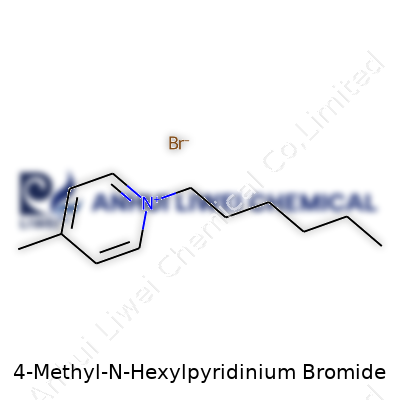
Start with the pyridinium part. Pyridine forms the backbone—a six-membered ring containing five carbons and one nitrogen atom. Scientists often refer to this nitrogen as position one. At position four, there’s a methyl group—just a single carbon with three hydrogens, tacked onto the ring. That’s where the “4-methyl” comes into play. On the nitrogen, there’s a hexyl group. That’s a straight six-carbon chain (C6H13). This extra chain turns the nitrogen into a positively charged center, making the molecule a pyridinium ion. The story does not end there; a bromide anion balances the charge, sticking close by in the finished salt.
Chemical Formula and Structure
The molecular formula ties these pieces together: C12H20BrN. The breakdown goes like this—nine from pyridine and methyl (C6H4–CH3), six more from hexyl (C6H13), plus a nitrogen (N) and a bromine (Br) tag along. All the parts work together in one piece.
Draw it out, and you’ll see a pyridine ring, a methyl group at the fourth spot, hexyl attached to the nitrogen, and a bromide hanging off as the counterion, keeping everything neutral in the grand scheme.
Why the Structure Matters in Practice
Beyond the textbook, chemical structure affects everything about how a compound behaves. My own time in the lab reinforced this lesson. Swapping one chain for another can take a mild-mannered salt and turn it into a potent chemical tool. In 4-methyl-N-hexylpyridinium bromide, the long hexyl chain gives the molecule a foot in both aqueous and organic worlds. I have seen similar pyridinium salts pop up in projects from ionic liquids to antimicrobial coatings.
Pyridinium salts show up in countless applications, from acting as phase-transfer catalysts—helping chemicals mingle between water and oil, to providing a base structure for ionic liquids used in green chemistry. The presence of the methyl group fine-tunes how the molecule interacts with its neighbors. What looks like a simple switch brings real-world change. People in chemical manufacturing appreciate how tweaking these groups leads to a finely tuned balance between solubility and activity.
Putting Safety First
With a bromide attached, there’s always a question about toxicity. Researchers spend a lot of time checking whether a salt like this could cause any harm to those working with it or to the environment. I always found it best to consult published safety sheets and consult trusted chemical databases. Responsible handling requires gloves, eye protection, and good ventilation, no matter how friendly the molecule might seem on paper. This approach saves headaches and builds trust, especially when the compound leaves the confines of the lab for industrial use.
Moving Forward with Knowledge
The formula and structure of 4-methyl-N-hexylpyridinium bromide only tell half the story. How people use and handle it depends on care, experience, and a willingness to look beyond the name. For those eager to explore new reactions, understanding the structure gives you a leg up. For companies scaling up production, the details matter to ensure safe, responsible, and effective use. That kind of understanding keeps progress moving, one well-characterized salt at a time.
Getting Storage Right Starts with Respect for the Substance
Many folks see chemicals only as bottles on a shelf, but every bottle tells a story about safety, good habits, and a responsibility to others. 4-Methyl-N-Hexylpyridinium Bromide isn’t a household name, but it shows up in research and specialty manufacturing. Every time I handle chemicals like this, I remember times I’ve seen someone ignore a small rule—just a missed label or a jar left a little loose—and realize those shortcuts create real problems.
Environment Dictates Performance — and Risk
If you want this chemical to stay stable and safe, you can’t just stick it anywhere. Store it in cool, dry places, away from direct sunlight. Heat always nudges more volatile reactions and can speed up decomposition. Desk drawers near radiators or windows rarely stay cool, and what seems like a quick temporary fix can snowball. A temperature-controlled storage cabinet beats general shelving, hands down.
One thing I’ve learned working in labs: humidity will sneak up on you. Shelves near sinks or in rooms without good airflow invite moisture, and plenty of complex organics react badly to even a little dampness. For 4-Methyl-N-Hexylpyridinium Bromide, sealed containers with well-fitting caps stop vapor travel and water vapor from getting in. I check seals before I grab a jar, not after.
Contamination Wastes Money and Compromises Safety
I can’t count how many times a chemical batch turned useless due to poor separation. Stack similar chemicals too close, powder lids get mixed, a single reckless scoop can cause cross-contamination. Separate storage by hazard class and by the likelihood of inertness. If I walk into a storeroom and see acids on the same shelf as organic bases, alarm bells go off. I apply the same logic to 4-Methyl-N-Hexylpyridinium Bromide: find a home just for it, not in a jumble of incompatible containers.
Labels should do more than name the chemical. Each bottle in our lab gets a storage date, safety symbols, and emergency procedures right on the label. Over time, memory fades, but the label keeps risks fresh. If you’re transferring chemicals to secondary containers, write all that info on the new bottle too. That’s not busywork—it’s a basic for both safety and reliable research data.
Good Ventilation Prevents Build-Up
Just because a chemical doesn’t have a smell doesn’t mean it’s safe to leave out. Some compounds produce invisible fumes or dust. I’ve seen storage cabinets with poor ventilation stain the inside or coat everything in residue. Well-ventilated, lockable cabinets lessen both personal risk and insurance headaches. If you use shared facilities, post up storage procedures to keep everyone honest.
Training Remains Non-Negotiable
Most chemical accidents start with someone who didn’t know or didn’t care. Hands-on training makes a difference. I insist every new team member walks through the storeroom and practices finding, handling, and returning chemicals. Safety goggles and gloves aren’t negotiable for retrieval. If the rules seem over-the-top, remember the stories behind them—most are written in response to real incidents.
Keep Inventory Lean, Check Regularly
Storing more than you need tempts fate. New shipments should get checked against inventory, confirming not a single container is cross-contaminated or outdated. Plan for disposal before it ever becomes a stockpile problem. Periodic audits provide a safety net and keep a lab manager sleeping easier.
Safe Storage: It’s Person-to-Person
No one stores 4-Methyl-N-Hexylpyridinium Bromide alone. Decisions in the storeroom affect everyone in the building. Good storage means more than following rules; it means making choices with real consequences in mind—health, reputation, research, and even the bottom line.
Getting to Know the Compound
4-Methyl-N-Hexylpyridinium Bromide isn’t a household name, though it draws attention in research labs. With a pyridinium core and a mix of methyl and hexyl side chains tacked on, the molecule packs both lipophilic and hydrophilic punch. This structure draws a line straight through a debate that matters to chemists and anyone using ionic liquids: does it fit better in water, or in organic solvents like chloroform or ethanol?
Solubility Starts with Structure
Thinking back to basic chemistry, “like dissolves like” holds up surprisingly well. That long hexyl chain prefers to huddle up with oils and organic solvents, but the charged pyridinium center swings the other way, reaching for the comfort of water. The bromide anion adds another layer, going with whatever offers the most energetic stability.
What It Does in Water
Put 4-Methyl-N-Hexylpyridinium Bromide into water, and the ionic head dives right in. Water molecules love ions, and the pyridinium bromide bit gets surrounded by hydration shells. That hexyl chain, though, doesn’t exactly want to play; it gets in the way and starts causing trouble at higher concentrations. Surfactant-style self-assembly follows, producing micelles if enough is present. I remember doing a similar experiment with closely related ionic liquids in grad school: right up until the mixture crossed a threshold, the solution stayed clear, but push it too far and things got milky. That shows moderate water solubility, especially when compared with shorter alkyl chains, where everything stays transparent much longer.
Organic Solvents Change the Rules
Pour the same salt into an organic solvent, and the story changes. The longer alkyl tail fits right in—hexane, chloroform, even butanol. Yet the ionic core doesn’t blend in so smoothly; most organic solvents don't cradle ions as well as water does. Solubility goes up in solvents with intermediate polarity. Ethanol often does a solid job here, offering a cushion for both the hydrophobic hexyl chain and the charged pyridinium. This duality drives chemists to explore such ionic compounds in phase transfer catalysis, separations, and green chemistry.
Why Solubility Impacts the Real World
Solubility doesn’t just help scientists draw neat diagrams—it's tied to safer synthesis routes, better drug delivery methods, and lower chemical waste. Ionic liquids, especially those with tailored solubility, cut down on the need for volatile, flammable organic solvents. With bromide salts like this, careful choice of alkyl chain length can swing a process from water-based to organic solvent-based processing, giving more control over extraction, separation, and cleanup. In pharmaceutical manufacturing, a molecule’s ability to dissolve in a specific medium determines how much active substance gets from pill to bloodstream.
Moving Toward Practical Solutions
Instead of guessing, measured data helps. Companies and labs using 4-Methyl-N-Hexylpyridinium Bromide should check published solubility tables or measure solubility themselves at their working temperature. Adjusting the alkyl chain length shapes not just solubility but also toxicity and environmental persistence. Regulatory agencies emphasize those characteristics, seeking greener, safer alternatives wherever possible.
Balancing Act in the Lab and Industry
Balancing water and organic solvent use isn’t about theory — it’s about picking the right solvent for each pathway. That gets clearer with molecules like 4-Methyl-N-Hexylpyridinium Bromide, which demand careful evaluation. Open access to measured solubility data, transparency about environmental impact, and willingness to use water when possible all help create safer, more sustainable chemistry.
References
1. Rogers RD, Seddon KR. Ionic liquids—solvents of the future? Science. 2003;302(5646):792-793.2. Wasserscheid P, Welton T (Eds.). Ionic Liquids in Synthesis. Wiley-VCH, 2007.3. Cysewski P, Przybyłek M. Solubility of ionic liquids in water and organic solvents. J Mol Liq. 2021;337:116397.