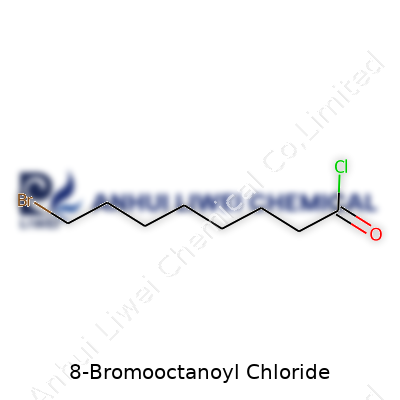
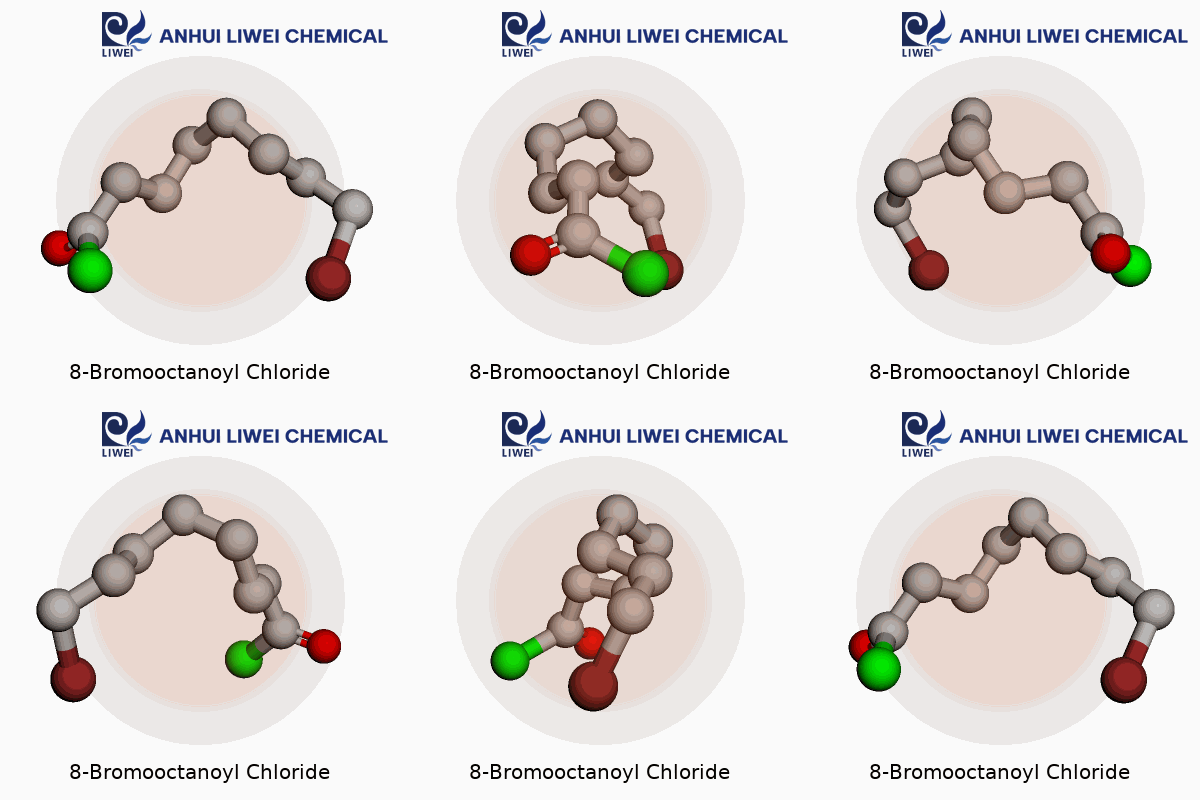
8-Bromooctanoyl Chloride: A Comprehensive Commentary
Historical Development
Chemistry often grows out of small discoveries in the lab, and 8-Bromooctanoyl chloride reflects decades of fine-tuning in organic synthesis and halogenated intermediates. Early fatty acid derivatives saw scientists swapping atoms and groups to unlock new paths in medicinal and materials science. Halogenated acyl chlorides, especially those built on medium-chain backbones, gained attention in the late twentieth century once researchers needed specialized molecules that could bridge lipid and reactive chemistries. This compound, with its eight-carbon tail and a bromine at the omega end, shows the type of progress made with more precise synthetic techniques and a deeper push for building blocks that fit complex molecular goals.
Product Overview
8-Bromooctanoyl chloride pulls together a straightforward fatty acyl backbone and adds two reactive groups—bromine and an acid chloride. Both enable chemists to perform selective changes. The product appears as a clear to pale yellow liquid or sometimes a crystalline solid at room temperature, depending on its purity and storage. Its combination of hydrophobic chain and reactive head sees it used in making new molecules for pharmaceuticals, specialty polymers, and molecular probes across labs and industrial plants alike.
Physical & Chemical Properties
This compound brings with it recognizable traits—a molecular formula of C8H14BrClO, a molecular weight close to 241.6 g/mol, and a boiling point that lands in the range suited to alkyl acyl chlorides, typically around 110–120°C at reduced pressure. Its density registers near 1.26 g/cm³. It offers low water solubility and reacts enthusiastically when exposed to moisture, creating hydrogen chloride gas and the original acid. Its stability in well-sealed glass or Teflon keeps unwanted reactions at bay before intentional use. The acyl chloride and bromine groups both enable strong reactivity with nucleophiles and reducing agents, drawing caution from anyone using or storing it.
Technical Specifications & Labeling
Researchers expect tight technical controls over specialty chemicals like this one. Purity often runs above 97% in catalog offerings, and suppliers usually provide precise GC or NMR chromatograms to back up their claims. Labels must give the CAS number, UN shipping ID, and hazardous designations—including “corrosive,” “lachrymatory,” and “environmental hazard.” Detailed data sheets support everything from shelf life to recommended PPE for handling.
Preparation Method
One standard path relies on converting 8-bromooctanoic acid to its acid chloride form using thionyl chloride or oxalyl chloride under anhydrous conditions. The reaction takes place in a dry solvent—often dichloromethane—chilled to control the exothermic process. Excess thionyl chloride drives the transformation, and as gas and byproducts bubble off, technicians monitor consumption by TLC or IR. After the reaction’s end, careful solvent removal yields the oily product. Some prefer phosphorus pentachloride in historic methods, yet thionyl chloride remains more practical in today’s labs.
Chemical Reactions & Modifications
Working with this compound, chemists build custom molecules through acylation. Reactive amines and alcohols attach at the acid chloride, forming amides and esters. Bromine at the chain end opens up routes like nucleophilic substitution, Grignard reactions, or transformations into azides and thiols. These twin handles on one molecule simplify stepwise syntheses—linking peptides, introducing fluorophores, or extending into amphiphilic surfactants. Control of reaction conditions and use of dry solvents make all the difference, as both groups can react rapidly in the wrong setting.
Synonyms & Product Names
Many catalogs and scientific resources recognize this molecule under several aliases—8-bromooctanoyl chloride, octanoyl chloride, 8-bromo-, and the less common 8-bromo-octanoyl chloride. Some reference the linear formula, CH3(CH2)6COCl with a bromine on the terminal carbon. It may be sold by brand names or codes unique to major suppliers, so researchers cross-check against the CAS number, 29886-23-3, to avoid mix-ups in procurement.
Safety & Operational Standards
Handling 8-bromooctanoyl chloride involves clear risks. The acid chloride group reacts violently with water, so even humidity can start unwanted reactions, including the release of hydrogen chloride gas. Direct contact or inhalation creates severe irritation to the skin, eyes, and respiratory tract, and the brominated chain carries additional toxicity concerns if mishandled. Technicians working with this compound lean on fume hoods, chemically resistant gloves, and full face shields. Facilities rely on spill kits with neutralizing agents like sodium bicarbonate close at hand. Proper training in hazard communication, segregation during storage, and strict waste protocols help keep incidents from turning serious.
Application Area
In my experience, the dual-reactive nature of 8-bromooctanoyl chloride finds it in academic and biotech projects where creating tailor-made molecules gets top billing. Medicinal chemists use it to introduce hydrophobic chains or linker arms into drug candidates, while polymer scientists use the acid chloride end to connect monomers and build block copolymers for membranes or coatings. The bromine acts as a handle for further derivatization, giving even small teams tools to craft complex structures on the benchtop. Sensor developers and surface modification experts also use these molecules to anchor chemical groups onto glass, silicon, or gold, leveraging their reactivity for custom detection platforms.
Research & Development
Research into this molecule highlights a rich interplay of organic synthesis, analytical chemistry, and applied research. Labs across the globe document new synthetic routes that skip hazardous byproducts, shift toward greener solvents, or enable more precise functional group installations. Some groups publish on automated and flow-based systems for safer, scalable production of acyl halides like this one. Others zero in on downstream applications—for example, integrating 8-bromooctanoyl chloride into probes for protein labeling, which advances biological imaging and mapping of cellular pathways. With each paper, capabilities in functionalization and control over molecular architecture push further, offering more usable tools for both fundamental and commercial science.
Toxicity Research
Unlike smaller or less-reactive acyl chlorides, this compound’s longer hydrophobic tail and brominated structure raise flags about both acute and chronic exposures. Rats and mice exposed to similar compounds in inhalation or oral dosing studies reveal clear signs of mucosal irritation, tissue damage, and, at higher concentrations, organ stress. Data suggests these effects depend heavily on both the acid chloride’s aggressive reactivity and the bromine atom’s metabolic fate—once inside the body, brominated byproducts linger and interact with enzymes far longer than their non-halogenated cousins. Chronic studies remain less common, but preliminary findings underscore the need for full containment, rigorous hygiene, and medical monitoring in workplaces using this molecule.
Future Prospects
New technologies almost always inspire reexamination of classic building blocks like 8-bromooctanoyl chloride. As research leans harder into targeted drug delivery, surface engineering, advanced diagnostics, and biodegradable materials, molecules with customized reactivity become even more valuable. I see opportunity where quantum dots or carbon nanostructures need organic ligands for medical or environmental sensors—here, bifunctional reagents like 8-bromooctanoyl chloride bridge cutting-edge technologies. Green chemistry methods, including solvent-free syntheses and recyclable reagents, stand to make production cleaner and more cost-effective. Stronger regulatory pushes around brominated organic compounds may direct innovation toward safer substitutes or demand new monitoring tools, but the deep utility of this intermediate will keep it in scientific toolkits for years.
Chemistry in Everyday Progress
8-Bromooctanoyl chloride isn’t the sort of chemical you see on kitchen shelves or mentioned in a weekend DIY project. Despite this, its importance rings loud in the laboratories driving the pharmaceutical and biochemical industries. With a structure connecting an eight-carbon fatty acid backbone, a bromine atom, and an acyl chloride group, this compound brings reactivity that opens doors for new molecules, life-saving drugs, and research tools.
Making Complex Molecules Possible
Synthesizing molecules in the lab always reminds me of cooking with unusual ingredients. For decades, organic chemists have looked for unique building blocks to slap functional groups together, and 8-bromooctanoyl chloride pops up exactly for this kind of work. Traditional fatty acid acyl chlorides fall short in making advanced surfactants, specialty polymers, or tailored pharmaceuticals. Throwing a bromine atom into the mix means researchers can target specific reactions, especially nucleophilic substitutions.
This chemical often steps into peptide chemistry and drug research. Scientists use it to attach special tags, build membrane-like molecules, or introduce hydrophobic (water-repellent) tails in active ingredients. Pharmaceutical teams, focusing on experimental drugs, lean on 8-bromooctanoyl chloride as a versatile linker or activation molecule. Without it, many sophisticated drug candidates would never make it past the drawing board, and treatment options might stagnate.
Inside the Lab and Beyond
I’ve spent time with researchers who talk excitedly about tweaking the fatty acid tails in potential new drugs. 8-Bromooctanoyl chloride regularly shows up in these conversations, since it allows further chemical modification after it’s linked to a growing molecule. The bromine atom works almost like a flag, attracting attention and making it much easier to swap in something new later. This flexibility makes it valuable for building up libraries of molecules for screening in everything from cancer studies to developing new antibiotics.
Material scientists aren’t left out, either. Some teams working on advanced coatings and nanomaterials harness the molecule’s reactivity to join together components that normally resist mixing. Adding a bromo group to the end of a fatty chain helps tune how substances stick together, repel liquids, or carry drugs directly into cells. Newer fields, particularly at the border of biology and engineering, rely on chemical tools like this to bridge science fiction and real-world results.
Risks and Solutions
Where powerful chemicals show up, risk tags along. Acyl chlorides like 8-bromooctanoyl chloride can react explosively with water or even moisture in the air, sending out acidic fumes and damaging surfaces or skin. Anyone who’s handled it in a lab knows the burn of a stray whiff. Solving these risks starts with training—knowing exactly when and how to open and use these bottles, working with gloves, and keeping strict control over humidity. Chemical engineering companies package and ship these materials in airtight containers for a reason.
Waste management also matters. Research sites have to follow rules that protect both the people in the building and the wider environment. Smart regulations and company policies guide chemists in breaking down leftover chemicals safely, neutralizing hazards, and disposing of anything left behind with care. As research moves forward, better substitutes or greener methods might appear, but for now, 8-bromooctanoyl chloride stays vital in fields that push scientific boundaries.
Breaking Down the Structure
Diving into organic chemistry brings a lot of lessons about patience and accuracy. Not every day brings a question like 8-Bromooctanoyl chloride, but it signals curiosity about what lies behind a name. This compound, used in some advanced chemical synthesis and pharmaceutical research, calls for a close look at its chemical makeup.
The molecular formula for 8-Bromooctanoyl chloride stands as C8H14BrClO. Figuring that out takes a look at its pieces: an eight-carbon backbone, a bromine at the far end, a chlorine bound in the acyl chloride group, and one oxygen. Careful analysis underlines the importance of every atom, not just for the sake of memorizing numbers, but for understanding how properties shift based on subtle changes.
Why Formula and Weight Shape Real Decisions
Some may see details such as molecular weight or formula as trivia, but those pieces impact daily lab work. The molecular weight of 8-Bromooctanoyl chloride is 257.56 g/mol. Working with this value doesn’t just fill a line on a data sheet; it keeps reactions accurate and safety procedures tight. Weighing out chemicals for a reaction requires absolute clarity or the recipe goes awry. I’ve watched new chemists get lazy with numbers and the result is always wasted time or, at worst, a safety scare nobody needs.
In a teaching lab years ago, we kept posters with bold, clear warnings—double-check every label, recalculate all weights before starting. reagents with halogen atoms and acid chloride groups often react more energetically with water, so even the smallest miscalculation can fuel an unwanted reaction. That’s a lesson that sticks.
Facts Underpinning Safe and Efficient Working Conditions
This compound combines an alkyl chain, a bromine, and an acid chloride. Each fragment means something: the bromine increases reactivity, and the chloride group demands dry handling. Molecular formulae aren’t just for textbooks—they’re used for sourcing raw materials, calculating stoichiometry, and forecasting hazards. In regulated environments, chemists rely on reference materials and digital catalogs to cross-check everything. Even small lab teams need to keep digital inventories up-to-date and flagged with formulas and weights for every compound.
Mistakes from inattention lead to setbacks, wasted budgets, and compliance problems. I’ve seen projects halted for weeks over missing data in a procurement file—usually something as basic as the wrong formula or molecular weight. Laboratories that make such errors start losing trust, from suppliers to regulatory auditors. Transparent sharing of accurate chemical data prevents those headaches before they start.
Solutions Rooted in Responsibility
In the world of specialty chemicals, details quickly become lifelines. Automatic calculators exist, yet double-checking by hand cultivates better habits. Many researchers now keep a notebook page for each compound they use regularly, with formulas, weights, and handling notes. Using trusted databases like PubChem or Sigma-Aldrich for reference avoids common pitfalls and ensures alignment with global standards. Training sessions for junior researchers focused on these fundamentals cut down on avoidable incidents.
For students or professionals working with unique halogenated compounds like 8-Bromooctanoyl chloride, investing time in cross-referencing structures, drawing out molecular diagrams, and practicing weight calculations creates a stronger foundation. Bringing these habits to the bench keeps individuals and teams safe, preserves budgets, and proves to both auditors and funders that science in that building operates with care and precision.
Why Proper Storage Can’t Be Ignored
Every chemist learns early that a mishap in the stockroom rarely ends well. Some chemicals demand respect more than others, and 8-Bromooctanoyl chloride stands on that list. Anyone who’s worked with acyl chlorides knows they find ways to escape even the tightest seals if left on a warm, open shelf. That foul, nose-biting reek? There’s your reminder to pay attention. Storing this chemical isn’t about paranoia—it's about not ruining your day or your research.
Real Risks: Humidity and Heat
This compound reacts fast with water, including what’s floating in the air. The reaction unleashes hydrogen chloride gas, which stings eyes and throat and leaves strong acids behind—in short, it chews through glassware and equipment. Humid labs speed that process up, making the work area unsafe. Heat is the other enemy. Many organohalides, this one included, will break down if temperatures creep up. A storage mistake means your expensive bottle transforms into a hazard or, worse, an uncontrolled experiment.
Smart Storage: What Works
Dry air and cool temperatures set the ground rules. It always made sense for me to stash bottles in a well-ventilated chemical storage fridge, the kind clearly labeled for corrosives. Direct sunlight should never touch the container. If it does, the contents can degrade fast, and pressure might build up, causing a cracked bottle or a popped cap. I’ve heard far too many stories of janitors and grad students alike getting vapor burns from poorly stored bottles left in random drawers.
Extra layers help. A tightly sealed, chemical-resistant container—or better yet, a smaller bottle inside a larger, sealed jar of desiccant—slows moisture seepage. Labeling every bottle is not optional. Hand-written masking tape fades; permanent labels and secondary containment (like an extra tray on the fridge shelf) turn a potential mess into just an inconvenience if anything leaks. If a spill does happen, calcium chloride or another appropriate drying agent can contain the liquid, though a full neutralization cleanup needs planning.
The Human Side: Training and Awareness
We can’t just lock things away and expect people to know what to do. Training matters more than any high-tech cabinet. I’ve seen seasoned bench workers teach newer folks about the “chloride test”—open the bottle inside the fume hood and wave your hand nearby. If your eyes start watering in seconds, the vapor’s already building up pressure. It’s common sense backed by experience, not theory. Sharing stories or “war stories” in lab meetings keeps people alert and reminds them that shortcuts punish harshly.
Holistic Safety: Procedures Over Lock-and-Key
Storing 8-Bromooctanoyl chloride properly goes beyond just slotting it on the right shelf. A workplace culture that respects chemicals, anticipates what can go wrong, keeps materials organized, and encourages questions protects everyone. An SOP written by people doing the work beats any boilerplate guidance. Double-checking inventory and logging each withdrawal makes sure the bottle doesn’t age unnoticed and avoids accidental surprises during inventory or moves.
Practical Solutions
Labs can invest in humidity monitors for storage spaces, stock up on compatible absorbent materials, and make clear how to report or clean up spills. Having an emergency shower and eyewash within reach helps in those rare cases when things do go wrong. Maintaining partnership with safety officers, even for small operations, means incidents get reported, and future problems are less likely. Strong habits and good equipment turn chemical storage into a safe, routine part of life, not a lurking danger.
Understanding the Risks
Working in a chemistry lab brings its share of dangers, and 8-Bromooctanoyl Chloride deserves some real respect. This compound, used in organic synthesis, gives off fumes that go straight for eyes, skin, and lungs. Fumbling with it or getting sloppy with protocols leads to accidents fast. A whiff can cause burning in the nose or throat; drops on your skin might leave blisters or a nasty rash. Constant mindfulness keeps mishaps at bay.
Personal Protective Gear: Not Optional
There’s no rationalizing away the use of proper gear. Splash goggles shield your eyes from fumes and droplets. Chemically-resistant gloves prevent painful burns and skin absorption. If you can smell the stuff, you already messed up; wear a well-fitted lab coat and closed shoes, and never trust bare hands around reagent bottles—nitrile gloves offer decent protection.
Avoid working alone. In case of a spill or splash, having someone nearby makes a huge difference. After a decade of lab work, I've seen how a half-second lapse—forgetting to grab goggles or ditching gloves just once—brings regrets nobody wants.
Ventilation and Fume Hoods
This chemical delivers a choking, acrid vapor if bottles get opened outside of proper ventilation. Always prep glassware in a certified chemical fume hood. Regular room air exchanges don’t cut it; only the forced airflow of a real hood deals with these fumes. Check that the air is moving as designed—sometimes issues go unnoticed until noses start to burn.
Safe Handling and Storage
Never pipette by mouth or use makeshift containers. Use glass, not plastic, since strong acids and chlorides chew through less robust materials. Keep containers well secured and labeled, away from moisture or heat. 8-Bromooctanoyl Chloride reacts quickly with water, producing hydrogen chloride gas, which brings added danger and corrosion. I’ve seen what one careless cap can do—rust spreading through a drawer, glassware pitting, everyone’s workflow interrupted. Keeping things dry and airtight makes life easier for everyone involved.
Dealing with Spills and Exposure
Spills happen, even with the best precautions. Spill kits with absorbent material, baking soda, and plenty of water need to stay nearby. Neutralize any residue before wiping up—straight water meets acid chloride and you get heat and fumes. If any touches skin, wash immediately under running water, then inform a supervisor. Failing to report and hoping a burn heals on its own compounds trouble. Exposed eyes need a safety shower or eyewash station, no excuses about inconvenience.
Training, Protocols, and Documentation
Everyone on the team should stay current with safety data sheets and regular training. Too many people treat chemical labels like background wallpaper, forgetting that a bored moment or bad guess means someone gets hurt. Ongoing training and checklists keep everyone sharp and reinforce that safety isn’t a single moment’s decision but an everyday practice, whether you’re in academia or industry.
Looking at the Basics
In the world of organic chemistry, the small details count for a lot. 8-Bromooctanoyl chloride brings those details right into focus. Research labs and chemical manufacturers pay close attention to purity and the physical look of this compound. The way it presents itself can make or break an experiment or synthesis run. I’ve seen a project go sideways just because a reagent picked up too much moisture from the air, turning a clear liquid murky.
Typical Purity Ranges
You rarely come across this molecule with less than 97% purity from reputable suppliers. This benchmark allows researchers and synthetic chemists to predict how their reactions will proceed. If you land below this mark, you might struggle with unpredictable results or need to purify your own batch, which racks up both time and cost. Any impurity can spark unwanted side reactions. Some producers offer this compound above 98%, which reassures most professionals that their starting material will behave as expected. Certificates of analysis back up these claims—they show test results from gas chromatography, nuclear magnetic resonance, or other analytical methods.
What to Expect Visually
8-Bromooctanoyl chloride usually arrives as a clear to slightly yellowish liquid. On a cold day or if it sits in a chilly corner of the lab, it might thicken up but should flow at room temperature. If you spot cloudiness, crystals, or a brown tint, you’re probably dealing with a batch that’s picked up moisture or started to break down. The acyl chloride group in the molecule reacts pretty fast with water from the air, so it doesn't take much to spoil a good bottle. A strong, almost pungent odor greets you as soon as you open the container, a sign of the acid chloride group doing its job. Handling it in a fume hood becomes nonnegotiable.
Why Purity and Appearance Affect Results
Getting a high-quality batch does more than just check a box—it keeps the data reliable and the process safe. Experienced technicians talk about the sharp eye needed to spot trouble. I’ve watched chemists sniff out contamination just by noticing a subtle shift in color or by seeing a batch move sluggishly in the flask. These aren’t little quirks—they’re warnings. Low purity or odd color can mean hydrolysis started, which dumps unwanted acids into your mix. That may sound minor but, for a pharmaceutical synthesis or polymer preparation, it can lead to failure or costly rework.
Solutions and Best Practices
Rotating stock, using smaller containers, and always working with fresh, dry glassware can help keep the compound at its best. Labs that store bottles under nitrogen or argon have fewer headaches. If a laboratory depends on a specific lot, sending out samples for independent testing can provide added confidence and catch changes before scale-up. Sticking with trusted suppliers and demanding up-to-date test data keeps surprises in check.
Every time you weigh out 8-bromooctanoyl chloride, purity and appearance tell you what to expect from your reaction. These little checks guard the integrity of research and help push new discoveries forward safely.