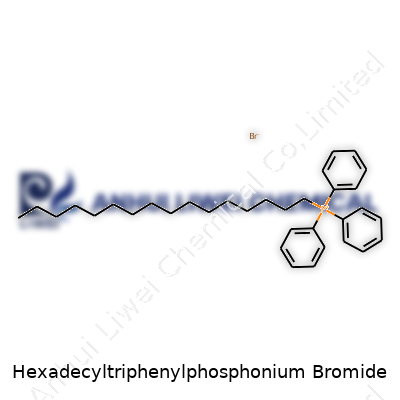
Hexadecyltriphenylphosphonium Bromide: Past, Present, and Future
Historical Development
Chemists started paying close attention to phosphonium salts during the mid-20th century, unlocked by a wave of interest in organophosphorus chemistry. Hexadecyltriphenylphosphonium bromide, known for its unique structure, drew the eyes of researchers looking to push boundaries in both classical and emerging fields. This compound didn't just appear in isolation; it grew out of decades devoted to harnessing phosphine ligands and leveraging quaternary ammonium and phosphonium species. Laboratories gravitated toward its strong ionic behavior and reliable synthetic protocols. From the early experiments that shaped the Wittig reaction to pioneering studies on ionic surfactants, hexadecyltriphenylphosphonium bromide held firm to its roots as both a tool for organic synthesis and a starting point for deeper chemical exploration.
Product Overview
Hexadecyltriphenylphosphonium bromide belongs to the family of quaternary phosphonium salts, carrying a bulky triphenylphosphine core attached to a long hexadecyl chain. Its formula, C34H46BrP, reflects a blend of hydrocarbon character and strong ionic potential. The material is typically found as a white powder or crystalline solid with a waxy feel between the fingertips. The compound’s popularity comes not just from its strong ionic charge but from its tendency to facilitate phase transfer reactions across organic and aqueous stages. Labs and industries value this versatility, drawing on it to streamline reaction protocols and shape bolder pathways in synthetic chemistry.
Physical and Chemical Properties
In everyday handling, hexadecyltriphenylphosphonium bromide stands out for its stability under normal conditions. It melts predictably in the range of 128-132°C. Its solubility pattern leans into non-polar solvents like chloroform, dichloromethane, and to a lesser extent, ethanol. The long alkyl tail gives it a surfactant-like nature, leading to strong interfacial activity. On the chemical side, the positive charge centered on phosphorus and balanced by bromide influences its interactions, including nucleophilic substitution and ion pairing. This strong ionic movement delivers reliable results in phase transfer catalysis and related transformation chemistry.
Technical Specifications and Labeling
Chemical suppliers typically ship materials like hexadecyltriphenylphosphonium bromide with grade designations—analytical, research, or industrial—each reflecting purity of above 98 percent. Package labels include batch numbers, shelf life, recommended storage at room temperature, and hazard symbols warning of skin and eye irritation risks. Standard shipping involves moisture-barrier packaging to prevent hydrolysis. As a rule, chemical datasheets list the molecular weight (549.6 g/mol), melting point, and solubility details, while hazard and precautionary statements match globally harmonized system (GHS) criteria. A lot number for traceability guarantees any issues can be traced.
Preparation Method
Labs synthesize hexadecyltriphenylphosphonium bromide by quaternizing triphenylphosphine with 1-bromohexadecane. The reaction typically takes place in a polar solvent under anhydrous conditions to prevent unnecessary side reactions. The mixture reacts with gentle stirring at temperatures around 50 to 60°C for several hours. Post-reaction, the crude product undergoes repeated washing with ethanol or ether to remove unreacted starting materials. The end product, once vacuum dried, lands as a powder suited for direct use in research or industrial settings. The process, often considered user-friendly, has set the gold standard for labs that demand high surface-active phosphonium salts.
Chemical Reactions and Modifications
Hexadecyltriphenylphosphonium bromide’s chemical resilience makes it an asset in multi-step organic syntheses. It efficiently participates in nucleophilic substitution reactions thanks to the labile bromide. Chemists rely on the strong phosphonium center in reactions calling for controlled ion exchange or transfer. Surfactant-like structure opens doors for micelle-assisted catalysis, where it acts as both a phase transfer catalyst and a template for nanoparticle growth. Some groups have modified the alkyl tail, experimenting with chain lengths and aromatic substitutions, and they’ve tracked direct consequences for surface activity and transport behavior. The compound interacts robustly with a variety of counterions, giving researchers plenty of room for fine-tuning performance in custom applications.
Synonyms and Product Names
Though most professionals refer to it as hexadecyltriphenylphosphonium bromide, suppliers and literature databases list several synonyms to watch for. Look for trade names such as C16TPPB or 16-TPPB, or systematic alternatives like triphenyl(hexadecyl)phosphonium bromide. The synonym landscape reflects a sprawling catalog, often matching local supplier branding or catalog requirements. Each variant ties back to the same robust molecule and signals the broad interest across chemistry, biology, and applied sciences.
Safety and Operational Standards
Handling hexadecyltriphenylphosphonium bromide calls for routine laboratory diligence. Gloves and goggles protect against mild skin and eye irritation, and dust masks reduce direct inhalation risks. Backup measures include eyewash stations and fume extraction, as the compound produces some dust during weighing or transfer. Its toxicity profile flags concern at elevated exposure levels, so following recommended occupational exposure limits ensures safe use. Storage in cool, airtight containers prevents moisture uptake, which could degrade its quality or introduce impurities. Correct disposal usually happens in compliance with local chemical waste regulations, with special care to avoid waterway contamination due to potential aquatic toxicity in high concentrations.
Application Area
Hexadecyltriphenylphosphonium bromide’s practical edge shows up across a range of sectors. Industrial chemists put it to work as a phase transfer catalyst in the production of pharmaceuticals, agrochemicals, and specialty plastics. Its efficiency in shuttling ions between phases keeps reaction times down and yields up. Research circles focus on its use in nanoparticle synthesis, exploring surfactant-mediated template growth for organic and inorganic materials. Biotechnologists have pushed the molecule into mitochondrial research, leveraging its selective mitochondrial targeting properties to study cell death and aging. In emerging areas, environmental engineers are exploring it for pollutant remediation, tapping into its surfactant and catalytic abilities to break down stubborn chemicals in water and soil.
Research and Development
Over the years, teams have invested time tweaking the molecule’s structure and reactivity. Key research projects explore its synergy with transition metals for new cross-coupling and oxidation reactions. Analytical labs use it to build more responsive sensors for tracing contaminants and metabolic intermediates. Material scientists investigate its behavior in complex fluids and nanostructure formation, hunting for improved performance or lower toxicity. Gaps remain—long-chain phosphonium salts still inspire curiosity over their full toxicological impact and environmental footprint. The research landscape stretches from private labs searching for a commercial edge to university groups pushing for fundamental understanding. Collaboration between academic and industrial teams marks most of the innovation, spurred by the potential to unlock greater efficiency or sustainability in chemical processes.
Toxicity Research
Debate continues over long-term exposure and scale-up risks. Most published reports find that hexadecyltriphenylphosphonium bromide exhibits moderate acute toxicity, with effects largely confined to direct contact or ingestion at high doses. In aquatic environments, its surfactant-like structure points to risks for fish and microflora, underlining the need to avoid spillage or improper disposal. Animal studies show low to moderate bioaccumulation, but more data are needed before broad environmental release. Medical researchers have studied its action within mitochondria, revealing both the potential for targeted therapies and, if mishandled, possible cellular stress or dysfunction. Regulatory agencies call for compliance with chemical handling, transport, and end-of-life disposal standards to minimize risk for both people and ecosystems.
Future Prospects
Innovation will keep driving new uses for hexadecyltriphenylphosphonium bromide. As the push for greener chemistry accelerates, future research targets more selective and less toxic analogs, borrowing lessons from both biology and industrial practice. Teams are exploring functionalized derivatives that promise sharper performance in catalysis or more precise mitochondrial targeting for medical applications. Researchers see opportunities to integrate this compound into smart materials that respond to environmental or electrical stimuli, opening doors for advanced electronics and high-tech coatings. At the same time, sustainability concerns are prompting the search for biodegradable alternatives or more efficient recycling and reclamation strategies. With both challenges and potential lining the road ahead, the chemical community looks for smart, responsible innovation to chart the next steps.
A Closer Look at a Unique Compound
Anyone who has spent time in a university chemistry lab probably remembers the colorful bottles with long, daunting names. Hexadecyltriphenylphosphonium bromide fits squarely into that world. At first glance, it looks like another part of the clutter. In reality, it keeps popping up in some meaningful corners of research and manufacturing.
The Science Behind the Name
Hexadecyltriphenylphosphonium bromide belongs to the phosphonium salt family. It combines a bulky organic group — hexadecyl (a 16-carbon chain) — with three hefty phenyl rings around a phosphorus atom. This structure gives it the kind of chemical baggage not every molecule brings to the table. Looking past the long name, this white crystalline powder turns into a workhorse as a phase-transfer catalyst.
Phase-transfer catalysts have a knack for getting two substances that don’t like to mix — let’s say oil and water — to work together. That’s much easier to appreciate in person: watching a normally sluggish reaction spring to life, just by adding a pinch of the right catalyst, can be striking. In organic synthesis, hexadecyltriphenylphosphonium bromide acts as the matchmaker, getting reagents talking in multi-phase systems. This simple trick helps chemists build complex molecules at lower temperatures, less waste, and often with faster results.
Shaping the Next Generation of Science
Lab life does not circle only around flasks and gases; real impact comes from tools that support scientific progress. Drug development, materials science, and polymer research have benefitted from this compound. Its cation — the positively charged half — helps carry reactants from the water side to the organic side in biphasic reactions. In pharmaceutical research, these reactions generate building blocks for new drugs, or help tweak molecules for better performance.
Mitochondria possess a unique membrane potential, drawing certain charged molecules inside. Scientists use derivatives of phosphonium compounds, like hexadecyltriphenylphosphonium bromide, to ferry drugs or sensors right where they’re needed inside a cell. Research on mitochondrial diseases and cancer therapy taps these properties. My own time helping bioscience students reminded me how hard it can be to deliver substances exactly where the cell will use them. Watching cells light up under a fluorescent microscope, thanks in part to these molecular carriers, brings the technical challenge to life.
Environmental and Industrial Considerations
Industrial applications, such as electroplating and polymer processing, take advantage of the molecule’s surface-active properties. Quaternary phosphonium salts like this one can offer strong antimicrobial activity, which might benefit new generations of disinfectants or materials with built-in safety features. Considering chemical waste, researchers pay close attention to how long these compounds persist in water and soil. The more we study their interaction with ecosystems, the more we need responsible disposal and greener alternatives.
Looking Ahead
Chemistry thrives on compounds that do more than just sit on a shelf. Hexadecyltriphenylphosphonium bromide brings versatility and innovation, bridging gaps between phases and even between professions — from chemical manufacturing to medical research. As clean technologies and smarter drug delivery climb higher on society’s wish list, understanding and respecting these specialty chemicals becomes more than an academic exercise. It can shape safer labs, better treatments, and more sustainable industries.
The Chemical Formula and Its Meaning
It’s easy to stare at a name like Hexadecyltriphenylphosphonium bromide and get lost, but there’s a clear structure behind it. The chemical formula here is C34H52BrP. Count each piece: thirty-four carbons, fifty-two hydrogens, one bromine, and one phosphorus. This combination characterizes a molecule that pulls from hydrocarbons and blends in aromatic rings, a dash of halogen, then mixes in phosphorus at its core.
Understanding the Backbone
The “hexadecyl” part means there’s a straight chain of sixteen carbon atoms, like you’d find in a fatty alcohol. “Triphenylphosphonium” signals three phenyl groups (rings you’d see in benzene) attached to a phosphorus atom that has picked up a positive charge. That phosphorus doesn’t go it alone—it links to the hexadecyl group, rounding out the molecule with a big, lopsided look: a packed hydrocarbon tail with a bulky phosphorus head. Bromide, the last piece, balances it out: an anion matching the positive charge.
Why Purity and Structure Matter so Much
Over years working in various labs, it’s become clear that molecules like this one aren’t just chemical trivia—they play roles that ripple out into medicine, industry, and research. Hexadecyltriphenylphosphonium bromide lands right in the middle of action in organic synthesis, phase-transfer catalysis, and biological experiments. Misreading the formula or botching the purity throws entire experiments off track. A single missing atom or incorrect chain means properties change, sometimes in subtle but crucial ways. For researchers and manufacturers, accuracy in chemical structure isn’t an academic point; it means the difference between reliable outcomes and misleading noise.
Practical Application and Risks
Walk into a pharmaceutical lab and you see compounds like C34H52BrP used to shuttle ions across barriers or catalyze tricky reactions. In development of new drugs, this molecule helps poke holes in membranes or move charged species where nature sometimes blocks the door. No surprise then, mislabeling or trace impurities can introduce risks downstream—medicine adulterated at the source leads to clinical headaches or worse, health threats. Regulatory bodies like the FDA keep a sharp eye here and lay down strict guidelines on reagent grade, batch testing, and documentation.
Transparency, Testing, and Trust
Trust in the chemical industry grows out of clear records, third-party testing, and quick access to data sheets and safety information. After years in this field, I’ve seen that organizations earning real trust open their doors to inspections and share analytical results without hiding behind jargon or paywalls. Solutions to mislabeling and quality lapses start from simple steps: well-trained lab techs, up-to-date reference books, traceable supply chains, and quality management systems that turn up problems before they hit customers.
Staying Informed and Safe
No substitute exists for up-to-date safety training, both in industry and in teaching labs. Compounds containing bromide and phosphorus demand gloves, goggles, and good ventilation as basics. Sharing best practices—whether through newsletters, conferences, or collaborative work—helps researchers keep pace with the shifting science and avoids old pitfalls.
Pushing for Progress
With demand for reliable chemicals rising worldwide, pressure grows for better education, transparent sourcing, and smart regulation. Reliable formulae like C34H52BrP only reach full potential through careful production, honest labeling, and persistent curiosity about how molecules shape the world around us.
Understanding What You're Dealing With
Anyone working in a lab for any length of time picks up a healthy respect for chemicals that stray outside the basics. Hexadecyltriphenylphosphonium Bromide isn’t just some obscure reagent; it finds frequent use in cell biology and organic synthesis, and possesses real potential risks if ignored. You don’t toss it on any old shelf and forget about it. Over the years, I’ve seen colleagues handle unfamiliar compounds like sugar—until something spills or starts fuming.
This compound demands attention, not paranoia. It’s a quaternary phosphonium salt, best known for its ability to pass through cell membranes or as a phase-transfer catalyst. The first lesson: treat the chemical with the same care you’d give to anything toxic and sensitive.
You Can't Ignore The Basics
No one enjoys returning to a storage area only to find clumped-together powder or a jar leaking yellow gunk. To keep Hexadecyltriphenylphosphonium Bromide intact and safe, store in a cool, dry spot. Direct sunlight turns many chemicals unpredictable., even more so for a phosphonium salt, given its tendency to break down. I once worked in a university lab that kept bottles near the window—by spring semester, the difference between properly stored chemicals and sun-warmed disasters was night and day.
Moisture matters. This isn’t a compound you leave close to the sink or high-humidity zones. Water transforms some reagents in subtle but dangerous ways, like caking, hydrolysis, or slow release of corrosive byproducts. Using a tightly closed container and anointed spot far from any water source is the only approach that works long term.
Don't Cut Corners on Containers
In my labs, we always reached for amber-glass bottles or high-quality plastic vessels. Cheap closures or sub-standard jars let in air over time; chemicals react, labels smudge, and before long, you’re left guessing about identity and safety. Chemical suppliers recommend storing phosphonium salts under inert gas if they’re used rarely, or at least with minimal airspace in the bottle. It’s not overkill; it’s about keeping the compound in one predictable state.
Keep Security and Labels In Mind
Picture a technician rushing, grabbing the wrong jar, and weighing out a toxic compound without reliable labeling. I learned early: every container deserves a clear, legible label showing the name, date received, and hazard icon. It’s not just about regulations. Lives and limbs depend on these warnings, since phosphonium compounds can cause irritation or worse.
If you’re working in a shared space, restrict access only to those trained and aware of the risks. Hexadecyltriphenylphosphonium Bromide isn’t a household item. Mix-ups or accidents happen quickly in a cluttered, communal store room.
Addressing Potential Accidents and Spills
Spills in my labs never came with dramatic clouds, but they always created tension. Keep spill kits close by—the basic materials: gloves, absorbent pads, chemical-resistant scoops. Small events spiral if staff doesn't react fast with the right gear. Emergency shower, eyewash stations, and ventilation systems make a difference. Containment, not just cleanup, matters.
Solutions: Training and Routine Audits
It’s easy to focus on fancy storage systems or new tech, but the most underappreciated fix remains simple: training. Regular sessions with all staff highlight what to do and what never to try. Conduct audits of storage cabinets twice a year. Outdated containers go, inventory gets updated, and safety becomes second nature.
The bottom line—respect for chemistry and a bit of discipline keep Hexadecyltriphenylphosphonium Bromide safely on the shelf and off the list of lab disasters.
What It Is and Where It Shows Up
Hexadecyltriphenylphosphonium bromide sounds like something straight out of a university lab, and that’s not far off the mark. Chemists often bring this name up when they talk about organic synthesis, particularly making new compounds for pharmaceutical or research purposes. Some lab workers see it as just another quaternary phosphonium salt. Outside the lab, though, few people know it even exists. This often leads to a debate about its safety and its risk profile for everyone around it, from chemists in training to experienced researchers.
Evaluating Health Risks
Experience says it’s never smart to shrug at long names in a bottle. Chemicals with complex structures, like hexadecyltriphenylphosphonium bromide, sometimes deliver more punch than their name suggests. According to published safety data, this compound can irritate the skin, eyes, and respiratory system. Inhalation and ingestion frequently lead to discomfort; prolonged exposure may damage organ functions. A story shared by colleagues in academia—a lab assistant ended up in the emergency room after a careless spill—shows just how swiftly irritation can escalate. This isn’t television drama; it’s day-to-day risk for people who treat chemical hygiene like an afterthought.
The Question of Environmental Danger
From an environmental perspective, the trouble doesn’t end with personal exposure. Many quaternary phosphonium compounds break down slowly once released into soil or water. That quality increases their persistence, raising risks for aquatic life and influencing studies on long-term contamination. Some researchers have noted bioaccumulation concerns, especially if the chemical reaches waterways downstream of labs or manufacturing sites. Fish and small aquatic creatures don’t get to choose what chemicals wash over them. Over time, that exposure can disrupt ecosystems and ripple through food chains.
Safer Practices and Practical Steps
In high school chemistry, the teacher handed out goggles before anybody touched a solution. That lesson sticks—respect the risk, gear up, and ask questions. For chemicals as reactive as hexadecyltriphenylphosphonium bromide, oversight can’t rest on memory or luck. Use gloves and goggles, keep fume hoods running, and train new researchers until precision handling becomes second nature. Labs should keep spill kits close and practice dealing with accidents the same way schools drill fire alarms. It might feel overcautious, but those habits build a safer workplace.
Chemical disposal needs the same attention. Pouring leftovers down the drain isn’t just lazy; it runs the risk of poisoning local water supplies over the long haul. Always send waste to certified chemical disposal services. Reporting even small spills reduces the chance that contamination grows out of sight. Regular audits, better labeling, and an open-door policy on safety concerns can build a lab culture that values precaution over convenience.
Trust Built on Knowledge and Transparency
Part of public trust in science depends on how openly researchers talk about risks—not just the benefits—around chemicals like hexadecyltriphenylphosphonium bromide. Transparency means sharing hazard data, listening to safety concerns from workers, and not glossing over potential health or environmental problems. If organizations don’t keep safety front and center, small mistakes can snowball into major harm. Community members, lab workers, and students deserve straight answers backed by real-world experience, not technical jargon or empty reassurances. That’s how responsibility grows, and that’s the foundation for safe, meaningful progress.
It All Starts with the Formula
Hexadecyltriphenylphosphonium bromide, known in labs as C34H46BrP, deserves more than a quick glance. Its molecular weight sits at around 597.6 grams per mole. That number lands on the bottle in any research lab and can make anyone who’s made up buffer solutions or weighed out reagents breathe a sigh of relief for its clarity. I’ve spent time in crowded university basements, sliding weights onto an old fashioned balance. Back then, nailing down an exact molar mass mattered more than the type of pipette you could get your hands on. The molecular weight isn’t just trivia—it steers practical lab decisions every day.
Why Chemists and Scientists Keep Coming Back to It
Knowing the molecular weight means you won’t burn through time or waste resources on shoddy measurements. I remember a chemist colleague once arguing with a supplier over a product label that looked off by a gram or two. It turned out the number printed didn’t include the bromide ion—a mistake that threw his reaction yield into chaos. Truth is, tiny errors in molecular weight calculation can ripple through an entire week’s worth of syntheses or analyses.
For Hexadecyltriphenylphosphonium bromide, combining the weights of all its atoms—carbon, hydrogen, phosphorus, and bromine—gets you that trusted 597.6 g/mol. Just obtaining the correct value supports not only chemical synthesis, but helps create consistency across publications and safety data sheets.
Beyond the Calculator: Impacts on Research and Industry
This salt pops up in organic, physical, and even medicinal chemistry. One of the most interesting places I’ve seen it used is as a phase transfer catalyst. In that context, its molecular weight isn’t just a number to plug into equations; it affects stoichiometry, cost, and even toxicity calculations.
Bromide-based compounds deserve an extra moment of attention, especially given the regulatory focus on handling halides safely in academic and industrial settings. Safety training manuals in every lab I’ve worked in stress the stakes—get the mass right, handle it right, report it right.
Improving Access to Reliable Information
Digital access cuts down on mistakes, but skepticism always lingers. Not all databases agree on molecular weights, and secondary sources sometimes round numbers or skip critical details. In 2023, a published study showing inconsistent molecular weights across supplier websites kicked off a campaign in my research group to double-check every reagent before starting new experiments.
Supplier accountability helps, but building in-house libraries filled with accurate, peer-reviewed data makes a difference on the day-to-day. Public chemistry resources such as PubChem and the CRC Handbook lay a solid foundation, and cross-referencing ensures you aren’t flying blind. Colleagues swapping experiences in the break room often warn against cutting corners here—a reminder born from long nights troubleshooting unexplained yield losses or reaction failures.
Moving Toward Reliability
A strong chemistry lab culture values accuracy, and the humble molecular weight factors into everything from grant proposals to final manuscripts. It’s worth taking the extra minute to check numbers, consult multiple reputable sources, and communicate clearly. In my own routine, I keep a dog-eared printout from the CRC Handbook taped over my desk. Habit like that saves more headaches than any fancy new gadget. When it comes to Hexadecyltriphenylphosphonium bromide and its molecular weight, small steps add up to big payoffs in trust, safety, and science that stands up to scrutiny.