Methyl Trioctyl Ammonium Tetrafluoroborate: A Practical Look at Its Development and Role in Modern Chemistry
Historical Development
The story of methyl trioctyl ammonium tetrafluoroborate (MTOATFB) traces back to the dramatic rise of quaternary ammonium compounds in the middle of the twentieth century. Back then, chemists began realizing that certain salts could bridge oil and water—literally. Folks spent years tweaking the carbon chain lengths and anion combinations, hunting for the perfect properties. In the process, tetrafluoroborate emerged as a favored pairing for stability and compatibility. Over the decades, MTOATFB found its way into electrolyte research, phase transfer catalysis, and extractive metallurgy. The journey featured lots of trial and error, with researchers refining preparation steps, reacting different alkyl groups, and comparing various bulky counterions to tune solubility and separation. Eventually, the compound’s reliability and consistency got attention in applied chemistry circles, prompting more investment and better production methods.
Product Overview
Methyl trioctyl ammonium tetrafluoroborate looks like a pale, waxy solid or sometimes a viscous liquid at room temperature, depending on how pure and dry it is. Unlike common table salt, its large organic cations and the robust tetrafluoroborate anion make it much less volatile and less prone to absorbing water directly from the air. Commercial suppliers offer the compound under names varying slightly for brand recognition, but the backbone formula stays the same. MTOATFB stands out because of its balance—high organic solubility, tunable hydrophobicity, and robust ionic interaction—making it a clever pick for certain separation science and electrochemical applications.
Physical & Chemical Properties
People dealing with MTOATFB care about its melting point, moisture sensitivity, and how it behaves across solvents. Its melting point usually floats between 57 and 68 degrees Celsius, although traces of impurities can drive this number up or down. MTOATFB dissolves especially well in organic solvents—think chloroform, dichloromethane, and ethyl acetate—while water doesn’t seem to do much for it. This hydrophobic behavior comes from the trioctyl groups wrapped around the ammonium core, giving it a waxy, oily feel. Chemically, the compound stays stable under neutral or mildly acidic conditions, with the boron-fluoride bonds, in particular, holding firm unless hit with strong alkalis or above-normal temperatures. Still, the large, flexible organic portion can make it tricky to crystallize, and it hydrolyzes very slowly in moist air—faster when exposed to strong acids or bases.
Technical Specifications & Labeling
Any bottle of methyl trioctyl ammonium tetrafluoroborate comes labeled with its CAS number, purity percentage, and specific hazard data. Most labs expect to see purities above 98%, which reduces impurities that could mess with research results. Labels also spell out storage suggestions—cool, dry, well-sealed conditions—and carry warning symbols dictated by international chemical safety rules. From experience, mishandling or skipping out on real labels creates real headaches in inventory, and accurate spec sheets prevent confusion about stability, shelf life, or potential contaminants.
Preparation Method
The classic preparation route starts by treating trioctylamine with excess methylating agents (such as methyl iodide) in an organic solvent, producing methyl trioctylammonium iodide. This intermediate reacts with sodium tetrafluoroborate via metathesis in water/organic biphasic systems. Stirring the solution yields a precipitate or emulsion, which gets extracted, washed, and dried. Scaling up means taking care with the methylating step—overexposure can cause overalkylation or trigger side reactions. Labs found rinsing with clean water and organic solvents helps remove unreacted starting materials, and rotary evaporation gets rid of traces of solvent. The resulting white or off-white paste can be dried further under vacuum and stored in airtight containers.
Chemical Reactions & Modifications
Chemists use methyl trioctyl ammonium tetrafluoroborate as a phase transfer catalyst or ion-pairing agent, and it can get swapped, modified, or built into larger ionic liquid families. It helps shuttle anionic species between water and oil, boosting yields in otherwise slow reactions. Swapping out the methyl, octyl, or tetrafluoroborate parts lets researchers fine-tune properties for custom needs—smaller methyl cations improve solubility, and switching to other anions like hexafluorophosphate or perchlorate tailors conductivity or reactivity. Electrophilic fluorination, alkylations, and even coupling reactions benefit from the compound’s ability to stabilize intermediates or pull specific product phases out of the mess.
Synonyms & Product Names
You’ll see methyl trioctyl ammonium tetrafluoroborate under various names, depending on the supplier and research focus: Aliquat 336 BF4, MTOA-BF4, methyl(trioctyl)ammonium tetrafluoroborate, or N-methyl-N,N,N-trioctylammonium tetrafluoroborate. People recognize “Aliquat” as a trade name linked with a whole suite of trialkyl ammonium salts, so reading the fine print on technical data sheets matters. Miscommunication about substance identity leads to missteps on both the bench and the procurement side.
Safety & Operational Standards
Most people handle methyl trioctyl ammonium tetrafluoroborate with gloves, goggles, and in a fume hood. If it touches bare skin, it feels greasy, sometimes irritating after repeated contact. The dust stings eyes and nose, and accidental ingestion or inhalation can trigger nausea or more serious effects since these quaternary ammonium salts don’t always metabolize easily in the body. Safety protocols call for keeping the compound off hands, away from the mouth and eyes, and out of reach of untrained workers. Proper ventilation and clearly labeled waste containers reduce the risk of cross-contamination. Spills usually wipe up with absorbent pads and get sealed for chemical disposal per local environmental rules. Emergency guides insist on eye washes and thorough rinsing when in doubt.
Application Area
Methyl trioctyl ammonium tetrafluoroborate finds a home in labs focused on hydrometallurgy, advanced analytical chemistry, and the growing world of ionic liquids for batteries and electronics. It can pull precious metals into organic phases for cleaner, more efficient recovery—something mining operations value for lowering waste. In electrochemical research, this salt gives researchers more control over ionic strength and electrostatic conditions inside experimental cells—think battery development, supercapacitor testing, and even next-generation sensor building. Analytical chemists lean on MTOATFB for separating hard-to-purify compounds or tweaking liquid-liquid extraction steps. This compound bridges practical problems in separation science and offers routes for improving old, inefficient processes.
Research & Development
Scientific teams keep finding new tricks for methyl trioctyl ammonium tetrafluoroborate, especially in green chemistry and electrochemical sensing. Investigation targets everything from catalyzing specialty polymerizations to supporting rare earth processing. A steady stream of academic publications explore how custom mixtures with this compound outperform traditional phase transfer agents, and industrial partners bankroll projects to scale it up safely and cost-effectively. Other teams explore its potential in pharmaceutical intermediate synthesis or in building ionic liquids with designer properties—lower toxicity, tunable melting points, stronger thermal resilience. The search involves lots of trialing new analogs, monitoring recyclability, and tracking short-term and chronic exposure impacts.
Toxicity Research
Nobody shrugs off toxicity concerns in today’s chemical industry. Researchers have tested MTOATFB in cell cultures, aquatic environments, and sometimes even animal models to gauge its bioaccumulation and metabolic fate. These studies show that while methyl trioctyl ammonium tetrafluoroborate resists rapid breakdown, it does not easily cross cell membranes unless solvents help it along. Chronic environmental exposure triggers slow changes at the cellular level, suggesting a need for containment and careful disposal. Acute toxicity appears modest compared to some heavy metal salts, although stricter regulations keep a close watch on effluent and residue management. Advances in in vitro modeling speed up detection of long-term effects, helping companies make smarter choices about safe handling and potential substitutions over time.
Future Prospects
The future for methyl trioctyl ammonium tetrafluoroborate depends on efficiency, environmental impact, and the hunger for high-performance materials. As battery and electronics industries chase longer-lasting, safer devices, MTOATFB and its relatives keep drawing attention for their unique mix of stability and tunable reactivity. The drive for greener processing pushes researchers to design derivatives with cleaner synthesis routes or lower toxicity footprints. Regulatory agencies are watching, driving producers to improve transparency in hazard communication and disposal practices. Ongoing collaborations between industry and academia look poised to expand its range, provided new findings keep up with demand and environmental pressures. The compound’s journey doesn’t just track historical progress—it echoes every push for smarter, safer, and more sustainable chemistry.
The Straightforward Role of Methyl Trioctyl Ammonium Tetrafluoroborate
In chemical circles, Methyl Trioctyl Ammonium Tetrafluoroborate sounds like a tongue-twister, but the compound serves purposes that cut to the core of certain modern processes. In my years discussing new approaches with lab technicians and chemical engineers, salts like this act as facilitators in developing cleaner and smarter technologies.
I have seen this compound show up in the electrolytes that drive some next-generation batteries. There’s a push right now to move away from traditional salts that corrode equipment or create safety headaches. This particular ammonium salt, thanks to its well-balanced chemical structure, solves that by lending high conductivity without causing metals to break down prematurely. Battery researchers know how crucial this is—any improvement here brings longer runtimes and less environmental waste.
Why Industry Bets on Task-Specific Ionic Liquids
This chemical sits at the crossroads of ionic liquid design, which many chemists swear by for tricky separation processes. Methyl Trioctyl Ammonium Tetrafluoroborate, as I’ve heard from colleagues in the refining industry, can selectively pull out valuable metals from complex ores or recycling streams. Traditional extraction methods often use a soup of organic solvents, with plenty of grime and harmful byproducts tossed out as a result. Chemistries based on these new salts promise fewer toxic leftovers and more tailored separation. The ability to fine-tune the separation process not only cuts costs—it clears a path for more responsible resource use.
Real Answers for Chemical Synthesis and Pharmaceuticals
Drug makers and specialty chemical companies lean into this salt for its ability to enable reactions that seem impossible in water or standard solvents. I’ve watched researchers harness its properties for smooth running catalytic cycles, often yielding higher purity products. Instead of using giant quantities of flammable chemicals, they use salts like Methyl Trioctyl Ammonium Tetrafluoroborate to keep things contained and efficient.
This approach is catching the attention of regulators and green chemistry advocates. Regulatory agencies reward process improvements that do less harm or leave a smaller carbon footprint. Drug companies chase efficiency—every gram of less chemical waste means both financial savings and a pat on the back from watchdog groups.
Challenges and Smarter Strategies Ahead
While this compound opens up opportunities, it doesn’t run without challenges. Large-scale production needs careful handling, since novel ions bring disposal questions. I’ve listened to teams stress over supply chain bottlenecks or the tricky process of recycling these specialized ionic solutions after use. Factoring in responsible disposal or developing ways to re-capture and reuse the salt stands out as the next big push.
Industry groups and universities push partnerships to create guidelines for safe use and disposal. Open dialogue between industry, regulators, and researchers brings real change. In the short run, labs continue to find ways to stretch the lifespan of each batch. Companies adopting these strategies stay prepared for a future where smart chemistry isn’t just a buzzword, but a requirement.
Why Respect for Chemistry Keeps Us Working
Some lab chemicals demand respect, not fear. Methyl Trioctyl Ammonium Tetrafluoroborate attracts attention because of its mix of uses and the risks sitting quietly beneath the surface. Once, while training new researchers, I watched someone reach for an unlabeled flask. Luckily, that day, we only lost a few minutes and got a harsh lecture — not a visit to the ER. These lessons shape how we treat every chemical after the first close call.
Understanding the Hidden Hazards
Not every guide spells it out, but this salt can bring both toxicity and reactivity. It may not fume or catch fire as easily as others, yet it still damages tissues, especially if it splashes into eyes or sticks to skin. Repeated exposure knocks the body off balance, irritating mucous membranes and lungs. Once inhaled as a fine dust, trouble starts before the symptoms even show up.
The tetrafluoroborate part adds possibility for forming hydrogen fluoride gas. This gas barely gives warning signs and attacks without mercy, sinking into tissues and bones, making it a true threat in accidental spill scenarios. These aren’t distant dangers; even seasoned professionals have landed in hospitals because of small mistakes.
Building the Right Safety Routine
Teaching safe habits means sticking to a few golden rules. Never work without gloves resistant to chemicals — nitrile or neoprene far outlast plain latex. Eye protection always matters, but a face shield wins the day if there’s any risk of splash. Working beneath a fume hood tops the list, since a bit of airflow prevents most inhalation accidents. I’ve seen a buddy cough for hours after skipping this, just to save a few minutes.
The right coat makes a difference. Cheap cotton won’t hold up to spills — a good quality lab coat with cuffs shields both skin and personal clothing. Friends have learned too late that lab shoes trump sandals, especially where chemicals like this might leak or splash low.
Label containers with both the name and hazard info, as second nature. Checking these labels before reaching for any bottle dodges confusion that could cost more than embarrassment. With the tongue-twisting name of this salt, shortcuts and bad handwriting lead to real risks.
Steps to Take After a Spill or Mistake
No amount of planning prevents every accident, so knowing how to clean up matters. Small spills stay controllable if you have absorbent pads and plenty of water on hand. Wipe up, then scrub carefully, bag disposables, and wash hands longer than usual. If the material hits skin, flush right away, call for backup, and never tough it out. Folks have ended up with burns or worse after “toughing it out” out of pride.
Larger accidents call for a fire department or hazmat team — don’t hesitate. Ventilate and clear the room. I once watched a slow, steady leak left unattended create a costly cleanup and weeks of project delays. Reporting straight away beats dealing with worse outcomes.
Why Rules Matter Each Time
Safety gear and habits aren’t about box-checking for compliance. Every caution grows from real stories of pain and recovery. Handling Methyl Trioctyl Ammonium Tetrafluoroborate asks for attention, not paranoia. If you make safety routine, the lab stays a place for discovery, not regrets. Science has enough surprises — don’t let avoidable hazards be one of them.
Getting into the Chemistry
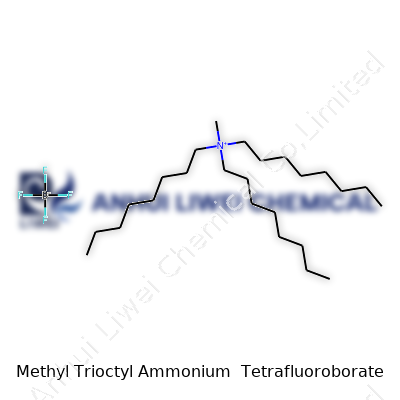
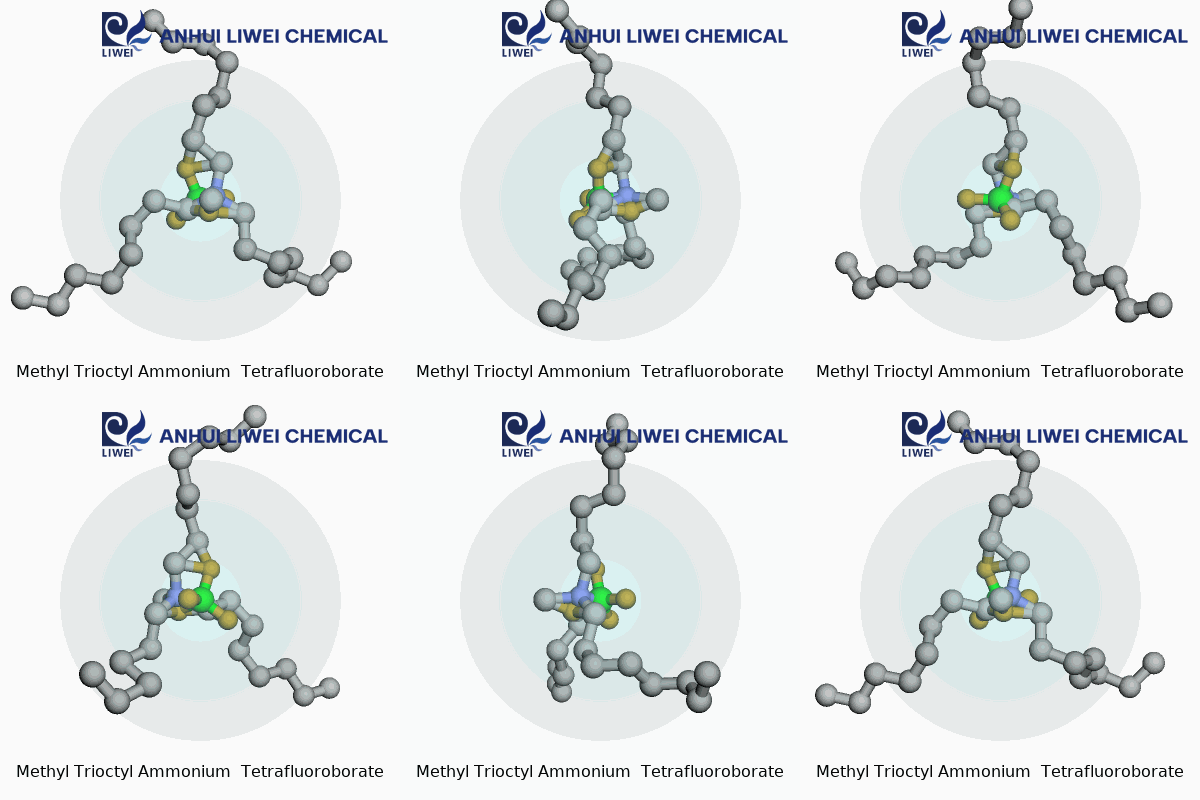
Methyl Trioctyl Ammonium Tetrafluoroborate is a mouthful for a reason—chemistry builds a solid reputation for long names that describe exactly what’s going on. This compound, with the formula C25H56N·BF4, sits in a class known as quaternary ammonium salts. In plain language, picture a central nitrogen atom surrounded by three octyl groups (each an eight-carbon chain) and one methyl group (a single carbon). The nitrogen grabs onto those, becoming the positively charged “cation.” The negative side of the equation comes from the tetrafluoroborate anion (BF4-), a group that’s got one boron hugged by four fluorine atoms.
Why Does Structure Matter?
This pairing of a hefty organic cation and a snug, stable anion packs a handful of uses. I’ve seen research labs consider chemicals like this not because they love the name, but because of the unique properties that pop out from the arrangement of each atom. The three octyl chains bring a lot of flexibility and make the compound much more soluble in organic solvents than in water. That quality turns out to be a big deal if you’re trying to pull off tricky chemistry where standard salts just won’t cut it.
On the practical side, tetrafluoroborate’s stability shakes up the story. Some anions like chloride or nitrate can stick their noses where they don’t belong during reactions, causing side products. Tetrafluoroborate, though, keeps a low profile, doing its job without getting in the way. That subtlety makes it reliable for tasks that need clean results—something those of us who’ve measured yield and purity on lab benches truly appreciate.
Real Applications Aren’t Just Theoretical
Working with ionic liquids, I found that Methyl Trioctyl Ammonium Tetrafluoroborate shows up as a star contestant. Ionic liquids—essentially, salts that stay liquid at or near room temperature—have started popping up everywhere, from battery research to green chemistry processes. Their low volatility means less risk of breathing in nasty fumes. The hefty tail of trioctyl groups in this compound adds to the “liquidity,” giving it serious potential in solvent extraction.
Extracting metals from solutions, separating organic from inorganic mixtures, even supporting transition-metal catalysts—each one demands something special from its players. Methyl Trioctyl Ammonium Tetrafluoroborate fits in when you need a combination of chemical resistance, stability, and solubility.
Safety and Responsibility
Wearing lab gloves, I’ve seen how essential it is to approach new salts with respect. The fluorine content in the anion increases chemical robustness but also brings toxicity risks if handled carelessly. Industry and academia both share the responsibility to train users—reading up on material safety data sheets and using good ventilation always top my to-do list with chemicals like these. Strong ethics in the lab go hand in hand with discovery.
Solving Current Challenges
Market growth for ionic liquids could boom if scale-up strategies become greener and less expensive. I’ve seen renewable feedstocks start making a dent in the field, shaping the way complex compounds are synthesized. Better process safety, more recycling of waste streams, and ongoing research into reducing fluorine content all look promising. The science points toward safer, cleaner chemistry, but it takes experienced hands and real commitment to quality.
Chemical names might seem abstract, but the impact of Methyl Trioctyl Ammonium Tetrafluoroborate reaches well beyond the textbook. Knowing the story behind the structure shapes everything from safe handling to breakthrough innovations.
Why Storage of Chemicals Like This Matters
Methyl Trioctyl Ammonium Tetrafluoroborate probably looks like a mouthful, but to anyone who’s worked in a lab or with specialty chemicals, it all comes down to one thing: safety depends on storage as much as on handling. Years ago, when I worked at a small research lab, we learned the hard way that improper storage doesn’t just cause inconvenience — it can lead to ruined experiments and big safety headaches.
This compound serves as an ionic liquid or phase-transfer catalyst in many chemical syntheses, so it regularly crops up in labs working with organics or electrochemistry. Its unique properties—stability at higher temperatures and low volatility—make people believe it’s more forgiving than it actually is.
Moisture, Light, and Temperature: The Real Enemies
Every chemist has seen what a little damp air can do to the wrong compound. Methyl Trioctyl Ammonium Tetrafluoroborate reacts slowly with water, and the tetrafluoroborate side isn’t immune to hydrolysis. Left exposed, the result might be slow decomposition with the formation of boric acid or even toxic hydrofluoric acid. Once, after a graduate student left the lid off overnight, we discovered sticky residue and a sharp odor the next morning—it forced us to throw out the whole batch.
That’s why dry, airtight containers matter. Glass with Teflon-lined caps resists corrosion and blocks air moisture. Polypropylene or polytetrafluoroethylene containers also provide good protection, so long as the seal stays tight.
Direct sunlight or strong room light kickstarts degradation in some ionic liquids, and tetrafluoroborates won’t fare any better. Store the bottles away from windows on a stable, shaded shelf or in a dark cabinet.
Most guidance recommends keeping this compound at cool room temperature. While refrigeration keeps the compound from decomposing, the constant in-and-out movement can cause condensation inside the bottle if things aren’t fully sealed. On the other hand, leaving it close to a heat source or in a hot room can break down the structure and potentially produce dangerous byproducts.
Labeling, Segregation and Good Habits
Without proper labeling, even the cleanest shelf system falls apart fast. Clear, chemical-resistant labels must show full chemical names, date received, and expiry date. Any sign of a damaged label means taking a minute to replace it.
Don’t group strong acids or bases, reactive metals, or oxidizers near this compound. I once saw incompatible materials stored together, causing tales of “smoking bottles” and spilled messes. Keep Methyl Trioctyl Ammonium Tetrafluoroborate on a shelf designated just for phase transfer catalysts or similar organic salts.
Spills can happen to anyone—always have material specific spill kits and plenty of gloves ready. Never taste, touch, or directly inhale the material even if it “looks safe.” Washing hands after handling should be automatic behavior, not just for lab exams.
Making Storage Safer for Everyone
Science doesn’t forgive carelessness. A safety culture in any facility emerges from repeated training, good signage, and routine checks. Make a checklist for weekly inspections and keep records of checks and container conditions.
If budget allows, invest in a ventilated chemical cabinet. Routinely update safety data sheets and make sure new team members know exactly how this compound gets treated from delivery to disposal.
Smart storage protects workers, preserves research results, and cuts costs from accidental loss. Every careful step matters in building a safer laboratory life.
Understanding Where It Dissolves—and Why It Matters
Every laboratory that works with quaternary ammonium salts runs into solubility questions. Methyl trioctyl ammonium tetrafluoroborate isn’t a household name, but in research circles, it sparks plenty of debate about how to handle and use it. Many folks want a straight answer: Can you dissolve it in water or will you get better results with organic solvents?
Water Just Won’t Do
Chemists I know often try to use water as their default solvent. It’s cheap, safe, and nearly everyone’s got a bottle on the bench. For methyl trioctyl ammonium tetrafluoroborate, though, water doesn’t cut it. This salt relies on three octyl groups attached to the nitrogen atom, making its structure long and oily. Tossing it in water leaves you staring at undissolved clumps. There’s science behind that. Water molecules stick tightly to each other, favoring ions with a smaller, more polar structure. Those big, greasy octyl chains just can’t break into the party.
Organic Solvents Open Up Possibilities
Switching to an organic solvent changes things. Take dichloromethane or chloroform. In these, the salt disappears almost right away. The hydrophobic nature of those octyl chains blends with the solvent, easing the salt into solution. In my own lab, I remember watching this play out. While water left white flakes at the bottom, a swirl of dichloromethane created a clear, colorless solution in seconds. Researchers with experience in ionic liquids or extraction chemistry have seen this pattern with many large alkyl ammonium salts. It’s not unique, but it’s important.
How Solubility Shapes Application
Few people fuss over these details unless they run into problems. Solubility, though, spells success or failure for projects in separation science and electrochemistry. This salt gets used for phase transfer catalysis, ion exchange, and as an ionic liquid. In my experience working with liquid-liquid extractions, picking the right solvent didn’t just save time—it determined if I could even finish the work.
For example, extractions run smoother if the salt prefers the organic phase. This means contaminants move where we want them, and recovery steps don’t drag on. In battery research, solubility in organic electrolytes defines shelf life and performance. If the salt clumps up or separates, reliability suffers.
Weighing Risks and Seeking Alternatives
Jumping toward organic solvents means people now have to think about health and environmental risks. Chloroform and dichloromethane, common choices for dissolving these salts, pose safety hassles. I’ve watched labs overhaul ventilation or track exposure closely, just to keep up with regulations. This brings up a need for better options—either less hazardous solvents or alternative salts that work in safer media. Green chemistry pushes chemists to keep searching for molecules that play nice with water or at least nontoxic organic compounds.
So the answer feels pretty clear-cut: methyl trioctyl ammonium tetrafluoroborate sticks with organics and snubs water. This quirk frustrates some, yet it shapes how scientists build cleaner, safer, and more effective processes. Every time I look down at a flask and see solution instead of sediment, I’m reminded how much these basic properties guide the bigger picture in chemistry.