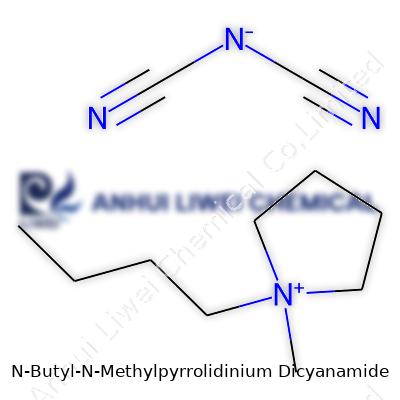
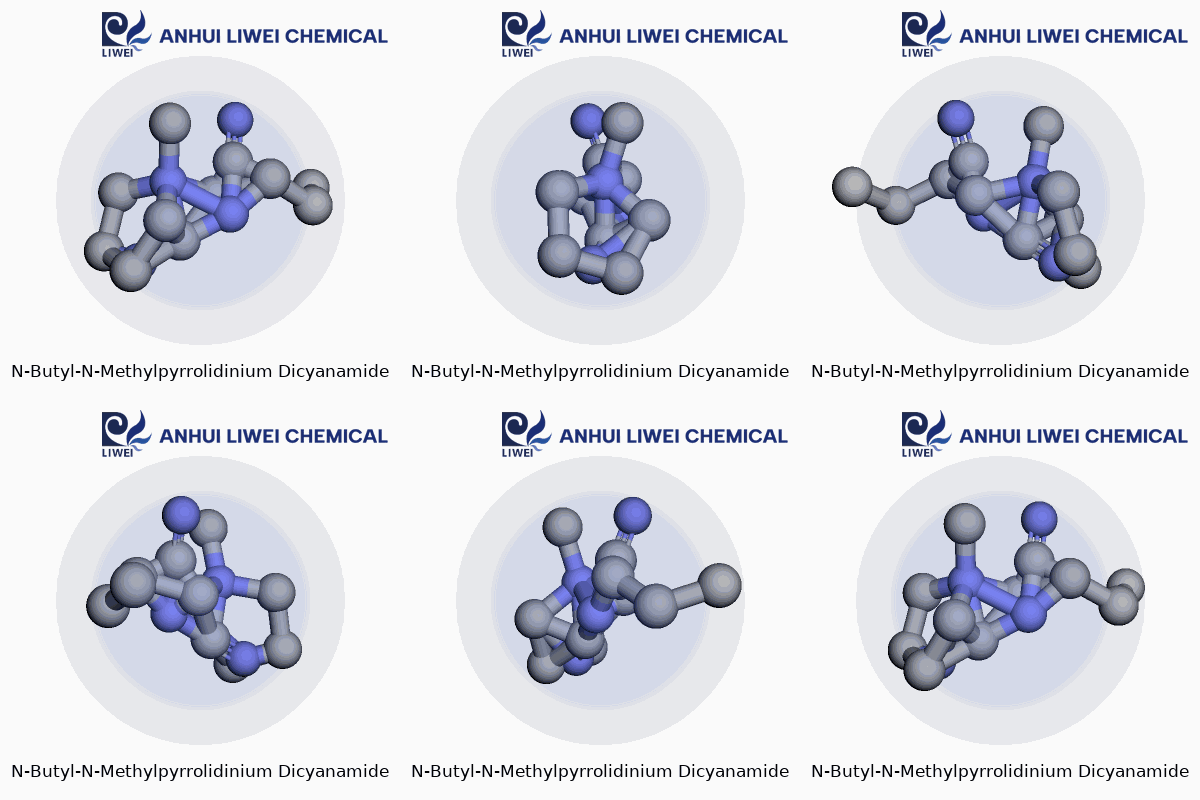
N-Butyl-N-Methylpyrrolidinium Dicyanamide: Exploring a Modern Ionic Liquid
Historical Development of N-Butyl-N-Methylpyrrolidinium Dicyanamide
This ionic liquid emerged from the wider movement toward room-temperature molten salts, often celebrated for transforming how chemists think about solvents. Scientists began exploring ionic liquids in the late 1990s, seeking alternatives to volatile, hazardous organic solvents. The arrival of N-butyl-N-methylpyrrolidinium dicyanamide marked a turning point. Researchers appreciated its low melting point, strong electrochemical window, and the lower toxicity compared to first-generation ionic liquids. Publications started pouring in from East Asia, North America, and Europe—each suggesting tweaks in preparation and hinting at fresh uses in clean energy and separation science. Its accessibility improved, with small startups and established chemical firms bringing high-purity versions to the market by the early 2010s. The journey reflects a larger trend of chemistry shifting toward sustainability, where reducing environmental and workplace risks shapes which compounds move out of the lab and into factories.
Product Overview and Synonyms
You might see N-butyl-N-methylpyrrolidinium dicyanamide go by a few names: BMP-DCA and [BMPyrr][DCA] show up in catalogs and research papers. This salt combines the pyrrolidinium cation with dicyanamide anion, delivering a stable material with huge promise for both academics and industry. Companies label it according to its molecular structure, and technical datasheets come with detailed breakdowns of purity and suggested handling practices. While the full IUPAC name can get unwieldy, most researchers just say BMP-DCA in conversation and reporting. Packaging usually comes in amber glass bottles, sealed and nitrogen-flushed to guard against moisture that could impact stability.
Physical and Chemical Properties
On the lab bench, N-butyl-N-methylpyrrolidinium dicyanamide appears as a clear, oily liquid under normal conditions. It boasts a melting point below room temperature, making it incredibly easy to handle without complex heating or cooling setups. Its viscosity clocks in lower than many other ionic liquids, which helps when trying to transfer it or mix with other solvents. The compound resists ignition and doesn’t evaporate, which makes it safer around open flame or under ambient conditions. It dissolves polar and nonpolar materials, a feature that makes it valuable for extracting or dissolving a wide range of compounds. Ionic conductivity sits on the higher end, fitting it well for electrochemical experiments or battery research. Thermal stability is impressive; it sustains performance past 200 degrees Celsius in most systems, even under a constant current or voltage.
Technical Specifications and Labeling
Manufacturers set tight controls over water content, reporting less than 0.5% by mass. Purity levels usually top 98%, and contamination with halide or metal ions can compromise use in sensitive applications like battery electrolytes. Labels carry hazard warnings related to toxicity and proper storage. Batch numbers, CAS number, and recommendations for shelf-life fill out a typical label, with dates of manufacture and expiration ensuring traceability. Every shipment comes with a certificate of analysis that covers appearance, pH, and impurities. In regulated workplaces, users log the lot and storage temperature. Few staff ever forget the first training on how cross-contamination puts complex experiments at risk—every user soon learns the cost of cleaner, safer setups.
Preparation Method
The most reliable way to make N-butyl-N-methylpyrrolidinium dicyanamide uses a straightforward metathesis reaction. Makers mix N-butyl-N-methylpyrrolidinium chloride with sodium or potassium dicyanamide in water. After stirring at room temperature, the ionic liquid floats out or settles to the bottom, depending on relative density. Several washes with an organic solvent like dichloromethane or ethyl acetate remove traces of the metal chloride salt. Finally, vacuum drying strips out moisture and light-extractable impurities. Scale-up demands some practical tricks. Large glass reactors or custom steel tanks hold the temperature steady and keep out oxygen or water, both of which could limit quality or lead to byproducts. In my own experience, impeccable technique in the washing and drying steps decides whether the final product meets electrochemical spec.
Chemical Reactions and Modifications
BMP-DCA doesn’t just act as a silent medium; it sometimes joins the action. The dicyanamide anion survives contact with many metals, but high-temperature reactions or potent oxidizers can degrade it to cyanogen compounds or nitrogen gas. Alkylating or arylating the pyrrolidinium ring tunes hydrophobicity or boosts viscosity. Chemists like to link BMP-DCA to polymer backbones for battery membranes or as part of supported ionic liquid phases in catalytic columns. Adding functional groups to either side—cation or anion—makes it fit emerging niches, whether in anti-static coatings or more exotic uses like carbon capture. My own lab found the addition of electron-donating groups on the cation changed extraction properties, giving more selectivity in rare earth metal recovery.
Safety and Operational Standards
BMP-DCA draws respect in the lab for better safety characteristics than many organic solvents, but that never means a free pass. Splashing this liquid onto bare skin calls for immediate washing, as it may cause irritation after prolonged exposure. Inhalation can’t be ignored: even odorless compounds may pose risks, and fume hoods or local exhaust systems ought to stay in use. I’ve seen safety data sheets point to environmental concerns if large amounts spill; ionics liquids like this often resist standard wastewater treatment, making containment critical. Personal protective equipment—nitrile gloves, protective eyewear, and lab coats—provide the basic layer of safety, and responsible chemists keep quick-acting spill kits close.
Application Area
The true beauty of BMP-DCA comes alive with its range of uses. Electrochemists turn to it as a non-flammable, stable electrolyte for supercapacitors and batteries, especially where lithium and sodium systems demand wide operational windows. Chemists testing green solvent strategies lean on its superb solubilizing features, which lower waste and limit worker exposure to hazardous fumes. Absorption chillers found in industrial cooling benefit by exploiting the material’s thermal stability, while researchers in separation science use it to dissolve stubborn organic molecules for high-efficiency extractions. Laboratory tests for chemical recycling embrace BMP-DCA thanks to its reusability and low volatility.
Research and Development
From the start, academic and corporate teams dove into BMP-DCA with high hopes for sustainability. Publications feature studies measuring ionic conductivity, probing compatibility with novel electrode materials, or tweaking synthesis routes to bring down cost and minimize waste. Development projects keep branching out—membranes made with embedded BMP-DCA are being tested for advanced batteries, while catalytic processes that hinge on unique ionic liquid mixtures aim to replace traditional solvents in bulk chemical production. I remember reviewing a grant built around using BMP-DCA to extract precious metals from spent electronics: the compound's stability against air and strong acids carried the technology over key hurdles. Such R&D reflects real momentum—researchers keep pressing, looking for breakthroughs in efficiency, durability, and environmental friendliness.
Toxicity Research
BMP-DCA fares better than most solvents used a generation ago, but its environmental fate isn’t trivial. Toxicological studies in mammals and aquatic environments suggest a lower acute toxicity than many halogenated solvents, yet chronic exposure leaves open questions. Scientists track how the dicyanamide anion, once released, moves through water and transforms under sunlight and biological action. Early animal studies hint at manageable health risks if handled with respect, yet regulators demand longer-term environmental data before clearing this compound for unrestrained industrial use. In some tests, low concentrations still led to changes in cell viability, raising a flag for handling it with care in both lab and plant settings. I’ve seen labs build secondary containment and specific waste streams just for ionic liquids—proactive moves ahead of regulation, steering clear of legacy pollution challenges tied to earlier synthetic solvents.
Future Prospects
N-butyl-N-methylpyrrolidinium dicyanamide stands on the edge of broader adoption as the world looks for safer, greener, and more reliable chemicals. Future work centers on understanding its full environmental profile, scaling up cost-effective production, and unlocking fresh applications in batteries, catalysis, and separation technology. As startups and multinational firms race to develop circular recycling for complex waste streams, BMP-DCA may play a growing role as the workhorse ionic liquid in closed-loop systems. My experience tells me that when real-world industrial trials meet careful R&D, transformations happen—reducing waste, saving money, and cutting risks for people and the environment. BMP-DCA belongs to a new wave of chemicals that could help re-write the rules for clean chemistry in the decades ahead.
Understanding the Chemical's Place in Modern Applications
N-Butyl-N-Methylpyrrolidinium Dicyanamide, a name that rarely gets much attention outside of specialized labs, drives progress in fields quietly shaping the future. Folks who work with advanced batteries, high-performance lubricants, and electrochemical devices have reason to pay close attention to this compound. While many chemicals land in categories like "solvent" or "additive" and go unnoticed, this one does things few others can manage.
Why Industry Relies on This Compound
Walk through any facility researching energy storage and you'll see whiteboards filled with ionic liquid structures. N-Butyl-N-Methylpyrrolidinium Dicyanamide stands out for its ionic liquid properties. It doesn’t evaporate quickly, barely sparks a flame, and can run at higher voltages than water-based or organic solvents. Battery designers run up against limits—the thicker you pack in energy, the harder it gets to keep things safe and stable. Here, ionic liquids step up to the plate. They let engineers use lithium-ion batteries at more demanding conditions, since they resist overheating and dropping in performance.
Laboratories experimenting with supercapacitors and next-generation energy storage push ionic solutions like this one for another reason: low volatility. Less chance of gas build-up, fewer worries about leaks—everything ticks along smoother over long cycles. Many researchers cite how these mixtures extend the life of their cells, meaning fewer replacements and less waste in the long run.
Benefits in Lubrication and Grease Formulations
Those who fix machines know the value of a lubricant that holds up under stress and temperature changes. Standard oils break down; residues replace smooth motion. With the right ionic additions, machinery in tough environments—like power plants or wind turbines—lasts longer and needs less maintenance. N-Butyl-N-Methylpyrrolidinium Dicyanamide blends into specialty greases where conventional molecules can’t stand up to the heat or pressure. It helps reduce friction so less energy vanishes as heat. This difference matters to anyone running heavy equipment that can’t afford downtime.
Potential Health and Safety Concerns
With all the promise, no responsible lab or factory skips over safety. Dicyanamide-based compounds prompt close study, since nitrogen-containing anions can raise eyebrows for toxicity. Regulatory agencies keep a watchful eye on how these chemicals are handled. Gloves, fume hoods, and regular training prevent accidents. The long-term environmental impact is still under debate, though early studies suggest safer profiles than many legacy solvents.
Challenges and the Path Forward
Supply chains play a big part too. Sourcing enough pure material has always meant working with reliable chemical suppliers, especially with new interest in clean energy. Some companies face cost hurdles; others find creative recycling options to recover used liquids. The focus stays on reducing environmental impact, both from production and end-of-life management. Every new regulatory standard pushes manufacturers to innovate, cut waste, and tune chemistry for fewer side effects.
Shaping the Future of Materials Science
N-Butyl-N-Methylpyrrolidinium Dicyanamide shows how unsung chemistry works behind the scenes in modern tech. From powering greener batteries to protecting the world’s infrastructure, compounds like these hold quiet power—pushing industries toward safer, longer-lasting solutions. Every time a new device charges a little faster or a wind turbine runs a little longer, expect some advanced chemistry making it possible.
Diving into the Nature of the Compound
N-Butyl-N-Methylpyrrolidinium Dicyanamide brings a reputation for stability and utility in fields craving innovation, like advanced batteries and specialized solvents. What sets this compound apart is not just its tongue-twisting title, but a combination of distinctive physical and chemical features. Grasping these helps anyone looking at the future of green chemistry or safer electrolytes appreciate where it can lead.
Physical Properties that Stand Out
Pour out a small sample of this ionic liquid, and one thing jumps out right away: it’s clear and nearly colorless. With a viscous character, it feels more like syrup than water. Its melting point comes in far below zero degrees Celsius, sometimes as low as −20°C, so it doesn’t freeze up in cold environments. Room temperatures keep it liquid, which opens doors for a range of uses.
Scent is faint, and it rarely evaporates like typical organic solvents. Its low vapor pressure signals minimal volatility. Handling it in a lab doesn’t slap you with strong odors, reducing concerns over inhalation compared to common chemicals like acetone or ether. Density puts it in the ballpark of 1 g/cm3; you won’t see it separating from water or oil without effort.
Chemical Properties Shaping its Role
This compound carries a positive pyrrolidinium cation and a negatively charged dicyanamide anion. Both bring unique chemistry. The dicyanamide part delivers good thermal stability, letting the ionic liquid withstand repeated heating to 200–300°C without breaking down. It also softens the compound’s flammability. Compared to classic solvents, the risk of ignition drops by several notches, making it a safer bet in applications where heat or electrical sparks are present.
Chemists who tinker with electrolytes recognize another perk: N-Butyl-N-Methylpyrrolidinium Dicyanamide barely reacts with metals. This helps it play a role in high-performance batteries or electrochemical devices, limiting the formation of unwanted byproducts. Its ions migrate efficiently without corrosive tendencies, staying stable alongside lithium or sodium for longer stretches.
Why these Properties Matter
Society moves toward greener tech, and every property of this compound nudges things that way. Traditional solvents often cause headaches because of their low flash points and toxicity. Here, both of those problems shrink. Thermal stability gives engineers more freedom to push for durable designs. Low volatility cuts down on emissions, limiting both air quality impacts and fire risks.
In my own experience working in academic electrochemistry labs, switching from volatile organic electrolytes to ionic liquids like N-Butyl-N-Methylpyrrolidinium Dicyanamide instantly improves air quality and reduces spill-related anxiety. Cleanup becomes easier without those rooms filled with unpleasant odors or flammable fumes. That kind of atmosphere helps students and young scientists focus on research, not on constant safety drills.
Tackling Remaining Hurdles
No compound solves every issue. The high viscosity sometimes slows down ion movement, posing a hurdle for fast-charging batteries or large-scale applications. Some production processes for dicyanamide salts still depend on chemicals with environmental baggage. To move forward, chemists look for tweaks—tuning side chains, blending with other liquids, or finding new synthesis routes that drop solvent waste and harsh reagents out of the equation.
Facts and experience both point toward a growing spot in the toolkit for N-Butyl-N-Methylpyrrolidinium Dicyanamide. With more work, especially in green production and design, this compound can help pave the way for safer and longer-lasting devices that power the next era of technology.
Understanding the Chemical
N-Butyl-N-Methylpyrrolidinium Dicyanamide looks like a mouthful, but it’s just an ionic liquid that’s popped up in labs and a few specialty industries over the years. Odd names aside, it’s become a popular choice because it stands up to heat and dissolves a broad range of materials. Experimenters prize the stuff for green chemistry projects and electrochemical applications, and the trend shows no signs of slowing down. Curiosity about what this material does to our health, or the environment, makes perfect sense.
Digging into Toxicity and Exposure
Nobody wants a dangerous chemical lurking in their workspace or products. N-Butyl-N-Methylpyrrolidinium Dicyanamide doesn’t get handed out with a skull-and-crossbones sticker, but that’s no excuse to let your guard down. A handful of studies weighed in on the basic hazards. The substance tends not to catch fire easily – a plus for anyone who’s dribbled solvents before – and it doesn’t reek like ammonia or cause immediate eye-watering in open air.
Digging deeper, toxicologists have raised eyebrows about the dicyanamide half of its structure. Dicyanamide-based ionic liquids have shown some toxicity to aquatic life in controlled environments, affecting organisms like fish embryos and water fleas at lower concentrations than you might expect. Chronic exposure in the environment could impact soil and waterways, so the story doesn’t end at the sink drain.
Health Impact (And the Gaps)
Working day in and day out with chemical solutions reminds anyone to take health risks seriously. Direct information about N-Butyl-N-Methylpyrrolidinium Dicyanamide’s effects on people is thin – the data mostly lives in studies on the broader class of ionic liquids. A couple of published reports note that skin or eye contact can bring irritation, especially with repeated exposure. There’s limited data about how this material acts inside the human body. No major regulatory body slapped it with a cancer warning, but that doesn’t rule out lesser chronic effects or risks in case of accidents.
Safety labels in labs usually come from test results on rats, fish, or tiny water bugs. N-Butyl-N-Methylpyrrolidinium Dicyanamide doesn’t score nearly as high on acute toxicity as something like formaldehyde or toluene, yet it’s not as nontoxic as plain table salt either. The jury’s out for now, but anyone who’s spent time cleaning up after an exposure knows irritation sometimes catches up later.
Taking Steps to Stay Safe
Lab safety folks have taught me to never trust a chemical just because the label doesn’t scream danger. Gloves and goggles go on, splash shields come up, and everything gets tracked from storage to disposal. Fume hoods and proper waste containers matter most for keeping exposure low and spills contained.
Beyond lab work, it makes sense for manufacturers to consider closed systems, regular training for workers, and clear emergency plans. Anyone using N-Butyl-N-Methylpyrrolidinium Dicyanamide off the lab bench ought to push for more long-term studies and environmental monitoring. Keeping an eye on wastewater runoff and workplace air quality helps keep surprises at bay.
Moving Toward Safer Solutions
I’ve learned that every novel chemical brings a mix of promise and caution. Ionic liquids like N-Butyl-N-Methylpyrrolidinium Dicyanamide help push science ahead, but the smartest teams ask tough questions and keep safety at the front. It takes commitment from researchers, regulators, and manufacturers to make sure progress doesn’t introduce hidden risks, especially with limited health data in the public record.
Getting Acquainted With This Chemical
N-Butyl-N-Methylpyrrolidinium Dicyanamide doesn’t show up on the ingredient list at the local grocery store, but it finds purpose in labs working with ionic liquids. This kind of material supports electrochemistry projects and advanced battery research, so many researchers need it close at hand. Storing and handling such chemicals in day-to-day routines comes with practical realities. Keeping things safe isn’t about blind obedience to a rulebook; it’s about understanding what this stuff can do, how it could hurt you, and how best to keep risk out of the daily workflow.
Storage Basics: Clean, Dry, and Stable
Liquids that bring nitrogen compounds and organic solvents to the table ask for dryness. Any moisture works against stability, and with dicyanamide ions present, you don’t want accidental reactions. Humidity control in the storage area makes a real difference. Tight-sealing bottles or drums, marked with the chemical’s name and appropriate warnings, tell everyone what’s inside. People I’ve worked with have always set aside shelves just for these ionic liquid bottles—in unbreakable containers far from water or food supplies—sometimes even fitted with secondary plastic tubs in case of breakage. Transparent plastic bins or lockers work well since they’re easy to check for leaks and spills.
Room temperature usually does the trick, but direct sunlight heats up containers and messes with chemical stability. Some types of ionic liquids hold up well, but anytime light or warmth can mean risk, play it safe. One of my old labs even stuck a thermometer near the chemical shelves and kept a paper log so temperature swings could get flagged before problems started.
Everyday Handling: Hands, Eyes, and Awareness
Dicyanamide compounds aren’t the sort you want on your skin. Nitrile gloves go on before lids come off, and lab coats keep sleeves safe. Chemical splash goggles stay nearby too, even if you think “just a drop” isn’t risky. During one routine weigh-out, a tiny amount splashed from a pipette and landed on my glove—a quick wipe and glove change prevented any skin contact. That moment sticks with me, and now I double-check my grip and container stability every time.
Ventilation matters, even if people say ionic liquids have low vapor pressure. If you ever worked in a room where something evaporated unnoticed, you know unexpected fumes cause headaches fast—using a fume hood or open window pays off for everyone in the lab, especially during transfers, mixing, or cleanup.
Disposal and Accidental Spills: Be Ready, Not Sorry
Old habits build from near-misses and tight routines. If a bottle cracks or contents hit the bench, paper towels alone rarely do the job. Absorbent pads made for chemical spills work better, and keeping a neutralizing agent meant for nitrogen-containing solvents nearby brings peace of mind. My colleagues and I always labeled a “spill kit” with a bold sign, so nobody wastes time searching during an emergency.
Pouring unused N-Butyl-N-Methylpyrrolidinium Dicyanamide down the sink isn’t an option—proper hazardous waste containers and logs handle the leftovers. Environmental protection rules aren’t just red tape; they come from past mistakes where chemicals like this leaked and hurt water systems. I remember a time when just one careless pour in a teaching lab led to big cleanup bills and harsh lessons from local regulators.
Building Habits That Last
Nobody starts out knowing all the details about chemical safety. Trust grows from watching how senior lab members handle everyday risks and taking training seriously. For anyone new to chemical storage, I always say: slow down, read the safety sheet, and practice the basics until they become second nature. Small routines—like labeling, double-checking seals, a daily walk-through of the storage shelf—turn into the habits that keep everyone safe, even on hectic days when the lab’s full and projects pile up.
Shifting the Landscape of Electrolyte Development
Battery technology keeps most of our gadgets running, but figuring out safer and more efficient electrolytes remains a struggle. Over years of reading research and chatting with chemical engineers, one material keeps coming up: N-Butyl-N-Methylpyrrolidinium Dicyanamide. Unlike those flammable, sometimes toxic solvents common in older lithium-ion designs, this salt-based ionic liquid calms down energy storage, making it a fit for safer, stable battery labs. Engineers working on cutting-edge batteries use this compound in lithium-ion cells, aiming for longer lifespans and less risk of overheating. Studies led by independent groups in Japan and Europe have shown that cells using this ionic liquid resist fire and last through more charge cycles. This means less waste and, hopefully down the road, a safer way to store power at home and on the grid.
Transforming Green Chemistry
My time watching chemical manufacturing shift to less polluting processes taught me the importance of creative solvent choices. Traditionally, scientists relied on harsh chemicals to dissolve reactants and run extractions — not great for worker health or the planet. N-Butyl-N-Methylpyrrolidinium Dicyanamide steps in as a less toxic alternative, used as a task-specific ionic liquid for extractions, catalysis, and separation. By replacing hydrocarbon solvents, chemists cut VOC emissions and make workplaces safer. For instance, research shared by the Royal Society of Chemistry found that dye extraction, which usually leaves a trail of contaminated water, saw better results and fewer waste products by using this ionic liquid. That matters when you look at how much water gets trashed in industries like textile dyeing.
Solving the Heat Problem in Electronics
If you’ve felt a laptop heating up on your knees, you know electronics run hot. Cooling those systems demands stable liquids that don’t just boil away under stress. Speaking with an old college friend who now works on industrial cooling loops, I learned this material gets pumped through certain prototype electronics and high-performance equipment. Its thermal stability and low volatility keep electronics operational without constant maintenance. Because it’s less reactive and stays liquid longer, this compound beats out water or simple oils for heat transfer in specialized settings. These features translate to less downtime and lower risks for big server farms and telecom infrastructure.
Playing a Role in Analytical Science
Solvents and additives in analytical labs need to stay out of the results, avoiding contamination at all costs. This ionic liquid meets the demands for clean, predictable performance in chromatography and mass spectrometry. University labs report that samples dissolved in it show fewer “ghost peaks” in readouts — basically, it behaves itself and doesn’t skew the numbers, so researchers spend less time troubleshooting bad data. That’s essential in clinical testing and drug discovery, where accuracy spells the difference between useful findings and costly reruns. In my visits to research labs, the most respected teams always put reproducible results ahead of sticking with traditional chemicals.
Supporting Safer Workplace Environments
Many solvents carry serious safety risks. Replacing them with N-Butyl-N-Methylpyrrolidinium Dicyanamide lowers exposure to flammable and hazardous fumes, which means quieter alarms in chemical plants and less stress for safety officers. Handling and storage get easier because this material stays stable at room temperature for months — fewer spills, fewer headaches, and better peace of mind for workers who handle tanks and vats every day.