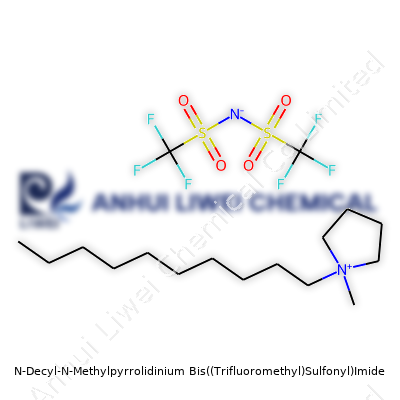
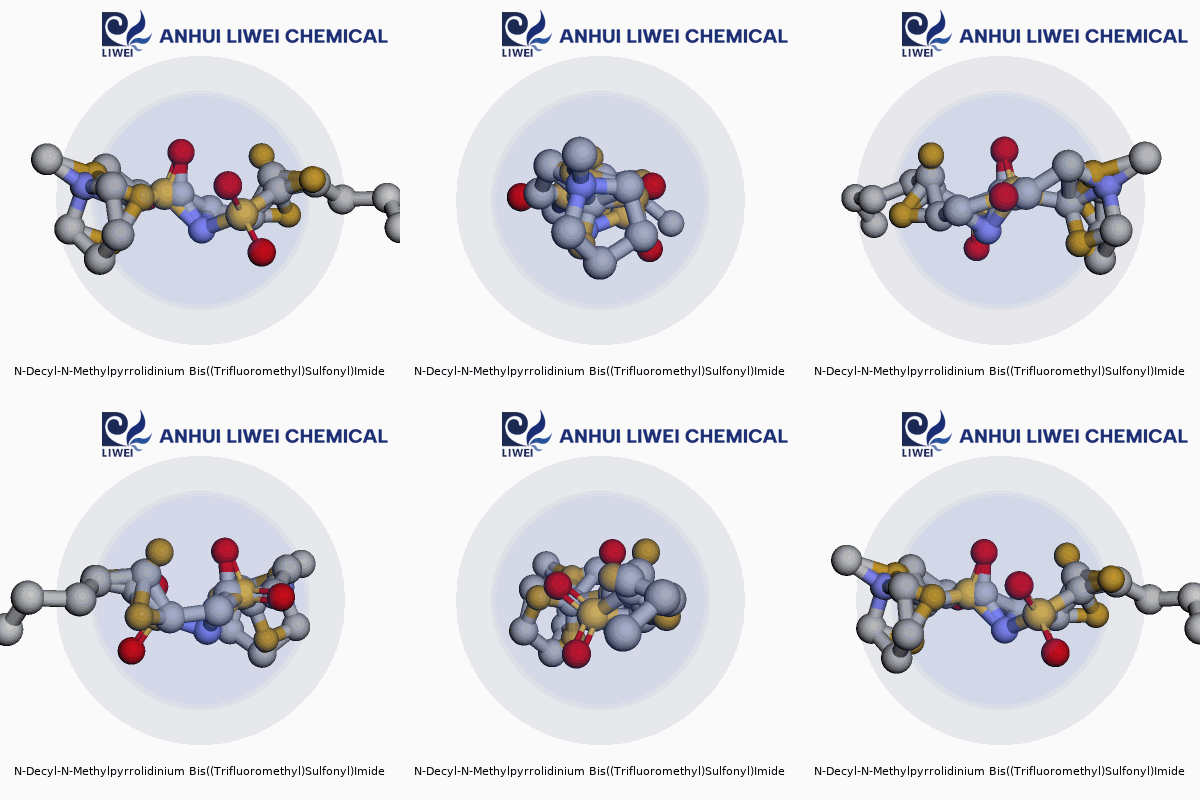
N-Decyl-N-Methylpyrrolidinium Bis((Trifluoromethyl)Sulfonyl)Imide: In-Depth Commentary
Historical Development
Decades ago, the search for better solvents nudged researchers towards the world of ionic liquids. In the early 2000s, curiosity focused on the family of pyrrolidinium-based salts because of their low volatility and high electrochemical stability. As folks dug deeper, someone figured out locking a decyl group and a methyl group onto the pyrrolidinium ring could create a winning recipe, especially after pairing the cation with the tough-to-beat bis((trifluoromethyl)sulfonyl)imide (TFSI) anion. This combination wasn’t just a lab oddity; the resulting ionic liquid brought something extra—remarkable thermal and chemical resilience, paired with the kind of performance that grabs the attention of energy storage and materials scientists. Over the years, journals filled up with studies detailing the properties and uses of this compound as more researchers tuned its structure to unlock fresh applications.
Product Overview
N-Decyl-N-Methylpyrrolidinium Bis((Trifluoromethyl)Sulfonyl)Imide appears as a clear or slightly yellow viscous liquid, carrying the typical heft of ionic liquids but sparing users the sharp, irritating scent you’d find in many organic solvents. Commercially, you find it offered in varying grades, from battery-grade to general laboratory purposes. Its blend of high hydrophobicity and low conductivity, compared to shorter alkyl chains, slots it into a diverse range of processes: electrolytes in advanced batteries, solvents for difficult organic transformations, and even as heat transfer fluids. Users get a compound that sidesteps many of the regulatory headaches tied to volatile organics, making it a modern tool for labs and pilot plants.
Physical & Chemical Properties
The dense structure of the compound stems from its long alkyl chain, ramping up both molecular weight and viscosity compared to its shorter relatives. It packs a melting point well below room temperature, often clocking in around -15 °C, and its decomposition temperature hovers well above 350 °C. Solubility extends mostly to nonpolar solvents—water does not easily dissolve it, a trait likely shaped by the decyl chain—and this helps prevent unwanted reactions in moisture-sensitive setups. The electrical conductivity isn’t among the highest in the class, though the broad liquid-phase window earns it a spot in demanding electrochemical environments. TFSI’s influence can’t be overstated: this anion makes the salt non-coordinating and tough against both acids and bases. If a chemist values stability under stress, this compound hangs tough.
Technical Specifications & Labeling
Any proper product listing should spell out at least 98% purity for N-Decyl-N-Methylpyrrolidinium Bis((Trifluoromethyl)Sulfonyl)Imide, though higher is common for energy or analytical uses. Water content usually sits below 0.1%, since trace moisture can foul up sensitive experiments. Color may be reported using APHA standards while heavy metals stay below single-digit ppm levels. CAS numbers like 79922-45-1, alongside batch number, manufacturer, and lot analysis, help users track the source and quality. Regulatory markings—REACH compliance for Europe, TSCA for the United States—usually show up on labels since modern labs and companies won’t take chances with unknown provenance or legal ambiguities anymore. MSDS sheets must cover handling, toxicity data, and emergency procedures, as regulatory bodies now expect detailed risk disclosures for ionic liquids.
Preparation Method
Lab-scale synthesis starts by reacting N-methylpyrrolidine with decyl bromide, producing the corresponding N-decyl-N-methylpyrrolidinium bromide via alkylation. After purification by recrystallization or repeated washing, metathesis enters the picture: the bromide salt is stirred with lithium bis((trifluoromethyl)sulfonyl)imide in water or an organic solvent. Insoluble lithium bromide is filtered out, and the ionic liquid—now mostly pure after removal of solvents—needs vacuum drying at moderate heat. Commercial setups scale up by modifying solvent selections and using continuous flow systems for cleaner separations, because every unreacted trace matters at bulk scale. The robustness of the chemistry means yields push toward the high 90s percent, but care is needed during purification to avoid trace halides, which can poison catalysis or battery function.
Chemical Reactions & Modifications
While the core ionic structure resists most chemical abuse, researchers have found that gentle hydrogen abstraction on the decyl chain can introduce minor branching or unsaturation, which tweaks viscosity and melting behavior. For applications needing higher polarity, chemists sometimes append short polar tails to the decyl group to nudge the solubility profile. On the anion side, exchanging TFSI for similar fluorinated species has led to subtle shifts in conductivity and hydrophobicity—smaller tweaks, but sometimes just what a process engineer asks for. The ring’s nitrogen atom, mostly shielded by its mated groups, won’t react easily, but with high heat and strong acids, partial dealkylation takes place—a useful way to reclaim or recycle byproducts. Most new research targets the fine-tuning of side chains, since adjusting those can shift the ionic liquid’s behavior more than swapping building blocks wholesale.
Synonyms & Product Names
People working in electrochemistry often call it [C10mpyr][TFSI], shorthand pointing to a decyl (C10) and methyl group on pyrrolidinium matched with TFSI. Suppliers list it as N-Decyl-N-Methylpyrrolidinium Bis(trifluoromethanesulfonyl)imide, with minor tweaks depending on country or regional spelling conventions—sometimes “bis(trifluoromethylsulfonyl)imide.” The TFSI anion also shows up as NTf2, a label pulled from early patent and research literature. Major suppliers keep to the IUPAC names in catalog entries to avoid confusion for customs regulators or importers, while battery manufacturers and academic journals lean on the notation that keeps chemical formulas succinct.
Safety & Operational Standards
Although N-Decyl-N-Methylpyrrolidinium Bis((Trifluoromethyl)Sulfonyl)Imide skips the flammability and vapor risks tied to traditional organics, nobody should get casual about personal protective gear. Splashed on bare skin or inhaled as atomized mist, the compound can trigger irritation, so gloves, lab coats, and eye protection aren’t optional. Engineering controls like sealed dosing or fume hoods see routine use in pilot plants and research labs. Disposal goes through hazardous organic waste streams, since municipal water treatment can’t break down the TFSI anion; incineration at high temperature offers the safest route. I remember one colleague’s spill on a hotplate: it didn’t go up in smoke, but the cleanup lingered much longer than anticipated because residue clung to every surface. The substance resists biological breakdown, and environmental regulations now require tracking and special containment for large-scale projects.
Application Area
Battery developers searching for more stable electrolytes dig into this compound because its electrochemical window stretches far enough for both lithium and sodium cells. Researchers testing high-voltage cathode materials reach for it, whether pushing cycling stability at 4.5 V or just aiming for longer shelf-life under hot climates. Beyond these, it powers electroplating baths for tough-to-coat metals and finds its way into separation processes, taking advantage of its ability to dissolve both polar and nonpolar organics. Catalysis claims a share of the pie: I’ve seen teams load up precious-metal catalysts with N-Decyl-N-Methylpyrrolidinium Bis((Trifluoromethyl)Sulfonyl)Imide, counting on its nonreactive background to keep the main process on track, plus its ability to dissolve stubborn substrates. In heat transfer and low-volatility lubricants, the high decomposition point and flow properties shine, especially where other fluids foul up pumps or corrode piping.
Research & Development
Efforts to tweak this ionic liquid rarely slow down for long. Teams try extending or shortening the alkyl tails, slotting in unsaturation or adding branching groups, chasing changes in viscosity, conductivity, and solubility. Battery groups partner with membrane researchers, blending the ionic liquid to improve dendrite resistance or up cycling stability. Pharmaceutical chemists explore its use in green extractions or as a reaction solvent for complex scaffolds, hoping to avoid the nasty byproducts of older solvents. Computer modeling steps in now, too, with quantum calculations mapping out ion movement and predicting new ions for even better results. During some projects, I noticed that bench results often matched up with what simulations predicted; this rapid feedback means the time from concept to usable product now moves at a pace old-school chemists only dreamed about. Still, each tweak means new rounds of toxicity and environmental checks, reminding the field it’s not just about speed—but safety.
Toxicity Research
As much as the chemical industry wants new materials, regulatory focus now demands hard answers about toxicity and environmental stability. N-Decyl-N-Methylpyrrolidinium Bis((Trifluoromethyl)Sulfonyl)Imide manages to avoid acute toxicity in most rodent trials, but sub-chronic exposure hints at bioaccumulation—especially given the stubborn stability of the TFSI anion. In cultures and aquatic models, growth inhibition starts at concentrations higher than many industrial chemicals, though caution flags rise when long-chain pyrrolidinium ions show up in bioaccumulation studies. The deep hydrophobicity makes removal from water technically challenging, and while dermal exposure causes limited concern, ingestion or chronic environmental release sends red lights flashing. The industry and national labs ramp up ongoing studies, using zebrafish, Daphnia, and sludge digesters to probe real-world impacts—facts regulators, not just researchers, need before greenlighting new plants or wide adoption in manufacturing.
Future Prospects
This compound and its kin won’t vanish from the landscape any time soon—battery and electronics R&D keeps stretching the boundaries where ionic liquids offer clear upgrades in safety and performance. Startups in Europe explore blending it with polymers for solid-state batteries, counting on the low vapor pressure and resistance to decomposition in field tests. Specialty chemical firms look at its use in closed-loop heat transfer, drawn by the chance to cut down on workplace accidents and environmental incidents. My own experience working on electrode coatings taught me that even small tweaks in liquid structure can mean doubling cycle life or reducing maintenance. Still, the future depends on greener synthesis, better end-of-life handling, and open toxicology—a challenge, but not one to shy away from. Collaboration across chemistry, engineering, and regulatory science won’t just push this molecule forward, but shape how the next generation of tailored materials steps out of the lab and into the world outside.
Why Chemical Structure Matters in the Real World
Anybody peering into the world of ionic liquids runs into names like N-Decyl-N-Methylpyrrolidinium Bis((Trifluoromethyl)Sulfonyl)Imide. A mouthful for sure, but behind this name lies a vivid and practical example of chemistry shaping entire industries. I spent years in a materials science lab, and every time our team debated new solvents, the real conversation circled back to molecular design. The structure of these compounds often sets their physical features and compatibility—how they dissolve things, how they tolerate heat, and even how they carry charge.
If we look at this molecule, it isn’t just a jumble of atoms. The cation part—a pyrrolidinium ring decorated with a decyl chain (ten carbons long) and a methyl group—brings flexibility and stability. These two chains make the liquid less prone to evaporating and less likely to ignite. In many labs, we valued this combo for safer experimentation, especially since fire risk is never far from a chemist's mind. The longer decyl tail, I learned while tackling electrolyte formulations, lends the substance a non-polar side, which broadens solubility. This versatility opens new doors for battery researchers.
The Anion Side: Structure Drives Performance
The bis((trifluoromethyl)sulfonyl)imide (often abbreviated as TFSI) forms the other half of this material's identity. This anion owes its popularity to a strong ability to stay stable under both heat and voltage, which pushes ionic liquids far ahead of legacy solvents. I saw batteries last longer using TFSI-based liquids. That matters for consumer safety and device reliability. The scattered arrangement of fluorine atoms causes less organization in the liquid phase, helping to keep the substance fluid even below freezing. Sometimes this surprised me: we’d run tests in walk-in freezers, and the liquid didn’t solidify when almost everything else in the tray turned into a block.
Challenges in Industry: Handling and Sustainability
Beneath every promising material, pitfalls demand attention. The dense structure and perfluorinated groups can pose challenges in manufacturing and end-of-life processing. Some companies now question the environmental toll of persistent fluorinated substances. A chemical’s slick performance often hides a heavy environmental footprint. In my work trailing behind environmental officers, I noticed concern over substances that stick around in water and soil. While lithium-ion batteries get all the attention, the solvents used inside them can force tough disposal decisions if their molecules resist breaking down.
The chemical backbone that makes these liquids so useful also anchors debates on how to manage waste and promote new chemistry. Teams are now exploring alternatives with fewer fluorine atoms or using components derived from renewable resources. Our lab rolled out testing on these bio-inspired anions, which brought slightly less thermal stability but promised easier downstream cleanup.
The Search for Solutions
To find balance between usefulness and responsibility, teams should keep pushing for innovation. The key lies in open information sharing, industry guidelines, and more rigorous lifecycle analysis. Chemists in both industry and academia are sketching out new blueprints for ionic liquids, building on what N-Decyl-N-Methylpyrrolidinium Bis((Trifluoromethyl)Sulfonyl)Imide offers but seeking gentler options. I believe transparent supply chains and honest reporting on toxicity and biodegradability create much-needed checks on unchecked material adoption. Chemistry, after all, brings powerful tools—best when wielded with open eyes and a hand steady on the long-term impact.
Trusted Friend in the Kitchen
Sodium bicarbonate, known by most people as baking soda, shows up in kitchens all over the world. I remember, growing up, my grandmother always kept a box near the stove. Adding it to batter made cakes fluffier. Tossing a pinch into beans cut down on cooking time. Food-grade baking soda plays such an important part in daily cooking that the pantry feels empty without it. It's a time-tested leavening agent, and no chocolate-chip cookie would be the same without it.
Freshening and Cleaning at Home
Beyond cooking, sodium bicarbonate has saved many households from bad smells. A stinky fridge often signals a baking soda box needs replacing. Sprinkling it in shoes or across carpets clears up unwanted odors fast. Mixing it with a little water scrubs away burnt-on stains from pans. Many families choose baking soda to clean kitchen counters, sinks, and bathroom tiles because it fights grime without scratching surfaces or releasing harsh fumes.
Support in Health and Personal Care
Sodium bicarbonate supports people facing heartburn and acid indigestion. A scoop of the powder stirred into water settles stomach acid, providing nearly instant relief. Some toothpastes and mouthwashes lean on its gentle cleaning ability. As a kid, I remember my mother suggesting a soak for tired feet or using baking soda to soothe bee stings and sunburns. Its role in personal care stands on years of experience and safe usage.
Protector of Pools and Water
Anyone managing a swimming pool deals with pH problems every summer. Baking soda helps keep pool water crystal-clear by balancing acidity levels. This protects expensive pumps and prevents algae from gaining a foothold. Farmers and gardeners treat outdoor water sources with sodium bicarbonate to keep ponds clear of unwanted growth. It’s not glamorous work but it keeps a lot of systems running smoothly.
Vital in Medicine and Hospitals
Doctors rely on sodium bicarbonate far beyond heartburn remedies. Emergency rooms trust it during certain poisoning cases. Kidney dialysis patients need controlled amounts to correct blood acidity. Health guidelines back up these medical uses, with the FDA and World Health Organization recognizing its importance in health care. Hospitals everywhere keep it on hand, saving lives in situations where quick action matters.
Backing Industrial and Fire Safety Uses
Fire extinguishers packed for kitchens, labs, and electrical rooms draw on baking soda’s ability to smother flames. Factories rely on it to cut down on acid spills. In textile mills, sodium bicarbonate helps reduce environmental impact by softening wastewater before release. The Environmental Protection Agency cites its versatility for neutralizing chemical releases and supporting safe, clean work environments.
Looking at Environmental Impact
Compared to synthetic cleaning powders and specialty chemicals, sodium bicarbonate breaks down cleanly in the environment. It leaves behind no dangerous residues. Even large-scale industries use it to trap sulfur dioxide emissions from smokestacks, which helps cut air pollution and supports public health. Growing research points out the benefits of everyday, non-toxic substances in protecting both families and the world around us.
Final Thoughts: Value Rooted in Everyday Life
Through the years, sodium bicarbonate has proven itself practical and reliable. From kitchens to hospitals to farms, its simple chemical structure offers answers to a surprising number of problems. People trust it, scientists recommend it, and regulators approve it. Roots in tradition combine with scientific support, reminding us that some of the oldest remedies still deserve a central place in modern society.
Respect for Chemistry: Keeping People and Labs Protected
In the lab, certain chemicals call for more than just attention—they demand respect and a solid understanding of what you’re working with. N-Decyl-N-Methylpyrrolidinium Bis((Trifluoromethyl)Sulfonyl)Imide falls in that camp. Many are drawn to this ionic liquid for its stability and non-flammability, but that image shouldn’t mean letting your guard down. I remember a time I saw colleagues working with this compound for electrolytes in novel batteries. Everyone used gloves, goggles, and full-sleeved lab coats—no exceptions. That attitude kept us safe in the long run, and it drives home a point: even compounds that look “tame” on paper still need careful handling.
Personal Precaution: Eyes, Skin, and Lungs Matter
Laboratories should always pair easy access to fume hoods with an understanding of why we use them. N-Decyl-N-Methylpyrrolidinium-based ionic liquids may not throw off strong odors, but some studies raise flags about potential irritation, especially if splashes reach the eyes or skin. A peer accidentally touched a droplet once and had to wash up right away, feeling a stinging sensation—a good reminder that skin absorption remains a risk. Proper chemical goggles, nitrile gloves, and sturdy lab coats stand between you and unexpected splashes or spills.
You can’t ignore the air you breathe, either. It might seem unlikely, but if fine droplets become airborne—maybe during pouring or an accidental spill—you stand a real chance of inhaling something harsh. Working under a chemical fume hood isn’t just for show. Ventilation changes the odds, and time spent cleaning up carefully, with spill kits and wet towels, chokes down dust or vapors.
Storage and Compatibility: Thinking Ahead
This class of chemicals doesn’t play well with moisture or certain metals. I once saw a small vial left out uncovered, and the residue started turning cloudy, hinting at hydrolysis. Keeping N-Decyl-N-Methylpyrrolidinium compounds in clearly labeled, tightly sealed containers—away from water and incompatible chemicals—sets you up to avoid nasty surprises. Stainless steel or polyethylene containers work well for the long haul; glass can be a safe bet, but only if caps and gaskets don’t allow leaks.
Waste and Environmental Attitude
Throwing remnants of ionic liquids down the drain isn’t responsible. Some research links breakdown products of these compounds with aquatic toxicity. My lab set up a simple waste management plan—segregated, labeled waste bottles, sent for hazardous waste processing—and it paid off each time the environmental officer stopped by. A more mindful approach upholds scientific integrity and keeps regulators at bay.
Training and Teamwork: Core of Reliable Chemistry
Caring for each other matters more than rules written on posters. Peer reminders, routine safety drills, and spot checks—none of that replaces a good conversation and clear demonstration about risks and safe practices. No single person in any lab works in a bubble; safety succeeds when shared knowledge and healthy caution run through the group. The culture behind how we handle N-Decyl-N-Methylpyrrolidinium Bis((Trifluoromethyl)Sulfonyl)Imide can mean the difference between uneventful research and dangerous mistakes.
Solutions Rooted in Awareness
Labels, controlled storage, the right personal protective equipment, and a commitment to learning from close calls shape strong chemical safety. We lean on published data, studies on toxicity, and direct experience to decide what works. Reviewing safety data sheets, attending refresher training, and keeping a neat lab have always been the best ways to invite confidence and keep problems at bay. No shortcut beats a well-practiced routine and honest respect for what we handle.
Understanding Ionic Liquids & Their Role in Modern Chemistry
Ionic liquids caught my attention the first time I worked in a lab that used them for dissolving stubborn organic substances. Their reputation wasn’t built on hype—they have changed the way chemists approach tasks that once seemed tricky, such as extracting rare earth metals or running green chemical reactions. Most ionic liquids are made up of big organic cations and smaller anions, which keeps them in a liquid state at lower temperatures than classic salts. But not every ionic liquid behaves the same way, especially when it comes to how they interact with solvents like water and common organics.
Why Solubility Really Matters
If you’ve tried to find the right solvent for a reaction, you know the headache. Solubility decides everything: it controls which reactions happen smoothly, how easy cleanup will be, and sometimes, how much the whole process costs. Water is everywhere and cheap, but many ionic liquids don’t play well with it. Others dissolve quickly, almost vanishing on contact. It’s not a minor detail—in fields like pharmaceutical development or sustainable chemistry, solubility shapes the outcome.
Solubility in Water: Not Always Straightforward
Some ionic liquids dissolve easily in water, especially if their ions carry oxygen or nitrogen groups that love forming hydrogen bonds. The classic example: 1-ethyl-3-methylimidazolium chloride. It mixes with water at almost any ratio. Swap the anion for hexafluorophosphate, and things flip—the new pairing prefers to stay out of water. Chemistry always throws curveballs. I’ve seen teams try to clean up an aqueous waste stream only to run into trouble separating their hydrophobic ionic liquid from the mix. The residue lingers, complicated, expensive to remove, and sometimes tough to analyze.
Going Beyond Water: Organic Solvent Choices
Organic solvents offer more flexibility. Ionic liquids with bulky, non-polar groups jump into solutions like dichloromethane or chloroform without a fight. Say you use 1-butyl-3-methylimidazolium bis(trifluoromethane)sulfonimide—it won't hesitate to join the party with these solvents. This isn’t just lab trickery; industries have used this property to extract metals and purify medicines. Still, this convenience comes with risk. Leaks, spills, or improper disposal can spread ionic liquids and their sometimes persistent residues.
What Shapes Solubility?
From my work and reading, three factors dominate: the size of the ions, their charge distribution, and the solvents you choose. Big, floppy organic ions reduce lattice energy, which means less resistance to dissolving in non-polar environments. Small ions, especially with high charge, stick together and prefer water. Add-on chemical groups tip the balance toward either hydrophobic (oil-loving) or hydrophilic (water-loving) behavior. You can tune the solubility, but nothing comes for free—changes echo through other physical properties like melting point and toxicity.
Rising Standards and Safe Practices
One lesson I keep running into: regulatory frameworks haven’t caught up. Scientists urge more studies on how ionic liquids behave in real-world settings. Because these liquids often resist deactivating through ordinary sewage, improper use risks unintentional pollution. Best practice calls for capturing, recycling, or safely incinerating spent liquids. Some chemical suppliers now provide detailed data sheets outlining solubility in dozens of solvents. This makes planning easier and allows companies to meet safety codes while turning out reliable products.
What the Future Holds
Research pushes forward. Teams across the globe work to design ionic liquids that break down naturally or show low toxicity. Customization—fitting the right liquid to the job—means solubility data must be clear, reliable, and thorough. Only with open communication and constant study can users unlock the promise of ionic liquids without taking on unseen risks.
Why Proper Storage Matters
N-Decyl-N-Methylpyrrolidinium Bis((Trifluoromethyl)Sulfonyl)Imide isn’t the sort of chemical you pick up from a local store, so it’s frustrating to see expensive supplies go to waste for simple storage mistakes. Stability affects everything from lab results to personal safety. Degradation makes a mess of research data and can even cause unexpected reactions. If you’ve spent time running material trials, watching a product lose effectiveness years before its official shelf life is just plain disappointing.
What Experience Has Taught Me
Most ionic liquids carry toughness, but that doesn’t mean they belong on a windowsill or a cluttered shelf in a warm room. I remember rummaging through a storage cabinet and finding containers sweating from heat and sunlight. Over time, such shortsightedness leads to color changes, foul odors, or worse—full loss of activity. You can spot trouble early by checking for haze or sediment. People tend to overlook these details when deadlines get tight, but that’s exactly how problems stack up.
Moisture kills purity in chemicals with hydrophobic and hydrophilic properties. In environments with high humidity, those “air-tight” lids often allow a bit of water to seep through, enough to shift composition. I’ve watched an ionic liquid go from clear to milky after one wrong weekend in a leaky storage cabinet.
Key Risks and Their Consequences
Direct sunlight intensifies decomposition—ultraviolet rays shake up bonds, and temperature swings give more energy for spontaneous reactions. Oxygen doesn’t play nice either; over time, some ionic liquids start to oxidize, and you end up spending resources treating the aftermath, or scrapping expensive batches. Few realize that the little things play such a big part, yet the stakes run high, especially once scaling up production.
Practical Steps for Safe Storage
A cool, dark space plays a bigger role than a fancy label. Chemical refrigerators (not those used for food) provide reliable low temperatures—typically between 2°C and 8°C. Even room temperature storage works, so long as the environment stays below 25°C and out of direct sunlight. For labs in hot climates, placing containers in insulated cabinets helps, so the outside temperature never creeps in.
Every container earns its keep by sealing tight. Glass vials with PTFE-lined caps cut down on both oxygen and water vapor. Polypropylene sometimes works in a pinch, but tougher chemicals call for borosilicate glass. Desiccant packs—silica gel or molecular sieves—keep air inside containers dry, especially after the first opening.
A simple label, showing both the date received and the date opened, prevents confusion over age and potential compromised batches. Logging a storage check into a digital inventory or lab notebook avoids headaches next quarter.
Solutions From Experience
Routine inspections stop surprises. Even with good habits, staff can skip steps during busy weeks. Scheduling monthly look-overs of all high-value chemicals uncovers lurking problems. If the storage area struggles to stay dry, dehumidifiers prove useful. Spending on controlled-access storage seems like overkill, but in research settings, it beats finding ruined reagents before critical deadlines.
Chemicals like N-Decyl-N-Methylpyrrolidinium Bis((Trifluoromethyl)Sulfonyl)Imide stake their value on careful handling. By respecting their fickle needs, everyone saves money and frustration, and every project runs that much smoother.