N-Decyl-N-Methylpyrrolidinium Bromide: A Practical Look at Its History, Properties, and Future
Historical Development
Chemists and engineers started working with quaternary ammonium salts early in the twentieth century, chasing a blend of improved stability and reactivity. N-Decyl-N-Methylpyrrolidinium Bromide, tucked into this broader class, traces its lineage back to the surge in ionic liquid and surfactant development in the 1980s and 1990s. Researchers who once focused on simple detergents began to push toward more specialized compounds. I remember my first university project involved looking at how simple pyrrolidinium derivatives changed in water, and seeing the leap to tailored compounds like Decyl-Methylpyrrolidinium Bromide was like moving from dial-up to fiber optic. Industry demands for better phase transfer catalysts and conductive materials helped carve a spot for this molecule, which ticked boxes for both chemical flexibility and environmental stability. Lab notes from that era show a scramble for new applications, ranging from electrochemistry to textile processing, as practical uses gradually built the compound’s reputation.
Product Overview
N-Decyl-N-Methylpyrrolidinium Bromide has carved out its role as a specialty salt, mostly employed as a phase-transfer reagent, surfactant, or ionic liquid precursor. The design gives it a long hydrophobic tail from the decyl chain and a positive charge from the pyrrolidinium group, with bromide riding along to balance things out. I’ve found its fatty side helps in breaking down stubborn organic-inorganic barriers, which comes in handy if you’re working with greasy or hydrophobic mixtures in water. This quality makes it a darling in emulsion polymerizations and certain separations. You want a compound that gets things to dissolve or react where basic salts offer little help, and this molecule steps in reliably.
Physical and Chemical Properties
You get a crystalline solid, white or off-white, stable at room temperature and not too sensitive to air. The melting point hovers between 70°C and 85°C, and it dissolves well in water and organic solvents like ethanol or acetone. That long decyl arm gives the surface-active punch, while the methylpyrrolidinium core holds up against chemical breakdown much better than older ammonium salts. The bromide helps its solubility and gives it a bump in conductivity, important for folks in electrochemistry and materials science. Its hygroscopic nature means that left open, it draws in moisture and can clump, something I learned after losing half a batch to ruined storage.
Technical Specifications & Labeling
Common suppliers keep purity north of 98%. Labels list the CAS number, batch codes, moisture content (often under 1%), and storage instructions. Researchers in fine chemicals want the bromide ion at high assay levels—trace chlorides or other halides can throw off pharmaceutical testing or catalyst performance. The structure formula, often drawn on the container, lays out the decyl chain (ten carbon atoms) and methyl group on the pyrrolidinium ring. In my own handling, I check for consistency in visual appearance, since even slight off-colors sometimes signal poor manufacturing practices, and a reputable supplier provides certificates of analysis with every shipment.
Preparation Method
The standard route starts by reacting N-methylpyrrolidine with decyl bromide under anhydrous conditions. You run this in a polar aprotic solvent, like acetonitrile, at mild heat. A quaternization reaction hooks the decyl and methyl groups to the nitrogen atom, and bromide attaches as the counterion. Yield depends on purity of starting materials and how carefully you exclude water, since moisture can hydrolyze the reactants. I recall running similar reactions in the lab, where overzealous heating created colored byproducts and under-mixing left you with incomplete conversion. Purification usually goes through a series of crystallizations or solvent washes, pulling out any unreacted amines or bromides.
Chemical Reactions & Modifications
This compound handles most common organic solvents and can swap the bromide for other anions if needed—nitrate, chloride, or tetrafluoroborate—opening new doors for catalyst systems or ionic liquids. Alkyl chain modifications also help tune its hydrophilic-lipophilic balance, changing how it sits at interfaces or catalyzes transfers. In my own tests, new derivatives with branching or aromatic tails showed different preferences for polar or nonpolar materials. Chemical robustness stands out: oxidation resistance trumps a lot of amine-based salts, and hydrolysis stays low, unless you really push the temperature or acidity. Covalent attachments can link it to polymers or resins, creating solid-supported catalysts or exchange media.
Synonyms & Product Names
You’ll spot this compound on labels as N-Decyl-N-Methylpyrrolidinium Bromide, sometimes written as Decylmethylpyrrolidinium Bromide or DMPyBr. Other entries in catalogs give systematic names like 1-Decyl-1-methylpyrrolidinium bromide. Short forms use DMPy+ Br- or the less common NMPyC10 Br. Every major chemical supplier catalogs it under these names, avoiding confusion among researchers ordering in bulk or checking regulatory requirements.
Safety & Operational Standards
Handling this compound calls for gloves and eye protection, and always work in a fume hood. Skin or eye contact can trigger mild irritation but doesn’t rank high on hazard scales, unlike shorter-chain quaternary salts known for stronger toxicity. Avoid breathing in dust, and use local exhaust ventilation. Storage works best below 25°C in tightly sealed containers, away from light and strong acids or bases. Clean spills right away with plenty of water and detergent. I’ve seen protocols in regulated labs where personnel monitor airborne concentrations, just in case. Disposal heads to chemical waste, following local environmental laws, since bromide-containing salts can impact wastewater treatment.
Application Area
N-Decyl-N-Methylpyrrolidinium Bromide lands in many corners of chemistry. In phase transfer catalysis, it gets stubborn reactants to mingle, especially in two-phase systems like oil and water. Electrochemists rely on its high conductivity and thermal stability in battery electrolytes, especially for ionic liquid research. Its surfactant action improves emulsion stability in polymer synthesis and helps extract metals in hydrometallurgy. Some textile manufacturers tap its cleaning properties for specialty fabrics. Biomedical researchers test it as a model cationic surfactant in drug delivery or membrane disruption, studying how the decyl tail interacts with bacterial and mammalian membranes. Environmental labs experiment with new forms to scrub organic waste from water, taking advantage of its surface activity and reactivity. In pilot projects, I’ve tried using it to stabilize nanoparticles, with results that outperformed cheaper ammonium alternatives.
Research & Development
Academic and industrial labs keep pushing the boundaries for N-Decyl-N-Methylpyrrolidinium Bromide. Development focuses on tuning its structure for advanced materials—changing tail lengths, swapping out counterions, and adding functional groups. Battery projects look for better electrolytes with higher voltage windows and thermal resistance. Pharmaceutical companies check variants for bioactivity, sometimes hoping for antimicrobial properties similar to other quaternary ammonium salts. Research into ionic liquids keeps growing, since pyrrolidinium-based ions resist degradation at high temperatures. I’ve seen reports on using this compound in organic synthesis to pull off selective alkylations or oxidations, and the field keeps spinning out new applications based on this flexible scaffold.
Toxicity Research
Lab studies show moderate toxicity compared to other surfactants—a necessary step before approving industrial or consumer use. Acute exposure affects aquatic organisms more than mammals, with concentrations in parts-per-million impacting fish and invertebrates, likely because the surfactant disrupts cell membranes. Chronic exposure data remains sparse, but evidence points toward low bioaccumulation, easing some concerns about environmental buildup. My own experience in handling and accidental skin contact supports the safety data—short-term exposure produced no strong reactions beyond dryness or minor irritation, but nobody wants exposure above recommended levels. Researchers keep tracking long-term degradation products to make sure new variants don’t spawn byproducts worse than the parent compound.
Future Prospects
With markets shifting toward sustainable chemistry and advanced energy storage, N-Decyl-N-Methylpyrrolidinium Bromide appears set for growth. Next-gen rechargeable batteries demand ionic liquids and salts with broad, stable operating temperatures, and this compound stands out for its durability and design flexibility. Ongoing research could turn it into a staple for green separation processes, or as a platform for custom surfactants in medicine or agriculture. The drive for safer and more efficient phase transfer catalysts keeps attention on this family, especially as older quaternary salts lose ground through environmental regulation. Continued study on its toxicity and bioaccumulation will steer use toward safer applications, while structural tuning could enable more targeted performance. Students and researchers probing the world of ionic compounds will keep finding new ways to squeeze value from this versatile molecule, and my own work keeps circling back to its potential for blending performance with safety.
Breaking Down N-Decyl-N-Methylpyrrolidinium Bromide
N-Decyl-N-Methylpyrrolidinium Bromide doesn’t have a catchy nickname, but chemists in various fields count on it for serious work. With its unique structure, this quaternary ammonium compound moves far past lab benches. The molecule, packing a long decyl chain and a bromide counterion, draws attention for its surfactant and antimicrobial features.
Major Role in Chemical Separations
Friends who have spent years running chromatography columns talk about surfactants and ionic liquids as if their careers depend on them. For those researchers, this chemical steps in as a phase-transfer catalyst and a component of ionic liquids, particularly in liquid-liquid extractions. Labs use it to lift metals, rare earths, or dyes out of tough mixtures, making separation faster and far more reliable. Without such chemistry, industries would face steeper costs and more pollution.
Contributions to Antimicrobial Formulations
Antimicrobial action links directly to quality of life, from medical devices to hand soap. The quaternary ammonium backbone of N-Decyl-N-Methylpyrrolidinium Bromide enables it to disrupt bacterial membranes by inserting itself and poking holes in them. Hospitals and manufacturers searching for more effective disinfectants look closely at these quats, because resistant bugs threaten public health. As superbugs multiply, traditional treatments lose punch. The industry can’t gamble on standard antiseptics. Adding this compound to cleaning formulations helps kill off microbes on surfaces in clinics, schools, and public transit.
Polymers and Surfactants: Making Things Work Under the Hood
Early in my research career, stubborn clumps in mixtures drove everyone nuts. Chemists beat this by using surfactants, and N-Decyl-N-Methylpyrrolidinium Bromide fits right in. Its molecular tail lowers surface tension, helping mix water with oil—or avoiding unwanted separation in emulsions. This matters to paint manufacturers, cosmetics producers, and anyone making food dressings look smooth.
Electrochemistry: Pushing the Edge in Batteries and Capacitors
A good friend in an energy storage lab swears by N-Decyl-N-Methylpyrrolidinium-based ionic liquids to boost device performance. The compound holds promise in electrolytes for advanced batteries and capacitors, owing to its thermal stability and broad electrochemical window. With the world shifting from fossil fuels, improving green battery tech takes more than just basic lithium salts. These ionic liquids keep batteries safer, reduce problems like leakage or fire, and support longer lifetimes. Research groups keep tuning these molecules, since even tiny changes ripple through battery efficiency.
Pushing for Safer and Cleaner Production
Some environmental scientists track surfactant effects downstream, and aquatic toxicity sparks debate. Regulations get tighter each decade. Industry takes note, swapping out older, less biodegradable surfactants for molecules like this one. Sustainable chemistry means process optimization, real biodegradability data, and product lifecycle checks. Making cleaner formulations aligns with both business and social responsibility. Issues don’t vanish with regulatory talk, but companies investing in robust data and green chemistry set higher standards and win trust.
Bridging Innovation Gaps
Not every bottle or device comes labeled with its full chemistry roster. Yet in medicine, energy, cleaning, and material science, N-Decyl-N-Methylpyrrolidinium Bromide quietly shapes daily life. Companies fund research into less toxic analogs, greener syntheses, and recycling systems to address real risks, not just press releases. Real breakthroughs come from smart experiments, field testing, and transparency. Chemicals like this serve as a reminder of what’s possible and highlight the ongoing conversation between science, industry, and the world beyond the lab.
Getting to Know the Molecule
Chemicals like N-Decyl-N-Methylpyrrolidinium Bromide rarely show up in everyday conversations. Yet, their roles span from laboratories to applied industries. This compound, a type of ionic liquid, combines an organic cation with an inorganic anion to serve vastly different uses, including as a surfactant or a component in electrochemical studies.
Chemical Structure: Breaking Down the Pieces
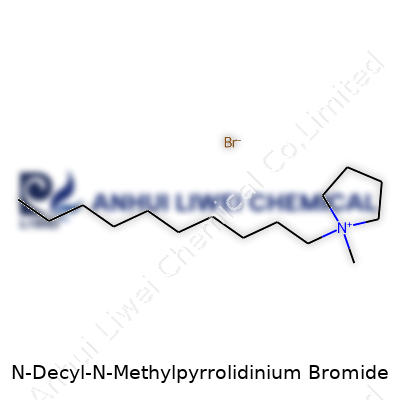
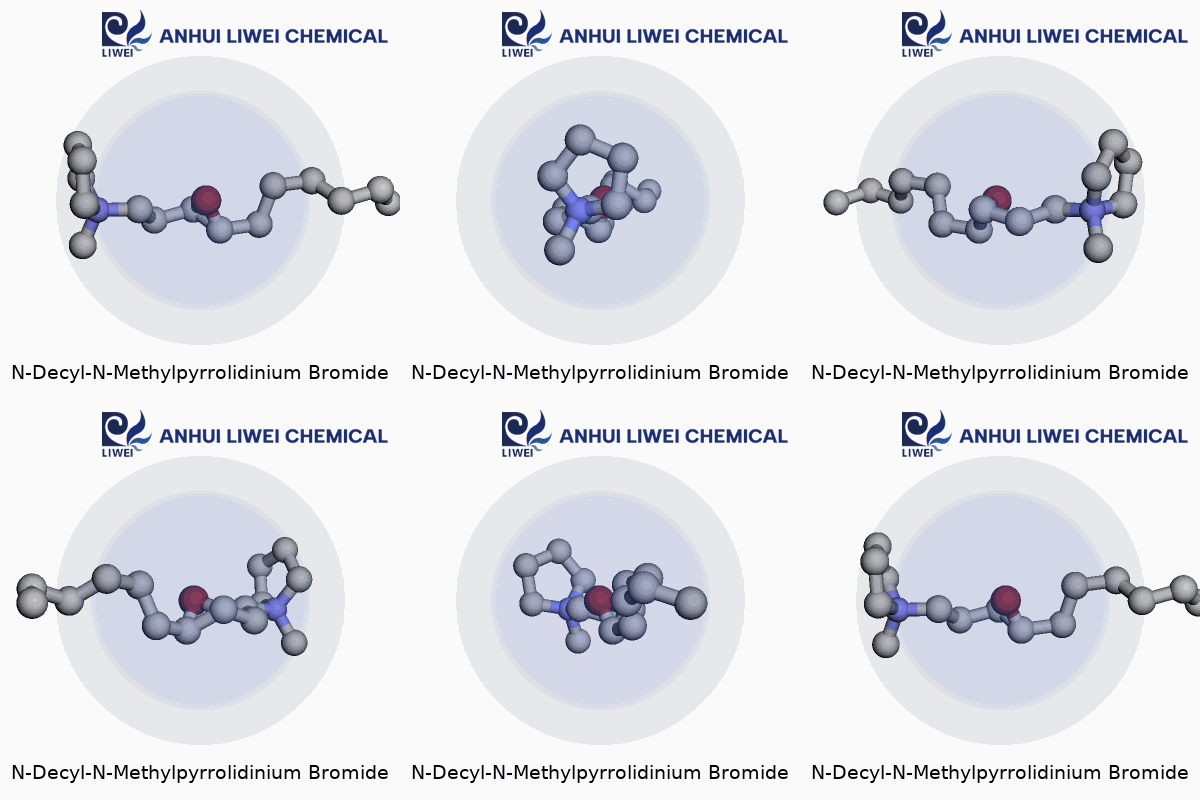
The core of this compound lies in the pyrrolidinium ring—a five-membered ring consisting of four carbon atoms and one nitrogen. Attaching a decyl chain (ten carbons long) and a methyl group (one carbon) to the nitrogen creates a cation with a long, flexible tail and a compact head. The final touch, a bromide ion, balances the charge.
Formally, chemists recognize its molecular formula as C15H32BrN. The structure tells a story. The decyl group gives this molecule a distinct hydrophobic section, which lets it interact with oily substances. The pyrrolidinium ring stays hydrophilic and brings the positive charge to the table. Pairing with a bromide anion gives it the final ionic nature.
From Bench to Industry: Real-World Impact
What strikes me about molecules like N-Decyl-N-Methylpyrrolidinium Bromide is their adaptability. On the surface, it looks like any other quaternary ammonium compound. Digging a little deeper, its long alkyl chain stands out, especially for people who work with surfactants or researchers in green chemistry. Ionic liquids have caught my attention because they often replace more hazardous solvents. They can handle heat and won’t evaporate as quickly, making them valuable in electrochemistry.
Handling these compounds takes care. The bromide part reminds me of how halides can react under certain conditions, especially when exposed to oxidizers. The long decyl chain means it will not mix well with water but meshes readily with organic layers. In my lab experience, ionic liquids like this one show less volatility and lower toxicity than legacy solvents, checking two important boxes for both safety and environmental responsibility.
Challenges and Opportunities
One hurdle for everyday use lands on price and purity. Sourcing high-purity N-Decyl-N-Methylpyrrolidinium Bromide can eat into research budgets. Impurities, even at low levels, throw off reactions or skew electrochemical results. Consistent batch-to-batch quality has improved, but researchers still run controls before each use.
Environmental impact represents another concern. The field continues to search for ways to recover and reuse ionic liquids effectively. Many of us believe circular use and better disposal methods are within reach. Some academic papers have pushed for more stringent waste management to prevent halogenated byproducts from reaching water systems. I've shared in the effort to keep lab waste streams sorted and documented, which makes a difference over the long haul.
Looking Forward: Smarter Chemistry
If recent history is any guide, molecular tweaks to the pyrrolidinium family lead to better ionic liquids—ones that last longer, cost less, and break down more cleanly. As more labs switch to greener solvents, demand for smart design grows. N-Decyl-N-Methylpyrrolidinium Bromide sits at a crossroads, offering a useful foundation for future compounds. The chemical structure and performance both matter, and each new study tells us what works and what can improve for both research and practical applications.
What This Chemical Does
N-Decyl-N-Methylpyrrolidinium Bromide often turns up in discussions about chemicals that support the electronics and chemical industries. Its main job involves acting as a surfactant in certain specialized reactions, especially where water doesn’t mix easily with other substances. That might sound pretty far removed from daily life, but behind each of these chemical names sits a need for clear thinking on risks and how people handle them.
The Real Hazards Behind the Name
People might spot a name like N-Decyl-N-Methylpyrrolidinium Bromide and feel instant concern. Chemical names can do that. The real picture gets clearer once you dig into toxicity studies, workplace safety reports, and real experiences from lab workers. Data points to a substance with hazards most non-scientists don’t always see coming.
Skin and eye contact come with risks. Exposure to the powder or concentrated solutions can irritate, redden, or cause other reactions—nothing to shrug off. Manual pages from chemical suppliers and government safety data sheets rate it as harmful after direct contact or if someone breathes it in. These warnings usually carry details on proper gloves, eye protection, and strong ventilation. For someone who has handled chemical surfactants in laboratories, it’s plain to see why. Gloves ripped once while I was preparing a demo, and a few drops hit my skin. Within an hour I dealt with itching and redness that lasted till the next day.
Gaps show up in long-term toxicity data. What animal studies there are, suggest moderate acute toxicity. Chronic exposure effects remain less certain, but that doesn’t suggest safety—it just marks an area needing more attention. Some pyrrolidinium compounds raise questions about nervous system impacts and potential impacts on organs, though N-Decyl-N-Methylpyrrolidinium Bromide hasn’t been as extensively studied as some other industrial chemicals.
Toxicity in the Bigger Picture
Comparisons sometimes help. Ammonium bromide compounds and other quaternary salts often receive warnings in research and industrial settings. Workers get annual safety training to avoid accidental spills or inhalation. Regulations around chemical waste point to risks for aquatic life when these substances wash into water. Aquatic toxicity studies show harm to small water organisms at relatively low concentrations. That forces facilities to install strong water treatment before letting discharge leave a plant.
Breathing chemical dust earns its own warning. Fine powders, especially those with cationic surfactant structure, may linger in the air after spills or careless pouring. Respiratory protection, such as P100 or N95 masks, stays on hand—not just for regulatory compliance, but because old stories from seasoned chemists remind us what happens when protection slips for only a moment.
What Industry and Labs Can Do Better
Stronger hazard labels ought to stay on every container. Facilities have moved to installing more precise chemical tracking systems, which helps, but daily routines matter just as much. Chemical fume hoods, shower stations, and up-to-date safety drills keep these hazards from turning into emergencies. Labs which audit their training and review near-misses usually see far fewer incidents.
Switching to less hazardous chemicals can help, though performance demands sometimes limit those choices. In those cases, tighter controls ought to step in: real-time air monitors, regular changing of protective gear, and spill response kits on every bench. None of this happens by accident; it needs people committed to safety at every step. With the right knowledge and respect for the risks, labs can keep workers safe and avoid harm to the world outside.
Understanding the Risks
N-Decyl-N-Methylpyrrolidinium Bromide stands out as a specialty chemical with regular use in labs and industry. It has practical applications, but smart handling keeps people and workplaces safe. This compound can irritate the skin and eyes. Inhaling dust adds to risk. Stories circulate in labs about minor spills turning into cleanup headaches, or how a missing pair of gloves brings hours of discomfort. Safety isn’t optional. It’s a daily action.
Good Storage Habits Prevent Mishaps
I’ve seen too many corners turned into hazardous material graveyards. Anyone storing chemicals gets tempted to cut corners now and then. Bad idea. Dry, cool cabinets protect chemicals like N-Decyl-N-Methylpyrrolidinium Bromide from moisture, light, and heat. These cabinets keep the container sealed and away from open air. Humidity can cause clumping or trigger reactions. Ordinary shelving in hot, open rooms destroys both safety and shelf life.
Chemical compatibility matters. Some facilities mark shelves with red or green tape, signaling what goes where. Mixing storage with strong acids or bases adds risk. Bromides belong with related salts, not near oxidizers or reactive metals.
PPE and Safe Handling
In my experience, confidence with chemical safety comes from repetition and real caution. Pouring or weighing N-Decyl-N-Methylpyrrolidinium Bromide demands gloves, long sleeves, eye protection, and a face mask if powder floats around. Accidental spills on exposed skin can hurt and leave rashes or burns. Skip the “just this once” mindset. Quick access to eye wash stations and gloves close at hand matter most when nobody expects an accident.
Ventilated workstations cut down dust and vapor. Clean workspaces also make a big difference. Open benches crammed with papers or bottles become accident waiting to happen. Separate the chemical from drinks, snacks, and phones. Washing up after handling avoids carrying traces out of the lab or plant.
Labeling, Recordkeeping, and Emergency Response
Mislabeling or reusing old bottles sets up disasters. My time in shared lab spaces taught me to double-check every bottle. Use a label that lists the full name, date, and hazard warnings. Keep a simple chemical log. It pays off during audits and helps when multiple people access the same storage spot.
Spill kits and written protocols belong near storage locations. Know the difference between a trivial dust spill and a major cleanup job. Soda ash or neutralizing agents help with containment, but fast reporting and reacting to exposure keep people safe. I’ve seen many new staff freeze in the moment. Regular drills build muscle memory for stressful moments.
Working Toward Better Safety Culture
Smart handling starts by respecting the risks. No one wants a chemical burn, lost product, or visit from the fire department. Setting up safe storage cabinets, keeping PPE in easy reach, and practicing regular drills form a trifecta for safety. Labeling even the “obvious” bottles stops mix-ups down the road. By building habits instead of shortcuts, a workplace keeps everyone healthy—and that’s something I’ve valued through every step of my own experience with laboratory chemicals.
The Realities of Chemical Sourcing
Shopping for specialty chemicals isn’t like grabbing milk at the corner store. When it comes to N-Decyl-N-Methylpyrrolidinium Bromide, purity matters—a fact any chemist who’s tried to reproduce sensitive results can confirm. Most suppliers offer this quaternary ammonium compound at or above 98% purity. High purity keeps impurities from muddling analytical work or interfering with synthetic reactions, which can make or break a research project. As a working chemist, I’ve seen small impurities create false positives in NMR spectra or throw off pharmaceutical experiments, leading to wasted weeks and budget headaches.
Why Purity Drives Results
High-purity N-Decyl-N-Methylpyrrolidinium Bromide remains key for ionic liquid research, catalysis, and surface modification. Residual solvents, trace water, or leftover reactants can introduce experimental noise or produce unpredictable byproducts. Pharmaceutical researchers and material scientists often demand at least 98% purity, but some projects go above 99%. Purity directly shapes the reliability of research; once, I worked with a sample sourced under cost pressure that sat at 95% purity and we lost a valuable compound due to unknown trace contaminants.
Packaging Sizes: More Than Just Bulk vs. Small-Batch
Many labs receive N-Decyl-N-Methylpyrrolidinium Bromide in tightly sealed bottles or jars designed for safety and shelf-life. For academia or R&D, suppliers commonly offer 1 g, 5 g, and 10 g bottles—these sizes help minimize excess handling and reduce exposure to air and moisture. Larger outfits or industry buyers may order 25 g, 100 g, half-kilogram, or full kilogram quantities. In practice, starting small is sound advice if you’re trialing a new compound. Once projects scale or protocols standardize, it makes sense to buy larger packaging to save cost per gram and cut down on packaging waste.
Chemical storage stands as a practical concern. Every researcher knows the pain of caked, degraded, or cross-contaminated samples due to poor packaging. Reliable suppliers ship N-Decyl-N-Methylpyrrolidinium Bromide in airtight, chemically resistant containers. Glass bottles lined with PTFE or HDPE stand up to the compound’s moisture-loving nature and reduce the odds of product breakdown, which means less loss through spoilage.
Why Sourcing Details Count
It’s easy to assume chemical shopping only comes down to price, but a few dollars saved upfront can collapse an entire experiment. Verifying lot specs, purity certification, and packaging standards protects research integrity. Suppliers who provide certificates of analysis and detailed traceability give peace of mind. I always push to see exact purity data and ask how long the material has sat on the shelf—fresh stock generally ensures better consistency.
Pushing for Better Practices
Labs can push for more transparency in supply chains. It helps to build relationships with vendors who openly share QC results and storage protocols. I’ve had the best results working with companies that let me specify packaging size and purity up front rather than settling for off-the-shelf options.
N-Decyl-N-Methylpyrrolidinium Bromide’s purity and packaging affect more than paperwork—they shape project outcomes, costs, and safety. Knowing what to ask for and demanding clear documentation keeps science rigorous and resourceful.