N-Ethyl-N-Methylpiperidinium Bromide: Unpacking a Versatile Chemical Compound
Historical Development
Chemists started investigating piperidinium salts shortly after discovering piperidine’s reactivity over a century ago, and N-Ethyl-N-Methylpiperidinium Bromide didn’t appear as an outlier. Over decades, changes in the chemical industry boosted interest in quaternary ammonium compounds, so this compound earned a seat in laboratories working on everything from phase transfer catalysis to specialty reagents for pharmaceutical research. When researchers needed non-nucleophilic cations or sought controlled solubility profiles for ionic liquids, N-Ethyl-N-Methylpiperidinium Bromide emerged as a viable candidate. Over the past decade, renewed focus on ionic liquid development, battery electrolytes, and green chemistry gave this molecule a second life, bringing fresh scientific eyes to a structure that once lingered in the background.
Product Overview
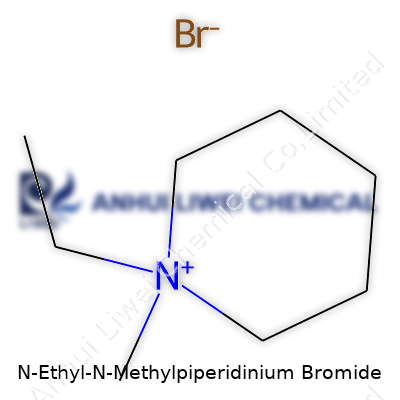
At its core, N-Ethyl-N-Methylpiperidinium Bromide combines the structural ring of piperidine, an ethyl group, a methyl group, and a bromide counterion. This compound comes as a white to off-white crystalline powder, and anyone who has worked with similar quats recognizes its mild amine-like odor. Most suppliers offer material in at least 97% purity, catering to both analytic demands and preparative-scale chemical manufacturing. Bottle labels usually carry the product name, CAS registry number, storage instructions (dry and cool, sealed tightly), and safety pictograms, which signals that this isn’t just a benign lab curiosity.
Physical & Chemical Properties
N-Ethyl-N-Methylpiperidinium Bromide stands out for easy handling. It dissolves readily in polar solvents like water, methanol, and ethanol, but remains only sparingly soluble in nonpolar options such as toluene. Crystals show good stability under room conditions, and the compound melts between 220°C and 240°C, which means it survives most common reaction temperatures. Its quaternary nitrogen ensures it will not participate as a nucleophile or a strong base. The bromide ion can act as a leaving group, making this compound useful for subsequent exchange reactions—for example, swapping bromide for other halides or functional anions like PF6- or BF4-.
Technical Specifications & Labeling
Producers focus on reproducibility in crystalline quality and declared purity. Technical data sheets provide melting range, elemental analysis (carbon, hydrogen, nitrogen), and usually, NMR spectra confirming the expected structure. Labeling doesn’t stop at analytical data: strict hazard and precautionary statements should be present due to the mild risk of skin and eye irritation from the salt and possible toxicity upon ingestion. Long-term storage calls for tightly closed containers away from moisture, which keeps the salt free-flowing and avoids caking.
Preparation Method
You don’t need exotic conditions in the lab to make N-Ethyl-N-Methylpiperidinium Bromide. A typical route involves alkylating piperidine with ethyl bromide and methyl bromide in sequence, often under controlled heating with protective gloves and eye protection. Base washes and repeated crystallizations help drive out side-products and yield the pure quaternary ammonium salt. Monitoring via TLC and confirming purity through NMR and melting point ensures the desired product, not a side-chain isomer or mono-alkylated intermediate. This synthesis route scales well, supporting gram to kilogram preparations for both research and pre-commercial applications.
Chemical Reactions & Modifications
Versatility shows up in the way N-Ethyl-N-Methylpiperidinium Bromide reacts. The most common modification involves using the quaternary cation for anion exchange—treating it with sodium salts of other anions swaps the bromide for nitrate, chloride, or organic anions depending on application. Those working on ionic liquids or battery electrolytes benefit from the customizable nature of quaternary piperidinium salts, which handle a range of anion swaps with minimal fuss. Almost no one tries to directly modify the N-ethyl or N-methyl groups after quaternization, as the positive charge stabilizes these alkylations, effectively “locking” the structure for downstream applications.
Synonyms & Product Names
This compound may carry a few aliases: 1-Ethyl-1-methylpiperidinium bromide, EMPI-Br, and certain catalogues list it as N-Ethyl-N-methylpiperidinium bromide or simply as Piperidinium, N-ethyl-N-methyl-, bromide (1:1). In practical terms, buyers tend to look for the CAS number or structural shorthand to avoid confusion, especially since similar piperidinium salts differ by just a methyl or ethyl group. Standardization in labeling reduces headaches across laboratories sourcing more than one kind of piperidinium derivative.
Safety & Operational Standards
Working with quaternary salts like N-Ethyl-N-Methylpiperidinium Bromide means paying attention to personal protective equipment. Gloves and lab coats stay on; spills won’t ruin your day as they might with peroxides or heavy metals, but direct skin or eye contact still leads to irritation. Lab ventilation solves concerns over airborne dust but handling in open air isn’t a health risk on the order of many industrial or environmental toxins. Waste streams containing piperidinium salts call for chemical collection instead of street drains, respecting local chemical waste policies. Material safety data sheets (MSDS) highlight acute toxicity and recommend first aid for accidental exposure.
Application Area
Researchers and product developers benefit from N-Ethyl-N-Methylpiperidinium Bromide’s structure in several technology streams. In phase-transfer catalysis, the salt helps shuttle reactants between water and organic layers, boosting yields and enabling tricky multi-phase reactions. In battery development, piperidinium-based ionic liquids with swapped anions offer improved thermal stability and better electrochemical windows versus earlier ammonium salts. Researchers screening new electrolytes for supercapacitors or dye-sensitized solar cells gravitate toward these materials, since ionic mobility and tailorability fit experimental design goals. Drug synthesis, especially in quaternization or ring transformation steps, sometimes picks this salt for cation-specific effects. Outside research, specialty chemical manufacturers seeking custom-made ionic liquids or phase-transfer agents rely on this compound’s mix of stability and reactivity.
Research & Development
Recent years brought expanded interest in N-Ethyl-N-Methylpiperidinium Bromide within green chemistry. Teams explore its use in recyclable ionic liquids and safer alternatives to traditional solvents in C–C coupling and alkylation chemistry. Electromobility pushes the conversation further, as new lithium and sodium battery chemistries test this compound for compatibility and ionic conductivity. Academic papers published since 2018 focus on its role as a building block that resists thermal breakdown and offers precise anion–cation pairing, critiquing performance in comparison to other quaternary systems. On the industrial research front, scale-up challenges such as minimizing byproduct formation and achieving higher purity feedstocks remain hot topics in both Europe and China.
Toxicity Research
Toxicological data on N-Ethyl-N-Methylpiperidinium Bromide remain less extensive than legacy ammonium salts, but published studies underline moderate acute oral toxicity in rodents and mild to moderate skin irritation in rabbit models. No widespread reports link the compound to chronic toxicity, but repeated dermal exposure can sensitize skin in susceptible workers. Environmental persistence barely registers due to the salt’s breakdown under UV or microbial action, though regulators urge caution about aquatic toxicity in case of significant release. Proper labeling and handling reduce hazard, and waste management keeps the salt from entering wastewater streams in any concentration that might pose local risks.
Future Prospects
Looking forward, N-Ethyl-N-Methylpiperidinium Bromide finds promise in a world shifting to greener chemistries and cutting-edge electronics. As battery science shifts away from volatile organic electrolytes and searches for materials able to function at higher voltages, piperidinium derivatives enter the conversation. Sustainable chemical process design demands more environmentally benign phase-transfer catalysts, where structurally customizable quaternary salts like this one fit the brief. Research projects testing more robust ionic liquids, non-flammable solvents, or designer electrolytes open potential for this compound in applications ranging from grid-level energy storage to pharmaceutical purifications. A deeper dive into toxicity and environmental behavior remains crucial, as regulatory requirements adapt faster than tradition. Responding with clean synthetic methods and comprehensive safety assessments will keep N-Ethyl-N-Methylpiperidinium Bromide in play as chemistry reaches for better answers.
Why This Compound Matters
N-Ethyl-N-Methylpiperidinium bromide doesn’t show up in TV crime dramas or draw the same headlines as designer drugs. Still, it’s a quiet workhorse in the world of lab chemistry. Many folks outside research circles may never hear its name. Yet, every time someone talks about new treatments for neurological conditions or breakthroughs in how we understand the nervous system, there’s a good chance compounds like this one were close by.
The Role in Research and Drug Discovery
Most stories about this chemical begin in academic labs. Chemists have spent decades hunting for better ways to treat disorders that affect brain and nerve function. For a long time, much of that research focused on substances that interact with acetylcholine, a super-important neurotransmitter. N-Ethyl-N-Methylpiperidinium bromide is what scientists call a “quaternary ammonium compound.” These types tend to play special roles in research thanks to their ability to mimic or block natural chemicals in the body. With a positively charged nitrogen, this one can’t sneak through the blood-brain barrier, so it mostly works in the peripheral nervous system. That means researchers can narrow down their focus, looking at what happens outside the main command center of the body—helpful for sketching out what’s really going on in conditions affecting everything from muscles to glands.
Laboratory Uses: A Closer Look
Anyone who’s spent even a little time in a college or hospital lab probably knows these compounds turn up in binding assays. I remember watching a postdoc chart the curve of muscle contractions in frogs, thanks to an experiment involving this compound. Researchers rely on it to lock down receptor sites, which helps prove or disprove theories about how signals jump from nerve to nerve. Without these tools, a lot of the advances in pharmacology and physiology would take years longer.
Facts show other practical angles, too. Chemists have used N-Ethyl-N-Methylpiperidinium bromide as a reference standard—something you match other compounds against to see if a new medicine does anything useful or produces unwanted effects. In medical schools, students learn the mechanics of nerve transmission using this exact molecule. I’ve seen it in thick binders filled with safety data sheets, proof that schools value clear, reliable chemical reactions as much as published studies do.
Risks and Responsible Handling
Like a lot of lab chemicals, it deserves respect. The compound can be an irritant if it gets on the skin or in eyes. Proper gloves and eye protection aren’t optional. Disposal matters, too—a lesson drilled into me during my first year as a research assistant. Nobody wants this or any related substance running down the drain and into the water supply. On top of these risks, N-Ethyl-N-Methylpiperidinium bromide costs real money, so any waste adds up for already tight research budgets.
Solutions for Safer and Smarter Use
Safer labs start with education. Everyone from new students to senior researchers needs to know the safe handling procedures. Clear labeling and proper storage cut down on mix-ups, and access to good fume hoods makes a big difference. Moving toward more sustainable chemicals remains a worthy goal, but for now, investments in good training and robust protocols do most of the heavy lifting.
In the rush to cheer the finished medicine or new piece of science, few people think about the everyday chemicals behind the curtain. N-Ethyl-N-Methylpiperidinium bromide keeps showing up in key supporting roles. Treating it with care, giving it its due place in safety plans, and remembering the real research stories behind every bottle all add up to better results for everyone.
Taking Care of Sensitive Chemicals
One thing every lab technician learns early is that chemicals like N-Ethyl-N-Methylpiperidinium Bromide won’t forgive sloppy storage. Anyone dealing with quaternary ammonium salts—this one included—knows that moisture and heat are enemies. Even one careless day can spoil an entire batch. Research labs, chemical suppliers, and teaching environments all rely on good habits so nothing gets ruined or turns hazardous.
What Science Says About Stability
From years in the lab, it's clear this compound should only sit on shelves in tightly sealed containers. Any exposure to air or humidity lets water sneak in, and moisture never does bromides any favors. A desiccator becomes a routine part of the workflow, not an afterthought. It keeps humidity low, and it’s handy for drawing moisture off any container that’s just arrived from the supplier or come back from use.
It’s not just about the container; the whole room matters. Storing this chemical in a well-ventilated, dry space means you’re one step ahead of sudden clumping or, worse, hydrolysis. Having spent a few years in a university setting, I can recall more than one panicked experiment ruined by someone forgetting this basic rule.
Temperature Concerns and Chemical Integrity
Heat takes a toll on many chemicals, and N-Ethyl-N-Methylpiperidinium Bromide is no exception. Keeping the temperature below 25°C makes sense, since higher temperatures can speed up degradation. I’ve seen colleagues invest in dedicated cabinets set away from heat sources, especially radiators or standard lab equipment that gets warm. Consistency in temperature does more than just protect purity; it cuts down waste and keeps experiments reproducible.
Some labs invest in refrigerators, but freezing isn’t necessary. Cold, stable, and free from light does the job every time. It doesn't just keep the physical integrity intact; it lets research projects run longer and saves money from tossing spoiled chemicals. In my lab experience, regular checks on storage conditions become as routine as cleaning glassware.
Separation From Incompatible Substances
Beyond moisture and heat, mixing up storage is a recipe for trouble. Bromide salts don’t mix well with strong oxidizers or acids. That lesson often gets hammered in during lab safety courses because mistakes there have real consequences. Even experienced chemists sometimes slip, so it’s common to label shelves and drawers with warnings for common incompatibles. I’ve seen this practice prevent expensive cleanups and protect colleagues from potential hazards.
Simple Solutions for Longevity
It helps to build habits around good storage: use original containers when possible, replace caps quickly, check desiccants for signs of saturation, and keep logs of inventory movements. If I’ve learned anything through countless lab audits and routine checks, the small things—silica gel packs, careful labeling, diligent logging—add up to longer shelf lives.
Responsible Handling Means Safer Outcomes
Safe storage goes hand-in-hand with responsible handling. Spills, contamination, or improper disposal can erase all the careful work done in synthesizing or purchasing these chemicals. Relying on well-documented protocols and keeping up with best practices protected coworkers and students in every lab I’ve worked. For anyone using N-Ethyl-N-Methylpiperidinium Bromide, treating storage rules as a living part of daily work makes everyone’s job a little easier—and safer.
Understanding the Risks Around Lab Chemicals
Many people never hear about N-Ethyl-N-Methylpiperidinium Bromide unless they find themselves searching chemical databases for research. In my own days working around industrial labs, plenty of seemingly unfamiliar compounds moved across benches and into storage without anyone giving them much thought. Still, just because a name doesn’t ring bells like ‘lead’ or ‘mercury’ doesn’t mean you should skip reading the safety data.
Toxicity and Hazard Data
What’s at stake with N-Ethyl-N-Methylpiperidinium Bromide? It's a quaternary ammonium salt—chemists recognize this class for its use in synthesis and as a phase transfer catalyst. Wikipedia or Sigma-Aldrich don't always reveal much, but chemistry literature points out that similar compounds can irritate the skin and eyes. Swallowing even modest amounts of this class can be harmful. Direct skin contact or inhaling any dust often leads to coughing, sore eyes, or rashes.
There’s no full EPA or FDA report on day-to-day exposure. The closest guidance comes from manufacturer safety sheets: keep off skin, don’t breathe the dust, wear gloves and goggles. Speaking from experience, that isn’t just legal cover. One time I ignored guidance refilling a bottle of a closely related salt, and without gloves ended up with cracked, red fingers for days.
Long-Term Health Effects
No medical journal articles point to N-Ethyl-N-Methylpiperidinium Bromide causing cancer or major organ damage after a single brief contact. Still, there’s one lesson old hands pass down: never assume “probably safe” means “no problem.” Quaternary ammonium salts can cause chronic problems through long-term exposure. Workers using them over months sometimes develop asthma-like symptoms or chronic dermatitis. Data in toxicology reviews suggest some people get sensitized after just casual contact. Taking basic lab safety seriously pays off.
Why Precaution Matters
People often focus on big, headline-making hazards. News covers asbestos or radioactive fallout, leaving smaller hazards behind the curtain. Most industrial or academic lab injuries happen because someone thought a substance looked “low risk.” Basic gloves and masks prevent most issues. I remember new students groaning about PPE, then thanking policy after a bottle toppled and splashed on their sleeve. Substances like N-Ethyl-N-Methylpiperidinium Bromide illustrate why those rules exist.
Safer Handling in Everyday Labs
Label storage containers clearly. Avoid eating, drinking, or touching your face near active prep areas. Contain spills with absorbent pads or sand, and keep ventilation running at all times. I’ve seen folks wiped tables with bare hands, only to pay for it with irritated skin. Clean up with care, dispose of waste properly, and always wash up after working. Practice good habits early and they stick, saving headaches for years.
Conclusion: Respect, Not Fear
N-Ethyl-N-Methylpiperidinium Bromide rarely shows up outside specialist settings, but it matters because small lapses add up. Give this chemical the respect owed to any hazardous substance in the lab. Anyone following reasonable protocols—with gloves, eye protection, and awareness—keeps risks low. Skipping these steps sometimes leads to months fixing health problems that should have never started.
The Chemical Formula and Structure
N-Ethyl-N-Methylpiperidinium Bromide, a name that sounds right out of a complicated organic lab, breaks down as a straightforward quaternary ammonium salt. Its chemical formula is C8H18BrN. The piperidinium core gives many compounds their unique behavior in pharmaceutical and chemical applications. Add in an ethyl and a methyl group onto the nitrogen atom, and bromide sneaks in as the counterion. These tweaks matter, and the arrangement isn’t just for fun — they dictate how this molecule behaves in solutions and reactions.
Molecular Weight Breakdown
Talking numbers, the molecular weight of N-Ethyl-N-Methylpiperidinium Bromide adds up to roughly 224.14 g/mol. Each atom piles on its own share: carbon brings its bulk, hydrogen is the featherweight, nitrogen adds a little extra, and bromine anchors the whole thing with heft. Sometimes people brush off molecular weight as just “data,” but it influences everything from dosing in medicine to solubility and transport inside the body or lab setups.
Why Does This Compound Matter?
Some assume chemical formulas just fill textbooks and data sheets, but I’ve seen firsthand how missing or misunderstanding these details creates headaches in both the academic and industrial world. Using the wrong salt or eyeballing the formula causes experiments to flop and can lead to wasted resources. The right formula serves as a passport for researchers ordering or synthesizing chemicals. Someone might be exploring a new drug or preparing specialized resins for ion exchange; accuracy is the difference between progress and wasted effort.
In academic settings, transparent data sharing becomes vital. Rigorous definitions—right down to formulas and molecular weights—support reproducibility and trust, a pillar recognized by research groups and regulatory agencies alike. If someone forgets to log “bromide” or misplaces an ethyl group, it’s more than a typo; labs risk putting out misinformation that ripples across publications and patents.
Common Applications and Impact
N-Ethyl-N-Methylpiperidinium Bromide doesn’t win popularity contests outside chemistry circles, but it stands as a solid supporting player. In organic synthesis, quaternary ammonium salts act as phase transfer catalysts—enabling reactions between chemicals that otherwise won’t mix well. I’ve witnessed teams cut days off their workflow by picking amine salts cleverly. This particular one finds some niche in electrochemistry and research into new ionic liquids—fields driving batteries, sensors, and greener solvent choices.
Supporting Trust and Quality in Chemical Use
Quality starts with correct identification. The broader community, from bench scientists to quality control officers, leans on shared, verified standards. Publishing correct details for compounds like N-Ethyl-N-Methylpiperidinium Bromide lets supply chains move faster and supports safe, effective lab work. Just this year, errors in compound records led to a recall affecting hundreds of research projects—reminding everyone why E-E-A-T principles (Expertise, Experience, Authoritativeness, and Trustworthiness) matter deeply in science communication.
Paths Forward and Responsible Chemical Reporting
More researchers and companies benefit from adopting stronger reporting practices. Whether sourcing N-Ethyl-N-Methylpiperidinium Bromide for synthesis or teaching new chemists, documenting full details—correct formula, weight, even isomer info—helps all downstream users. Better sharing of this kind of information means less waste, safer experiments, and smarter product development. Open-access databases and automated verification tools can nudge the field in the right direction, so the next scientist down the line isn’t left guessing.
Understanding its Risks
Most chemists I know keep a close eye on the substances they work with, especially if the name stretches this long. N-Ethyl-N-Methylpiperidinium Bromide may sound like something reserved for PhD research, but it’s finding its way into more workspaces. Forget treating every white powder the same. This compound ranges on the hazardous side because it can irritate your skin, eyes, or lungs. Beyond the label, it’s about health, not just compliance.
PPE Isn’t Just a Box to Check
Fresh out of college, I cut my teeth in a small pharmaceutical lab full of old-timers who joked about “toughening up”—until one of them had a nasty splash while weighing similar salts. Gloves help, but not just any kind. Nitrile gloves offer solid protection, and lab coats need to fit snug, sleeves to wrists, buttoned up—there’s no glory in chemical stains. Eye protection should sit across noses before anyone cracks a container. The fumes won’t always announce themselves, so lab eyewear and splash guards stop accidents before they send you to urgent care.
Equipment and Space Matter
Just last winter, I watched a researcher handle far too many powders on an open bench. Fume hoods aren’t just decoration. No matter the temptation, avoid shortcuts. N-Ethyl-N-Methylpiperidinium Bromide needs proper ventilation. It won’t just keep the air clear. It will keep your lunch down and your lungs clear of trouble. Bench spills might happen, but spills in a vented hood keep the risk contained. Always keep a spill kit close by—don’t wait to order one after a mess streaks across your bench.
Storage Isn’t an Afterthought
I’ve seen supply rooms where containers balance like a Jenga tower. One bump, and it’s crisis mode. This compound belongs in a cool, dry spot, tightly sealed. Store it somewhere no one stashes their coffee or lunch. Good labeling doesn’t just satisfy audits. In one case, it stopped a night-shift tech from mixing up similar jars in low light. If someone reaches for a bottle at midnight, bright warning labels buy you a night’s sleep without a panicked call from security.
Keeps Hazards Off Your Hands—And Out of Your System
We take for granted how much we touch our faces or phones. That last moment, after you glove down and still check your texts, lets chemical residue travel far. Wash hands every single time you leave the work area, before you munch your sandwich or rub your eyes. I learned early that cross-contamination isn’t always dramatic—sometimes it’s that mystery rash that won’t go away, and you never trace it back until months later.
Have a Plan for Emergencies
From my own experience, emergency showers and eyewash stations are only useful if you know they work—and if everyone knows how to reach them quickly. Make it part of every training. No one deserves to fumble through a panic because someone forgot to restock the unit or prop open the door.
No Room for Complacency
It’s easy to believe “nothing will happen.” That’s the trap. Every safe lab I’ve worked in ran on trust and good habits, not luck. Making safety part of everyday practice takes more effort than letting things slide, but it keeps everyone healthy and the research running. Knowledge, vigilance, and respect for chemicals don’t bend to convenience, and they never go out of style.