N-Hexyl Pyridinium Bromide: From Laboratory Curiosity to Modern Application
Historical Development
Chemists began noticing the unique properties of alkylpyridinium salts decades ago. Mid-20th century research into antimicrobial compounds led to the synthesis of N-Hexyl Pyridinium Bromide. Scientists needed molecules that balanced hydrophobic and hydrophilic character, and the hexyl chain length proved especially interesting. Early patents described its preparation as a quaternary ammonium salt, and labs experimented with its effects on bacterial growth, ion transport, and as phase-transfer catalysts. Over the years, this compound earned an important place in the catalogue of specialty chemicals for both fundamental research and commercial laboratories.
Product Overview
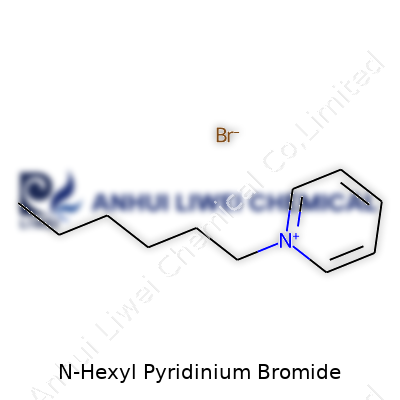
N-Hexyl Pyridinium Bromide stands out for its balance of solubility and amphiphilicity. Chemists often look at its crystal form, which handles moisture fairly well, and find its utility in organic synthesis and electrochemistry. This compound features a pyridinium ring attached to a six-carbon alkyl chain, finished with a bromide counterion. People who handle specialized separations or work in research settings with ionic liquids frequently encounter it. It usually arrives in aluminum-sealed bottles or amber vials to minimize moisture and photolytic degradation.
Physical & Chemical Properties
Solid at room temperature, N-Hexyl Pyridinium Bromide forms colorless to pale yellow crystals. It dissolves in water and organic solvents like methanol, ethanol, and DMF. The melting point sticks close to 150°C, with decomposition kicking in at higher temperatures. Under standard conditions, there’s little odor. Infrared and NMR spectra demonstrate the expected vibrations and chemical shifts for pyridinium and alkyl groups. It has a molecular formula of C11H18BrN and a molar mass around 260.18 g/mol. The compound’s amphiphilic nature arises from the polar pyridinium and the non-polar hexyl chain, influencing everything from surface activity to ionic conductivity.
Technical Specifications & Labeling
Strict quality specifications set the minimum purity above 98%. Its appearance should be consistent, with low water content and no foreign particulates. Labeling includes the IUPAC name: 1-hexylpyridinium bromide. Supply includes CAS number 1122-93-6, batch number, and lot-specific analysis data from third-party or in-house chromatographic and spectrometric characterization. Material safety data comes attached, with hazard pictograms for irritancy and guidance on personal protective equipment. Storage instructions generally recommend airtight conditions away from strong bases and oxidizers.
Preparation Method
Organic chemists typically react pyridine with 1-bromohexane under reflux in anhydrous acetonitrile or ethanol, yielding N-Hexyl Pyridinium Bromide by direct nucleophilic substitution at the nitrogen. After cooling, the product is precipitated, filtered, and recrystallized—often from ethyl acetate or acetone—to enhance purity. The entire process is scalable, and similar quaternization methods broaden the family of pyridinium salts. Every lab run ends with careful washing to remove by-products, and residual solvents are checked to meet pharmacopeial or industrial standards.
Chemical Reactions & Modifications
People investigating ionic liquids or surfactant-like molecules modify the length of the alkyl chain: shorter or longer chains can tune solubility, toxicity, and phase behavior. The pyridinium cation can quench radical species or confer antimicrobial effects in certain formulations. N-Hexyl Pyridinium Bromide serves as a precursor for more complex salts by ion exchange, where bromide is swapped for other anions such as PF6−, BF4−, or even hydrogen sulfate. In alkylation chemistry, the pyridinium ring can serve as a leaving group or undergo nucleophilic substitution, enabling synthesis of more advanced organic materials.
Synonyms & Product Names
Catalogues list alternative names like 1-Hexylpyridinium Bromide, Pyridinium, N-hexyl-, bromide, and N-hexylpyridinium bromide. Sometimes specialty distributors invent product codes or abbreviations such as HPyBr or HexPyBr. Chemists and supply managers know the importance of checking both IUPAC and trade names to avoid mix-ups, especially at high volumes or for regulated applications.
Safety & Operational Standards
Handling the solid requires gloves and goggles. Dust may irritate the eyes, skin, and lungs. In solution, it can sting on contact and demands ventilation to minimize inhalation risks. Material safety sheets classify it under specific hazard classes based on local laws. Labs keep it segregated from reactive metals and strong reducing agents. Routine protocol includes spill containment with inert absorbents and waste disposal in line with campus or industrial hazardous waste streams. Some biodegradation studies urge caution before letting any quaternary pyridinium derivatives enter wastewater, owing to aquatic toxicity concerns.
Application Area
N-Hexyl Pyridinium Bromide finds its way into analytical chemistry labs looking for phase-transfer catalysis or ionic liquid formulation. It performs well in electrochemical experiments as a supporting electrolyte or in mechanistic studies of reaction intermediates. Microbiologists and materials scientists use it to disrupt membranes or stabilize certain charged surfaces. Some researchers pivot toward biomedical contexts when investigating antimicrobial coatings or drug delivery vesicles. Analytical testing kits sometimes incorporate this salt for its well-understood ion-pairing properties.
Research & Development
Innovation in ionic liquid development leans heavily on molecules like N-Hexyl Pyridinium Bromide. Labs aim for greener solvents or enhanced electrolytes for batteries and supercapacitors. Applied researchers screen a library of related pyridinium salts to find the best candidates for separating rare earths, extracting metal ions, or stabilizing enzymes outside aqueous environments. Careful measurement of conductivity, viscosity, and surface tension supports new publications in peer-reviewed journals. Insights gained inspire next-generation materials, leading to further tweaks of the pyridinium backbone or the counterion component.
Toxicity Research
Toxicologists noted that quaternary ammonium compounds sometimes disrupt cellular membranes, so it made sense to test N-Hexyl Pyridinium Bromide closely. Studies show dose-dependent toxicity against Gram-positive and Gram-negative bacteria and moderate effects on aquatic species. Mammalian cell assays reveal some threshold for cytotoxicity, which narrows its safe operational window. Chronic exposure data remain limited, leading responsible labs to minimize large-scale discharges and promote safer handling protocols. Published findings underscore the need for toxicity testing and careful risk assessment.
Future Prospects
With increasing attention on sustainable synthesis and advanced materials, demand for structurally tunable salts like N-Hexyl Pyridinium Bromide looks steady. Interest centers on improving battery life, designing efficient separation media, and finding alternatives to traditional volatile organic solvents. Startups and established chemical manufacturers seek to commercialize ionic liquids with improved environmental profiles and predictable toxicity. Regulatory scrutiny pushes producers to release fuller data on long-term ecological impact. Ongoing research explores bio-based synthesis routes to lower the environmental footprint and create biodegradable analogues, promising a more sustainable path for this storied compound.
A Closer Look at Its Role in Modern Science
Walk into any research lab focused on chemistry, and you might spot vials labeled with complex names. One of these is N-Hexyl Pyridinium Bromide. This compound plays many supporting roles in the world of science, from making new materials to keeping bacteria in check. The name might sound like a mouthful, but the compound’s contributions reach into both industry and the lab bench.
Assisting Organic Synthesis
Making new molecules is no small feat. Chemists have turned to N-Hexyl Pyridinium Bromide to help reactions go smoother. This compound acts as a phase-transfer catalyst, which means it shuttles molecules between water and oil-like layers, letting chemists run reactions that would otherwise stall out. By boosting the interaction between two different phases, it speeds up reactions and often gives higher yields. If you’re working in organic synthesis, that means less waste, shorter production times, and smaller bills for raw materials. Not just theoretical, these benefits show up in research and manufacturing settings every day.
Tackling Microbes in Healthcare and Industry
Keeping surfaces and equipment free of germs keeps everyone safer. Some versions of pyridinium compounds, including N-Hexyl Pyridinium Bromide, hit hard against bacteria and fungi. Hospitals and food processing centers use these kinds of molecules for disinfection routines. By breaking down microbial cell membranes, N-Hexyl Pyridinium Bromide limits the spread of infections and controls spoilage. A study published by the American Chemical Society detailed strong antibacterial effects, sometimes outperforming traditional quats. Products using this compound provide another tool in the fight against superbugs, which calls for constant vigilance and new approaches every year.
Unlocking Potential in Ionic Liquids
Solvents set the pace for many chemical processes. Traditional options often cause pollution and safety headaches. N-Hexyl Pyridinium Bromide, in combination with other compounds, creates ionic liquids. These are salts that stay liquid at room temperature. They give researchers a non-volatile, often less toxic option for running experiments, recycling metals, and processing pharmaceuticals. In recent years, these liquids opened up greener pathways for extractions and separations, letting industries lower their environmental impact.
Shipping, Handling, and Smart Use
Every chemical—no matter how useful—comes with risks. N-Hexyl Pyridinium Bromide isn’t used in consumer products. It lands in specialized settings, handled by folks who know chemical hazards inside-out. Its manufacturing, transport, and disposal face tight regulation. Safety data sheets highlight the importance of gloves, goggles, and ventilation. Accidental spills cause skin and eye irritation, or worse if inhaled or ingested. Responsible companies invest in training and infrastructure for containment. Good stewardship means looking out for both workers and the wider environment.
Looking Ahead: Sustainability and Responsibility
Sustainability is on every manager’s mind. Chemists continually search for cleaner ways to make and use compounds like N-Hexyl Pyridinium Bromide. Green chemistry approaches look at the raw materials, energy spent, and waste left behind. Collaboration between researchers, industry, and regulators brings new safety protocols and greener alternatives into widespread use. The field keeps evolving, but it relies on a deep respect for both science and safe practice. Seeing these discussions play out in real labs shows that finding the right balance between innovation and safety is a shared commitment, not just a talking point.
Getting to Know N-Hexyl Pyridinium Bromide
N-Hexyl Pyridinium Bromide isn’t a household name. In the lab, though, it gets more attention. I remember my time as a graduate researcher, dealing with quaternary ammonium salts and ionic liquids, finding myself drawn toward oddball compounds like this one. N-Hexyl Pyridinium Bromide fits into the big family of pyridinium salts, where you take a pyridine ring and add one more thing: a hexyl group, which is a chain of six carbon atoms attached to the nitrogen. Then, attach a bromide ion to balance the positive charge. It’s an organic salt with a simple elegance: a pyridinium cation with a hexyl twist.
Decoding Its Chemical Formula
The formula isn’t complicated once you look at each piece. Pyridine itself has the formula C5H5N. Replace one of those hydrogens on the nitrogen with a hexyl group, which has the formula C6H13. So the resulting N-hexylpyridinium cation becomes C11H17N+. Then, for every positive cation, you add a negative bromide anion: Br-. The whole salt as a unit reads C11H17NBr.
I would glance at product catalogs and see this formula listed right alongside others—nothing unusual, but understanding why it looks that way helps if you ever have to make it or explain it to someone in a rush to finish their synthesis.
Why Structure Matters in the Real World
People talk about the structure of chemicals as if it’s an abstract exercise, but I’ve watched how the change in a side chain shifts everything, from solubility to antimicrobial action. Take N-Hexyl Pyridinium Bromide: the hexyl group makes it less polar than shorter alkyl cousins. That gives it a different touch when used in phase transfer catalysis or as an antimicrobial. The bromide doesn’t just sit there, either. It can swap out in exchange reactions, sometimes shaking up results more than you’d expect.
Each time I see a student struggle with the difference between similar molecules, it reminds me that clear formulas do more than fill spaces in a notebook. They shape how we pick reagents. Imagine screening for new pharmaceutical ingredients—knowing exactly how the molecular structure looks tells you whether you’re headed for a win or a time-waster.
Looking at Research and Application
N-Hexyl Pyridinium Bromide pops up in journals about ionic liquids, extraction methods, and microbial control. Many chemists use it for its ability to break with water’s rules: it slips into organic phases, bringing along anions that don’t travel easily by themselves. In my own experience, these salts make certain separation steps run smoother—not magic, just smart science.
The University of Cambridge published data showing various pyridinium salts, including hexyl versions, providing stable, recyclable solvents. In antimicrobial studies, the hexyl chain offers a happy medium: not as toxic as longer chains, but more punch than methyl or ethyl analogues. It’s a tool, and like most tools in chemistry, knowing its makeup lets you use it better.
Room for Innovation and Safer Choices
Research continues on greener synthesis and safer handling. Finding ways to swap out bromide for less hazardous partners or making these salts with less waste appeals to anyone who’s ever tried to empty a fume hood. More labs now publish work on alternative pathways, using benign reagents and renewable feedstocks. Chemists are increasingly guided by real-world needs—less environmental impact, more efficient reactions.
That attitude matches my own drive in the lab: seek what works, but push for what works better. N-Hexyl Pyridinium Bromide represents both a finished product and a starting point for new ideas. Getting its formula right—C11H17NBr—may seem small, but it sets the tone for everything that comes after.
What Is N-Hexyl Pyridinium Bromide?
Most folks haven’t heard of N-Hexyl Pyridinium Bromide, but this chemical pops up in specialty labs and occasionally in research settings. With science moving fast, curiosity about the safety of lesser-known compounds like this keeps bubbling up—not only inside academia, but also among those who work near chemistry day-to-day.
Understanding Exposure and Hazards
Anyone asking about toxicity wants to know: Will this substance harm me or my community? There’s not a mountain of evidence on N-Hexyl Pyridinium Bromide, but what’s out there shows it’s no table salt. Pyridinium compounds as a group can irritate skin and eyes, and some even disrupt cells or damage organs if handled carelessly. N-Hexyl Pyridinium Bromide draws concern because of its structure—a long alkyl chain attached to a charged ring—giving it both detergent-like and reactive properties.
Lab reports note skin redness, eye discomfort, and in extreme exposures, problems with breathing. Ingesting or inhaling concentrated forms spells trouble for lungs and stomach, causing inflammation or burns. Some pyridinium salts get flagged for toxic effects on aquatic life after entering wastewater, especially since they resist breaking down quickly.
Why Safety Standards Matter
Folks in lab coats are no strangers to gloves and goggles. These basic habits matter more with N-Hexyl Pyridinium Bromide. I’ve seen firsthand how easy accidents can happen even during routine tasks—mixing reagents, rinsing glassware. Just a few drops on bare skin can irritate or cause a rash. Splashing the eyes almost always sends someone to the eyewash station, with burning and blurred vision for hours. In workplaces where chemicals move around often, labeling bottles and training staff should never become a box-ticking exercise. It saves the kind of nights people remember for the wrong reasons.
One lesson learned early: cleanup spills promptly. Traces of N-Hexyl Pyridinium Bromide shouldn’t linger on benches or floors. Even dry residues can become a hazard, especially if kids or pets get anywhere near the wrong area at home or in teaching labs.
E-E-A-T: Why Trust and Care Go Hand-in-Hand
Trust in chemical safety doesn’t just come from rules. It takes experience, transparency, and accountability. Chemical companies must share clear data, and government agencies deserve the resources to keep watching for emerging risks. Researchers in Europe flagged related pyridinium salts for their environmental stubbornness and toxicity. Reading safety data sheets always matters, not because someone loves paperwork, but because the right information lets people make real choices—like picking better alternatives or stepping up protective gear.
Solutions and Responsible Handling
Researchers worldwide chase after greener chemicals. N-Hexyl Pyridinium Bromide won’t vanish from labs overnight, but smart practices limit harm. Using fume hoods reduces fumes, careful waste disposal keeps rivers clean, and secondary containment prevents leaks. Substituting less hazardous chemicals, where possible, cuts down on risk at the source. It’s not just about ticking off compliance boxes—protecting people and wildlife works better with everyone in the loop, from chemists to janitors, teachers to students.
Respecting chemicals carries weight. No shortcuts, no guessing games. Experience teaches that as science advances, controlling risks never plays catchup—it leads the way.
What N-Hexyl Pyridinium Bromide Means for Laboratories
Anyone who works in a lab knows that handling chemicals brings real-world responsibility. I’ve spent years working around compounds that sound obscure but can ruin your day if ignored. N-Hexyl Pyridinium Bromide isn’t a household name, though its uses in research, pharmaceutical development, and synthesis put it squarely into the hands of folks who ought to know their way around safety protocols.
Key Storage Concerns
N-Hexyl Pyridinium Bromide comes as a powder and can pull moisture from the air. Left open on a cluttered bench, pretty soon you’re working with a cake of mystery, not the product you paid for. Air-tight containers make a big difference. In my own work, I always reach for glass bottles that seal tight, with desiccant packs when humidity runs high. Never scoop directly from the bottle—transfer only what’s needed.
Some folks roll their eyes at temperature controls, but the right storage temp saves costs and headaches. According to chemical supplier data, this salt stays stable below 30°C, ideally settled in a cool, dry cabinet—out of sunlight, away from ovens or any spot that sees big swings in temperature. Don’t stack this near acids, oxidizers, or strong bases. Reactions in shared storage don’t ask for permission.
Why Labeling and Segregation Isn’t Optional
I’ve found that one overlooked step is clear labeling. More than one lab accident comes from unmarked jars. Every bottle should have the date received, an expiry if available, and any hazard warning symbols supplied by the manufacturer or safety data sheet. Detailed labeling with hazard pictograms follows guidelines from agencies like OSHA and the European Chemicals Agency.
Segregating chemicals by class isn’t just for show. N-Hexyl Pyridinium Bromide doesn’t mix well with strong reactants—store it away from gloveboxes that handle reducing or oxidizing agents. An open shelf or a spare closet doesn’t do the job. Lock it up with similar organic salts if possible. Even outside of accident scenarios, cross-contamination will spoil your results and waste effort.
Personal Precautions Pay Off
You can follow every rule in the book, but setting up a space for zero spills goes beyond compliance. I always lay a spill tray under storage, check for moisture with a glance at the lid, and keep gloves nearby. These steps feel routine until the day something leaks or breaks. Once, a new intern stacked a bottle in a drawer, and a week later, it became a damp mess. Simple habits prevent headaches.
Informed, Consistent Practices Make the Difference
Science asks us to repeat, document, and question. Chemical safety sits in that same cycle. Take five minutes every week to check storage, rotate stock, and refresh labels. N-Hexyl Pyridinium Bromide sits on the shelf like any other salt, but it demands respect. From sealed containers to proper logs, consistent practices allow research to keep moving forward and keep people safe.
Reference to Trusted Sources
Guidance from the Safety Data Sheet (SDS), trusted suppliers like Sigma-Aldrich, and resources from the National Institutes of Health provide clear advice. Aligning storage standards with these references means no one has to guess. In this field, certainty counts more than shortcuts.
What Is N-Hexyl Pyridinium Bromide?
Mention N-Hexyl Pyridinium Bromide in a group of chemists and someone will remark on its curious mix of utility and structure. If you break it down, this compound includes a pyridinium ring, a six-carbon (hexyl) chain, and a bromide. Its molecular formula is C11H18BrN, which brings us to the main number sought after in labs and lecture halls: the molecular weight. Tally it up—carbon weighs 12.01 g/mol, hydrogen sits at 1.01 g/mol, nitrogen holds 14.01 g/mol, and bromine brings a heavy 79.90 g/mol to the table. Add the counts for each atom, and you end up at about 260.18 g/mol. This isn’t an arbitrary figure; it has real-world significance in the lab.
Why Molecular Weight Isn’t Just for Textbooks
Chemists and students run into molecular weight on a regular basis, not just for curiosity, but because so much depends on using it correctly. In my early research days, prepping a batch reaction demanded rigor—get this number wrong and the project fizzles. Imagine measuring out the starting material for synthesizing ionic liquids or surfactants, both common uses for N-Hexyl Pyridinium Bromide. Overshoot the mass or fall short and reaction yields wander off-target, wasting time and money. For anyone running chemical protocols, from drug studies to liquid crystal displays, knowing the weight anchors accuracy.
Understanding Real Impact: Lab to Application
The value of 260.18 g/mol seems small, but it supports entire workflows. Weighing the right mass matters for reproducibility—a cornerstone in scientific research. With everyone following the same math, results can be trusted and repeated. In industry, even a fractional error in molecular weight calculations scales up, amplifying material costs and safety risks. Synthetic chemists depend on precision when scaling up from grams to kilograms. My colleagues in formulation often share stories of batches that failed, traced back to small missteps with numbers like this.
Common Pitfalls and Simple Solutions
Confusion often starts with misreading molecular formulas or selecting the wrong isotope for an element. Bromine, for instance, has two stable isotopes, but standard practice asks us to use the average. Early in my career, I leaned hard on calculators and missed some decimal places. Writing down intermediate steps and double-checking atomic weights against authoritative sources closed that gap.
In teaching settings, molecular weight pops up as a gotcha question. I always urge students to use reputable tables and not rely solely on internet search snippets. Published handbooks like CRC or online peer-reviewed chemical databases stand out as the best starting points.
Building Better Habits for the Lab
Accuracy with numbers like 260.18 g/mol feeds into broader habits—rigorous double-checking, recording data clearly, and thinking ahead about consequences throughout research. Developing an eye for these details smooths collaborations and keeps projects within budget and timeline.
Plenty of mistakes in research arise from glossing over details during preparation or calculation. Experience shows the fastest route through a headache is a thoughtful pause at the start, confirming every number, especially ones as central as the molecular weight.
Key Takeaways
For N-Hexyl Pyridinium Bromide, the molecular weight is much more than a line on a datasheet. It translates directly into safety, cost, and reliability, whether someone is preparing buffer solutions, developing new compounds, or teaching tomorrow’s chemists. Counting atoms and adding up their weights is not just academic rigor—it is daily insurance against failure and frustration in any chemistry-driven project.