N-Hexylimidazolium Tetrafluoroborate: An In-Depth Look
Historical Development
N-Hexylimidazolium tetrafluoroborate, often mentioned in lab circles as a "room temperature ionic liquid," didn’t just appear in journals overnight. The backstory goes back to the expansive search for green solvents back in the 1990s. Chemists looked to ionic liquids because standard organic solvents raised toxicity and volatility concerns. Early work on imidazolium salts caught people’s attention for their ability to remain liquid at room temperature. N-Hexylimidazolium tetrafluoroborate carved out its niche owing to its aliphatic chain attached to the imidazolium ring, which helps tune properties like viscosity and hydrophobicity. In those early exploration days, chemists couldn’t find many alternatives that combined stability, usefulness in catalysis, and the ability to dissolve diverse chemicals. It quickly became a preferred choice for electrochemistry research and synthetic applications. As industries hunted for safer ways to run extractions and facilitate new types of reactions, the compound migrated from academic labs into the toolkits of tech-oriented chemical manufacturers.
Product Overview
In practice, N-Hexylimidazolium tetrafluoroborate stands out for practical reasons. It’s a viscous liquid under ambient conditions, packing that hexyl group which makes phases separate more easily in biphasic systems. People working in battery research or organic synthesis often choose it for its fine-tuned conductivity and wide electrochemical window. This ionic liquid has built a loyal following in labs that demand a consistent and reliable performance, especially for electrolytes, separation, and solvent purposes. Unlike earlier ionic liquids that failed to solve solubility problems or brought safety headaches, this compound manages to strike a balance between usability and fewer hazardous byproducts.
Physical & Chemical Properties
On the bench, N-Hexylimidazolium tetrafluoroborate behaves predictably, which matters a lot in a crowded lab. It’s a colorless to slightly yellow liquid, free-flowing at room temperature. It doesn’t evaporate quickly like conventional volatile solvents. The density hovers near 1.015-1.05 g/cm³, so it feels heavier when you pipette it. The melting point sits far below zero, keeping it liquid in most climates. You rarely spot any aroma, which sets it apart from more pungent chemicals. Its conductivity supports experiments that demand stable ionic flow, and the viscosity (often a stumbling block for other ionic liquids) lands in a workable range for many setups. The tetrafluoroborate anion adds stability and chemical resistance, opening the door for a wider set of process conditions.
Technical Specifications & Labeling
Specifications on the bottle give a lot away. Researchers often track not only purity—typically over 98%, confirmed by NMR and water content checked via Karl Fischer titration—but also cation/anion ratios and trace metal limits. Bottles feature hazard symbols because improper handling carries risk, though the compound avoids the worst volatility you get from old-school solvents. Reliable suppliers stamp batch numbers, storage instructions, and shipping approvals following regulations, so you can track quality from shelf to setup. A big red flag for labs: any product without clear origin and certification puts your experiment—and safety—on shaky ground.
Preparation Method
Lab syntheses of N-hexylimidazolium tetrafluoroborate run through a quaternization step. Most procedures combine 1-methylimidazole with 1-chlorohexane under reflux, often in acetonitrile or another inert solvent. The resulting chloride salt gets a clean-up, then reacts with sodium tetrafluoroborate in water. You often see phase separation—and the ionic liquid layer can be recovered, washed, and dried. From personal experience, patience in the drying step pays off; even a smidge of residual water throws off physical properties. Some researchers push for solvent-free microwave-assisted methods to cut down waste. While lab prep works for gram scales, most industries depend on low-waste continuous flow reactions with exhaustive purification. Reliable, sustainable preparation serves as the backbone of this compound’s growing applications.
Chemical Reactions & Modifications
N-Hexylimidazolium tetrafluoroborate responds well to innovation. People have tweaked the alkyl chain lengths, swapped the anions, or integrated functional groups to shape solubility and performance. The core imidazolium ring resists degradation, even under high temperatures or reactive atmospheres. This resilience means the compound is fit for demanding electrochemical work and catalysis. Researchers have run coupling reactions, extractions, and even enzyme catalysis in its presence; it doesn’t break down easily or foul equipment. Those in battery and fuel cell labs appreciate how the ionic structure limits unwanted side-reactions and supports stable charge flow over hundreds of cycles.
Synonyms & Product Names
Everyone who has spent time searching chemical catalogs gets used to the jumble of names. For N-Hexylimidazolium tetrafluoroborate, expect listings such as 1-Hexyl-3-methylimidazolium tetrafluoroborate or [HMIM][BF4]. Some suppliers focus on branding and will tweak the suffix or prefix, but the essential structure stays the same. Researchers should always check the CAS number, as supplier-provided names can become confusing, especially for people comparing results across publications or product lines.
Safety & Operational Standards
Safety in the lab always starts with respect. N-Hexylimidazolium tetrafluoroborate doesn’t escape scrutiny: you need gloves and eye protection, and a good fume hood, regardless of claims about low vapor pressure. Spills don’t fill the room with fumes, but cleanup requires absorbent materials, and the waste flows into designated organic chemical disposal lines. MSDS sheets point out that tetrafluoroborate can break down under severe heat, possibly releasing toxic gases like hydrogen fluoride. Long-term toxicity isn’t fully mapped, so professional training and adherence to chemical hygiene procedures aren’t optional. Regulatory agencies haven’t caught up to every new ionic liquid, making it crucial for labs to set their own strict internal protocols.
Application Area
People put N-Hexylimidazolium tetrafluoroborate to work across a surprising range of fields. Electrochemistry and energy storage dominate the headlines, with custom electrolytes for lithium batteries, fuel cells, and even supercapacitors. Synthetic chemists use it to run alkylation, cycloaddition, and metathesis reactions with higher selectivity and less waste. In fields like pharmaceutical extraction or biotechnology, it helps pull desired compounds from tricky mixtures, serving as both phase transfer agent and solvent. Recently, environmental engineers have explored using it to capture heavy metals or separate rare elements without the toxic downsides of older reagents. Each application depends on the ionic liquid’s stability and ability to blend with either polar or non-polar partners.
Research & Development
Every year, new studies push the boundaries of what this compound can do. Research labs keep tuning both the cation and anion to lower viscosity, raise conductivity, or enhance selectivity for specific ions or organics. Some projects evaluate how it can serve as a safer replacement for halogenated solvents in industrial synthesis. Collaborations between chemists, material scientists, and engineers have even brought N-Hexylimidazolium tetrafluoroborate into the world of advanced separations, extraction of rare earth metals, and as solvents for cellulose processing. Suppliers monitor each development closely, updating certifications and purity grades to meet evolving demands. I’ve seen colleagues rethink standard reactions once they realize how this ionic liquid enables steps that used to need harsh acids or base, making research cleaner and more reproducible.
Toxicity Research
Toxicity represents a moving target for any new chemical, and N-Hexylimidazolium tetrafluoroborate is no exception. Current animal and in vitro tests indicate a generally lower acute toxicity than volatile solvents like toluene or chloroform, but the story doesn’t end there. Some early studies suggest that long-term aquatic toxicity depends not only on the cation but also on breakdown products of tetrafluoroborate. Chronic exposure data remain scarce, and the environmental persistence still triggers serious debate. European regulatory agencies have flagged ionic liquids as “chemicals of emerging concern,” urging more detailed life-cycle analysis and biodegradability studies. As a researcher, relying on fresh studies and independent toxicological review helps cut through supplier marketing and make better safety decisions.
Future Prospects
The future for N-Hexylimidazolium tetrafluoroborate looks busy. Demands for greener chemistry keep growing, from battery technology to pharmaceutical extraction. Researchers remain focused on lowering the environmental footprint at every stage, from synthesis through waste treatment. Advances in recycling used ionic liquids, combined with smarter design of both cations and anions, promise new opportunities. Some groups now engineer task-specific ionic liquids using N-Hexylimidazolium as a backbone, customizing for specific separations, catalysis, or electronic needs. Battery manufacturers and process chemists remain on the lookout for any data on long-term environmental impact or hidden toxicity. With open access data sharing and international collaboration, each lab’s efforts add a piece to the puzzle. There’s no sign the pace of research will slow, especially with industries looking to cut down waste and build smarter, safer products.
What Is N-Hexylimidazolium Tetrafluoroborate?
The name N-Hexylimidazolium Tetrafluoroborate might sound complex, but this compound does interesting work in the real world. It belongs to a family known as ionic liquids. Folks in the science and engineering fields use it as a solvent, electrolyte, catalyst, and sometimes as a conductor. Most people never run into this stuff at home, but it plays a helpful role in labs and industrial processes.
Uses in Electrochemistry and Batteries
Ionic liquids changed the game for battery research. Many lithium-ion and next-generation battery designs run into issues with flammable and volatile solvents. I’ve watched battery developers struggle with these old stumbling blocks, and it’s frustrating. N-Hexylimidazolium Tetrafluoroborate shows up as an answer. It helps batteries function at different temperatures without the dangers of catching fire or breaking down. This one property alone pushes research forward, offering safer ways to store and move energy.
Green Chemistry and Sustainability
People want cleaner manufacturing methods. The usual organic solvents often pollute water or evaporate into the air. N-Hexylimidazolium Tetrafluoroborate doesn’t release those fumes. Its low volatility and chemical stability lower health and environmental risks. Green chemistry matters to me, and this compound lines up with cleaner lab practices. Manufacturing plants aiming for sustainable output can swap out nastier chemicals for this ionic liquid, cutting down on hazardous waste.
Solvents for Chemical Reactions
Chemical companies, pharmaceutical factories, and universities use this compound as a solvent. It dissolves stubborn compounds that don’t mix well in water or common solvents. I’ve met scientists who used it while making new drug molecules. In many cases, it makes hard reactions possible by helping different chemicals meet and interact in ways that water or alcohol can’t match. Sometimes, it helps isolate sensitive molecules during experiments that require a gentle touch.
Catalysis and Synthesis
Catalysts speed up chemical reactions. This compound helps reactions work faster and with greater precision. The unique structure of N-Hexylimidazolium Tetrafluoroborate lets it join in, providing a smoother route for chemical change. It works well for organic reactions, reducing energy use and making better outcomes possible. When researchers talk about “green processes,” this approach often sits front and center in their strategy.
Concerns and Looking Ahead
No compound is perfect. Ionic liquids, including N-Hexylimidazolium Tetrafluoroborate, cost more to produce than regular solvents. Large-scale adoption asks for improvements in how we make them and what happens after they serve their purpose. Some folks worry about them lingering in the environment if not handled right. New regulations and recycling tactics will help address this. Manufacturers can invest in take-back programs, while researchers keep searching for even safer, more affordable versions.
Why It Deserves Attention
We seldom stop to consider what drives safer batteries, less polluted air, or smarter ways to make medicine. Compounds like N-Hexylimidazolium Tetrafluoroborate power change behind the curtain. People need smarter chemicals as the world faces resource limits and climate challenges. Scientific innovation doesn’t always grab headlines, but the choices made in chemical labs today shape options down the road. N-Hexylimidazolium Tetrafluoroborate offers real benefits, but the story isn’t finished. Smart policies, responsible production, and creativity will push these solutions where they count most.
The Basics: Chemical Formula and Weight
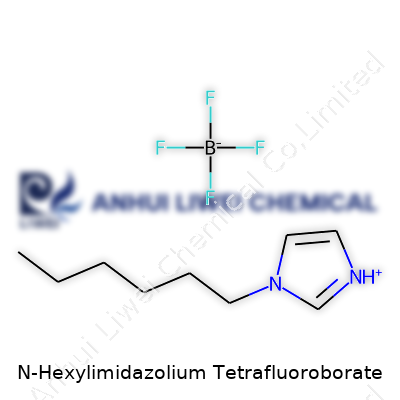
N-Hexylimidazolium tetrafluoroborate shows up in scientific circles with the chemical formula C9H17BF4N2. Each molecule measures up with a molecular weight of 256.05 g/mol. On the molecular level, this compound combines an imidazolium ring—well-known among chemists for its stable ionic properties—with a straight six-carbon alkyl chain and the robust counterion tetrafluoroborate (BF4-). That’s not just name-dropping; it’s the real recipe that makes this compound unique in labs and sometimes industry spaces.
Why People Turn to N-Hexylimidazolium Tetrafluoroborate
As someone who’s watched ionic liquids jump from obscure academic interest to valuable laboratory tools, it’s not hard to see the appeal. When research needs a solvent that doesn’t evaporate at the drop of a hat, this ionic liquid fits the bill. The presence of the hexyl group does more than stretch its carbon count—it also cranks up its hydrophobic nature. Instead of dissolving in water, this compound tends to attract organic solutes, helping researchers separate chemicals that don’t play nice in typical water-based environments.
Unlike old-school organic solvents that often bring health concerns and fire risks, ionic liquids like N-hexylimidazolium tetrafluoroborate usually don’t give off flammable vapors at room temperature. Speaking from personal experience in university labs, handling this kind of material feels more controlled than dealing with volatile, flammable alternatives like diethyl ether or dichloromethane. And in a safety-conscious world, those details matter.
Applications—From Lab Bench to Technology
This compound finds its way into a few corners of technology. Electrochemistry counts among its chief playgrounds, where the stable nature of the imidazolium cation can help create a reliable medium for batteries and supercapacitors. Some colleagues have experimented with ionic liquids to fine-tune the performance of lithium-ion batteries, specifically looking to balance electrical stability with more sustainable chemical choices. The presence of the tetrafluoroborate anion adds electrochemical stability, making this compound a candidate for high-voltage environments.
Organic synthesis labs have also latched onto these ionic salts when traditional solutions create too many cleanup headaches. Less volatile waste simplifies disposal, and the reactivity profile lets chemists coax along tricky reactions that might stall in less forgiving solvents.
Looking at the Risks
Every chemical brings baggage. N-Hexylimidazolium tetrafluoroborate doesn’t jump out as the most toxic salt in the cabinet, but its breakdown products and persistence in the environment haven’t been completely mapped out. Handling it with gloves and goggles goes beyond guidelines—it’s just good practice. Over time, more studies have started to examine what happens as these salts enter water treatment streams. The imidazolium core can stick around longer than anyone expected a few decades ago.
Some regulatory agencies are moving to track and limit novel ionic liquids for this reason. Data from the European Chemicals Agency has begun catching up, so chemical manufacturers now face more pressure to document environmental testing results. If a greener future for chemistry is going to include ionic liquids, we need clear evidence on what happens after the lab work is done.
Towards Safer and Cleaner Chemistry
It isn’t enough to chase performance alone. R&D labs have started screening new ionic liquids with an eye towards biodegradability. If the next generation of chemistry students is going to inherit these tools, industry and academia need to coordinate on safer, more transparent formulas. Open publication of toxicity and degradation data takes priority.
N-Hexylimidazolium tetrafluoroborate stands at the intersection of practical needs and new responsibilities. Understanding its structure and weight only marks the starting point—we all have a stake in what happens next.
Looking at Solubility:
N-Hexylimidazolium tetrafluoroborate sits at a crossroads where chemistry meets practicality. In my years of working with ionic liquids, I noticed this one popping up in research labs, from electrochemistry setups to organic synthesis runs. The question always comes up at the planning stage: Will it dissolve where I need it? The answer shapes experiments, costs, and sometimes safety considerations.
Water or Organic Solvents?
With a structure built on an imidazolium core, a six-carbon hexyl chain, and a tetrafluoroborate counterion, the solubility cues become clearer. Imidazolium salts mix with water easily when their side chains remain short. Pushing out to six carbons, like n-hexyl, shifts the balance. Every time my team made this compound in the lab, we noticed it resisting water much more than its smaller siblings. Reports echo the same story: N-hexylimidazolium tetrafluoroborate forms a heavy, sometimes sticky layer when dropped into water, instead of freely dissolving.
Yet drop the compound in something like acetonitrile, dichloromethane, even ethanol, and you’ll see it blend in with little agitation. The hexyl group gives it an affinity for nonpolar or slightly polar solvents. If I had to do a quick separation or purification, I would always reach for those organic solvents for a reason. Researchers back this up: published solubility tables show moderate to strong solubility in organics, with acetonitrile and acetone consistently listed as good choices. That opens up easy pathways for catalysis, electrochemistry, or even extraction in organic phases.
Why Chemists Care
Whether setting up a battery, working with enzyme catalysis, or running a green chemistry process, the solvent often makes or breaks the functionality. If an ionic liquid doesn’t dissolve as expected, costs go up and yields stall. One experiment I joined lost several days and a fair bit of funding because the team assumed this salt would mix with water the same way its butyl cousin did. Equipment sat idle while we searched for solvents that fit the needs of the moment.
Facts show that ionic liquids with longer alkyl chains tend to shed water solubility and embrace organics. For those scaling up production or designing new reactions, recognizing this fact saves time and money. Mishandling the solubility side can mean dealing with messy separations, poor battery performance, or even unanticipated toxicology risks if a supposedly water-miscible compound turns out to separate—and creates a two-phase hazard.
What to Do About It
As the applications for ionic liquids grow, from green solvent design to advanced manufacturing, researchers and manufacturers can use key facts about molecular structure and solvent behavior to avoid hiccups. Including routine small-scale solvent screening always paid off in my own work, long before large investments. Taking five minutes to check how one of these salts mixes gave back hours down the road.
There’s value in paying attention not just to the base molecule but to what happens when a hexyl chain joins the mix. Checking supplier data sheets, reading up on published solubility studies, even asking peers what they’ve seen in the lab always led to better outcomes for my teams. In the world of fast-moving chemical research, skipping the solubility homework costs more than anyone expects.
Moving Forward with Confidence
Understanding and predicting solubility isn’t just a theoretical curiosity. It shapes safe practices, efficient experiments, and the path toward better products. Whether you’re running a small bench project or rolling out a new chemical process, knowing your solvents—and respecting what makes N-hexylimidazolium tetrafluoroborate pick one over another—gives anyone in the field a much stronger hand.
Why Being Careful With This Compound Matters
Working with chemicals comes with enough stories – some good, some only told as cautionary tales. I remember my first months in a real lab, just learning the ropes, how even a missed label could turn a normal day into a panic to find what was leaking behind a cabinet. Now, with compounds like N-Hexylimidazolium Tetrafluoroborate, one wrong move or lazy storage routine does more than mess up an experiment; it could send someone to the ER. This isn’t just about lab rules: it’s about people. That’s why anyone handling this ionic liquid should treat it like a guest that’s helpful, but only if you show respect.
Conditions That Keep Things Safe
Any honest chemist will tell you, some chemicals just don’t play well with oxygen or water. N-Hexylimidazolium Tetrafluoroborate falls into that club. If you ever see its container left open, stop and close it. Humidity can break it down, and some breakdown products don’t belong near human skin or lungs. So, storage in a cool, dry spot keeps it out of trouble. A tightly sealed glass or high-quality plastic bottle works best. If possible, add a layer of dry nitrogen. This protective blanket keeps moisture away, which means fewer surprises next time you need to use it.
Protecting People Works Better Than Dealing With Accidents
I learned quickly that most lab mistakes come from trying to “just do this real quick”. Skipping gloves or decent ventilation always catches up to you. Personal protective equipment is the ticket here: nitrile gloves, safety goggles, and proper lab coats. Ventilated fume hoods aren’t just for the big, scary acids. Ionic liquids like this one release vapors or react with other substances, especially if someone spills or accidentally heats it. At the very least, keep open flames far away. Some borates release pretty nasty gases under heat or in the wrong chemical mix.
Don’t forget about waste. Even a tiny bit leftover in a pipette or weighing dish counts. Don’t toss it in the sink or trash. Set up a marked waste container, and make sure everyone using the lab knows where it goes. Accidental mixing of incompatible waste starts bigger problems. A good label stops confusion – just imagine cleaning up a mess because nobody said what’s in “bottle #42”.
Solutions Built From Practice, Not Just Protocols
Every lab has its own way of doing things, but policies fall short without respect for the materials. Open conversations work better than posted signs alone. If someone sees a shortcut, they should call it out. Training helps, but so does sharing stories – real mistakes, honest lessons. Good records matter, too. Jot down purchase dates, storage info, and incidents. It’s not red tape – it’s the fastest way to save a disaster when you can’t remember what happened last week.
If resources allow, installing basic environmental controls pays off. Even a low-cost humidity monitor or backup containment trays cut risk. Nobody wants to wind up as an example in a “what went wrong” lecture. By treating N-Hexylimidazolium Tetrafluoroborate with steady attention and sharing good practices, we do better than just ticking safety boxes. We build labs people trust – and keep those stories boring in the best way.
What Makes This Ionic Liquid Stand Out?
In the world of ionic liquids, N-Hexylimidazolium Tetrafluoroborate holds a special spot for anyone exploring greener solvents or advanced energy storage. I remember sorting through rows of imidazolium-based liquids in a lab, and this one always caught my attention for its blend of stability and unique handling properties. It isn’t just a chemical by name; it brings together traits that shape how it’s used, stored, and paired with other substances.
Physical Traits You Can’t Ignore
This compound pours out as a clear, sometimes slightly yellowish liquid. At room temperature, it doesn’t freeze or boil off easily, giving it reliable use in both chill and warm workspaces. Its viscosity sits somewhere between thick syrup and light oil, which offers flexibility in flow—but it’s not prone to evaporating like common organic solvents. That means less worry about fumes filling up a workspace or changing concentration mid-experiment. Lab-based measurements report its melting point resting below 0°C, and it takes a high temperature—often upwards of 300°C—before decomposing. That makes it a solid choice for tasks needing heat without the mess of constant monitoring.
Chemical Strength on Display
Imidazolium cations, paired with the tetrafluoroborate anion, open the door to chemical robustness. The imidazolium core protects this molecule from breaking down quickly in water or air, as long as you keep strong acids and bases away. Researchers enjoy the stability; you can store it for months if sealed from moisture. In my own experience, the balance of hydrophobic and hydrophilic character plays a role. The long hexyl chain drags the compound toward nonpolar behavior, so it resists mixing with water. At the same time, it dissolves salts and some organic compounds, helping separate tricky mixtures or forming unusual electrolytes for batteries.
Low Volatility Keeps Work Safe and Consistent
Low vapor pressure stands out for anyone who’s struggled with solvent losses or lab safety. You can handle it outside the fume hood in small amounts, and it sticks around for the long run in devices like supercapacitors or sensors. I’ve seen battery prototypes that keep going strong without drying out because the electrolyte hangs tight for months. The benefit here lies not just in the absence of toxic fumes, but also maintaining chemical integrity during long-term use.
Electrical Conductivity and Real-world Impact
One of the core properties driving demand is electrical conductivity. With just the right balance of ions, N-Hexylimidazolium Tetrafluoroborate runs current better than many traditional solvents. This quality won’t put it on par with metals, but for applications like electrochemical sensors, it fits the bill. The ionic conductivity is enough to support development in fuel cells and flow batteries, allowing for compact storage with less risk and fewer emissions than some conventional electrolytes.
What Needs Attention Next?
Every new material calls for scrutiny. Tetrafluoroborate isn’t inherently toxic, but it’s important to keep an eye on contamination risks. I’ve worked in labs that enforce strict waste protocols to prevent issues with environmental disposal. Keeping this liquid dry and protected from strong acids helps maintain its shelf life and safety profile. Researchers keep pushing its limits, testing how it works in greener extraction, recycling spent electrolyte, and swapping the anion for even safer versions in hopes of a broader future.