N-Octyl-N-Methylpiperidinium Bromide: Looking Past the Lab Bench
Historical Development
Back in the late 20th century, researchers in organic synthesis hunted for ionic compounds with a knack for stability and solubility in organic solutions. That search led to quaternary ammonium salts like N-Octyl-N-Methylpiperidinium Bromide. Chemists explored hundreds of variations, adjusting carbon chain lengths and nitrogen substitutions, but the octyl group showed surprising promise. Early applications sprouted in the pharmaceutical industry—driven by the need for effective phase-transfer catalysts that could push stubborn ions into desired reactions. The compound picked up steam in the 1990s as material scientists tried to coax better performance out of polymers and advanced surfactants. Good ideas often linger before hitting their stride, and as patents expired, open research brought this salt into broader practical use, linking academic curiosity with genuine industrial need.
Product Overview
N-Octyl-N-Methylpiperidinium Bromide belongs to the family of quaternary ammonium compounds. It appears as a white to off-white powder or crystalline solid, sometimes forming clumps if humidity creeps past safe storage conditions. Folks in the chemical supply business tend to package it in dark bottles or foil-lined pouches—not just for looks, but because light can cause slow breakdowns over time. Typical product offerings boast purities above 98%. Most production lots pass rigorous inspection to keep harmful byproducts or moisture content out. Chemists and material engineers choose this chemical for its ability to shuttle ions where traditional salts struggle, and for its relatively low tendency to cause unwanted side products under common synthesis conditions.
Physical & Chemical Properties
With a molecular formula of C15H32BrN, N-Octyl-N-Methylpiperidinium Bromide lands right between midweight organic salts and heavier industrial surfactants. The melting point usually falls in the 180-190°C range. That’s not unusual for a quaternary ammonium salt, but it does mean the compound holds up under moderate heating without decomposing. Solubility stands out—highly soluble in water, methanol, ethanol, and many polar solvents. It’s less comfortable in nonpolar hydrocarbons. The octyl group’s long tail changes how this salt interacts with both hydrophilic and lipophilic systems, giving formulators room to balance performance and compatibility. The bromide ion does more than hang around as a counterion; it can participate in further reactions, adding flexibility for folks looking to modify molecular scaffolds.
Technical Specifications & Labeling
Manufacturers typically detail percent purity, lot batch, storage temperature, and recommended handling precautions on every label. Instead of fluffy marketing, they drill down to specifics: moisture content stays below 0.5%, heavy metals remain under strict limits, and pH ranges are carefully controlled. Labels commonly display shelf life, usually 24–36 months if kept sealed at room temperature away from light. Some suppliers slap barcodes or digital QR links right on the packaging to track lots and speed up recalls or verification. Every specification sheet includes a spectral fingerprint, like NMR or Mass Spec data, so researchers verify that what arrived matches their needs. It’s a solid step towards keeping quality high and surprises low.
Preparation Method
Laboratories and commercial plants synthesize N-Octyl-N-Methylpiperidinium Bromide using a two-step method: alkylating piperidine with octyl bromide to produce N-Octylpiperidine, then methylating the result with methyl bromide. This sequence pins down a quaternary ammonium center. Reaction temperatures rarely rise above 80°C, avoiding side reactions that strip yield or generate toxic byproducts. Solvents like acetonitrile and ethanol show up often; they dissolve both reactants and the bromide leaving groups. After the reaction, cooling the mixture usually precipitates the finished product, which then gets washed and dried under vacuum. Many chemists skip elaborate purification, since crystallization and a few washes clean up the salt well enough for research or production.
Chemical Reactions & Modifications
In the hands of a creative synthetic chemist, N-Octyl-N-Methylpiperidinium Bromide becomes both a reactant and a platform for further changes. The quaternary nitrogen, carrying no hydrogen, stays resistant to basic or mild acidic conditions. Yet, swap out the bromide ion through metathesis, and you can create a series of salts with alternate anions—tetrafluoroborate, perchlorate, or even organic acids. Reactivity centers on the bromide, which enables SN2 substitutions and various cross-coupling reactions. In catalysis, this salt steps up as a phase-transfer agent, ferrying otherwise trapped ions into action. Environmental engineers sometimes modify its structure, aiming to tune surface-active properties or promote selective ion exchange in water treatment systems.
Synonyms & Product Names
Products hit catalogs under many names: you’ll see N-Octyl-N-Methylpiperidinium Bromide, Octyl-methylpiperidinium bromide, or even 1-Octyl-1-Methylpiperidinium Bromide. CAS numbers attach directly to prevent mixups. A few proprietary blends package this salt under trade names, often as additives or growth media supplements. In pharmaceutical texts and patent filings, expect to find synonyms like 1-Octyl-1-methylpiperidinium bromide or shortened forms using chemical abbreviations. Industry leans on these identifiers to cut through confusion, and I’ve found that double checking CAS or catalog numbers when swapping suppliers heads off headaches later.
Safety & Operational Standards
Handling any quaternary ammonium salt demands caution—N-Octyl-N-Methylpiperidinium Bromide is no exception. Direct contact may irritate skin or eyes, and inhaling dust brings respiratory discomfort for some. Material Safety Data Sheets recommend full PPE: gloves, goggles, and lab coats, especially during weighing or mixing. Fire risk stays low, since the salt resists ignition, but strong oxidizers may react dangerously. Disposal routes need thought; typical practice funnels spent materials into halogenated waste streams for controlled destruction. Workplaces must keep good ventilation, spill absorbents, and first-aid kits close by at all times. For anyone running experiments or production, regular staff training and emergency drills beat winging it in a crisis.
Application Area
The reach of N-Octyl-N-Methylpiperidinium Bromide stretches well beyond the lab. In chemical synthesis, it’s valued for making cross-coupling and alkylation reactions work more smoothly, especially where mixing polar and nonpolar phases causes trouble. Materials scientists look to this compound when designing custom ionic liquids for use in batteries, fuel cells, or electrochemical devices. Surfactants produced from these salts play a role in environmental cleanup efforts—grabbing onto pollutants that simple soaps can’t budge. Inside pharmaceutical development, the salt acts as a helpful solubilizer, coaxing reluctant molecules into solution for testing or formulation. I’ve seen research teams in biotech use it to patch up tough membrane studies or help separate complex proteins during purification steps.
Research & Development
Academic and industrial scientists continue probing the boundaries of what N-Octyl-N-Methylpiperidinium Bromide can do. Novel routes for greener synthesis have cropped up, using less toxic solvents or cutback waste. Research in electrochemical devices leverages its stability to extend lifetimes for ionic liquids in supercapacitors or lithium-ion cells. There’s also a push in drug delivery, looking to harness the surfactant properties to boost bioavailability of next-generation formulations. Computational chemists model the compound’s interaction with biological membranes or synthetic polymers to predict performance in new contexts. Collaboration between chemists, engineers, and toxicologists grows more common, aiming to spot issues before scaling up any new product line.
Toxicity Research
Every chemical bears scrutiny in toxicity testing, and N-Octyl-N-Methylpiperidinium Bromide has drawn its share. Animal studies reveal moderate acute toxicity through ingestion, with endpoints focused on liver and kidney function. Localized irritation stands as the main risk for workplace exposure, prompting strict handling procedures in production plants. Chronic exposure data remain limited, so regulatory agencies err on the side of caution, limiting allowable concentrations in workplace air. Environmental fate testing shows the bromide portion moves freely in water, and researchers keep an eye on any disturbance to aquatic life—since the amphiphilic structure will bind with cell membranes. Ongoing in vitro studies screen for any potential mutagenic or carcinogenic effects before wider product launches.
Future Prospects
Prospects for N-Octyl-N-Methylpiperidinium Bromide appear bright, carried by the demand for highly tuned phase-transfer catalysts and stable ionic conductors in clean energy storage. The growth of green chemistry stirs up interest in salts that work well under mild conditions or support recyclable processes. Regulatory scrutiny continues shaping both production and disposal, with stricter standards pushing chemists to cut residual contaminants and shrink the environmental footprint. Possible expansion into controlled drug delivery or biodegradable surfactant market brings both promise and responsibility. Researchers worldwide focus not just on what new tricks these salts can perform, but also how safely and sustainably they can be made and used. The story of this compound keeps evolving, tied closely to society’s appetite for safer chemistry and smarter applications.
Understanding the Role in Science
N-Octyl-N-methylpiperidinium bromide sounds complicated, and it is. This chemical fits into a group called quaternary ammonium compounds. Folks in research labs, especially those hunting for better batteries and fuels, see this compound as more than just a tongue-twister. They use it in electrochemistry—specifically, in ionic liquids and electrolytes. The structure of this molecule lets it help move charge in batteries. For example, scientists working on lithium-ion batteries and fuel cells rely on substances like it to bump up conductivity and stability. Without stable and efficient electrolytes, those fancy, long-lasting batteries for electric cars and phones would stay science fiction.
Industrial and Commercial Relevance
This compound also pops up in places I didn’t expect. Industrial labs use it as a phase-transfer catalyst. That means it helps chemicals mix or react by carrying one ingredient into another layer. This can make certain chemical reactions safer, less toxic, and much faster. For example, making pharmaceuticals and agrochemicals often gets a boost with this approach, and the people making those products get more reliable results.
Real-world impact starts to show when we look at waste treatment or water purification. N-Octyl-N-methylpiperidinium bromide helps pull out heavy metals and other nasty substances from the water. Factories or towns with contaminated water supplies use chemicals like this to meet safety standards and protect public health.
Safety and Environmental Concerns
Working with any quaternary ammonium compound brings up its own challenges. People in labs must follow strict safety measures, since this chemical can irritate the skin, eyes, or lungs. It’s not just about mishaps in the workplace—there’s more. We know that some substances from this chemical family linger in the environment and harm aquatic life. That makes disposal and handling important, so people don’t trade one problem (like dirty water) for another (like pollution).
Regulatory agencies have begun to watch these types of chemicals more closely. If future research shows big risks to the environment or people, some uses might get tighter rules or better alternatives.
Looking Ahead
Shifting to greener chemistry stands out as the big challenge. Companies and universities still look for options that break down quickly and don't build up in nature. Some research suggests tweaking the structure of compounds like N-Octyl-N-methylpiperidinium bromide could lead to less toxicity and faster degradation.
The chemical industry always has to balance progress with responsibility. If manufacturers, public health groups, and researchers share what they learn—including any risks and ways to deal with them—then progress won’t come at the expense of safety or the planet. In my own experience working near facilities that use tough chemicals, honest communication and strong safety rules make a difference. People need to see the whole picture, not just the benefit in a test tube.
What to Watch
Anyone interested in technology, safety, or the environment has reasons to care about what happens with chemicals like N-Octyl-N-methylpiperidinium bromide. The next breakthrough in batteries, medicine, or clean water could start with a small tweak to compounds like this one, but the costs and risks have to be just as important as the rewards.
Breaking Down the Structure
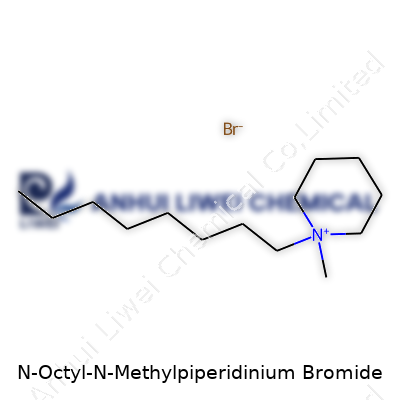
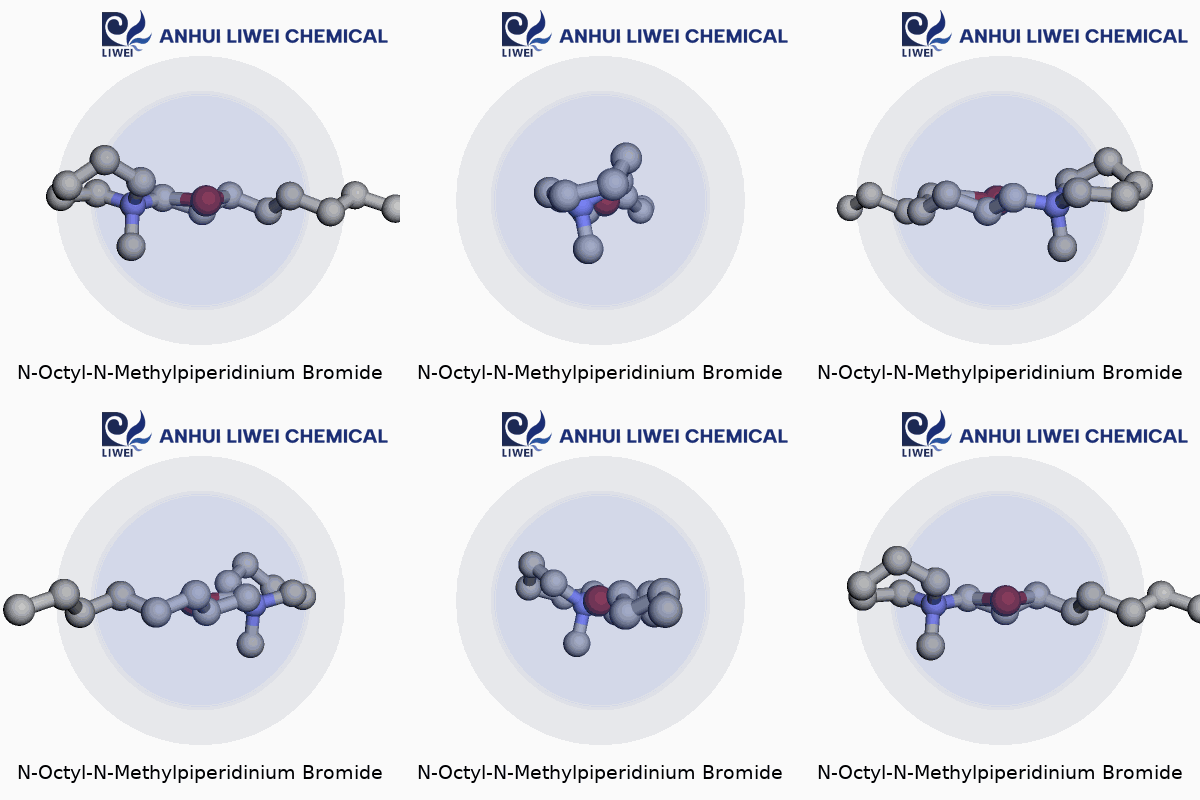
N-Octyl-N-methylpiperidinium bromide is a mouthful to say, but its chemistry offers more than just a fancy name. This molecule starts with a piperidine ring, a simple six-membered ring packing five carbons and a nitrogen. Attach a methyl group and an octyl chain to that nitrogen, and the molecule starts to show its character—one end carries a bulky, oil-loving tail, and the rest forms a water-friendly head. The structure ends with a bromide ion—this balances the positive charge left by adding extra alkyl groups to the nitrogen on the ring.
The chemical formula puts it all together: C14H30BrN. Chemists write it out as the piperidinium ring with a methyl group (–CH₃) and an octyl group (–C₈H₁₇) connected at the nitrogen. That bromide sits outside the ring, all because they need to even out the charges in the end product.
Real-World Value
Anyone digging into surfactants or specialty chemicals will eventually run into quaternary ammonium compounds like this one. You see these structures popping up wherever someone needs both water and oil to cooperate, or when they’re looking to kill bacteria gently but effectively. The long octyl chain brings oil and grease into the fold, while the methylpiperidinium head sticks with water and disrupts cell membranes in microbes. Researchers and product designers love this kind of versatility.
Factories and labs rely on the exact structure because small changes—shorter or longer chains, swapping the position of a methyl group—change how the molecule behaves. For instance, swapping the octyl tail for a shorter ethyl chain drops the effectiveness in both detergency and biological action. The piperidinium ring, compared to more basic alkyl ammonium heads, offers a slightly different fit against cell walls or surfaces. This matters in pharmaceuticals, surface disinfection, and industrial cleaning. The chemistry gets real practical, real fast.
Why Structure Matters: E-E-A-T in Chemistry
Expertise stands out most when someone shows how structure links to function. Education in organic synthesis gave me a front-row look at how little tweaks ripple out. Researchers don’t just toss the longest tail or the biggest ring onto a molecule—they tailor it for speed of action, safety to people, and reliability in the field. Labs have tried and tested these molecules under different conditions. Trust in the data grows from reproducibility, which relies on describing the structure in full detail and being honest about limits.
N-Octyl-N-methylpiperidinium bromide doesn’t exist only in textbooks—the structure guides how it gets used in disinfectants, helps decide if it’s suitable for contact with skin, and shapes its breakdown in the environment. Regulatory agencies lean on the chemistry to check safety profiles, demand traceability, and push for greener substitutes. Laypersons rarely read chemical formulas, but they do rely on the real-world outcomes, and understanding the structure means better choices at every level.
Room for Better Chemicals
Innovation isn’t finished. While this molecule brings strengths, chemists and manufacturers can chase improvements—safer breakdown, less environmental persistence, better performance in biofilms, or more selective targeting of harmful bacteria over beneficial ones. The structure points the way, guiding substitutions at the ring or the tail end, or the choice of balancing ion. Green chemistry calls for redesign, not just recycling old tricks. Teams with real expertise use the blueprint of N-Octyl-N-methylpiperidinium bromide as a jumping-off point, not just a final destination.
Why It Matters
N-Octyl-N-Methylpiperidinium Bromide doesn’t strike most people as a household name. Still, in labs and some specialty industries, keeping chemicals like this in top shape keeps research and operations running without headaches. Once, I watched a colleague scramble to replace an entire batch of material after reading the storage guidelines a little too late. That mistake cost time and money—but more importantly, it caused a break in trust. So, proper storage goes deeper than just tidiness or compliance. It touches everything, from research integrity to lab safety. Anyone using specialized chemicals gets the same lesson sooner or later, often the hard way.
Sticking to the Basics
Poor storage conditions can shorten the useful life of N-Octyl-N-Methylpiperidinium Bromide. Too much moisture, sun, or heat can start chemical changes that nobody wants. The result: unexpected reactions or simple loss of product. Storing this compound in a cool, dry place away from direct sunlight makes all the difference. In my time working with similar salts, proper storage stopped bottles from gumming up and labels from peeling, which saved me from confusion and possible accidents down the road.
Sealed and Labeled Containers
Once you open a chemical, the risks stack up fast. Moisture from the air, dust, or careless hands have a way of working into containers. I learned early on not to trust a half-closed lid. Always keep N-Octyl-N-Methylpiperidinium Bromide in airtight containers, and double-check that lids close tightly each time. Labels should show the full name, date received, and date opened. If anything looks off, better to toss a questionable bottle than risk a ruined experiment—or much worse, a chemical mishap.
Temperature Control
I’ve seen rooms swing from stifling heat to bone-chilling cold thanks to broken HVAC units. N-Octyl-N-Methylpiperidinium Bromide should stay at a steady temperature, never above room temperature, and far from any radiator or window. Excessive heat can speed up chemical breakdown or spark reactions. Fridges or climate-controlled cabinets solve these issues. Just make sure to separate incompatible chemicals, because cramming everything into one fridge can cause more problems than fixes.
Safe Location and Security
Spills are a pain to clean and sometimes dangerous. Never store this compound where people rush past, or where heavy equipment could knock it over. A shelf at shoulder height, far from edges, keeps containers visible and less prone to accidents. My old university lab marked shelves with colored tape, and those markings kept everyone on track even during the busiest days. Access controls limit who can handle or even see certain chemicals, cutting down on tampering or theft. That’s especially true in shared research spaces.
Disposal and Emergency Planning
Unusable or expired chemicals shouldn’t linger in storage. It pays to track inventory every couple of months. Old samples create extra waste and put people at risk. In my own lab work, regular cleanouts freed up space, kept records accurate, and made emergency planning simple. For those rare times something does spill, every lab should post emergency contact numbers, provide spill kits, and walk every new team member through cleanup drills. Chalk that up to lessons learned from late-night lab sessions and one too many near misses.
Understanding the Substance
N-Octyl-N-Methylpiperidinium Bromide sounds complicated at first glance, but beneath the chemical name, you'll find a compound used in research settings and some industrial applications. The structure combines a piperidine ring with octyl and methyl groups, sticking a bromide counterion on for balance. Researchers pay attention to chemicals like this because getting careless can have real consequences, especially in labs with less safety oversight.
Health Concerns and Real-World Effects
Handling lab chemicals reminds me of my own early days in university—being eager, maybe a bit ignorant. Chemicals that sound tame sometimes surprise you. According to safety data sheets from suppliers, N-Octyl-N-Methylpiperidinium Bromide can irritate skin, eyes, and the respiratory tract. The irritation comes quickly if someone isn’t wearing gloves, goggles, or working in a well-ventilated space. I’ve known students who shrugged off these warnings and learned the hard way. Redness, itching, a cough that didn’t quit for a day or two—these are not just annoyances.
It’s rare, but ingestion or inhalation in higher doses amplifies the risks. There are reports of nausea, headaches, and in extreme cases, impacts on the nervous system. The exact long-term toxicity profile still needs fuller study, but chemical cousins in this category (the quaternary ammonium salts) sometimes show up as irritants and, on prolonged exposure, can have chronic effects. That uncertainty always feels more dangerous than a hazard with clearly labeled boundaries.
Workplace Safety and Environmental Impact
Regulatory agencies set exposure limits after real incidents pile up, but this particular chemical has not yet earned broad scrutiny from EPA or OSHA. Lack of regulation doesn’t mean exemption from harm—just ask any chemist with a rash on their arm. Proper training, reliable PPE, and regular ventilation checks keep people out of trouble. I’ve seen lab protocols skipped in a hurry, and it doesn’t take more than a slip to get someone into an emergency wash station.
Disposal matters, too. This kind of substance shouldn’t go down the drain or into regular trash. Improperly handled, chemicals can build up downstream. It might seem small in a single lab, but multiplied by dozens or hundreds of sites, trace contaminants can leak into groundwater or disrupt microbial communities. Local authorities usually spell out hazardous waste rules—the smart move is to follow them to the letter.
Responsible Handling is Key
Transparency around risk promotes trust. Academic and industrial users who document health incidents, track small spills, and report anything unusual help regulators update safety resources that others rely on. Talking with safety officers feels tedious, but those conversations build a stronger culture for everyone. If you’re faced with handling this stuff, gloves, goggles, and a working fume hood belong on your checklist every single time.
Knowledge gaps remain, so a bit of humility serves well. Until studies draw clearer lines for this compound, treating it with respect and adopting high safety standards towers above any shortcut. Every seasoned scientist remembers a close call—a lesson that sticks far longer than an item in a textbook list. A well-informed approach saves skin, lungs, and sometimes a career.
From Lab Benches to Manufacturing Plants
In the circles of chemistry and biotechnology, N-Octyl-N-Methylpiperidinium Bromide turns heads for good reason. People working in the lab don’t choose chemicals at random. They look for ones that bring results and hold up under scrutiny. So this one, with its distinct molecular structure, draws repeat scrutiny, especially among researchers focusing on separation and purification.
Standing Out in Separation Science
What makes this piperidinium salt catch attention comes down to its charge and the “long tail” built into its composition. It helps push molecules apart in analytical systems. In my experience running column chromatography for protein purification, a cationic surfactant like N-Octyl-N-Methylpiperidinium Bromide acts as a silent operator. It sits in the mobile phase and interacts with proteins or peptides, guiding them apart based on their affinity for the ionic component. When you need crisp results without smearing, tweaking for the right surfactant can mean the difference between a failed experiment and clear answers. Many biotech protocols rely on exactly this kind of chemical to draw reliable boundaries between closely related molecules.
Electrochemistry and Material Science
Applications move well beyond the test tube. In batteries and fuel cells, researchers have used these bromide salts as ionic liquids or as additives in electrolytes. Picture an electrochemical cell needing both stability and efficient ion transport through its membrane. Adding an organic cation like N-Octyl-N-Methylpiperidinium doesn’t just boost stability; it can also reduce unwanted side reactions. That extra bump in performance might help shave off months during the development of a new membrane technology. For me, working in a clean lab, the frustration of failed conductivity tests gets real. A tweak to the ionic environment—shifting from a standard alkali salt to one of these organic ions—helped push a struggling prototype across the finish line.
Antimicrobial Research and Formulation Science
Discussions around antibacterial and antifungal agents keep running into resistance issues. Quaternary ammonium salts, and N-Octyl-N-Methylpiperidinium fits the bill, pop up across literature as potential alternatives or enhancers. The octyl group offers a balance: it’s big enough to disrupt microbial membranes, small enough not to gum up the works. A chemist I know shared results from a screen against hospital isolates — this category of piperidinium compounds stacked up well against established germ-fighters. Not every microbial threat gets wiped out, but the work makes a dent, especially in high-contact environments like medical devices or industrial surfaces.
Making Chemistry Safer and Greener
Another thing worth mentioning: safety and the environment. Traditional surfactants often leave behind tough residues or pose toxicity problems. Cleaner, more biodegradable molecules become more attractive when regulatory pressure mounts. This compound doesn’t always tick every green chemistry box, but compared to some older chemicals, it steers away from the most stubborn pollutants.
Looking Ahead
The usefulness of N-Octyl-N-Methylpiperidinium Bromide depends on open-minded experimenters willing to trial something outside the standard toolbox. Success out in the field comes from adapting existing methods, asking the right questions, and taking cues from what happens at the edge of each pipette. For every successful application you’ll see in published journals, a dozen attempts got made on the way. Facts show that innovation often comes from side steps, not straight lines.