N-Propyl-N-Methylpiperidinium Bromide: Insight, Impact, and Outlook
Historical Development
N-Propyl-N-Methylpiperidinium Bromide entered the labs of chemists at a time when new organic salts offered promise in electrochemistry and catalysis. A journey spanning decades, its story goes back to researchers searching for more stable and effective phase-transfer catalysts in the late 20th century. Quaternary ammonium salts started shaping green chemistry and industrial synthesis, and this compound stood out, not because of sheer availability, but because it fit new roles in both research and production. Its adoption proved that sometimes, the right tweak—in this case, swapping an alkyl side chain on a basic piperidinium scaffold—could push a familiar molecule into fresh territory. Laboratories leaned on it for its predictable behavior and robust performance, shaping new reactions and discoveries right through to now.
Product Overview
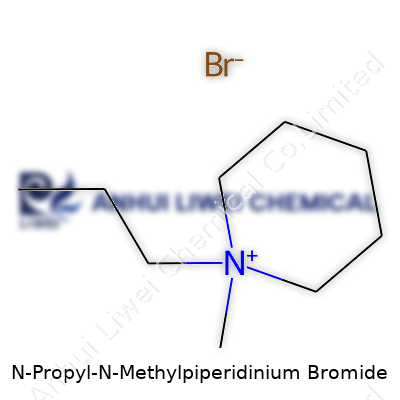
This compound falls under the category of quaternary ammonium salts, built on a piperidine ring substituted with a propyl and a methyl group, plus bromide as counterion. The trade names vary, but chemists often refer to its shorthand—N-Propyl-N-Methylpiperidinium Bromide or derivatives like PMP-Br. It usually arrives as a solid, pale off-white to white, easy to handle compared to some liquid counterparts. Producers who serve research labs and pilot plants emphasize the purity, which tends to land in the high ninety percent range, with water and trace salt levels kept impressively low.
Physical & Chemical Properties
Solid at room temperature, N-Propyl-N-Methylpiperidinium Bromide dissolves well in both water and polar organic solvents. Its melting point sits close to 200°C, but exact numbers shift based on crystal form and any residual moisture. The presence of a bromide anion delivers better thermal and chemical stability than corresponding chlorides. In practice, it resists breakdown under basic or mildly acidic conditions and does not release pungent odors. Handling this compound rarely leaves residue behind, and its hygroscopic profile remains moderate—enough care prevents clumping, but it won’t cake up a storage jar overnight. Shelf life stretches for years if kept sealed and cool.
Technical Specifications & Labeling
Specs for this compound reflect market priorities: purity not below 98%, by gas or liquid chromatography, water content at or below 0.5%, and a bromide assay that lets buyers know they’re not getting extra sodium or potassium. Certificates of analysis typically list IR and NMR spectra, mass spec confirmation, and a batch-specific lot number. European and American suppliers put GHS-compliant hazard pictograms on their labels, reminding users about skin and eye precautions. Each label should also carry emergency contacts and a quick response (QR) code for digital safety sheets—a practice that’s taken off since 2020.
Preparation Method
Making N-Propyl-N-Methylpiperidinium Bromide hinges on classic alkylation chemistry. Technicians start with piperidine, then introduce a controlled amount of methyl bromide and propyl bromide in a two-step or one-pot process, depending on yield and scale. To keep side reactions low, temperatures hover around 0 to 30°C, and slow addition prevents runaway reactions. Once the alkylation wraps up, precipitation or solvent extraction isolates the crude salt, which undergoes crystallization—common solvents include ethanol or isopropanol. Vacuum drying rounds out the process, yielding a product that rarely smells but carries a slight sting if mishandled. This route avoids the use of more exotic or dangerous reagents, making it fit into existing pilot-scale workflows.
Chemical Reactions & Modifications
This salt does not merely stand still in a bottle. Researchers often use it as a phase-transfer catalyst or employ it to make ionic liquids for battery research. The quaternary ammonium center lets chemists swap the counterion for other halides, turning bromide into chloride or iodide with metathesis reactions in water or acetone. Advanced labs modify the alkyl groups, stretching the length of the propyl side chain or branching others off the ring, which customizes hydrophobicity and ionic character. Reactions with nucleophiles generally don’t touch the ammonium center under standard conditions, which fits the goals of consistency and low byproduct formation in large-scale synthesis. When needed, researchers run thermal or oxidative stability tests to check how the structure responds under stress.
Synonyms & Product Names
Catalogs might list this as N-Methyl-N-Propylpiperidinium Bromide, 1-Methyl-1-Propylpiperidinium Bromide, or even its systematic IUPAC name for regulatory filings. Lab shorthand, like PMP-Br, crops up in published methods. Awareness of synonyms matters—a missed name can mean overlooked data or wasted time sourcing from multiple vendors. Some brands stick with house codes or catalog numbers, often included in digital ordering systems, but the chemical structure does not change. This keeps procurement consistent across continents and industrial use cases.
Safety & Operational Standards
No one should take chemical safety lightly in the case of quaternary ammonium compounds, even those with benign reputations. Skin contact rarely causes burns, but practitioners have to use gloves and goggles because accidental splashes irritate mucous membranes. Inhalation hazards remain minor under standard use, given low vapor pressure, but aerosol or powder dispersal in busy labs can happen on a bad day without proper procedures. Regular training covers spill cleanup with inert absorbents and disposal into approved waste streams—organic halide disposal regulations have tightened since 2010, with several European and American agencies pushing for stricter thresholds. Fire risk stays low; the salt does not burn easily or feed a blaze. Still, its chemical relatives have occasionally tripped up undergraduates who ignore standard protocols.
Application Area
This molecule’s sweet spot is phase-transfer catalysis. It moves ions back and forth across solvent boundaries—key to reactions like nucleophilic substitutions, oxidation reactions, and industrial-scale hydrolysis. Its performance in green chemistry projects and electrochemical cells explains why battery and capacitor researchers keep it around. Importantly, it brings reliable results to synthesis of active pharmaceutical ingredients, where small changes in catalyst behavior drive multi-kilogram costs. In materials science, it acts as a building block for advanced ionic liquids that stay stable under punishing voltages and temperatures. A few textile companies have even explored its antiseptic side, though its most substantial commercial footprint sits with labs and specialty producers.
Research & Development
Over the years, R&D teams dug deeper into the tuning of piperidinium-based salts for energy storage and green synthesis. Academic groups published structure-activity studies, switching out alkyl chains to target either higher conductivity or better phase compatibility. In electrochemical testing, results suggest hybrids of N-Propyl-N-Methylpiperidinium bromide show improved ionic conductivity compared to older ammonium salts. Pharmaceutical teams in process chemistry keep watching for side reactions and cross-coupling triggers, knowing that one missed interaction can distort output or regulatory compliance. In university labs, funding often goes to sustainability studies—testing whether waste streams from the product’s prep get easier to clean up or reuse. Global patent filings ticked up after 2015, pointing to wider industrial interest and application.
Toxicity Research
Studies so far classify this salt as mildly toxic. Rats and mice exposed over time display modest changes in physiological markers; nothing stands out as acutely dangerous at doses used in industry. Chronic exposure data remain sparse, and researchers urge routine monitoring for anyone handling the compound weekly or beyond. For environmental impact, the story remains mixed—some waterborne organisms show sensitivity to trace amounts, so waste streams must go through treatment plants capable of capturing halides and ammonium catabolites. Regulators in multiple countries now call for expanded bioassays to fill data gaps, especially for products used outside the lab.
Future Prospects
Looking down the road, N-Propyl-N-Methylpiperidinium Bromide sits at a crossroads in green chemistry and energy technology. Pushes toward fully recyclable batteries and greener catalytic cycles boost its importance, since reliable, tailorable ionic centers have become keystones for innovation. Tech companies want salts that last longer and perform better across multiple charge-discharge cycles, and this compound looks well-suited for those challenges. Process chemists keep searching for safer, faster manufacturing methods that cut waste and energy. Tighter environmental and occupational rules could shift demand, but the drive to keep scaling up synthesis with fewer hazardous intermediates plays to this compound's strengths. Research trends suggest it will keep gaining ground, especially as researchers chase better batteries, advanced materials, and more sustainable industrial processes.
Turning a Complex Name Into Practical Use
Chemists run into strange names almost every day, but N-Propyl-N-Methylpiperidinium Bromide actually serves a real purpose beyond the tongue-twister. This compound gets used in research labs that dig into advanced materials and chemical processes. For those who grew up in or around universities or biotech corridors, the search for better, safer, and cleaner processes is ongoing.
People often ask what sets this compound apart from all the rest. In labs, its main role traces back to its function as an ionic liquid or as a building block to make other specialized materials. Ionic liquids have low melting points and don’t evaporate like water or alcohol. That property keeps chemists from fighting with fumes or spills that punch up into your nose; it offers safer workspaces and, in the long run, fewer workplace health issues. A safer lab means fewer nights spent scrubbing chemical vapors from your skin or explaining the cost of a ruined experiment to your adviser.
Key Research and Real-World Impact
Research around this chemical pushes technological progress in fields like battery development, catalysis, and pharmaceuticals. N-Propyl-N-Methylpiperidinium Bromide provides a stable platform for chemical reactions that demand control and precision. In battery science, for example, ionic liquids help develop systems that store electricity longer and operate in wider temperature ranges. Cars, phones, and renewable energy grids all benefit when batteries last longer and hold up under strain.
Some pharmaceutical procedures require chemicals that won’t interfere with delicate molecules or create unwanted byproducts. N-Propyl-N-Methylpiperidinium Bromide offers the right chemical environment for complex synthesis steps, keeping reactions steady and predictable. That’s something I’ve seen frustrate researchers when less specialized compounds mess up months of careful work. Getting a consistent result saves money and nerves, which matters to small labs running short on budget or time.
Concerns and Solutions
Like many lab chemicals, safety becomes a concern in storage and disposal. Bromide salts can raise environmental questions if they get flushed or dumped carelessly. Some early studies showed certain piperidinium salts linger in water and soil, where they can damage plants or disrupt water treatment processes. Research calls for better handling rules and recycling systems, which tend to lag behind the pace of discovery. I once helped a student group build a program to recover and reuse ionic liquids in collaboration with local waste managers. It helped both our department and city keep hazardous waste low and set a model for others to follow.
At the industrial level, keeping chemicals like this one out of rivers and into proper recycling loops remains a big challenge. Europe and Japan enforce tough disposal standards, while other places still treat chemicals as single-use. Every step toward recovery or safe neutralization matters—acting now can head off a mess later and protect neighborhoods near factories or water systems.
Innovation Matters
Compounds like N-Propyl-N-Methylpiperidinium Bromide help unlock new technologies and cleaner methods, but only if safety and waste don’t get pushed aside. The path from a synthetic recipe in a journal to real products on shelves means not just clever chemistry, but careful attention to what happens after the mixing and testing finish. In the end, safer, smarter use benefits everyone who depends on the results—inside and outside the lab.
Understanding What Matters in Chemical Storage
People forget that some chemicals act like chameleons — stable in one situation, unpredictable in another. Take N-Propyl-N-Methylpiperidinium Bromide, for example. While it doesn’t demand a high-security bunker, the right storage environment keeps both users and the material safe, maintains quality, and helps labs stay clear of surprises down the line.
Temperature: The Foundation of Good Storage
Most researchers have seen products degrade simply because they sat in a cabinet that got too warm. N-Propyl-N-Methylpiperidinium Bromide stays in good shape if enough attention goes to room temperature — that means avoiding spots close to heating vents or windows where the sun sneaks in. Heat speeds up the breakdown of chemical bonds. That can change how the material behaves, clouding results and safety profiles. My years around lab benches and freezers taught me that stable environments matter more than fancy technology. A dedicated, labeled shelf in a climate-controlled storeroom often beats any fridge with mystery contents and constant door swings.
Light and Moisture: Underrated Threats
It’s easy to overlook what a little moisture or sunlight can do. Even one open vial on a humid day can cause clumping, changes in solubility, or unexpected reactivity. Store N-Propyl-N-Methylpiperidinium Bromide in airtight containers. Keep cabinets dry — no open sinks nearby, and consider silica packs if local humidity runs high. Amber glass bottles make a big difference since light exposure nudges some compounds toward slow degradation. In my own lab, we once saw a costly batch discolor within weeks from a single overlooked skylight, reminding us that some lessons live in small mistakes.
Segregation: Avoiding Dangerous Mix-Ups
Combining the wrong chemicals under one roof leads to more headaches than most realize. N-Propyl-N-Methylpiperidinium Bromide, a hygroscopic ionic compound, doesn’t mesh well with strong oxidizers and acids. Store this material in a designated section—far from those groups. The old practice of alphabetizing everything once caused a near-miss in a teaching lab I worked at. Since then, I keep ionic compounds away from reactive organics and pull out the Material Safety Data Sheet for every unfamiliar addition to the stockroom.
Labeling and Housekeeping: Preventing Everyday Mistakes
Organized labs rarely suffer cross-contamination or accidental exposure. Every time someone rushes and skips labeling, the odds of a bad mix-up climb. Include concentration, date received, and hazard pictograms on every bottle. A printed or digital record helps spot degraded stock before use. From my own record-keeping efforts, I’ve sidestepped more than one situation where an unlabeled powder could have meant wasted experiments or worse.
Training and Routine Checks: Building Safe Habits
No protocol works if only one or two people know it. Everyone who steps into the storeroom should know what can stand together and which materials deserve space apart. Schedule regular audits—checking for label clarity, leaks, or dated stock. Long experience tells me most near-misses happen not because of poor intention, but because someone thought, “I’ll fix it later.”
Solutions and Ongoing Challenges
Safe chemical storage doesn’t require endless resources. Clear protocols, reliable climate control, basic labeling, and committed oversight go a long way. Review storage instructions at onboarding. Place reminders where chemicals live. In a pinch, even a simple checklist can prevent costly accidents. Years around research and teaching benches remind me: good habits and clear expectations keep materials like N-Propyl-N-Methylpiperidinium Bromide usable and everyone safer.
Getting To Know The Chemical
N-Propyl-N-Methylpiperidinium Bromide sounds like a mouthful, but if you work in a chemistry lab, it likely crops up as a reagent or intermediate. It falls under quaternary ammonium compounds, a group found everywhere—cleaners, medicines, and sometimes even in fabric softeners. That said, this chemical isn't as common in daily life. Handling it inside a research lab means scientists and engineers often bump into questions about its safety and whether exposure poses real risks—especially as regulations keep changing.
What We Know About Hazards And Toxicity
Sourcing solid safety info sometimes feels like a treasure hunt. For more widely used quaternary ammonium salts, studies flag skin and respiratory irritation as the most immediate issues. N-Propyl-N-Methylpiperidinium Bromide doesn’t turn up in big toxicology reviews like household disinfectants do. But by its chemical relatives, it likely produces similar risks if you touch or breathe it in. The bromide side can cause some concern for people with thyroid conditions, but the bigger deal comes from the piperidinium structure, which can land it on the list of compounds you don’t want splashed in your eyes or on your hands.
Research from laboratory supply safety sheets routinely shows warnings: avoid inhalation, don’t get on your skin, keep out of eyes, and use gloves and goggles. Nobody wants to discover a new allergy or skin rash because they skipped gloves. As with most lab chemicals, there’s a simple way to avoid trouble—respect your PPE (Personal Protective Equipment). Even without high-profile news stories of harm, treating it as a potential irritant just makes sense.
Pushing for Smarter Safety
I’ve watched experienced chemists treat every bottle as if it might hide a snake. That habit pays off, because you can’t always trust the label to hint every danger. Stories I’ve heard have ranged from accidental spills to vapor exposures that led to headaches or coughing fits after long hours in a poorly ventilated hood. Industrial hygiene guides recommend ventilation and the use of sealed containers, in part because even trace amounts drifting in the air can irritate sensitive lungs.
Companies and universities rely on standardized protocols—Material Safety Data Sheets (MSDS) get read before ever opening a bottle. If your lab doesn’t post clear guidelines, that’s a reason to push for an update. The Occupational Safety and Health Administration (OSHA) doesn’t list N-Propyl-N-Methylpiperidinium Bromide directly, but they cover chemical exposure standards and employer responsibilities generally under HazCom (Hazard Communication Standard).
Solutions For Future Handling
Hoping for fewer accidents means starting with clear labeling and locked cabinets. Strong air flow in the workspace prevents tiny spills from becoming much bigger headaches. Even swapping out a compound for a less toxic one, when synthesis allows it, makes a difference. Annual safety training, even for old-timers, keeps awareness where it belongs—right at the bench. Most important, supporting those flagging near-misses or close calls gives teams real info for better decision-making.
The upshot: this isn’t a household toxin, but in the lab, smart habits, up-to-date protocols, and a willingness to stop and ask questions keep risk in check. I’ve seen scientists swap stories about near misses, only to learn later those moments changed how they label bottles, ventilate labs, and train new hires. With that attitude, even unfamiliar reagents like N-Propyl-N-Methylpiperidinium Bromide lose their power to surprise.
Getting Down to the Basics
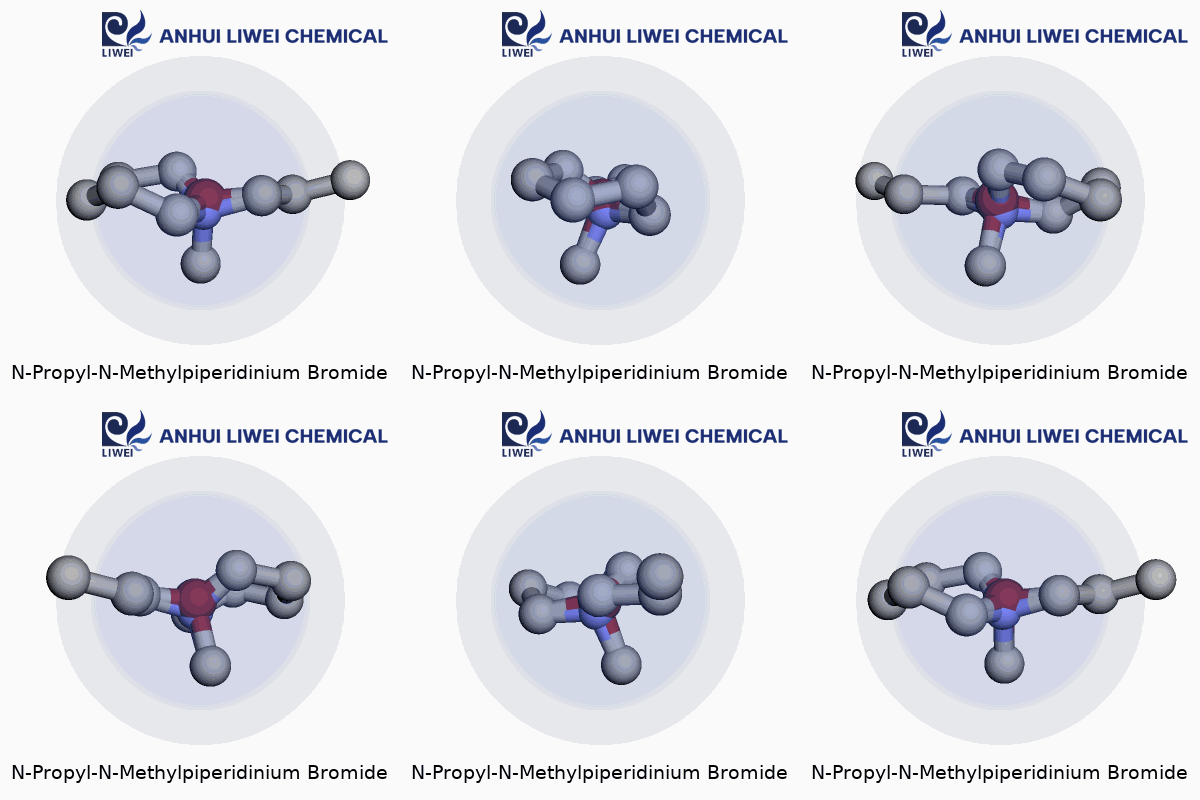
N-Propyl-N-Methylpiperidinium Bromide doesn’t show up on the shelf at your neighborhood pharmacy, yet it's caught the attention of researchers across the globe. Its molecular structure tells a story, built on a piperidine ring — that six-membered ring with one nitrogen tucked inside. Tack on one methyl group and a propyl group connected directly to the nitrogen, and you round it out with a bromide ion balancing things out. The molecular formula for this compound clocks in at C9H20BrN. The formula spells out its building blocks: nine carbons, twenty hydrogens, a bromine atom, and one nitrogen. Each atom has a distinctive weight, and to find the full molecular weight, you add the atomic masses: carbon (12.011), hydrogen (1.008), nitrogen (14.007), and bromine (79.904). Altogether, N-Propyl-N-Methylpiperidinium Bromide weighs in at 238.17 g/mol. No guesswork — that number comes from simple addition.
Why Do Chemists Care About Molecular Formula and Weight?
This question pops up regularly in laboratories — not just because chemists are detail-oriented, but because knowing these figures is vital for safe and effective research. Molecular weight guides everything from dosing to solubility to how a substance interacts with other chemicals. Miss the number, and calculations for experiments or formulation can go sideways. Take my time working in an industrial lab: weighing out compounds without the precise weight cost time, and sometimes ruined entire batches. There’s little room for error or shortcuts when the results matter this much.
Practical Uses and Lessons from the Lab
N-Propyl-N-Methylpiperidinium Bromide shows up in synthesis pipelines, often as a phase transfer catalyst. That’s not just jargon for chemistry journals. In real-world applications, it can help speed up reactions that struggle to get going, basically encouraging molecules to play nice in water and non-water environments. In the years I've mixed chemicals and measured out powders, materials like this let us avoid toxic alternatives and open the door to smoother, safer experiments, especially for processes running at scale. Still, handling a compound with a bromide anion calls for caution: one mishap with cleanup or disposal can lead to environmental headaches.
Weighing Safety and Environmental Impact
Addressing laboratory safety with any bromide salt, including N-Propyl-N-Methylpiperidinium Bromide, isn’t optional. Ignoring proper PPE or fume hoods spells trouble. Many labs make the switch to less hazardous materials when possible, but that’s not always feasible. I’ve seen teams adapt protocols and upgrade waste treatment to keep risks in check — swapping out glassware for plastic to avoid breakage or running reactions at lower concentrations. These small changes save lives and lab time.
Improving Outcomes Through Shared Knowledge
Calling out the formula or weight isn’t just an academic exercise. By standardizing information, teams keep research reproducible. The moment someone skips over a decimal or misreads a formula, every process down the line wobbles. I’ve leaned on respected chemical databases and double-checked with reference materials more times than I can count, and sharing accurate details with colleagues made a difference in speeding up troubleshooting. Building a culture that values transparency and fact-checking pays off when new scientists step into the lab. In short, staying alert to the numbers — right down to the last decimal — raises the bar for chemistry everywhere.
Understanding the Risks Involved
N-Propyl-N-Methylpiperidinium Bromide pops up in specialized labs. A lot of people working with this chemical have experience with potent reagents, but even experts need fresh reminders about what safety really means. Even if you’re careful, mistakes around chemicals can have real consequences—one wrong splash can harm skin, and poorly ventilated spaces can lead to hazardous inhalation. The bromide salt itself releases toxic fumes if heated or spilled onto hot surfaces, so open flames or high heat sources have no place nearby.
The MSDS warns about respiratory irritation, burns on contact, and violent reactions with strong oxidizers. I’ve seen even seasoned chemists get careless, skipping gloves just to “quickly” open a bottle or wipe a bench. Those shortcuts invite disaster. You need nitrile gloves, a proper lab coat, and goggles from the second you handle the container. No exceptions. Having worked in research labs myself, I wouldn’t let students pipette or weigh this out without proper PPE and a fume hood. Rushing seldom pays off here—any spill can lead to a chain of problems that linger beyond a single shift.
Storage Makes a Difference
A tightly sealed container protects more than the contents—it shields people from leaks and vapors. On a personal note, store the chemical away from acids, oxidizers, and anything else that might react violently. Placing bromide salts near incompatible chemicals is playing with fire. I’ve found that simple organization on the shelves—clear labeling, physical segregation—keeps accidents at bay. If everyone in a lab respects these ground rules, cleanup after a spill rarely turns into a crisis.
Disposal: Don’t Treat It Like Regular Trash
N-Propyl-N-Methylpiperidinium Bromide has no business going down a sink or into the regular garbage. Water treatment plants aren’t equipped for these contaminants, and landfill leachate winds up back in the environment. Every hazardous waste protocol I’ve read—and followed—demands collection in a compatible, tightly closed container. Never collect inorganic compounds like this with organics or acids. Maintain a log. Waste contractors will ask for detailed manifests; I’ve watched whole shipments get rejected because someone got sloppy with documentation.
Working with a certified chemical waste handler costs more short-term. Long-term, though, the peace of mind, the potential fines avoided, and the impact kept away from groundwater make it a clear choice. States and localities set out strict regulations for hazardous waste. In my experience, environmental officers show little patience when they find non-compliance at audits. Nobody wants forced shutdowns or lawsuits, so following the rules makes sense. For small amounts remaining in beakers or vials, neutralization isn’t always practical. Collection and professional incineration remove that risk for good.
People Shape Safety Culture
Training comes alive with practical walkthroughs, not just handouts and online checklists. I remember a young researcher who once tried to clean a droplet with paper towels. After a quick intervention and a calm explanation about toxicity and proper absorbents, that mistake never happened again. The best labs foster a culture where people speak up and look out for each other. Labeling every secondary container and using spill kits with absorbent pads—not makeshift solutions—goes a long way. Sharing stories about near-misses, rather than hiding them, helps everyone learn the stakes of cutting corners.
Proper handling and disposal of N-Propyl-N-Methylpiperidinium Bromide comes down to knowledge, vigilance, and respect for chemistry’s risks. Make those your habits, and you protect more than just yourself—you safeguard the whole lab and the world outside its doors.