Octadecyltrimethylammonium Chloride: Roots, Uses, and the View Forward
Historical Development
People have been wrestling with surfactants for more than a century, looking for ways to control water-loving and water-hating surfaces. Octadecyltrimethylammonium chloride, often dubbed OTAC, didn’t appear overnight. Chemists digging into quaternary ammonium compounds in the early 20th century noticed the power of long-chain molecules to break up dirt, change surface tension, and kill bacteria. The postwar chemical boom of the 1950s gave new purpose to these findings. Industrial process engineers started relying on OTAC for textile processing, ore flotation, and later, as coatings evolved, the compound kept earning new roles. Through every decade, more industries found uses for OTAC, both for its surface chemistry and its ability to modify particles and surfaces at the microscopic level.
Product Overview
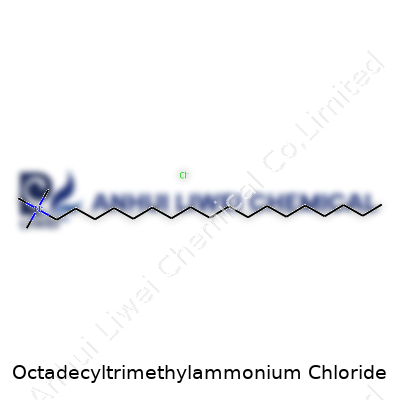
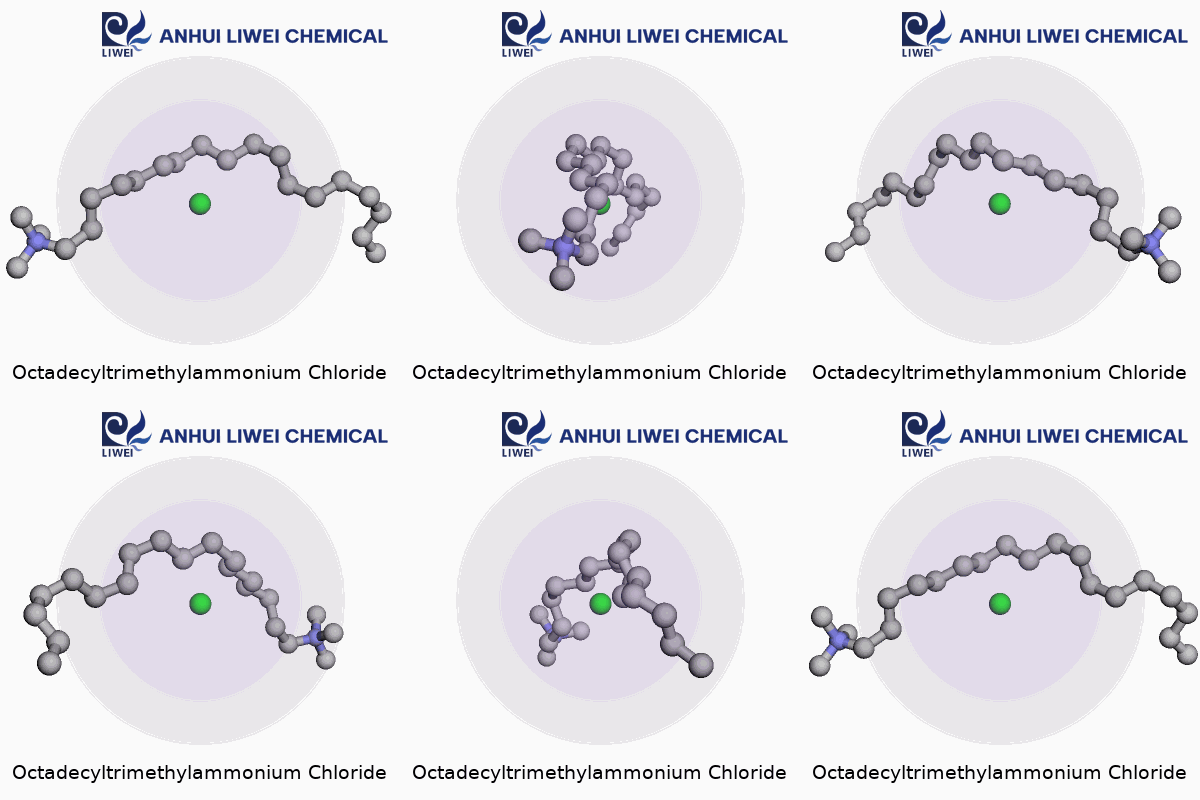
Octadecyltrimethylammonium chloride falls among the quaternary ammonium salts, a category known for mixing compatibility and decisive action against unwanted microbes. Chemists typically find OTAC as a white crystalline powder or waxy flakes, easily dissolving in water and some alcohols. The molecule anchors a long 18-carbon chain to a charged nitrogen center, flanked by three methyl groups. That structure gives it both grease-seeking and water-seeking sides—a property called amphiphilicity—making OTAC a mainstay in making solutions stable, shifting surface charge, and breaking up particles in suspension. The product also responds well to precise formula design. It’s versatile, fitting in as an antistatic agent, corrosion inhibitor, fabric softener, and surfactant in both established and cutting-edge sectors.
Physical & Chemical Properties
A handful of white flakes, a faint but distinctive organic scent, and a texture that can clump together until spread out: that's what you're dealing with in high purity OTAC. It weighs in with a molar mass near 364.05 g/mol and a boiling point that doesn’t really matter because it decomposes before boiling—typical for quats. The melting point hovers around 50°C, and its solubility brings practical ease for formulating lab solutions or mixing industrial batches. The cationic nature of OTAC (due to its positive nitrogen center) explains the affinity for negatively charged materials, including many mineral surfaces, microbes, and fabrics. Put OTAC in a solution, and you’ll notice it reduces surface tension and organizes itself at interfaces—skills that few molecules handle as elegantly.
Technical Specifications & Labeling
Manufacturers list technical data that matters to operators handling the product. Purity levels usually top 98%. Moisture sits under 2%. Labels on commercial buckets list chemical name, chemical class, batch number, and a clutch of regulatory codes—some referencing the EC or UN identifiers. Dangerous goods labels warn of skin or eye irritation. Material safety sheets list the critical limits for exposure and the need for gloves, goggles, and sometimes respirators. Big players in surfactants publish safety data and provide clear markings for storage temperature, compatible packing materials, and production date, giving end-users decent confidence in what they're handling.
Preparation Method
Turning chemicals into OTAC isn’t a mystical art, but it takes care and control. At the heart of it, the process links octadecylamine with methyl chloride under controlled pressure and heat. The chemical dance forms the ammonium ion and releases a chloride, creating the final salt. Fine-tuning these steps—temperature, pressure, reaction time, and purification—gauges yield and purity. Once the reaction completes, the raw product usually heads for filtration and washing, then gets dried and flaked or powdered. Large-scale operations automate this, but the logic holds whether you’re making a kilogram or a tanker.
Chemical Reactions & Modifications
OTAC stands ready to participate in more than just the initial synthesis. Chemists sometimes tailor the molecule for specific purposes by swapping counterions or adding functional side groups. Changing the anion, for example, alters water solubility and performance in mixtures. OTAC can undergo quaternization of other long-chain amines, stretching its reach into new materials. Its benzalkonium and cetrimonium cousins blend easily into formulations. Though stable in ambient conditions, OTAC does show sensitivity to strong acids or oxidizing agents, which can break apart its hydrocarbon chain or rip apart the quaternary center. In all of these transformations, control is crucial—one slip and you’ll see degradation or reduced surfactant potency.
Synonyms & Product Names
Chemists classify octadecyltrimethylammonium chloride under more than one alias. You’ll run across names like Stearyltrimethylammonium chloride, n-Octadecyltrimethylammonium chloride, or Stearyl TMA chloride. Industry catalogs use numerical identifiers—CAS numbers and EC numbers—for clarity. Product names sometimes reflect manufacturer branding: Stearylquat, Arquad 18, and others—all pointing back to the same long-chain cation and its chloride partner. For buyers, learning these names helps sidestep sourcing mistakes, improves communication with suppliers, and can help trace product back through supply chains if an issue crops up in use.
Safety & Operational Standards
Anyone working in a plant, lab, or warehouse with OTAC must pay attention to the risks. Most quaternary ammonium salts can irritate skin or eyes. If you breathe in dust, you may feel discomfort or soreness. Goggles, gloves, and sometimes dust masks get pulled from the safety kit before opening bags or drums. For larger operations, exhaust ventilation and automated feeding systems help contain dust. Spill kits and emergency showers stay close to the storage area. Clean-up after handling means washing with water and soap, with contaminated waste channeled for controlled disposal. Manufacturing and transport sit under the purview of global regulators—REACH in Europe, EPA in the U.S.—dictating both storage and labeling. Missing these steps can put employees and the public at risk, and bring regulatory trouble.
Application Area
Folk in water treatment plants rely on OTAC to keep piping and filter systems free from scale and microbial growth. Textile manufacturers use it to give cloth “hand,” softness, and antistatic properties—a must for synthetic blends. In chemical labs, it shows up as a surfactant helping separate ore in mining or promote dispersion in coatings and adhesives. Some specialty cleaners and disinfectants also leverage OTAC as their microbial agent, banking on the cationic head’s ability to puncture cell membranes. Bits of OTAC even pop up in hair conditioners and creams, smoothing frizz and helping oils stay put in water-rich emulsions. In these niches, OTAC’s balancing act—grease-loving tail, water-loving head—solves problems that simpler molecular groups just can’t handle.
Research & Development
Academic researchers and industrial developers both keep turning to OTAC to address old and fresh problems. Nanotechnology projects leverage its ability to cap and suspend nanoparticles. Environmental scientists tinker with OTAC-modified clays and silicas to catch heavy metals or organic toxins in water, counting on the strong affinity between the OTAC cation and negative molecule sites. In the search for greener chemistries, labs experiment with renewable precursors to the long hydrocarbon chain, cutting the fossil fuel link. Modification of OTAC’s backbone and side chains opens doors to more targeted action, new binding strategies, or improved degradability after use. In my own experience in surface science, blending OTAC with other amphiphiles changed performance dramatically, especially when formulating water-in-oil emulsions for coatings. The space for discovery keeps stretching wide.
Toxicity Research
Few people want their workplace to be toxic. OTAC, like its shorter-chain relatives, sits under the microscope for this reason. Toxicological reports point to mild-to-moderate skin and eye irritation. Inhalation can irritate upper respiratory tracts. Animal studies raise concerns at high doses, but real-world exposure standards keep safety margins comfortable. Environmentalists worry about OTAC’s slow breakdown in natural water, especially once large volumes enter wastewater streams. Aquatic toxicity shows up in some fish and invertebrate studies. Regulation responds by setting limits on OTAC use in situations where runoff could flow into rivers or lakes. Workers and environmental stewards benefit from these checks. In research from the past decade, scientists suggest more biodegradable versions to ease the impact.
Future Prospects
As regulations on older, more persistent surfactants tighten, and as industries hunt for efficiency, OTAC stands well-placed for adaptation. Development continues in making the synthesis more sustainable—using bio-based amines, greener methylating agents, or improved purification technologies to cut chemical waste. In the life sciences, researchers investigate ways to graft OTAC onto polymers for antimicrobial coatings in hospitals and public transit. Water treatment engineers focus on more selective targeting of micropollutants using OTAC derivatives bound to resins or minerals. Computational chemistry helps design molecules that keep OTAC’s performance but improve breakdown in the environment. By tracking developments in both academic publications and patents, anyone in chemicals or materials fields can spot new opportunities cropping up. From what the trend lines show, OTAC will keep finding new ground as science and industry keep chasing better, safer ways to make and use surfactants.
Tackling Water Treatment Challenges
Clean water keeps people healthy, but removing impurities remains a challenge for many communities. Octadecyltrimethylammonium Chloride plays a straight-shooting role as a phase transfer catalyst in industrial water purification. Its chemical structure helps break up emulsions and carry away dissolved substances that otherwise hang around too long in water supplies. This compound doesn’t just work in high-tech facilities. You’ll see it in municipal water systems and industrial wastewater treatment, where separating oil, grease, or other organic materials often stalls the entire cleaning line. By helping these substances lift out of water, it allows plants to filter contaminants out faster and more effectively, so families and businesses get cleaner water without endless downtime.
Fighting Germs, Supporting Clean Workspaces
Germs crowd into public transport, schools, and hospitals. A good disinfectant makes all the difference, especially somewhere like a hospital room, where the tiniest bit of contamination can have real consequences. Octadecyltrimethylammonium Chloride shows up in disinfectant sprays and surface wipes thanks to its strong antimicrobial action. As a quaternary ammonium compound, it’s especially tough on bacteria, fungi, and even some viruses. In my experience working in facilities maintenance, the hospital staff counted on disinfectants with this ingredient to keep surfaces germ-free after every shift. There’s more confidence in products with a proven track record, and Octadecyltrimethylammonium Chloride fits that bill. The Centers for Disease Control and Prevention lists it as an effective agent in infection control, especially in busy settings.
Keeps Fabrics and Papers Looking Sharp
Laundry detergents and fabric softeners need something extra to stop static and leave clothes feeling soft. Octadecyltrimethylammonium Chloride steps up as a cationic surfactant. It practically grabs on to textiles, fighting static cling and leaving behind a silky feel. My own run-ins with scratchy towels or shirts that seem to stick together after a wash remind me just how much difference a good surfactant makes. Paper manufacturers, too, use it to strengthen paper fibers and boost their print quality. Tech papers and specialty card stocks benefit from the way this compound helps bind fibers tightly, so prints turn out crisp every time.
Oil Recovery and Mining Operations
Oil recovery and mineral extraction often mean wrestling with sticky, greasy materials. Octadecyltrimethylammonium Chloride joins the fight as a flotation agent that binds to mineral particles, making it easier for operators to pull out what they want from the sludge. In oilfields, it acts as a clay stabilizer, stopping stubborn clays from swelling up and blocking pipes. With every barrel of oil saved or every extra gram of copper pulled out, operations run smoother and waste drops. I’ve talked with mining engineers who swear by this compound’s ability to raise extraction yields. The science backs them up—studies from the Society for Mining, Metallurgy, and Exploration show quaternary ammonium compounds boost recovery rates while keeping costs manageable.
Safety, Health, and Next Steps
Handling Octadecyltrimethylammonium Chloride takes care. Overexposure may cause skin or eye irritation, especially in concentrated forms. Trusted manufacturers label their products clearly, and workers rely on gloves and goggles when mixing or applying it. Researchers are watching for long-term environmental impacts, especially in aquatic systems. Regulations in North America and Europe already set sensible limits on discharges, so responsible use keeps everyone safe. As markets move toward greener chemistry, companies are starting to blend its benefits with biodegradable alternatives, aiming to keep both performance and environmental safety in check.
Everyday Encounters with Chemicals
Octadecyltrimethylammonium chloride, a mouthful for sure, shows up in a range of cleaning aids, fabric softeners, and industrial products. People using it usually work in laundry services, chemical manufacturing, or water treatment. On paper, it serves as a surfactant, which means it helps separate and clean. In practice, it wins points for breaking up tough grease. Though it seems common, some questions about safety keep popping up.
Hazards and Real Risks
Contact with this chemical can irritate your skin, eyes, and respiratory tract. Many quaternary ammonium compounds, which belong to the same chemical family, share similar safety profiles. Experience in industrial labs taught me to respect any quats, even at low concentrations. Workers without gloves would sometimes forget just how quickly hands can itch or develop a rash. Splashes in your eyes sting, sometimes worse than bleach. Inhalation, usually rare, leaves people coughing and uncomfortable.
Several agencies classify octadecyltrimethylammonium chloride as harmful if swallowed, and care is needed to prevent accidental ingestion. The U.S. National Library of Medicine highlights risks from acute exposure, especially larger amounts. Long-term exposure is less well understood, so many facilities err on the side of caution.
Environmental Impact
This chemical doesn’t break down quickly in nature. Released into waterways, it harms aquatic life and lingers in the environment. Factories dumping untreated waste create downstream problems for communities relying on clean water. Sometimes, even household drains contribute to low but steady contamination, slowly building up in the places we least expect.
Countries with strong environmental rules require treatment systems, but lapses still happen. Evidence links overuse of cationic surfactants to lower oxygen levels in rivers, endangering fish and small organisms. These aren’t just numbers in a report; real people see changes in the waterways near them.
Safe Use Requires Clear Rules
Gloves, goggles, and lab coats aren’t just for show. Facilities train workers to handle spills quickly and ventilate workspaces so vapors don’t concentrate. In my own job, we checked labels, double-checked storage locations, and kept decontamination kits in easy reach. A single mistake led to burns or long-lasting allergies for coworkers.
Good training beats luck every time. Storing octadecyltrimethylammonium chloride separately from acids and oxidizers stops dangerous chemical reactions before they start. Many companies keep detailed chemical inventories and require routine safety drills. Reminders on sticky notes and whiteboards saved more than one rookie from dipping bare hands into a cleaning bath.
Looking for Alternatives
Green chemistry pushes for less persistent and less toxic options. Some facilities have switched to biodegradable surfactants or reduced concentrations, cutting down on accidental exposure. Consumers want transparency and less risk in household products, driving innovation on safer compounds.
Local regulations, honest hazard communication, and updated procedures protect both workers and anyone living nearby. Investments in wastewater treatment and better ventilation pay off. While no chemical is risk-free, a responsible approach to using octadecyltrimethylammonium chloride makes a difference for everyone involved.
Keeping Safety Front and Center
Octadecyltrimethylammonium chloride pops up in labs because of its surfactant properties, making it useful in everything from industrial processing to specialized research. Storing this chemical right keeps the workspace safe, helps it last, and avoids accidents that ripple far past the cost of the material itself. Every time a lab cuts corners on storage, the risks jump—not only to equipment but also to people.
What Proper Storage Looks Like In Practice
Based on years working with surfactants, strong storage practices start with temperature control. Octadecyltrimethylammonium chloride likes stable, cool spaces—room temperature or a little lower, away from heaters or direct sunlight. If stored in the chemical storeroom, avoid top shelves under skylights or near windows. Too much heat shortens shelf life, and sunlight starts chemical breakdowns that can go unnoticed until things go wrong in the next experiment.
This compound draws moisture from the air. Over time, humidity encourages clumping, which throws off measurements and can make a mess of the labeling. Air-tight, non-metal containers with well-fitted lids shield it from both air and accidental spills. Plastics such as high-density polyethylene work better than more reactive metals, which may start to corrode and add unknowns to the next batch.
Protecting Health and Lab Performance
Exposure to even small amounts irritates skin and eyes, and dust can linger longer than most realize. The first rule in any stockroom is never lose track of where powdered chemicals end up. A dry, ventilated cabinet—marked clearly with hazard information—sets the tone for chemical safety. I’ve seen labs get caught out with leaks underneath bottles, so keep an absorbent mat or tray underneath containers, just in case.
Ventilation makes a difference, especially if containers are opened frequently. Stagnant cupboards let vapors and tiny particles build up. Active air flow keeps the environment safe for everyone who handles chemicals. Always keep safety goggles and gloves close, because even the best container does nothing if users get careless opening it.
Fact-Driven Recommendations
Regulatory agencies agree—OSHA, NIOSH, and the European Chemicals Agency all highlight temperature, moisture protection, and labeling as non-negotiables. Reading through their data sheets, I notice they stress secondary containment and segregation from oxidizers, acids, and chemically incompatible materials. Accidents come from cross-contamination; it takes only one misplaced bottle between shifts to cause issues.
It pays to train staff in these best practices and check up on storerooms. Quick, regular checks pick up on rising humidity or cracked containers before anything serious happens. Investing in digital temperature and humidity loggers saves headaches later—a lesson learned after seeing one too many ruined batches costing more than the price of a monitor.
Better Storage Means Fewer Problems Down the Road
Safe storage isn’t just about following regulations. It keeps the lab moving, costly reorders down, and hazards low. Every worker benefits when chemicals like octadecyltrimethylammonium chloride are handled with respect for their risks and value. Good habits in the storeroom show up downstream, from cleaner experiments to safer coworkers and longer-lasting supplies. Simple steps, followed every time, keep trouble at bay.
What Octadecyltrimethylammonium Chloride Shows Up As
Octadecyltrimethylammonium chloride, which some folks know as OTAC or STAC, stands on the shelf as a waxy, white solid if it isn’t showing up as fine powder or small flakes. Your fingers will tell you right away: this material feels slick, almost greasy, because it owes a lot to its long hydrocarbon tail. Water doesn’t dissolve it easily unless the temperature climbs, so most suppliers don't bother with liquid bottles. Some people in the lab might deal with 25-kilogram paper-lined sacks or thick plastic drums because this compound likes to cling to surfaces and draws moisture out of the air.
Packaging That Actually Works
No one wants their chemicals spoiled before they even unpack. For OTAC, that means producers stick to double-layer packaging with heavy-duty polyethylene liners. You won’t see it sent out in thin bags or cardboard boxes that let moisture in. On the outside, you’ll likely spot firm fiber drums, reinforced plastic pails, or steel drums if the shipment crosses oceans. Some industrial buyers go for smaller, 5- or 10-kilogram high-density PE containers for easier storage, but bulk buyers generally choose 25- or 50-kilogram drums. These drums stand up to banging around and don’t react with the chemical. Labels usually give batch numbers, dates of manufacture, and strong hazard markings since this chemical can be harmful if it gets on bare skin or in the eyes.
Real-World Importance of Smart Packaging
Too many businesses have lost valuable material from simple packaging mistakes. If you pick up a cheap sack and see powder escaping at the seams or a drum that can't handle summer humidity, you're not just risking a mess—you face a safety and compliance issue. I’ve seen labs turned upside down after a shipment arrived with the liner torn, and the material turned into a slippery paste. Keeping air and water out saves companies real money and massive headaches. It prevents product waste and lowers exposure risks for folks moving or dissolving this stuff in large tanks or mixing vats.
Making the Routine Work Safer
Anyone ordering should check for updated safety sheets and proper labeling before accepting delivery. OTAC dust can cause irritation, so it helps to get packages with clear opening instructions and warnings printed big. Double-bagging might slow down unpacking, but it cuts down the odds of a spill or spillover into the workspace. It makes me appreciate suppliers who pay attention to chemical hygiene, from the drum seal to the last printed hazard symbol.
Where the Supply Chain Sometimes Trips Up
Problems crop up fast when suppliers cut corners—especially overseas—by packing in thin-walled drums or skipping moisture barriers. Less reputable outfits use recycled containers that used to hold other chemicals, risking contamination. That practice can turn a reliable product into one that's unreliable or even unsafe. Buyers need to quiz their sources about packaging and ask for supporting documents that prove compliance with regional and international standards.
What Buyers Watch For
Those of us who’ve worked on the factory floor or mixed up solutions for textile or microbiology labs look for tamper-proof sealing, rigid containers, and readable hazard icons. A supplier that can’t show these details easily doesn’t earn trust. Extra cost for safer packaging pays off tenfold. Groups like the European Chemicals Agency (ECHA) and OSHA in the US call for strict labeling and packaging, and smart outfits pay attention. It's the difference between peace of mind and finding half your shipment on the warehouse floor soaked in a greasy puddle.
Why Chemical Purity Matters
Octadecyltrimethylammonium chloride (OTAC) gets attention for its specialized uses, from personal care to textile processing and even in the lab as a phase transfer catalyst. In practice, pure OTAC means fewer headaches, cleaner results, and trustworthy performance. It’s an essential factor, especially when the final product can’t tolerate unwanted surprises from contaminants. Speaking from experience in lab work, one impurity can throw off an entire batch, and that sets back time and blows up costs.
Typical Purity Specifications
Most reputable suppliers, especially those catering to industries that demand reliability, offer OTAC with purity levels above 98%. This number measures the actual content of the compound itself – anything left over could be residual solvents, water, or related organic salts. High purity ensures that end-users do not have to troubleshoot unexpected reactions or degraded products. Reputable labs and companies will back up their claims with a certificate of analysis, listing exact percentages, water content, pH, and any trace impurities.
Testing and Verification
Speaking as someone who’s handled a variety of specialty chemicals, relying solely on a supplier’s word won’t cut it, especially when the stakes are high. Independent verification stands out. Labs often use tools like gas chromatography, NMR, or FTIR to check that what they’ve received matches their expectations. Anyone sourcing OTAC for critical applications, such as pharmaceuticals or research, will make a point of spot-checking quality before using a new batch.
Why Impurities Are a Problem
Impurities might sound like a minor nuisance, but they can be a major stumbling block. Even trace levels can lead to product instability, strange odors, discoloration, and unpredictable performance. For instance, in surfactant roles, excess salts or short-chain analogues could mess with solubility or conductivity. In formulations, unnecessary byproducts can hurt consistency, texture, or shelf life. Having managed formulation projects for consumer products, seeing product recalls tied to out-of-spec raw materials is a tough lesson nobody forgets.
What Safeguards Work Best
Responsible suppliers provide not only purity data but also details on how batches are produced and controlled. Transparency builds trust. Good practice means requesting technical datasheets, batch-specific certificates, and storage recommendations. Some go further with third-party audits or even sharing results from heavy metal screening.
Those buying for regulated markets, like food or pharmaceuticals, will dig deeper for information on residual solvents, microbial content, and compliance with standards set by agencies such as the USP or EU Pharmacopeia. These details matter, since downstream contamination can create regulatory risks.
From personal experience, building a relationship with reliable suppliers goes further than price wars. Asking tough questions, requesting batch samples, and running your own tests pay off in the long run. Training staff to recognize quality shifts and keeping close tabs on every shipment are practical steps any lab or manufacturer can take.
The Way Ahead
Quality starts at the source. Companies handling OTAC, or any quaternary ammonium compound, can push for joint audits and robust supplier certifications. Sharing knowledge among industry peers about which suppliers perform consistently well keeps everyone safer. No one wants to gamble with critical production processes. Being transparent, verifying quality, and insisting on clear data benefits everyone along the supply chain.