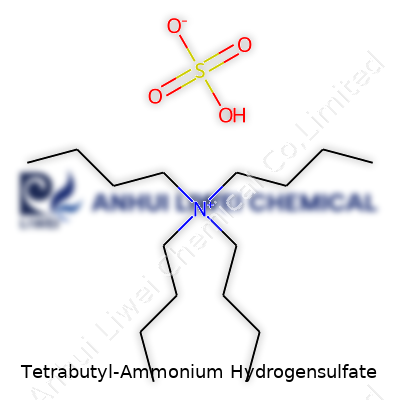
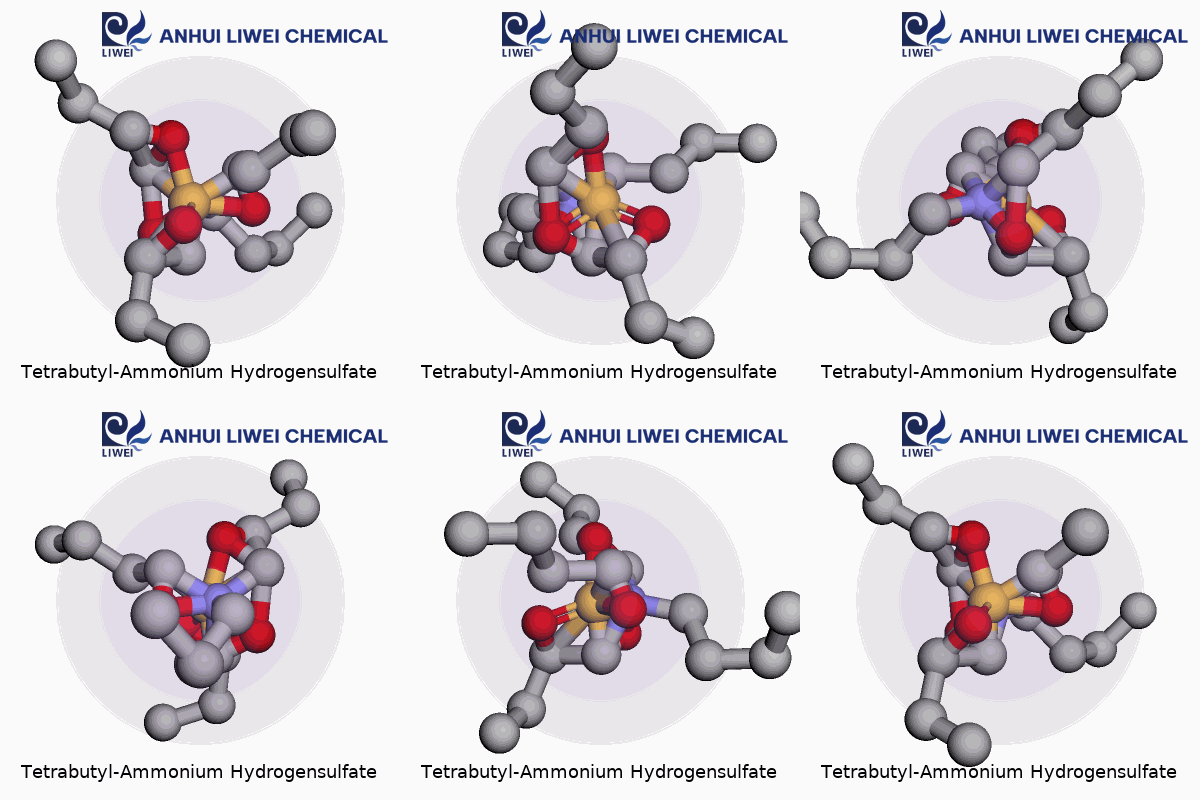
Tetrabutyl-Ammonium Hydrogensulfate: A Deep Dive
Historical Development
A lot of chemistry’s progress comes from the need to make reactions easier, faster, or cleaner, and that is just what drove the development of salts like tetrabutyl-ammonium hydrogensulfate. This compound came onto the scene as scientists searched for ways to steer complex chemical processes, especially during the second half of the twentieth century, when organic chemistry turned its focus toward more challenging syntheses and the need for creative approaches. As phase-transfer catalysis began catching on in both laboratories and industrial plants, compounds like this salt became tools not just for the textbook, but for producing real products. There is usually a clear story behind why chemists pick up a new chemical, and this salt’s story roots itself in practical demands: greener processes, fewer hazards from volatile materials, and sharper yields. It illustrates how chemistry keeps adapting to tackle new challenges as the field pushes forward.
Product Overview
Giving chemists the power to shuttle ions and molecules between watery and oily phases, tetrabutyl-ammonium hydrogensulfate offers an alternative to harsher, more dangerous reagents. Its bulky shape and unique charge distribution lead to properties that regular salts don’t provide, and its low melting point, solubility in organic solvents, and knack for speeding up reactions started drawing attention in research and industry alike. Used as a phase-transfer catalyst, it simplifies lab setups and shrinks environmental footprints by reducing the pile of toxic byproducts. That versatility means bottles of this salt show up in chemical storerooms from the bench-scale work of grad students to the tanks of industrial reactors, tying together the worlds of academic innovation and day-to-day manufacturing.
Physical & Chemical Properties
This compound brings a distinct personality to the bench, featuring a waxy, sometimes crystalline solid that ranges from colorless to faintly yellow. With a molecular formula of C16H37NO4S and a molar mass that checks in at just over 339 grams per mole, it feels hefty in molecular terms. Tetrabutyl-ammonium hydrogensulfate does not just dissolve in water; it thrives in many organic solvents like acetone and chloroform, helping it blend into reaction mixtures where other salts fail or clog up the works. Standing up to temperatures over 200°C before breaking down, it fares well for a quaternary ammonium salt. Its hygroscopic nature signals—store this carefully, or it will draw in water from any humid air nearby. Chemists handling it often take note of its slight odor, and though relatively stable, it still deserves respect in the lab.
Technical Specifications & Labeling
Suppliers put care into this material’s labeling, marking purity at 98 percent or higher with trace impurities spelled out on technical data sheets. Packaging usually arrives in moisture-safe bottles with hazard labels warning of corrosive risks and environmental precautions. Data sheets break down melting point, solubility ranges, and safety codes, which helps both new and seasoned users stay ahead of potential missteps. Labeling includes not just chemical identifiers but also batch numbers for quality tracking, something every laboratory technician learns to check before weighing out even a few grams. In practice, this attention to specification builds trust between buyers and producers, especially for users with regulatory paperwork looming overhead.
Preparation Method
Industry typically prepares tetrabutyl-ammonium hydrogensulfate by treating tetrabutylammonium hydroxide with a strong acid, usually sulfuric acid, in a careful titration. Controlling ratios and reaction conditions proves important for making sure the final salt contains the right balance of hydrogen sulfate ions rather than the fully neutralized sulfate or leftover acid. Once the salt crystallizes from the reaction mixture, it can be filtered, washed, and dried under gentle heat or vacuum. The process isn’t particularly glamorous, yet it demands precision because careless work can contaminate products with side salts that disrupt downstream applications. The method echoes countless stories from synthetic organic chemistry—straightforward on paper, finicky in practice when quality counts.
Chemical Reactions & Modifications
Once in hand, tetrabutyl-ammonium hydrogensulfate serves several roles in the lab. It catalyzes substitutions, oxidations, and nucleophilic reactions that stall under less suitable conditions. The salt’s ability to carry anions across immiscible phases breathes life into reactions involving organic halides or sulfur compounds—a game-changer for certain pharmaceutical, agrochemical, and specialty chemical syntheses. Chemists sometimes tweak its structure, swapping out the butyl chains for other alkyl groups or exchanging the hydrogensulfate for alternative acids to tune its solubility and reactivity. In multi-step syntheses, its catalytic performance can improve yields compared to less sophisticated phase shuttles, saving both time and raw materials.
Synonyms & Product Names
Anyone ordering tetrabutyl-ammonium hydrogensulfate knows it comes under a whole catalog of names: N,N,N-tributylbutan-1-aminium hydrogensulfate, TBAHS, and sometimes just as “tetrabutylammonium hydrogen sulfate” in older cartoons or inventory spreadsheets. Some companies tack on branding or technical grades to signal suitability for industrial rather than analytical work, but every chemist who’s handled it can tell where it fits alongside cousins like tetrabutylammonium bromide or methyltrioctylammonium chloride—each with their quirks, each crucial in the right niche.
Safety & Operational Standards
This salt doesn’t usually make major headlines for safety incidents, though that doesn’t make it benign. The hydrogensulfate anion brings risks of skin and eye irritation or burns if mishandled, and ingestion or inhalation can trigger nausea, respiratory discomfort, or worse. Goggles, gloves, and local exhaust ventilation become normal requirements, and safety training should stress spill responses using plenty of water and inert absorbents. Environmental rules highlight dangers of dumping this compound unchecked, since aquatic toxicity can arise in some forms. Frequent audits and checklists help companies spot lapses in container labeling or stockroom storage; these routines keep small slip-ups from turning into real hazards.
Application Area
Where does tetrabutyl-ammonium hydrogensulfate make its mark? In organic synthesis, it adds value to nucleophilic substitutions, especially for making fine chemicals, flavors, and pharmaceutical intermediates. The salt’s catalytic qualities shine in oxidation reactions, epoxidations, and certain polymer modifications. It also finds a niche in the electrochemical world, supporting reactions where traditional supporting electrolytes fall short. Water treatment schemes have borrowed ideas from its phase transfer abilities, finding ways to remove persistent contaminants. Lab veterans often recommend this compound for stubborn transformations that refuse to run cleanly under standard procedures—its presence can mean the difference between a failed experiment and a publishable success.
Research & Development
Research trends for tetrabutyl-ammonium hydrogensulfate keep shifting as chemists hunt for more sustainable chemistry. New journals feature creative uses for this salt: ionic liquids, supramolecular assemblies, and even as a building block for designer materials with selectivity for separating troublesome ions or protecting unstable intermediates. Academic groups use it to model and understand phase interfaces, while drug companies keep exploring routes built around phase-transfer catalysis for efficiency gains. Projects searching to reduce hazardous waste or to open new catalytic cycles often circle back to this compound’s reliable performance, driving applied and basic science hand in hand. University training often introduces students to this compound during hands-on teaching labs focused on practical organic reactions, embedding knowledge that carries forward into industrial settings.
Toxicity Research
Toxicologists approach tetrabutyl-ammonium hydrogensulfate by tracking both acute and chronic exposures, drawing on animal studies and laboratory exposure records. The salt’s low volatility limits airborne risks, but attention shifts to dermal and oral contact, where evidence points to irritation and moderate toxicity. Evaluations of environmental persistence indicate a need for responsible disposal, as breakdown products can stress aquatic systems or soil microbes. Chronic exposure studies have yet to reveal broad systemic effects in typical laboratory settings, but the chemical’s risk profile urges ongoing caution, especially as more industries adopt the salt. Keeping track of exposure limits and periodic reviews of material safety data sheets provide the first lines of defense for both workers and researchers.
Future Prospects
Tetrabutyl-ammonium hydrogensulfate looks set to hang around in chemists’ toolkits for a long while. Its reliability and versatility keep opening doors, from green chemistry to advanced catalysis. Research into less toxic, more biodegradable adaptions may address lingering environmental concerns, blending the salt’s strong technical foundation with modern priorities in sustainability. Its place in phase-transfer catalysis, along with ongoing tweaks to improve performance or safety, signals a future shaped by practical needs and smarter synthesis strategies. For students just learning the ropes or seasoned process chemists scaling up big batches, this compound captures the evolving spirit of applied chemistry—steadfastly practical yet always open to improvement.
Digging Into Why This Compound Matters
Anyone who’s spent time in a laboratory knows the bench is home to more than test tubes and microscopes. Sometimes, it’s the chemicals with the jawbreaker names that keep the show running. Tetrabutyl-ammonium hydrogensulfate is a good example. It sounds like something out of a sci-fi novel, but this salt makes real-world progress in research, industry, and even in your car’s tank without any fanfare.
Practical Work in Phase Transfer Catalysis
I’ve worked alongside organic chemists who grumble about running sluggish reactions. Thanks to tetrabutyl-ammonium hydrogensulfate, tough jobs get easier. This compound acts as a phase transfer catalyst. Imagine you’re trying to mix oil and water—tricky since each wants nothing to do with the other. By tossing in this salt, it helps shuttle important ions between layers, so the reaction doesn't get stuck. That means more efficient yields, less waste—and anyone paying for raw materials appreciates that.
Boosting Green Chemistry Moves
Clean technology keeps pushing engineers and scientists to think twice before reaching for pollution-prone substances. I’ve seen labs edge away from “classic” solvents toward eco-friendlier systems. In these cases, tetrabutyl-ammonium hydrogensulfate offers a nudge in the right direction. It works well in water-based setups, reducing the need for volatile organic solvents that can harm both workers and air quality. That shift matters not just for the chemistry nerds, but for the folks living near chemical plants.
Supporting Electrochemistry and Energy Research
Energy storage breakthroughs don’t land on magazine covers as often as they should. Still, battery researchers know which compounds provide stability and strong performance. Tetrabutyl-ammonium hydrogensulfate steps in as an electrolyte additive. It keeps current flowing without introducing corrosion or gunking up expensive electrodes. As electric vehicles find their way into city centers and rural highways, these additives will see greater demand, even if you never see their names on a sticker or in a manual.
Refining and Synthesis on an Industrial Scale
For factories that churn out chemicals, scale changes everything. Small changes in a beaker don’t always translate to a thousand-gallon tank. Tetrabutyl-ammonium hydrogensulfate delivers reproducible results from gram to ton scale, making it valuable in the synthesis of specialty pharmaceuticals, agrochemicals, and certain plastics. Without this reliability, the chemical supply chain faces snags and higher costs—a problem felt across industries and by end-users in the form of pricier products.
Challenges and Ways Forward
No solution is perfect. This salt, while useful, is not the cheapest on the market. Some chemical plants still seek alternatives that balance performance with price. Its disposal can also raise red flags, as quaternary ammonium salts may hang around in the environment longer than some would like. Industry has started to experiment with more biodegradable cousins, and green chemistry research keeps looking for safer replacements. Redesigning reactions from the ground up may take time and cost, but reducing environmental footprints in the chemical sector benefits everyone.
Final Thoughts
An outsider might never hear about tetrabutyl-ammonium hydrogensulfate, but none of the progress in organic reactions, cleaner energy, or large-scale synthesis happens without smart choices around supporting chemicals. For anyone who thinks chemistry is only about bubbling flasks or flashy explosions, the quiet role of ingredients like this one proves real innovation often happens behind the scenes.
Getting to Know Tetrabutyl-Ammonium Hydrogensulfate
Tetrabutyl-ammonium hydrogensulfate often pops up in the world of chemistry labs and research, sometimes with a long name that seems almost impossible to say out loud. It helps to start simple: the chemical formula is (C₄H₉)₄NHSO₄. Each part of the formula tells a story. The "tetra" signals four butyl groups, all hooked onto a single nitrogen atom, forming a positive ion—called the tetrabutylammonium cation. This cation links up with a hydrogensulfate anion, which is written as HSO₄⁻.
What Sets Tetrabutyl-Ammonium Hydrogensulfate Apart?
This compound doesn’t just live in theory or on paper. In my years helping friends who work in research or teaching chemistry, I’ve seen firsthand how tetrabutyl-ammonium hydrogensulfate pops up any time phase transfer catalysis comes up. This process lets molecules, which usually don’t mix, actually come together and react. That can be a game-changer in making certain drugs, dyes, or specialty polymers.
The formula tells us about more than just the atoms present. Each butyl group—four in total—gives the molecule a kind of oiliness that lets it dissolve into organic solvents. At the same time, the hydrogensulfate half loves water. This strange partnership means it works well as a bridge between oily and watery environments.
Why Purity Matters with This Chemical
Beakers don’t lie. If you have a sloppy batch of tetrabutyl-ammonium hydrogensulfate—maybe contaminated with leftover reactants or other ions—the whole reaction can fall apart or make something you never wanted. My old chemistry professor once told us about an experiment that failed three times until he realized the batch he was using had the tiniest impurity. That experience stuck with me. Researchers and manufacturers need the right formula—and the confident knowledge that every shipment matches that formula—if they want predictable results and safe products.
Safety in Handling and Use
Nobody wants a trip to the emergency room thanks to careless chemistry. Even stable-looking salts like tetrabutyl-ammonium hydrogensulfate can cause trouble if handled without care. The butyl groups make it easy to absorb through the skin, and the hydrogensulfate part makes the powder a bit acidic. Proper gloves, goggles, and a fume hood turn a messy, dangerous situation into a routine day in the lab. My advice from having helped clean up more than one accidental spill: triple-check your equipment and know exactly what’s on your workbench.
Making Better Chemistry
Tetrabutyl-ammonium hydrogensulfate keeps earning its spot in chemistry toolkits because of its unique balance. Researchers still look for ways to work safer, produce less waste, and save money. Some labs swap it out for greener alternatives based on project needs. Green chemistry takes center stage more often now, focusing on less wasteful and less harmful substances. Chemistry doesn’t only live in the pages of a textbook—it shapes medicine, energy, and materials science.
Summary
Knowing the formula ((C₄H₉)₄NHSO₄) matters, not just for exams but to keep people safe and processes efficient. Every chemist—seasoned professionals and newcomers alike—relies on the details found in chemical formulas to guide their work, keep labs safe, and move technology forward.
What Tetrabutyl-Ammonium Hydrogensulfate Is Used For
I got my start in chemistry labs years back, handling all sorts of chemicals that barely made headlines. Tetrabutyl-Ammonium Hydrogensulfate isn’t a household name, but for those who work in organic synthesis, it’s a familiar sight. You’ll find it in chemical reactions, setting the stage for molecular change, sometimes helping to move ions from water into organic solvents. Researchers lean on it for its unique ability to serve as a phase transfer catalyst. If you don’t work in a lab, odds are you’ve never had direct contact with it, but the people behind new pharmaceuticals and specialty polymers have.
What the Risks Really Look Like
Just because something doesn’t show up on nightly news doesn’t mean it can be ignored. I’ve seen enough chemical risk sheets to know: Tetrabutyl-Ammonium Hydrogensulfate isn’t the most aggressive substance in the storeroom, but it isn’t harmless either. The biggest worry comes from skin and eye contact. It can irritate on touch. If you’re unlucky enough to get it in your eyes, expect burning and redness. Inhaling its dust leads to throat and lung irritation—lab techs who skip their masks find out the hard way.
Handling the pure chemical without gloves sometimes leaves workers with dry, raw skin. Reactivity with other chemicals brings another set of worries, since its components can break down and cause unpredictable reactions. Accidental spills sometimes pop up in articles from chemical safety boards. A splash rarely sends someone to the hospital but can sideline them for a few days. I’ve seen coworkers fumble a bottle, spend hours at the sink, then file an incident report later. Reports in peer-reviewed literature, and data pulled from MSDS sheets, echo the same thing: toxicity is mild to moderate, but long-term effects from repeated exposure haven’t been deeply studied. Chronic exposure might stress kidneys or liver. Animal studies suggest caution, but real-world risk stays low with proper PPE.
Regulations Aren’t Enough
You’d think with so many chemicals floating around, laws would keep everyone safe. It’s not always the case. Regulatory bodies lump Tetrabutyl-Ammonium Hydrogensulfate together with other ammonium salts. It gets labeled as an irritant, not a toxin, so oversight is light. OSHA doesn’t set a specific exposure limit. Europe and Asia offer basic worker protections but rely on companies to enforce safety plans. In practice, it’s on lab managers, safety officers, and workers to build habits—gloves, goggles, lab coats, and prompt cleanup of spills. One slip in discipline, and that “irritant” tag turns into days off with medical bills.
Solutions Rely on Better Awareness
Having spent years training new lab staff, I see the risks dropping when veteran workers take time to explain hazards in plain English. Labels and data sheets matter, but hands-on instruction makes the lessons stick. I’d push for mandatory annual refreshers on handling and emergency protocols. Newcomers benefit from shadowing older staff before flying solo. Regular checks on personal protective equipment save skin and lungs. Company-wide culture change—where everyone speaks up at the first sign of risky behavior—keeps health incidents down.
Publicly available databases (like PubChem and HazMat) offer quick health snapshots. Transparent information helps everyone stay one step ahead. It’s not about running scared—it’s about respect for chemicals, big or small, and watching out for the folks working down the bench.
Understanding the Hazards
Tetrabutyl-Ammonium Hydrogensulfate crops up in labs that tackle organic chemistry, as it serves as a phase-transfer catalyst. Many people see an exotic chemical name and forget real risks attached to careless storage. With direct experience behind a lab bench, a big lesson stands out: proper storage spares plenty of headaches, from ruined research to health scares.
Keep It Dry, Keep It Sealed
This compound draws moisture from air. The white, clumpy powder quickly cakes and loses punch if left out. Humidity doesn’t just change how it looks—it pushes the chemical to break down and form unwanted byproducts. After seeing a half-used bottle turn rock-hard over summer due to bad sealing, it’s clear every container deserves a tight-fitting lid. Silica gel packs slip easily into cabinets and help soak up stray moisture—worth every penny.
Protect from Heat and Sunlight
Heat speeds up breakdown and increases chances of a mess. Store this salt on shelves that skip the sunbeam and far away from radiators or hot equipment. Cool storage isn’t just about keeping it in shape—heat increases vapor release, which means a stink that stings eyes and nose. A common fridge in a lab keeps most sensitive chemicals stable, but always check incompatibility first. Tetrabutyl-Ammonium Hydrogensulfate doesn’t crave the freezer, just a plain cool cabinet does the job.
Keep Away from Dangerous Neighbors
Mix-ups cause most accidents. I’ve worked in places where acids sat next to bases and saw close calls with smoke and heat. This ammonium salt belongs with other organic reagents, far from strong mineral acids, oxidizers, and flammables. Chemical inventory labels and good shelves make a difference—color-coded stickers help even a tired researcher grab the right bottle.
Glass or Plastic? Choose the Right Container
Glass bottles often win for chemical stability. Polyethylene or polypropylene provide a safer, lightweight substitute. After seeing cheap, brittle plastic split and spill salt across a bench, I trust only sturdy containers rated for chemical resistance. Always check the original packaging—if it cracks or warps, transfer the chemical right away, relabel it, and mark the date.
Proper Labeling Saves Time and Trouble
Faded or missing labels lead to real confusion. Someone grabs what looks like common salt, adds it to a reaction, and gets a failure or worse. Every bottle needs a clear, permanent label showing the chemical’s name, date received, and any special hazards. Printed safety data sheets belong nearby for quick checks.
Don’t Skip Routine Checks
Lots of labs trust their memory instead of making regular inspections. I learned to look for leaks, corrosion, or missing labels every few weeks. Routine checks help catch risks before they snowball. Even in busy labs, fifteen minutes a month looking through storage shelves can save money and wellness.
Employee Education and Emergency Gear
No chemical storage works without people power. Staff training on handling, spill cleanup, and PPE keeps everyone on the same page. Safety goggles, gloves, and lab coats come standard. I’ve cleaned up spills where simple rubber gloves made all the difference between a quick fix and a burned hand.
Better Practices, Safer Workplaces
Chemical safety feels like a chore, but cutting corners costs more later. Storing Tetrabutyl-Ammonium Hydrogensulfate isn’t about paranoia—it’s about respecting risk and keeping labs running. Invest in tight lids, dry shelves, clear labels, and good training for smoother, safer days at work.
The Unsung Workhorse in Organic Synthesis
Tetrabutyl-ammonium hydrogensulfate sounds like a mouthful, but out in the lab, this salt finds steady use, especially among chemists trying to link water-based and oil-based ingredients together. Sometimes, it shows up as the bridge between these two worlds. Take phase-transfer catalysis. Chemists run into problems when one reactant only loves water and the other stays in the oil phase. Add some tetrabutyl-ammonium hydrogensulfate, and suddenly the reaction moves along, because this salt gives a ride to those stubborn water-loving ions, delivering them where they need to go.
People often reach for this compound when making fine chemicals or pharmaceuticals. Small tweaks in synthesis—swapping out harsher, more hazardous conditions for milder ones—can turn a dangerous reaction into something manageable. In my own work, using standard phase-transfer agents like this made prepping an intermediate for an antiviral much less of a chore. I saved hours and got higher yields, and the process avoided hazardous solvents—always a bonus both for my nerves and for the safety manager.
Rethinking Green Chemistry and Cleaner Workflows
Some researchers dig into tetrabutyl-ammonium hydrogensulfate’s other side: greener chemistry. In the push for sustainable lab practices, chemists moved away from stubborn solvents and dangerous reactants. This salt helps reactions run at room temperature, and because it often works in water, waste gets cut down. Less toxic stuff to haul away or neutralize at the end of the day.
Industries chasing ionic reactions lean on this salt for speed and selectivity. Epoxidation and alkylation—big names in the book of organic tricks—move along faster and smoother. Imagine a big batch of fine fragrance ingredients or advanced intermediates. Time saved here means less energy, fewer resources, and a more reliable output. I’ve seen entire kilo-scale reactions improve overnight, just by choosing the right phase-transfer catalyst like tetrabutyl-ammonium hydrogensulfate.
Analytical Chemistry and Electrochemistry Boosts
Analytical labs don't shy away either. This salt shows up when researchers need to separate ions, especially in some ion exchange chromatography setups. Complex mixtures get sorted out more effectively, boosting speed and accuracy for folks running environmental samples or checking process impurities. In some cases, this means catching contaminants at safer, lower levels than older techniques allowed.
Electrochemical researchers get a lift from tetrabutyl-ammonium hydrogensulfate too. Its stable, non-reactive nature makes it a solid pick for supporting electrolytes in experiments involving electrolysis or electrochemical sensors. Stable readings mean better data, and a more direct path to real-world devices.
Challenges and Ways Forward
While this salt offers clear benefits, its environmental impact can’t be brushed aside. Tetrabutyl-ammonium compounds show persistence in the environment, because they break down slowly. In my own lab, we started integrating closed-loop recycling systems for these salts, reducing how much heads down the drain or offsite for disposal. Chemical companies now look at improved recovery methods, more efficient batch-use cycles, and tweaks in the molecule itself to help it degrade after use.
The real answer for wider adoption lies in balancing performance with environmental safety. Industry groups lay out stricter waste protocols. Academics and product developers keep hunting for new variants with similar performance, but better environmental fate. This sharing of best practices—swapping experiences and learning from each other—drives progress as much as the chemistry itself.