Tetrabutylammonium Tetrafluoroborate: A Closer Look at a Trusted Reagent
Tracing the Roots: Historical Development
Chemistry in the twentieth century saw an influx of ionic compounds tailored for organic and inorganic labs. Tetrabutylammonium tetrafluoroborate stands out with its roots in early phase-transfer catalysis research. Around the 1960s, the growth of organometallic synthesis required salts that blended solubility with chemical stability. This compound offered chemists a way to drive reactions in nonaqueous media, freeing researchers from the rigid limitations of traditional alkali salts. Reports highlighted robust yields in biphasic systems; the wider chemical community caught on quickly. By the 1980s, it became common to find bottles lining the shelves of laboratories interested in synthesis, electrochemistry, and analytical chemistry.
What Sets the Product Apart
Tetrabutylammonium tetrafluoroborate, or TBABF4, has become the go-to choice for many. It comes as a white, crystalline powder, easy to handle in air and straightforward to store. TBABF4 acts like an electrolyte salt with a reliable, neutral taste in reactions—a supporting player that never upstages the main event. Its structure features a large, non-coordinating cation balanced by a robust, weakly coordinating anion. This makes it useful in settings where solubility matters more than reactivity. Standard containers ship with tight seals to keep out moisture, as humidity encourages caking or decomposition.
Physical and Chemical Properties
Pure TBABF4 forms colorless to white crystals. Up close, the substance feels slightly waxy by touch. It dissolves readily in organic solvents like acetonitrile, dichloromethane, and methanol. Its melting point lands near 126°C, which allows it to remain stable during most synthetic work. The compound resists oxidation and shows minimal hygroscopic behavior, though persistent exposure to moist air isn’t ideal. It has a molecular formula of C16H36BF4N and a molar mass near 322.29 g/mol—numbers appreciated by those used to weighing out salts for precise reactions. The non-coordinating nature of both cation and anion stops them from interacting in ways that might interfere with catalytic cycles or promote unwanted side reactions.
Technical Specs and Labeling Insights
Suppliers focus on purity, often reporting values above 98%. Labels show batch numbers, hazard statements, and best storage practices. Several safety pictograms accompany most shipments, flagging irritant and environmental risks. Each package identifies the salt by CAS Number 429-42-5. Storage info warns against sources of strong acids, bases, and moisture. Weighing instructions recommend the use of gloves and eye protection due to the slight risk of skin or eye irritation with prolonged contact. Good laboratory practice encourages small transfer tools and minimal exposure to open air. Labels from major chemical houses often detail the country of origin, date of manufacture, and a clear expiry to keep lab workers informed.
Preparation Approach
Preparing TBABF4 in the lab involves a straightforward salt metathesis. Mixing an aqueous solution of tetrabutylammonium bromide with sodium tetrafluoroborate leads to immediate precipitation. Filtration, successive washings, and vacuum drying follow. The final crystal is pure, provided solvents and reagents received pretreatment, such as distillation or recrystallization. In experienced hands, yields consistently cross 90%, which is crucial for cost-sensitive processes. Solvent removal relies on rotary evaporation with gentle heating, followed by low-temperature desiccation.
Chemical Reactions and Modifications
Most organic and inorganic chemists appreciate the way TBABF4 maintains a low profile during redox events. The salt introduces minimal interference, making it a trusted supporting electrolyte in electrochemical investigations. Coupling or metathesis reactions sometimes call for TBABF4 when researchers want bulky, non-coordinating species around metal centers. Under strong acid or base conditions, the salt doesn’t break down easily, which encourages its use in a wide range of environments. Researchers have tested its stability by heating it with Lewis acids; decomposition tends to require harsh extremes. Minor modifications—like ion exchange to incorporate isotopically labeled boron—have opened new doors for studies in analytical chemistry and tracing studies.
Common Synonyms and Trade Names
This compound moves under several names in catalogs and publications. Tetrabutylammonium tetrafluoroborate remains the most common, but abbreviations such as TBABF4 or NBu4BF4 fill technical papers. In non-English speaking regions, similar names appear with translations or alternate structural notations, but the central acronym persists. Researchers often search using the CAS number to navigate suppliers’ listings, sidestepping regional language barriers.
Safety and Operational Standards
Any technician who’s spent time in chemical storage rooms knows the importance of proper handling for any salt, even seemingly safe ones. TBABF4 doesn’t pose acute hazards like strong acids or oxidizers, but routine precautions matter. Safety data sheets specify the need for gloves, splash-resistant goggles, and sometimes a fume hood, especially during weighing and transfer steps. Skin contact can cause mild irritation, so quick rinsing with soap and water matters. Inhalation risks climb if the powder becomes airborne—rare with careful handling but worth remembering. Labs set up ventilation and local exhaust to minimize these events. For cleanup, a damp cloth and careful sweeping pick up spills—no need for strong neutralizers, but double-bagging waste remains standard.
Areas of Application
TBABF4 appears in synthetic organic chemistry, supporting various transition-metal complexes in catalysis or acting as a phase-transfer agent for nucleophilic substitutions. It plays an unsung but crucial role in electrochemistry, especially in nonaqueous electrolysis, where researchers need an inert background. Analytical chemists include it in reference electrolyte solutions for cyclic voltammetry. Several patents detail its use in pharmaceuticals for purification steps or supporting selective transformations. In material science, it serves as an additive in perovskite solar cell research and lithium battery development, offering high ionic conductivity without reactivity. Exploratory work with ionic liquids pulls from TBABF4 as a source of the tetrafluoroborate anion, which tunes solubility and viscosity in designer solvents.
Current Research and Development
Recent years have seen TBABF4 pop up in experimental designs testing new electrochemical windows and electrode materials. Its non-interfering nature gives clean background signals for voltammetric studies. In green chemistry, efforts turn toward catalysis under mild conditions, where this compound acts as a facilitator for two-phase reactions. Academic groups investigate its interaction with nanoparticles, seeking to craft new composites for sensors or energy storage. More studies examine its behavior in aqueous organic solvents, hoping to minimize waste or improve recovery in industrial setups. Research funding from public and private sectors keeps pushing labs to find tweaks or functional analogues, but many keep circling back to TBABF4 for reliability.
Toxicity and Risk Research
Animal studies and cell-based assays have aimed to clarify toxicity profiles for TBABF4. Standard findings point to low acute oral and dermal toxicity, but results show that repeated exposure irritates eyes and skin. Environmental impact assessments urge careful waste disposal, since tetrafluoroborate anions can be slow to break down in soil and water. Lab technicians with respiratory conditions pay extra attention during weighing or mixing. Chronic toxicity data for long-term exposure stays limited, which drives the need for continued investigation. As a rule, material safety officers treat large-scale spills with seriousness, organizing removal in accordance with local environmental regulation. All users benefit from training and regular safety reviews.
What’s Ahead: Future Prospects
TBABF4 isn't going away in labs any time soon. The demand for stable, easy-to-handle salts in electrochemistry and catalysis continues to grow. Emerging areas like molecular electronics and sustainable synthesis keep demanding compounds that offer both solubility and inertness. Research into biodegradable analogues could shape future use, especially if regulations tighten on persistent anions. For now, the tried-and-tested formula helps advance research, industrial scale reactions, and the development of new materials. Improvements in manufacturing and purification will likely drive down costs and open new application areas.
Behind the Unusual Name
Tetrabutyl-ammonium tetrafluoroborate sounds like one of those chemicals you’d only see in a well-worn university textbook. In reality, this salt quietly drives important work in science, technology, and manufacturing. Experience tells me these specialized chemicals show their value far from academic labs, especially in industries where precision matters.
Helping Electrochemistry Run Smoothly
Not all salts play the same game. Table salt sits on most kitchen counters without a fuss. Chemicals like tetrabutyl-ammonium tetrafluoroborate serve a different purpose. You find it in electrochemistry labs, helping people build batteries, solar cells, and sensors. I’ve seen research projects where a small vial of this white powder makes a tough electrochemical measurement behave as it should. Its molecules help carry electric current in solvents that don't like water. Without it, electron flow slogs through the test, or nothing gets measured at all.
Commercial labs and manufacturing plants use this salt to keep the “background noise” low in their sensitive instruments. Without a strong supporting electrolyte, voltage readings jump around and make results impossible to trust. That’s frustrating for researchers and costly for companies.
Keeping Organic Synthesis on Track
Many folks working in organic chemistry have this chemical in their back pocket. During certain reactions, especially those involving electrochemical steps, tetrabutyl-ammonium tetrafluoroborate helps keep things moving. Some complex molecules only come together when both electrons and molecules transfer neatly from place to place. Any hiccup there, and the end result changes, wasting time and money.
Experienced chemists know that every step in synthesis has its own unique quirks. Chemicals like this one address those quirks, helping create new drugs, specialty materials, and even laboratory plastics.
Making Materials for the Future
Development of new electronics keeps pushing demands for innovative materials. Researchers building organic light-emitting diodes (OLEDs) or designing new conductive polymers turn to this salt for help. In simple terms, TBA tetrafluoroborate goes into specialty inks and solutions that need precise charge flow. It doesn’t clog up the chemistry, doesn’t corrode metals, and can be cleaned up at the end.
Think about energy storage — batteries and supercapacitors show up in almost every device we use. This salt gives designers freedom to choose non-aqueous solvents, which offer better stability and higher voltages. Thanks to its high solubility, high purity version gives those battery makers the consistency they demand.
Is Tetrabutyl-Ammonium Tetrafluoroborate Safe?
Handling any industrial salt calls for respect. Tetrabutyl-ammonium tetrafluoroborate does not build up in the body like heavy metals, but safety goggles and gloves matter during handling. Chemical safety data points to potential irritation in eyes or on skin. Facilities with strong safety cultures provide the right personal protective equipment and training, keeping exposure to a minimum. Proper storage in dry, closed containers avoids spoilage or accidental mixing, which keeps both people and projects safe.
Where We Go from Here
Specialty chemicals like tetrabutyl-ammonium tetrafluoroborate will keep playing a crucial part as green energy, advanced batteries, and new electronics continue to move forward. Consistent quality and supply matter. Sourcing from reliable producers, working with up-to-date safety protocols, and supporting technical education will help everyone who needs this compound get the most out of it.
Getting Straight to the Formula
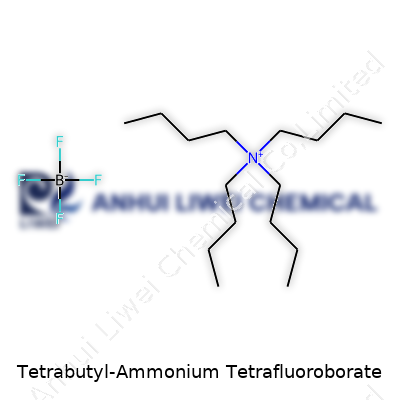
Tetrabutylammonium tetrafluoroborate packs quite a name, but at its core, it’s made up of a Tetrabutylammonium cation and a Tetrafluoroborate anion. To spell it out for anyone digging through a chemistry textbook or troubleshooting a tricky experiment, the formula looks like this: (C4H9)4NBF4.
Seeing Past the Surface
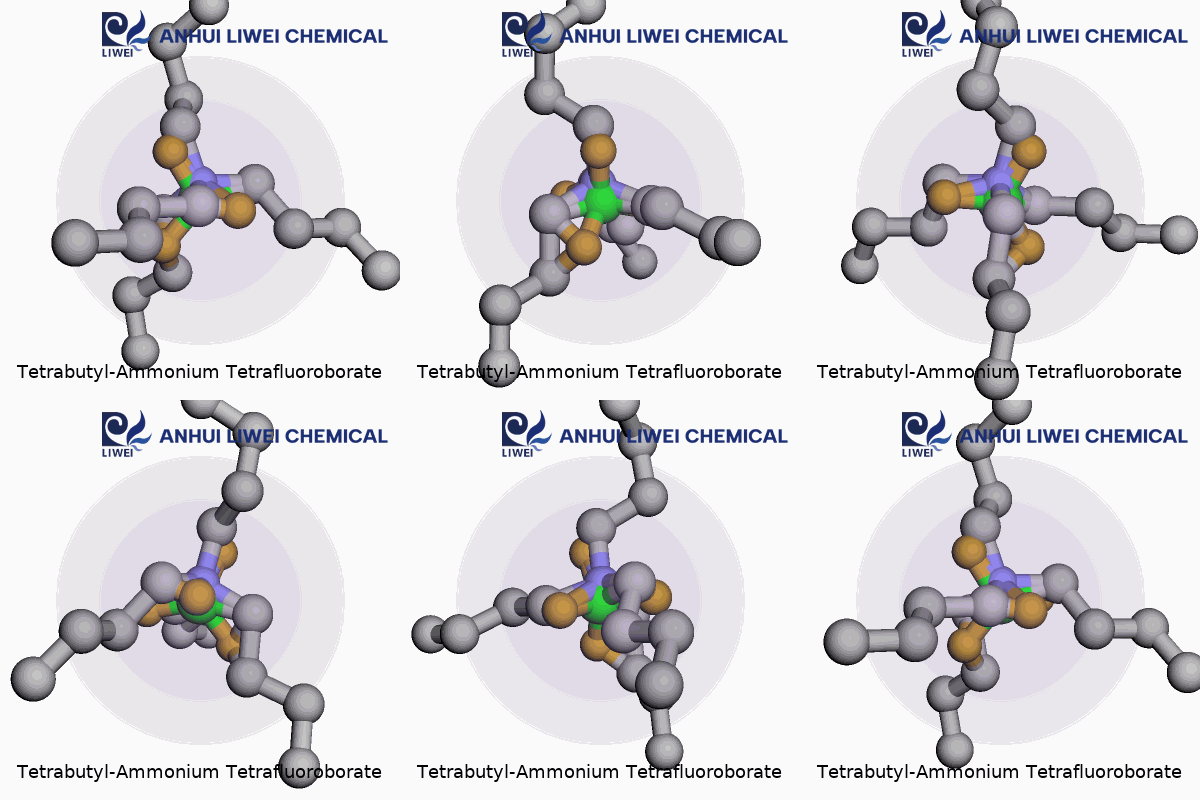
This salt pops up again and again in real labs. Having juggled many bottles of the stuff myself, I see it more than just a complex jumble of elements and bonds. This compound’s formula isn’t plucked from random mixing, it’s a well-defined snapshot of its structure — four butyl groups (each with four carbons and nine hydrogens) circle around a nitrogen, then dance with BF4-: one boron and four fluorines.
Importance in Real Work
Tetrabutylammonium tetrafluoroborate helps a lot in moving ions from one place to another in organic chemistry, especially in electrochemistry and phase transfer catalysis. When researchers want a solution to conduct electricity — not fry it or gum it up with metal cations — they reach for compounds like this one. Its formula tells experienced chemists what to expect: predictable solubility, reliable behavior during reactions, no extra drama from water-loving or reactive pieces.
Trustworthy Building Block
Labs depend on consistent ingredients, kind of like keeping a sturdy rolling pin in a bakery. This salt meets that mark. Its identity is clear thanks to its exact atomic roster: carbon, hydrogen, nitrogen, boron, and fluorine, with no guests crashing the party. Handy in non-aqueous solvents, it never hogs the center stage but makes the main reaction happen smoothly.
Safety Reminders Around the Bench
Fluorine can sound wild, and for good reason. Tetrafluoroborate itself brings stability, but that doesn’t make it a household cleaner. The formula links each element, but it’s not an invitation to ignore basic rules. I’ve learned to label bottles, keep gloves on, and double-check the Safety Data Sheet. The BLUF: it’s not radioactive or absurdly toxic, yet safe handling still matters because lab accidents rarely send early invitations.
The Worth of Clarity in Chemistry
In practice, getting the formula right keeps people safe and experiments rolling. I have watched students trip up when two compounds swap labels, leading to wasted days and unhappy results. By setting every onion-layer of the formula out in black and white, experienced teachers and careful researchers cut down on confusion. Four butyl chains, a single nitrogen, and the BF4 anion — precise and reliable, never mistaken for sodium chloride or more aggressive salts.
Thinking Forward in the Lab
Moving chemistry forward means balancing innovation and caution. Researchers keep an eye out for alternatives that hit the mark without environmental baggage. Tetrabutylammonium tetrafluoroborate has earned its place, but as more eco-friendly options show promise, labs can weigh their benefits using solid facts. Staying open to improved materials matters, but getting the formula straight is always step one.
The Realities Behind White Crystals in the Lab
Anyone working in a chemistry lab long enough runs into plenty of white, powdery chemicals that look deceptively harmless. Tetrabutyl-Ammonium Tetrafluoroborate—often abbreviated as TBABF4—shows up in research that dives into electrochemistry, ionic liquids, and phase-transfer catalysis. The first time I saw a bottle of this stuff, I didn’t give it much thought. It seemed as ordinary as table salt. A colleague set me straight, sharing stories of ruined work from poor storage and a busted project budget.
Moisture is the Hidden Enemy
One hard lesson from my early research days: TBABF4 doesn’t play nice with water. Even without visible spills, humidity seeps into every crack if the container stays open or loose. After a few months, my lab’s TBABF4 clumped like old sugar. The chemistry went downhill—impurities in the bottle started throwing off yields and analysis. Humidity doesn’t just affect how it looks; it pushes unwanted decomposition and can make the salt act unpredictably.
Storing Chemicals Away From Light and Heat
I always check where bottles live in the storage room. TBABF4 does best tucked away from direct sunlight and heat sources. Sunlight may not spark an immediate reaction, but over time, UV can mess with chemical stability and let impurities form. Curious undergrads find their mistakes during summer, only realizing too late that a window shelf destroys reagents. Heat, even from sitting near lab equipment, risks speeding up decomposition. My old instructor made a habit of double-checking storage cabinets to prevent unnecessary waste.
Choosing the Right Container Makes a Difference
Glass, screw-capped jars outperform plastic bags every time. Moisture sneaks through thin packaging, even when it feels tightly sealed. I keep a stash of glass bottles with lined caps for anything hygroscopic. Squeeze in a small packet of desiccant—those silica beads—next to the jar if long-term storage is the goal. It may feel excessive, but I know from experience how a few grams of bad TBABF4 can waste hours and skew results. Strong labeling, legible by everyone in the lab, prevents surprises and stops mix-ups with similar-looking salts.
Thinking About People and Places
Labs should keep flammable, reactive, and corrosive chemicals in separate cabinets, and TBABF4 fits best away from acids and bases that trigger ugly reactions. My own checklist ties into regular safety walk-throughs—checking seals, replacing any stained or cracked containers, and tossing anything with obvious contamination. Having standard procedures reflects care, not just compliance. A lab with clear shelves and well-marked containers signals that staff value health, safety, and the unpredictable nature of chemistry.
Reducing Risks, Not Just Following Rules
The best-run labs don’t just follow a rulebook; they treat storage as a shared responsibility. Whenever I train newcomers, I emphasize the cost of careless storage. Even small lapses have big consequences—unexpected splashes, ruined experiments, or exposure to harmful dust. Take a moment to double-check: dry, cool place, away from the light, tightly sealed, and with a desiccant nearby. Mistakes don’t need to be repeated generation after generation. Smart storage—done well—saves money, time, and keeps everyone safer.
The Real Risks in the Lab
If you spend any time reading chemical labels or lab safety data sheets, Tetrabutyl-Ammonium Tetrafluoroborate (TBABF4) doesn’t scream danger like some compounds do. It’s a white, crystalline powder that researchers toss into electrochemistry experiments and organic syntheses to help ions get where they need to go. Yet, once you peel back the routine, things get more complicated.
Toxicity: More Than Just a Number
Toxicity isn’t a guessing game: the facts matter. TBABF4 falls into the “moderate” category, meaning it can mess with your skin, eyes, and lungs—nothing like sodium cyanide, but not a sugar pill either. Most published data comes from animal studies and chemical analogs. Acute oral toxicity tests with similar quaternary ammonium salts show problems at relatively high doses, such as irritation, mucous membrane damage, and mild central nervous system effects. High dose exposure may cause gastrointestinal upset or, in bad cases, more serious systemic concerns (like liver or kidney stress), though you rarely see this unless there’s a major spill or someone ignores the rules.
Routes of Exposure
The places you get into trouble tend to be through dust inhalation, getting the stuff on your bare hands, or splashing it in your eyes. In the lab, I’ve watched colleagues grab bottles without gloves—skin irritation appears before you know it. If you’re unlucky and get a dust cloud, plan on irritated airways: cough, sneeze, or temporary shortness of breath. Pouring it into a beaker often seems clean, but powder clings to surfaces and sneaks out when you least expect.
Environmental and Waste Concerns
Tossing TBABF4 down the drain isn’t an option. Boron compounds can feed algal blooms or shift aquatic ecosystems if enough accumulates downstream. Ammonium pieces don’t break down easily and can add to the load on wastewater systems. Chemical disposal protocols exist for a reason. Every university and research institute insists on collecting TBABF4 waste in dedicated containers for hazardous pickup, precisely because scientists know, over time, contamination builds up in unexpected places.
Fixing the Hazards: Practical Safety Steps
Common sense beats fear every time. Anybody handling TBABF4 needs goggles, gloves, and a lab coat—this isn’t negotiable. Use a fume hood to pour or weigh, even if you’re just making a small solution. Keep containers closed tight and clean up small spills with damp towels or spill kits, not a dry brush. Good housekeeping also reduces risk: keep TBABF4 far from acids (it can make toxic gases like hydrogen fluoride in the wrong conditions) and never store it near food or drink.
Learning from Experience
Too many researchers slide into bad habits because TBABF4 looks so ordinary. But I’ve seen enough redness and sneezing from barehanded transfers to know how small exposures add up. One slip, one shortcut—next thing you’re running to the eyewash or feeling your throat itch. It serves as a reminder to respect every reagent, even those outside the “high hazard” headlines.
Summary
In the end, Tetrabutyl-Ammonium Tetrafluoroborate doesn’t belong in the “killer chemicals” bin. It’s a tool, but a tool that bites if ignored. Safety rules and respect for the waste stream keep the risks low for researchers, the environment, and anyone downstream. That’s good science, and better for everyone.
Digging Into the Solubility of TBABF4
Walking into any research lab focused on electrochemistry or modern synthesis, you’ll spot Tetrabutyl-Ammonium Tetrafluoroborate (TBABF4) on the shelves. This compound finds its way into so many beakers and flasks because it simply dissolves where other salts clump up. Solubility governs a chemist’s workflow more often than anyone admits. TBABF4 points to this fact with every use.
Water and TBABF4: Tricky Neighbors
Pouring TBABF4 into water rarely results in a clear solution. Its butyl chains, strung out from the ammonium core, rebel against polar water. Most reliable data reports that TBABF4 dissolves at about 0.01 M in water, making it poorly soluble for many standard applications. Watching it settle at the bottom of an aqueous solution always reminds me of how big hydrophobic organic groups simply don’t get along well with water’s polar structure.
Organic Solvents: A Natural Habitat
Anyone who has run an electrochemical reaction in acetonitrile or dimethylformamide knows TBABF4 as a go-to supporting electrolyte. Its affinity for organic solvents stems from its molecular structure—the same butyl arms that spell trouble in water turn into assets in less polar media. Acetonitrile (MeCN) allows high concentrations—often over 1 M—more than enough for most practical needs. Dimethyl sulfoxide (DMSO), DMF, and even dichloromethane or tetrahydrofuran (THF) handle generous doses without fuss. Published solubility numbers back that up: 1.5–2.0 M in acetonitrile, similarly robust values in DMSO and DMF.
Using TBABF4 gave me a way to sidestep solubility bottlenecks in organic electrochemical experiments. Anyone in organic battery prototyping or electroorganic synthesis probably feels the same relief. The salt’s ability to dissolve completely leaves no gritty residue, which matters when reliable ion exchange and clean voltammetry signals mark the difference between real insight and wasted time.
Why Solubility Matters in Research and Industry
Many labs use TBABF4 for reasons tied directly to reliability and consistency. The salt’s ready solubility in organic solvents keeps ionic strength predictable and avoids surprises during sensitive measurements. Chloride or perchlorate salts sometimes bring headaches, different solubilities, even safety concerns, especially around oxidizing agents. TBABF4 bypasses those issues.
I remember an episode where a team struggled with sluggish electrodeposition in water-based electrolytes. Swapping in a more soluble salt like sodium perchlorate helped—but only to an extent. What really opened up new experimental options was moving into acetonitrile with TBABF4 as the supporting electrolyte. Without layers of undissolved salt, the system delivered true, repeatable results.
Solutions: Getting the Most Out of TBABF4
Choose solvents that match the salt’s character. In practice, acetonitrile and DMSO take the crown for high solubility. Using TBABF4 in water puts up a roadblock for most high-concentration needs. For projects where water must feature heavily, exploring less hydrophobic tetraalkylammonium salts can leave options open. Sometimes, tweaking temperature or mixing in co-solvents lifts solubility just enough, but the molecular structure keeps limits in place.
Research keeps looking for salts like TBABF4 that offer even better properties—greater safety, broader solvent compatibility, lower cost. Until then, its unique balance of characteristics means chemists worldwide stick with it, knowing where it shines and where it stalls.