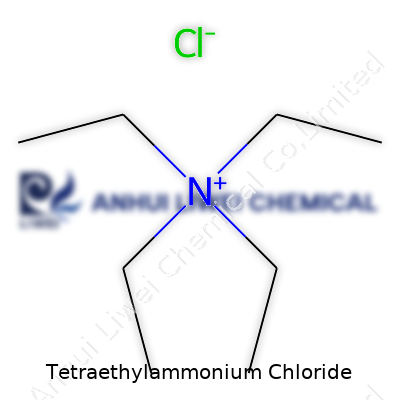
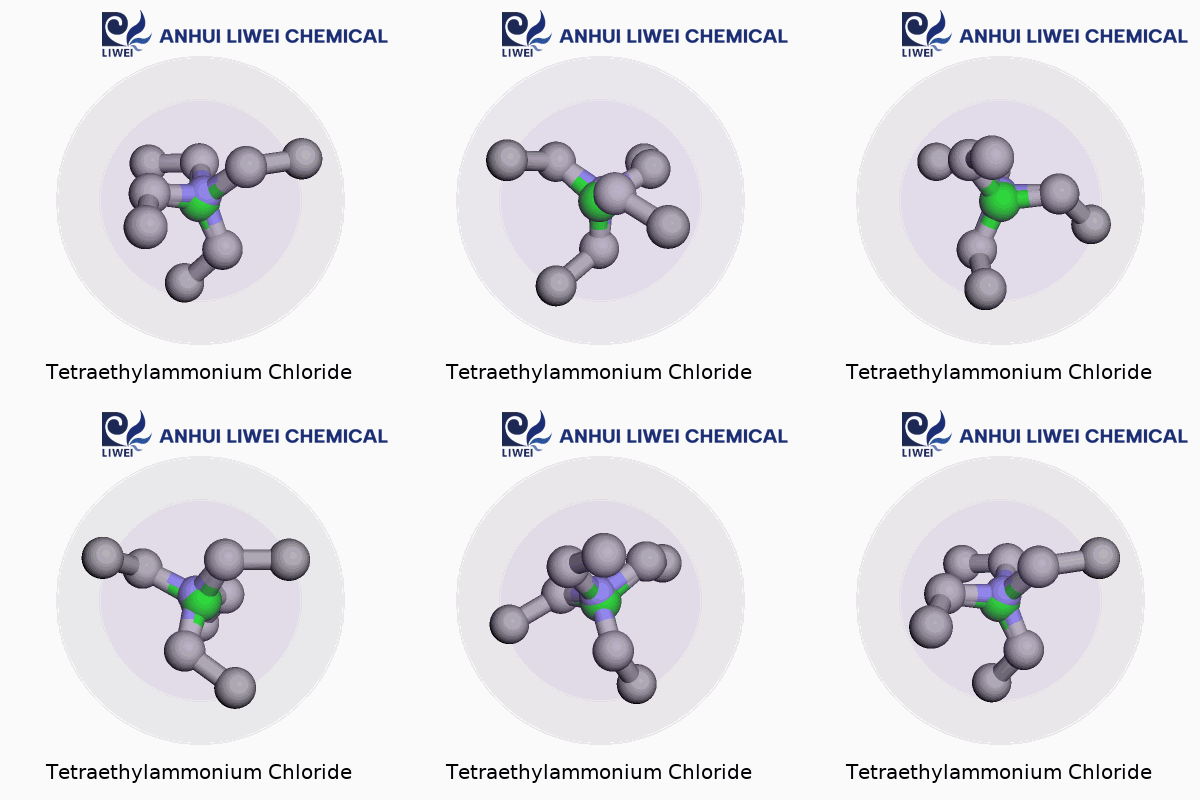
Tetraethylammonium Chloride: Past, Present, and Beyond
Historical Development
Scientists have been tinkering with quaternary ammonium salts for more than a century, and tetraethylammonium chloride (TEAC) is one compound that keeps turning up whenever folks dig around in the chemistry of nerve transmission and ion channels. Back in the early 1900s, researchers found that modifying ammonium ions with ethyl groups could shift their properties dramatically, especially in terms of how they affect nerves and muscles. The road to TEAC was paved by curiosity about how small changes in chemical structure can tilt the balance in living systems. As early as the 1940s, TEAC landed on the bench in labs looking into hypertension, sparking debate as doctors poked at its possible use as a ganglionic blocker. TEAC’s journey from a strange salt to something valuable for biologists and chemists shows how unpredictable discovery can be. No one expected it to stick around for quite this long, yet here we are.
Product Overview
TEAC shows up today in bottles that look pretty unimpressive: white, crystalline, sometimes a powder, other times a few sticky lumps if it’s soaked up moisture from the air. It dissolves well in water and certain organic solvents, a fact that makes things easier for people using it in a lab. Chemists reach for it when they need a simple strong electrolyte that doesn’t mess up their experiment with side reactions. Electrophysiologists love it because of how reliably it blocks potassium channels, a property that makes it a workhorse for neuroscience research. Many see it as just a handy tool, sometimes missing the fact that this simple-looking salt hides some deep secrets about how cells talk to each other and shuffle ions around.
Physical & Chemical Properties
TEAC has a straightforward formula: (C2H5)4NCl. On paper, it doesn’t seem flashy, but its physical properties matter. The melting point lands around 285–290 °C, high enough to rule out any melting in a typical lab setup. TEAC easily dissolves in water, pushing the boundaries up to about 600 grams per liter at room temperature, throwing out a strong ionic punch. In ethanol and methanol, solubility remains decent, while in less polar solvents, it falls out. As for appearance, TEAC forms small crystals or a flaky powder, pure white if made right. Stability holds up under dry conditions, but as soon as humidity creeps in, it pulls in water and forms a sticky mass. Misjudging this hygroscopic side leaves bottles turning into mush if left open on a humid afternoon. Chemically, the salt stays inert toward many organic compounds, but reacts strongly with silver nitrate, forming a solid silver chloride precipitate that’s handy for certain tests.
Technical Specifications & Labeling
Lab-grade TEAC comes with quality checks for things like purity, moisture content, and presence of residual alkylamines. Reliable suppliers give purity of at least 98%, with less than 1% water, and chloride content that matches stoichiometric needs. Labels highlight hazards: the signal word “Warning,” hazard pictograms, and R/S phrases related to toxicity and irritation. UN numbers flag transport issues, and storage guidelines stay front and center because of the hygroscopic problem. Whether it’s packed in small glass bottles or bulkier plastic jars, the best practice is sealing tight after every use. SDS paperwork remains essential, with advice on glove use, goggles, and what to do if TEAC ends up on your skin. Mislabeling or slack packaging led to headaches in research labs long ago, something vendors and users try to sidestep today with strict paperwork and clear batch records.
Preparation Method
Most commercial TEAC comes from a reaction between tetraethylammonium hydroxide (freshly made or as a concentrated aqueous solution) and hydrochloric acid. The reaction gives water and TEAC hydrochloride as the main products. If someone pushes the chemistry further, they can swap other anions using ion exchange columns packed with specific resins. After forming the salt, manufacturers often wash it with ether to strip off any leftover amine or other contaminants, dry it thoroughly, and recrystallize it from alcohol-water mixtures. Small-scale synthesis at the bench isn’t complicated but demands clean glassware and careful handling of reagents that don’t forgive sloppiness or contamination.
Chemical Reactions & Modifications
Once TEAC sits in hand, it doesn’t react with most organic solvents or mild acids and bases—one reason it passes muster in a mix of chemical experiments. Chemists sometimes play around with the chloride by swapping the anion through metathesis, giving tetraethylammonium bromide, iodide, or perchlorate as needed. Under strong basic or oxidative conditions, the ethyl groups can break off, leaving less useful products and, in bad cases, hazardously reactive fragments. In the context of electrochemistry, TEAC often appears in organic reaction media where it serves as an inert electrolyte. Sometimes people wish they could tweak the basic structure for even better properties, but too many changes kill off the features that make TEAC valuable for potassium channel blocking and other applications.
Synonyms & Product Names
Depending on where you look, TEAC pops up under several names: Tetraethylazanium chloride, Tetraethyllammonium chloride, N,N,N,N-Tetraethylammonium chloride, and on rare occasions, TEACl. Chemical databases list CAS number 56-34-8. Suppliers sometimes sell it under their own catalog numbers, but the basic chemical name stays clear on invoices and labels to cut down confusion—important in research where mixing up a chloride for a bromide could throw weeks of work off course.
Safety & Operational Standards
TEAC isn’t in the league of acutely toxic industrial chemicals, but a smart lab worker still takes it seriously. Gloves, safety goggles, and keeping containers sealed all add to a safer lab. TEAC can irritate skin, eyes, and respiratory passages. If inhaled or splashed around, symptoms crop up mostly as burning or discomfort, rarely as major health concerns, unless there’s prolonged exposure or someone really mishandles larger amounts. In storage, dry cool spaces work best; wet conditions cause it to agglomerate. Regular safety audits and up-to-date SDS sheets keep things running smoothly, as does clear waste disposal: collecting TEAC-contaminated materials and sending them through standard hazardous waste routes, never pouring leftovers down the drain.
Application Area
TEAC cuts its teeth mostly in research labs, especially in physiological and electrophysiological studies. Blocking potassium channels isn’t a minor trick; TEAC’s ability to do so led directly to some landmark work in understanding how nerves fire and muscles contract. Modern biophysics courses wouldn’t be possible without this salt making a cameo in at least a few experiments. Besides neuroscience, TEAC also appears in organic synthesis as a phase-transfer catalyst, helping shuttle reactants in electrochemical reactions. Environmental labs sometimes use it to study the way ions drift through soils or water. Its simple structure made it a model compound in computational and theoretical chemistry as well, rounding out its strange, broad presence.
Research & Development
Scientists keep finding new angles to probe with TEAC, especially since potassium channels are so intimately tied to human health. Much modern research goes into mapping different channel subtypes and sifting through the subtleties that TEAC reveals when blocking them. The compound’s role in organic electrosynthesis remains strong, with electrochemists using it in battery prototypes, fuel cells, and sometimes experimental semiconductors. Computational chemists use TEAC when they want to test software or models on something small and predictable. It has popped up in nanotechnology, where its role in controlling ionic gradients at very small scales started intriguing engineers looking for new types of switches and sensors. People push for derivatives with modified structures, but time and again, the original TEAC pulls weight because its physical properties stick right in the sweet spot.
Toxicity Research
Toxicological profiles for TEAC give a mixed bag. At low concentrations, folks rarely see lasting harm in animal studies, but higher doses bring twitching, muscle weakness, and sometimes respiratory challenges—direct signs of interrupted nerve conduction. Chronic toxicity data remains thin, but lab reports flagged developmental concerns if exposure remains high and extended. TEAC breaks down slowly in the environment, so disposal and effluent guidelines stick closely to best practices for lab chemicals. There’s always a push to substitute less persistent salts in commercial applications, a trend that could shape new protocols in academic and industry labs. I’ve seen nervous grad students double-check their gloves and fume hood settings every time TEAC lands in the daily experiment lineup, and there’s good reason to keep that caution.
Future Prospects
TEAC keeps finding a niche in research even as newer blockers and more elaborate organic salts hit the market. Neuroscientists may never fully move away from it, given its proven track record and how deeply it’s woven into the literature around ion channel studies. Emerging work on custom-tailored pharmaceuticals could use lessons learned from its mechanism, especially since drug designers look for precision and minimal off-target effects. Some sustainability-minded chemists want to develop biodegradable analogues, aiming for compounds that match TEAC’s blocking power but give back less stubborn waste. As much as technology shifts fast, TEAC’s durability in research serves as a reminder that some reliable tools just keep their spot. Every now and then, something simple like TEAC outlasts the hype around flashier chemical gadgets.
Unpacking Tetraethylammonium Chloride
Tetraethylammonium chloride barely shows up on the radar outside laboratories, but anyone who has spent time in a chemistry lab knows its value. This compound, often abbreviated as TEA-Cl, looks like a typical white powder. Beneath that simple appearance sits a molecule with a surprising set of jobs, mostly well outside a regular person’s day-to-day routine.
Supporting Science One Reaction at a Time
My earliest brush with TEA-Cl came during an undergraduate biochemistry course. A professor handed us a small vial, and explained that what it could do mattered more than what it looked like. TEA-Cl blocks certain potassium channels, and that delivers a direct impact for research on nerves and muscle cells. The compound doesn’t cure disease, but it lets scientists break down exactly how electrical signals travel through the body.
For neurologists and pharmacologists, TEA-Cl can be the key to understanding why some nerve cells fire differently. Figure out those pathways, and you might find better ways to treat epilepsy or muscle disorders. TEA-Cl does not stand alone, but it gets used as a starting point for bigger questions.
Practical Chemistry in the Lab
Many research labs keep TEA-Cl on hand for more general experiments. Its structure lets it dissolve readily in water, which makes it much easier to use in testing how molecules move through cell membranes. Lab work often demands exact controls, and TEA-Cl provides a predictable, repeatable result.
TEA-Cl plays a crucial part in organic synthesis. Chemists depend on it for phase transfer catalysis—a process that brings together chemicals that do not normally want to interact. The presence of TEA-Cl can speed up reactions or make them cleaner. In my own graduate work, the difference between a successful synthesis and wasted time often came down to selecting the right agent—sometimes, TEA-Cl made that difference.
Electronics Experiments and Beyond
Researchers wearing white lab coats aren’t the only ones who reach for a bottle of TEA-Cl. Engineers studying batteries or fuel cells use it as an electrolyte. It helps create more stable test conditions, and since its behavior is well understood, it’s a favorite for experiments that measure electrical conductivity.
It’s even made its way into pharmacological studies, where it can act as a reference in drug formulation and testing. The compound itself doesn’t heal, but it shows up whenever someone wants to measure or push the limits of how ions cross barriers—something at the core of new medical devices and therapies.
Staying Safe and Building Trust
Working with chemicals like TEA-Cl reminds me every day how attention to safety shapes progress. Inhalation and contact risks keep researchers cautious. Strict lab protocols, gloves, and fume hoods protect everyone involved. Mistakes with basic lab chemicals can set back research or spark long-lasting anxiety about chemical safety.
For anyone not in the field, TEA-Cl’s story really comes down to how complex science builds on reliable tools. From my experience, the smallest bottle on a lab shelf sometimes supports the largest breakthroughs. Every step along the way, trust in proper handling and honest reporting feeds the next stage of discovery.
What Comes Next
With science moving quickly, TEA-Cl’s uses can change. Lab procedures evolve. Engineers may find new approaches that make some of its uses obsolete. Continued collaboration helps researchers adapt. Sharing practical tips—like storing TEA-Cl dry and tightly sealed, monitoring exposure, and sharing findings openly with colleagues—keeps the scientific community strong, grounded, and better prepared for future challenges.
Understanding TEACl and Its Role in Science
Tetraethylammonium chloride pops up in countless labs. Its chemical formula, (C2H5)4NCl, shows how it’s made from four ethyl groups attached to a nitrogen atom, and paired with a chloride ion. This simple structure has opened doors in fields from cell biology to organic chemistry. I first encountered it during electrophysiology experiments. The professor explained it could block potassium channels in neuron membranes, helping us trace how electrical signals move. TEACl looked humble but proved essential for gathering data that shaped our understanding of neural activity.
It doesn’t end in the lab. Researchers rely on TEACl for synthesizing organic compounds, separating substances, and calibrating sensitive instruments. In classrooms, students use it as a trusty example for studying how ions move through water or membranes. Because it carries a single positive and negative charge, it’s incredibly soluble and stable in aqueous solutions. For someone who needed consistent results during trials, that reliability mattered. You could trust your solution didn’t change unexpectedly over time or under light.
Why Chemical Purity and Sourcing Matter
TEACl, like many lab reagents, must meet strict purity standards. Small amounts of impurities can throw off experiments, making results unreliable. I’ve seen projects waste weeks because a batch contained moisture or byproducts from poor synthesis. Keeping an eye on sourcing, checking certificates of analysis, and maintaining solid supplier relationships helped prevent headaches. It’s not enough to know the formula; you have to question how the solid was made and stored, right down to the bottle’s label.
There’s also the human side. Plenty of new scientists dismiss safety instructions, thinking a salt like TEACl can't do much harm. The reality is different. This compound can irritate skin or the respiratory tract. Once, a teammate ended up with red, itchy hands after skipping gloves. That incident reinforced a lesson: being casual with even “simple” compounds can cause problems nobody needs. Sometimes it takes a mild scare to help lab workers respect their tools.
Access and Environmental Responsibility
Demand for TEACl has put some pressure on chemical supply chains. People forget: the production processes need careful management to avoid environmental waste. Ammonium and chloride ions don't break down easily, so proper waste treatment is crucial. Many researchers, me included, don’t notice this until disposal day, facing containers of used solutions. Labs today push for greener methods, catching spills quickly and tracking waste with databases. Simple steps, but ones that add up over time.
Despite its age, tetraethylammonium chloride stays relevant. Scientists count on its robust performance, so regulations are tightening around quality control, shipping, and documentation. Anyone thinking TEACl is just a dusty shelf staple makes a mistake. It’s a foundational tool, shaping what we know about nerves, reactions, and life itself. Respect for this small molecule keeps turning good research into great science.
Tetraethylammonium Chloride — What’s in the Bottle?
In labs and chemistry circles, someone might mention tetraethylammonium chloride and either spark a look of confidence or hesitation. This compound acts as a powerful tool for scientists working with nerve signals and ion channels. I’ve seen it labeled as both useful and hazardous, which sums up why it catches attention. The chemical has a simple enough recipe on paper, but the story gets complicated the moment you move past technical handbooks and see how it behaves with people and the environment.
Direct Hazards: Human and Lab Experience
I remember handling this compound with healthy respect when first working with it. Exposure risks hit the skin and eyes quickly if personal protection drops. Redness, irritation or even burns can show up after direct contact. Breathing it in brings coughs, throat discomfort, sometimes dizziness. Safety data sheets often list ‘corrosive’ and ‘toxic’ side by side, not as a casual warning but as a reminder: no one wants a spill or splash in the wrong place.
Lab accidents with tetraethylammonium chloride rarely make news, but one incident sticks in my mind. A bottle slipped, powder went airborne, and the taste of panic spread almost faster than the compound itself. Quick teamwork—ventilation, gloves, eye protection—kept everyone safe. That moment drove home how a simple routine can turn risky, especially with a compound that can disrupt nerves, slow heart rates, or even cause paralysis in high doses. Reading safety data is useful, but muscle memory in safety drills proves its worth when seconds matter.
Toxicity: What Scientists Know
There’s no real debate about its toxicity. Animal studies over several decades point to its effects on the nervous system. Low doses block certain channels in cell membranes—helpful if you’re mapping brain circuits, but a danger outside of strict control. Higher levels overwhelm heart or respiratory function. No one should downplay what a little mishandling can do, even if exposure risks stay low for the general public.
Chronic exposure data feels thinner, which worries some scientists. The acute risks—those you feel right away—get most of the attention, but repeated small doses over months or years remain less understood. Anyone working regularly with this chemical benefits from rotating out of exposed tasks, regular health monitoring, and a workplace culture that takes every odd symptom seriously.
What’s Next for Lab and Industry Practices?
I’ve watched universities and research labs tighten their storage and waste rules after safety reviews. Locking cabinets, double labeling, clear spill kits on hand—all standard moves now, and for good reason. Some labs switched to less risky alternatives where possible, especially for teaching labs where less experienced hands work with chemicals.
Clear communication about hazards, not just paperwork for compliance, shifts attitudes from routine to proactive. Regular audits, honest reporting of near-misses, and keeping personal protective equipment front and center don’t just protect staff—they set an example for new scientists. Tetraethylammonium chloride’s benefits are pretty specific, but stories and data make one thing plain: knowing its risks and respecting those risks beats regret every time.
A Closer Look at Storage for Safety’s Sake
Tetraethylammonium chloride changes the pace in research labs. Its role in blocking potassium channels puts it on shelves everywhere from neurobiology labs to universities and commercial outfits. My own time working with it on the bench hammered home a straightforward point: storage choices can spell the difference between safe science and trouble nobody wants. It’s not just about avoiding spills. Improper storage undercuts purity, undermines research, and risks health. You don’t mess around with that.
Key Details from Experience and Evidence
Tetraethylammonium chloride usually shows up as a white, hygroscopic solid. It grabs moisture from the air like a sponge. Once that happens, clumping kicks in, sometimes followed by chemical drift that nobody wants to explain to the boss. In one hectic semester, a leaky desiccator let moisture sneak in, and whole lots wound up sticky—useless for tight measurements. Point is, moisture control can’t get ignored.
Temperature matters. High heat breaks compounds down, and with tetraethylammonium chloride, stability fades fast well above room temperature. Even modest warmth over a few days can shift properties. From published chemical safety data, common recommendation is simple: store at room temperature, out of direct sunlight, and far from any heat sources. No fancy fridge, but no hot shelf either.
Avoiding sunlight protects the sample, since some compounds slowly degrade under UV. The direct overhead glare that fills daytime windows in labs does more harm than I once realized. So, shaded cupboards or lockers work best.
Protect from Dust, Water, and Incompatibles
Keeping containers closed tight stops not just humidity, but unwanted reactions. Airborne dust, vapors, or chemical fumes easily sneak in once the lid’s off. I learned the hard way how even small cross-contamination can waste not just chemicals, but hours of work. Glass or good quality plastic jars with screw-on caps close the door to most of those headaches. Labels need to be clear and up to date, with hazard warnings where they jump out. Lost or unmarked bottles turn labs into guessing games that nobody wins.
Strong acids, bases, and oxidizers have no business in the same locker. Tetraethylammonium chloride can react, sometimes forming nasty byproducts. In crowded labs, ‘run out of space’ often tempts people to pile unrelated bottles together. That’s just asking for trouble the first time a bottle cracks or leaks.
Forward-Looking Solutions for Better Lab Storage
Problems with routine storage often trace back to rushed handling or outdated habits. Better training helps, especially for a new generation used to digital instructions but unfamiliar with bottle-by-bottle care. Some labs have moved to digital inventory systems that highlight expiration dates and scheduled safety checks. In my experience, digital reminders catch issues before anyone opens a compromised sample.
Dedicated humidity-controlled dry cabinets have proven cost-effective for high-value chemicals like tetraethylammonium chloride, especially for long-term storage. Data supports their use: not only does stability extend, but fewer waste incidents crop up. Even older labs can retrofit a corner with silica gel or other low-humidity options to control the environment at a fraction of the price of full automation.
Good practices start with small steps—clear labels, dry containers, thoughtful placement. Talking over storage plans at lab meetings and checking up on each other keeps standards high and accidents off the books. With chemicals like tetraethylammonium chloride, good habits travel far: from the first study session to breakthroughs that reach way beyond the lab door.
A Closer Look at Tetraethylammonium Chloride in Daily Lab Work
Tetraethylammonium chloride catches the attention of chemists and lab workers thanks to its role in ion channel studies and organic syntheses. Its usefulness comes with a risk, though. One careless move can lead to spills, skin irritation, or inhalation hazards.
Anyone who has worked with quaternary ammonium compounds knows gloves and goggles aren't just for show. They help keep a routine day from turning into one you won’t forget for all the wrong reasons. It’s easy to dismiss these things as minor irritants because TEA chloride doesn’t explode or leave a strong stench. But skin contact leaves burning sensations, and splashy transfers don’t only scare beginners.
Why the Safety Data Sheet Matters, Even If It’s Boring
I kept my SDS binder underneath glassware racks, not because the rules said so, but because once, years ago, an eager undergrad left a bottle open and coughed for hours. SDS sheets lay out everything: TEA chloride is hygroscopic, so it sucks up moisture fast. That sticky powder cakes inside jars and on gloves, making accidents easier. In labs without a fume hood, the fine dust finds its way into the air, and your lungs aren't made to handle any of that.
Gloves, Goggles, and the Reality of Human Error
I once wore a single glove to weigh out TEA chloride because I thought I wasn’t touching anything risky that day. Powder ended up under my fingernail. Since then, double-gloving felt less like overkill. Nitrile gloves and safety goggles set a clear barrier between hands and eyes and the compound. A lab coat sleeves rolled down blocks stray grains from finding skin. Savvy chemists keep their workspace uncluttered, weigh inside closed balances, and never bring snacks near the bench. It’s not a badge of honor to ignore these steps. It shows real-world experience.
Good Ventilation: More Than Fresh Air
Once, I saw TEA chloride poured in a corner lab without any hood or fan. Afterward, the air got heavy, and someone started coughing. Proper ventilation pulls dust and vapors away from your face before you even know they’re there. Working with the compound inside a certified fume hood transforms safety from hope into habit. If a hood isn’t possible, small-scale transfers, slow motions, and wet paper wipes cut back on dust. People sometimes forget the value of simple steps like labeling and prompt clean-up, but every bit helps.
Spill Response That Doesn’t Leave Room for Regret
Spills with TEA chloride can turn a quick cleanup into a panic if no one knows what to do. Labeled containers for spilled powder and contaminated gloves help a team act fast. Standard cleanup steps—moistened wipes, bagging and binning waste, clear labels—prevent cross-contamination. I mark surfaces with tape after cleaning, letting everyone know things are safe again, and that small signal always drew nods from coworkers who knew these measures meant trust.
Solutions Going Forward
Lab supervisors who run quick meetings remind their teams of the basics more often than the complicated stuff. Regular refreshers on procedures ensure no one gets comfortable enough to cut corners. New staff get hands-on training, while regulars swap reminders and stories. The spirit grows from experience, not fear. Good habits, passed along in person, stop most problems before they start.