Tetramethylammonium Hexafluorophosphate: A Comprehensive Look
Historical Development
Chemists have been charting the course of tetramethylammonium hexafluorophosphate since the 1960s, not long after both the tetramethylammonium cation and the PF6− anion caught the eye of scientists seeking alternatives to more reactive salts. Early breakthroughs in organofluorine chemistry set the stage for discovering salt pairs that combined the non-coordinating qualities of hexafluorophosphate with sturdy organic cations. Colleagues in physical chemistry, electrochemistry, and synthetic chemistry soon singled out this compound for its versatility, integrating it in applications from battery electrolytes to phase-transfer catalysts and ionic liquids. Pathways for its preparation shifted from batchwise salt metathesis to more refined, controlled crystallization and handling, driven by the need for higher purity and safer techniques.
Product Overview
Tetramethylammonium hexafluorophosphate, sometimes abbreviated as Me4N+ PF6−, comes as a white, fine-grained powder. Its main draw: excellent solubility in polar organic solvents and thermal stability, especially when used in nonaqueous environments. This salt often serves roles in organic synthesis, NMR spectroscopy, and high-energy batteries. Labs range from academic research benches to industrial settings have kept jars of this material on shelves for decades. Researchers value its stable ionic character for work that demands conductive yet inert supporting electrolytes.
Physical & Chemical Properties
With a molecular formula of C4H12NPF6, this salt weighs in at 229.12 g/mol. Under standardized conditions (room temperature and ambient pressure), it appears as an odorless, white crystalline solid. Tetramethylammonium hexafluorophosphate melts at around 255°C, breaking down without boiling—volatility hasn’t been a problem. Solubility mainly concerns solvents like acetonitrile, nitromethane, and propylene carbonate, making it suitable for electrochemistry and separation science. It does not hydrolyze easily, but it will react in hot, concentrated acid. This salt offers a broad electrochemical window, meaning it doesn’t take part in unwanted side reactions within typical voltage ranges—a key advantage for battery chemists and electroanalytical researchers.
Technical Specifications & Labeling
Manufacturers supply this product in sealed, moisture-proof containers, clearly marked with chemical purity, batch identification, and hazard pictograms. Typical technical data sheets include purity ratings above 98%, residual moisture content, and allowable limits for metallic and organic impurities. Clear hazard labels, showing “toxic by ingestion” and “irritant to mucous membranes and skin,” support safe use in storage and handling. Many providers include shelf-life guidance and good laboratory practice recommendations, aligning with international safety standards such as GHS and REACH.
Preparation Method
Sourcing this salt often traces back to a double displacement reaction between tetramethylammonium chloride and potassium hexafluorophosphate in anhydrous solvents like acetonitrile. Mixtures are stirred, filtered, and washed to remove potassium chloride, leaving tetramethylammonium hexafluorophosphate to crystallize from the solution. Careful exclusion of moisture is a must, since hydrolysis of PF6− releases hazardous gases. In my experience, gloveboxes and dry boxes make the process less risky and give higher yields. Some research outfits move away from large-batch synthesis and favor on-demand, small-volume preparations to minimize risky stockpiling.
Chemical Reactions & Modifications
Tetramethylammonium hexafluorophosphate rarely reacts at room temperature, but conditions change under heat or strong acids. Chemists sometimes swap out the cation in metathesis reactions, producing other hexafluorophosphates. Under strong nucleophilic attack—uncommon except in specialized synthesis—decomposition of the PF6− group may release hazardous PF5 and fluoride. The salt is not much for redox chemistry, which is part of what keeps it stable as a supporting electrolyte. Ion-exchange columns can recover or recycle the cation, and custom modifications are rare, since the Me4N+ cation’s simple structure affords little space for functionalization.
Synonyms & Product Names
Everyone in the lab prefers short names, so Me4N+ PF6− shows up on sample vials and lab notebooks. Catalogs and regulatory filings go by “tetramethylammonium hexafluorophosphate,” and in some supply chains, it gets called “TMA PF6.” ChemIDplus, PubChem, and European regulatory listings tie the name to CAS number 15541-60-3. Old references and trade names don’t stray far from the main theme—clarity matters in procurement, transportation, and storage for substances with toxicity concerns.
Safety & Operational Standards
Routine use in the lab requires serious respect for this white powder. Even though it has never caused a runaway incident in my experience, the hexafluorophosphate anion decomposes if mishandled, evolving corrosive hydrogen fluoride and toxic PF5. Users wear gloves, safety glasses, and lab coats, and ventilated enclosures keep the workspace clear of dust. Spilled material gets swept up wet to prevent airborne dispersion. Waste disposal guidelines require sealed, labeled containers destined for specialized chemical incineration or hazardous material disposal. Documented standard operating procedures keep everyone on the same page, and periodic training programs make sure newcomers don’t overlook hazards.
Application Area
Electrochemical research and high-energy storage technologies owe a lot to this compound’s ability to create stable, conductive solutions in nonaqueous media. Redox chemists appreciate its inertness, while spectroscopists use it as a benign counterion in paramagnetic NMR studies. Some flow batteries and supercapacitors feature it as the electrolyte backbone, favoring the lack of coordinating interactions. In liquid-liquid extractions and phase-transfer catalysis, it helps shuttle ions between unlikely reaction partners. Specialty chemical synthesis and materials chemistry labs call on it for tasks that require both solubility and chemical stability across a wide solvent range.
Research & Development
Researchers keep exploring new ways to use and improve tetramethylammonium hexafluorophosphate—often in the drive for greener chemistry and better energy storage. Electrochemical teams study how different cations influence battery performance, compare the salt against other supporting electrolytes, and modify structures for higher voltage windows. Analytical labs look at traces left behind after aging, trying to reduce decomposition and extend battery life. There’s interest in tweaking manufacturing methods to lower residual chloride or metal content, boosting the quality for sensitive organic reactions. Academic groups develop predictive models for salt solubility and behavior within next-generation solvents—sometimes combining hardware tests with high-throughput simulations.
Toxicity Research
The record shows tetramethylammonium salts can be acutely toxic. Ingestion, inhalation, and direct skin contact trigger symptoms such as nausea, nerve effects, and in extreme cases, respiratory paralysis. Hexafluorophosphate compounds can decompose to release hydrogen fluoride, a well-studied and dangerous respiratory hazard. Animal studies helped regulators set strict workplace exposure limits and fostered the practice of working under local exhaust or inside gloveboxes. Research into long-term, low-level exposures continues, since chronic effects are less well understood. Many groups now study salt substitutes to sidestep toxicity, or improve warning labels and supply chain transparency, hoping to make lab work less hazardous for both workers and the environment.
Future Prospects
Demand for advanced batteries, high-resolution spectroscopy, and efficient chemical synthesis all drive continued interest in tetramethylammonium hexafluorophosphate. Greener production processes, robust safety protocols, and steps to cut environmental persistence seem inevitable. Researchers might replace PF6− over time due to concerns about fluoride ion release and environmental buildup, but the salt’s core properties—non-coordination, solubility, and stability—will keep it in scientific toolkits for years. The trend leans toward better engineered salts and smarter encapsulation, not outright abandonment. Ongoing education and safer alternatives will tip the balance, but for now, the practical advantages and extensive documentation surrounding tetramethylammonium hexafluorophosphate secure its role in research, even as the search for cleaner, safer chemicals pushes forward.
Chemists Rely on It Behind the Scenes
In the world of chemistry labs, some compounds never grab headlines but they keep research moving. Tetramethylammonium hexafluorophosphate falls into that club. You won’t find it on grocery shelves. Specialists in electrochemistry or organic synthesis often lean on it during work that seems far-off from daily life, but the impact circles back to the products and tech that touch our lives.
Key Role in Electrochemistry
Traditionally, liquid electrolytes play a big part in devices like batteries, supercapacitors, and certain sensors. Not every salt works. Chemists need something that dissolves well, stays stable, and doesn’t react with everything else in the pot. Tetramethylammonium hexafluorophosphate, or TMAPF6, charges into that gap. The molecule splits into a large, non-coordinating cation and a PF6– anion, which helps keep electrodes apart and lets ions zip through solutions.
This quality turns it into a solid electrolyte choice for cyclic voltammetry—the bread-and-butter measurement in battery or solar cell research. In my university lab, we used TMAPF6 for the precise, reproducible current readings it gave us. Other salts gummed up our results or clogged the works. One frustrated week of swapping alternatives taught us that lesson quickly.
Organic Synthesis: More Than Just a Salt
People who make molecules for drugs or new materials want reactions that go to completion and give material free from interfering leftovers. Tetramethylammonium hexafluorophosphate often steps in as an “innocent” counterion. Chemists can swap out a chlorine or nitrate and slip in PF6–, which then doesn’t get in the way of what matters. Studies have shown that switching to PF6– often boosts a challenging reaction by lowering side products and helping researchers isolate exactly what they want.
Research on ionic liquids—solvents that stay fluid at low temperatures—also benefits from TMAPF6. The salt can tailor the physical properties of an ionic liquid, giving scientists tools to design safer, greener reactions.
Safety and Environmental Realities
Working with TMAPF6 takes more than a basic glove and goggles mindset. PF6– can react to release toxic HF gas under certain conditions, so lab workers need solid training. Disposal involves protocols that meet strict regulations. The industry sources almost all large-scale material through companies that provide detailed safety sheets and clear labeling. My own experience with chemical spills reinforced how even a tiny lapse in handling or disposal creates bigger environmental or workplace hazards.
Looking Forward: Alternatives and Green Chemistry
Research keeps driving toward electrolytes and reagents that score higher on sustainability, safety, and cost. While TMAPF6 does the job well, there’s a push for less toxic, more biodegradable options. The change will take time—scientists want performance, but they’re also aware of the footprint they leave. Fresh ideas like organic anion alternatives or improved protocols for recycling are showing promise.
Lab Workhorse With Challenges and Promise
TMAPF6 powers discovery in labs striving to create the next battery, solar cell, or breakthrough medicine. Its strengths have shaped modern science, yet the push for safer, environmentally sound alternatives signals a field always in motion. Scientists, students, and workers all invest their energy into balancing remarkable results with a growing responsibility to people and the planet.
Handling a Sensitive Chemical in the Real World
Most people outside of labs probably haven’t heard of tetramethylammonium hexafluorophosphate. In my experience as a writer who’s spent more than a few hours around chemistry benches and warehouse shelves, it rarely gets talked about unless a shipment label shows up on a busy afternoon and a lab manager pauses to explain, “Don’t just toss that on a random shelf.” Staying alert around chemicals like this one isn’t about ticking a box — it’s about safety, common sense, and protecting the chain of research.
What Proper Storage Means for Tetramethylammonium Hexafluorophosphate
People often picture flammable liquids or acids as the big worries in lab storerooms. Tetramethylammonium hexafluorophosphate comes with its own stubborn set of rules. It reacts with water. Even humidity in the air can turn storage into a real problem. Store it in a tightly sealed container, away from moisture, to keep it stable and avoid accidental hydrolysis. Even one careless moment — leaving it uncapped, storing in a damp fridge — can set off problems down the line. Anyone who’s dealt with corroded caps or a sticky residue in a dry bottle knows it means wasted work and extra cleanup.
Temperature control matters here, too. Extreme heat encourages decomposition. Keep storage cool but not freezing. Standard room temperature, out of direct sunlight, avoids headaches. All it takes is a shelf too close to a sunny window to ignite a long hunt for the source of contamination. Neat, labeled storage bins in a ventilated, temperature-stable storeroom save time and keep things running smoothly. Never trust luck—careful arrangement always outweighs vague memory.
Transport: Not Just a Box and a Label
Transporting this salt from one bench to another or sending it across town calls for real attention. Use containers specifically rated for chemicals of this kind. No shortcuts with Ziplocs or makeshift jars. Thick-walled jars with gasketed lids, vacuum-sealed bags, and secondary containment keep substances from leaking out or picking up unwanted moisture. If you’ve ever had to explain why a shipment arrived wet, you know how damaging it is to move carelessly.
Personal protection goes hand-in-hand with handling. I always pull on chemical-resistant gloves, goggles, and a lab coat even for “quick” transfers. Spills or skin contact aren’t just minor irritations—this compound’s toxicity means exposure calls for urgent action. Working in a fume hood provides clean air; even a tiny spill on a bench can mean hours lost to decontamination and stack up costs.
Records, Training, and a ‘No Surprises’ Policy
Every safe storeroom or shipping dock has a good system for records and communication. Log each use, every purchase, and disposal or transfer, no exceptions. Anyone new in the lab deserves full training, not just a quick summary. Sharing horror stories helps people remember—chemical safety is built on repetition and open discussion.
Safe chemical handling is never “set it and forget it.” You get better results, respect the work, and keep everyone out of trouble by treating each bottle with the care it truly demands. That’s something I try to live by every day.
Looking at the Hazards
Tetramethylammonium hexafluorophosphate often pops up in chemistry labs. It plays a part in synthesis, especially as an electrolyte in electrochemical settings. Not everyone in the research community gives it a second thought, but this compound isn’t just another benign salt. My stint in an academic chemistry lab brought plenty of face-to-face time with substances like this—you come to respect them quickly.
You won’t spot this chemical at the hardware store or lying around in home workshops. Its main users understand chemical safety data sheets because those sheets spell out a story: careful handling prevents pain—or worse. Tetramethylammonium ions already have a reputation, and not a good one. People in the field know the broader tetramethylammonium group poses real toxicity risks. Lab manuals describe acute toxicity. The compound can affect the nervous system, with symptoms ranging from muscle twitching to trouble breathing if exposure gets serious.
Hexafluorophosphate doesn’t make things any easier. Mix that with moisture, and you get hydrogen fluoride gas, a nasty respiratory irritant that’s corrosive and toxic in its own right. Pouring cleanup water down the drain never flies with this stuff—the risks follow you outside the lab if disposal slips past regulations.
Lab Safety Isn’t Optional
Universities drill protocols for substances like this for good reason. I’ve learned that just cracking open the bottle without gloves and goggles feels like inviting trouble. Fume hoods matter. Contact with skin might sound minor, and in a rush, skipping long sleeves looks tempting. Then you look at the safety data: skin, eyes, respiratory—this compound finds its way in if you let your guard down. I remember a colleague ignoring his mask while weighing out an ammonium compound. He coughed for hours, his nose running longer. That incident did more to cement respect for chemical safety than any sign on the wall.
Data from the National Institutes of Health and chemical registries reinforce what we know on the ground—tetramethylammonium compounds come with LD50 values low enough to put them in the “dangerous” category. Not all chemicals need massive exposure to do harm, and a relaxed posture in the lab can add up, fast. Stories drift through departments about near misses or episodes that sent students to doctors.
Factoring in the Workplace and Disposal
Beyond the bench, people handling this compound in industry settings rely on protocols that go further. Ventilation systems, spill kits, specific disposal procedures—these aren’t overkill. That’s protecting people and the environment. The Environmental Protection Agency continues to outline safe disposal for fluorinated salts. Sewers, soil, and rivers don’t filter these risks away. I’ve seen barrels hauled away by specialist waste firms, marked with more warnings than almost anything else in the storage room.
Steps Toward Safety
Working smart means treating tetramethylammonium hexafluorophosphate with the caution it deserves. Training everyone, not just the “experts,” helps a lot. Making sure spill response kits stay stocked would have saved us panic more than once. Accidents don’t need to happen. Substituting less toxic reagents often makes a project slower, but it moves safety up the list. Checks on storage, label clarity, and up-to-date safety sheets make a real impact. In my experience, vigilance isn’t just for rules—it’s the difference between a routine day and a call to emergency services.
Exploring the Details Behind a Common Reagent
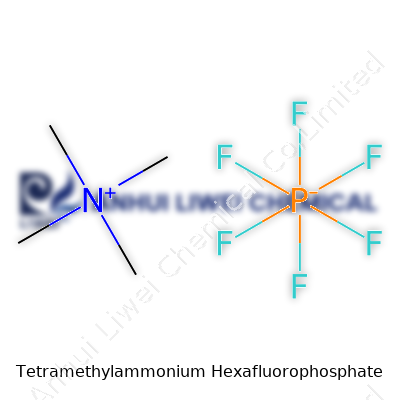
Every chemist, from student to seasoned researcher, likely remembers staring down a bottle labeled “Tetramethylammonium Hexafluorophosphate” at some point. Even if the name looks intimidating, breaking it into chemical pieces changes everything. Tetramethylammonium brings together a nitrogen atom with four methyl groups, each one a -CH3. Hexafluorophosphate lines up as a phosphorus atom bonded to six fluorine atoms, tightly packed into a stable anion. Both form a salt with unique properties—and distinct uses across organic synthesis and electrochemistry.
Formula Construction
Let’s not overcomplicate a clear answer. The chemical formula comes as: (CH3)4N+ PF6-. Written another way, it reads C4H12N PF6. The ammonium group gives its positive charge, the hexafluorophosphate its negative. Together, they balance out into one electrically neutral unit. The shape may sound dry, but it’s a go-to for chemists seeking inertness and high solubility in organic solvents.
Molar Mass Calculation
Looking up the atomic masses to do this right becomes second nature after enough lab experience. Here’s the breakdown:
- Carbon (C): 12.01 g/mol x 4 = 48.04 g/mol
- Hydrogen (H): 1.01 g/mol x 12 = 12.12 g/mol
- Nitrogen (N): 14.01 g/mol x 1 = 14.01 g/mol
- Phosphorus (P): 30.97 g/mol x 1 = 30.97 g/mol
- Fluorine (F): 19.00 g/mol x 6 = 114.00 g/mol
Total: 48.04 + 12.12 + 14.01 + 30.97 + 114.00 = 209.14 g/mol.
Straight arithmetic, no tricks. Rounding at each step mirrors real-world practice—a reminder that accuracy keeps lab results on target.
Why This Salt Matters in The Lab
Not every salt works the same. Tetramethylammonium Hexafluorophosphate dissolves in many organic solvents, unlike old standbys like sodium chloride. In my own experience, switching supporting electrolytes in electrochemical experiments reveals how minor tweaks in solubility and chemical reactivity change everything. Solutions with TMAHFP run clearer. The hexafluorophosphate ion, in particular, refuses to take part in redox side reactions, keeping analytical data cleaner and more reliable. This reliability supports experiments in sensitive fields, from battery research to organometallic catalysis.
Concerns and Solutions for Safe Handling
Some folks forget chemistry extends past theory. Companies ship TMAHFP in moisture-tight bottles for a reason. The compound doesn’t love humidity—water wrecks its purity and could trigger slow hydrolysis. Inhalation, skin, or eye exposure raises toxicity risks, so gloves and goggles stay essential, even on routine days. If a spill happens, sticking to a clear cleanup protocol—quick containment, careful waste disposal—protects everyone around.
Sustainability and safety need front-and-center attention. While modern labs prioritize green methods, TMAHFP’s manufacture and disposal rely on tightly regulated processes to limit environmental impact. Research trends focus on redox-inert salts with biodegradability in mind. Standing in a lab, holding that bottle, I see both challenge and responsibility. Every decision—how much to use, how to store, how to discard—ripples through the wider world.
Why Special Attention Matters
Tetramethylammonium hexafluorophosphate shows up in many chemistry labs and battery research facilities. I remember handling this salt with a real sense of caution, knowing it packs health and environmental risks well beyond what its crisp white crystals suggest. Careless disposal sends toxic elements into lab drains or landfill, threatening water sources and soil health. Fluorine compounds in particular cause damage that stretches far beyond the lab, breaking down into persistent toxins that linger for years and poison wildlife. Trying to cut corners leads to regulatory fines and puts real people in harm’s way. Guidelines are in place for good reason, and ignoring them bites back quickly.
What Makes Disposal Tricky
The salt carries both an organic cation and an inorganic fluoride anion. In the wrong hands, hexafluorophosphate anions release hydrogen fluoride, which is notorious for being highly corrosive and fatal in high doses. Staff working with this stuff need to know exactly what they’re handling. I have seen new chemists underestimate these risks; even small spills require rigid protocols and thorough cleanup, often triggering management reviews and facility checks. Mixing hexafluorophosphate with water or acids creates especially nasty byproducts.
Safe Steps for Disposal
Collect all waste containing tetramethylammonium hexafluorophosphate in clearly labeled, leak-proof containers with tight lids. Never dilute the salt with water or other chemicals hoping to “wash it away.” Good practice includes using chemically resistant containers—glass or specific plastics hold up well against fluoride ions, which will slowly attack some metals. I’ve seen too many well-meaning people use improper containers, leading to leaks and additional hazards down the line. Labels need clear, unmistakable wording showing the contents and date. Each lab or workplace should keep a waste log and update it every time material gets collected or moved.
Once you’ve gathered and labeled the waste, reach out to certified hazardous chemical disposal services. Never send waste to municipal trash or pour it down the drain—doing so violates safety regulations and endangers community health. Professional handlers move the waste to special facilities, where trained staff will either neutralize or destroy the compounds using high-temperature incineration or advanced chemical treatments. Some university labs and companies work with local governments to set up supervised chemical “take-back” days, which helps ensure no mystery containers end up abandoned years later.
Training and Policy Matter
Nobody likes mandatory safety training, but without it, even smart and well-intentioned staff make mistakes with complex reagents. Regular drills and up-to-date reference sheets hanging in work areas save trouble and prevent panic during inevitable accidents. Facilities benefit from regular reviews of their disposal partners. Some services cut corners, so audits matter. There are documented cases of improper disposal leading to groundwater contamination or unexpected fires at treatment plants. Asking tough questions during contract renewals goes a long way.
Moving Toward Better Solutions
Chemists and lab managers can focus on purchasing only what is truly needed, minimizing leftovers. Substituting less hazardous compounds cuts down on waste before it starts, which many research groups now consider best practice. Periodic inventories keep old stock from sitting on shelves, out of sight and mind. Safety equipment, like proper fume hoods and spill kits, should always stay in reach and get inspected regularly.
Disposing of hazardous chemicals like tetramethylammonium hexafluorophosphate safely isn’t glamorous, but it prevents costly disasters and protects more than just lab workers. Diligent handling and proactive planning make the difference between safe progress and reckless risk.