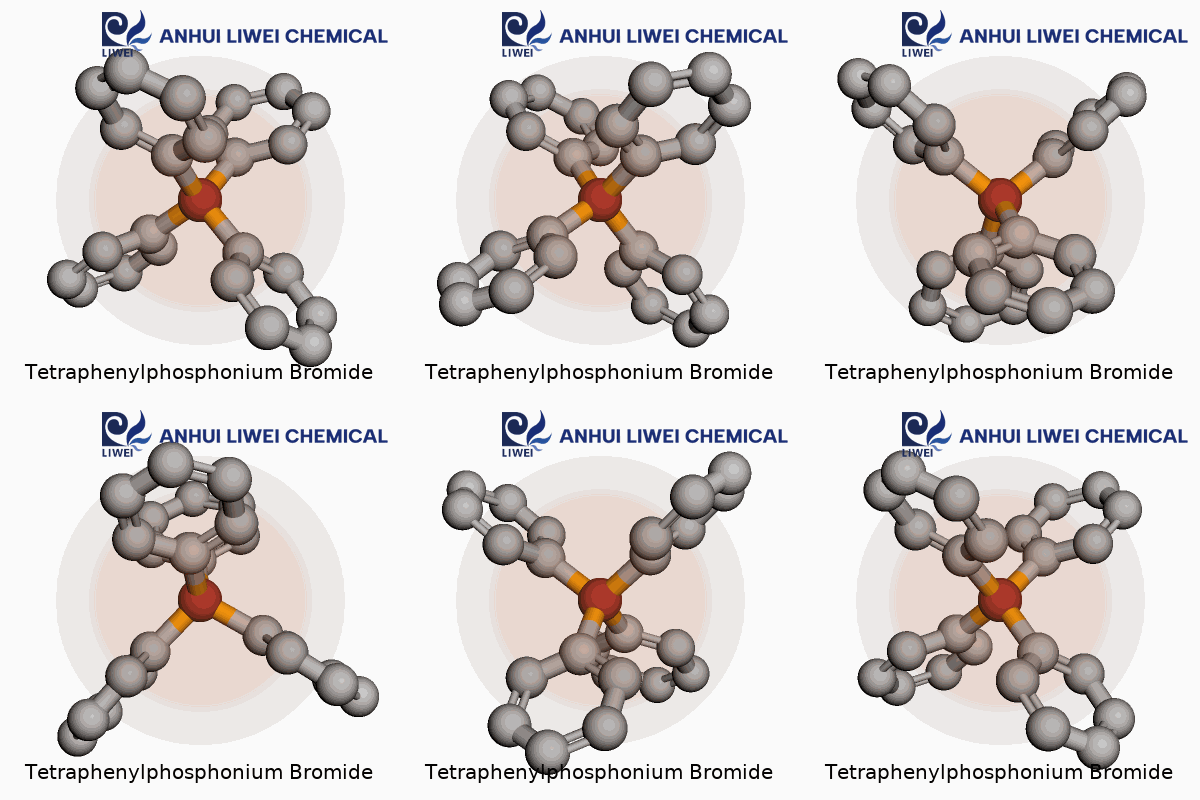
Tetraphenylphosphonium Bromide: Insights and Perspectives
Historical Development
Talking about tetraphenylphosphonium bromide always takes me back to my time in a university chemical stockroom. This compound began to appear frequently on chemical order lists during the middle of the twentieth century, right alongside other phosphonium salts that found new life in organic synthesis and analytical chemistry. Chemists like Wittig and Schlosser needed practical, lipophilic counterions, and laboratories began reaching for this salt due to its ability to transfer large, stable cations. The story offers a glimpse at how organic synthesis transformed in response to increasingly complex targets, with the spread of Phase-Transfer Catalysis (PTC) making room for salts that once sat in the back shelf.
Product Overview
Tetraphenylphosphonium bromide shows up as a white crystalline solid—there’s a faint, characteristic odor that’s hard to forget, hinting at its organophosphorus heritage. It boasts strong thermal stability and excellent shelf life if kept away from moisture. Its molecular formula, C24H20PBr, puts it into the heavyweight class compared to more familiar tetraalkylammonium salts, and that heaviness translates into behavior you notice when mixing or dissolving it in less polar solvents.
Physical & Chemical Properties
It resists decomposition below 300°C, and the solid feels dense in the palm—almost waxy to the touch. In the lab, it dissolves best in organic solvents like acetonitrile and dichloromethane, less so in water, making it a reliable partner for biphasic systems where separation after a reaction is crucial. Chemically, the big phenyl rings surrounding the phosphorus create remarkable steric hindrance, keeping the cation intact even in conditions that break apart lighter ions. Its melting point, usually reported between 250°C to 254°C, acts as a quality indicator: impure samples melt lower and show off-color streaks.
Technical Specifications & Labeling
Pharmaceutical and chemical suppliers offer tetraphenylphosphonium bromide with minimum purity thresholds—99% or better by HPLC or titration—and label each bottle by batch number, purity (including moisture and halide content), and storage instructions. Labels reflect regulatory guidelines, including safety pictograms for irritant and environmental hazard, and the CAS number 2751-90-8 for tracking in research and safety databases. In the field, technicians pay close attention to labeling because even minor bromide or phenyl impurities can ruin sensitive reactions. Manufacturers also supply certificates of analysis for each lot, helping researchers track variations that sometimes crop up between providers or production runs.
Preparation Method
Synthesis relies on reacting tetraphenylphosphonium chloride with sodium bromide in a mixed aqueous-organic environment. During my years as a chemistry TA, we made small batches with this salt metathesis approach, swirling the mixture until the white precipitate formed. Filtering, washing, and careful drying produce high-purity product, but careless work leaves halide contamination and oily residues that complicate downstream use. Industrial producers sometimes turn to direct bromination or exchange with more exotic systems to improve yield, but the principle never strays far from the classic salt-swap that underpins so much of basic inorganic chemistry.
Chemical Reactions & Modifications
The true power of tetraphenylphosphonium bromide emerges in chemical synthesis. Acting as a stable cation, it helps shuttle anions across phase boundaries, dramatically speeding up reactions in biphasic systems. In my own lab work, we exploited this trait to couple ions with hydrophobic reagents that normally wouldn’t mix. The phenyl groups also let researchers build hybrid organic-inorganic frameworks through substitution or metalation, especially when exploring new organophosphorus ligands. Reductive and oxidative treatments rarely bother the core cation, making it a “safe pair of hands” even when conditions turn harsh.
Synonyms & Product Names
Depending on the supplier, you may find this salt offered as Ph4PBr, TPPB, or even Tetraphenylphosphonium(1+) bromide. Some catalogs list it under role-based names: “phase transfer catalyst,” or “cationic transport agent.” From long familiarity, most chemists just call it “tetraphenylphosphonium bromide,” but paperwork and regulatory filings almost always refer to the full IUPAC designation to dodge confusion. Regardless of the label, it pays to double-check so you don’t wind up with a substituted variant when a pure, unsubstituted salt is needed.
Safety & Operational Standards
Safety protocols for tetraphenylphosphonium bromide mirror those for other organophosphorus salts with moderate toxicity. Gloves, goggles, and good ventilation always come first—this is a compound that irritates skin, eyes, and mucous membranes. Storage guidelines recommend tightly sealed containers away from moisture and incompatible reagents like strong acids or reducing agents. Spill cleanup can get messy, as the crystalline powder clings stubbornly to surfaces and won’t dissolve away with just water. Disposal relies on incineration or approved chemical waste handling; pouring into drains isn’t an option, especially as regulatory agencies focus on long-term environmental impact. Lab safety sheets underline the need for proper record-keeping and periodic review of storage practices to catch leaks or early signs of decomposition. Even experienced chemists sometimes overlook the importance of fume hood airflow checks and routine PPE inspections, but these basics prevent costly, painful accidents.
Application Area
Tetraphenylphosphonium bromide belongs to that rare class of chemicals that quietly power a wide stretch of experimental science. In organic synthesis, it acts as both a phase transfer agent and a stabilizing counterion in complex anion chemistry, opening routes to molecules that traditional aqueous systems can’t deliver. Analytical chemists reach for it when prepping samples for ion-selective electrodes, or when manipulating rare anions for spectral analysis. Biochemists use it to probe mitochondrial membrane potentials—its cation slips across lipid bilayers and tracks gradients in ways few other salts can match. In my time working with materials science groups, I watched it help build supermolecular assemblies and facilitate the crystallization of exotic organometallic complexes. Even as new designer reagents appear, this compound holds its ground because it solves old problems nobody else has answered as simply or as dependably.
Research & Development
Academic research continues hammering away at the limits of what tetraphenylphosphonium bromide can do, especially as spectroscopic and imaging techniques visualize its movement in real-time. Computational chemists explore its electronic structure for clues on why it resists decomposition under stress. Pharmacologists explore modified versions as carriers for drug delivery, hoping its lipophilicity and charge will help sneak therapeutic molecules past tough biological barriers. Every so often, journals report on newly discovered applications in nanoassembly, as the salt shepherds metal clusters into ordered arrays or acts as a building block for targeted catalysis. Each new use highlights how a simple combination of phenyl groups and phosphorus holds surprising versatility.
Toxicity Research
Work with organophosphorus salts always invites scrutiny over health effects. Tetraphenylphosphonium bromide stands safer than volatile counterparts, lacking the acute neurotoxicity of agents like phosphine gas, but it still warrants respect. Animal studies suggest moderate chronic toxicity with repeated exposure, and environmental research tracks slow breakdown in soil and water, raising questions about persistence. Regulatory agencies limit workplace exposure and demand strict tracking of waste streams. Labs have recently begun exploring greener synthesis routes and more thorough bioassays, trying to map the compound’s fate once it leaves controlled environments. Persistent attention to these details not only protects workers and researchers, but also builds a safety culture novices and experts alike come to trust.
Future Prospects
Looking out over the next years, research groups clearly aim to push tetraphenylphosphonium bromide in new directions. Advanced electrochemistry draws on its abilities as a supporting electrolyte, especially in non-aqueous media where classic salts like perchlorates struggle. Medicinal chemists probe structural variants for drug-delivery platforms targeting resistant bacteria and cancer cells. Material scientists eye its potential for assembling organic electronics, where thermal and chemical stability count just as much as charge-carrying prowess. My own hope lies in continued improvement in synthesis efficiency and reduced environmental impact, supporting both the rush for new results and the broader push for sustainable chemistry. Tetraphenylphosphonium bromide may belong to a well-established family of chemical salts, but its blend of stability, versatility, and adaptability earns it a permanent place in both the lab and the wider push for scientific progress.
From The Chemistry Bench Into Real Life Labs
Tetraphenylphosphonium bromide doesn’t get much attention outside chemical circles, but anyone who’s worked in an electrochemistry or pharmaceuticals lab knows its value. I remember the first time a professor asked for “TPP Br” on a hurried afternoon. It looked like just another white powder stacked among jars, but it ended up setting the tone for how I’d see specialty chemicals: not just as ingredients, but as tools unlocking new discoveries.
Where It Shows Up Most Often
This salt—made from four phenyl groups attached to phosphorus, with bromide hanging on—shows up in research spaces needing a reliable phase transfer agent. It helps move ions and organic molecules from one solvent system into another, especially water into organic phases. Picture trying to get oil and water to mingle in an experiment—tetraphenylphosphonium bromide steps in like a translator between two stubborn parties.
Labs focused on synthesizing new molecules, especially ones that don’t mix well naturally, rely on this compound to get everything moving smoothly. It pops up in organometallic chemistry, usually nudging reactions along where different charge states make a difference. Sometimes, it even joins the mix to pull out specific ions through precipitation.
Pushing Boundaries In Pharmaceuticals
Drug makers tap tetraphenylphosphonium bromide for more than just helping molecules along in a reaction vessel. In mitochondrial research—a hotbed for new therapies—it acts as a tracking tag. TPP+ (the phosphonium part) can slip through cell membranes, homing in on mitochondria. Researchers attach it to drugs or markers, using its natural tendencies for experiments on cell energy or to pinpoint potential drug targets for conditions like Parkinson’s and Alzheimer’s.
Trouble Spots And Safety Worries
Anyone handling chemicals this specialized learns caution isn’t optional; small molecules sometimes surprise you. TPP Br isn’t known as one of the most toxic, but it can pose risks if handled carelessly—eye and skin irritation, for starters. Safety data sheets warn against breathing any dust. Back in grad school, a spill—even a tiny one—meant scrubbing gear and washing trays thoroughly, not just because of risk but because traces of it can wreck sensitive experiments.
Another shadow follows in waste. Labs often let these specialty salts go down drains. Over time, constant disposal can build up environmental threats, especially if people get lax on protocols. Local guidelines make a difference. Once, our lab switched to collecting waste in separate containers, and we saw a clear drop in chemical waste violations. It took extra work—labeling, hauling bins—but the sense of responsibility shifted for everyone.
Where Science Moves From Here
Chemists love reliable building blocks. TPP Br belongs in the toolkit for research, not for everyday use or on an industrial scale. As more researchers tackle green chemistry, some look for less hazardous phase transfer agents and ways to reclaim these compounds from waste streams. Conversations about mitigation and alternatives pick up in conferences and journals more each year.
So much of scientific progress depends on little, often overlooked compounds. Tetraphenylphosphonium bromide might not make headlines, but its fingerprints show up on numerous lab breakthroughs and patient treatments that follow. The respect comes not just from its power, but from how thoughtfully it should be managed.
What Makes Tetraphenylphosphonium Bromide Special?
Chemistry is full of compounds with long, tongue-twisting names. Still, the structure behind these names tells a story. Tetraphenylphosphonium bromide is one of those molecules you remember from organic labs for its unique look and usefulness. You don’t find it in a kitchen cupboard; you’re more likely to spot it in a research lab where synthetic chemists weave new molecules together.
Chemical Formula of Tetraphenylphosphonium Bromide
The chemical formula is C24H20PBr. This formula says a lot in a cluster of characters: there are twenty-four carbon atoms, twenty hydrogens, one phosphorus atom, and one bromine atom. The structure comes from bonding four phenyl groups—those six-carbon aromatic rings—onto a single phosphorus atom, then pairing that with a bromide ion.
Why Care About This Compound?
During my time huddled over glassware in grad school, I learned that compounds like this one play supporting roles in bringing together bigger, flashier molecules. Tetraphenylphosphonium bromide often acts as a salt, helping chemists move ions around or adjust polarity. It doesn’t just sit on the shelf; it nudges reactions in directions that simpler salts can’t reach.
This molecule works as a phase transfer catalyst. That sounds high-brow, but the idea is simple. Say you have an oil-based reaction and a water-loving ingredient. These two don’t mix well—like oil and water at dinner. Tetraphenylphosphonium bromide jumps in to help the needed pieces get where they need to go, letting the reaction finish up, often much faster.
Real Impact: Research and Industry
Behind the scenes, this compound steps up in the development of drugs and advanced materials. Organic chemists reach for it during steps that demand more than generic lab salts, especially in making more specialized organic compounds. Sometimes even companies that work on dyes, sensors, or polymers lean on it to improve yields and open up new chemistry routes.
Safety deserves mention, though. Like most lab salts, it needs careful handling. Its chemical relatives sometimes find use in fire retardants, but in the lab, following protocols protects skin, lungs, and eyes. Proper gloves and fume hoods became habits early on for me—nobody wants a trip to the emergency room for a preventable mistake.
What’s Next for Tetraphenylphosphonium Bromide?
Scientists push boundaries with new solvents and creative reaction designs. Tetraphenylphosphonium bromide plays a steady role in these experiments. To reduce waste, labs can recycle it after reactions. Universities and research companies talk about green chemistry practices, and finding safer ways to make and use such salts lines up with that goal. There’s a chance to apply modern purification or recovery technology so every gram works harder and ends up reused.
Building Confidence: Reliable Information Matters
Reading a label from a supply bottle or a chemical database, you get the assurance that C24H20PBr is the right way to represent tetraphenylphosphonium bromide. Reliable sources—like peer-reviewed chemistry journals and trusted supplier catalogs—provide the backbone for this knowledge. Relying on such sources matters, especially for chemists who make decisions that hinge on every atom counting.
Understanding the Risks Hidden in Fine Chemicals
Lab workers and chemical suppliers see Tetraphenylphosphonium Bromide as a go-to agent in organic synthesis and biochemistry. I’ve crossed paths with this salt in research settings more than a few times. It’s not a household name, but its hazards deserve clear attention. The risks come both from what’s listed on the safety sheet and from what’s easy to overlook in a busy lab.
Toxicity Isn’t Just a Number
Tetraphenylphosphonium Bromide appears as a white crystalline powder, mild-mannered at first glance. Its Material Safety Data Sheet rings alarm bells all the same. Direct contact with skin can provoke irritation. Getting it in your eyes brings a painful burn. The real worry comes from accidental ingestion or inhalation. Animal studies show it can disrupt cellular processes, and human data is sparse. The lack of long-term studies doesn’t mean the coast is clear—it means we cross into unknown territory with every spill.
I remember colleagues joking about “exotic” chemicals, tossing safety practices aside because a bottle didn’t come with a skull and crossbones. These same folks found out the hard way that unusual chemicals don’t always wear their dangers on their label. I watched a skin rash develop after a careless splash. The lessons lingered longer than the discomfort.
Chemical Handling in Real Life
Chemical manufacturers and research institutions rely on Hazard Communication regulations. The Occupational Safety and Health Administration (OSHA) sets clear rules: Don’t eat, drink, or smoke around this stuff. Glove up, don your goggles, use a fume hood. These steps aren’t bureaucratic red tape—they reflect years of accident data. Ignoring them risks your health, your coworkers’ safety, and damage to the research itself.
Disposal matters, too. Flushing Tetraphenylphosphonium Bromide down the drain isn’t just illegal for many municipalities—it poses a threat to aquatic life. This compound doesn’t break down fast in the environment. Small spills won’t destroy a river, but every bit adds up, and researchers hold responsibility for their share.
Ways to Lower the Risk
I believe in training, not fearmongering. Every new researcher taking a chemistry lab tour with me gets a real demonstration of glove selection, spill kits, and proper ventilation. Storing Tetraphenylphosphonium Bromide in the right container, labeling it clearly, and locking it away from acids or reducers drastically reduces accidents. If you work with this salt, build good habits: Clean your bench, triple-check labels, and don’t shortcut the fume hood, even for a “quick” reaction.
Beyond personal responsibility, supervision and lab culture make or break safety. Peer reminders, posted safety instructions, and regular drills keep the danger top of mind. Accidents tend to happen not with the newest grad student, but with those who feel most comfortable. Familiarity can trick even skilled chemists into careless mistakes.
The Bigger Picture: Earning Trust in Chemical Handling
Companies and labs answer to a wider community. Following strict safety rules doesn’t just protect individuals—it earns public trust. Stories of unsafe chemical handling travel fast and spark outrage. Those of us who work with chemical hazards daily know rules aren’t an obstacle, but a shield for all of us. By treating compounds like Tetraphenylphosphonium Bromide with respect, we protect our health, our research, and the environment that surrounds the work.
What Makes This Chemical Different?
Tetraphenylphosphonium bromide pops up in many labs—sometimes for research, sometimes as a tool in synthesis. Anyone who has handled chemicals in a real lab knows the hazards stack up quickly. With a bulky organic salt like this one, you look at more than just a label or a standard storage chart. You pay attention to what the substance actually brings into your space.
Keeping It Dry Isn’t Optional
Moisture always spells trouble for phosphonium salts. Leave a bottle open on a humid day, and watch the powder clump or go sticky. That isn’t good practice in any lab—the wrong texture can mess with your work and even kick-start slow, unplanned reactions. An airtight container earns its place on every shelf for a reason. Most folks use glass jars with screw tops or sealed plastic containers. Toss in a desiccant pack and keep humidity from creeping in.
Temperature: Cooler Is Safer
Most people think room temperature sounds simple, but labs run warm in the summer. Higher heat can shorten the life of organic salts. For Tetraphenylphosphonium bromide, cool means below 25°C. Some researchers push for fridge storage, but that isn’t always realistic. I’ve seen labs label a drawer “phosphonium salts” and make sure it stays close to the coldest corner of the room—just one real-life hack that keeps compounds steady if space runs tight in the fridge.
Avoiding Light to Make It Last
Exposure to strong light, especially sunlight, hurts organic compounds. Fading color is only the beginning—light can speed up chemical breakdown. Opaque containers help, but dark cabinets work in a pinch. It doesn’t cost anything to choose a spot on a lower shelf where sunlight never hits. Years ago, I wrapped bottles in aluminum foil as a cheap backup. Results were always better than with clear jars under bright lights.
Stay Clear of Strong Oxidizers
Phosphonium cations won’t stay safe near aggressive chemicals. Storing tetraphenylphosphonium bromide with nitrates, peroxides, or acids only invites disaster. Most safety guidelines lean on color-coded storage: keep organics apart from oxidizers and acids. Big accidents usually come not from the chemicals, but from forgetting where you parked each bottle. I always check storage maps—one quick glance saves a lot of grief.
Labeling and Routine Checks Matter
Sharp labels steer a lab clear of confusion. Every jar or bottle gets the compound name, the date it landed in storage, and a hazard warning. Outdated labels cost time, or worse, safety. I’ve seen too many undergrads waste hours trying to guess what’s in an unlabeled bottle.
Routine inspection takes minutes. Check seals, look for soggy desiccant, scan for odd smells or color shifts. It’s these habits—easy to keep, easy to forget—that keep accidents at bay.
Training Saves the Day
No fancy storage method replaces a team that knows what to do. Every new member of the lab walks through storage and handling protocols. Even the most careful student benefits from hands-on reminders, not just printed instructions. It’s the little routines—closing the jar as soon as you take what you need, not working alone with risky chemicals, following up on any leaks or spills—that shape a safe lab culture.
Labs run smoother with practical steps, not just rulebooks. Tetraphenylphosphonium bromide deserves the same attention as anything else that can go wrong if you turn your back for too long.
Putting a Number to a Chemical Name
Tetraphenylphosphonium bromide may not roll off the tongue, but it shows up in many labs. Behind every formula, there’s a story made of atoms linked together. Chemists and lab workers often cross paths with this salt. Once you need to set up a reaction, prepare a buffer, or purify a compound, accuracy matters. Too much, and your reaction can flop or slow to a crawl; too little, and you can throw off whole routines.
The molar mass is the groundwork for any measurement. Here’s what makes up Tetraphenylphosphonium bromide: the cation, tetraphenylphosphonium (P(C6H5)4⁺), and the anion, bromide (Br⁻). Each phenyl ring brings six carbons and five hydrogens. So for the full molecule:
- Carbon (C): 24 atoms (4 rings × 6 each)
- Hydrogen (H): 20 atoms (4 rings × 5 each)
- Phosphorus (P): 1 atom
- Bromine (Br): 1 atom
Let’s hammer out the numbers:Carbon: 24 × 12.01 = 288.24 g/mol Hydrogen: 20 × 1.008 = 20.16 g/mol Phosphorus: 1 × 30.97 = 30.97 g/mol Bromine: 1 × 79.90 = 79.90 g/mol
Add those up—your calculator lands on 419.27 g/mol. This isn’t just a figure to jot down in a notebook. If you’re measuring out Tetraphenylphosphonium bromide for a reaction, this value keeps your experiment honest. Precision counts in both bench chemistry and industrial settings.
Why Molar Mass Isn’t Just a Number
Real-world chemistry doesn’t leave much room for rough guesses. I've watched fresh technicians skip this step. Nobody likes backtracking or fixing costly mistakes, especially with expensive chemicals. Once, in a student lab, someone misread a label, mixed up their calculation, and spiked a sensitive reaction with ten percent more chemical than needed. The frustration from wasted time and resources stings more than the sting from spilled acid.
Molar mass links every practical decision in the lab. Weighing salts for a titration? Calculating yields for a publication? Setting a standard in an industry report? Each job circles back to knowing this value cold. A gram here, a fraction there—all translate to quality down the road.
In pharmaceutical labs and academic settings, regulators and researchers demand traceability and repeatability. Labs keep tight books and digital records for every batch. If molar masses slip or get misquoted, not only can you lose time, but trust evaporates as well. Journal reviewers dig through the numbers. Competitors notice gaps. Clients remember mistakes. One easy fix? Double-check the math.
Raising Accuracy in Everyday Chemistry
Teaching new chemists means running through these calculations early and often. I value keeping laminated molar mass sheets on hand. No shame in checking numbers before heading to the balance. Peer review in the lab goes a long way. Another set of eyes on a calculation buffers risk and keeps everyone focused. Over time, these good habits pay off through sharper work and fewer headaches.
Digital tools help. Though I trust mental math, spreadsheet templates and apps place accuracy one click away. Still, knowing the basics—the nuts and bolts—prepares you to catch oddball results or spot a typo in published values. If uncertainty pops up, trace the math yourself back to the periodic table.
On the shelf or in the flask, 419.27 g/mol stands as the right value for Tetraphenylphosphonium bromide. Get this right, and the rest falls into place a lot smoother.