Tetraphenylphosphonium Iodide: Roots, Realities, and Road Ahead
Historical Development
Chemists often chase new tools to solve tricky problems, and tetraphenylphosphonium iodide answers this call in surprising ways. The compound first showed up in research labs decades ago, not because folks set out to build it for its own sake, but because they were after catalysts and reagents that could go places ordinary ions couldn’t. Pioneers in organophosphorus chemistry kept tinkering, looking for salts that behaved with steady hands during reactions. Tetraphenylphosphonium salts gained traction in the mid-20th century as counterions for big, complex anions—especially in organic and organometallic chemistry—offering stability and solubility where simple alkali metals fell short. What started as a curiosity in lucite-clear test tubes and old-school beakers turned into a workhorse in modern labs everywhere.
Product Overview
Tetraphenylphosphonium iodide doesn’t sell itself on flash or color—it’s a striking white, crystalline solid, and, for most, it lives in tightly capped amber bottles lined up on a shelf. Yet for industrial and academic chemists, it plays a role more profound than its looks suggest. It stands out as a phase-transfer agent, a reagent, and occasionally a precursor for making other tetraphenylphosphonium salts. In practical use, batches are usually reliable; bottles arrive dry, with a minimum of visible caking, and the contents stay free flowing for long months if kept sealed and cool.
Physical & Chemical Properties
The compound comes as a fine to small granular powder, white under a good fluorescent light. Tetraphenylphosphonium iodide’s formula is C24H20IP, with a molecular mass just shy of 500 g/mol. Its melting point hovers near 250°C, which—compared to common inorganic salts—speaks to the heavy, aromatic nature of the molecule. Tetraphenylphosphonium iodide dissolves easily in polar organics like acetone, acetonitrile, or ethanol. Water doesn’t take it up quite so generously, which matters when you want to extract it from a two-phase mix, or wash away water-soluble junk in a synthesis. Its crystalline lattice packs in strong ionic bonds between large cations and anions but remains far less hygroscopic than many ammonium or sodium salts, meaning a researcher can expect fewer unpredictable drifts in moisture or mass during weighing and measuring.
Technical Specifications & Labeling
Manufacturers list purity, sometimes boasting 98% or higher—less than this is rare for reputable suppliers. Labels usually specify appearance (white to off-white solid), melting point, and storage conditions—keep it under nitrogen or argon if long-term, keep it sealed tight against the humid air. Hazard phrases note harm to aquatic life and hazard to eyes and skin. Batch numbers and lot controls appear on every container; traceability runs as a theme, echoing demands from labs that every bottle can tell its story from origin to experiment.
Preparation Method
Labs can produce tetraphenylphosphonium iodide by reacting tetraphenylphosphonium chloride with potassium iodide in a controlled water-ethanol mix. The chloride salt mixes in solution, the potassium salt selected for its cheapness and easy filtration. The iodide swaps with chloride, precipitating the less soluble tetraphenylphosphonium iodide as flocculent white solid. Filtration, washing, and drying complete the process. This basic route survives years of use with only minor tweaks because of its efficiency and minimal waste. Larger-scale production swaps in continuous stirring and temperature control for smoother yields—small-scale runs still happen on hotplates and glassware found in every bench lab.
Chemical Reactions & Modifications
Tetraphenylphosphonium iodide acts mainly as a counterion, not a reactive centerpiece. Still, chemists can substitute its iodide for other anions by simple salt metathesis, creating tetraphenylphosphonium bromide, perchlorate, or other derivatives as needed for various experiments. Its stability under heat and mild acid/base keeps it intact where more fragile organics would break down. Under special conditions, the aromatic rings might react with strong oxidizers or halogenating agents, but most researchers choose the compound precisely for its unreactive nature in complex mixtures.
Synonyms & Product Names
Across catalogs, the title “tetraphenylphosphonium iodide” turns up more often than alternatives, but chemical databases sometimes use “TPP-I” or “Ph4PI.” CAS numbers like 2091-21-4 give clarity regardless of language or supplier, avoiding mix-ups over synonyms. No household names here—just clear chemical shorthand that matches across publications, batch sheets, and shipping documents.
Safety & Operational Standards
Sensible handling means gloves, safety specs, and good ventilation. The compound irritates skin and eyes, so working with goggles and quick access to washing stations stays essential. Labels advise against breathing in fine dust, and spills ask for a cautious sweep-up, not a rushed brush-off. Waste disposal lists it as hazardous—rinsing it down drains doesn’t cut it due to toxicity to aquatic systems. Labs install protocols about usage logs, inventory, and double-checking container closures. Safety datasheets—often overlooked in day-to-day habits—make clear not to mix with strong oxidizers or acids without proper planning.
Application Area
Tetraphenylphosphonium iodide’s uses spread across many corners of chemistry. In phase-transfer catalysis, it ferries ions from aqueous to organic phases, making tough reactions run “clean” that otherwise wouldn’t cross the water/oil boundary. Electrochemistry labs favor it as a supporting electrolyte for studying redox events in organic solvents, since bulky cations avoid interfering with sensitive measurements. Analytical chemists use it in ion-selective electrodes and as a crystal growth agent for certain perovskite compounds. My own experience as a graduate student pointed to its reliability: batch after batch of catalytic systems clicked into place with this compound setting the rhythm, outperforming smaller quaternary ammonium salts in stability and ease of separation. Researchers reach for it when they need a non-coordinating cation in complex organometallic preparations, making high-yield, reproducible reactions possible.
Research & Development
Academic papers in the past decade link tetraphenylphosphonium iodide to explorations in new synthetic methods for drugs, fine chemicals, and polymers. Teams working on supramolecular chemistry count on it as a template for growing large, well-ordered crystalline arrays. Research on ionic liquids pivots around its structure, using tetraphenylphosphonium as part of custom liquid-phase matrices with tunable properties. The compound helps power comparative tests in catalysis, letting chemists draw clean lines between effects from different counterions without the noise of side reactions.
Toxicity Research
Toxicity data shows a need for careful use. Studies on model organisms and cell lines reveal moderate toxicity, mostly due to the iodide ion and the lipophilic bulk of the cation, which carries a tendency to cross biological membranes. Strong exposure causes issues with respiration and cellular metabolism—enough to drive strict limits for routine work. Labs measure and document exposure, train new users on safe handling, and always treat spills as notable incidents. This kind of strict approach makes sure health and environmental risks stay low, but ongoing work around toxicity keeps refining the understanding of long-term impacts. Institutions call for additional data, especially connected to wastewater treatment and the environmental paths of quaternary phosphonium salts.
Future Prospects
Looking ahead, tetraphenylphosphonium iodide may emerge more often in greener syntheses, where its phase-transfer capabilities could help cut down on solvent waste and lengthy purification. Technology for smart materials and molecular electronics taps into its structure for building more robust, tunable organic systems. With more industries demanding tailored, high-purity intermediates, I expect processes for making and recycling this compound will get cleaner. Researchers already share new ways to recover and reuse tetraphenylphosphonium salts in lab-scale circular systems, reducing the pressure on waste management. As regulations tighten around persistent organic pollutants, chemical makers and end users will invest more in safety data, hazard reduction, and better containment—all approaches pushing both science and stewardship forward side by side.
What Makes Tetraphenylphosphonium Iodide Unique
Tetraphenylphosphonium iodide turns up in labs far more often than most people realize. At first glance, it’s just another white crystalline powder. For a chemist with some experience behind the bench, its value reaches beyond its appearance. I remember running into it during my postgraduate research — the bottle sitting quietly on the shelf, labeled "TPPI." Its true role shows up in processes where reliable ion transport or salt formation makes the difference between failure and publishable results.
The Real-World Roles of Tetraphenylphosphonium Iodide
This compound gets a lot of attention in the world of analytical chemistry. Laboratories often use it to prepare tetraphenylphosphonium salts, which serve as reference standards in electroanalytical studies. The bulky, hydrophobic tetraphenylphosphonium cation helps chemists move ions across membranes or extract ionic pairs from solution. Studies on how drugs move through cells or how membranes control ion flow often depend on reagents like this. It’s no exaggeration to say these tools keep the gears turning in biological and physical chemistry.
The medical field benefits too. In some hospital labs, TPPI helps trace mitochondrial function by tagging certain cell processes. Researchers who chase answers about cell health and diseases like Parkinson’s or cancer end up relying on these ionic markers. Having used it myself, I know how much it speeds up experiments where smaller cations struggle to get across cell barriers. With TPPI, researchers watch interaction patterns and rates they might otherwise miss.
To anyone outside the lab, TPPI may look niche, but its reach extends into chemical synthesis. Chemists use it to introduce the tetraphenylphosphonium group in organic molecules, setting the stage for future transformations. In my own synthetic work, swapping ions in and out with TPPI has often meant hitting yields and purities that older methods miss. Moreover, because TPPI forms stable salts, it enables isolation of difficult intermediates, something that anyone who spends time optimizing synthesis conditions appreciates.
Supporting Reliable Scientific Progress
Any chemical used in research needs to offer reliable performance. TPPI stands out for its high purity and its ability to maintain stability under lab conditions. This isn't just about theory; in day-to-day research, knowing your reagents can be trusted makes a difference. Labs around the world build on data generated with TPPI. Literature studies confirm its use in everything from phase-transfer catalysis to analytical method development.
Safety holds weight, too. TPPI brings fewer risks compared to many similar lab reagents. Researchers still use gloves and safety goggles when weighing out doses, but compared to some alternatives, it poses less risk to health. This reduces lab accidents and lowers costs for disposal and handling. Responsible disposal of halides and phosphonium compounds remains important, though, and I always encourage colleagues to follow up-to-date safety protocols.
Looking Ahead: Supporting Discovery and Innovation
Science thrives on tools that open new doors, and that’s what TPPI provides. By making ion pairing, extraction, and synthesis more accessible, it fuels progress across industries—pharmaceuticals, diagnostics, and materials research all gain from its use. In my own journey, I’ve watched TPPI move from niche specialty to trusted staple. It serves as a reminder that even lesser-known reagents can carry real value for discovery and innovation.
Understanding the Formula: Breaking Down the Molecule
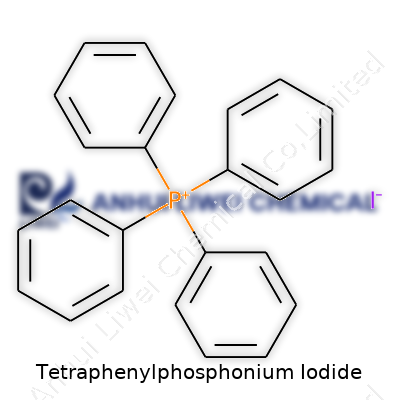
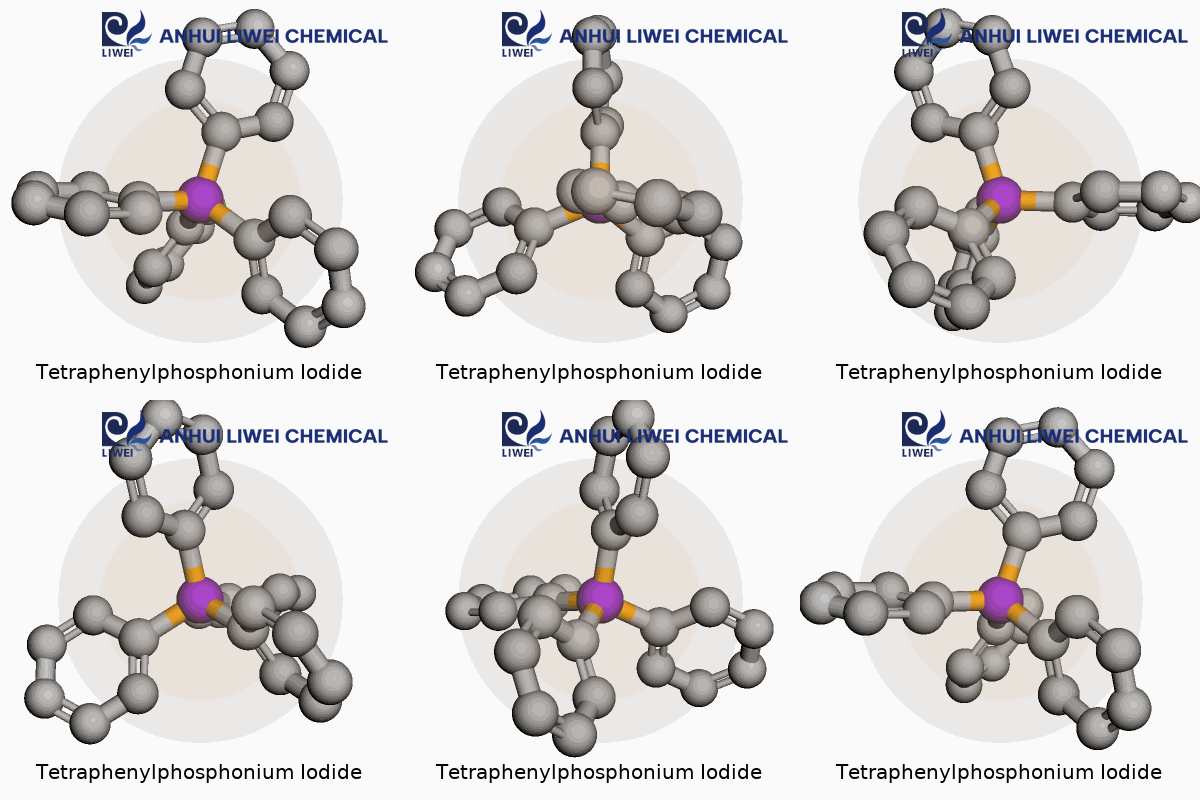
Tetraphenylphosphonium iodide carries the molecular formula C24H20IP. Each molecule brings together four phenyl groups stuck to a phosphorus atom, sitting right next to an iodide anion. For anyone who paid enough attention in organic chemistry, that shows a sharp split between structure and function.
Why This Compound Matters
This salt steps in as a heavyweight in organophosphorus chemistry. In a lab, you might spend long hours looking for a stable, bulky cation or testing out counterions for crystal structures—tetraphenylphosphonium iodide often gets picked because it’s ready to do this reliably. I remember undergrad students grumbling about tricky syntheses, but breathing easy after swapping in a big, lipophilic cation like this one.
The phenyl groups, stacked around a single phosphorus atom, give it a solid hydrophobic character. Unlike lighter, smaller cations like sodium or potassium, this PPh4+ doesn’t easily dissolve in water but fits right in with organic solvents. That opens a lot of doors in non-aqueous chemistry and helps chemists understand reactions where water just messes things up.
Applications and Research Footprint
In real-world labs, tetraphenylphosphonium iodide serves as a source of the tetraphenylphosphonium cation, handy for swapping anions during synthesis or growing single crystals to learn about the distance and arrangement of molecules. X-ray crystallography has changed how chemistry sees its own building blocks, and salts like this one play a key role.
This particular iodide salt pops up in organic synthesis for phase-transfer catalysis, acting as a bridge for ions to move between layers that don’t normally mix. That saves time, raises yields, cuts waste, and keeps things cleaner—a win for both research and the planet. In teaching organic labs, clear results matter. For me, nothing built as much confidence in chemistry students as seeing clean crystallization using this salt.
Doctors and researchers have noticed tetraphenylphosphonium’s affinity for mitochondria too. It sneaks into cells and lands on organelles by tracking the negative charge. That trick makes it useful for tracking drug delivery or even imaging cells, areas where technical details make or break a project’s success.
Safety and Handling
Despite all its utility, tetraphenylphosphonium iodide isn’t something you want on your skin or in your lungs. The iodide ion can cause issues for the thyroid, and organic phosphonium salts deserve handling with respect. In my experience, good lab practice — gloves, goggles, patient technique — keeps these risks in check and lets the benefits shine through.
Building a Better Chemical Future
Chemists can keep pushing for safer, greener alternatives, but right now, compounds like tetraphenylphosphonium iodide do heavy lifting in both basic and applied science. Technology keeps evolving, and so does the need for compounds with better environmental and health profiles. Open access to molecular data, honest reporting of toxicity, and collaborative work stand out as real steps to improve lab safety and sustainability. For students, researchers, and chemical suppliers, aiming higher means seeing both the promise and the pitfalls of widely used compounds—and handling them with knowledge, not just caution.
Why Storage Habits Shape Lab Safety
Walking into any chemistry storage room, stacks of reagent bottles fight for shelf space. Some are classics, always around. Tetraphenylphosphonium iodide isn’t exactly a household name, but it plays a quiet role in organic syntheses. Most chemists know it by sight: pale, off-white powder in a tightly capped bottle. But stashing it takes more thought than just tossing it on the shelf.
Humidity and Air Are Not Its Friends
Years in shared labs taught me that powders pick up moisture fast, especially if the cap’s left loose for a few days. Tetraphenylphosphonium iodide acts no different. It can clump or degrade, and those subtle losses add up. Desiccators or dry storage cabinets help a lot. So does screwing that lid back on right after each use. It’s not paranoia—no one enjoys running thin-layer chromatography and seeing fuzzy spots from decomposed product.
The reward for careful storage choices? Consistent results—something every technician or chemist appreciates. Moisture triggers breakdown, affects purity, and might mean wasted work. Adding a silica gel pack and storing it away from wet air pays off month after month.
Heat, Sunlight—Underrated Enemies
It turns out that some compounds, even if they seem rock-solid, sneakily react when left near windows or in hot rooms. Bright sunlight can speed up the process. Overheating might push Tetraphenylphosphonium iodide out of its comfort zone, so dark, cool cupboards work best. Refrigeration works in hot climates, but only if the bottle stays well sealed—cycles of cold-warm air pump in condensation.
In my time, I've seen new students leave chemical jars too close to radiators. They learn quickly after a ruined batch. Chemicals know no mercy for forgetfulness.
Security and Labeling Count More Than We Admit
Storing dangerous chemicals gets the headlines, but all fine powders deserve respect. Good practice always starts with a readable, up-to-date label. Over the years those faintly marked bottles or abbreviations in old handwriting have caused confusion—and sometimes dangerous mistakes.
Clear labeling avoids confusion. Locking the stockroom keeps curious hands away, especially in academic labs full of rotating people. Even if regulatory guidelines don’t demand it, restricted access builds safer spaces for everyone.
Solutions That Actually Work
Most problems in chemical storage circle back to people, not protocols. Simple solutions stand the test of time. Screw the cap on tight. Store bottles in dry, cool, shaded cupboards. Avoid kitchen fridges—dedicated cold storage is better. Mark dates and initials, so everyone knows who opened what and when.
Sharing these habits makes new lab members feel like part of a team. Peer reminders help keep everyone’s work on track, and nobody likes hunting for mislabeled jars. Tried-and-true approaches—keep dry, cool, protected, and documented—beat fancy tech or expensive gadgets every time.
In a modern lab, good storage of Tetraphenylphosphonium iodide spells fewer headaches, less waste, and better results. That’s not just theory—it’s what experience in the lab really shows.
Straight Talk about Chemical Safety
Tetraphenylphosphonium iodide may sound obscure unless you’ve spent time in a chemistry lab. I come from a family where someone always had a project bubbling away—my father tinkered with copper sulfate crystals and my sister studied chemical reactions at university. These chemicals always came with a mix of curiosity and caution. Like many lab staples, tetraphenylphosphonium iodide holds both promise and risk.
Facts on Toxicity
Plenty of research exists on phosphonium salts and their hazards. Tetraphenylphosphonium iodide can be harmful when swallowed, inhaled, or if it gets on your skin or in your eyes. The compound doesn’t catch fire easily, but it reacts with strong oxidizers, and this sort of reaction in the wrong place can spell trouble. Acute exposure can lead to symptoms like irritation, and larger doses could cause central nervous system effects.
This chemical isn’t under strict nationwide controls like asbestos or lead, partly because most people encounter it only in research or industrial settings. The bigger concern happens at the point of use—labs, universities, specialty factories—places with training and protocols. But exposure can still happen if something goes wrong, and individuals working closely with the compound should take warnings seriously. In my time helping with high school chemistry classes, the golden rule was: label everything, respect every hazard symbol, and never skip the gloves and goggles even if you think you know the material by heart.
Environmental and Workplace Impact
Tetraphenylphosphonium iodide doesn’t break down quickly in the environment. Bigger spills or careless disposal risk polluting soil and water. The long-term effects may not be clear from animal studies, but specialists point to bioaccumulation in aquatic life as a possible issue. It’s one of those chemicals where what you don’t see can sneak up on local ecosystems and people. Respect for disposal guidelines makes a difference here. No one wants to find out their drinking water supply has taken a hit from improper cleanup.
Practical Precautions and Solutions
Many mistakes stem from a belief that small amounts don’t matter, or that once the job wraps up, risks vanish. In reality, storing tetraphenylphosphonium iodide in tightly sealed containers away from heat and incompatible substances reduces many dangers. It pays to have a spill kit and a plan. I’ve seen seasoned chemists check each other’s work precisely for this reason—a small misstep in practice can lead to lifelong regrets.
Better training forms half the answer. Even among professionals, reminders about the basics—washing hands, ventilating workspaces, reporting symptoms promptly—protect against complacency. In my own circles, a routine hazard review cuts down on accidents. Universities and workplaces must share up-to-date safety data and encourage questions about procedures rather than punish people for asking.
The Road Ahead
Tetraphenylphosphonium iodide belongs to a family of chemicals that need respect, not fear. Sometimes, moving past jargon and focusing on clear communication allows everyone—from seasoned researchers to the just-hired assistant—to understand what’s at stake. Open conversation, practical solutions, and honest acknowledgment of unknowns push us in the right direction.
Understanding the Real Numbers
Ask any seasoned chemist about Tetraphenylphosphonium Iodide, and grade lands at the center of the conversation. Most chemical suppliers offer this salt at 98% or higher purity, labelling it as ACS or reagent grade. Buyers expect that level of cleanliness for good reason. A single percent of impurity can swing results, from spectroscopy to catalysis, so even one batch can shape the outcome of an experiment or production run.
The Details Are in the Data
Purity numbers come straight from careful analysis. Analytical teams usually rely on methods like NMR, HPLC, and mass spectrometry. If you plan to grow crystals for X-ray diffraction or run an electrochemical test, this sort of data makes all the difference. One time, while setting up a battery test in the lab, a 98% purity batch gave me solid results, but a lower grade salt left my runs full of interference spikes. No tech specs list every contaminant, but reputable suppliers back their claims with certificate of analysis and batch-specific data.
Grades: Not Just a Label
“ACS” on a bottle signals a material meets standards set by the American Chemical Society, including metal and water content checks. For research, ACS grade gets the job done in most cases. But for pharmaceutical manufacturing or specialized analytics, folks lean on “Ultra pure” or “Pharmaceutical grade,” which go through even tighter screening. The small difference between grades affects not just safety, but also how much work you’ll end up doing by re-purifying or troubleshooting.
Contaminants Hit Where It Hurts
Iodide salts like Tetraphenylphosphonium Iodide pick up moisture fast. Even a little water can mess with titrations or make reactions stall. Sometimes heavy metals or leftover reactants such as triphenylphosphine slip through if the process isn’t airtight. In college, one round of organometallic prep nearly failed because trace benzene from a supplier’s impure batch changed the reaction color and output.
Supporting Trust With Transparency
A supplier’s willingness to share exact analytical test reports matters immensely in building trust. Some companies just list “>98%” on their site, no questions asked. The best ones provide downloadable certificates, batch records, and respond quickly to technical questions. Without this, users fly blind, especially in regulated industries where documentation spells the difference between a smooth audit and a week of phone calls.
Tackling the Issues: What Works
Stronger communication between buyers and suppliers benefits both sides. Laboratories keep processes consistent by insisting on batch records and storing backup samples. Unfortunately, price pressure sometimes pushes teams to ignore purity and go for the cheapest source. In my own work, trouble-shooting contaminated product always costs more than buying higher-grade chemicals from a proven supplier in the first place.
Room for Progress
Manufacturers can help by opening up more about their purification steps and making routine third-party validation a selling point. Labs with high standards stick to suppliers who stay transparent and back their claims. For anyone scaling up a process or headed for clinical trials, these details matter more than ever.